
|
시장보고서
상품코드
2122780
용사 코팅 : 시장 점유율 분석, 업계 동향 및 통계, 성장 예측(2026-2031년)Thermal Spray Coatings - Market Share Analysis, Industry Trends & Statistics, Growth Forecasts (2026 - 2031) |
||||||
 Mordor Intelligence
Mordor Intelligence에 의하면, 2026년 용사 코팅 시장 규모는 95억 3,000만 달러로 추정되고 2025년 91억 5,000만 달러에서 확대해, 2031년에는 116억 5,000만 달러에 이를 것으로 예측됩니다.
2026-2031년 동안 연평균 성장률(CAGR) 4.11%로 성장할 것으로 전망됩니다.

본 보고서는 분체 코팅 재료(세라믹 산화물, 탄화물, 금속, 폴리머 및 기타 재료), 공정(연소, 전기 에너지), 최종 사용자 산업(항공우주, 산업용 가스 터빈,자동차, 전자기기, 의료기기, 기타), 지역(아시아태평양, 북미, 유럽, 남미, 기타)별로 세분화되어 있습니다. 시장 예측은 금액(달러) 기준으로 제시되어 있습니다.
세계의 용사 코팅 시장 동향 및 인사이트
의료용 임플란트 및 의수·의족에서의 사용 증가
의료용 플라즈마 용사법을 통한 하이드록시아파타이트는 양산되는 정형외과용 임플란트 분야에서 여전히 FDA 승인을 받은 유일한 코팅 기술이며, B상 Ti 합금을 활용한 최근 연구를 통해 뼈와의 탄성률 불일치가 완화되었습니다. 현재, 고출력 임펄스 마그네트론 스퍼터링과 HVOF 오버레이가 결합되어, 골유착을 저해하지 않으면서 항균성 표면을 구현하는 다층 구조를 형성하고 있습니다. 3D 프린팅된 격자형 임플란트의 규모가 확대됨에 따라, 스프레이 도포를 통한 바이오 세라믹 마감 처리로 환자별로 최적화된 형태의 제품이 인증 절차를 더 신속하게 통과할 수 있게 되었지만, 규제 당국은 여전히 검사 프로토콜의 최종 조정을 진행하고 있습니다. 재현 가능한 표면 거칠기 및 상 조성을 인증할 수 있는 코팅 공급업체가 새로운 다년 공급 계약을 수주하고 있습니다.
항공우주용 터빈 및 기체 부품에서의 채택 확대
각 엔진 제조업체들은 터빈 흡기 온도를 높이는 동시에, 모든 검사 샘플에서 엄격한 두께 공차를 충족하는 스마트 팩토리를 요구하고 있습니다. 엘리콘(Elicon)과 MTU 에어로엔진즈(MTU Aero Engines)가 개발한 디지털화된 스프레이 셀은 현재 폐쇄 루프 방식의 플룸 진단을 채택하고 있으며, 이를 통해 재작업률을 25% 절감하고 있습니다. 콜드 스프레이는 정비 기지에서의 수리 현장에서 최전선 도구로 자리 잡고 있으며, 알루미늄 재질의 비행 제어 하우징이나 마그네슘 재질의 기어박스 커버를 열 영향으로 인한 변형 없이 재구성할 수 있게 해줍니다. 내산화성 중간층을 갖춘 다층 세라믹 산화물 배리어 스택 덕분에 엔진 정밀 점검 주기가 연장되어, 항공사는 협폭기(나로우드) 항공기의 운항 기간을 연장할 수 있게 되었습니다.
신뢰성 및 코팅 품질 재현성과 관련된 과제
주요 OEM 업체들은 현재 소규모 위탁 가공업체가 달성하기 어려운 통계적 공정 범위를 규정하고 있습니다. 입자 직경의 편차, 플룸의 거동, 기판의 예열은 모두 산화물 함량과 기공률에 영향을 미치며, 결과적으로 운용 중 마모를 좌우합니다. 자동 시각 검사 및 인라인 음향 센서는 규격 외 상태를 감지하는 데 도움이 되지만, 소량 생산 용도의 경우 도입 비용이 여전히 높은 수준을 유지하고 있습니다. 실시간 모니터링에 관한 세계 기준이 없기 때문에 특히 항공우주 및 의료기기 프로그램에서 인증 주기가 장기화되고 있습니다.
부문별 분석
세라믹 산화물은 2025년 매출의 29.78%를 차지했으며, 연평균 성장률(CAGR) 4.91%로 가장 빠르게 성장할 전망입니다. 이러한 우위는 뛰어난 고온 안정성과 생체 적합성에 기인하며, 산화물은 터빈, 의료, 수소 인프라 프로젝트에서 표준 소재로 자리 잡고 있습니다. 그 다음으로, 탄화물 혼합물은 석유 및 가스용 밸브나 광산용 공구 등 극심한 마모에 노출되는 용도에서 사용되고 있습니다. Ni-Cr-Mo 합금과 같은 금속은 해양 구조물의 부식 방지에 기여하고 있는 반면, 폴리머 기반 오버레이는 유전 특성이 중요한 전자 기기 부문을 대상으로 합니다. 서스펜션 플라즈마 스프레이 공법으로 제조된 나노 구조 산화물은 열 사이클 수명을 향상시켜 미래 추진 시스템 구조의 가능성을 열어주고 있습니다. 희토류 원소를 도핑한 지르코니아와 기능 구배 결합층을 결합한 제조업체는 현재 5만 시간의 내구성을 보장하고 있으며, 이로 인해 열 스프레이 코팅 시장에 대한 인식이 단순한 ‘보호’에서 ‘성능 향상’으로 변화하고 있습니다.
또한, 새로운 분말 분무 기법을 통해 텅스텐 카바이드공급 위험도 경감되고 있습니다. 아시아의 여러 공장에서는 카바이드 스크랩을 응집형 WC-Co 원료로 재활용하는 노력이 시작되어, 중국의 1차 텅스텐에 대한 의존도를 낮추고 있습니다. 동시에 하이브리드형 스파크·플라즈마 소결 로드 스톡을 통해 원료 선택의 폭이 넓어지고 있습니다. 이러한 변화는 원료 비용의 변동을 완화하고, 지역 밀착형 분말 거점 구축을 가능하게 함으로써 열분사 코팅 시장을 강화할 것으로 보입니다.
지역별 분석
북미는 확립된 항공우주, 방위, 의료기기 생태계를 배경으로 2025년에는 매출의 33.86%를 차지하며 시장을 주도했습니다. FAA 인증 수리 공장에서는 현재 고가의 부품 교체를 피하기 위해 마그네슘 기어박스에 대한 재료 재적층에 콜드 스프레이 기술을 채택하고 있는 반면, 에너지부는 수소 대응 터빈용 산화물 코팅 연구에 자금을 지원하고 있습니다. 캘리포니아주의 대기질 조사로 인해 규제 준수 불확실성이 높아지고 있지만, 스마트 스프레이 셀 부문에서 이 지역의 선구자로서의 우위를 바탕으로 예측 기간 동안 주도적인 위치를 유지할 것으로 전망됩니다.
아시아태평양은 자동차의 전기화, 가전제품 생산 능력 확대, 가스 터빈 건설 붐에 힘입어 연평균 성장률(CAGR) 6.03%로 가장 빠른 성장이 예상됩니다. 중국의 분말 재활용 업체들은 이미 현지 코팅 업체에 탄화물 원료를 공급하고 있으며, 미국 지질조사국(USGS)이 지적한 텅스텐 관련 위험을 헤지하고 있습니다. 일본의 반도체 공장에서는 5nm 이하 에칭 챔버용 플라즈마 내성 알루미나 코팅의 규모 확대가 진행되고 있는 반면, 인도 철도에서는 고속철도용 궤도 부품에 아크 용사 방식의 강철 오버레이를 지정하고 있습니다. 이러한 프로젝트들은 용사 코팅 시장이 해당 지역의 제조업 전반에 얼마나 깊이 침투하고 있는지를 보여줍니다.
유럽에서는 VOC 규제 강화로 인해 사업자들이 폐쇄형 플라즈마 부스나 수성 바인더로 전환해야 하는 상황에서 꾸준한 진전이 나타나고 있습니다. 북해의 해상 풍력 발전소에서는 현재 모노파일 내부에 알루미늄-아연(Al-Zn) 용사 방식의 희생 양극 사용이 지정되어 있어, 수명이 25년 이상으로 연장되었습니다. 유럽연합 집행위원회의 ‘Fit-for-55’ 패키지는 산업용 가스 터빈용 효율 향상형 배리어 코팅에 대한 수요를 간접적으로 끌어올리고 있습니다. 중동 및 아프리카는 현재로서는 틈새 시장에 그치고 있지만, 정유시설 개보수 및 해수 담수화 플랜트에서 수명이 긴 부식 방지 코팅에 대한 수요가 증가함에 따라 도입이 확대될 전망입니다.
기타 혜택
- 엑셀 형식 시장 예측(ME) 시트
- 3개월간의 애널리스트 지원
자주 묻는 질문
목차
제1장 서론
제2장 조사 방법
제3장 주요 요약
제4장 시장 구도
제5장 시장 규모 및 성장 예측
제6장 경쟁 구도
제7장 시장 기회 및 향후 전망
KTH 26.09.08According to Mordor Intelligence, thermal spray coatings market size in 2026 is estimated at USD 9.53 billion, growing from 2025 value of USD 9.15 billion with 2031 projections showing USD 11.65 billion, growing at 4.11% CAGR over 2026-2031.
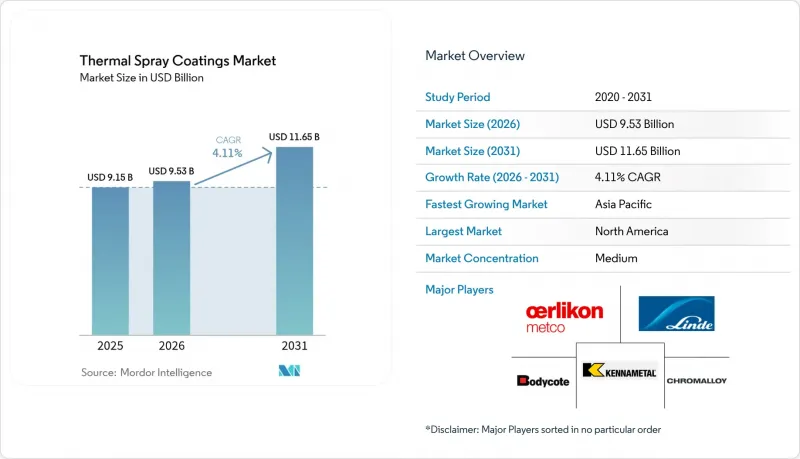
This report is Segmented by Powder Coating Materials (Ceramic Oxides, Carbides, Metals, Polymers & Other Materials), Process (Combustion, Electric Energy), End-User Industry (Aerospace, Industrial Gas Turbines, Automotive, Electronics, Medical Devices, and More), and Geography (Asia-Pacific, North America, Europe, South America, , and More). The Market Forecasts are Provided in Terms of Value (USD).
Global Thermal Spray Coatings Market Trends and Insights
Increased Usage in Medical Implants and Prosthetics
Medical-grade plasma-sprayed hydroxyapatite continues to be the only FDA-cleared coating technology for mass-produced orthopedic implants, and recent work with B-phase Ti alloys is reducing elastic-modulus mismatch to bone. High-power impulse magnetron sputtering and HVOF overlays are now being combined in layered constructs that supply antibacterial surfaces without compromising osseointegration. As 3-D printed lattice implants scale up, spray-applied bio-ceramic finishes allow patient-specific geometries to move through qualification more quickly, though regulators are still finalizing test protocols. Coating providers able to certify repeatable roughness and phase composition are winning new multi-year supply contracts.
Growing Adoption in Aerospace Turbine & Air-Frame Parts
Engine primes are raising turbine inlet temperatures and demanding smart factories that deliver tight thickness windows on every coupon. Digitalized spray cells developed by Oerlikon and MTU Aero Engines now employ closed-loop plume diagnostics that cut rework rates by 25%. Cold-spray has become a frontline depot-repair tool, allowing aluminum flight-control housings and magnesium gearbox covers to be rebuilt without heat-affected distortion. Multilayer ceramic-oxide barrier stacks with oxidation-resistant inter-layers are extending engine overhaul intervals, enabling airlines to keep narrow-body fleets in service longer.
Reliability & Coating-Quality Repeatability Issues
Large OEMs now specify statistical process windows that smaller job shops struggle to meet. Particle size variance, plume dynamics, and substrate pre-heat all influence oxide content and porosity, which in turn dictate in-service wear. Automated vision and inline acoustic sensors are helping detect off-nominal conditions, but integration costs remain high for low-volume applications. Without global standards on real-time monitoring, qualification cycles lengthen, especially in aerospace and medical device programs.
Other drivers and restraints analyzed in the detailed report include:
- Rising Preference for Ceramic-Oxide Barrier Coatings
- Cold-Spray EMI Shielding for E-Mobility Components
- Tightening VOC / Dust-Emission Regulations
For complete list of drivers and restraints, kindly check the Table Of Contents.
Segment Analysis
Ceramic oxides recorded 29.78% of 2025 revenue and will grow fastest at 4.91% CAGR. This dominance arises from outstanding high-temperature stability and bio-compatibility, making oxides the default for turbine, medical, and hydrogen infrastructure projects. Carbide blends follow for extreme wear tasks on oil-and-gas valves and mining tools. Metals such as Ni-Cr-Mo alloys serve corrosion defense of marine structures, while polymer-based overlays target electronics where dielectric properties matter. Nanostructured oxides fabricated via suspension plasma spray tighten thermal-cycling life and are unlocking future propulsion architectures. Manufacturers combining rare-earth-doped zirconia with functionally graded bond coats now market 50 000-hour durability guarantees, lifting the thermal spray coating market perception from protective to performance-enabling.
New powder atomization methods are also trimming tungsten carbide supply risk. Several Asian plants have begun recycling hard-metal scrap into agglomerated WC-Co feedstock, lessening exposure to Chinese primary tungsten. At the same time, hybrid spark-plasma-sintered rod stock is widening the choice of feed materials. These shifts will strengthen the thermal spray coating market by easing raw-material cost swings and opening the door to localized powder hubs.
Complete Report Scope:
- By Powder Coating Materials
- Ceramic Oxides
- Carbides
- Metals
- Polymers & Other Materials
- By Process
- Combustion
- Electric Energy
- By End-user Industry
- Aerospace
- Industrial Gas Turbines
- Automotive
- Electronics
- Medical Devices
- Energy and Power
- Oil and Gas
- Others (Pulp and Paper, Mining, etc.)
- By Geography
- Asia-Pacific
- China
- India
- Japan
- South Korea
- Rest of Asia-Pacific
- North America
- United States
- Canada
- Mexico
- Europe
- Germany
- United Kingdom
- Italy
- France
- Rest of Europe
- South America
- Brazil
- Argentina
- Rest of South America
- Middle East and Africa
- Saudi Arabia
- South Africa
- Rest of Middle East and Africa
- Asia-Pacific
Geography Analysis
North America led with 33.86% revenue in 2025 on the back of entrenched aerospace, defense, and medical device ecosystems. FAA-class repair shops now rely on cold-spray to redeposit material on magnesium gearboxes, avoiding costly part replacement, while the Department of Energy funds oxide-coating research for hydrogen-ready turbines. California's air-quality probes add compliance uncertainty, but the region's first-mover advantage in smart spray cells should preserve leadership during the forecast window.
Asia-Pacific is projected to grow fastest at 6.03% CAGR as automotive electrification, consumer-electronics capacity, and gas-turbine build-outs surge. Chinese powder recyclers already supply carbide feedstock to local coaters, hedging tungsten risks identified by USGS. Japanese semiconductor plants are scaling plasma-resistant alumina coatings for sub-5 nm etch chambers, while Indian railways specify arc-sprayed steel overlays on high-speed track components. These projects illustrate how the thermal spray coating market is embedding itself across the region's manufacturing spectrum.
Europe shows steady progress as tougher VOC caps push operators toward closed-loop plasma booths and water-borne binders. Offshore wind farms in the North Sea now specify Al-Zn thermally sprayed sacrificial anodes on monopile interiors, lengthening service life beyond 25 years. The European Commission's "Fit-for-55" package indirectly boosts demand for efficiency-raising barrier coatings on industrial gas turbines. Middle East and Africa remain niche today but will see higher uptake as refinery revamps and desalination plants pursue long-life corrosion shields.
- Abakan Inc.
- APS Materials Inc.
- Bodycote
- Chromalloy Gas Turbine LLC
- Curtiss-Wright Corporation (FW Gartner)
- Fisher Barton
- Flame Spray Technologies BV
- Hannecard Roller Coatings, Inc - ASB Industries
- Kennametal Inc.
- Linde
- OC Oerlikon Management AG
- Steel Goode Products, LLC
- Sulzer Ltd
- Thermion
- Tocalo Co. Ltd.
- TST LLC
Additional Benefits:
- The market estimate (ME) sheet in Excel format
- 3 months of analyst support
TABLE OF CONTENTS
1 Introduction
- 1.1 Study Assumptions & Market Definition
- 1.2 Scope of the Study
2 Research Methodology
3 Executive Summary
4 Market Landscape
- 4.1 Market Overview
- 4.2 Market Drivers
- 4.2.1 Increased usage in medical implants & prosthetics
- 4.2.2 Growing adoption in aerospace turbine & air-frame parts
- 4.2.3 Rising preference for ceramic-oxide barrier coatings
- 4.2.4 Cold-spray EMI shielding for e-mobility components
- 4.2.5 Additive-manufacturing repair of super-alloy parts
- 4.3 Market Restraints
- 4.3.1 Reliability & coating-quality repeatability issues
- 4.3.2 Tightening VOC / dust-emission regulations
- 4.3.3 Critical-powder supply volatility (WC, rare carbides)
- 4.4 Value Chain Analysis
- 4.5 Porter's Five Forces
- 4.5.1 Bargaining Power of Suppliers
- 4.5.2 Bargaining Power of Buyers
- 4.5.3 Threat of New Entrants
- 4.5.4 Threat of Substitutes
- 4.5.5 Degree of Competition
5 Market Size & Growth Forecasts (Value)
- 5.1 By Powder Coating Materials
- 5.1.1 Ceramic Oxides
- 5.1.2 Carbides
- 5.1.3 Metals
- 5.1.4 Polymers & Other Materials
- 5.2 By Process
- 5.2.1 Combustion
- 5.2.2 Electric Energy
- 5.3 By End-user Industry
- 5.3.1 Aerospace
- 5.3.2 Industrial Gas Turbines
- 5.3.3 Automotive
- 5.3.4 Electronics
- 5.3.5 Medical Devices
- 5.3.6 Energy and Power
- 5.3.7 Oil and Gas
- 5.3.8 Others (Pulp and Paper, Mining, etc.)
- 5.4 By Geography
- 5.4.1 Asia-Pacific
- 5.4.1.1 China
- 5.4.1.2 India
- 5.4.1.3 Japan
- 5.4.1.4 South Korea
- 5.4.1.5 Rest of Asia-Pacific
- 5.4.2 North America
- 5.4.2.1 United States
- 5.4.2.2 Canada
- 5.4.2.3 Mexico
- 5.4.3 Europe
- 5.4.3.1 Germany
- 5.4.3.2 United Kingdom
- 5.4.3.3 Italy
- 5.4.3.4 France
- 5.4.3.5 Rest of Europe
- 5.4.4 South America
- 5.4.4.1 Brazil
- 5.4.4.2 Argentina
- 5.4.4.3 Rest of South America
- 5.4.5 Middle East and Africa
- 5.4.5.1 Saudi Arabia
- 5.4.5.2 South Africa
- 5.4.5.3 Rest of Middle East and Africa
- 5.4.1 Asia-Pacific
6 Competitive Landscape
- 6.1 Market Concentration
- 6.2 Strategic Moves
- 6.3 Market Share Analysis
- 6.4 Company Profiles (includes Global level Overview, Market level overview, Core Segments, Financials as available, Strategic Information, Market Rank/Share, Products & Services, Recent Developments)
- 6.4.1 Abakan Inc.
- 6.4.2 APS Materials Inc.
- 6.4.3 Bodycote
- 6.4.4 Chromalloy Gas Turbine LLC
- 6.4.5 Curtiss-Wright Corporation (FW Gartner)
- 6.4.6 Fisher Barton
- 6.4.7 Flame Spray Technologies BV
- 6.4.8 Hannecard Roller Coatings, Inc - ASB Industries
- 6.4.9 Kennametal Inc.
- 6.4.10 Linde
- 6.4.11 OC Oerlikon Management AG
- 6.4.12 Steel Goode Products, LLC
- 6.4.13 Sulzer Ltd
- 6.4.14 Thermion
- 6.4.15 Tocalo Co. Ltd.
- 6.4.16 TST LLC
7 Market Opportunities & Future Outlook
- 7.1 White-space & Unmet-need Assessment