

|
시장보고서
상품코드
2122797
일렉트로크로믹 재료 : 시장 점유율 분석, 업계 동향 및 통계, 성장 예측(2026-2031년)Electrochromic Materials - Market Share Analysis, Industry Trends & Statistics, Growth Forecasts (2026 - 2031) |
||||||
 Mordor Intelligence
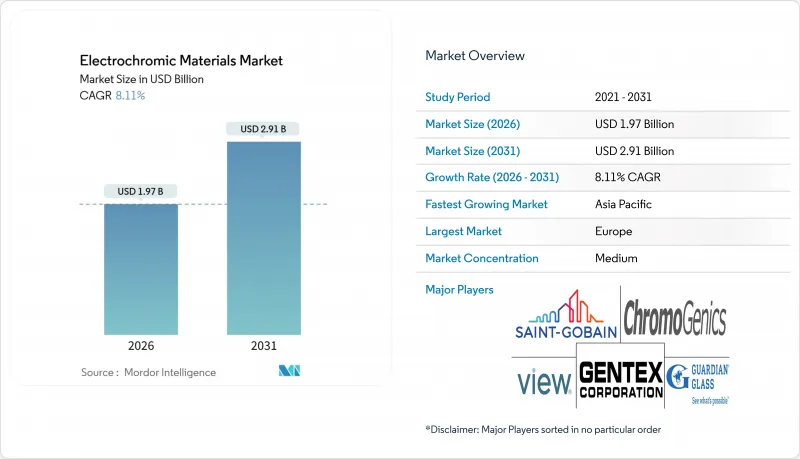
Mordor Intelligence에 의하면, 일렉트로크로믹 재료 시장 규모는 2026년에 19억 7,000만 달러로 추정되고 예측 기간(2026-2031년) CAGR 8.11%로 성장을 지속하여, 2031년에는 29억 1,000만 달러에 이를 전망입니다.

본 보고서는 제품 유형(금속 산화물, 바이오로젠, 기타), 디바이스 유형(스마트 윈도우, 거울, 디스플레이, 기타), 폼 팩터(유리 기판, 폴리머 필름, 잉크·도료), 최종 사용자 산업(건축 및 건설, 자동차, 기타),지역(아시아태평양, 북미, 유럽, 기타)별로 분류되어 있습니다. 시장 전망은 금액(달러) 기준으로 제시되어 있습니다.
세계의 일렉트로크로믹 재료 시장 동향 및 인사이트
에너지 효율 규제가 스마트 윈도우 도입을 가속화
유럽, 미국, 영국의 건축 기준에서는 현재 다이내믹 유리가 선택적 기능이 아닌 주요 적합 수단으로 인정받고 있으며, 이로 인해 투자 회수 기간이 단축되고 대규모 개보수 공사가 촉진되고 있습니다. 프랑스의 RE2020에서는 HVAC 가동 시간을 20% 단축하는 파사드에 대해 15%의 탄소 상쇄 크레딧이 부여되는데, 이 기준은 일렉트로크로믹 유리를 통해 충족됩니다. ENERGY STAR 버전 7.0에서는 ‘다이나믹 퍼포먼스’라는 평가 구분이 신설되었으며, 이를 충족하는 것은 일렉트로크로믹 유리 또는 부유 입자 방식의 장치로 한정됩니다. 2024년 NREL이 실시한 현장 조사에 따르면, 피닉스에서 진행된 사무실 개보수 공사에서는 피크 수요 요금 급등에 따라 단순 회수 기간이 7.2년으로 단축되었습니다. 영국의 ‘퓨처 홈스 스탠다드(Future Homes Standard)’에서는 2025년 이후 운영 시 탄소 배출량을 75% 감축할 것을 의무화하고 있으며, 단열 포장만으로는 불충분한 상황에서 간접적으로 일렉트로크로믹 유리의 보급을 촉진하고 있습니다.
자동차 부문에서의 자동 조광 미러 및 파노라마 선루프 수요
현재 고급 전기차에는 90초 이내에 전환이 가능한 필름형 일렉트로크로믹 루프가 채택되어, 기존에 있던 눈부심에 대한 불만이 해소되고 있습니다. GM이 2024년에 취득한 구역별 전면 유리 관련 특허는 승객 측을 차광하면서도 운전자의 시야를 확보하는 구역별로 구분된 조광 기능으로의 전환을 보여줍니다. 1.5m×1.6m를 초과하는 대형 프로토타입은 제조 규모 확대를 뒷받침하고 있지만, 800-1,200달러의 추가 비용이 배터리 주행 거리 향상과 상충되기 때문에 대중 시장용 등급에서의 보급률은 여전히 5% 이하에 머물고 있습니다.
기존 코팅 유리에 비해 높은 단가
제곱피트당 평균 85달러의 설치 가격은 저방사(Low-E) 이중 유리의 기준 가격인 제곱피트당 22달러를 훨씬 상회하고 있어, 그 도입은 A급 및 고급 주택 프로젝트로 제한되고 있습니다. 미국 개발사 중 투기성 사무실 건물에 일렉트로크로믹 유리를 지정하는 곳은 고작 12%에 불과하지만, 빌드 투 수트(BTO) 프로젝트의 경우 임차인에게 운영 비용 절감 효과가 주어지는 경우 더 높은 자본 지출(CAPEX)을 수용하고 있습니다. 2024년 View Inc.의 파산은 규모 확대 없이 양산 중심의 비용 절감이 초래하는 자금 유출 위험을 여실히 드러내고 있습니다.
부문별 분석
2025년, 금속 산화물은 매출의 49.51%를 차지했으며, 그 기반이 된 것은 삼산화 텅스텐의 60-70%에 달하는 광변조 범위와 5만 사이클을 넘는 수명입니다. 계층 다공성 W3O8 필름은 5초 이하의 스위칭을 실현하여, 기존에는 더 빠른 화학 물질로만 제한되었던 대시보드로의 응용 가능성을 넓혔습니다. 전도성 폴리머 시장은 10.71%의 성장률을 보이고 있습니다. 이는 OEM 및 개조 업체들이 제조 비용을 40% 절감하고, 곡면 지지대에도 구부러질 수 있는 롤-투-롤 방식의 PEDOT 및 PANI 층을 채택하고 있기 때문입니다. 그러나 자외선 차단 코팅을 추가하면 평방미터당 8-12달러의 비용이 증가하기 때문에 단기적인 가격 동향에는 억제적인 영향을 미치고 있습니다. 1초 미만의 응답 속도와 눈부심 방지 성능이 수명에 대한 우려를 상회하는 부문에서는 비오로겐 및 프러시안 블루의 틈새 시장이 여전히 존재하고 있습니다.
현재 일렉트로크로믹 재료 시장에서는 명암비와 마찬가지로 기판의 유연성도 엄격하게 평가되고 있습니다. 리코의 곡면 A필러용 필름은 PEDOT가 취성 산화물의 균열을 어떻게 극복하고 있는지를 보여주고 있는 반면, 텅스텐계 시스템은 30년간의 파사드 보증 면에서 우수합니다. 현재 연구가 진행 중인 하이브리드 복합 소재는 산화물 수준의 내구성과 폴리머와 같은 가공성을 겸비할 것으로 기대되지만, 합성의 복잡성과 라이선싱 장벽으로 인해 대규모 시장 출시가 정체되어 있습니다.
스마트 윈도는 수천 제곱미터 규모의 건축 수주를 배경으로 2025년에는 매출의 46.13%를 차지했지만, 디스플레이 시장은 햇빛 아래에서도 식별 가능한 자동차 계기판과 옥외 소매용 간판 덕분에 연평균 성장률(CAGR) 11.12%를 기록할 전망입니다. 일렉트로크로믹 디스플레이는 10만 룩스 이하의 환경에서도 10 : 1의 명암비를 유지하며 반투과형 LCD를 능가하는 성능을 발휘하고 있으며, ‘크라운’이라는 이름의 프로토타입은 2초 이내에 완전히 전환됩니다. 카메라식 후방 카메라 시스템의 보급에 따라 미러 시장 점유율은 감소하고 있지만, 애프터마켓 상용차에서는 여전히 자동 조광 유리가 채택되고 있습니다. 폴리트로닉스(Polytronics)사가 설치 비용을 1제곱피트당 40달러로 낮춤에 따라, 개조 설치용 필름 및 코팅이 새로운 양산 시장을 형성하고 있습니다. 조광 기능과 엣지 LED를 융합한 다기능 패널은 기기의 경계를 모호하게 만들고, 1제곱미터당 콘텐츠 양을 증가시키고 있습니다.
지역별 분석
2025년, 유럽은 매출의 33.45%를 차지했습니다. 이는 공공 건축물의 연간 3% 개조를 의무화하는 EPBD(에너지 성능에 관한 건축물 지침) 개정과 독일 KfW의 ‘Efficiency House 40’ 인센티브에 힘입은 결과입니다. 프랑스의 ‘RE2020’과 영국의 ‘Future Homes Standard’는 기존 유리로는 달성할 수 없는 탄소 배출 상한선을 설정함으로써, 일렉트로크로믹 기술의 보급을 촉진하고 있습니다. 북유럽의 패시브하우스 도입국에서는 겨울철 열 획득과 여름철 일사 차단을 위해 EC 유리를 활용하고 있지만, 이탈리아와 스페인에서는 전기 요금이 저렴하여 투자 회수 기간이 길어짐에 따라 도입이 지연되고 있습니다.
아시아태평양은 연평균 성장률(CAGR) 11.12%로 확대되고 있으며, ‘중국 제조 2025’에 따른 중국의 수입 대체 추진, 일본의 OEM을 통한 일렉트로크로믹 지붕 통합, 한국의 주요 디스플레이 기업들이 햇빛 아래에서도 가독성이 확보되는 전자 종이(e-paper)로의 전환을 추진하고 있는 점이 호재로 작용하고 있습니다. 인도의 ‘2024년 에너지 절약 건축 기준’에서는 다이내믹 유리 도입에 대해 자발적인 크레딧이 제공되어, 향후 수요를 위한 기반이 마련되었습니다. 싱가포르의 ‘그린마크 플래티넘’ 인증 기준에서는 HVAC(냉난방 공조) 에너지 소비량을 20% 감축한 건물에 보상이 주어져, 지자체 차원의 조기 도입이 촉진되고 있습니다.
북미에서는 캘리포니아주의 ‘타이틀 24’ 개정과 뉴욕주의 ‘로컬 로 97’에 따라 다이내믹 글라스를 뒷받침하는 탄소 배출 벌금이 부과되는 한편, 연방 정부의 넷제로 의무화로 인해 2030년까지 확실한 수요 파이프라인이 형성되고 있습니다. ‘섹션 301’ 관세로 인해 중국산 수입품의 도착 비용이 25% 증가한 데 따라, 생고뱅(Saint-Gobain)사는 미네소타주에서 4,500만 달러 규모의 사업 확장을 추진하고 있습니다. 캐나다의 ‘팬-캐나디안 프레임워크’는 각 주의 건축 기준 조화를 촉진하고 있으며, 브리티시컬럼비아주와 온타리오주에서는 공공 인프라에 EC 유리 사용이 규정되어 있습니다. 라틴아메리카와 중동에서의 도입은 여전히 고급 오피스 빌딩이나 사우디아라비아의 NEOM과 같은 대도시 개발 프로젝트에 의해 주도되고 있습니다.
기타 혜택
- 엑셀 형식 시장 예측(ME) 시트
- 3개월간의 애널리스트 지원
자주 묻는 질문
목차
제1장 서론
제2장 조사 방법
제3장 주요 요약
제4장 시장 구도
제5장 시장 규모 및 성장 예측
제6장 경쟁 구도
제7장 시장 기회 및 향후 전망
KTH 26.09.08According to Mordor Intelligence, the electrochromic materials market size is estimated at USD 1.97 billion in 2026, and is expected to reach USD 2.91 billion by 2031, at a CAGR of 8.11% during the forecast period (2026-2031).
This report is Segmented by Product Type (Metal Oxides, Viologens, and More), Device Type (Smart Windows, Mirrors, Displays, and More), Form Factor (Glass Substrates, Polymer Films, and Inks and Paints), End-User Industry (Building and Construction, Automotive, and More), and Geography (Asia-Pacific, North America, Europe, and More). The Market Forecasts are Provided in Terms of Value (USD).
Global Electrochromic Materials Market Trends and Insights
Energy-Efficiency Regulations Accelerating Smart-Window Adoption
European, U.S. and U.K. building codes now recognize dynamic glazing as a primary compliance route rather than a discretionary feature, compressing payback periods and triggering large scale retrofits. France's RE2020 grants a 15% carbon-offset credit for facades that reduce HVAC runtime by 20%, a threshold met by electrochromic glass. ENERGY STAR Version 7.0 created a "dynamic performance" tier that only electrochromic or suspended-particle devices satisfy. NREL field work in 2024 showed that Phoenix office retrofits cut simple payback to 7.2 years as peak-demand charges escalated. The UK Future Homes Standard mandates 75% lower operational carbon from 2025, indirectly boosting electrochromics as insulation-only packages become insufficient.
Automotive Demand for Auto-Dimming Mirrors and Panoramic Sunroofs
Premium electric vehicles now rely on film-based electrochromic roofs that switch in under 90 seconds, addressing legacy glare complaints. GM's 2024 patent for zone-specific windshields illustrates the shift toward segmented dimming that preserves driver sightlines while shading passengers. Large-format prototypes exceeding 1.5 m X 1.6 m confirm manufacturing scale-up, yet penetration in mass-market trims remains below 5% because the USD 800-1,200 adder competes with battery-range upgrades.
High Unit Cost Versus Conventional Coated Glass
Installed prices averaging USD 85 per ft2 dwarf the USD 22 per ft2 baseline for low-e double glazing, limiting adoption to Class-A and high-end residential projects. Only 12% of U.S. developers specify electrochromics for speculative offices, though build-to-suit projects accept higher capex when operational savings accrue to tenants. Bankruptcy of View Inc. in 2024 highlights the cash-burn risk of volume-driven cost reduction without scale.
Other drivers and restraints analyzed in the detailed report include:
- Aerospace Window Upgrades for Weight and Glare Reduction
- Self-Powered Electrochromic Smart Windows Integrating Solar Harvesters
- Cycling-Stability and Durability Challenges
For complete list of drivers and restraints, kindly check the Table Of Contents.
Segment Analysis
Metal oxides maintained 49.51% revenue in 2025, anchored by tungsten-trioxide's 60-70% light-modulation range and more than 50,000 cycle life. Hierarchically porous W3O8 films achieved sub-5 s switching, opening dashboard opportunities previously reserved for faster chemistries. Conducting polymers grow at 10.71% as OEMs and retrofitters adopt roll-to-roll PEDOT and PANI layers that cut manufacturing costs 40% and bend onto curved pillars. However, additional ultraviolet-barrier coatings add USD 8-12 per m2, tempering the near-term price narrative. Viologen and Prussian blue niches persist where less than 1 s response or anti-glare performance outweighs lifetime concerns.
The electrochromic materials market now evaluates substrate flexibility as rigorously as contrast ratio. Ricoh's curved A-pillar film shows how PEDOT overcomes brittle-oxide cracking, whereas tungsten systems excel in 30-year facade warranties. Hybrid composites under investigation promise oxide-level durability with polymer-style processability, yet synthesis complexity and licensing hurdles stall large-scale launch.
Smart windows captured 46.13% revenue in 2025 on the back of multi-thousand-square-meter building orders, but displays will post an 11.12% CAGR thanks to sunlight-readable automotive clusters and outdoor retail signage. Electrochromic displays maintain 10:1 contrast under 100,000 lux, outperforming transflective LCDs, and crown-labeled prototypes transition fully in less than 2s. Mirrors lose share as camera-based rear vision scales, yet after-market commercial vehicles still specify auto-dimming glass. Retrofit films and coatings furnish a new volume tier as Polytronix cuts install costs to USD 40 ft2. Multi-function panels that fuse dimming with edge LEDs blur device boundaries and raise content per square meter.
Complete Report Scope:
- By Product Type
- Metal Oxides
- Viologens
- Conducting Polymers
- Prussian Blue
- Other Product Types
- By Device Type
- Smart Windows
- Mirrors
- Displays
- Films and Coatings
- Other Device Types
- By Form Factor
- Glass Substrates
- Polymer Films
- Inks and Paints
- By End-user Industry
- Building and Construction
- Automotive
- Electrical and Electronics
- Aerospace and Defense
- Other End-user Industries
- By Geography
- Asia-Pacific
- China
- India
- Japan
- South Korea
- ASEAN Countries
- Rest of Asia-Pacific
- North America
- United States
- Canada
- Mexico
- Europe
- Germany
- United Kingdom
- Italy
- France
- NORDIC Countries
- Rest of Europe
- South America
- Brazil
- Argentina
- Rest of South America
- Middle-East and Africa
- Saudi Arabia
- South Africa
- Rest of Middle-East and Africa
- Asia-Pacific
Geography Analysis
Europe delivered 33.45% revenue in 2025, propelled by the EPBD recast that obliges 3% annual public building retrofits and Germany's KfW Efficiency House 40 incentives. France's RE2020 and the U.K.'s Future Homes Standard push electrochromic uptake by setting carbon ceilings that static glazing cannot breach. Nordic passive-house adopters exploit EC glass for winter gain and summer shading, while Italy and Spain lag as lower electricity tariffs prolong payback.
Asia-Pacific, advancing at an 11.12% CAGR, benefits from China's import-substitution push under Made in China 2025, Japanese OEM integration of electrochromic roofs, and South Korean display giants turning to sunlight-readable e-paper. India's 2024 Energy Conservation Building Code offers a voluntary dynamic-glazing credit, setting the groundwork for future demand. Singapore's Green Mark Platinum pathway rewards 20% HVAC energy cuts, fostering early municipal adoption.
In North America, California's Title 24 updates and New York's Local Law 97 impose carbon penalties that favor dynamic glazing, while federal net-zero mandates create a captive demand pipeline through 2030. Section 301 tariffs increase landed costs for Chinese imports by 25%, spurring Saint-Gobain's USD 45 million Minnesota expansion. Canada's Pan-Canadian Framework backs provincial code harmonization, with British Columbia and Ontario specifying EC glass in public infrastructure. Latin American and Middle-East uptake remains project-driven in prestige office towers and megacity developments like Saudi Arabia's NEOM.
- AGC Inc.
- Changzhou YAPU new material Co., Ltd.
- ChromoGenics
- Crown Electrokinetics Corp.
- EControl-Glas GmbH & Co. KG
- GENTEX CORPORATION
- Guardian Glass
- KIBING GROUP
- Kinestral Technologies (Halio)
- Miru Smart Technologies
- Ningbo Miruo Electronic Technology Co., Ltd.
- Polytronix, Inc.
- Ricoh
- Saint-Gobain
- View, Inc.
- Zhuhai Kaivo Optoelectronic Technology Co., Ltd.
Additional Benefits:
- The market estimate (ME) sheet in Excel format
- 3 months of analyst support
TABLE OF CONTENTS
1 Introduction
- 1.1 Study Assumptions and Market Definition
- 1.2 Scope of the Study
2 Research Methodology
3 Executive Summary
4 Market Landscape
- 4.1 Market Overview
- 4.2 Market Drivers
- 4.2.1 Energy-Efficiency Regulations Accelerating Smart-Window Adoption
- 4.2.2 Automotive Demand for Auto-Dimming Mirrors and Panoramic Sunroofs
- 4.2.3 Aerospace Window Upgrades for Weight and Glare Reduction
- 4.2.4 Self-Powered Electrochromic Smart Windows Integrating Solar Harvesters
- 4.2.5 Tariff-Driven Reshoring of Electrochromic Material Supply Chains
- 4.3 Market Restraints
- 4.3.1 High Unit Cost Versus Conventional Coated Glass
- 4.3.2 Cycling-Stability and Durability Challenges
- 4.3.3 Digital Rear-View Mirrors Eroding Automotive EC Mirror Demand
- 4.4 Value Chain Analysis
- 4.5 Porter's Five Forces
- 4.5.1 Bargaining Power of Suppliers
- 4.5.2 Bargaining Power of Consumers
- 4.5.3 Threat of New Entrants
- 4.5.4 Threat of Substitute Products and Services
- 4.5.5 Degree of Competition
5 Market Size and Growth Forecasts (Value)
- 5.1 By Product Type
- 5.1.1 Metal Oxides
- 5.1.2 Viologens
- 5.1.3 Conducting Polymers
- 5.1.4 Prussian Blue
- 5.1.5 Other Product Types
- 5.2 By Device Type
- 5.2.1 Smart Windows
- 5.2.2 Mirrors
- 5.2.3 Displays
- 5.2.4 Films and Coatings
- 5.2.5 Other Device Types
- 5.3 By Form Factor
- 5.3.1 Glass Substrates
- 5.3.2 Polymer Films
- 5.3.3 Inks and Paints
- 5.4 By End-user Industry
- 5.4.1 Building and Construction
- 5.4.2 Automotive
- 5.4.3 Electrical and Electronics
- 5.4.4 Aerospace and Defense
- 5.4.5 Other End-user Industries
- 5.5 By Geography
- 5.5.1 Asia-Pacific
- 5.5.1.1 China
- 5.5.1.2 India
- 5.5.1.3 Japan
- 5.5.1.4 South Korea
- 5.5.1.5 ASEAN Countries
- 5.5.1.6 Rest of Asia-Pacific
- 5.5.2 North America
- 5.5.2.1 United States
- 5.5.2.2 Canada
- 5.5.2.3 Mexico
- 5.5.3 Europe
- 5.5.3.1 Germany
- 5.5.3.2 United Kingdom
- 5.5.3.3 Italy
- 5.5.3.4 France
- 5.5.3.5 NORDIC Countries
- 5.5.3.6 Rest of Europe
- 5.5.4 South America
- 5.5.4.1 Brazil
- 5.5.4.2 Argentina
- 5.5.4.3 Rest of South America
- 5.5.5 Middle-East and Africa
- 5.5.5.1 Saudi Arabia
- 5.5.5.2 South Africa
- 5.5.5.3 Rest of Middle-East and Africa
- 5.5.1 Asia-Pacific
6 Competitive Landscape
- 6.1 Market Concentration
- 6.2 Strategic Moves
- 6.3 Market Share(%)/Ranking Analysis
- 6.4 Company Profiles (includes Global level Overview, Market level overview, Core Segments, Financials as available, Strategic Information, Products and Services, and Recent Developments)
- 6.4.1 AGC Inc.
- 6.4.2 Changzhou YAPU new material Co., Ltd.
- 6.4.3 ChromoGenics
- 6.4.4 Crown Electrokinetics Corp.
- 6.4.5 EControl-Glas GmbH & Co. KG
- 6.4.6 GENTEX CORPORATION
- 6.4.7 Guardian Glass
- 6.4.8 KIBING GROUP
- 6.4.9 Kinestral Technologies (Halio)
- 6.4.10 Miru Smart Technologies
- 6.4.11 Ningbo Miruo Electronic Technology Co., Ltd.
- 6.4.12 Polytronix, Inc.
- 6.4.13 Ricoh
- 6.4.14 Saint-Gobain
- 6.4.15 View, Inc.
- 6.4.16 Zhuhai Kaivo Optoelectronic Technology Co., Ltd.
7 Market Opportunities and Future Outlook
- 7.1 White-space and Unmet-need Assessment


