|
시장보고서
상품코드
2122798
전도성 폴리머 : 시장 점유율 분석, 업계 동향 및 통계, 성장 예측(2026-2031년)Conductive Polymers - Market Share Analysis, Industry Trends & Statistics, Growth Forecasts (2026 - 2031) |
||||||
 Mordor Intelligence
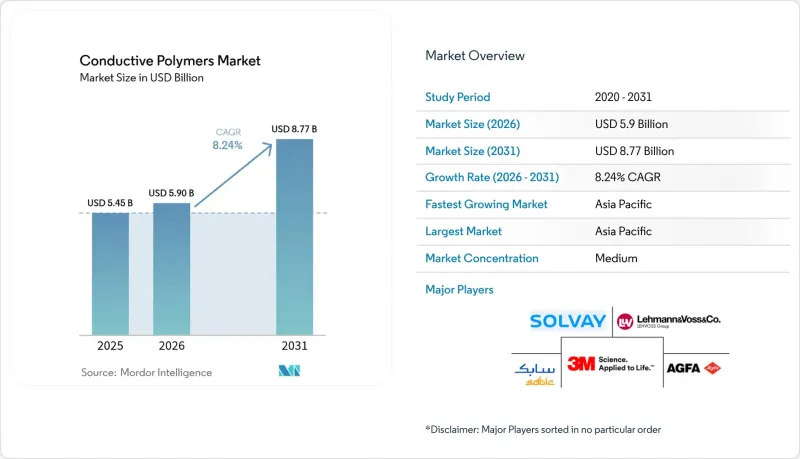
Mordor Intelligence에 의하면, 2026년 전도성 폴리머 시장 규모는 59억 달러로 추정되고 2025년 54억 5,000만 달러에서 확대해, 2031년에는 87억 7,000만 달러에 이를 것으로 예측됩니다.
2026-2031년 동안 연평균 성장률(CAGR) 8.24%로 성장할 것으로 전망됩니다.

본 보고서는 폴리머 유형(고유 전도성 폴리머(ICP), 고유 소산성 폴리머(IDP), 기타), 등급(공액 전도성 폴리머, 전하 이동형 폴리머, 기타), 용도(제품 부품, 정전기 방지 포장, 자재관리, 기타),최종 사용자 산업(전기 및 전자 기기, 자동차·e-모빌리티, 기타), 지역(아시아태평양, 북미, 기타)별로 분류되어 있습니다. 시장 예측은 금액(달러) 기준으로 제시되어 있습니다.
세계의 전도성 폴리머 시장 동향 및 인사이트
전기차(EV) 및 가전제품 분야에서 경량 EMI 차폐재에 대한 수요가 급증
전기자동차는 내연기관 차량보다 더 높은 전자기 간섭을 발생시킵니다. 기존의 금속 차폐재는 무게를 늘리고 주행 거리를 단축시키기 때문에 각 OEM 업체들은 경량 전도성 폴리머의 채택을 지정하고 있습니다. 이를 통해 동등한 차폐 효과를 유지하면서 부품의 질량을 최대 28%까지 줄일 수 있습니다. 스마트폰의 경우, 5G 회로가 안테나에 더 가까운 위치에 배치되어 있기 때문에 제조업체들은 신호 품질을 저하시키지 않으면서도 기기 두께를 얇게 만들 수 있는 폴리머 차폐재를 선택하고 있습니다. 아시아태평양은 전 세계 전기차용 배터리 및 휴대전화 조립 라인의 대부분을 보유하고 있어 가장 큰 혜택을 보고 있습니다. 유럽의 자동차 제조업체들도 차량 배기가스 규제 목표를 달성하기 위해 유사한 솔루션을 채택하고 있습니다. 소비자용 기기를 위해 제작된 설계 라이브러리가 현재 자동차 플랫폼으로 전환되면서 산업 전반에 걸친 도입이 가속화되고 있습니다.
전자상거래가 주도하는 정전기 방지 포장재의 보급
온라인 주문 처리 센터에서는 매년 수십억 개의 전자 기기가 출하되고 있어, 정전기 방지 기능이 적용된 포장재에 대한 수요가 증가하고 있습니다. 물류 업체에 따르면, 폴리머 안감이 부착된 우편용 봉투를 도입한 후 정전기와 관련된 제품 반품이 37% 감소했다는 보고가 있으며, 소포 처리량이 지속적으로 증가하고 있는 북미에서는 수요가 확대되고 있습니다. 아시아태평양의 수출업체들은 구매자의 사양을 충족하기 위해 이러한 노력을 모방하고 있으며, 이는 전도성 폴리머 시장을 더욱 확대시키고 있습니다.
높은 가공 비용과 제한된 기계적 강도
폴리머에서 금속 수준의 전도성을 실현하려면 일반적으로 산 세정이나 용매 교환과 같은 후처리 공정이 필요하며, 이로 인해 기존 플라스틱에 비해 생산 비용이 최대 23% 상승합니다. 기계적 피로는 여전히 과제로 남아 있습니다. 이는 고농도로 도핑된 구조체가 반복적인 굽힘으로 인해 균열이 발생할 수 있기 때문입니다. 자동차 제조업체들은 보강 첨가제의 사용을 지정하고 있지만, 이는 무게를 증가시켜 일부 이점을 상쇄해 버립니다. 연구 그룹은 특성의 균형을 맞추기 위해 전도성 도메인을 봉입하는 엘라스토머 매트릭스를 모색하고 있으나, 대규모 도입을 위해서는 비용 절감 로드맵이 핵심이 됩니다.
부문별 분석
2025년 시점에서 전도성 플라스틱은 전도성 폴리머 시장 규모의 44.60%를 차지했습니다. 이는 압출 성형 및 사출 성형 설비가 이미 상각되었으며, 수 킬로톤 규모의 경제적인 생산이 가능하기 때문입니다. 이러한 폴리머는 노트북 케이스 및 자동차용 센서 브래킷의 EMI 기준을 충족하여 성숙한 응용 분야에서의 확장을 뒷받침하고 있습니다. 고유 전도성 폴리머는 웨어러블 의료기기 및 컨포멀 안테나 분야에서 그램당 전도성 향상이 요구되고 있기 때문에 2031년까지 8.42%라는 가장 높은 연평균 성장률(CAGR)을 보일 것으로 전망됩니다. 기상 중합 등의 가공 기술 발전으로 결함 밀도가 감소하여 금속과의 특성 차이가 점차 좁혀지고 있습니다.
고유한 소산성을 지닌 폴리머는 공장 현장이나 반도체 제조 라인에서 정전기를 신속하게 방전시켜 미세 손상을 방지하는 틈새 용도로 활용되고 있습니다. 그 밖의 폴리머 유형으로는 나노 카본 필러와 열가소성 폴리우레탄을 결합한 하이브리드 복합재가 있으며, 이를 통해 신축성 회로를 구현하고 있습니다. 지속적인 기술 발전에 힘입어, 전도성 폴리머 시장은 가격에 민감한 광범위한 용도를 유지하면서, 범용 플라스틱에서 고부가가치 ICP 배합으로 점차 전환될 것으로 예측됩니다.
공액형 전도성 폴리머는 신뢰성 높은 합성 프로토콜과 상온에서의 안정성 덕분에 2025년에는 전도성 폴리머 시장 점유율의 40.10%를 차지했습니다. 이들은 디스플레이의 투명 전극으로, 또한 현장 진단(Point-of-Care)에 사용되는 유기 전기화학 트랜지스터의 활성층으로 기능합니다.
이온 전도성 폴리머는 시장 규모는 작지만, 전자 전하와 이온 전하를 모두 운반하는 특성을 가지고 있어 연평균 성장률(CAGR) 8.72%로 확대되고 있습니다. 이 특성은 바이오 인터페이스 및 고체 전지에 매우 중요합니다. 전하 이동형 폴리머는 특정 산화-환원 전위를 필요로 하는 센서에 활용되고 있습니다. 전도성 충전 폴리머는 적당한 전도성과 충분한 정전기 방지 기능을 갖춘 트레이 분야에서 여전히 가격 경쟁력을 유지하고 있습니다.
지역별 분석
아시아태평양은 2025년에 전도성 폴리머 시장의 45.70% 점유율을 차지했으며, 전자기기 제조 클러스터의 밀집과 전기차(EV)에 대한 정부 보조금의 지원에 힘입어 2031년까지 연평균 성장률(CAGR) 9.05%로 성장하고 있습니다. 중국은 스마트폰 조립 및 전기차(EV) 배터리 팩 분야에서 대량 생산을 주도하고 있는 반면, 일본은 고순도 폴리머의 연구 개발을 주도하고 있습니다.
북미에서는 미국이 연방 정부의 세제 혜택 조치에 따라 국내 전기차 생산을 가속화하고 있어, 경량 차폐 부품에 대한 수요를 끌어올리고 있습니다. 국방 지출을 통해 고유한 전도성을 지닌 폴리머를 사양으로 하는 컨포멀 안테나 프로그램에 자금이 투입되고 있습니다. 캐나다 항공우주 산업에서는 신축성 회로가 기내 안전 시스템에 통합되고 있으며, 멕시코에서 수출되는 전기차 조립품이 지역 수요를 끌어올리고 있습니다. 국경을 넘는 자재 흐름을 촉진하는 무역 협정이 시장 통합을 뒷받침하고 있습니다.
유럽에서는 경량화를 장려하는 엄격한 자동차 배기가스 규제에 힘입어 꾸준한 수요 증가가 나타나고 있습니다. 독일은 고급 전기차용 폴리머를 다량 사용한 EMI 대책 솔루션 개발을 주도하고 있습니다. 프랑스 항공우주 부문에서는 기내 안테나용으로 고성능 등급의 소재가 요구되고 있습니다. 북유럽 국가들의 순환형 경제 추진은 재활용 가능한 전도성 플라스틱을 뒷받침하고 있습니다. EU의 REACH 체계는 저VOC 폴리머 공정을 장려하고 있습니다. 동유럽의 전자제품 제조 거점들은 전 세계 고객 감사에 대응하기 위해 정전기 방지 바닥재를 채택하고 있으며, 이로 인해 유럽 대륙 내 전도성 폴리머 시장의 범위가 확대되고 있습니다.
기타 혜택
- 엑셀 형식 시장 예측(ME) 시트
- 3개월간의 애널리스트 지원
자주 묻는 질문
목차
제1장 서론
제2장 조사 방법
제3장 주요 요약
제4장 시장 구도
제5장 시장 규모 및 성장 예측
제6장 경쟁 구도
제7장 시장 기회 및 향후 전망
KTH 26.09.08According to Mordor Intelligence, conductive polymers market size in 2026 is estimated at USD 5.9 billion, growing from 2025 value of USD 5.45 billion with 2031 projections showing USD 8.77 billion, growing at 8.24% CAGR over 2026-2031.
This report is Segmented by Polymer Type (Inherently Conductive Polymers, Inherently Dissipative Polymers, and More), Class (Conjugated Conducting Polymers, Charge-Transfer Polymers, and More), Application (Product Components, Antistatic Packaging, Material Handling, and More), End-Use Industry (Electrical and Electronics, Automotive and E-Mobility, and More), and Geography (Asia-Pacific, North America, and More)
Global Conductive Polymers Market Trends and Insights
Lightweight EMI-Shielding Demand Surging in EV and Consumer Electronics
Electric vehicles emit higher electromagnetic interference than internal-combustion cars. Traditional metal shields add weight that curtails range, prompting OEMs to specify lightweight conductive polymers, which cut component mass by up to 28% while achieving comparable shielding effectiveness. In smartphones, 5G circuitry sits closer to antennas; thus, manufacturers select polymer shields that thin device walls without compromising signal quality. Asia Pacific benefits most because it hosts the bulk of global EV battery and handset assembly lines. European automakers are adopting similar solutions to meet fleet-emission targets. Design libraries created for consumer devices now transfer to automotive platforms, accelerating cross-sector adoption.
E-Commerce-Driven Uptake of Antistatic Packaging
Online fulfilment centres ship billions of electronics each year, heightening the need for static-safe packaging. Logistics providers report 37% fewer static-related product returns after adopting polymer-lined mailers, boosting demand in North America, where parcel volumes continue to rise. Asia Pacific exporters replicate these practices to satisfy buyer specifications, further expanding the conductive polymer market.
High Processing Cost and Limited Mechanical Robustness
Achieving metal-like conductivity in polymers typically requires post-treatment steps such as acid washing or solvent exchange, which lift production costs by as much as 23% relative to conventional plastics. Mechanical fatigue remains a challenge because highly doped structures can crack under repeated flexing. Automakers specify reinforcement additives, but these raise weight and erase some advantages. Research groups are exploring elastomeric matrices that encapsulate conductive domains to balance properties, yet mass-scale adoption hinges on cost-down roadmaps.
Other drivers and restraints analyzed in the detailed report include:
- Flexible Thermoelectric Wearables Adoption Post-2025
- Military-Grade Conformal Antennas Using Inherently Conductive Polymers
- Volatile Aniline and Specialty Monomer Prices
For complete list of drivers and restraints, kindly check the Table Of Contents.
Segment Analysis
Conductive plastics held 44.60% of the conductive polymer market size in 2025 because extrusion and injection-moulding assets are already amortised, allowing economic output at multi-kiloton scale. These polymers meet EMI standards for laptop housings and automotive sensor brackets, supporting expansion across mature applications. Inherently conductive polymers post the fastest 8.42% CAGR through 2031 as wearable healthcare devices and conformal antennas demand elevated conductivity per gram. Processing breakthroughs such as vapor-phase polymerisation lower defect density, narrowing the property gap with metals.
Inherently dissipative polymers maintain a niche in factory floors and semiconductor lines where rapid static bleed-off prevents micro-damage. Other polymer types include hybrid composites that marry nano-carbon fillers with thermoplastic polyurethane, enabling stretchable circuits. Continuous improvements suggest the conductive polymer market will gradually shift from commodity plastics toward higher-value ICP formulations while maintaining a broad base of price-sensitive applications.
Conjugated conducting polymers captured 40.10% of the conductive polymer market share in 2025 due to reliable synthesis protocols and stability under ambient conditions. They function as transparent electrodes in displays and as active layers in organic electrochemical transistors used for point-of-care diagnostics.
Despite their smaller base, ionically conducting polymers expand at a 8.72% CAGR because they carry both electronic and ionic charges, critical for biointerfaces and solid-state batteries. Charge-transfer polymers cater to sensors requiring specific redox potentials. Conductively filled polymers remain cost-competitive for antistatic trays where moderate conductivity suffices.
Complete Report Scope:
- By Polymer Type
- Inherently Conductive Polymers (ICPs)
- Inherently Dissipative Polymers (IDPs)
- Conductive Plastics
- Other Polymer Types
- By Class
- Conjugated Conducting Polymers
- Charge-Transfer Polymers
- Ionically Conducting Polymers
- Conductively Filled Polymers
- By Application
- Product Components (e.g., EMI housings, sensors)
- Antistatic Packaging
- Material Handling (trays, totes)
- Work-surface and Flooring
- Others
- By End-user Industry
- Electrical and Electronics
- Automotive and E-Mobility
- Aerospace and Defense
- Healthcare and Wearables
- Others (Industrial Packaging and Logistics)
- By Geography
- Asia-Pacific
- China
- India
- Japan
- South Korea
- ASEAN Countries
- Rest of Asia-Pacific
- North America
- United States
- Canada
- Mexico
- Europe
- Germany
- United Kingdom
- France
- Italy
- NORDIC
- Russia
- Rest of Europe
- South America
- Brazil
- Argentina
- Rest of South America
- Middle-East and Africa
- Saudi Arabia
- United Arab Emirates
- South Africa
- Rest of Middle-East and Africa
- Asia-Pacific
Geography Analysis
Asia Pacific held 45.70% share of the conductive polymer market in 2025 and is growing at a 9.05% CAGR through 2031, driven by its dense electronics manufacturing clusters and government subsidies for electric mobility. China commands bulk volume in smartphone assembly and EV battery packs, while Japan spearheads high-purity polymer research and development.
In North America the United States accelerates domestic EV production with federal tax incentives, creating upward demand for lightweight shield components. Defence spending channels funds into conformal antenna programmes that specify inherently conductive polymers. Canada's aerospace industry integrates stretchable circuits into cabin safety systems, while Mexico's EV assembly exports augment regional demand. Trade accords facilitating materials flow across borders support market coherence.
Europe exhibits steady uptake supported by stringent vehicle emission limits that reward weight reduction. Germany pioneers polymer-rich EMI solutions in premium EVs. France's aerospace sector demands high-performance grades for in-flight antennas. Nordic initiatives in circular economy favour recyclable conductive plastics. The EU's REACH framework incentivises low-VOC polymer processes. Eastern European electronics manufacturing hubs adopt antistatic flooring to meet global customer audits, expanding the conductive polymer market perimeter within the continent.
- 3M
- Agfa-Gevaert Group
- Arkema
- Cabot Corporation
- Celanese Corporation
- Covestro AG
- Dupont
- Eeonyx
- Heraeus Holding
- Lehmann&Voss&Co.
- Parker Hannifin Corp
- PolyOne Corporation
- Premix Group
- RTP Company
- SABIC
- Solvay
- The Lubrizol Corporation
- The Lubrizol Corporation
- Westlake Plastics
Additional Benefits:
- The market estimate (ME) sheet in Excel format
- 3 months of analyst support
TABLE OF CONTENTS
1 Introduction
- 1.1 Study Assumptions and Market Definition
- 1.2 Scope of the Study
2 Research Methodology
3 Executive Summary
4 Market Landscape
- 4.1 Market Overview
- 4.2 Market Drivers
- 4.2.1 Lightweight EMI-Shielding Demand Surging in EV And Consumer Electronics
- 4.2.2 E-Commerce-Driven Uptake of Antistatic Packaging
- 4.2.3 Flexible Thermoelectric Wearables Adoption Post-2025
- 4.2.4 Military-Grade Conformal Antennas Using Inherently Conductive Polymers (ICPs)
- 4.2.5 Design Flexibility and Huge Scope of Innovation and Product Development Through Customization
- 4.3 Market Restraints
- 4.3.1 High Processing Cost and Limited Mechanical Robustness
- 4.3.2 Volatile Aniline and Specialty Monomer Prices
- 4.3.3 End-Of-Life Recycling Challenges of Hybrid Composites
- 4.4 Value Chain Analysis
- 4.5 Porter's Five Forces
- 4.5.1 Bargaining Power of Suppliers
- 4.5.2 Bargaining Power of Buyers
- 4.5.3 Threat of New Entrants
- 4.5.4 Threat of Substitutes
- 4.5.5 Degree of Competition
5 Market Size and Growth Forecasts (Value)
- 5.1 By Polymer Type
- 5.1.1 Inherently Conductive Polymers (ICPs)
- 5.1.2 Inherently Dissipative Polymers (IDPs)
- 5.1.3 Conductive Plastics
- 5.1.4 Other Polymer Types
- 5.2 By Class
- 5.2.1 Conjugated Conducting Polymers
- 5.2.2 Charge-Transfer Polymers
- 5.2.3 Ionically Conducting Polymers
- 5.2.4 Conductively Filled Polymers
- 5.3 By Application
- 5.3.1 Product Components (e.g., EMI housings, sensors)
- 5.3.2 Antistatic Packaging
- 5.3.3 Material Handling (trays, totes)
- 5.3.4 Work-surface and Flooring
- 5.3.5 Others
- 5.4 By End-user Industry
- 5.4.1 Electrical and Electronics
- 5.4.2 Automotive and E-Mobility
- 5.4.3 Aerospace and Defense
- 5.4.4 Healthcare and Wearables
- 5.4.5 Others (Industrial Packaging and Logistics)
- 5.5 By Geography
- 5.5.1 Asia-Pacific
- 5.5.1.1 China
- 5.5.1.2 India
- 5.5.1.3 Japan
- 5.5.1.4 South Korea
- 5.5.1.5 ASEAN Countries
- 5.5.1.6 Rest of Asia-Pacific
- 5.5.2 North America
- 5.5.2.1 United States
- 5.5.2.2 Canada
- 5.5.2.3 Mexico
- 5.5.3 Europe
- 5.5.3.1 Germany
- 5.5.3.2 United Kingdom
- 5.5.3.3 France
- 5.5.3.4 Italy
- 5.5.3.5 NORDIC
- 5.5.3.6 Russia
- 5.5.3.7 Rest of Europe
- 5.5.4 South America
- 5.5.4.1 Brazil
- 5.5.4.2 Argentina
- 5.5.4.3 Rest of South America
- 5.5.5 Middle-East and Africa
- 5.5.5.1 Saudi Arabia
- 5.5.5.2 United Arab Emirates
- 5.5.5.3 South Africa
- 5.5.5.4 Rest of Middle-East and Africa
- 5.5.1 Asia-Pacific
6 Competitive Landscape
- 6.1 Market Concentration
- 6.2 Strategic Moves
- 6.3 Market Share Analysis
- 6.4 Company Profiles (includes Global Level Overview, Market Level Overview, Core Segments, Financials, Strategic Info, Market Rank/Share, Products and Services, Recent Developments)
- 6.4.1 3M
- 6.4.2 Agfa-Gevaert Group
- 6.4.3 Arkema
- 6.4.4 Cabot Corporation
- 6.4.5 Celanese Corporation
- 6.4.6 Covestro AG
- 6.4.7 Dupont
- 6.4.8 Eeonyx
- 6.4.9 Heraeus Holding
- 6.4.10 Lehmann&Voss&Co.
- 6.4.11 Parker Hannifin Corp
- 6.4.13 PolyOne Corporation
- 6.4.14 Premix Group
- 6.4.15 RTP Company
- 6.4.16 SABIC
- 6.4.17 Solvay
- 6.4.18 The Lubrizol Corporation
- 6.4.19 The Lubrizol Corporation
- 6.4.20 Westlake Plastics
7 Market Opportunities and Future Outlook
- 7.1 White-space and Unmet-need Assessment
- 7.2 Growth in smart textiles and IoT devices fuels need for flexible, conductive materials.