|
시장보고서
상품코드
2122805
멀티플렉스 어세이 : 시장 점유율 분석, 업계 동향 및 통계, 성장 예측(2026-2031년)Multiplex Assays - Market Share Analysis, Industry Trends & Statistics, Growth Forecasts (2026 - 2031) |
||||||
 Mordor Intelligence
멀티플렉스 어세이 시장 규모는 2025년에 20억 1,000만 달러로 평가되었습니다. 2026년 23억 달러에서 2031년까지 45억 2,000만 달러에 이를 것으로 예상되며, 예측 기간(2026-2031년) CAGR은 14.49%를 나타낼 전망입니다.

본 보고서는 유형(세포 기반 멀티플렉스 어세이, 단백질 멀티플렉스 어세이 등), 기술(멀티플렉스 실시간 PCR, 유세포 분석 등), 용도(감염병 진단, 종양학 및 동반 진단 등), 최종 사용자(제약 및 바이오의약품 기업 등), 그리고 지역별로 분류되어 있습니다. 시장 전망은 금액(달러) 기준으로 제시되어 있습니다.
세계의 멀티플렉스 어세이 시장 동향 및 인사이트
정밀·맞춤형 의료의 확산
분자 특이적 치료에 대한 의존도가 높아짐에 따라, 여러 바이오마커를 동시에 측정할 수 있는 검사가 요구되고 있습니다. 2024년 서모피셔가 Olink를 31억 달러에 인수한 것은 고처리량 근접 확장 단백질 패널을 임상 워크플로우의 주류로 정착시키는 데 일조했습니다. FDA는 500개의 유전자를 포괄하는 범종양 동반 진단인 ‘TruSight Oncology Comprehensive’를 승인함으로써, 데이터 밀도가 높은 프로파일링에 대한 공식적인 지지를 표명했습니다. 연구에 따르면, 대규모 검사 기관에서는 현재 루푸스 진단 정확도를 높이기 위해 자가항체와 보체 마커를 조합하여 검사하는 것이 일반화되어 있으며, 단일 분석 항목만 검사할 때보다 민감도가 향상된 것으로 나타났습니다. 의료 기관들은 다중 검사 전략을 통해 재검사 비용을 절감하고 치료 방침 결정을 신속화할 수 있음을 인식하고 있으며, 머신러닝 모델은 복잡한 시그니처를 명확한 지침으로 집약함으로써 해석 능력을 한층 더 높이고 있습니다.
만성 질환 및 감염증의 부담 확대
고령화에 따라 만성 질환 모니터링이 중요해지는 한편, 재발하는 감염병의 유행으로 인해 광범위한 병원체 패널에 대한 수요가 증가하고 있습니다. 중환자실에서 진행된 전향적 임상시험을 통해 호흡기 증후군 검사가 배양 검사에 비해 적절한 치료 시작까지의 시간을 단축한다는 사실이 확인되었습니다. FDA는 SARS-CoV-2, A형/B형 인플루엔자, RSV를 대상으로 20분 내에 결과가 나오는 4가지 병원체 분자 검사를 승인하며, 신속한 멀티플렉스 검출의 공중보건적 가치를 강조했습니다. 만성 신장 질환 프로그램에서는 현재 유전체학, 단백체학, 대사체학을 하나의 검사로 통합하여 조기 악화를 감지함으로써, 멀티오믹스와 예방 의학 간의 임상적 연관성을 강화하고 있습니다. 팬데믹 이후, 임상의들은 일상적인 감시 처리 능력을 유지하면서 새로운 위협에 신속하게 대응할 수 있는 검사 패널을 기대하고 있으며, 이에 따라 다항목 검사 시장은 상승 추세를 유지하고 있습니다.
높은 설비 투자 비용과 복잡한 워크플로우
최고급 스펙트럼 유세포 분석기는 50만 달러 이상이 들며, 관련 인프라 구축도 소유 비용 부담을 가중시킵니다. QIAGEN사는 팬데믹 이후 수요가 부진했다는 이유로 2024년에 자동 PCR 타워를 시장에서 철수시켰는데, 이는 자본 예산이 감소했을 때의 상업적 위험을 여실히 보여줍니다. 소규모 시설의 경우, 품질 관리 및 데이터 처리에 대한 학습 곡선이 가파르기 때문에 투자 회수가 늦어지는 경향이 있습니다.
부문별 분석
2025년, 단백질 패널은 멀티플렉스 어세이 시장 점유율의 41.31%를 차지하며, 약물 표적 검증 및 임상 의사 결정 지원 분야에서 확고한 입지를 다졌습니다. 비드 기반 면역 분석법 및 근접 신장법을 통해 마이크로리터 단위의 시료에서 수백 유형의 사이토카인을 동시에 정량할 수 있게 되었습니다. CRISPR 및 차세대 염기서열 분석이 종양학의 범위를 넘어 이식 모니터링 및 감염증의 유전자형 판정으로 확대됨에 따라, 핵산 부문은 2031년까지 연평균 성장률(CAGR) 16.98%를 기록할 전망입니다. 세포 기반 형식은 면역종양학 연구에 기여하고 있는 반면, 단백질과 유전자를 통합한 워크플로는 멀티오믹스의 미래를 선도하고 있습니다.
이러한 통합 추세는 제품 설계를 혁신하고 있습니다. 2024년에 출시된 서모피셔(Thermo Fisher)의 질량 분석기 ‘Stellar’는 정량 감도를 10배 향상시켜, 연구소가 공통의 자동화 시스템 위에서 단백질체학와 유전체학을 결합할 수 있도록 지원하고 있습니다. 광범위한 유전체 동반 진단제에 대한 규제 당국의 승인은 대규모 멀티플렉스 시퀀싱의 유효성을 입증하며, 핵산 분야의 혁신에 대한 투자를 촉진하고 있습니다. 이러한 요인들이 결합되어 멀티플렉스 어세이 시장은 분자 분류별로 계속해서 다양화되고 있습니다.
유세포 분석은 확립된 장비군과 광범위한 임상 지침 덕분에 2025년 매출의 32.08%를 차지했습니다. 스펙트럼 언믹싱 기술로 인해 채널당 마커 분석 수가 향상되어 플랫폼의 수명이 연장되고 있습니다. 한편, 질량 유세포 분석법은 금속 표지 항체를 활용하여 스펙트럼 중첩 없이 100개 이상의 매개변수를 판독할 수 있기 때문에 연평균 성장률(CAGR) 15.06%를 나타낼 것으로 예측됩니다. 스탠다드 바이오툴즈의 ‘CyTOF XT PRO’는 일상적인 임상 검사 워크플로우로의 전환을 상징하는 제품입니다.
실시간 PCR은 호흡기 및 패혈증 패널 검사에서 여전히 필수적이지만, 시퀀싱 플랫폼은 종양학 및 희귀질환 검사 분야를 다루고 있습니다. Luminex의 xMAP은 고처리량 단백질 분석 요구를 충족시키고 있으며, 마이크로어레이는 틈새 시장인 유전자 발현 분석 용도에서 활용되고 있습니다. AI 도구를 통해 패널 설계 및 자동 게이팅이 용이해짐에 따라 경쟁사 간의 격차가 급속히 좁혀지고 있으며, 임상 실험실에서의 첨단 유세포 분석 및 질량 유세포 분석의 보급이 촉진되고 있습니다.
지역별 분석
북미는 기술의 조기 도입과 명확한 보험 환급 경로를 통해 2025년 매출의 40.02%를 차지했습니다. 서모피셔는 2029년까지 미국의 제조 및 연구개발을 확대하기 위해 20억 달러를 투자하겠다고 약속하며, 해당 지역에서의 리더십을 강화하고 있습니다. 유럽은 성능 주장을 표준화하는 IVDR(체외진단용 의료기기 규정) 요건에 따라 그 뒤를 따르고 있으나, 적합성 평가의 병목 현상으로 인해 일부 제품 출시가 지연되고 있습니다.
아시아태평양은 중국, 일본, 한국이 바이오의약품에 대한 투자를 확대하고 분자 프로파일링의 보험 급여 코드를 갱신함에 따라 연평균 성장률(CAGR) 16.62%를 나타낼 것으로 전망됩니다. 정부 보조금을 통해 시약 및 장비의 현지 생산이 촉진되어 수입 의존도가 낮아지고 있습니다. 인도의 병원 체인에서는 사망률을 낮추기 위해 다항목 패혈증 패널이 도입되고 있어 신흥 시장의 잠재력을 보여주고 있습니다.
중동 및 아프리카에서는 많은 경우 국제 원조의 지원을 받아 3차 의료기관에서 증후군별 호흡기 패널의 시범 도입이 진행되고 있습니다. 남미에서는 선택적인 성장이 관찰되고 있으며, 브라질의 주요 종양 전문 병원에서는 면역 요법 모니터링을 위해 다중 유세포 분석기가 도입되고 있습니다. 각 지역별로 규제 진행 상황과 인프라 성숙도의 차이에 따라, 다중 분석 벤더에게는 지역별로 최적화된 시장 진입 계획이 요구되고 있습니다.
기타 혜택 :
- 엑셀 형식 시장 예측(ME) 시트
- 3개월간의 애널리스트 지원
자주 묻는 질문
목차
제1장 서론
제2장 조사 방법
제3장 주요 요약
제4장 시장 구도
제5장 시장 규모 및 성장 예측
제6장 경쟁 구도
제7장 시장 기회 및 향후 전망
KTHAccording to Mordor Intelligence, the multiplex assays market size was valued at USD 2.01 billion in 2025 and estimated to grow from USD 2.30 billion in 2026 to reach USD 4.52 billion by 2031, at a CAGR of 14.49% during the forecast period (2026-2031).
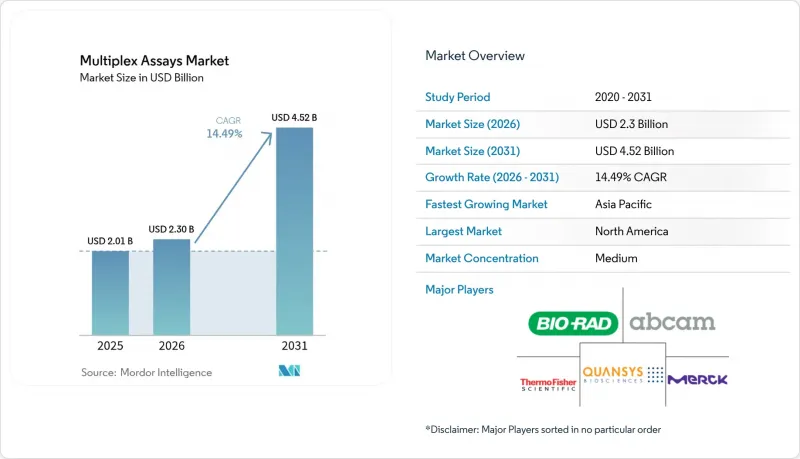
This report is Segmented by Type (Cell-Based Multiplex Assays, Protein Multiplex Assays, and More), Technology (Multiplex Real-Time PCR, Flow Cytometry, and More), Application (Infectious Disease Diagnostics, Oncology & Companion Diagnostics and More), End-User (Pharmaceutical & Biopharmaceutical Companies, and More), and Geography. The Market Forecasts are Provided in Terms of Value (USD).
Global Multiplex Assays Market Trends and Insights
Increasing Adoption of Precision-Personalized Medicine
Growing reliance on molecule-specific therapies demands tests that read several biomarkers at once. Thermo Fisher's USD 3.1 billion purchase of Olink in 2024 helped bring high-throughput proximity extension protein panels into mainstream clinical workflows. The FDA endorsed TruSight Oncology Comprehensive, a 500-gene pan-tumor companion diagnostic, illustrating official support for data-dense profiling. Large reference labs now routinely combine autoantibody and complement markers to refine lupus diagnoses, studies show improved sensitivity over single analytes. Health systems recognize that multiplex strategies cut repeat testing costs and speed treatment alignment, and machine-learning models further boost interpretive power by distilling complex signatures into clear guidance.
Expanding Burden of Chronic & Infectious Diseases
Aging populations drive chronic disease monitoring while recurrent outbreaks reinforce demand for broad pathogen panels. Prospective trials in intensive care settings confirm that respiratory syndromic tests improve time-to-appropriate therapy versus cultures. The FDA authorized a 20-minute four-pathogen molecular test for SARS-CoV-2, Influenza A/B, and RSV, underscoring the public-health value of rapid multiplex detection. Chronic kidney disease programs now integrate genomics, proteomics, and metabolomics in one assay to flag early deterioration, tightening the clinical link between multiomics and preventive care. Post-pandemic, clinicians expect panels that pivot quickly to new threats while maintaining throughput for routine surveillance, keeping the multiplex assays market on an upward trajectory.
High Capital Cost and Complex Workflows
A top-tier spectral flow cytometer costs more than USD 500,000, and supporting infrastructure adds to ownership burden. QIAGEN withdrew its automated PCR tower in 2024 due to shallow post-pandemic demand, illustrating commercial risk when capital budgets tighten. Smaller sites face steep learning curves around quality control and data handling, delaying return on investment.
Other drivers and restraints analyzed in the detailed report include:
- Distinct Advantages Over Singleplex Assays
- Rise of CRISPR-Powered Multiplex Point-of-Care Panels
- Stringent Multi-Jurisdictional Regulatory Pathways
For complete list of drivers and restraints, kindly check the Table Of Contents.
Segment Analysis
Protein panels accounted for 41.31% of multiplex assays market share in 2025, cementing their status in drug-target validation and clinical decision support. Bead-based immunoassays and proximity extension methods enable simultaneous quantification of hundreds of cytokines from microliter samples. The nucleic-acid category is set to log a 16.98% CAGR to 2031 as CRISPR and next-generation sequencing expand beyond oncology into transplant monitoring and infectious-disease genotyping. Cell-based formats serve immuno-oncology research, while integrated protein-gene workflows herald a multiomics future.
Integration trends reshape product design. Thermo Fisher's Stellar mass spectrometer, introduced in 2024, delivers ten-fold better quantitative sensitivity, encouraging labs to pair proteomics with genomics on shared automation. Regulatory approval of broad genomic companion diagnostics validates large-scale multiplex sequencing, reinforcing investment in nucleic-acid innovation. As these forces converge, the multiplex assays market continues to diversify across molecular classes.
Flow cytometry delivered 32. 08% of 2025 revenue, thanks to entrenched instrument fleets and extensive clinical guidelines. Spectral unmixing now resolves more markers per channel, extending platform life. Mass cytometry, however, is forecast to grow at 15.06% CAGR, leveraging metal-tagged antibodies to read over 100 parameters without spectral overlap. Standard BioTools' CyTOF XT PRO exemplifies this push toward routine trial workflows.
Real-time PCR remains vital for respiratory and sepsis panels, whereas sequencing platforms capture oncology and rare-disease testing. Luminex xMAP satisfies high-throughput protein needs, and microarrays occupy niche gene-expression applications. Competitive gaps close rapidly as AI tools ease panel design and auto-gating, encouraging broader adoption of advanced flow and mass cytometry in clinical labs.
Complete Report Scope:
- By Type
- Cell-based multiplex assays
- Protein multiplex assays
- Nucleic-acid multiplex assays
- Bead-based immunoassays
- By Technology
- Multiplex real-time PCR
- Flow cytometry
- Bead-based xMAP/Luminex
- Next-generation sequencing-based
- Mass cytometry (CyTOF)
- Microarray & others
- By Application
- Infectious disease diagnostics
- Oncology & companion diagnostics
- Autoimmune & allergy testing
- Drug discovery & biomarker validation
- Others
- By End-User
- Pharmaceutical & biopharmaceutical companies
- Academic & research institutes
- Contract research organizations
- Hospitals & diagnostic laboratories
- Others
- By Geography
- North America
- United States
- Canada
- Mexico
- Europe
- Germany
- United Kingdom
- France
- Italy
- Spain
- Rest of Europe
- Asia-Pacific
- China
- Japan
- India
- Australia
- South Korea
- Rest of Asia-Pacific
- Middle East and Africa
- GCC
- South Africa
- Rest of Middle East and Africa
- South America
- Brazil
- Argentina
- Rest of South America
- North America
Geography Analysis
North America captured 40.02% of 2025 revenue owing to early technology adoption and clear reimbursement paths. Thermo Fisher pledged USD 2 billion to expand U.S. manufacturing and R&D through 2029, reinforcing the region's leadership. Europe follows, guided by IVDR mandates that standardize performance claims, though conformity-assessment bottlenecks slow some launches.
Asia-Pacific is poised for a 16.62% CAGR as China, Japan, and South Korea boost biopharma investment and update reimbursement codes for molecular profiling. Government grants fund local manufacturing of reagents and instruments, cutting import dependency. India's hospital chains adopt multiplex sepsis panels to reduce mortality, illustrating emerging-market potential.
The Middle East and Africa region sees pilot rollouts of syndromic respiratory panels in tertiary centers, often backed by international aid. South America shows selective growth, with Brazil's leading oncology hospitals installing mass cytometers for immunotherapy monitoring. Across regions, differing regulatory clocks and infrastructure maturity dictate tailored go-to-market plans for multiplex assay vendors.
- Thermo Fisher Scientific
- DiaSorin
- Bio-Rad Laboratories
- Beckton Dickinson
- Illumina
- Merck
- QIAGEN
- Revvity
- Abcam
- biomerieux SA
- Hologic
- Seegene
- Promega
- Quansys Biosciences
- Standard BioTools (Fluidigm)
- Olink Holding AB
- Siemens Healthineers
- Abbott Laboratories
- Roche
- Danaher Corp.
Additional Benefits:
- The market estimate (ME) sheet in Excel format
- 3 months of analyst support
TABLE OF CONTENTS
1 Introduction
- 1.1 Study Assumptions and Market Definition
- 1.2 Scope of the Study
2 Research Methodology
3 Executive Summary
4 Market Landscape
- 4.1 Market Overview
- 4.2 Market Drivers
- 4.2.1 Increasing Adoption Of Precision-Personalized Medicine
- 4.2.2 Expanding Burden Of Chronic & Infectious Diseases
- 4.2.3 Distinct Advantages Over Singleplex Assays
- 4.2.4 Rise Of CRISPR-Powered Multiplex POC Panels
- 4.2.5 Clinical Deployment Of 40-Plus-Color Flow Cytometry
- 4.2.6 AI-Driven Assay Design & High-Dimensional Analytics
- 4.3 Market Restraints
- 4.3.1 High Capital Cost & Complex Workflows
- 4.3.2 Stringent Multi-Jurisdictional Regulatory Pathways
- 4.3.3 Shortage Of Bioinformatics Talent
- 4.3.4 Supply-Chain Volatility Of Rare Dyes & Beads
- 4.4 Value / Supply-Chain Analysis
- 4.5 Regulatory Landscape
- 4.6 Technology Outlook
- 4.7 Porter's Five Forces Analysis
- 4.7.1 Bargaining Power of Suppliers
- 4.7.2 Bargaining Power of Buyers
- 4.7.3 Threat of New Entrants
- 4.7.4 Threat of Substitutes
- 4.7.5 Intensity of Competitive Rivalry
5 Market Size and Growth Forecasts (Value-USD)
- 5.1 By Type
- 5.1.1 Cell-based multiplex assays
- 5.1.2 Protein multiplex assays
- 5.1.3 Nucleic-acid multiplex assays
- 5.1.4 Bead-based immunoassays
- 5.2 By Technology
- 5.2.1 Multiplex real-time PCR
- 5.2.2 Flow cytometry
- 5.2.3 Bead-based xMAP/Luminex
- 5.2.4 Next-generation sequencing-based
- 5.2.5 Mass cytometry (CyTOF)
- 5.2.6 Microarray & others
- 5.3 By Application
- 5.3.1 Infectious disease diagnostics
- 5.3.2 Oncology & companion diagnostics
- 5.3.3 Autoimmune & allergy testing
- 5.3.4 Drug discovery & biomarker validation
- 5.3.5 Others
- 5.4 By End-User
- 5.4.1 Pharmaceutical & biopharmaceutical companies
- 5.4.2 Academic & research institutes
- 5.4.3 Contract research organizations
- 5.4.4 Hospitals & diagnostic laboratories
- 5.4.5 Others
- 5.5 By Geography
- 5.5.1 North America
- 5.5.1.1 United States
- 5.5.1.2 Canada
- 5.5.1.3 Mexico
- 5.5.2 Europe
- 5.5.2.1 Germany
- 5.5.2.2 United Kingdom
- 5.5.2.3 France
- 5.5.2.4 Italy
- 5.5.2.5 Spain
- 5.5.2.6 Rest of Europe
- 5.5.3 Asia-Pacific
- 5.5.3.1 China
- 5.5.3.2 Japan
- 5.5.3.3 India
- 5.5.3.4 Australia
- 5.5.3.5 South Korea
- 5.5.3.6 Rest of Asia-Pacific
- 5.5.4 Middle East and Africa
- 5.5.4.1 GCC
- 5.5.4.2 South Africa
- 5.5.4.3 Rest of Middle East and Africa
- 5.5.5 South America
- 5.5.5.1 Brazil
- 5.5.5.2 Argentina
- 5.5.5.3 Rest of South America
- 5.5.1 North America
6 Competitive Landscape
- 6.1 Market Concentration
- 6.2 Market Share Analysis
- 6.3 Company profiles (includes Global level Overview, Market level overview, Core Segments, Financials as available, Strategic Information, Market Rank/Share for key companies, Products and Services, and Recent Developments)
- 6.3.1 Thermo Fisher Scientific
- 6.3.2 DiaSorin
- 6.3.3 Bio-Rad Laboratories
- 6.3.4 Becton Dickinson & Company
- 6.3.5 Illumina Inc.
- 6.3.6 Merck KGaA
- 6.3.7 Qiagen
- 6.3.8 Revvity
- 6.3.9 Abcam plc
- 6.3.10 biomerieux SA
- 6.3.11 Hologic Corporation
- 6.3.12 Seegene Inc.
- 6.3.13 Promega Corporation
- 6.3.14 Quansys Biosciences
- 6.3.15 Standard BioTools (Fluidigm)
- 6.3.16 Olink Holding AB
- 6.3.17 Siemens Healthineers
- 6.3.18 Abbott Laboratories
- 6.3.19 F. Hoffmann-La Roche Ltd
- 6.3.20 Danaher Corp.
7 Market Opportunities & Future Outlook
- 7.1 White-space & Unmet-need Assessment