|
시장보고서
상품코드
2122807
마이크로캐리어 : 시장 점유율 분석, 업계 동향 및 통계, 성장 예측(2026-2031년)Microcarrier - Market Share Analysis, Industry Trends & Statistics, Growth Forecasts (2026 - 2031) |
||||||
 Mordor Intelligence
마이크로캐리어 시장 규모는 2026년에 22억 7,000만 달러로 추정되고 2025년 21억 5,000만 달러에서 확대해, 2031년에는 30억 1,000만 달러에 이를 것으로 예측됩니다.
2026년부터 2031년까지 연평균 성장률(CAGR) 5.79%로 성장할 것으로 전망됩니다.

본 보고서는 소재 유형(폴리스티렌계, 덱스트란계, 알긴산염계 등), 용도(백신 제조, 세포 치료, 기타),최종 사용자(바이오의약품·바이오기술 기업 등), 사업 규모(실험실 규모, 파일럿 규모, 상업 규모), 지역(북미, 유럽 등)별로 분류되어 있습니다. 시장 예측은 금액(달러) 기준으로 제시되어 있습니다.
세계의 마이크로캐리어 시장 동향 및 인사이트
세포 유래 백신 및 치료제에 대한 수요
가속화되는 mRNA 및 바이러스 벡터 프로그램에는 현탁 배양에서 일반적인 500만-800만 세포/mL를 훨씬 상회하는 2,000만 세포/mL 이상의 용량을 가진 부착 배양 시스템이 필요합니다. 규제 합리화로 인해 특정 치료법의 개발 기간이 7-10년으로 단축됨에 따라, 확장성이 뛰어난 마이크로캐리어 플랫폼에 대한 지속적인 주문이 촉진되고 있습니다. 팬데믹 기간 동안 국내 백신 생산 능력에 대한 투자를 통해 반응기의 설치 면적을 최대 70%까지 줄이고, 중소기업의 자본 제약을 완화하는 최적화된 마이크로캐리어의 역할이 확고해졌습니다. 맞춤형 의료 파이프라인에서는 유연성이 뛰어난 소량 생산용 바이오리액터가 요구되고 있어, 마이크로캐리어의 도입을 더욱 뒷받침하고 있습니다. 이러한 요인들이 복합적으로 작용하여 마이크로캐리어 시장의 예상 연평균 성장률(CAGR)에 1.2%를 더하고 있습니다.
바이오의약품 및 바이오시밀러 생산 확대
2025년에는 바이오의약품 매출이 3,000억 달러를 돌파했으며, 중국과 인도 정부는 지난 2년 동안 그린필드 바이오의약품 생산 능력에 150억 달러 이상을 투자했습니다. 연속 관류 시스템은 체적 생산성을 10배 높이고 배지 사용량을 50% 절감하지만, 이러한 고세포 밀도에서 시스템을 가동하기 위해서는 지속적인 전단력을 견딜 수 있는 견고한 마이크로캐리어가 필수적입니다. 바이오시밀러 개발 기업들은 원개발품의 배양 조건을 충실히 재현하는 캐리어의 화학적 특성을 요구하고 있으며, 이에 따라 표면 개질 정밀도에 대한 요구 수준이 높아지고 있습니다. ‘BIOSECURE 방식’에 따라 유럽과 미국의 아웃소싱 대상이 인도의 CDMO로 이동하고 있으며, 2024년에는 인도로의 문의 건수가 40% 이상 급증하면서 마이크로캐리어 시장의 세계 확장이 가속화되고 있습니다.
바이오의약품 및 세포 치료제의 높은 비용
세포 치료 분야에서 제조 비용은 최종 사용자 가격의 40-60%를 차지하며, 저분자 의약품의 전형적인 10-15%를 훨씬 상회합니다. 그 결과, 신흥 시장의 보험 지급 기관은 보험 적용을 제한하고 있으며, 이로 인해 시설 건설이 억제되고 새로운 마이크로캐리어 설비에 대한 수요도 둔화되고 있습니다. 규모 확대는 규모의 경제를 가져오는 한편, 소규모 기업이 감당하기 어려운 검증 비용을 발생시켜 상용화 일정을 지연시키고 있습니다. 캐리어의 상세한 특성 평가에는 규제 당국에 제출하는 신청 비용으로 200만-500만 달러가 추가로 발생할 가능성이 있으며, 이는 신규 소재 시장 진입을 가로막아 마이크로캐리어 시장의 성장을 둔화시키고 있습니다.
부문별 분석
폴리스티렌 캐리어는 바이러스 백신 및 단일 클론 항체 생산 라인에서 오랫동안 주력 제품으로 활용되어 왔기 때문에 2025년 마이크로캐리어 시장 규모에서 42.88%의 점유율을 유지했습니다. 표면 화학적 특성이 충분히 규명되어 있고, 로트 간 균일성이 높으며, 규제 관련 자료도 잘 갖춰져 있어 적합성 평가의 문턱이 낮습니다. 그러나 바이오의약품 업계의 환경에 대한 관심 증가와 배양육 제조업체의 부상으로 인해, 연구 개발 예산은 생분해성 알긴산염, 키토산,셀룰로오스의 각 변형으로 점차 이동하고 있습니다. 알긴산염 계열은 식용 적합성과 Ca2+ 농도 구배 하에서의 겔화 능력-이는 배양육에서 근육 섬유의 지지대로 높이 평가받는 특성입니다-을 강점으로 삼아, 전체 소재 분류 중 가장 높은 연평균 성장률(CAGR) 6.55%로 성장을 지속하고 있습니다.
하이브리드 제제는 현재 강성이 높은 합성 코어와 생물학적 활성을 지닌 외층을 융합하여, 높은 전단력이 가해지는 관류 처리 중에도 기계적 내구성을 확보하는 동시에, 섬세한 줄기세포에 천연 리간드를 제공합니다. 콜라겐 단편으로 코팅된 자성 폴리스티렌 코어는 자동 분리 및 부드러운 박리를 가능하게 하여, 상업용 플랜트에서 수확 시간을 30-40% 단축하고 있습니다. 열 반응성 폴리-N-이소프로파일아크릴아미드 쉘은 효소에 의한 손상을 주지 않고 5°C의 온도 저하로 세포를 방출하므로, 세포 치료의 유효성에 필수적인 막 결합 단백질을 유지할 수 있습니다. 화학적으로 정의되고 동물 유래 성분을 포함하지 않는 공정에 대한 규제 움직임은 합성 및 식물 하이브리드에 대한 수요를 더욱 자극하여 마이크로캐리어 시장의 성장 모멘텀을 유지하고 있습니다.
2025년에는 인플루엔자, 소아마비, 그리고 최근에는 mRNA 기반 플랫폼에서 항원 및 바이러스 증식에 부착성 세포주가 사용되고 있기 때문에 백신 제조가 마이크로캐리어 시장 규모의 38.55%를 차지했습니다. 수십 년에 걸친 공정 최적화로 인해 신규 진입 장벽은 여전히 높으며, 안정적인 수요가 확보되고 있습니다. 그러나 CAR-T, 중간엽 줄기세포, 유도 만능 줄기세포, NK 세포에 이르는 세포 치료 파이프라인은 연평균 성장률(CAGR) 6.38%를 견인하며, 다른 모든 이용 사례를 능가하고 있습니다. 동종 ‘오프 더 쉘프(off-the-shelf)’ 면역요법에 대한 규제 당국의 승인을 받으려면, 1로트당 수십억 개의 세포를 저장할 수 있고, 로트 릴리스까지의 기간을 2주 이내로 단축할 수 있는 반응기가 필요합니다. 이는 마이크로캐리어 배양을 강화해야만 달성 가능한 기준입니다.
다수의 센서가 탑재된 수확 스키드를 통합한 자동화 시스템을 통해 인라인 세척, 농축, 충전 및 마무리 공정이 가능해졌으며, CAR-T 후보 물질의 ‘정맥에서 정맥까지’ 소요 시간이 20일에서 12일 미만으로 대폭 단축되었습니다. 다운스트림 공정에서는 배양육용 캐리어의 경우, 식감이나 풍미를 해치지 않으면서 분해되거나 식용 가능한 상태를 유지하는 것이 중요한 설계 매개변수로 자리 잡고 있습니다. 조직 공학 및 장기-온-칩을 포함한 연구 개발 분야에서는 확장 가능한 개념 검증 연구를 위해 마이크로캐리어의 채택이 진행되고 있으며, 마이크로캐리어 시장의 응용 기반이 서서히 확대되고 있습니다.
지역별 분석
북미는 성숙한 GMP 인프라, 견조한 벤처 자금 조달, 그리고 종종 세계 검증 기준을 설정하는 규제 당국과의 근접성에 힘입어 2025년 매출의 42.31%를 차지했습니다. 숙련된 인력 부족과 높은 운영 비용으로 인해 기업들은 듀얼 쇼어 모델로의 전환을 강요받고 있지만, 이 지역은 고부가가치 세포 및 유전자 치료 분야에서 리더십을 유지하고 있으며, 마이크로캐리어 혁신 파이프라인이 가장 밀집된 클러스터 중 하나가 되었습니다.
아시아태평양은 정부 보조금, 낮은 인건비, 바이오시밀러 수출 확대에 힘입어 연평균 성장률(CAGR) 6.68%로 가장 빠르게 성장하는 지역입니다. 중국은 2024년에 바이오의약품 산업 단지에 80억 달러 이상을 투자하여, 시드 트레인에서 하베스트에 이르기까지 마이크로캐리어 공정을 표준화하는 전용 설계의 일회용 스위트를 구축했습니다. 인도의 CDMO 시설에서는 미국공급망 관련 법안을 계기로 프로젝트 관련 문의가 40% 이상 급증했으며, 하이데라바드와 벵갈루루에서 생산 능력 확대가 진행되고 있습니다. 일본과 한국은 재생의료 및 세포 치료의 상용화에 주력하고 있으며, 엄격한 약전 기준을 충족하기 위해 공급망 추적 가능성을 갖춘 첨단 캐리어가 요구되고 있습니다.
유럽에서는 순환 경제에 관한 지침이 생분해성 캐리어 및 폐쇄형 물 시스템의 도입을 뒷받침하여, 환경을 고려한 꾸준한 성장이 나타나고 있습니다. 산업 정책에 따라 독일, 네덜란드, 아일랜드의 연속 제조 파일럿 플랜트가 지원받고 있으며, 에너지 비용 상승 속에서도 마이크로캐리어 시장의 성장세가 유지되고 있습니다. 중동 및 아프리카, 남미 등 신흥 지역에서는 기술 이전 계약 및 모듈식 GMP 시설 등을 통해 기반 역량을 구축하고 있으며, 마이크로캐리어 시장 규모를 서서히 확대되고 있습니다.
기타 혜택 :
- 엑셀 형식 시장 예측(ME) 시트
- 3개월간의 애널리스트 지원
자주 묻는 질문
목차
제1장 서론
제2장 조사 방법
제3장 주요 요약
제4장 시장 구도
제5장 시장 규모 및 성장 예측
제6장 경쟁 구도
제7장 시장 기회 및 향후 전망
KTH 26.09.08According to Mordor Intelligence, microcarrier market size in 2026 is estimated at USD 2.27 billion, growing from 2025 value of USD 2.15 billion with 2031 projections showing USD 3.01 billion, growing at 5.79% CAGR over 2026-2031.
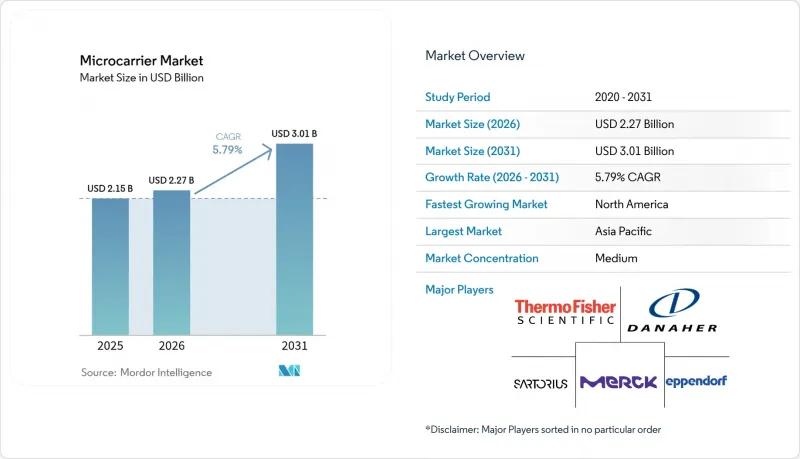
This report is Segmented by Material Type (Polystyrene-Based, Dextran-Based, Alginate-Based, and More), Application (Vaccine Manufacturing, Cell Therapy, Others), End User (Biopharma and Biotechnology Firms, and More), Scale of Operation (Laboratory Scale, Pilot Scale, Commercial Scale), and Geography (North America, Europe, and More). The Market Forecasts are Provided in Terms of Value (USD).
Global Microcarrier Market Trends and Insights
Demand for Cell-Based Vaccines & Therapeutics
Accelerated mRNA and viral-vector programs need adherent cell culture systems capable of exceeding 20 million cells/mL, well above the 5-8 million cells/mL typical of suspension cultures. Regulatory streamlining now shortens development timelines to 7-10 years for select modalities, stimulating sustained orders for scalable microcarrier platforms. Pandemic-era investment in domestic vaccine capacity cemented the role of optimized microcarriers that shrink reactor footprints by as much as 70%, easing capital constraints for smaller firms. Personalized-medicine pipelines demand flexible, small-batch bioreactors, further reinforcing microcarrier adoption. Collectively, these factors add 1.2 percentage points to the forecast CAGR of the microcarrier market.
Expansion of Biologics & Biosimilar Manufacturing
Biologics revenue surpassed USD 300 billion in 2025, while governments in China and India injected over USD 15 billion into green-field biopharma capacity over the past two years. Continuous perfusion systems achieve 10-fold volumetric productivity and 50% media savings, but their high cell-density operation depends on rugged microcarriers that tolerate sustained shear. Biosimilar developers seek carrier chemistries that faithfully replicate originator culture conditions, raising the bar for surface-modification precision. The BIOSECURE Act is redirecting Western outsourcing toward India's CDMOs, where inquiry volumes jumped more than 40% in 2024, expanding the global footprint of the microcarrier market.
High Cost of Biologics & Cell-Based Therapies
Manufacturing accounts for 40-60% of end-user prices in cell therapies, far above the 10-15% typical for small-molecule drugs. Emerging-market payers therefore restrict reimbursement, curbing facility builds and muting demand for new microcarrier installations. While scale-up promises economies of scale, it also introduces validation costs that smaller firms struggle to absorb, delaying commercialization timelines. Extensive carrier characterization can add USD 2-5 million to regulatory filings, deterring novel-material entrants and tempering growth in the microcarrier market.
Other drivers and restraints analyzed in the detailed report include:
- Surge in Global Funding for Cell & Gene Therapy R&D
- Shift Toward Single-Use Bioprocessing Platforms
- Shear-Stress & Aggregation Issues in Carrier Cultures
For complete list of drivers and restraints, kindly check the Table Of Contents.
Segment Analysis
Polystyrene carriers retained a 42.88% share of the microcarrier market size in 2025 as the long-standing workhorse for viral vaccine and monoclonal-antibody lines. Their surface chemistry is well understood, lot-to-lot consistency is high, and regulatory files are mature, lowering qualification hurdles. However, the growing environmental focus of biopharma and the ascent of cultivated-meat producers are redirecting R&D budgets toward biodegradable alginate, chitosan, and cellulose variants. The alginate cohort is charting a 6.55% CAGR, the fastest across material classes, benefiting from its edible profile and ability to gel under Ca2+ gradients, a prized attribute for muscle-fiber scaffolding in cultured meat.
Hybridformulations now merge rigid synthetic cores with bio-active outer layers, delivering mechanical resilience during high-shear perfusion runs while presenting natural ligands for delicate stem cells. Magnetic polystyrene cores coated in collagen fragments enable auto-separation and gentle detachment, trimming harvest times by 30-40% in commercial plants . Thermo-responsive poly-N-isopropyl-acrylamide shells release cells upon a 5 °C temperature drop without enzymatic insult, preserving membrane-bound proteins vital to cell-therapy potency. The regulatory push toward chemically defined, animal-component-free processes further stimulates demand for synthetic-plant hybrids, upholding growth momentum in the microcarrier market.
Vaccine production absorbed 38.55% of the microcarrier market size in 2025 as influenza, polio, and more recently mRNA-based platforms rely on adherent lines for antigen or virus propagation. Decades of process optimization keep barrier-to-entry high for challengers, ensuring stable demand. Yet cell-therapy pipelines-spanning CAR-T, mesenchymal stromal cells, induced pluripotent stem cells, and NK cells-are driving a 6.38% CAGR, outpacing every other use case. Regulatory approvals for allogeneic "off-the-shelf" immunotherapies demand reactors that can bank billions of cells per lot with lot-release timelines under two weeks, a benchmark achievable only with intensified microcarrier cultures.
Automation suites integrating sensor-rich harvest skids now support inline washing, concentration, and fill-finish activities, slashing vein-to-vein time for CAR-T candidates from 20 days to under 12 days. Downstream, edibility is becoming a critical design parameter for cultured-meat carriers that must degrade or remain consumable without altering texture or taste. R&D segments, including tissue engineering and organ-on-chip, continue to adopt microcarriers for scalable proof-of-concept studies, gradually widening the microcarrier market application base.
Complete Report Scope:
- By Material Type
- Polystyrene-based
- Dextran-based
- Alginate-based
- Collagen-/Gelatin-based
- Others
- By Application
- Vaccine Manufacturing
- Cell Therapy
- Others
- By End User
- Biopharma and Biotechnology Firms
- CROs and CDMOs
- Academic & Research Institutes
- Others
- By Scale of Operation
- Laboratory Scale
- Pilot Scale
- Commercial Scale
- By Geography
- North America
- United States
- Canada
- Mexico
- Europe
- Germany
- United Kingdom
- France
- Italy
- Spain
- Rest of Europe
- Asia-Pacific
- China
- Japan
- India
- Australia
- South Korea
- Rest of Asia-Pacific
- Middle East and Africa
- GCC
- South Africa
- Rest of Middle East and Africa
- South America
- Brazil
- Argentina
- Rest of South America
- North America
Geography Analysis
North America captured 42.31% of 2025 revenue, supported by mature GMP infrastructure, robust venture funding, and proximity to regulators that often set global validation benchmarks. Skilled-labor shortages and premium operating costs are nudging firms toward dual-shore models, yet the region retains leadership in high-value cell-and-gene therapies and maintains one of the densest clusters of microcarrier innovation pipelines.
Asia-Pacific is the fastest-growing territory at a 6.68% CAGR, underpinned by government subsidies, lower labor overhead, and expanding biosimilar exports. China allocated more than USD 8 billion to biopharma industrial parks in 2024, featuring purpose-built single-use suites that standardize microcarrier processes from seed train to harvest. India's CDMO complex saw inbound project inquiries soar by over 40% following U.S. supply-chain legislation, prompting capacity expansions in Hyderabad and Bangalore. Japan and South Korea focus on regenerative medicine and cell-therapy commercialization, demanding advanced carriers with traceable supply chains to satisfy strict pharmacopoeial standards.
Europe shows steady, environmentally focused growth, with circular-economy directives incentivizing biodegradable carriers and closed-loop water systems. Industrial policy supports continuous manufacturing pilot plants in Germany, the Netherlands, and Ireland, ensuring that the microcarrier market maintains momentum amid rising energy costs. Emerging regions in the Middle East, Africa, and South America are building foundational capability, often through technology-transfer agreements and modular GMP suites, gradually enlarging the microcarrier market footprint.
- Thermo Fisher Scientific
- Merck
- Sartorius
- Danaher (Cytiva & Pall)
- Corning
- Lonza Group Ltd.
- Eppendorf
- VWR International
- Becton Dickinson & Co.
- Getinge
- Greiner Bio-One GmbH
- Matrix F.T.
- Gelatex Technologies
- CelVivo ApS
- CELLTREAT Scientific
- HiMedia Laboratories
- Microcarriers Labs (China)
- Esco Aster
- Nanofiber Solutions
- PBS Biotech
Additional Benefits:
- The market estimate (ME) sheet in Excel format
- 3 months of analyst support
TABLE OF CONTENTS
1 Introduction
- 1.1 Study Assumptions & Market Definition
- 1.2 Scope of the Study
2 Research Methodology
3 Executive Summary
4 Market Landscape
- 4.1 Market Overview
- 4.2 Market Drivers
- 4.2.1 Demand for cell-based vaccines & therapeutics
- 4.2.2 Expansion of biologics & biosimilar manufacturing
- 4.2.3 Surge in global funding for cell & gene therapy R&D
- 4.2.4 Shift toward single-use bioprocessing platforms
- 4.2.5 Growth of cultivated-meat industry demanding edible carriers
- 4.2.6 Process-intensification via magnetic & thermo-responsive carriers
- 4.3 Market Restraints
- 4.3.1 High cost of biologics & cell-based therapies
- 4.3.2 Shear-stress & aggregation issues in carrier cultures
- 4.3.3 Lack of regulatory-cleared biodegradable microcarriers
- 4.3.4 Supply-chain volatility for specialty polymers & coatings
- 4.4 Regulatory Landscape
- 4.5 Technological Outlook
- 4.6 Porters Five Forces Analysis
- 4.6.1 Threat of New Entrants
- 4.6.2 Bargaining Power of Buyers
- 4.6.3 Bargaining Power of Suppliers
- 4.6.4 Threat of Substitutes
- 4.6.5 Competitive Rivalry
5 Market Size & Growth Forecasts (Value, USD)
- 5.1 By Material Type
- 5.1.1 Polystyrene-based
- 5.1.2 Dextran-based
- 5.1.3 Alginate-based
- 5.1.4 Collagen-/Gelatin-based
- 5.1.5 Others
- 5.2 By Application
- 5.2.1 Vaccine Manufacturing
- 5.2.2 Cell Therapy
- 5.2.3 Others
- 5.3 By End User
- 5.3.1 Biopharma and Biotechnology Firms
- 5.3.2 CROs and CDMOs
- 5.3.3 Academic & Research Institutes
- 5.3.4 Others
- 5.4 By Scale of Operation
- 5.4.1 Laboratory Scale
- 5.4.2 Pilot Scale
- 5.4.3 Commercial Scale
- 5.5 By Geography
- 5.5.1 North America
- 5.5.1.1 United States
- 5.5.1.2 Canada
- 5.5.1.3 Mexico
- 5.5.2 Europe
- 5.5.2.1 Germany
- 5.5.2.2 United Kingdom
- 5.5.2.3 France
- 5.5.2.4 Italy
- 5.5.2.5 Spain
- 5.5.2.6 Rest of Europe
- 5.5.3 Asia-Pacific
- 5.5.3.1 China
- 5.5.3.2 Japan
- 5.5.3.3 India
- 5.5.3.4 Australia
- 5.5.3.5 South Korea
- 5.5.3.6 Rest of Asia-Pacific
- 5.5.4 Middle East and Africa
- 5.5.4.1 GCC
- 5.5.4.2 South Africa
- 5.5.4.3 Rest of Middle East and Africa
- 5.5.5 South America
- 5.5.5.1 Brazil
- 5.5.5.2 Argentina
- 5.5.5.3 Rest of South America
- 5.5.1 North America
6 Competitive Landscape
- 6.1 Market Concentration
- 6.2 Market Share Analysis
- 6.3 Company Profiles (includes Global level Overview, Market level overview, Core Segments, Financials as available, Strategic Information, Market Rank/Share for key companies, Products & Services, and Recent Developments)
- 6.3.1 Thermo Fisher Scientific Inc.
- 6.3.2 Merck KGaA
- 6.3.3 Sartorius AG
- 6.3.4 Danaher (Cytiva & Pall)
- 6.3.5 Corning Inc.
- 6.3.6 Lonza Group Ltd.
- 6.3.7 Eppendorf SE
- 6.3.8 VWR International LLC
- 6.3.9 Becton Dickinson & Co.
- 6.3.10 Getinge AB
- 6.3.11 Greiner Bio-One GmbH
- 6.3.12 Matrix F.T.
- 6.3.13 Gelatex Technologies
- 6.3.14 CelVivo ApS
- 6.3.15 CELLTREAT Scientific
- 6.3.16 HiMedia Laboratories
- 6.3.17 Microcarriers Labs (China)
- 6.3.18 Esco Aster
- 6.3.19 Nanofiber Solutions
- 6.3.20 PBS Biotech
7 Market Opportunities & Future Outlook
- 7.1 White-space & Unmet-need Assessment