|
시장보고서
상품코드
2122847
살리실산 시장 : 시장 점유율 분석, 업계 동향 및 통계, 성장 예측(2026-2031년)Salicylic Acid - Market Share Analysis, Industry Trends & Statistics, Growth Forecasts (2026 - 2031) |
||||||
 Mordor Intelligence
Mordor Intelligence에 의하면, 살리실산 시장 규모는 2025년 1억 2,161만 달러로 평가되었고, 2026년에는 1억 2,954만 달러로 추정되고, 2026-2031년 CAGR 6.52%로 성장을 지속할 전망이며, 2031년에는 1억 7,761만 달러에 이를 것으로 예측됩니다.
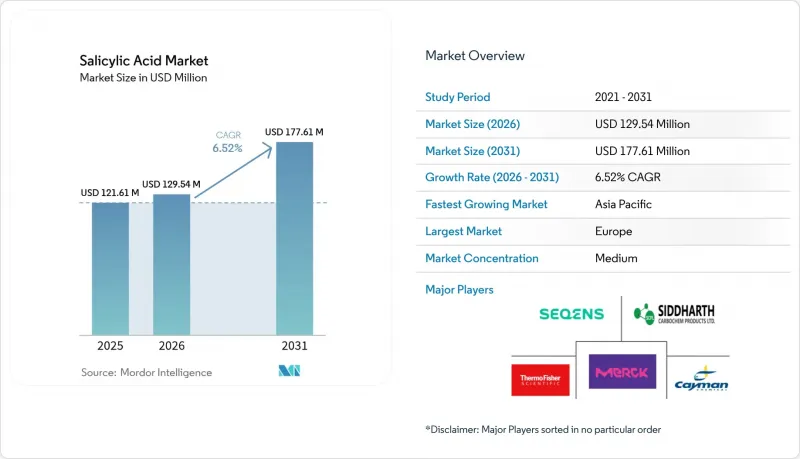
본 보고서는 용도별(의약품, 화장품 및 퍼스널케어, 식품 및 음료, 기타), 형태별(분말·결정, 액체), 지역별(북미, 유럽, 아시아태평양, 남미, 중동 및 아프리카)로 분류되어 있습니다. 시장 예측은 금액(달러) 기준으로 제시되어 있습니다.
세계의 살리실산 시장 동향 및 인사이트
제약 업계에서의 살리실산 수요 증가
의약품 분야에서의 용도는 치료 적응증의 확대와 제제 기술의 향상을 통해 시장 성장을 주도하고 있습니다. 첨단 전달 시스템, 특히 초분자 제제는 기존 제제와 비교하여 콜라겐 밀도를 탁월하게 개선하고 피부 자극을 줄여주며, 그동안 치료에 폭넓게 도입되는 것을 방해해 온 역사적 제약을 해소하고 있습니다. 의약품 분야의 특허 활동은 여전히 활발하며, 최근 출원에서는 생체이용률을 높이는 동시에 위장관 부작용을 최소화하는 병용 요법이나 새로운 전달 메커니즘에 초점이 맞추어지고 있습니다. 의약품 분야는 확립된 규제 절차에 더해, 기존의 피부과 용도를 넘어선 살리실산의 항염증 작용에 대한 인식이 높아짐에 따라 혜택을 보고 있습니다. 또한, 이 화합물의 확립된 안전성 프로파일과 규제 당국의 승인으로 인해 제조업체들은 다양한 제형에 살리실산을 적극적으로 도입하고 있습니다. 허베이 징예 그룹 및 산동 신화사와 같은 주요 공급업체들은 세계 시장을 대상으로 한 의약품 등급 살리실산 생산에서 중요한 역할을 수행하고 있습니다. 마지막으로, 자가 관리 솔루션을 선호하는 소비자 트렌드의 부양에 힘입어 살리실산을 함유한 일반의약품의 급증 또한 시장 성장에 크게 기여하고 있습니다.
스킨케어 및 퍼스널케어 제품에 대한 수요 증가
과학적으로 입증된 유효 성분에 대한 소비자의 선호는 화장품 처방에 살리실산이 채택되는 것을 지속적으로 뒷받침하고 있습니다. 그러나 안전성에 대한 규제 당국의 감시가 강화되면서 이 성분의 사용 방식에 영향을 미치고 있습니다. 예를 들어, 유럽연합 집행위원회의 소비자 안전 과학 위원회는 최근 소아용 화장품에 함유된 살리실산의 농도를 피부 도포 용도의 경우 0.1%로 제한했습니다. 이는 안전성에 대한 우려가 높아지고 있음을 반영한 조치이지만, 성인용 제품에 대해서는 여전히 더 높은 농도가 허용되고 있습니다. 미국에서도 규제 집행이 엄격해지고 있습니다. 그 일례로, 미국 식품의약국(FDA)이 고농도의 살리실산을 함유한 미승인 화학 필링 제품과 관련하여 Skin Beauty Solutions사에 경고장을 발송한 것을 들 수 있습니다. 이에 따라 제조업체들은 규정을 준수하는 안전한 처방 개발에 주력하고 있습니다. 또한, ‘화장품 규제 현대화법’에 따라 새로운 등록 요건이 도입되어 규정 준수 기준과 시장 진입 절차가 강화되고 있습니다. 화장품 및 퍼스널케어 제품 제조업체들은 과학적으로 입증된 스킨케어 제품에 대한 시장 수요에 부응하기 위해 살리실산을 처방에 포함시키고 있습니다. 애브비(AbbVie)의 자회사인 알러간 에스테틱스(Allergan Aesthetics)는 2024년 4월 여드름 치료용 ‘SkinMedica’ 제품 2종을 출시했습니다. ‘Acne Clarifying Treatment’와 ‘Pore Purifying Gel Cleanser’는 서방형 효과와 자극 감소를 위해 2%의 캡슐화 살리실산을 채택했습니다.
대체 제품의 입수 가능성
의약품 및 화장품 분야에서 대체 유효 성분의 등장은 특히 비용에 민감한 시장 부문에서 효능의 차이만으로는 프리미엄 가격을 정당화할 수 없는 경우, 경쟁 압력을 야기하고 있습니다. 살리실산 베타인 등의 베타-하이드록시산이나 글리콜산 등의 알파-하이드록시산은 살리실산과 유사한 각질 제거 효과를 가지면서도 자극이 비교적 적을 가능성이 있어, 살리실산으로 인해 부작용을 느끼는 민감성 피부 소비자들에게 매력적인 선택지가 되고 있습니다. 농업 분야에서는 합성 식물 성장 조절제나 이를 대체할 수 있는 천연 화합물이 시장 점유율을 놓고 경쟁하고 있지만, 살리실산이 성장 촉진제와 병해 저항성 증강제라는 두 가지 역할을 수행한다는 점은 차별화의 이점으로 작용하고 있습니다. 여러 유효 성분을 배합한 복합 제품의 등장으로, 특히 다기능 성분이 프리미엄 위치를 차지하는 화장품 제형에서 살리실산을 단독 성분으로 의존하는 경향이 줄어들 가능성이 있습니다. 주요 제형 기술에 대한 특허 만료로 인해 제네릭 제품의 경쟁이나 대체품 채택이 가속화될 가능성이 있습니다. 시장 역학은 뛰어난 ‘유효성 대 자극성 비율’을 보이는 제품을 지지하고 있으며, 이는 살리실산 제형 및 경쟁 대체품 모두에서 혁신을 촉진하고 있습니다.
부문 분석
분말/결정 형태는 확립된 제조 공정과 비용 효율적인 생산 체제에 힘입어 2025년에도 71.05%의 점유율을 유지하며 시장을 계속 주도했습니다. 액상 제제는 제조업체들이 생체 이용률 향상과 사용 편의성을 추구함에 따라 연평균 성장률(CAGR) 7.12%라는 가속화된 성장을 보이고 있습니다. 기존의 분말 형태는 안정성의 우위와 확립된 공급망 인프라의 혜택을 받고 있으며, 특히 정확한 투여량과 장기 보존성이 여전히 중요한 요건인 의약품 용도에서 그 강점을 발휘하고 있습니다.
살리실산 시장에서는 뛰어난 용해성, 효율적인 피부 흡수 및 사용 편의성으로 인해 액상 제제의 채택이 증가하고 있습니다. 이러한 특성은 특히 여드름 치료제, 각질 제거제 및 피부 정돈용 토너와 같이 바로 사용할 수 있는 화장품에 대한 시장 수요를 충족시킵니다. 살리실산은 안정된 액상 기제에 배합됨으로써 그 효능이 높아집니다. 또한, 경피 패치나 서방형 젤과 같은 새로운 전달 시스템은 고형 제제의 안정성과 액상 제제의 즉효성이라는 장점을 융합하고 있습니다. 이러한 발전으로 인해 최적의 성능을 발휘하고, 피부 자극을 최소화하며, 효율적인 사용 방법을 제공하는 살리실산 제품에 대한 시장 수요가 증가하고 있습니다.
지역별 분석
유럽은 확립된 의약품 제조 인프라와 제품의 품질 및 안전 기준을 검증하는 엄격한 규제 체계를 바탕으로, 2025년에는 30.78%의 점유율로 시장 리더십을 유지했습니다. 이 지역은 유럽의약품청(EMA) 및 각국 당국의 종합적인 규제 감독의 혜택을 받고 있으며, 이를 통해 살리실산 함유 제품에 대한 소비자의 신뢰가 높아지는 한편, 제조업체에게는 명확한 규정 준수 경로가 확립되어 있습니다. 유럽 제조업체들은 첨단 생산 기술과 확립된 유통망을 활용하여 국내 시장과 수출 시장 모두에 제품을 공급하고 있으며, 특히 고부가가치 의약품 및 화장품 용도 분야에서 강점을 발휘하고 있습니다.
아시아태평양은 제약 생산 능력 확대, 농업 용도 증가, 그리고 퍼스널케어 제품에 포함된 유효 성분의 이점에 대한 소비자 인식 제고에 힘입어 2031년까지 연평균 성장률(CAGR)이 9.44%에 달하며 가장 빠르게 성장하는 지역으로 부상하고 있습니다. 중국은 환경 규정 준수 대책 및 첨단 공정 기술을 접목한 새로운 생산 시설 설립 등 제조 분야에 대한 대규모 투자를 통해 이 지역의 성장을 주도하고 있습니다. 또한, 북미는 성숙한 시장으로, 종합적인 규제 체계와 유효 성분의 이점에 대한 소비자의 확고한 수용에 힘입어 의약품, 화장품, 그리고 신흥 식품 보존 용도에서 안정적인 수요 패턴을 보이고 있습니다. 미국 식품의약국(FDA)이 다양한 용도에서의 살리실산 사용에 대해 제시한 명확한 지침은 제품 개발 및 시장 진출 전략을 뒷받침하는 규제상의 확실성을 제공합니다.
남미 및 중동 및 아프리카(MEA) 시장에서는 도시화, 가처분 소득 증가, 의약품 및 퍼스널케어 제품에 대한 수요 증가를 배경으로 살리실산의 성장 기회가 전망됩니다. 브라질과 멕시코에서는 국내 의약품 제조 및 일반 의약품 스킨케어 분야가 성장하고 있어, 살리실산이 함유된 제품의 채택이 증가하고 있습니다. 중동 및 아프리카(MEA) 지역에서는 개인 위생 및 피부 건강에 대한 소비자의 인식이 높아지고 있으며, 그 결과 여드름 치료제 및 각질 제거 제품에서 살리실산에 대한 수요가 증가하고 있습니다. 그러나 시장 성장은 제조 능력의 한계, 지역별 규제 차이, 수입 의존도 등의 제약에 직면해 있습니다. 전 세계 제조업체들은 이 지역에서 시장 점유율을 확대하고 보다 견고한 공급망을 구축하기 위해 전략적 제휴 및 현지 사업 확장에 주력하고 있습니다.
기타 혜택 :
- 엑셀 형식 시장 예측(ME) 시트
- 3개월간의 애널리스트 지원
자주 묻는 질문
목차
제1장 서론
제2장 조사 방법
제3장 주요 요약
제4장 시장 구도
제5장 시장 규모 및 성장 예측(금액, 백만 달러)
제6장 경쟁 구도
제7장 시장 기회 및 향후 전망
AJY 26.09.07According to Mordor Intelligence, the salicylic acid market size is expected to grow from USD 121.61 million in 2025 to USD 129.54 million in 2026 and is forecast to reach USD 177.61 million by 2031 at 6.52% CAGR over 2026-2031.
This report is Segmented by Application (Pharmaceuticals, Cosmetics and Personal Care, Food and Beverages, and Others), Form (Powder/Crystal and Liquid), and Geography (North America, Europe, Asia-Pacific, South America, and Middle East and Africa). The Market Forecasts are Provided in Terms of Value (USD).
Global Salicylic Acid Market Trends and Insights
Increasing Demand for Salicylic Acid in the Pharmaceutical Industry
Pharmaceutical applications drive market expansion through expanding therapeutic indications and enhanced formulation technologies. Advanced delivery systems, particularly supramolecular formulations, demonstrate superior collagen density improvement and reduced skin irritation compared to conventional preparations, addressing historical limitations that constrained broader therapeutic adoption. Patent activity in pharmaceutical applications remains robust, with recent filings focusing on combination therapies and novel delivery mechanisms that enhance bioavailability while minimizing gastrointestinal side effects. The pharmaceutical segment benefits from established regulatory pathways and growing recognition of salicylic acid's anti-inflammatory properties beyond traditional dermatological applications. Moreover, the compound's established safety profile and regulatory approvals encourage manufacturers to incorporate it into various formulations. Key suppliers such as Hebei Jingye Group, Shandong Xinhua Company, and others play a significant role in producing pharmaceutical-grade salicylic acid for global markets. Finally, the surge in over-the-counter pharmaceutical products containing salicylic acid, driven by consumer preference for self-care solutions, also contributes significantly to the market's growth.
Rising Demand in Skincare and Personal Care Products
Consumer preference for scientifically validated active ingredients continues to drive the adoption of salicylic acid in cosmetic formulations. However, increasing regulatory scrutiny around safety is shaping how the ingredient is used. For instance, the European Commission's Scientific Committee on Consumer Safety recently limited the concentration of salicylic acid in children's cosmetic products to 0.1% for dermal applications, reflecting growing safety concerns while still allowing higher concentrations in adult products . In the United States, regulatory enforcement is also tightening, as evidenced by the United States Food and Drug Administration (FDA)'s warning letter to Skin Beauty Solutions regarding unapproved chemical peel products containing high concentrations of salicylic acid. This has prompted manufacturers to focus on developing compliant, safe formulations. Additionally, the Modernization of Cosmetics Regulation Act implements new registration requirements, increasing compliance standards and market entry protocols. Cosmetic and personal care manufacturers are integrating salicylic acid into formulations to address market demand for scientifically validated skincare products. Allergan Aesthetics, an AbbVie subsidiary, launched two SkinMedica products in April 2024 for acne treatment. The Acne Clarifying Treatment and Pore Purifying Gel Cleanser utilize 2% encapsulated salicylic acid for controlled release and reduced irritation.
Availability of Substitutes
Alternative active ingredients in pharmaceutical and cosmetic applications create competitive pressure, particularly in cost-sensitive market segments where efficacy differences may not justify premium pricing. Beta-hydroxy acids like betaine salicylate and alpha-hydroxy acids such as glycolic acid offer similar exfoliation benefits with potentially reduced irritation profiles, appealing to sensitive-skin consumers who experience adverse reactions to salicylic acid. In agricultural applications, synthetic plant growth regulators and alternative natural compounds compete for market share, though salicylic acid's dual role as both growth promoter and a disease resistance enhancer provides differentiation advantages. The availability of combination products that blend multiple active ingredients can reduce reliance on salicylic acid as a standalone component, particularly in cosmetic formulations where multi-functional ingredients command premium positioning. Patent expiration on key formulation technologies may accelerate generic competition and substitute adoption. Market dynamics favor products that demonstrate superior efficacy-to-irritation ratios, driving innovation in both salicylic acid formulations and competitive alternatives.
Other drivers and restraints analyzed in the detailed report include:
- Rise in Clean-Label Beverage Preservation Approvals
- Increasing Demand for Salicylic Acid in the Packaged Food Sector as a Food Preservative
- Price Volatility of Raw Materials
For complete list of drivers and restraints, kindly check the Table Of Contents.
Segment Analysis
Powder/crystal forms maintain market leadership with a 71.05% share in 2025, supported by established manufacturing processes and cost-effective production economics. Liquid formulations exhibit accelerated growth at 7.12% CAGR as manufacturers develop enhanced bioavailability and application convenience. Traditional powder forms benefit from stability advantages and established supply chain infrastructure, particularly in pharmaceutical applications where precise dosing and extended shelf life remain critical requirements.
The salicylic acid market demonstrates increased adoption of liquid formulations, attributed to their superior solubility, efficient skin absorption, and application convenience. These characteristics address market demand for ready-to-use cosmetic products, specifically in acne treatments, exfoliators, and clarifying toners. The efficacy of salicylic acid increases when formulated in stable liquid bases. Furthermore, emerging delivery systems, including transdermal patches and controlled-release gels, integrate the advantages of solid formulations' stability with liquid forms' rapid effectiveness. These advancements drive market demand for salicylic acid products that deliver optimal performance, minimize skin sensitivity, and provide efficient application methods.
Complete Report Scope:
- By Application
- Pharmaceuticals
- Cosmetics and Personal Care
- Food and Beverages
- Others
- By Form
- Powder/Crystal
- Liquid
- By Geography
- North America
- United States
- Canada
- Mexico
- Rest of North America
- Europe
- Germany
- France
- United Kingdom
- Spain
- Italy
- Russia
- Rest of Europe
- Asia-Pacific
- China
- India
- Japan
- Australia
- Rest of Asia-Pacific
- South America
- Brazil
- Argentina
- Rest of South America
- Middle East and Africa
- South Africa
- Saudi Arabia
- Rest of Middle East and Africa
- North America
Geography Analysis
Europe maintains market leadership with a 30.78% share in 2025, supported by established pharmaceutical manufacturing infrastructure and stringent regulatory frameworks that validate product quality and safety standards. The region benefits from comprehensive regulatory oversight through the European Medicines Agency and national authorities, creating consumer confidence in salicylic acid-containing products while establishing clear compliance pathways for manufacturers. European manufacturers leverage advanced production technologies and established distribution networks to serve both domestic and export markets, with particular strength in high-value pharmaceutical and cosmetic applications.
The Asia-Pacific region emerges as the fastest-growing region, with a 9.44% CAGR through 2031, driven by expanding pharmaceutical manufacturing capacity, increasing agricultural applications, and rising consumer awareness of the benefits of active ingredients in personal care products. China leads regional growth through significant investments in manufacturing, including the establishment of new production facilities that incorporate environmental compliance measures and advanced process technologies. Moreover, North America represents a mature market with stable demand patterns across pharmaceutical, cosmetic, and emerging food preservation applications, supported by comprehensive regulatory frameworks and established consumer acceptance of active ingredient benefits. The United States Food and Drug Administration (FDA)'s clear guidance on salicylic acid use in various applications provides regulatory certainty that supports product development and market entry strategies.
South America, and Middle East and Africa (MEA) markets present growth opportunities for salicylic acid, driven by urbanization, higher disposable incomes, and increased demand for pharmaceutical and personal care products. Brazil and Mexico are experiencing growth in their domestic pharmaceutical manufacturing and over-the-counter skincare segments, leading to increased adoption of salicylic acid formulations. The Middle East and Africa (MEA) region shows increased consumer awareness of personal hygiene and skin health, resulting in higher demand for salicylic acid in acne treatments and exfoliating products. However, market growth faces constraints from limited manufacturing capabilities, varying regulations across regions, and dependence on imports. Global manufacturers are focusing on strategic partnerships and local presence to expand their market reach and establish stronger supply chains in these regions.
- Seqens Group
- Merck KGaA
- Thermo Fisher Scientific
- Cayman Chemical Company
- Siddharth Carbochem Products
- Lona Industries (Alta Laboratories)
- SimSon Pharma Limited
- Hebei Jingye Group
- Zhenjiang Gaopeng Pharmaceutical
- Spectrum Chemical Mfg
- Avantor Inc.
- Emco Group (Emco Dyestuff Pvt Ltd)
- Alpha Chemika
- Flychem Private Limited
- Central Drug House
- MedChemExpress
- The Andhra Sugars Limited.
- GFS Chemicals
- Plater Group
- Honeywell Research Chemical
Additional Benefits:
- The market estimate (ME) sheet in Excel format
- 3 months of analyst support
TABLE OF CONTENTS
1 INTRODUCTION
- 1.1 Study Assumptions and Market Definition
- 1.2 Scope of the Study
2 RESEARCH METHODOLOGY
3 EXECUTIVE SUMMARY
4 MARKET LANDSCAPE
- 4.1 Market Overview
- 4.2 Market Drivers
- 4.2.1 Increasing Demand for Salicylic Acid in the Pharmaceutical Industry
- 4.2.2 Rising Demand in Skincare and Personal Care Products
- 4.2.3 Rise in Clean-Label Beverage Preservation Approvals
- 4.2.4 Increasing Demand for Salicylic Acid in the Packaged Food Sector as a Food Preservative
- 4.2.5 Growing Need for Plant Growth Regulators
- 4.2.6 Increasing Consumer Preference for Dermatologically Tested and Natural Ingredients
- 4.3 Market Restraints
- 4.3.1 Availability of Substitutes
- 4.3.2 Price Volatality of Raw materials
- 4.3.3 Stringent Regulatory Approvals and Compliance Requirements
- 4.3.4 Potential Health Risks and Skin Sensitivities
- 4.4 Supply-Chain Analysis
- 4.5 Regulatory Outlook
- 4.6 Porter's Five Forces Analysis
- 4.6.1 Threat of New Entrants
- 4.6.2 Bargaining Power of Buyers
- 4.6.3 Bargaining Power of Suppliers
- 4.6.4 Threat of Substitutes
- 4.6.5 Competitive Rivalry
5 MARKET SIZE AND GROWTH FORECASTS (VALUE, USD MN)
- 5.1 By Application
- 5.1.1 Pharmaceuticals
- 5.1.2 Cosmetics and Personal Care
- 5.1.3 Food and Beverages
- 5.1.4 Others
- 5.2 By Form
- 5.2.1 Powder/Crystal
- 5.2.2 Liquid
- 5.3 By Geography
- 5.3.1 North America
- 5.3.1.1 United States
- 5.3.1.2 Canada
- 5.3.1.3 Mexico
- 5.3.1.4 Rest of North America
- 5.3.2 Europe
- 5.3.2.1 Germany
- 5.3.2.2 France
- 5.3.2.3 United Kingdom
- 5.3.2.4 Spain
- 5.3.2.5 Italy
- 5.3.2.6 Russia
- 5.3.2.7 Rest of Europe
- 5.3.3 Asia-Pacific
- 5.3.3.1 China
- 5.3.3.2 India
- 5.3.3.3 Japan
- 5.3.3.4 Australia
- 5.3.3.5 Rest of Asia-Pacific
- 5.3.4 South America
- 5.3.4.1 Brazil
- 5.3.4.2 Argentina
- 5.3.4.3 Rest of South America
- 5.3.5 Middle East and Africa
- 5.3.5.1 South Africa
- 5.3.5.2 Saudi Arabia
- 5.3.5.3 Rest of Middle East and Africa
- 5.3.1 North America
6 COMPETITIVE LANDSCAPE
- 6.1 Market Concentration
- 6.2 Strategic Moves
- 6.3 Market Ranking Analysis
- 6.4 Company Profiles (includes Global level Overview, Market level overview, Core Segments, Financials as available, Strategic Information, Market Rank/Share for key companies, Products and Services, and Recent Developments)
- 6.4.1 Seqens Group
- 6.4.2 Merck KGaA
- 6.4.3 Thermo Fisher Scientific
- 6.4.4 Cayman Chemical Company
- 6.4.5 Siddharth Carbochem Products
- 6.4.6 Lona Industries (Alta Laboratories)
- 6.4.7 SimSon Pharma Limited
- 6.4.8 Hebei Jingye Group
- 6.4.9 Zhenjiang Gaopeng Pharmaceutical
- 6.4.10 Spectrum Chemical Mfg
- 6.4.11 Avantor Inc.
- 6.4.12 Emco Group (Emco Dyestuff Pvt Ltd)
- 6.4.13 Alpha Chemika
- 6.4.14 Flychem Private Limited
- 6.4.15 Central Drug House
- 6.4.16 MedChemExpress
- 6.4.17 The Andhra Sugars Limited.
- 6.4.18 GFS Chemicals
- 6.4.19 Plater Group
- 6.4.20 Honeywell Research Chemical