|
시장보고서
상품코드
2122853
비뇨생식기계 의약품 : 시장 점유율 분석, 업계 동향 및 통계, 성장 예측(2026-2031년)Genitourinary Drugs - Market Share Analysis, Industry Trends & Statistics, Growth Forecasts (2026 - 2031) |
||||||
 Mordor Intelligence
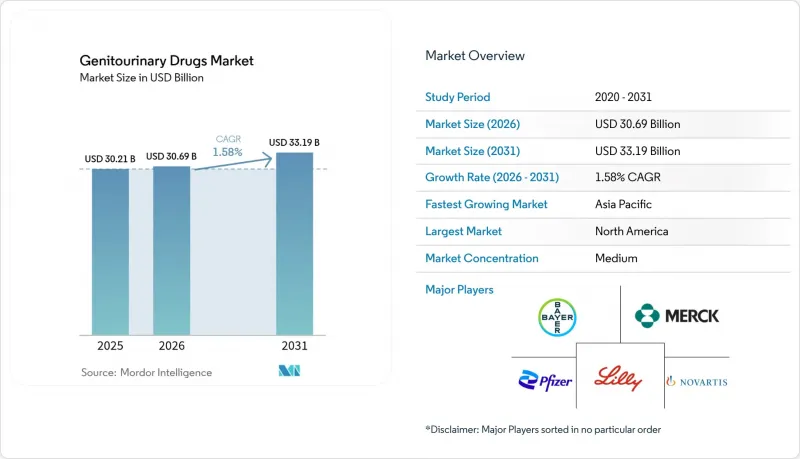
비뇨생식기계 의약품 시장 규모는 2026년에 306억 9,000만 달러로 추정되고 2025년 302억 1,000만 달러에서 확대해, 2031년에는 331억 9,000만 달러에 이를 것으로 예측됩니다.
2026년부터 2031년까지의 연평균 성장률(CAGR)은 1.58%가 될 것으로 전망됩니다.

본 보고서는 질환 유형(발기부전 등), 약물 분류(호르몬 요법 등), 투여 경로(경구, 주사 등), 성별(남성·여성), 유통 채널(병원 약국 등), 분자 유형(저분자 유형 등), 지역(북미, 유럽 등)별로 분류되어 있습니다. 시장 전망은 금액(달러) 기준으로 제시되어 있습니다.
세계의 비뇨생식기계 의약품 시장 동향 및 인사이트
비뇨생식기 질환 유병률 증가
전립선 비대증은 60-69세 남성의 50% 이상에 영향을 미치며, 85세가 되면 그 비율이 최대 90%에 달하기 때문에 진단율 및 치료율의 상승으로 이어지고 있습니다. FDA가 2025년에 Optilume BPH 시스템을 승인한 것은 의료기기를 이용한 중재를 통해 성 기능을 보호하면서 최대 요류 속도를 7.9 mL/s에서 16.4 mL/s로 향상시킬 수 있음을 보여줍니다. 요실금은 이미 65세 이상 여성의 25-45%에게 영향을 미치고 있으며, 항콜린 작용에 따른 부작용을 피할 수 있는 B-3 아드레날린 작용제에 대한 수요를 뒷받침하고 있습니다. ‘MyProstateScore 2.0’ 소변 검사는 고악성도 전립선암의 94%를 검출할 수 있어 조기 치료에 대한 수요를 촉진하고 있습니다. 의료 제도에서는 비뇨생식기 질환이 삶의 질(QOL)의 우선순위로 자리매김하는 경향이 강해지고 있으며, 이는 보험 적용 범위의 확대로 이어져 비뇨생식기계 의약품 시장의 장기적인 견조함을 뒷받침하고 있습니다.
비뇨기계 문제를 겪는 고령 남성 인구 증가
테스토스테론 결핍증은 60세 이상 남성의 20%, 80세 이상 남성의 50%에게 영향을 미치고 있습니다. 2025년 2월, FDA는 TRAVERSE 임상시험 결과를 반영하여 테스토스테론의 첨부 문서를 개정하고, 오랫동안 지속되어 온 노화성 성선 기능 저하증에 대한 경고를 삭제함으로써 처방 의사의 우려를 불식시켰습니다. 전립선암 발병률은 50세 이후 10년마다 2배로 증가합니다. 바이엘의 ‘누베카(Nubeqa)’는 2024년에 약 10만 명의 환자에게 투여되었으며, ARANOTE 임상시험에서 위약군의 7.8%에 비해 42.6%라는 매우 낮은 PSA 반응률을 보였습니다. 수명 연장과 성 건강에 대한 기대감이 높아지면서 발기부전 치료제 및 관련 병용 요법에 대한 수요가 증가하고 있으며, 이는 비뇨생식기계 의약품 시장의 수익 기반을 강화하고 있습니다.
치료 순응도 부족
비뇨생식기 질환 전반에 걸쳐, 약물 복용 순응도는 40-70% 범위입니다. 과활동성 방광 치료제는 항콜린 작용에 따른 부작용의 영향으로 6개월 이내에 50%의 환자가 치료를 중단하고 있습니다. 비베그론과 같은 장기 작용형 B-3 작용제는 더 우수한 내약성을 보입니다. 발기부전 치료법은 파트너와의 관계나 성적 수행에 대한 불안으로 인한 행동적 장벽에 직면해 있습니다. 원격의료 기업들은 매월 처방전 갱신 서비스나 지속적인 상담을 통해 치료 지속률을 높이기 위해 노력하고 있지만, 확고한 종단적 데이터는 아직 축적되는 단계입니다. 복약 순응도의 격차를 해소하고 비뇨생식기계 의약품 시장에서 가치 유출을 방지하기 위해, 디지털 알림 기능이나 임플란트형 투여 시스템이 연구되고 있습니다.
부문별 분석
2025년, 발기부전을 대상으로 한 비뇨생식기계 의약품 시장은 원격의료의 보급과 제네릭 PDE5 억제제의 저렴한 가격 덕분에 시장 점유율 34.42%를 차지하며 1위 자리를 확고히 했습니다. 그러나 이 부문은 치료 측면에서 포화 상태에 가까워지고 있으며, GLP-1 유발성 기능 장애라는 새로운 합병증에 직면함에 따라 성장이 둔화되고 있습니다. 요실금은 3.42%의 연평균 성장률(CAGR)이 예상되며, 고령화와 진단 기술의 향상으로 인해 B-3 작용제 및 저침습적 기기·의약품 하이브리드 제품에 대한 수요가 가속화되면서 그 격차를 좁혀가고 있습니다.
요로감염 치료제는 약물 내성 문제가 있음에도 불구하고 안정적인 수익원을 유지하고 있는 반면, 전립선암 치료제는 안드로겐 수용체를 정밀하게 표적화함으로써 고가 가격대를 실현하고 있습니다. TAR-200 등의 방광암 치료법은 국소 투여가 치료 성과를 어떻게 재정의할 수 있는지를 보여주고 있으며, 연구 개발 투자를 고위험이자 비근층 침윤성 질환이라는 틈새 분야로 유도하고 있습니다. 이러한 변화들이 맞물리면서 비뇨생식기계 의약품 시장 내 포트폴리오의 우선순위가 재검토되고 있습니다.
2025년, 포스포디에스테라제 5(PDE5) 억제제는 임상 현장에서의 폭넓은 인지도와 경구 투여에 대한 강한 선호도에 힘입어 비뇨생식기계 의약품 시장 매출의 29.12%를 차지했습니다. 그러나 특허 만료로 인해 가격 수준이 압박받으면서, 차별화된 제형 및 병용 요법으로의 전환이 촉진되고 있습니다. 연평균 성장률(CAGR) 3.6%로 성장하고 있는 β-3 아드레날린 수용체 작용제는 항콜린 작용에 따른 부작용을 억제함으로써 과활동성 방광 치료 분야에서 점유율을 확대되고 있습니다.
FDA의 첨부 문서 명확화에 따라 호르몬 요법이 탄력을 받고 있는 한편, α-차단제/5α-환원효소 억제제의 고정 용량 요법은 복약 순응도 향상에 기여하고 있습니다. 뉴로키닌 길항제나 마이크로바이옴 조절제가 파이프라인의 초기 단계에서 많이 발견되며, 비뇨생식기계 의약품 시장의 장기적인 확장을 뒷받침하는 다양화 추세가 두드러지고 있습니다.
지역별 분석
북미는 성숙한 보험 환급 제도와 선구적인 원격 의료의 보급을 활용하여 2025년 매출의 42.10%를 차지했습니다. FDA의 패스트 트랙 제도를 통해 TAR-200과 같은 혁신적인 치료법이 신속하게 도입되고 있으며, 인구 고령화와 전립선암 검진율의 높이가 환자 수요를 뒷받침하고 있습니다. PDE5 억제제 제네릭 의약품에 의한 시장 침식은 가격을 억제하는 한편 판매량을 확대시켜, 비뇨생식기계 의약품 시장의 전체적인 성장을 안정시키고 있습니다.
연평균 성장률(CAGR) 2.55%로 성장하는 아시아태평양은 보험 적용 범위 확대, 도시화, 그리고 서유럽에서의 승인에 대한 규제 지연을 단축하는 정책 개혁의 혜택을 받고 있습니다. 중국의 중앙 집중식 조달 제도는 비용을 절감하면서도 접근성을 확대하고 있는 반면, 일본의 초고령화 사회는 요실금 및 전립선 비대증(BPH) 치료제 수요를 뒷받침하고 있습니다. 인도의 제네릭 의약품에 대한 전문 지식은 국내 및 수출 수요를 모두 충족시키며, 지역의 자급자족 수준을 높이고 있습니다. 가격 압박은 치열하지만, 절대적인 환자 수 덕분에 이 지역은 비뇨생식기계 의약품 시장의 장기적인 성장 동력으로서의 입지를 확고히 하고 있습니다.
유럽에서는 성장률이 완만하긴 하지만 꾸준한 확대가 예상됩니다. 유럽의약품청(EMA)에 의한 심사 일원화로 신청 절차가 간소화되었으며, 독일 등 일부 국가에서는 비베그론과 같은 신약에 대해 높은 가격을 유지하고 있습니다. 다만, 일부 시장의 긴축 재정 조치와 국가별로 제각각인 환급 규정이 신약 출시 순서를 복잡하게 만들고 있습니다. 동유럽에서는 의료 서비스의 현대화가 EU 기준에 부합해 감에 따라 추가적인 성장 여지가 생기고 있습니다. 브렉시트로 인해 영국은 단독으로 신청할 수밖에 없게 되어 비용은 소폭 상승했으나, 비뇨생식기계 의약품 시장 수요에 대한 기본적 여건에는 변화가 없습니다.
기타 혜택 :
- 엑셀 형식 시장 예측(ME) 시트
- 3개월간의 애널리스트 지원
자주 묻는 질문
목차
제1장 서론
제2장 조사 방법
제3장 주요 요약
제4장 시장 구도
제5장 시장 규모 및 성장 예측
제6장 경쟁 구도
제7장 시장 기회 및 향후 전망
KTH 26.09.08According to Mordor Intelligence, genitourinary drugs market size in 2026 is estimated at USD 30.69 billion, growing from 2025 value of USD 30.21 billion with 2031 projections showing USD 33.19 billion, growing at 1.58% CAGR over 2026-2031.
This report is Segmented by Disease Type (Erectile Dysfunction, and More), Drug Class (Hormonal Therapy, and More), Route of Administration (Oral, Injectable, and More), Gender (Male and Female), Distribution Channel (Hospital Pharmacies, and More), Molecular Type (Small-Molecular Type, and More), Geography (North America, Europe, and More). The Market Forecasts are Provided in Terms of Value (USD).
Global Genitourinary Drugs Market Trends and Insights
Increasing Prevalence of Genitourinary Disorders
Benign prostatic hyperplasia affects more than 50% of men aged 60-69 and up to 90% by age 85, prompting higher diagnostic and treatment rates. The FDA's 2025 clearance of the Optilume BPH system illustrates how device-assisted interventions can improve maximum urinary flow from 7.9 mL/s to 16.4 mL/s while protecting sexual function. Urinary incontinence already impacts 25-45% of women over 65, fueling demand for B-3 adrenergic agonists that avoid anticholinergic side effects. The MyProstateScore 2.0 urine assay detects 94% of high-grade prostate cancers, reinforcing early-stage therapeutic demand. Health systems increasingly classify genitourinary disorders as quality-of-life priorities, which strengthens reimbursement coverage and underpins the long-term resilience of the genitourinary drugs market.
Growing Aging Male Population with Urological Issues
Testosterone deficiency touches 20% of men over 60 and 50% above 80. In February 2025, the FDA revised testosterone labels to reflect the TRAVERSE trial, removing longstanding age-related hypogonadism warnings and easing prescriber concerns. Prostate cancer incidence doubles every decade after 50; Bayer's Nubeqa treated nearly 100,000 patients in 2024 with an ultra-low PSA response of 42.6% versus 7.8% for placebo in the ARANOTE study. Longer lifespans coupled with higher expectations for sexual wellness elevate demand for erectile dysfunction therapies and related combination regimens, reinforcing the revenue base of the genitourinary drugs market.
Lack Of Therapy Compliance
Adherence rates range from 40-70% across genitourinary conditions. Overactive bladder drugs suffer from anticholinergic side effects that drive 50% discontinuation inside six months. Long-acting B-3 agonists such as vibegron offer better tolerability. Erectile dysfunction regimens face behavioral barriers tied to partner dynamics and performance anxiety. Telemedicine firms attempt to improve persistence through monthly refill services and ongoing counseling, but robust longitudinal data are still emerging. Digital reminders and implant-based delivery systems are under study to close the adherence gap and safeguard value leakage from the genitourinary drugs market.
Other drivers and restraints analyzed in the detailed report include:
- Rising Adoption of Generic PDE5 Inhibitors Post Patent Expiry
- Expanding Pipeline of Novel Genitourinary Therapeutics
- Escalating Antibiotic Resistance In UTI Pathogens
For complete list of drivers and restraints, kindly check the Table Of Contents.
Segment Analysis
The genitourinary drugs market size for erectile dysfunction stood at a leading 34.42% share in 2025, benefiting from telemedicine penetration and generic PDE5 affordability. Yet growth is slowing as the segment approaches therapeutic saturation and faces emerging GLP-1-induced dysfunction complications. Urinary incontinence, with a 3.42% CAGR outlook, is narrowing the gap as aging populations and improved diagnosis accelerate demand for B-3 agonists and minimally invasive device-drug hybrids.
Urinary tract infection therapeutics retain stable revenue streams despite resistance issues, while prostate cancer drugs capture premium pricing through precision androgen-receptor targeting. Bladder cancer interventions such as TAR-200 demonstrate how localized delivery can redefine outcomes, drawing R&D investment toward high-risk, non-muscle-invasive disease niches. Together, these shifts recalibrate portfolio priorities within the genitourinary drugs market.
Phosphodiesterase-5 inhibitors contributed 29.12% of genitourinary drugs market revenue in 2025, upheld by broad clinical familiarity and strong oral preference. Patent expiries, however, compress price points and spur a migration toward differentiated formulations and combination therapies. B-3 adrenergic agonists, growing at 3.6% CAGR, are winning share in overactive bladder by limiting anticholinergic adverse events.
Hormone therapies gain momentum after the FDA's labeling clarification, while a-blocker/5a-reductase inhibitor fixed-dose regimens improve adherence. Neurokinin antagonists and microbiome-modulating agents populate early pipelines, highlighting diversification themes that support the long-term expansion of the genitourinary drugs market.
Complete Report Scope:
- By Disease Type
- Erectile Dysfunction
- Urinary Tract Infections
- Urinary Incontinence
- Gonorrhoea
- Genital Herpes
- Glomerulonephritis
- Chronic Renal Failure
- Other Disease Types
- By Drug Class
- Hormonal Therapy
- Phosphodiesterase-5 Inhibitors
- ?-Blockers & 5-? Reductase Inhibitors
- Uterine Relaxants & Stimulants
- Urinary Antispasmodics
- Urinary pH Modifiers
- Miscellaneous Genitourinary Agents
- By Route Of Administration
- Oral
- Injectable
- Topical / Transdermal
- Vaginal / Rectal Suppository
- By Gender
- Male
- Female
- By Distribution Channel
- Hospital Pharmacies
- Retail Pharmacies
- Online Pharmacies
- By Molecule Type
- Small-Molecule Drugs
- Biologics & Peptides
- Geography
- North America
- United States
- Canada
- Mexico
- South America
- Brazil
- Argentina
- Rest of South America
- Europe
- Germany
- United Kingdom
- France
- Italy
- Spain
- Russia
- Rest of Europe
- APAC
- China
- Japan
- India
- Australia
- South Korea
- Rest of APAC
- Middle East and Africa
- GCC
- South Africa
- Rest of Middle East and Africa
- North America
Geography Analysis
North America generated 42.10% of 2025 revenue, leveraging mature reimbursement systems and pioneering telehealth penetration. FDA fast-track pathways enable swift uptake of innovations such as TAR-200, and patient demand is reinforced by demographic aging and high prostate-cancer screening rates. Generic PDE5 erosion tempers pricing but expands volume, stabilizing overall regional growth for the genitourinary drugs market.
Asia-Pacific, advancing at 2.55% CAGR, benefits from expanding insurance coverage, urbanization, and policy reforms that shorten the regulatory lag behind Western approvals. China's centralized procurement lowers costs yet enlarges access, while Japan's super-aging society propels incontinence and BPH therapeutics. India's generics expertise supplies both domestic and export demand, strengthening regional self-sufficiency. Although pricing pressure is intense, absolute patient volumes position the region as a long-run growth engine for the genitourinary drugs market.
Europe delivers consistent though slower expansion. EMA centralization simplifies submissions, and countries such as Germany sustain premium prices for novel agents like vibegron. Nonetheless, austerity measures in certain markets and fragmented national reimbursement rules complicate launch sequencing. Eastern Europe offers incremental upside as healthcare modernization aligns with EU standards. Brexit forces isolated UK filings, marginally raising costs but not altering demand fundamentals for the genitourinary drugs market.
- Pfizer
- Eli Lilly and Company
- Bayer
- Merck
- Novartis
- GlaxoSmithKline
- Cipla
- Viatris
- Roche
- Melinta Therapeutics
- Camber Pharmaceuticals
- Astellas Pharma
- Teva Pharmaceutical Industries
- Sun Pharmaceuticals Industries
- Endo International
- Boston Scientific
- Abbvie
- Johnson & Johnson
- Aspen Pharmacare
Additional Benefits:
- The market estimate (ME) sheet in Excel format
- 3 months of analyst support
TABLE OF CONTENTS
1 Introduction
- 1.1 Study Assumptions & Market Definition
- 1.2 Scope of the Study
2 Research Methodology
3 Executive Summary
4 Market Landscape
- 4.1 Market Overview
- 4.2 Market Drivers
- 4.2.1 Increasing Prevalence of Genitourinary Disorders
- 4.2.2 Growing Aging Male Population with Urological Issues
- 4.2.3 Rising Adoption of Generic PDE5 Inhibitors Post Patent Expiry
- 4.2.4 Expanding Pipeline of Novel Genitourinary Therapeutics
- 4.2.5 Microbiome-Modulating Urotherapeutics Entering Clinical Trials
- 4.2.6 Telemedicine-Based Sexual Health Platforms Boosting Prescription Rates
- 4.3 Market Restraints
- 4.3.1 Lack of Therapy Compliance
- 4.3.2 Escalating Antibiotic Resistance in Uti Pathogens
- 4.3.3 Proliferation of Counterfeit Erectile Dysfunction Drugs
- 4.3.4 Emerging Glp-1 Related Sexual Dysfunction Confounding Treatment Uptake
- 4.4 Regulatory Landscape
- 4.5 Porter's Five Forces Analysis
- 4.5.1 Threat of New Entrants
- 4.5.2 Bargaining Power of Buyers
- 4.5.3 Bargaining Power of Suppliers
- 4.5.4 Threat of Substitute Products
- 4.5.5 Intensity of Competitive Rivalry
5 Market Size & Growth Forecasts (Value, USD)
- 5.1 By Disease Type
- 5.1.1 Erectile Dysfunction
- 5.1.2 Urinary Tract Infections
- 5.1.3 Urinary Incontinence
- 5.1.4 Gonorrhoea
- 5.1.5 Genital Herpes
- 5.1.6 Glomerulonephritis
- 5.1.7 Chronic Renal Failure
- 5.1.8 Other Disease Types
- 5.2 By Drug Class
- 5.2.1 Hormonal Therapy
- 5.2.2 Phosphodiesterase-5 Inhibitors
- 5.2.3 ?-Blockers & 5-? Reductase Inhibitors
- 5.2.4 Uterine Relaxants & Stimulants
- 5.2.5 Urinary Antispasmodics
- 5.2.6 Urinary pH Modifiers
- 5.2.7 Miscellaneous Genitourinary Agents
- 5.3 By Route Of Administration
- 5.3.1 Oral
- 5.3.2 Injectable
- 5.3.3 Topical / Transdermal
- 5.3.4 Vaginal / Rectal Suppository
- 5.4 By Gender
- 5.4.1 Male
- 5.4.2 Female
- 5.5 By Distribution Channel
- 5.5.1 Hospital Pharmacies
- 5.5.2 Retail Pharmacies
- 5.5.3 Online Pharmacies
- 5.6 By Molecule Type
- 5.6.1 Small-Molecule Drugs
- 5.6.2 Biologics & Peptides
- 5.7 Geography
- 5.7.1 North America
- 5.7.1.1 United States
- 5.7.1.2 Canada
- 5.7.1.3 Mexico
- 5.7.2 South America
- 5.7.2.1 Brazil
- 5.7.2.2 Argentina
- 5.7.2.3 Rest of South America
- 5.7.3 Europe
- 5.7.3.1 Germany
- 5.7.3.2 United Kingdom
- 5.7.3.3 France
- 5.7.3.4 Italy
- 5.7.3.5 Spain
- 5.7.3.6 Russia
- 5.7.3.7 Rest of Europe
- 5.7.4 APAC
- 5.7.4.1 China
- 5.7.4.2 Japan
- 5.7.4.3 India
- 5.7.4.4 Australia
- 5.7.4.5 South Korea
- 5.7.4.6 Rest of APAC
- 5.7.5 Middle East and Africa
- 5.7.5.1 GCC
- 5.7.5.2 South Africa
- 5.7.5.3 Rest of Middle East and Africa
- 5.7.1 North America
6 Competitive Landscape
- 6.1 Market Concentration
- 6.2 Market Share Analysis
- 6.3 Company Profiles (includes Global level Overview, Market level overview, Core Business Segments, Financials, Headcount, Key Information, Market Rank, Market Share, Products and Services, and analysis of Recent Developments)
- 6.3.1 Pfizer Inc.
- 6.3.2 Eli Lilly and Company
- 6.3.3 Bayer AG
- 6.3.4 Merck & Co., Inc.
- 6.3.5 Novartis AG
- 6.3.6 GlaxoSmithKline plc
- 6.3.7 Cipla Ltd.
- 6.3.8 Viatris Inc.
- 6.3.9 F. Hoffmann-La Roche Ltd
- 6.3.10 Melinta Therapeutics Inc.
- 6.3.11 Camber Pharmaceuticals, Inc.
- 6.3.12 Astellas Pharma Inc.
- 6.3.13 Teva Pharmaceutical Industries Ltd.
- 6.3.14 Sun Pharmaceutical Industries Ltd.
- 6.3.15 Endo International plc
- 6.3.16 Boston Scientific Corp.
- 6.3.17 AbbVie Inc.
- 6.3.18 Johnson & Johnson (Janssen)
- 6.3.19 Aspen Pharmacare
7 Market Opportunities & Future Outlook
- 7.1 White-Space & Unmet-Need Assessment