

|
시장보고서
상품코드
2122855
정신분열증 치료제 시장 : 시장 점유율 분석, 업계 동향 및 통계, 성장 예측(2026-2031년)Schizophrenia Drugs - Market Share Analysis, Industry Trends & Statistics, Growth Forecasts (2026 - 2031) |
||||||
 Mordor Intelligence
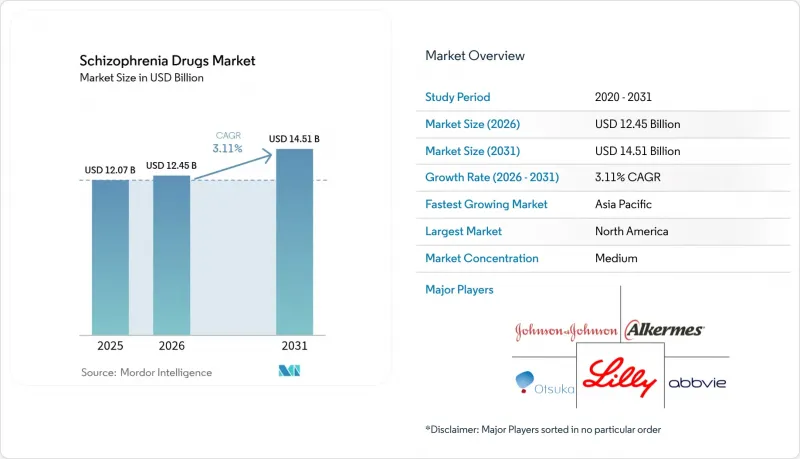
Mordor Intelligence에 의하면, 2026년 세계의 정신분열증 치료제 시장 규모는 124억 5,000만 달러로 추정되며, 2025년 120억 7,000만 달러에서 확대해, 2031년에는 145억 1,000만 달러에 이를 것으로 예측됩니다.
2026-2031년 연평균 성장률(CAGR)은 3.11%를 나타낼 전망입니다.
본 보고서는 치료 분류별(2세대(비정형) 항정신병제 등), 약리 작용기전별(도파민·세로토닌 길항제 등), 치료 형태별(경구제, 지속형 주사제 등), 유통 채널별(병원 약국 등), 지역별(북미, 유럽 등)로 분류되어 있습니다. 시장 전망은 금액(달러) 기준으로 제시되어 있습니다.
세계의 정신분열증 치료제 시장 동향 및 인사이트
전 세계 유병률 증가와 조현병의 조기 진단
2025년에는 전 세계 유병자 수가 2,400만 명에 달한 것으로 평가되었으며, 1차 진료에서의 선별 검사 체계 개선으로 인해 더 많은 환자가 조기에 치료를 시작하게 되었습니다. 조기 개입 프로그램은 일본의 전국적인 EIP 네트워크에서 칠레의 시범 사업에 이르기까지 확산되고 있으며, 전구기를 단축하고 치료 대상 환자층을 확대되고 있습니다. 2024년에는 미국의 경제적 부담이 3,432억 달러에 달한 것으로 평가되었으며, 재발로 인한 입원을 줄여주는 약제에 대한 지불자 수요가 높아지고 있습니다. 호주와 싱가포르의 학술 기관에서는 바이오마커 발견에 도움이 되는 종단적 데이터 세트를 공유하고 있으며, 이러한 움직임으로 인해 조만간 환자군별 처방 패턴이 더욱 정교해질 가능성이 있습니다. 이를 종합해 보면, 유병률 상승과 적극적인 진단이 정신분열증 치료제 시장의 매출 증가를 뒷받침하고 있습니다.
복약 순응도 향상을 위한 지속형 주사제 채택 확대
환자의 최대 절반이 1년 이내에 경구 요법을 중단하고 있지만, 지속형 주사제(LAI)는 치료 실패 위험을 26-45% 줄이고 재입원율을 대폭 낮춥니다. 현재 보험사는 파리페리돈을 3개월마다, 올란자핀을 월 1회, 경구제와 동등한 조건으로 보험 적용하고 있으며, 이로 인해 미국 및 독일의 외래 진료소에서 도입이 촉진되고 있습니다. 2025년에는 중국의 진료 지침에 초발 발병 시 치료 경로에 LAI가 추가되면서 아시아태평양 수요가 확고해졌습니다. 연구 개발의 흐름은 피하 저장 제제로 이동하고 있으며, 테바(Teva)사의 TEV-749는 3상 임상시험에서 92% 이상의 환자 만족도를 달성하여, 편의성이 지속적인 복약 순응도로 이어진다는 점을 시사하고 있습니다. 이러한 동향들이 맞물려, 정신분열증 치료제 시장에서 LAI의 보급률은 꾸준히 확대되고 있습니다.
장기 사용을 제한하는 뿌리 깊은 안전성 우려(대사, 심혈관, 신경학적)
2세대 약물을 복용하는 환자의 최대 60%에서 체중 증가나 혈당 이상이 관찰되며, 이로 인해 심혈관계 사망률이 일반 인구에 비해 2배로 높아집니다. 지연성 운동 이상증이나 대사 증후군에 대한 우려로 인해 빈번하게 약물을 변경하게 되어, 복약 지속률이 저하되고 있습니다. 3세대 분자는 대사 부담을 줄여주지만, 임상의들은 여전히 QT 간격 연장이나 아카시아를 모니터링하고 있어 장기적인 복약 순응 계획을 복잡하게 만들고 있습니다. 이러한 미해결 안전성 문제는 정신분열증 치료제 시장 전체에서 만성 치료의 보급을 저해하고 있습니다.
부문 분석
2세대 의약품은 입증된 효능을 바탕으로 2025년에 정신분열증 치료제 시장의 69.35% 점유율을 차지했습니다. 그러나 3세대 치료제는 7.18%라는 가장 높은 연평균 성장률(CAGR)을 기록하고 있으며, 우수한 대사 프로파일이 보험사 및 의사의 지지를 얻음에 따라 시장 내 침투가 더욱 확대될 것으로 예측됩니다. 현재의 보급 추세가 지속된다면, 3세대 제품에 기인한 정신분열증 치료제 시장 규모는 2031년까지 31억 5,000만 달러를 넘어설 가능성이 있습니다. 1세대 약물은 여전히 비용 제약이 있는 환경에서 사용되고 있지만, 부작용에 대한 우려로 인해 그 사용량은 점차 감소하고 있습니다.
현재 각 개발사들은 무스카린 작용성, TAAR-1 및 글루타메이트 작용성 접근법을 추구하고 있어, 한때 안정적이었던 약물 분류 구조가 세분화되고 있습니다. 바이오마커의 등장과 함께 처방 의사들은 알고리즘에 기반한 약물 선택을 기대하고 있으며, 이로 인해 정신분열증 치료제 시장 내에서 작용기전에 따른 성장 분야가 가속화되고 있습니다.
과거에는 도파민·세로토닌 길항제가 치료를 독점했지만, 부분 작용제 및 신규 조절제가 점유율을 확대한 결과, 2025년 매출에서 차지하는 그 점유율은 79.35% 미만으로 떨어졌습니다. 칼리프라진의 D3 수용체에 대한 선택성은 음성 증상의 완화를 촉진하는 반면, NMDA 조절제는 인지 기능 장애에 대한 희망을 안겨주고 있습니다. 도파민 D2/D3 부분 작용제와 관련된 정신분열증 치료제 시장 규모는 2031년까지 연평균 성장률(CAGR) 6.55%로 확대될 것으로 예측됩니다.
현재 규제 당국은 다양한 작용기전을 가진 파이프라인을 장려하고 있으며, ‘퍼스트-인-클래스(First-in-Class)’ 약물에 대한 패스트 트랙 지정을 신속하게 진행하고 있습니다. 증상의 다양성이 높아짐에 따라, 처방 의사가 증상 군에 맞추어 치료법을 조정할 가능성이 높아지고 있으며, 이는 정신분열증 치료제 시장 내에서의 세분화된 경쟁을 촉진하고 있습니다.
지역별 분석
2025년, 북미는 정신분열증 치료제 시장 매출의 45.05%를 차지했습니다. 이는 높은 진단율, 탄탄한 보험 제도, 그리고 신약의 조기 도입에 힘입은 결과입니다. 또한, 이 지역에서는 주요 임상시험의 대부분이 수행되고 있어 시장 선점 우위가 강화되고 있습니다. 그러나 전문의약품 가격 상승률이 임금 상승률을 상회함에 따라 지불 기관들은 사전 승인 심사를 엄격히 하고 있으며, 이는 향후 판매량 증가를 억제할 가능성이 있습니다.
아시아태평양은 8.17%라는 가장 높은 연평균 성장률(CAGR)을 기록하며, 2031년까지 시장 점유율을 27.35%까지 끌어올릴 것으로 예측됩니다. 그 요인으로는 가처분 소득 증가, 정부의 보험 제도 확충, 그리고 일본과 한국의 조기 개입 프로그램 등이 꼽힙니다. 중국의 대량 조달 정책으로 인해 가격이 대폭 인하되어, 2025년에는 각 성에서 LAI 도입이 가능해질 전망입니다. 뉴론(Neuron)사가 일본 및 한국을 대상으로 에베나미드의 라이선싱을 진행한 것과 같은 전략적 제휴는 현지화가 정신분열증 치료제 시장으로의 침투를 얼마나 가속화할 수 있는지를 보여주고 있습니다.
유럽에서는 국민건강보험 제도와 통합 치료 모델을 배경으로 여전히 큰 시장 규모를 유지하고 있습니다. 독일이 LAI 도입을 주도하는 한편, 스페인의 디지털 처방전 도입으로 처방전 갱신 지연이 18% 감소했습니다. 또한 유럽 대륙에는 유효 성분의 제조 거점이 여러 곳 존재하여, 정신분열증 치료제 시장의 가격 변동 충격을 완화하는 탄탄한 공급망이 구축되어 있습니다.
기타 혜택 :
- 엑셀 형식 시장 예측(ME) 시트
- 3개월간의 애널리스트 지원
자주 묻는 질문
목차
제1장 서론
제2장 조사 방법
제3장 주요 요약
제4장 시장 구도
제5장 시장 규모 및 성장 예측
제6장 경쟁 구도
제7장 시장 기회 및 향후 전망
AJY 26.09.07According to Mordor Intelligence, the global schizophrenia drugs market size in 2026 is estimated at USD 12.45 billion, growing from 2025 value of USD 12.07 billion with 2031 projections showing USD 14.51 billion, growing at 3.11% CAGR over 2026-2031.
This report is Segmented by Therapeutic Class (Second-Generation (Atypical) Antipsychotics, and More), Drug Mechanism of Action (Dopamine-Serotonin Antagonists, and More), Treatment Type (Oral, Long-Acting Injectables, and More), Distribution Channel (Hospital Pharmacies, and More), and Geography (North America, Europe, and More). The Market Forecasts are Provided in Terms of Value (USD).
Global Schizophrenia Drugs Market Trends and Insights
Growing Global Prevalence & Earlier Diagnosis of Schizophrenia
Global prevalence has climbed to 24 million in 2025, and improved screening in primary care means more patients enter treatment earlier. Early intervention programs now stretch from Japan's nationwide EIP network to pilot schemes in Chile, shortening the prodromal phase and enlarging the treated population. The economic burden reached USD 343.2 billion in the United States in 2024, intensifying payer appetite for drugs that cut relapse-driven hospital stays. Academic centers in Australia and Singapore are sharing longitudinal data sets that aid biomarker discovery, a move that may soon refine segment-specific prescribing. Taken together, rising prevalence and proactive diagnosis underpin volume growth for the schizophrenia drugs market.
Rising Adoption of Long-Acting Injectable Formulations for Improved Adherence
Up to half of patients discontinue oral therapy within one year, yet LAIs slash treatment-failure risk by 26-45% and materially lower rehospitalization. Payers now reimburse paliperidone every three months and olanzapine once monthly at parity with oral regimens, bolstering uptake in U.S. and German outpatient clinics. Chinese guidelines added LAIs to first-episode care pathways in 2025, cementing Asia-Pacific demand. R&D momentum is shifting to subcutaneous depots; Teva's TEV-749 delivered >92% patient satisfaction in Phase 3, indicating convenience can translate into sustained adherence. The cumulative effect of these developments is a steady expansion of LAI penetration within the schizophrenia drugs market.
Persistent Safety Concerns (Metabolic, Cardiovascular, Neurological) Limiting Long-Term Use
Up to 60% of patients on second-generation drugs develop weight gain or glucose abnormalities that double cardiovascular mortality versus the general population. Fear of tardive dyskinesia and metabolic syndrome drives frequent switching, eroding persistence rates. While third-generation molecules reduce metabolic load, clinicians still monitor QT prolongation and akathisia, complicating long-term adherence plans. These unresolved safety issues dampen uptake of chronic therapy across the schizophrenia drugs market.
Other drivers and restraints analyzed in the detailed report include:
- Launch of Novel Third-Generation & Multi-Target Agents Expanding Treatment Options
- Expansion of Mental-Health Insurance Coverage & Government Funding Worldwide
- High Stigma & Low Treatment-Seeking Behavior Curtailing Uptake
For complete list of drivers and restraints, kindly check the Table Of Contents.
Segment Analysis
Second-generation medicines captured 69.35% of schizophrenia drugs market share in 2025 on the back of proven efficacy. However, third-generation therapies recorded the fastest 7.18% CAGR and are projected to carve deeper inroads as favorable metabolic profiles resonate with payers and physicians. The schizophrenia drugs market size attributable to third-generation products could top USD 3.15 billion by 2031 if current uptake trends hold. First-generation drugs still serve cost-constrained settings but gradually relinquish volume amid side-effect worries.
Developers now pursue muscarinic, TAAR-1, and glutamatergic avenues, fragmenting the once-stable class landscape. As biomarkers emerge, prescribers anticipate algorithm-guided selection, accelerating mechanism-specific growth nodes inside the schizophrenia drugs market.
Dopamine-serotonin antagonists once monopolized treatment, yet their dominance fell below 79.35% of 2025 revenue as partial agonists and novel modulators gained share. Cariprazine's D3 preference enhances negative-symptom relief, while NMDA modulators offer hope for cognitive deficits. The schizophrenia drugs market size linked to dopamine D2/D3 partial agonists is forecast to rise at 6.55% CAGR through 2031.
Regulators now encourage mechanism-rich pipelines, expediting fast-track designations for first-in-class agents. Greater heterogeneity boosts the likelihood that prescribers tailor regimens to symptom clusters, fostering nuanced competition within the schizophrenia drugs market.
Complete Report Scope:
- By Therapeutic Class
- Second-Generation (Atypical) Antipsychotics
- Third-Generation (D2/D3 Partial Agonists)
- First-Generation (Typical) Antipsychotics
- Other Therapeutic Classes
- By Drug Mechanism of Action
- Dopamine-Serotonin Antagonists
- Dopamine D2/D3 Partial Agonists
- NMDA-Receptor Modulators
- Novel Multi-Target Modulators
- By Treatment Type
- Oral (Tablets, Capsules, Solutions)
- Long-Acting Injectables (Depot)
- Short-Acting Injectables
- Transdermal Patch
- By Distribution Channel
- Hospital Pharmacies
- Retail Pharmacies
- Online Pharmacies
- Geography
- North America
- United States
- Canada
- Mexico
- Europe
- Germany
- United Kingdom
- France
- Italy
- Spain
- Rest of Europe
- Asia-Pacific
- China
- Japan
- India
- South Korea
- Australia
- Rest of Asia-Pacific
- Middle East and Africa
- GCC
- South Africa
- Rest of Middle East and Africa
- South America
- Brazil
- Argentina
- Rest of South America
- North America
Geography Analysis
North America accounted for 45.05% of schizophrenia drugs market revenue in 2025, anchored by high diagnosis, robust insurance, and early adoption of novel agents. The region also fields the majority of pivotal trials, reinforcing first-to-market advantages. However, specialty drug inflation outpaced wage growth, prompting payers to tighten prior-authorizations that could temper future volume growth.
Asia-Pacific posted the fastest 8.17% CAGR and is projected to lift its share to 27.35% by 2031. Drivers include rising disposable income, government insurance expansion, and early-intervention programs in Japan and South Korea. China's bulk-procurement policy slashed prices, enabling provincial roll-outs of LAIs in 2025. Strategic deals, such as Newron's evenamide licenses for Japan and Korea, illustrate how localization accelerates penetration in the schizophrenia drugs market.
Europe retained substantial volume on the back of universal coverage and integrated care models. Germany led LAI adoption, while Spain's digital prescription initiative cut refill gaps by 18%. The continent also houses several manufacturing sites for active pharmaceutical ingredients, offering supply-chain resilience that can buffer price shocks within the schizophrenia drugs market.
- Alkermes plc
- Abbvie
- AstraZeneca
- Eli Lilly and Company
- Johnson & Johnson
- Pfizer
- Sumitomo Dainippon Pharma
- Vanda Pharmaceuticals
- Bristol-Myers Squibb
- Otsuka Pharmaceutical Co.
- Acadia Pharmaceuticals
- Karuna Therapeutics
- H. Lundbeck
- Teva Pharmaceutical Industries
- Dr Reddy's Laboratories
- Sun Pharmaceuticals Industries
- Sunovion Pharmaceuticals
- Amneal Pharmaceuticals
- Lupin
- Aurobindo Pharma
- Takeda Pharmaceuticals
- Sandoz Group
Additional Benefits:
- The market estimate (ME) sheet in Excel format
- 3 months of analyst support
TABLE OF CONTENTS
1 Introduction
- 1.1 Study Assumptions & Market Definition
- 1.2 Scope of the Study
2 Research Methodology
3 Executive Summary
4 Market Landscape
- 4.1 Market Overview
- 4.2 Market Drivers
- 4.2.1 Growing Global Prevalence & Earlier Diagnosis of Schizophrenia
- 4.2.2 Rising Adoption of Long-Acting Injectable Formulations for Improved Adherence
- 4.2.3 Launch of Novel Third-Generation & Multi-Target Agents Expanding Treatment Options
- 4.2.4 Expansion of Mental-Health Insurance Coverage & Government Funding Worldwide
- 4.2.5 Affordable Generics & Public Procurement Programs Enhancing Access in Emerging Markets
- 4.3 Market Restraints
- 4.3.1 Persistent Safety Concerns (Metabolic, Cardiovascular, Neurological) Limiting Long-Term Use
- 4.3.2 High Stigma & Low Treatment-Seeking Behavior Curtailing Uptake
- 4.3.3 Complex Regulatory & Reimbursement Pathways Delaying Launch of Novel Therapies
- 4.3.4 Patent Expiries Triggering Price Erosion & Revenue Decline for Innovator Brands
- 4.4 Supply-Chain Analysis
- 4.5 Porter's Five Forces
- 4.5.1 Bargaining Power of Buyers
- 4.5.2 Bargaining Power of Suppliers
- 4.5.3 Threat of New Entrants
- 4.5.4 Threat of Substitutes
- 4.5.5 Intensity of Competitive Rivalry
5 Market Size & Growth Forecasts (Value, USD)
- 5.1 By Therapeutic Class
- 5.1.1 Second-Generation (Atypical) Antipsychotics
- 5.1.2 Third-Generation (D2/D3 Partial Agonists)
- 5.1.3 First-Generation (Typical) Antipsychotics
- 5.1.4 Other Therapeutic Classes
- 5.2 By Drug Mechanism of Action
- 5.2.1 Dopamine-Serotonin Antagonists
- 5.2.2 Dopamine D2/D3 Partial Agonists
- 5.2.3 NMDA-Receptor Modulators
- 5.2.4 Novel Multi-Target Modulators
- 5.3 By Treatment Type
- 5.3.1 Oral (Tablets, Capsules, Solutions)
- 5.3.2 Long-Acting Injectables (Depot)
- 5.3.3 Short-Acting Injectables
- 5.3.4 Transdermal Patch
- 5.4 By Distribution Channel
- 5.4.1 Hospital Pharmacies
- 5.4.2 Retail Pharmacies
- 5.4.3 Online Pharmacies
- 5.5 Geography
- 5.5.1 North America
- 5.5.1.1 United States
- 5.5.1.2 Canada
- 5.5.1.3 Mexico
- 5.5.2 Europe
- 5.5.2.1 Germany
- 5.5.2.2 United Kingdom
- 5.5.2.3 France
- 5.5.2.4 Italy
- 5.5.2.5 Spain
- 5.5.2.6 Rest of Europe
- 5.5.3 Asia-Pacific
- 5.5.3.1 China
- 5.5.3.2 Japan
- 5.5.3.3 India
- 5.5.3.4 South Korea
- 5.5.3.5 Australia
- 5.5.3.6 Rest of Asia-Pacific
- 5.5.4 Middle East and Africa
- 5.5.4.1 GCC
- 5.5.4.2 South Africa
- 5.5.4.3 Rest of Middle East and Africa
- 5.5.5 South America
- 5.5.5.1 Brazil
- 5.5.5.2 Argentina
- 5.5.5.3 Rest of South America
- 5.5.1 North America
6 Competitive Landscape
- 6.1 Market Concentration
- 6.2 Market Share Analysis
- 6.3 Company Profiles (includes Global level Overview, Market level overview, Core Business Segments, Financials, Headcount, Key Information, Market Rank, Market Share, Products and Services, and analysis of Recent Developments)
- 6.3.1 Alkermes plc
- 6.3.2 AbbVie Inc. (Allergan)
- 6.3.3 AstraZeneca plc
- 6.3.4 Eli Lilly and Company
- 6.3.5 Johnson & Johnson (Janssen)
- 6.3.6 Pfizer Inc.
- 6.3.7 Sumitomo Dainippon Pharma
- 6.3.8 Vanda Pharmaceuticals
- 6.3.9 Bristol-Myers Squibb
- 6.3.10 Otsuka Pharmaceutical Co.
- 6.3.11 Acadia Pharmaceuticals
- 6.3.12 Karuna Therapeutics
- 6.3.13 H. Lundbeck A/S
- 6.3.14 Teva Pharmaceutical Industries
- 6.3.15 Dr Reddy's Laboratories
- 6.3.16 Sun Pharmaceutical
- 6.3.17 Sunovion Pharmaceuticals
- 6.3.18 Amneal Pharmaceuticals
- 6.3.19 Lupin Ltd.
- 6.3.20 Aurobindo Pharma
- 6.3.21 Takeda Pharmaceutical
- 6.3.22 Sandoz AG
7 Market Opportunities & Future Outlook
- 7.1 White-Space & Unmet-Need Assessment


