

|
시장보고서
상품코드
2122858
다낭성 난소 증후군(PCOS) 치료 : 시장 점유율 분석, 업계 동향 및 통계, 성장 예측(2026-2031년)Polycystic Ovarian Syndrome Treatment - Market Share Analysis, Industry Trends & Statistics, Growth Forecasts (2026 - 2031) |
||||||
 Mordor Intelligence
다낭성 난소 증후군(PCOS) 치료 시장 규모는 2025년에 50억 8,000만 달러로 평가되었습니다. 2026년 53억 9,000만 달러에서 2031년까지 72억 4,000만 달러에 이를 것으로 추정되고 예측 기간(2026-2031년) CAGR은 6.07%를 나타낼 전망입니다.

본 보고서는 치료법(약제 분류별 및 외과 수술), 환자 요구(불임 관리 등), 투여 경로(경구 투여 등), 유통 채널(병원 약국 등), 지역(북미, 유럽, 아시아태평양, 중동 및 아프리카, 남미)별로 세분화되어 있습니다. 시장 전망은 금액(달러) 기준으로 제시되어 있습니다.
세계의 다낭성 난소 증후군(PCOS) 치료 시장 동향 및 인사이트
전 세계적으로 증가하는 다낭성 난소 증후군의 질병 부담
새로운 역학 조사에 따르면, 18-35세 도시 여성의 유병률은 17.40%에 달하며, 이는 이전의 세계 추정치인 8-13%를 크게 상회하는 수치입니다. 『Global Burden of Disease 2021』 최신판에 따르면, 1990년부터 2021년에 걸쳐 진단 사례가 89% 증가했으며, 장애 조정 수명년(DALY)도 87% 증가한 것으로 기록되어 있습니다. 현재 의료진은 비만이나 생리 불순을 호소하는 사춘기 환자를 대상으로 일상적으로 선별 검사를 실시하고 있으며, 과거에는 기록되지 않았던 경미한 사례도 파악할 수 있게 되었습니다. 경제적 부담은 더 이상 불임 치료에만 그치지 않고, 이차적인 당뇨병이나 심혈관 질환, 생산성 저하가 의료 예산에 점점 더 큰 부담을 주고 있습니다. 그 결과, 인도, 사우디아라비아, 필리핀의 각 보건부는 PCOS(다낭성 난소 증후군)에 관한 모듈을 국가 비전염성 질환 프로그램에 포함시켜, 통합적인 해결책에 대한 장기적인 수요를 확고히 하고 있습니다.
여성의 대사 건강에 대한 관심 증가
PCOS 환자의 적어도 절반이 인슐린 저항성을 보이는 만큼, 치료의 초점은 순수한 생식 관련 목표에서 장기적인 심혈관 및 대사 건강 보호로 전환되고 있습니다. 48주간의 직접 비교 임상시험에서 세마글루티드 2.4mg은 메트포르민 군의 5.7%에 비해 평균 12.3%의 체중 감소를 가져왔을 뿐만 아니라, 유리 테스토스테론도 34% 억제했습니다. GLP-1, GIP, 글루카곤 경로를 자극하는 3가지 작용을 겸비한 인크레틴 작용제는 현재 2상 임상시험 단계에 있으며, 내장 지방 감소 및 배란 기능 회복에 대한 시너지 효과가 기대되고 있습니다. 독일과 호주의 보험 당국은 최근 PCOS를 ‘고위험 당뇨병 전단계’로 분류하고, 보다 조기적인 대사 약물 요법을 승인했습니다.
PCOS에 특화된 FDA 승인 치료제의 부재
PCOS에 대해 공식적으로 승인된 약물이 없기 때문에 임상의들은 당뇨병, 피임, 체중 감량 등의 적응증에 의존할 수밖에 없으며, 번거로운 사전 승인 절차라는 장벽이 존재합니다. 미국 환자의 83%는 GLP-1 치료를 받기 전에 적어도 한 번은 승인 거부를 경험한 바 있습니다. 임상시험 설계는 표현형의 이질성으로 인해 복잡해지고 있으며, 복합 평가 지표에 대한 합의 형성이 지연되고 있습니다. 최근 FDA의 지침 초안을 통해 명확성이 확보되고는 있지만, 정식 승인까지 아직 수년이 소요될 것으로 예상되어 상용화 주기가 장기화되고, 단기적인 수익 창출이 억제되고 있습니다.
부문별 분석
2025년, 다낭성 난소 증후군(PCOS) 치료 시장에서 의약품은 56.92%의 점유율을 차지하며, 높은 처방 갱신율과 광범위한 보험 적용 범위를 바탕으로 수익 기반을 다졌습니다. 복합 경구 피임약, 메트포르민, 그리고 1세대 GLP-1 제제가 보험 적용 목록을 주도하고 있으며, 선택적 세로토닌 재흡수 억제제(SSRI)는 환자의 68%에서 동반된 불안 및 우울증 치료에 사용되고 있습니다. 생명공학 기업들이 안드로겐 수용체 분해제 및 과립막 세포 조절제 임상시험을 진행함에 따라 파이프라인의 다양성이 확대되고 있습니다. 현재 2상 임상시험 중인 차세대 인크레틴 삼중 작용제가 배란 관련 평가 지표를 발표할 경우, 경쟁은 더욱 치열해질 전망입니다.
외과적 및 기기 기반 치료법은 규모는 작지만, 저침습적 난소 천자 및 새롭게 등장한 전기열 절제 플랫폼에 힘입어 연평균 성장률(CAGR) 8.43%로 확대되고 있습니다. REBALANCE 임상시험에서는 May Health사의 카테터형 기기가 검증되고 있습니다. 이 기기는 초음파 유도 하에 1초 미만의 고주파 펄스를 조사하는 것으로, 복강경 수술에 비해 유착 위험을 줄일 가능성이 있습니다. 12개월간의 배란 데이터가 뒷받침된다면, 보험사는 클로미펜 내성 환자군에서 비용이 많이 드는 약물 요법의 반복보다 먼저 기기 요법의 위치를 재조정하고, 보험 급여 우선순위를 재구성할 가능성이 있습니다.
2025년에는 불임 치료 관리 비용이 환자 부담액의 54.88%를 차지했습니다. 이는 다낭성 난소 증후군(PCOS)으로 인한 무배란성 불임의 비율이 높다는 점과, 배란 유도제 및 보조생식기술(ART) 서비스에 대한 수요가 활발하다는 점을 반영합니다. 35세 미만 여성의 경우, 인슐린 감수성 개선제나 황체기 지원을 정확하게 반영한 맞춤형 자극 프로토콜을 채택할 경우, 출산율은 60%를 초과합니다. 현재 클리닉에서는 내분비학, 영양학, 배아 관련 서비스를 결합한 패키지를 판매하여 환자 1인당 수익을 확대되고 있습니다.
미용 목적 및 다모증, 여드름, 탈모증을 포함한 고안드로겐증 완화에 대한 수요는 2위를 차지하며, 연평균 성장률(CAGR) 8.69%로 가장 빠르게 성장할 것으로 예측됩니다. 환자 보고 결과(PRO)에 따르면, 정상 배란형인 경우에도 지속적인 고통이 확인되고 있으며, 이는 외용 항안드로겐제, 다이오드 레이저 제모 시스템 및 피부과 원격 진료의 이용 확대를 뒷받침하고 있습니다. 디지털 헬스 플랫폼에는 사진 기반 경과 추적 기능과 호르몬 대시보드가 통합되어 있어, 사용자에게 측정 가능한 진척 지표를 제공함으로써 불임 치료를 중심으로 한 기간을 넘어 구독 유지율을 높이고 있습니다.
지역별 분석
북미는 진단 검사에 대한 광범위한 보험 적용, 성숙한 불임 치료 인프라, 그리고 활발한 임상시험 활동에 힘입어 2025년에는 41.98%의 점유율로 1위를 차지했습니다. 미국은 지역 매출의 80% 이상을 차지하고 있지만, 사전 승인 절차의 장벽으로 인해 GLP-1 제제의 투여 시작이 중앙값 기준으로 37일 지연되고 있습니다. 캐나다가 최근 혈관운동 증상에 대한 페졸리네탄의 승인을 내린 것은 갱년기 및 대사 관련 평가 지표에 대해 규제 당국이 긍정적인 태도를 보이고 있음을 나타내며, 향후 PCOS 적응증 신청을 위한 선례가 될 것입니다.
아시아태평양은 도시 지역의 높은 유병률, 가처분 소득 증가, 그리고 충족되지 않은 불임 치료 수요를 배경으로 연평균 성장률(CAGR) 7.44%를 기록하며 가장 빠르게 성장하고 있는 지역입니다. 인도의 대도시권 조사에서는 20-29세 여성의 유병률이 17.40%인 것으로 보고되었으며, 이에 따라 연방 보건 센터에서는 산전 검진 시 PCOS(다낭성 난소 증후군)에 대한 보편적 선별 검사를 도입하고 있습니다. 아세안 의약품 실무그룹(Pharmaceutical Product Working Group)에 의한 규제 조화는 국경을 초월한 의약품 출시를 용이하게 하고 있으며, 한편 중국의 ‘세 자녀 정책’ 완화는 생식 의료 서비스 이용 확대로 이어지고 있습니다.
유럽에서는 보편적 의료 보장(UHC)과 견고한 전문의 네트워크 덕분에 한 자릿수 중반대의 꾸준한 성장이 예상됩니다. 각국의 제도에서 질병 진행 초기 단계의 대사 중재에 대한 보험 적용이 확대되고 있으며, 독일의 법정 건강보험 기관은 2025년에 PCOS에 대한 비만 치료제로 세마글루타이드를 급여 대상 목록에 추가했습니다. 스칸디나비아 국가들의 등록 데이터에서 얻은 실세계 데이터가 안전 당국에 제공되어 병용 요법의 첨부 문서 갱신이 가속화되고 있습니다.
중동 및 아프리카에서는 유병률이 급격히 상승하고 있습니다(1990년부터 2019년 사이 연령 조정 유병률은 37.9% 증가했습니다). 그러나 보험 환급 제도의 불균일성과 전문의 부족으로 인해 치료의 보급은 여전히 제한적입니다. 사우디아라비아에서 시행되고 있는 텔레엔도크리놀로지(원격 내분비 진료) 시범 프로그램에서는 내원 시간이 60% 단축되었으며, 이는 디지털 케어가 의료시설 부족이라는 한계를 뛰어넘어 문제를 해결할 가능성이 있음을 시사합니다. 남미에서는 이에 대한 인식이 높아지고 있습니다. 브라질 순환기학회에서는 현재 PCOS를 위험 증대 요인으로 분류하고 있으며, 이를 통해 지질 프로파일 검사의 보험 적용 및 대사 스크리닝이 촉진되고 있습니다.
기타 혜택 :
- 엑셀 형식 시장 예측(ME) 시트
- 3개월간의 애널리스트 지원
자주 묻는 질문
목차
제1장 서론
제2장 조사 방법
제3장 주요 요약
제4장 시장 구도
제5장 시장 규모 및 성장 예측
제6장 경쟁 구도
제7장 시장 기회 및 향후 전망
KTH 26.09.08According to Mordor Intelligence, the polycystic ovarian syndrome treatment market size was valued at USD 5.08 billion in 2025 and estimated to grow from USD 5.39 billion in 2026 to reach USD 7.24 billion by 2031, at a CAGR of 6.07% during the forecast period (2026-2031).
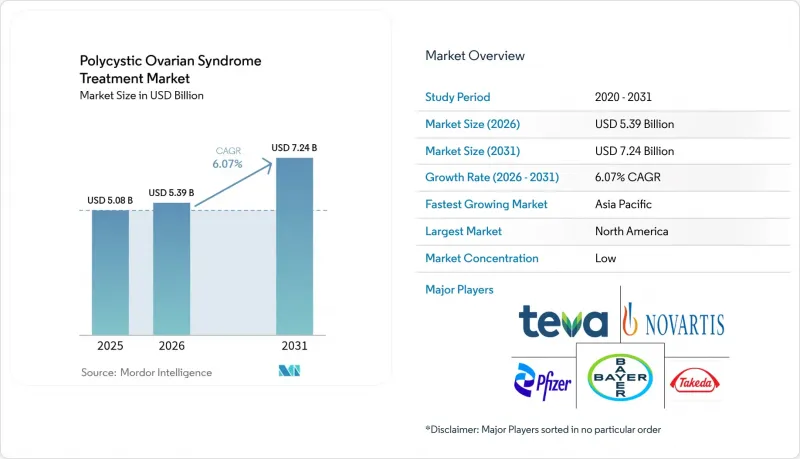
This report is Segmented by Treatment (Drug Class and Surgery), Patient Need (Fertility Management, and More), Route of Administration (Oral, and More), Distribution Channel (Hospital Pharmacies, and More), Geography (North America, Europe, Asia-Pacific, The Middle East and Africa, and South America). The Market Forecasts are Provided in Terms of Value (USD).
Global Polycystic Ovarian Syndrome Treatment Market Trends and Insights
Rising Global Burden of Polycystic Ovary Syndrome
New epidemiological surveys report prevalence as high as 17.40% among urban women aged 18-35, far above earlier global estimates of 8-13%. The Global Burden of Disease 2021 update logged an 89% rise in diagnosed cases between 1990 and 2021, with disability-adjusted life years up 87%. Providers now routinely screen adolescents presenting with obesity or irregular cycles, capturing milder phenotypes that once went unrecorded. Economic drag is no longer limited to infertility treatments; downstream diabetes, cardiovascular events, and lost productivity place mounting strain on health budgets. As a result, ministries of health in India, Saudi Arabia, and the Philippines are embedding PCOS modules into national non-communicable disease programs, anchoring long-term demand for integrated solutions.
Growing Focus on Women's Metabolic Health
Insulin resistance afflicts at least half of all PCOS patients, prompting a pivot from purely reproductive goals to long-run cardiometabolic safeguarding. Semaglutide 2.4 mg produced 12.3% mean weight loss versus 5.7% with metformin in a 48-week head-to-head study, while also curbing free testosterone by 34%. Three-in-one incretin agonists that stimulate GLP-1, GIP, and glucagon pathways are in Phase II, promising additive effects on visceral fat and ovulatory recovery. Payers in Germany and Australia recently classified PCOS as a high-risk pre-diabetes state, green-lighting earlier metabolic pharmacotherapy.
Lack of PCOS-Specific FDA-Approved Therapeutics
With no drug formally labelled for PCOS, clinicians lean on diabetes, contraceptive, and weight-loss indications, setting up cumbersome prior-authorization hurdles: 83% of US patients confront at least one rejection before receiving GLP-1 therapy. Trial design is complicated by heterogeneous phenotypes, making agreement on composite endpoints slow. Although recent FDA draft guidance provides clarity, full approvals remain several years away, elongating commercialization cycles and tempering short-term revenue capture.
Other drivers and restraints analyzed in the detailed report include:
- Expansion of Fertility Services and Assisted-Reproduction Clinics
- Advances in Endocrine and Metabolic Drug Development
- Safety Concerns With Long-Term Hormonal Therapy
For complete list of drivers and restraints, kindly check the Table Of Contents.
Segment Analysis
Drugs captured 56.92% of the Polycystic Ovarian Syndrome Treatment market in 2025, anchoring revenue through high prescription renewal rates and broad insurance familiarity. Combined oral contraceptives, metformin, and the first wave of GLP-1s dominate formularies, with selective serotonin-reuptake inhibitors addressing comorbid anxiety and depression in 68% of patients. Pipeline diversity is widening as biotechs test androgen receptor degraders and granulosa-cell modulators. Competitive intensity should rise once next-generation incretin tri-agonists, now in Phase II, publish ovulation endpoints.
Surgical and device-based interventions are expanding at an 8.43% CAGR, albeit from a smaller base, driven by minimally invasive ovarian drilling and emerging electrothermal ablation platforms. The REBALANCE study investigates May Health's catheter-based device, which applies sub-second radiofrequency bursts under ultrasound guidance, potentially reducing adhesion risk versus laparoscopy. Should 12-month ovulation data hold, payors may reposition device therapy ahead of costly repeat pharmacological cycles in clomiphene-resistant cohorts, reshaping reimbursement hierarchies.
Fertility management commanded 54.88% of patient expenditure in 2025, reflecting the high share of anovulatory infertility attributable to PCOS and strong demand for ovulation-induction agents and assisted reproduction services. Live-birth rates surpass 60% in women under 35 when individualized stimulation protocols incorporate insulin sensitizers and time-luteal support precisely. Clinics now market bundled packages that weave endocrinology, nutrition, and embryo services, elongating revenue per patient.
Demand for cosmetic and hyperandrogenism relief-covering hirsutism, acne, alopecia-ranks second and will grow fastest at 8.69% CAGR. Patient-reported outcomes reveal sustained distress even in normo-ovulatory phenotypes, spurring uptake of topical anti-androgens, diode-laser hair systems, and dermatology teleconsults. Digital health platforms embed photo-tracking and hormonal dashboards, giving users measurable progress indicators and driving subscription retention beyond fertility-centric windows.
Complete Report Scope:
- By Treatment
- Drug Class
- Hormonal Contraceptives
- Insulin-Sensitizing Agents
- Anti-Depressants
- Anti-Obesity Agents
- Other Drug Classes
- Surgery
- Ovarian Wedge Resection
- Laparoscopic Ovarian Drilling
- Other Surgeries
- Drug Class
- By Patient Need
- Fertility Management
- Metabolic / Weight Management
- Cosmetic / Hyper-androgenism Relief
- By Route of Administration
- Oral
- Injectable
- Implantable
- Transdermal
- By Distribution Channel
- Hospital Pharmacies
- Retail Pharmacies
- Online Pharmacies & DTC Platforms
- Geography
- North America
- United States
- Canada
- Mexico
- Europe
- Germany
- United Kingdom
- France
- Italy
- Spain
- Rest of Europe
- Asia-Pacific
- China
- Japan
- India
- Australia
- South Korea
- Rest of Asia-Pacific
- Middle East & Africa
- GCC
- South Africa
- Rest of Middle East & Africa
- South America
- Brazil
- Argentina
- Rest of South America
- North America
Geography Analysis
North America led with 41.98% share in 2025, fueled by broad insurance coverage for diagnostic workups, mature fertility infrastructure, and extensive clinical-trial activity. The United States accounted for more than 80% of regional revenue, although prior-authorization hurdles delay GLP-1 starts by a median 37 days. Canada's recent approval of fezolinetant for vasomotor symptoms signals a regulator receptive to menopausal and metabolic endpoints, setting a precedent for future PCOS-label applications.
Asia-Pacific is the fastest-growing territory at 7.44% CAGR, underpinned by higher urban prevalence, rising disposable income, and large unmet fertility demand. Indian metropolitan studies document 17.40% prevalence in women aged 20-29, spurring federal health centers to adopt universal PCOS screening during antenatal visits. Regulatory harmonization under ASEAN's Pharmaceutical Product Working Group eases cross-border drug launches, while China's relaxation of the three-child policy expands reproductive-service enrolments.
Europe delivers steady mid-single-digit gains thanks to universal health coverage and robust specialist networks. National frameworks increasingly reimburse metabolic interventions earlier in the disease course, with Germany's statutory insurers adding semaglutide to the obesity benefit list for PCOS in 2025. Real-world data from Scandinavian registries feed safety authorities, accelerating label updates for combination therapies.
The Middle East and Africa display sharp prevalence spikes-age-standardized rates rose 37.9% between 1990 and 2019-yet therapeutic uptake remains limited by fragmented reimbursement and specialist scarcity. Pilot tele-endocrinology programs in Saudi Arabia reduce travel times by 60%, indicating digital care may leapfrog facility shortages. South American awareness is climbing: Brazilian cardiovascular societies now classify PCOS as a risk enhancer, prompting lipid-panel reimbursement and metabolic screening.
- Abbott Laboratories
- Abbvie
- Addex Therapeutics
- AstraZeneca
- Bayer
- BIOCAD
- Bristol-Myers Squibb
- Crinetics Pharmaceuticals
- EffRx Inc.
- Ferring Pharmaceuticals
- Johnson & Johnson
- Merck
- Mylan
- Neurocrine Biosciences
- Novartis
- Pfizer
- Sanofi
- Shire PLC (Takeda)
- Takeda Pharmaceuticals
- Teva Pharmaceutical Industries
- Organon
- Gedeon Richter PLC
- Novo Nordisk
Additional Benefits:
- The market estimate (ME) sheet in Excel format
- 3 months of analyst support
TABLE OF CONTENTS
1 Introduction
- 1.1 Study Assumptions & Market Definition
- 1.2 Scope of the Study
2 Research Methodology
3 Executive Summary
4 Market Landscape
- 4.1 Market Overview
- 4.2 Market Drivers
- 4.2.1 Rising Global Burden of Polycystic Ovary Syndrome
- 4.2.2 Increasing Adoption of Hormonal Contraceptives For Symptom Management
- 4.2.3 Growing Focus on Women's Metabolic Health
- 4.2.4 Expansion of Fertility Services And Assisted Reproduction Clinics
- 4.2.5 Advances in Endocrine and Metabolic Drug Development
- 4.2.6 Government-Led Awareness and Screening Programs
- 4.3 Market Restraints
- 4.3.1 Lack of Pcos-Specific Fda Approved Therapeutics
- 4.3.2 Safety Concerns With Long-Term Hormonal Therapy
- 4.3.3 High Out-Of-Pocket Costs For Infertility Treatments
- 4.3.4 Limited Access to Specialist Care in Emerging Markets
- 4.4 Regulatory Landscape
- 4.5 Porter's Five Forces Analysis
- 4.5.1 Threat of New Entrants
- 4.5.2 Bargaining Power of Buyers
- 4.5.3 Bargaining Power of Suppliers
- 4.5.4 Threat of Substitutes
- 4.5.5 Competitive Rivalry
5 Market Size & Growth Forecasts (Value, USD)
- 5.1 By Treatment
- 5.1.1 Drug Class
- 5.1.1.1 Hormonal Contraceptives
- 5.1.1.2 Insulin-Sensitizing Agents
- 5.1.1.3 Anti-Depressants
- 5.1.1.4 Anti-Obesity Agents
- 5.1.1.5 Other Drug Classes
- 5.1.2 Surgery
- 5.1.2.1 Ovarian Wedge Resection
- 5.1.2.2 Laparoscopic Ovarian Drilling
- 5.1.2.3 Other Surgeries
- 5.1.1 Drug Class
- 5.2 By Patient Need
- 5.2.1 Fertility Management
- 5.2.2 Metabolic / Weight Management
- 5.2.3 Cosmetic / Hyper-androgenism Relief
- 5.3 By Route of Administration
- 5.3.1 Oral
- 5.3.2 Injectable
- 5.3.3 Implantable
- 5.3.4 Transdermal
- 5.4 By Distribution Channel
- 5.4.1 Hospital Pharmacies
- 5.4.2 Retail Pharmacies
- 5.4.3 Online Pharmacies & DTC Platforms
- 5.5 Geography
- 5.5.1 North America
- 5.5.1.1 United States
- 5.5.1.2 Canada
- 5.5.1.3 Mexico
- 5.5.2 Europe
- 5.5.2.1 Germany
- 5.5.2.2 United Kingdom
- 5.5.2.3 France
- 5.5.2.4 Italy
- 5.5.2.5 Spain
- 5.5.2.6 Rest of Europe
- 5.5.3 Asia-Pacific
- 5.5.3.1 China
- 5.5.3.2 Japan
- 5.5.3.3 India
- 5.5.3.4 Australia
- 5.5.3.5 South Korea
- 5.5.3.6 Rest of Asia-Pacific
- 5.5.4 Middle East & Africa
- 5.5.4.1 GCC
- 5.5.4.2 South Africa
- 5.5.4.3 Rest of Middle East & Africa
- 5.5.5 South America
- 5.5.5.1 Brazil
- 5.5.5.2 Argentina
- 5.5.5.3 Rest of South America
- 5.5.1 North America
6 Competitive Landscape
- 6.1 Market Concentration
- 6.2 Market Share Analysis
- 6.3 Company Profiles (includes Global level Overview, Market level Overview, Core Segments, Financials as available, Strategic Information, Market Rank/Share for key companies, Products & Services, and Recent Developments)
- 6.3.1 Abbott Laboratories
- 6.3.2 AbbVie Plc
- 6.3.3 Addex Therapeutics Ltd.
- 6.3.4 AstraZeneca PLC
- 6.3.5 Bayer AG
- 6.3.6 BIOCAD
- 6.3.7 Bristol-Myers Squibb Co.
- 6.3.8 Crinetics Pharmaceuticals
- 6.3.9 EffRx Inc.
- 6.3.10 Ferring BV
- 6.3.11 Johnson & Johnson
- 6.3.12 Merck KGaA
- 6.3.13 Mylan N.V.
- 6.3.14 Neurocrine Biosciences Inc.
- 6.3.15 Novartis International AG
- 6.3.16 Pfizer Inc.
- 6.3.17 Sanofi SA
- 6.3.18 Shire PLC (Takeda)
- 6.3.19 Takeda Pharmaceutical Co. Ltd.
- 6.3.20 Teva Pharmaceutical Industries Ltd.
- 6.3.21 Organon & Co.
- 6.3.22 Gedeon Richter PLC
- 6.3.23 Novo Nordisk A/S
7 Market Opportunities & Future Outlook
- 7.1 White-space & Unmet-Need Assessment


