

|
시장보고서
상품코드
2122862
소아용 백신 시장 : 시장 점유율 분석, 업계 동향 및 통계, 성장 예측(2026-2031년)Pediatric Vaccines - Market Share Analysis, Industry Trends & Statistics, Growth Forecasts (2026 - 2031) |
||||||
 Mordor Intelligence
Mordor Intelligence에 의하면, 소아용 백신 시장 규모는 2025년에 402억 4,000만 달러로 평가되었고, 2026년 425억 3,000만 달러로 추정되며, 2031년까지 560억 6,000만 달러에 이를 것으로 예측됩니다.
예측 기간(2026-2031년) 동안 연평균 성장률(CAGR)은 5.68%가 될 것으로 전망됩니다.
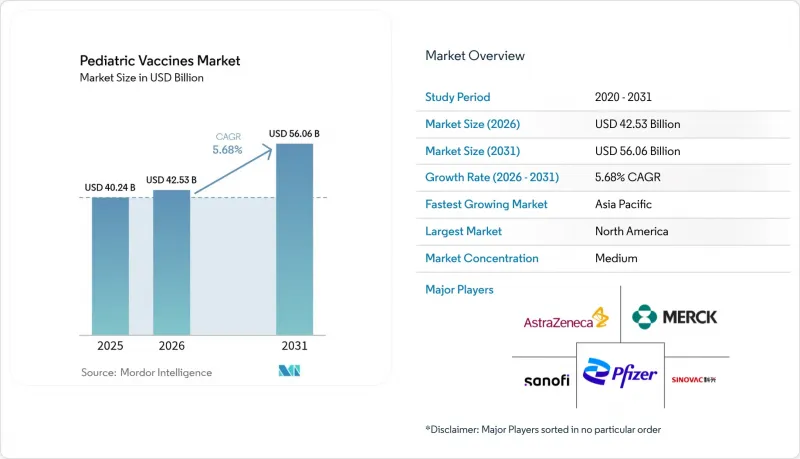
본 보고서는 백신의 가수별(단가 및 다가), 기술 플랫폼별(약독 생백신, 불활성화 백신, 독소이드 등), 적응증별(DTP(디프테리아·파상풍·백일해), 폐렴구균 감염증 등), 유통 채널별(공공·민간), 지역별(북미, 유럽, 아시아태평양 등)로 분류되어 있습니다. 시장 규모 및 전망은 금액(달러) 기준으로 제시되어 있습니다.
세계의 소아용 백신 시장 동향 및 인사이트
백신으로 예방 가능한 질병의 부담 증가와 예방접종에 대한 인식 제고
홍역 집단 발생은 면역 격차의 확대를 여실히 보여주고 있으며, 베트남에서는 2025년에 8만 1,691건의 의심 사례가 보고되어 2020년 이후 최고치를 기록했습니다. 사하라 이남 아프리카 각지에서도 백일해와 수두의 유사한 급증 현상이 나타나고 있어, 긴급 추가 접종 캠페인이 실시되고 있습니다. 이에 따라 단기적인 조달량 급증은 물론, 정기 예방접종 일정을 강화하기 위한 장기적인 노력도 진행되고 있습니다. 마찬가지로, 소아 인플루엔자 사망률은 여전히 정책적 초점이며, 각국 기관은 계절성 백신 접종에 대한 인식 제고 활동을 강화하는 한편, 면역원성이 높은 보조제 함유 제제나 세포 유래 제제로의 전환을 추진하고 있습니다. 이러한 역학적 압박은 콜드체인 구축을 위한 투자를 촉진하는 한편, 개별 접종 완료 현황을 추적하고 미완료자를 실시간으로 식별할 수 있는 진료 현장의 디지털 등록 시스템 도입을 뒷받침하고 있습니다. 이러한 조치들이 맞물려 편의성을 중시한 복합 제제에 대한 수요를 확대시키고, 신규 항원 승인 절차의 가속화를 촉진하고 있습니다.
소아용 백신 연구 개발 및 조달을 위한 정부·NGO의 자금 지원 확대
‘프로젝트 넥스트젠(Project NextGen)’은 소아 대상 평가 단계에 있는 점막 백신 및 범코로나바이러스 백신 후보에 50억 달러를 투입하고 있으며, 획기적인 예방법에 대한 연방 정부의 장기적인 노력을 보여주고 있습니다. 이와 병행하여, 가비(Gavi)의 2026-2030년 전략에서는 최소 90억 달러의 신규 기부금 모금을 목표로 하고 있으며, 생산의 현지화를 도모하기 위해 ‘아프리카 백신 제조 촉진 프로그램’에 12억 달러를 배정하고 있습니다. 접근성 측면에서는 미국의 ‘소아용 백신 프로그램(VFC)’이 본인 부담 비용을 확실히 해소하고, 기초 공급량을 안정화시키며, 제조업체를 수요의 급격한 변동으로부터 보호하고 있습니다. 이러한 다층적인 자금 조달 체계는 혁신의 위험을 경감하고 투자 회수 기간을 단축하는 동시에, 소아의 미충족 의료 수요를 대상으로 한 다양화된 후기 개발 단계 파이프라인의 유지에 기여하고 있습니다.
어린이 1인당 완전한 예방접종 일정에 드는 고액 비용
CDC는 현재 2세까지 36회, 18세까지 70회 이상의 접종을 권장하고 있으며, 동료 심사를 거친 분석에 따르면 이는 1인당 공공 부문 비용 약 1,452달러, 민간 부문 지출 2,012달러에 해당합니다. 최근 Gavi의 지원에서 벗어난 중소득 국가들은 정가가 국내 구매력을 초과하는 반면, 기부자들의 지원이 축소되고 있어 그 부담을 가장 심각하게 느끼고 있습니다. 혼합 백신은 지출을 어느 정도 경감시키지만, mRNA와 같은 새로운 플랫폼은 첨단 바이오프로세스 및 유통에 드는 간접비 때문에 여전히 고가입니다. 그 결과, 조달 기관들은 예산 한도를 초과하지 않으면서 접종률을 유지하기 위해 성과 연계형 계약이나 공동 사전 구매 계약의 시범 도입을 추진하고 있습니다.
부문 분석
2025년에는 다가 제제가 소아용 백신 시장 매출의 61.83%를 차지한 것으로 나타났으며, 1회 주사로 여러 항원을 투여함으로써 의료 시스템이 뚜렷한 효율성을 실현하고 있는 것으로 나타났습니다. 이 부문은 물류 간소화, 병원 방문 횟수 감소, 보호자의 수용성 향상과 같은 이점을 누리고 있으며, 이 모든 요소가 접종 누락률 감소로 이어져 지속적인 집단 면역 유지에 기여하고 있습니다.
단가 제제에 대한 수요는 여전히 견조하며, 단일 항원 부스터, 신속한 집단 감염 억제, 면역 결핍 아동에 대한 예방 접종과 같은 틈새 용도가 등장함에 따라 2031년까지 연평균 성장률(CAGR) 6.35%를 나타낼 것으로 예측됩니다. MIT의 서방형 미립자 기술과 같은 혁신 기술은 별도의 용량을 한 번의 주사에 통합함으로써 단일 항원 접근법과 다중 항원 접근법의 경계를 모호하게 만들 가능성을 내포하고 있습니다. 국가 예방접종 일정이 임산부용 RSV 백신 및 수막구균 백신의 보호 범위 확대를 포함하도록 확충됨에 따라, 소아용 백신 시장은 편의성을 중시한 다가 백신의 보급과 특정 역학적 격차를 해소하기 위한 표적형 단가 백신의 개입 사이에서 균형을 계속 유지해 나갈 것입니다.
결합형 백신은 캡시드를 가진 세균에 대한 20년에 걸친 임상 실적과 거의 모든 생후 1년 차 예방접종 일정에 포함되어 있다는 점을 바탕으로, 2025년에도 매출액 기준 35.82%의 선두 자리를 유지했습니다. 이 우위가 당장 약화될 가능성은 낮지만, 그럼에도 불구하고 각 제약사가 고수율 발현 시스템과 확장 가능한 바이오리액터를 활용하여 전 세계적으로 급증하는 수요에 대응하고 있기 때문에 재조합 기술은 연평균 성장률(CAGR) 6.31%라는 가장 빠른 속도로 발전하고 있습니다.
사노피의 PCV21과 같은 다가 백신이 3상 임상시험을 완료하고 입찰 주기에 접어들면, 재조합 백신 후보의 소아용 백신 시장 규모는 대폭 확대될 것으로 예측됩니다. 동시에, 다가 mRNA-DTP 프로토타입은 백일해에 대한 면역력 저하 문제를 해결하기 위해 재조합 플랫폼과 핵산 플랫폼이 어떻게 연계될 수 있는지를 보여주고 있습니다. 이러한 융합을 통해 제품 포트폴리오의 갱신 속도가 가속화되며, 중견 제약사들에게 기존 소수의 기업이 지배해 온 복잡한 항원 시장에 진입할 수 있는 비용 효율적인 경로가 열릴 것입니다.
지역별 분석
북미는 2025년, 견실한 보험 환급 제도, 엄격한 취학 요건, 그리고 GSK사의 5가 수막구균 백신 및 머크사의 VAXNEUVANCE의 소아 적응증 등 FDA의 지속적인 승인을 바탕으로 전 세계 매출의 38.72%를 차지했습니다. 그러나 이 지역에서는 접종률 기준치를 위협하는 국지적인 백신 접종 기피 현상이 나타나고 있어, 접종률을 유지하기 위해 새로운 디지털 알림 캠페인과 약사 주도의 접종 프로그램이 도입되고 있습니다. 북미 소아용 백신 시장 규모는 다중 병원체 후보 백신을 개발하는 국내 제조업체의 기술적 위험을 줄여주는 ‘프로젝트 넥스트젠(Project NextGen)’의 자금 지원에 힘입어 더욱 견고해지고 있습니다.
아시아태평양은 2031년까지 6.46%라는 가장 높은 연평균 성장률(CAGR)을 나타낼 전망입니다. 그 요인으로는 대규모 출생 코호트, 가처분 소득 증가, 그리고 2023년까지 부스터 접종률이 83%에 달한 인도의 폐렴구균 결합형 백신의 확대와 같은 국가적 전개가 꼽힙니다. 그러나 인프라 격차와 감염병의 재유행은 여전히 시급한 과제로 남아 있습니다. 베트남과 인근 국가들에서 홍역이 급증함에 따라 긴급 백신 비축 및 신속한 입찰 절차가 촉진되었습니다. APEC과 같은 지역 기구들은 코로나19로 인한 혼란 속에서 예방접종을 받지 못한 2,300만 명의 어린이들에게 백신을 접종하는 것을 목표로 하는 10개년 계획을 채택했으며, 이는 급성장하는 경제권에서 소아용 백신 시장의 모멘텀이 지속되고 있음을 보여줍니다.
유럽은 여전히 큰 시장 점유율을 유지하고 있으며, 그 배경에는 조화로운 접근을 신속하게 하는 유럽위원회의 집중형 판매 승인 절차가 있습니다. 최근 승인된 화이자의 ‘PREVENAR 20’은 영유아 및 청소년에게 역대 가장 광범위한 폐렴구균 혈청형 커버리지를 제공하며, 회원국 전반에 걸쳐 결합형 백신의 보급을 공고히 하고 있습니다. 그러나 일부 경제권에서는 예산 상한선으로 인해 가치 기반 조달에 대한 관심이 높아지고 있으며, 상환에 대한 검토는 실제 환경에서의 유효성 데이터와 점점 더 밀접하게 연계되고 있습니다.
중동 및 아프리카 및 남미에서는 상황이 제각각입니다. 아프리카 연합(AU)의 일부 회원국은 Gavi의 공동 자금 조달을 활용하여 ‘아프리카 백신 제조 가속화 이니셔티브(African Vaccine Manufacturing Accelerator)’ 하에서 현지 생산 체계 구축을 추진하고 있는 반면,페루 및 인근 시장에서는 팬데믹 기간 동안 떨어진 아동 정기 예방접종률 회복에 주력하고 있습니다. 전반적으로 자금 조달 및 인프라의 편차로 인해 성장률은 세계 평균에 미치지 못할 전망이지만, 표적화된 기부자 주도 노력, 기술 이전 협정, 콜드체인의 현대화를 통해 이들 지역의 소아용 백신 시장은 점차 개선될 것으로 예측됩니다.
기타 혜택 :
- 엑셀 형식 시장 예측(ME) 시트
- 3개월간의 애널리스트 지원
자주 묻는 질문
목차
제1장 서론
제2장 조사 방법
제3장 주요 요약
제4장 시장 구도
제5장 시장 규모 및 성장 예측
제6장 경쟁 구도
제7장 시장 기회 및 향후 전망
AJY 26.09.07According to Mordor Intelligence, the pediatric vaccines market size was valued at USD 40.24 billion in 2025 and estimated to grow from USD 42.53 billion in 2026 to reach USD 56.06 billion by 2031, at a CAGR of 5.68% during the forecast period (2026-2031).
This report is Segmented by Vaccine Valence (Monovalent and Multivalent), Technology Platform (Live Attenuated, Inactivated, Toxoid, and More), Indication (DTP (Diphtheria-Tetanus-Pertussis), Pneumococcal Disease, and More), Distribution Channel (Public and Private), and Geography (North America, Europe, Asia-Pacific, and More). The Market and Forecasts are Provided in Terms of Value (USD).
Global Pediatric Vaccines Market Trends and Insights
Rising burden of vaccine-preventable diseases & growing immunization awareness
Measles outbreaks underscore widening immunity gaps, with Vietnam recording 81,691 suspected cases in 2025, the highest since 2020 . Similar spikes in pertussis and varicella across parts of Sub-Saharan Africa are prompting emergency catch-up campaigns, driving short-term procurement surges and longer-run commitments to reinforce routine schedules. Influenza mortality among children likewise remains a policy flashpoint, leading national agencies to intensify seasonal vaccination messaging and pivot toward highly immunogenic adjuvanted or cell-based formulations. These epidemiological pressures are stimulating investment in cold-chain upgrades as well as point-of-care digital registries that track individual dose completion and flag drop-outs in real time. Collectively, such measures expand demand for convenience-oriented combination products and encourage accelerated approvals for novel antigens.
Escalating government & NGO funding for pediatric vaccine R&D and procurement
Project NextGen channels USD 5 billion into mucosal and pan-coronavirus candidates poised for pediatric evaluation, signalling long-term federal commitment to transformative prophylaxis. In parallel, Gavi's 2026-2030 strategy seeks at least USD 9 billion in new donor pledges and allocates USD 1.2 billion to the African Vaccine Manufacturing Accelerator to localize production. At the access end, the United States Vaccines for Children Program reliably removes out-of-pocket costs, stabilizing baseline volumes and insulating manufacturers from demand shocks. Such multi-tiered funding frameworks de-risk innovation, shorten payback horizons and help sustain a diversified late-stage pipeline targeting unmet pediatric needs.
High cost of full immunization schedules per child
The CDC now recommends 36 doses before age 2 and more than 70 by age 18, translating into public-sector costs of roughly USD 1,452 and private-sector outlays of USD 2,012 per child according to peer-reviewed analyses. Middle-income economies that recently transitioned out of Gavi support feel the squeeze most acutely, as list prices outpace national purchasing power yet donor assistance winds down. Combination vaccines mitigate some expenditure, but newer platforms such as mRNA still carry premium price tags owing to sophisticated bioprocessing and distribution overheads. Consequently, procurement agencies are piloting outcome-based contracts and pooled advance purchase agreements to preserve coverage levels without breaching budget ceilings.
Other drivers and restraints analyzed in the detailed report include:
- Rapid adoption of higher-valent/combination vaccines to reduce needle burden
- Expansion of next-gen platforms (mRNA, VLP, viral-vector) into pediatric profiles
- Limited healthcare coverage & infrastructure in low- and middle-income countries
For complete list of drivers and restraints, kindly check the Table Of Contents.
Segment Analysis
Multivalent formulations captured 61.83% of pediatric vaccines market revenue in 2025, illustrating the clear efficiency gains health systems achieve when several antigens are delivered in one injection. The segment benefits from simplified logistics, reduced clinic visits and improved caregiver acceptance, all of which lower missed-dose rates and contribute to sustained herd immunity.
Demand for monovalent products remains resilient, growing at a 6.35% CAGR through 2031 as niche applications emerge for single-antigen boosters, rapid outbreak control and immunisation of immunocompromised children. Innovations such as MIT's time-release microparticle technology promise to blur the line between single and multi-antigen approaches by packaging separate doses into one shot. As national schedules widen to include maternal RSV and expanded meningococcal protection, the pediatric vaccines market will continue to balance convenience-driven multivalent uptake against targeted monovalent interventions that address specific epidemiological gaps.
Conjugate vaccines maintained a 35.82% revenue lead in 2025, buoyed by two decades of clinical performance against encapsulated bacteria and their inclusion in nearly all first-year schedules. This dominance is unlikely to diminish soon; nevertheless, recombinant technologies are advancing the fastest at 6.31% CAGR as manufacturers exploit high-yield expression systems and scalable bioreactors to meet surging global demand.
The pediatric vaccines market size for recombinant candidates is forecast to expand materially once higher-valent constructs like Sanofi's PCV21 move beyond Phase 3 and enter tender cycles. Concurrently, multivalent mRNA-DTP prototypes illustrate how recombinant and nucleic-acid platforms can cooperate to address waning pertussis immunity. This convergence accelerates portfolio refresh rates and provides mid-tier manufacturers with a cost-effective route into complex antigen markets traditionally controlled by a handful of incumbents.
Complete Report Scope:
- By Vaccine Valence
- Monovalent
- Multivalent
- By Technology Platform
- Live Attenuated
- Inactivated
- Toxoid
- Conjugate
- Recombinant
- Others
- By Indication
- DTP (Diphtheria-Tetanus-Pertussis)
- Pneumococcal Disease
- Influenza
- Measles-Mumps-Rubella (MMR)
- Others
- By Distribution Channel
- Public
- Private
- By Geography
- North America
- United States
- Canada
- Mexico
- Europe
- Germany
- United Kingdom
- France
- Italy
- Spain
- Rest of Europe
- Asia-Pacific
- China
- Japan
- India
- Australia
- South Korea
- Rest of Asia-Pacific
- Middle East and Africa
- GCC
- South Africa
- Rest of Middle East and Africa
- South America
- Brazil
- Argentina
- Rest of South America
- North America
Geography Analysis
North America controlled 38.72% of global revenue in 2025, buoyed by robust reimbursement systems, stringent school-entry mandates and a continuous stream of FDA approvals such as GSK's 5-in-1 meningococcal shot and Merck's VAXNEUVANCE pediatric indication. The region nonetheless grapples with pockets of hesitancy that threaten coverage thresholds, prompting new digital reminder campaigns and pharmacist-administered programs to keep uptake high. The pediatric vaccines market size in North America is further sustained by Project NextGen funding that lowers technological risk for domestic manufacturers developing multi-pathogen candidates.
Asia-Pacific is forecast to post the highest 6.46% CAGR through 2031. Drivers include large birth cohorts, rising disposable incomes and national rollouts such as India's successful pneumococcal conjugate expansion, which reached 83% booster coverage by 2023. Yet infrastructure gaps and disease resurgence remain pressing challenges; measles surges in Vietnam and neighbouring nations have spurred emergency vaccine stockpiles and fast-track tendering. Regional bodies like APEC have adopted a decade-long plan aiming to vaccinate 23 million children who missed doses during COVID-19 disruptions, signalling persistent momentum for the pediatric vaccines market in fast-growing economies.
Europe retains a sizable share, underpinned by the European Commission's centralised marketing authorisation process that speeds harmonised access. Recent approval of Pfizer's PREVENAR 20 offers the broadest pneumococcal serotype coverage yet for infants and adolescents, cementing conjugate uptake across member states. However, budget ceilings in several economies sharpen the focus on value-based procurement, and reimbursement deliberations are increasingly linked to real-world effectiveness data.
The Middle East & Africa and South America present mixed pictures. Several African Union members leverage Gavi co-financing to build indigenous manufacturing under the African Vaccine Manufacturing Accelerator, while Peru and neighbouring markets work to restore routine childhood coverage lost during the pandemic. Overall, heterogeneous funding and infrastructure will keep growth below the global average, yet targeted donor initiatives, technology transfer agreements and cold-chain modernisation point to gradual improvements in the pediatric vaccines market across these regions.
- GlaxoSmithKline
- Pfizer
- Sanofi
- Merck
- AstraZeneca
- Indian Immunologicals
- Serum Institute of India
- Bharat Biotech International Ltd.
- Biological E Ltd.
- Mitsubishi Tanabe Pharma Corp.
- Takeda Pharmaceutical Co.
- Novavax
- Moderna
- Bavarian Nordic
- SK Bioscience Co., Ltd.
- Sinovac Biotech
- Daiichi Sankyo Co., Ltd.
- Valneva
- Johnson & Johnson
- Vaxart, Inc.
Additional Benefits:
- The market estimate (ME) sheet in Excel format
- 3 months of analyst support
TABLE OF CONTENTS
1 Introduction
- 1.1 Study Assumptions & Market Definition
- 1.2 Scope of the Study
2 Research Methodology
3 Executive Summary
4 Market Landscape
- 4.1 Market Overview
- 4.2 Market Drivers
- 4.2.1 Rising burden of vaccine-preventable diseases (VPDs) & growing immunization awareness
- 4.2.2 Escalating government & NGO funding for pediatric vaccine R&D and procurement
- 4.2.3 Rapid adoption of higher-valent/combination vaccines to reduce needle burden
- 4.2.4 Expansion of next-gen platforms (mRNA, VLP, viral-vector) into pediatric profiles
- 4.2.5 Emergence of maternal & neonatal RSV immunization as a new blockbuster segment
- 4.2.6 Clinic-level digital supply-chain automation improving pediatric vaccine uptake
- 4.3 Market Restraints
- 4.3.1 High cost of full immunization schedules per child
- 4.3.2 Limited healthcare coverage & infrastructure in low- and middle-income countries
- 4.3.3 Growing vaccine hesitancy and misinformation on pediatric shots
- 4.3.4 Ultra-cold-chain & last-mile logistics gaps for novel modalities (e.g., mRNA)
- 4.4 Regulatory Landscape
- 4.5 Technological Outlook
- 4.6 Porters Five Forces Analysis
- 4.6.1 Threat of New Entrants
- 4.6.2 Bargaining Power of Buyers/Consumers
- 4.6.3 Bargaining Power of Suppliers
- 4.6.4 Threat of Substitute Products
- 4.6.5 Intensity of Competitive Rivalry
5 Market Size & Growth Forecasts (Value, USD)
- 5.1 By Vaccine Valence
- 5.1.1 Monovalent
- 5.1.2 Multivalent
- 5.2 By Technology Platform
- 5.2.1 Live Attenuated
- 5.2.2 Inactivated
- 5.2.3 Toxoid
- 5.2.4 Conjugate
- 5.2.5 Recombinant
- 5.2.6 Others
- 5.3 By Indication
- 5.3.1 DTP (Diphtheria-Tetanus-Pertussis)
- 5.3.2 Pneumococcal Disease
- 5.3.3 Influenza
- 5.3.4 Measles-Mumps-Rubella (MMR)
- 5.3.5 Others
- 5.4 By Distribution Channel
- 5.4.1 Public
- 5.4.2 Private
- 5.5 By Geography
- 5.5.1 North America
- 5.5.1.1 United States
- 5.5.1.2 Canada
- 5.5.1.3 Mexico
- 5.5.2 Europe
- 5.5.2.1 Germany
- 5.5.2.2 United Kingdom
- 5.5.2.3 France
- 5.5.2.4 Italy
- 5.5.2.5 Spain
- 5.5.2.6 Rest of Europe
- 5.5.3 Asia-Pacific
- 5.5.3.1 China
- 5.5.3.2 Japan
- 5.5.3.3 India
- 5.5.3.4 Australia
- 5.5.3.5 South Korea
- 5.5.3.6 Rest of Asia-Pacific
- 5.5.4 Middle East and Africa
- 5.5.4.1 GCC
- 5.5.4.2 South Africa
- 5.5.4.3 Rest of Middle East and Africa
- 5.5.5 South America
- 5.5.5.1 Brazil
- 5.5.5.2 Argentina
- 5.5.5.3 Rest of South America
- 5.5.1 North America
6 Competitive Landscape
- 6.1 Market Concentration
- 6.2 Market Share Analysis
- 6.3 Company Profiles (includes Global level Overview, Market level overview, Core Segments, Financials as available, Strategic Information, Market Rank/Share for key companies, Products & Services, and Recent Developments)
- 6.3.1 GlaxoSmithKline plc
- 6.3.2 Pfizer Inc.
- 6.3.3 Sanofi SA
- 6.3.4 Merck & Co., Inc.
- 6.3.5 AstraZeneca plc
- 6.3.6 Indian Immunologicals Ltd.
- 6.3.7 Serum Institute of India Pvt. Ltd.
- 6.3.8 Bharat Biotech International Ltd.
- 6.3.9 Biological E Ltd.
- 6.3.10 Mitsubishi Tanabe Pharma Corp.
- 6.3.11 Takeda Pharmaceutical Co.
- 6.3.12 Novavax, Inc.
- 6.3.13 Moderna, Inc.
- 6.3.14 Bavarian Nordic A/S
- 6.3.15 SK Bioscience Co., Ltd.
- 6.3.16 Sinovac Biotech Ltd.
- 6.3.17 Daiichi Sankyo Co., Ltd.
- 6.3.18 Valneva SE
- 6.3.19 Johnson & Johnson
- 6.3.20 Vaxart, Inc.
7 Market Opportunities & Future Outlook
- 7.1 White-space & Unmet-need Assessment


