

|
시장보고서
상품코드
2122864
라이트 타워 : 시장 점유율 분석, 업계 동향 및 통계, 성장 예측(2026-2031년)Light Tower - Market Share Analysis, Industry Trends & Statistics, Growth Forecasts (2026 - 2031) |
||||||
 Mordor Intelligence
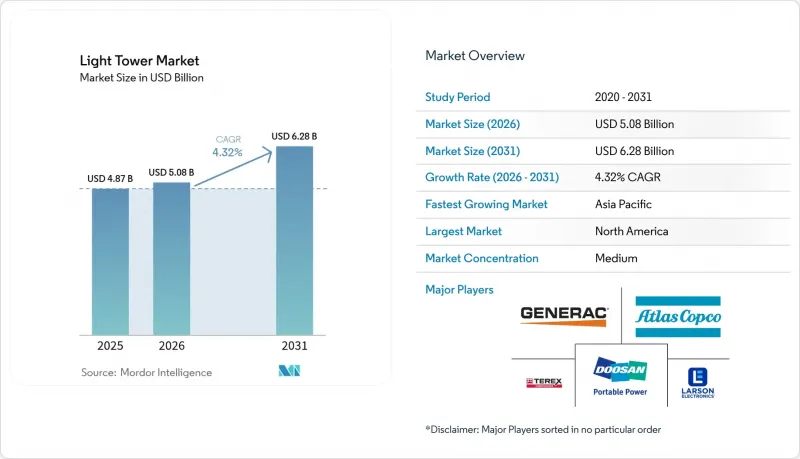
라이트 타워 시장 규모는 2025년에 48억 7,000만 달러로 평가되었습니다. 2026년 50억 8,000만 달러에서 2031년까지 62억 8,000만 달러에 이를 것으로 예상되며, 예측 기간(2026-2031년) CAGR은 4.32%를 나타낼 전망입니다.

본 보고서는 유형별(LED 라이트 타워 등), 전원별(디젤 구동, 태양광 하이브리드 구동 등), 마스트 높이별(30피트 미만 등), 이동 방식별(이동식/트레일러 탑재형, 스키드/고정식),소유 형태별(대여/리스, 직접 구매), 최종 사용자 산업(건설, 석유 및 가스, 기타), 지역별로 분류되어 있습니다. 시장 예측은 금액(달러) 기준으로 제시되어 있습니다.
세계의 라이트 타워 시장 동향 및 인사이트
북미의 24시간 365일 체제 인프라 보수 프로그램의 급속한 확대
24시간 체제로 진행되는 교량, 공항, 고속도로의 보수 공사로 인해 여러 교대 근무에 걸쳐 가동 가능한 고출력 타워에 대한 지속적인 수요가 발생하고 있습니다. 미국토목학회(ASCE)는 9조 1,000억 달러 규모의 인프라 격차를 지적하고 있으며, 이는 야간 작업 일정을 가속화하고 조명 요구 사항을 높이고 있습니다. 지자체 예산도 이러한 시급성을 반영하고 있으며, 샌디에이고시는 2025년부터 2029년에 걸쳐 가로등 교체에 4억 5,137만 달러를 배정하여, 이동식 장비의 광범위한 조달이 예상됩니다. 현재 장비 사양서에는 연료 탱크 용량 확대와 가동 시간 모니터링을 위한 텔레매틱스 기능이 강조되고 있습니다. 각 제조업체는 175시간의 연속 가동 시간을 특징으로 하는 올맨드(Allmand)사의 ‘Maxi-Lite’와 같은 설계로 이에 대응하고 있으며, 이러한 사양은 급유 횟수 감소를 요구하는 계약업체의 요구를 충족시키고 있습니다.
유럽 전역의 렌탈 차량에서 LED로의 급속한 전환
유럽의 렌탈 업체들은 총 운영 비용 측면에서 경쟁하고 있으며, 이는 메탈 할라이드에서 LED로의 차량 전환을 촉진하고 있습니다. 밀집된 도시 지역의 소음 및 배기가스 규제도 LED 조명 기구가 연료 소비와 유지보수 횟수를 줄여주기 때문에 이러한 전환을 가속화하고 있습니다. 제네락 모바일(Genelac Mobile)의 GLT 시리즈는 현재 조절 가능한 LED 어레이와 엄격한 지자체 기준을 충족하는 하이브리드 모델을 제공합니다. 공공 계약에서 지속가능성 기준이 평가 대상이 될 경우, 조기에 도입한 기업은 입찰에서 우위를 점할 수 있습니다. 또한, 이러한 개조 추세는 잔존 가치 산정에도 변화를 가져오고 있으며, LED 유닛은 더 높은 재판매 가격을 실현하고 있습니다. 이러한 이점은 에너지 효율이 높은 모델을 우선시하는 렌탈 요금 체계에도 반영되고 있습니다.
수소 연료 타워에는 높은 초기 설비 투자(CAPEX)가 필요합니다.
연료전지 유닛은 연소로 인한 배출물을 제거하지만, 기존 디젤 모델에 비해 비용이 3-4배 더 비쌉니다. 투자 회수 기간을 중시하는 조달 부서는 수명 주기 전체에 걸쳐 비용 절감이 예상에도 불구하고 구매를 미루는 경우가 많습니다. 연료 보급 인프라가 제한적이기 때문에 도입은 시범 사이트나 주목도가 높은 행사로 국한되어 있습니다. 수소 허브가 확대되고 스택 가격이 하락함에 따라 도입 장벽은 낮아질 것으로 예상되지만, 당분간 성장은 엄격한 자본 예산과 프로젝트 입찰 압박으로 인해 억제된 상태를 유지할 것입니다.
부문별 분석
LED 타워는 2025년에 조명 타워 시장의 61.35% 점유율을 유지했으며 4.38%의 연평균 성장률(CAGR)로 성장을 이어가고 있습니다. 전력 소비 감소와 5만시간을 넘는 전구 수명으로 인해 연료 소비량과 유지보수 주기가 단축되어, 지속가능성 지표에서 높은 점수를 받는 임대 입찰에서 LED가 표준 사양으로 자리 잡고 있습니다. 밝은 백색광은 작업 현장의 가시성을 향상시키고 사고율을 낮출 뿐만 아니라, 규제상의 안전 체크리스트도 충족시킵니다. 유럽 도시 지역의 건설 도급업체들은 소음 및 빛 공해 관련 조례를 준수하기 위해 저눈부심 LED 어레이의 채택을 점점 더 지정하고 있습니다.
메탈 할라이드 시스템은 연료 소비보다 대당 매우 높은 루멘 출력이 우선시되는 틈새 중공업 분야에서 여전히 사용되고 있습니다. 각 제조업체는 예열 시간을 단축하기 위해 견고한 하우징과 퀵 스트라이크 램프를 채택하여 대응하고 있습니다. 제품 혁신은 두 형태 모두에 걸쳐 이루어지고 있습니다. 아트라스코프코의 ‘Hilight V4+’는 성형 캐노피 아래에서 부품을 보호하고, 13미터 트럭에 16대를 적재할 수 있는 등, 설계 효율이 조명 성능을 어떻게 보완하는지 보여주고 있습니다. LED와 메탈 할라이드의 공존으로 부품 공급망은 다양성을 유지하고 있지만, 연구 개발 예산은 솔리드 스테이트 기술로 이동하고 있습니다.
2025년, 라이트 타워 시장 점유율의 69.20%를 디젤 구동형 타워가 차지했습니다. 이는 곳곳에 잘 갖춰진 연료 공급 인프라와 현장에서 입증된 신뢰성 덕분입니다. 전자 제어 기능이 탑재된 Tier-4 엔진은 배기가스와 공회전 시간을 줄여주며, 자동 시동-정지 기능은 가동 시간을 실제 조명 수요에 맞추어 조정함으로써 연료비를 절감합니다. 이러한 개선을 통해 일조 조건이나 배터리 성능이 불안정한 외딴 지역이나 가혹한 환경에서도 디젤 유닛은 경쟁력을 유지할 수 있습니다.
태양광 하이브리드 설계는 6.91%라는 가장 높은 연평균 성장률(CAGR)을 보일 것으로 예측됩니다. 일체형 패널이 낮 동안 차량용 배터리를 충전함으로써 야간에는 저소음 운전이 가능해지며, 배터리 잔량이 임계값 아래로 떨어졌을 때만 소형 엔진이 작동합니다. 아틀라스콥코의 ‘HiLight BI+4’는 리튬 이온 배터리 팩과 마이크로 디젤 엔진을 결합하여, 표준 주간 가동 기간 동안 이산화탄소 배출량을 절반 이상 줄이고 있습니다. TCP 그룹이 2025년에 완성한 500대 규모의 차량과 같은 수소 연료전지 프로토타입은 현지에서 배출 제로를 실현할 가능성을 지니고 있지만, 여전히 비용이 높습니다. 전력망에 직접 연결되는 타워는 육상 전원을 이용할 수 있는 터널 굴착이나 대규모 행사에서 특수한 역할을 수행하며, 광범위한 조명 타워 시장에서 다양한 기술의 조합을 입증하고 있습니다.
지역별 분석
2025년, 북미는 33.60%의 점유율로 조명 타워 시장을 주도했습니다. 인프라 갱신 의무화, 엄격한 안전 규제, 빈번한 기상 이변으로 인해 연중 내내 수요가 뒷받침되고 있습니다. 미국 토목공학회(ASCE)는 야간 공사 일정을 불가피하게 만드는 투자 격차를 강조하고 있습니다. 매니토바주의 2024/2025 회계연도 전략에는 캐나다 교통부의 규정을 충족하기 위한 활주로 조명 개보수가 포함되어 있어, 항공 분야의 기여도가 두드러집니다. 주요 렌탈 기업들은 ‘Total Control’과 같은 디지털 플랫폼을 활용하여 차량 배분을 최적화하고 있으며, 이를 통해 계약업체는 통합된 대시보드에서 조명탑, 발전기, 펌프를 통합하여 운영할 수 있게 되었습니다.
아시아태평양은 대규모 광업 활동, 도시 인구 증가, 재생에너지 인프라 확장에 힘입어 연평균 성장률(CAGR) 5.12%로 가장 빠르게 성장하고 있는 지역입니다. 호주의 프로젝트에서는 수 킬로미터에 달하는 운반 도로를 밝히기 위해 높은 마스트 타워가 필요합니다. 다른 지역에서는 급속한 도시 확장에 따라 교량, 철도, 복합 애플리케이션 개발 프로젝트를 위한 유연성이 높은 트레일러 유닛이 요구되고 있습니다. 블룸버그 NEF의 추산에 따르면, 2050년까지 탄소 중립을 달성하려면 89조 달러의 에너지 투자가 필요하며, 이는 송전망 및 재생에너지 설비에 대한 장기적인 자본 유입을 시사하는 것으로, 건설 단계에서는 일시적인 조명이 필요합니다.
유럽은 엄격한 배출 규제를 준수하고 렌탈 시장이 점차 확산되고 있다는 특징을 지닌, 여전히 규모가 큰 시장입니다. 도시 지역의 환경 규제와 탄소 가격 메커니즘으로 인해 LED 및 하이브리드 제품의 채택률은 세계 평균을 상회하고 있습니다. 저배출 장비에 대한 정부의 인센티브로 인해 차세대 타워의 투자 회수 기간이 단축되고 있습니다. 중동 및 아프리카에서는 석유 및 가스·유틸리티 사업자들이 외딴 사막 지대를 위해 태양광 하이브리드 유닛을 도입하고 있어 꾸준한 성장이 예상됩니다. 남미 수요는 원자재 사이클에 따라 변동합니다. 칠레와 브라질의 구리·철광석 광산에서는 산악 지대에 적합한 높은 마스트와 견고한 섀시가 조달되고 있습니다. 또한, 통신용 광섬유 설치도 장비 수주를 뒷받침하고 있으며, 네트워크 설치 업체들은 일몰 후 도랑 파기 및 연결 작업을 위해 스포트 조명이 필요합니다.
기타 혜택 :
- 엑셀 형식 시장 예측(ME) 시트
- 3개월간의 애널리스트 지원
자주 묻는 질문
목차
제1장 서론
제2장 조사 방법
제3장 주요 요약
제4장 시장 구도
제5장 시장 규모 및 성장 예측
제6장 경쟁 구도
제7장 시장 기회 및 향후 전망
KTH 26.09.08According to Mordor Intelligence, the light tower market size was valued at USD 4.87 billion in 2025 and estimated to grow from USD 5.08 billion in 2026 to reach USD 6.28 billion by 2031, at a CAGR of 4.32% during the forecast period (2026-2031).
This report is Segmented by Type (LED Light Towers, and More), Power Source (Diesel Powered, Solar-Hybrid Powered, and More), Mast Height (Below 30 Ft, and More), Mobility (Mobile/Trailer-Mounted, and Skid/Fix-Mounted), Ownership Model (Rental/Leased, and Direct Purchase), End-User Industry (Construction, Oil and Gas, and More), and Geography. The Market Forecasts are Provided in Terms of Value (USD).
Global Light Tower Market Trends and Insights
Booming 24 X 7 Infrastructure-Repair Programs in North America
Round-the-clock bridge, airport, and highway refurbishments create sustained demand for high-output towers able to operate for multiple shifts. The American Society of Civil Engineers lists a USD 9.1 trillion infrastructure gap that accelerates night-work schedules and heightens lighting requirements. Municipal budgets mirror this urgency; San Diego earmarked USD 451.37 million for streetlight upgrades across 2025-2029, signaling widespread procurement of portable units. Equipment spec sheets now highlight extended fuel tanks and telematics for up-time monitoring. Manufacturers respond with designs like Allmand's Maxi-Lite, featuring a 175-hour runtime, a specification that meets contractor requests for fewer refuels.
Rapid Shift Toward LED Retrofit in Rental Fleets across Europe
European rental houses compete on total operating cost, prompting fleet conversions from metal-halide to LED. Restrictions on noise and exhaust in dense urban zones speed the switch, as LED fixtures cut fuel burn and maintenance visits. Generac Mobile's GLT series now offers adjustable LED arrays and hybrid variants that meet strict municipal standards. Early adopters gain tender advantages when public contracts score sustainability criteria. The retrofit trend has also shifted residual-value calculations, with LED units achieving higher resale prices, a benefit reflected in rental rate structures that favor energy-efficient models.
High Initial CAPEX for Hydrogen-Fuel Towers
Fuel-cell units eliminate combustion emissions but cost three to four times more than conventional diesel models. Procurement departments focused on payback periods often defer purchases despite lifecycle savings. Limited refueling infrastructure confines deployments to pilot sites and high-profile events. As hydrogen hubs expand and stack prices fall, adoption barriers are expected to recede, yet near-term growth remains tempered by tight capital budgets and project bid pressures.
Other drivers and restraints analyzed in the detailed report include:
- Rising Deployment of Solar-Hybrid Towers at Remote Oil and Gas Pads in MENA
- Stringent Tier-4 and Stage V Emission Norms Fueling Hybrid-Powered Adoption
- Operational Downtime Due to Battery Drain in Cold Nordic Climates
For complete list of drivers and restraints, kindly check the Table Of Contents.
Segment Analysis
LED towers retained 61.35% share of the light tower market in 2025 and continue growing at a 4.38% CAGR. Reduced wattage and bulb lifespans beyond 50,000 hours cut fuel burn and service intervals, making LED the default specification for rental bids that score on sustainability metrics. Bright white output improves worksite visibility, reducing accident rates and aligning with regulatory safety checklists. Construction contractors in urban Europe increasingly specify low-glare LED arrays to comply with noise and light-pollution ordinances.
Metal-halide systems persist in niche heavy-industrial applications where very high lumen output per fixture is prioritized over fuel use. Manufacturers respond with ruggedized housings and quick-strike lamps to shorten warm-up times. Product innovation extends across both formats; Atlas Copco's Hilight V4+ protects components under a molded canopy and fits 16 units per 13-m truck, showcasing how design efficiency supplements lighting performance. The coexistence of LED and metal-halide keeps component supply chains diversified yet tilts R&D budgets toward solid-state technologies.
Diesel-powered towers accounted for 69.20% of the light tower market share in 2025, benefiting from ubiquitous fueling infrastructure and field-proven reliability. Tier-4 engines with electronic management cut emissions and idle time, while automatic start-stop functions align runtime with real light demand, trimming fuel bills. These enhancements enable diesel units to remain competitive in remote or extreme environments where solar exposure or battery performance is uncertain.
Solar-hybrid designs post the highest 6.91% CAGR forecast. Integrated panels charge onboard batteries by day, allowing silent night operations, with small engines activating only under low-state-of-charge thresholds. Atlas Copco's HiLight BI+4 matches lithium-ion packs with a micro-diesel engine, cutting carbon dioxide output by more than half across a standard workweek. Hydrogen fuel-cell prototypes, like TCP Group's 500-unit fleet completed in 2025, promise zero-local-emission performance but remain cost-intensive. Direct grid-connected towers fill specialized roles in tunneling and large events where shore power exists, demonstrating the diversified technology mix inside the broader light tower market.
Complete Report Scope:
- By Type
- LED Light Towers
- Metal-Halide Light Towers
- By Power Source
- Diesel Powered
- Solar-Hybrid Powered
- Hydrogen Fuel-Cell Powered
- Direct Grid/Battery Powered
- By Mast Height
- Below 30 ft
- 30 - 60 ft
- Above 60 ft
- By Mobility
- Mobile/Trailer-Mounted
- Skid/Fix-Mounted
- By Ownership Model
- Rental/Leased
- Direct Purchase
- By End-user Industry
- Construction
- Oil and Gas
- Mining
- Industrial and Manufacturing
- Infrastructure (Road, Rail, Airport, Ports)
- Events, Sports and Entertainment
- Military, Emergency and Disaster Relief
- By Geography
- North America
- United States
- Canada
- Mexico
- Europe
- Germany
- United Kingdom
- France
- Italy
- Spain
- Nordics (Denmark, Sweden, Norway, Finland)
- Rest of Europe
- Asia-Pacific
- China
- Japan
- South Korea
- India
- Southeast Asia
- Australia
- Rest of Asia-Pacific
- South America
- Brazil
- Argentina
- Rest of South America
- Middle East
- Gulf Cooperation Council Countries
- Turkey
- Rest of Middle East
- Africa
- South Africa
- Nigeria
- Rest of Africa
- North America
Geography Analysis
North America led the light tower market with a 33.60% share in 2025. Infrastructure renewal mandates, stringent safety regulations, and frequent extreme-weather events sustain year-round demand. The American Society of Civil Engineers underscores the investment gap that drives night construction schedules. Manitoba's 2024/2025 strategy includes runway light upgrades to meet Transport Canada rules, highlighting aviation's contribution. Rental giants leverage digital platforms such as Total Control to optimize fleet allocation, enabling contractors to combine towers, generators, and pumps within unified dashboards.
Asia Pacific is the fastest-growing region at 5.12% CAGR, propelled by mega-mining activities, urban population growth, and expanding renewable-energy infrastructure. Australian projects necessitate high-mast towers to illuminate haul roads spanning several kilometers. Elsewhere, rapid urban expansion requires flexible trailer units for bridge, rail, and mixed-use developments. BloombergNEF estimates USD 89 trillion in energy investments are needed for net-zero by 2050, signaling long-term capital flows into grid and renewable installations that will require temporary lighting during build-out phases.
Europe remains a sizable market characterized by strict emission compliance and sophisticated rental penetration. LED and hybrid adoption rates exceed global averages due to urban environmental restrictions and carbon-pricing mechanisms. Government incentives for low-emission equipment increase the payback speed of next-generation towers. The Middle East and Africa register steady growth as oil, gas, and utility operators embrace solar-hybrid units for remote desert sites. South America's demand varies by commodity cycle; copper and iron ore mines in Chile and Brazil procure taller masts and robust chassis suited for mountainous terrain. Telecommunications fiber rollouts also spur equipment orders, as network installers require spot illumination for trenching and splice work after daylight.
- Atlas Copco AB
- Generac Power Systems Inc. (Generac Mobile)
- Terex Corp.
- Doosan Portable Power
- Wacker Neuson SE
- Trime S.r.l.
- Allmand Bros. Inc. (Briggs and Stratton)
- Larson Electronics LLC
- Wanco Inc.
- Xylem Inc. (Seltorque)
- J C Bamford Excavators Ltd.
- United Rentals Inc.
- BMI Group (Genergy)
- Lind Equipment Ltd.
- Colorado Standby
- Youngman Richardson and Co. Ltd.
- Westquip Diesel Sales Ltd.
- Inmesol Gensets SL
- Atlas Luminaires Inc.
- The Will-Burt Company
Additional Benefits:
- The market estimate (ME) sheet in Excel format
- 3 months of analyst support
TABLE OF CONTENTS
1 INTRODUCTION
- 1.1 Study Assumptions and Market Definition
- 1.2 Scope of the Study
2 RESEARCH METHODOLOGY
3 EXECUTIVE SUMMARY
4 MARKET LANDSCAPE
- 4.1 Market Overview
- 4.2 Market Drivers
- 4.2.1 Booming 24x7 Infrastructure-Repair Programs in North America
- 4.2.2 Rapid Shift Toward LED Retrofit in Rental Fleets across Europe
- 4.2.3 Rising Deployment of Solar-Hybrid Towers at Remote Oil and Gas Pads in MENA
- 4.2.4 Stringent Tier-4 and Stage V Emission Norms Fueling Hybrid-Powered Adoption
- 4.2.5 Mega-Mining Projects in Australia Accelerating High-Mast (Above 60 ft) Demand
- 4.2.6 Disaster-Relief Funding Surge Driving Mobile Towers in ASEAN
- 4.3 Market Restraints
- 4.3.1 High Initial CAPEX for Hydrogen-Fuel Towers
- 4.3.2 Operational Downtime Due to Battery-Drain in Cold Nordic Climates
- 4.3.3 Volatile Diesel Prices Distorting Rental Pricing Models
- 4.3.4 Complex Permitting for Temporary Lighting in EU Urban Zones
- 4.4 Industry Ecosystem Analysis
- 4.5 Technological Outlook
- 4.6 Porter's Five Forces Analysis
- 4.6.1 Bargaining Power of Suppliers
- 4.6.2 Bargaining Power of Consumers
- 4.6.3 Threat of New Entrants
- 4.6.4 Threat of Substitute Products
- 4.6.5 Intensity of Competitive Rivalry
5 MARKET SIZE AND GROWTH FORECASTS (VALUES)
- 5.1 By Type
- 5.1.1 LED Light Towers
- 5.1.2 Metal-Halide Light Towers
- 5.2 By Power Source
- 5.2.1 Diesel Powered
- 5.2.2 Solar-Hybrid Powered
- 5.2.3 Hydrogen Fuel-Cell Powered
- 5.2.4 Direct Grid/Battery Powered
- 5.3 By Mast Height
- 5.3.1 Below 30 ft
- 5.3.2 30 - 60 ft
- 5.3.3 Above 60 ft
- 5.4 By Mobility
- 5.4.1 Mobile/Trailer-Mounted
- 5.4.2 Skid/Fix-Mounted
- 5.5 By Ownership Model
- 5.5.1 Rental/Leased
- 5.5.2 Direct Purchase
- 5.6 By End-user Industry
- 5.6.1 Construction
- 5.6.2 Oil and Gas
- 5.6.3 Mining
- 5.6.4 Industrial and Manufacturing
- 5.6.5 Infrastructure (Road, Rail, Airport, Ports)
- 5.6.6 Events, Sports and Entertainment
- 5.6.7 Military, Emergency and Disaster Relief
- 5.7 By Geography
- 5.7.1 North America
- 5.7.1.1 United States
- 5.7.1.2 Canada
- 5.7.1.3 Mexico
- 5.7.2 Europe
- 5.7.2.1 Germany
- 5.7.2.2 United Kingdom
- 5.7.2.3 France
- 5.7.2.4 Italy
- 5.7.2.5 Spain
- 5.7.2.6 Nordics (Denmark, Sweden, Norway, Finland)
- 5.7.2.7 Rest of Europe
- 5.7.3 Asia-Pacific
- 5.7.3.1 China
- 5.7.3.2 Japan
- 5.7.3.3 South Korea
- 5.7.3.4 India
- 5.7.3.5 Southeast Asia
- 5.7.3.6 Australia
- 5.7.3.7 Rest of Asia-Pacific
- 5.7.4 South America
- 5.7.4.1 Brazil
- 5.7.4.2 Argentina
- 5.7.4.3 Rest of South America
- 5.7.5 Middle East
- 5.7.5.1 Gulf Cooperation Council Countries
- 5.7.5.2 Turkey
- 5.7.5.3 Rest of Middle East
- 5.7.6 Africa
- 5.7.6.1 South Africa
- 5.7.6.2 Nigeria
- 5.7.6.3 Rest of Africa
- 5.7.1 North America
6 COMPETITIVE LANDSCAPE
- 6.1 Market Concentration
- 6.2 Strategic Moves
- 6.3 Market Share Analysis
- 6.4 Company Profiles {(includes Global level Overview, Market level overview, Core Segments, Financials as available, Strategic Information, Market Rank/Share for key companies, Products and Services, and Recent Developments)}
- 6.4.1 Atlas Copco AB
- 6.4.2 Generac Power Systems Inc. (Generac Mobile)
- 6.4.3 Terex Corp.
- 6.4.4 Doosan Portable Power
- 6.4.5 Wacker Neuson SE
- 6.4.6 Trime S.r.l.
- 6.4.7 Allmand Bros. Inc. (Briggs and Stratton)
- 6.4.8 Larson Electronics LLC
- 6.4.9 Wanco Inc.
- 6.4.10 Xylem Inc. (Seltorque)
- 6.4.11 J C Bamford Excavators Ltd.
- 6.4.12 United Rentals Inc.
- 6.4.13 BMI Group (Genergy)
- 6.4.14 Lind Equipment Ltd.
- 6.4.15 Colorado Standby
- 6.4.16 Youngman Richardson and Co. Ltd.
- 6.4.17 Westquip Diesel Sales Ltd.
- 6.4.18 Inmesol Gensets SL
- 6.4.19 Atlas Luminaires Inc.
- 6.4.20 The Will-Burt Company
7 MARKET OPPORTUNITIES AND FUTURE OUTLOOK
- 7.1 White-space and Unmet-need Assessment


