

|
시장보고서
상품코드
2122866
위성 안테나 : 시장 점유율 분석, 업계 동향 및 통계, 성장 예측(2026-2031년)Satellite Antenna - Market Share Analysis, Industry Trends & Statistics, Growth Forecasts (2026 - 2031) |
||||||
 Mordor Intelligence
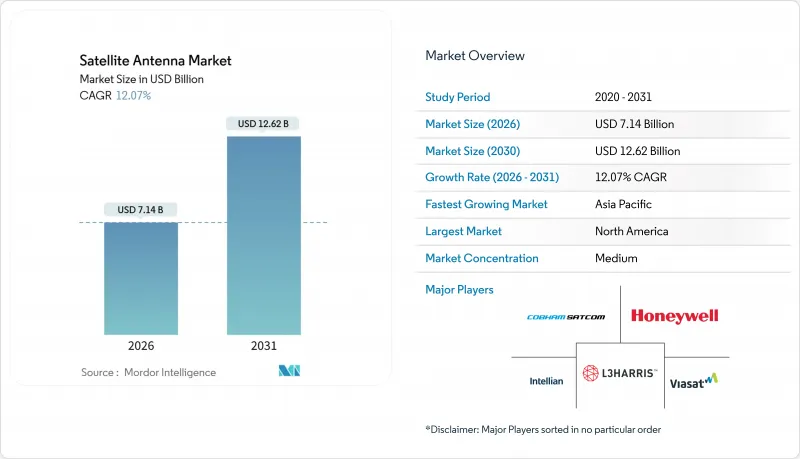
위성 안테나 시장 규모는 2026년에 71억 4,000만 달러에 이르고, 2031년까지 126억 2,000만 달러에 이를 것으로 예상되며, 예측 기간 CAGR 12.07%로 확대되고 있습니다.

본 보고서는 주파수 대역(C-밴드, X-밴드, Ku-밴드, Ka-밴드, L/S-밴드 및 VHF/UHF-밴드), 안테나 유형(파라볼라 반사기, 평면 패널 ESA/RSA, 혼,유전체 공진기, FRP 레이돔 및 금속 프레스), 용도(우주 탑재, 항공기 탑재, 선박 탑재, 지상), 최종 사용자(민간, 정부·국방) 및 지역별로 분류되어 있습니다. 시장 전망은 금액(달러)으로 제시되어 있습니다.
세계의 위성 안테나 시장 동향 및 인사이트
LEO 광대역 위성 군집의 급증
2024년 말까지 6,750기 이상의 스타링크 위성이 궤도에 투입되었으며, 같은 해 유텔샛 원웹도 648기의 위성으로 구성된 1세대 네트워크를 완성할 전망입니다. 아마존의 프로젝트 카이퍼는 주파수 대역을 확보하기 위해 2026년 7월까지 1,663기의 위성을 궤도에 투입해야 하며, 이 마일스톤이 다가옴에 따라 사용자 단말기에 대한 수요가 확고해지고 있습니다. 이러한 거대 위성군 구축에 따라 고속으로 이동하는 여러 대상을 추적할 수 있는 안테나가 요구되고 있으며, 항공, 해상, 지상 이동통신 각 분야에서 파라볼라 안테나를 대신해 ESA(전자 스캔 안테나)가 보급되고 있습니다. 생산량 증가에 따라 플랫 패널 안테나의 가격이 동등한 수준으로 다가오면서, 위성 군 사업자들은 가입자 확산을 가속화하기 위해 하드웨어 보조금을 제공하는 경우가 많아지고 있습니다. 그 결과로 발생하는 생태계의 변화로 인해 메가비트당 비용이 절감되고 있으며, 외딴 지역의 통신 사업자들이 라스트 마일 광대역 서비스를 위해 위성 백홀을 도입하는 움직임이 촉진되고 있습니다.
우주의 급속한 군사화(MilSATCOM)
미국 공군은 2024년 중반, L3Harris사에 12억 달러 규모의 단말기 계약을 수주했습니다. 이는 다중 궤도를 통한 내결함성에 대한 국방 분야 수요 증가를 여실히 보여줍니다. 나토(NATO)는 전파 교란을 회피하기 위해 상용 위성과 군용 위성 간에 밀리초 단위로 단말기를 전환하도록 의무화하는 내결함성 SATCOM 프레임워크를 발표했습니다. 아시아의 국방 기관들도 유사한 입장을 보이고 있습니다. 인도는 2024년에 전용 통신 위성을 발사할 예정이며, 일본은 2025년도 예산에 새로운 X-밴드 지상국 건설 자금을 편성했습니다. 이러한 노력에 힘입어 암호화 기능, 내장형 사이버 보안, 그리고 방해 대책 파형을 갖춘 X-밴드 및 Ka-밴드 하드웨어에 대한 수요가 증가하고 있습니다. 기밀 프로그램 경험을 보유한 유수의 주요 제조업체들이 여전히 우위를 점하고 있지만, 평면 패널 분야의 혁신 기업들도 시스템 통합사업자와 제휴함으로써 기세를 높이고 있습니다.
ESA 칩셋 관련 수출 규제의 병목 현상
미국 산업안보국(BIS)은 2024년에 갈륨 질화물 수출 규제를 강화하여, 아시아태평양 구매자에 대한 위상 배열용 칩셋 납품이 지연되었습니다. 중국은 이에 대응하여 갈륨 및 게르마늄의 수출을 제한했기 때문에 중국 이외의 반도체 제조 공장은 더 높은 비용을 들여 대체 공급망 인증을 취득할 수밖에 없게 되었습니다. Kymeta사가 투자자용 자료에서 밝힌 바와 같이, ITAR(국제무기거래규정) 규제로 인해 많은 상업 거래에서 6-9개월의 지연이 발생하고 있습니다. Hanwha Phasor사는 이 규제를 극복하기 위해 미국 자회사를 설립하기로 선택했으나, 그 결과 엔지니어링 자원이 중복되고 로드맵이 장기화되었습니다. 이러한 제약으로 인해 가격에 민감한 지역에서는 단말기 가격이 상승하고, 다국적 진출 일정이 복잡해지고 있습니다.
부문별 분석
Ka 대역은 2031년까지 연평균 11.80%의 성장률을 보일 것으로 예측되며, 위성 안테나 시장에서 가장 빠르게 성장하는 분야가 될 전망입니다. SES의 ‘O3b mPOWER’와 Viasat의 ‘ViaSat-3’는 모두 지역별로 유연하게 조정 가능한 Ka 대역 스팟 빔에 의존하고 있으며, 이 두 가지 수요가 합쳐져 듀얼 밴드 ESA에 대한 다년간의 조달을 뒷받침하고 있습니다. 대조적으로, C-밴드는 2025년에도 위성 안테나 시장에서 38.75%의 점유율을 유지했으며, 비로 인한 신호 감쇠에 대한 내성을 중시하는 정부계 텔레포트, 재해 복구 노드, 방송용 업링크에 이용되고 있습니다. Ku 대역은 직접 수신(DTH) 및 1세대 항공 통신 링크에서 여전히 주류를 이루고 있지만, 용량이 더 높은 주파수 대역으로 전환됨에 따라 그 성장세는 둔화되고 있습니다. L/S 대역 및 VHF/UHF 대역은 이동 위성 서비스 및 기존 방위용 무선기에서 틈새 역할을 담당하고 있습니다.
통신 사업자들은 더 높은 스펙트럼 효율과 2023년 세계 무선통신 회의에서 확보된 풍부한 규제 할당량을 이유로 Ka 대역을 활용하고 있습니다. 시스템 통합사업자들은 현재 적도 페이드를 억제하기 위해 적응형 부호화를 통합하고, 악천후 시에는 트래픽을 Ku 대역으로 유도하여 서비스 품질을 유지하는 듀얼 밴드 아키텍처를 채택하고 있습니다. 이러한 혼합 스펙트럼 접근 방식을 통해 고급 항공사는 스트리밍 품질의 기내 엔터테인먼트를 보장할 수 있고, 석유 시추 시설 운영자는 폭풍우 속에서도 SCADA 네트워크를 계속 가동할 수 있습니다. 단가 하락에 따라 Ka 대역 안테나는 소형 상선이나 외딴 지역의 농업 분야와 같은 저가 시장에도 침투하여, C 대역의 신뢰성 수준을 저해하지 않으면서 고객 기반을 확대되고 있습니다.
파라볼라 반사판은 2025년 매출의 44.10%를 차지했으며, 이는 고정 설치 현장에서 입증된 구조와 낮은 초기 비용을 뒷받침합니다. 그럼에도 불구하고, 평면 패널 설계는 연평균 성장률(CAGR) 34.2%로 확대되고 있으며, 항공기의 공기 저항을 줄이고 차량의 가동 부품을 제거하는 슬림형 설계 덕분에 2031년까지 위성 안테나 시장에서 두드러진 성장률을 보이고 있습니다. 볼 에어로스페이스(Ball Aerospace)는 플렉스(Flex)와 제휴하여 자동차용 표면실장기술의 비용 효율성을 페이즈 어레이 제품 라인에 도입함으로써, 대당 가격을 40% 절감하는 것을 목표로 하고 있습니다. 키메타(Kymeta)의 ‘오스프리 u8’은 2024년에 9,000달러 미만의 가격으로 책정되어 소형 항공기의 도입 비용을 대폭 절감했습니다. 혼형, 유전체 공진기형, FRP 라돔형 및 금속 프레스 성형형 등 각 변형 제품은 특수한 방사기 또는 보호 하우징으로서 시장을 지탱하는 역할을 하고 있습니다.
각 제조업체는 하이브리드 솔루션을 통해 제품 라인업을 다양화하고 있습니다. 예를 들어, 인텔리안(Intellian)의 ‘v240MT’는 2.4m 파라볼라 안테나와 소프트웨어 정의 모뎀을 결합하여 GEO(정지 궤도)와 LEO(저궤도) 간의 신속한 핸드오버를 가능하게 합니다. All.Space사의 광 빔 포밍 프로토타입은 무선 주파수 위상 변이기를 액정 소자로 대체함으로써 부품 수를 60% 줄이고, 수율을 향상시키며, 전력 소비를 절감하고 있습니다. 한편, Greenerwave사의 재구성 가능한 지능형 표면은 능동형 RF 부품을 사용하지 않고 빔을 제어하는 것을 목표로 하고 있으며, 이는 배터리 구동 방식의 지상 휴대 단말기에 혁신을 가져올 수 있는 길이 되고 있습니다.
지역별 분석
북미는 초기 LEO 전개, 우주군의 현대화 로드맵, 그리고 FAA의 프로세스 효율화에 힘입어 2025년 매출의 41.50%를 차지했습니다. L3Harris 및 Viasat와 같은 주요 방위 기업들은 상업용 항공기 개조가 가속화되는 가운데에서도 국내 수요를 안정화시키는 다년 계약을 누리고 있습니다. 또한, 캐나다의 지방 광대역 프로그램에서는 수천 대의 고정 단말기가 조달되고 있어, 고객 기반이 모바일 분야 이외로도 확대되고 있습니다. 설치 기반이 성숙해짐에 따라 성장은 둔화되고 있지만, 듀얼 밴드 기능에 대한 애프터마켓 업그레이드가 판매량을 뒷받침하고 있습니다.
아시아태평양은 2031년까지 연평균 성장률(CAGR) 9.7%로 확대될 것으로 예측되며, 위성 안테나 시장에서 가장 강력한 지역적 성장 궤도를 보이고 있습니다. 중국이 2030년까지 1만 3,000기의 위성을 궤도에 투입할 계획에 따라 매년 수만 대의 지상 단말기가 필요할 것으로 예상되며, 중국은 미국의 수출 규제에 대한 의존도를 낮추기 위해 국내 GaN 파운드리 설립을 급속도로 추진하고 있습니다. 인도는 2033년까지 440억 달러 규모의 우주 경제를 목표로 하고 있으며, 이는 안테나 제조 분야의 민관 합작 사업을 촉진하고 있습니다. 일본의 준천정 위성 확충과 한국의 방위 수출 의지도 추가적인 수요를 뒷받침하고 있습니다. 호주와 인도네시아의 규제 당국은 현재 스타링크 단말기의 수입을 사전 승인하고 있으며, 이는 지역 전체의 정책적 추진력을 반영하고 있습니다.
유럽에서는 국가 안보 목표와 상업적 야망 간의 균형을 모색하고 있습니다. 유럽우주기구(ESA)의 보안 연결 위성군 ‘IRIS2’는 2024년에 1억 5,000만 유로를 조달하여, 중요 인프라 사업자의 사용자 단말기 조달에 직접 보조금을 지원했습니다. OneWeb이 구축을 완료한 네트워크는 북해와 지중해의 해양 사업자에게 광대역 서비스를 제공하고 있으며, LEO(저궤도)와 GEO(정지궤도) 링크 간을 로밍하는 듀얼 밴드 안테나가 필요합니다. 중동에서는 달 게이트웨이 미션과 외딴 지역의 유전에서의 내결함성이 높은 통신을 지원하기 위해 Ka 대역 지상국에 대한 투자가 진행되고 있습니다. 사하라 이남 아프리카와 남미에서는 설비 투자가 뒤처지고 있지만, 스타링크의 ‘소비자 직접 판매’ 모델은 통신 사업자 파트너를 거치지 않고 농촌 가정에 자가 설치 키트를 배송함으로써 저비용 ESA에 대한 수요를 점차 불러일으키고 있습니다.
기타 혜택 :
- 엑셀 형식 시장 예측(ME) 시트
- 3개월간의 애널리스트 지원
자주 묻는 질문
목차
제1장 서론
제2장 조사 방법
제3장 주요 요약
제4장 시장 구도
제5장 시장 규모 및 성장 예측
제6장 경쟁 구도
제7장 시장 기회 및 향후 전망
KTH 26.09.08According to Mordor Intelligence, the satellite antenna market size reached USD 7.14 billion in 2026 and is on track to hit USD 12.62 billion by 2031, advancing at a 12.07% CAGR over the period.
This report is Segmented by Frequency Band (C Band, X Band, Ku Band, Ka Band, L/S Band, and VHF/UHF Band), Antenna Type (Parabolic Reflector, Flat-Panel ESA/RSA, Horn, Dielectric-Resonator, FRP-Radome, and Metal-Stamp), Application (Spaceborne, Airborne, Maritime, and Land), End-User (Commercial, Government and Defense), and Geography. Market Forecasts are Provided in Value (USD).
Global Satellite Antenna Market Trends and Insights
Proliferation of LEO Broadband Constellations
More than 6,750 Starlink spacecraft orbited by late-2024, with Eutelsat OneWeb completing its 648-satellite first-generation network the same year. Amazon's Project Kuiper must orbit 1,663 satellites by July 2026 to preserve spectrum, locking in demand for user terminals as milestones near. These mega-constellations oblige antennas that track multiple fast-moving targets, pushing ESAs over parabolic dishes in aviation, maritime, and land-mobile segments. Parity pricing on flat panels is emerging as volumes climb, and constellation operators often subsidize hardware to accelerate subscriber uptake. The resulting ecosystem shift compresses cost per megabit, encouraging telcos in remote regions to adopt satellite backhaul for last-mile broadband.
Rapid Militarization of Space (MilSATCOM)
The U.S. Department of the Air Force awarded L3Harris a USD 1.2 billion terminal contract in mid-2024, underscoring defense appetite for multi-orbit resiliency. NATO released a resilient SATCOM framework that mandates terminal agility between commercial and military satellites within milliseconds to avoid jamming . Asian defense agencies mirror this posture: India launched dedicated communications satellites in 2024 and Japan funded new X-band ground stations in its 2025 budget. These initiatives elevate demand for X- and Ka-band hardware with encryption, embedded cybersecurity, and anti-jam waveforms. Established primes with classified-program experience retain an edge, although flat-panel innovators are gaining traction by partnering with system integrators.
Export-Control Bottlenecks on ESA Chipsets
The Bureau of Industry and Security tightened export controls on gallium nitride in 2024, slowing phased-array chipset deliveries to Asia-Pacific buyers. China countered by restricting outbound gallium and germanium, prompting non-Chinese fabs to qualify alternative supply chains at higher cost. ITAR rules add six-to-nine-month delays for many commercial transactions, as Kymeta disclosed in investor materials. Hanwha Phasor chose to open a U.S. subsidiary to navigate the regime, duplicating engineering resources and elongating roadmaps. These constraints elevate terminal pricing in price-sensitive regions and complicate multinational deployment schedules.
Other drivers and restraints analyzed in the detailed report include:
- High Throughput Satellite Payload Adoption
- Commercial In-Flight Connectivity Boom
- Ku/Ka-Band Rain Fade in Equatorial Regions
For complete list of drivers and restraints, kindly check the Table Of Contents.
Segment Analysis
Ka Band is projected to record an 11.80% annual expansion to 2031, making it the fastest-growing slice of the satellite antenna market. SES O3b mPOWER and Viasat ViaSat-3 both rely on Ka spot beams that can be flexed regionally, and their combined demand anchors multiyear procurement of dual-band ESAs. In contrast, C Band retained a 38.75% satellite antenna market share in 2025, serving government teleports, disaster-recovery nodes, and broadcast uplinks that prize rain-fade resilience. Ku Band remains a workhorse for direct-to-home and first-generation aeronautical links, yet growth is slowing as capacity migrates upward in frequency. L/S and VHF/UHF bands hold niche roles in mobile satellite services and legacy defense radios.
Operators lean on Ka-band for higher spectral efficiency and abundant regulatory allocations secured at the 2023 World Radiocommunication Conference. Integrators now bundle adaptive coding to tame equatorial fade and employ dual-band architectures that steer traffic to Ku during severe weather, preserving quality of service. This mixed-spectrum approach allows premium airlines to guarantee streaming-grade inflight plans and lets oil-rig operators keep SCADA networks online during storms. As unit costs fall, Ka antennas move down-market into small merchant ships and remote agriculture, broadening the customer base without cannibalizing C-band reliability tiers.
Parabolic reflectors held 44.10% of 2025 revenue, a testament to proven mechanics and low upfront cost for fixed sites. Nonetheless, flat-panel designs are scaling at a 34.2% CAGR, the standout rate in the satellite antenna market through 2031, thanks to thin profiles that reduce drag on aircraft and eliminate moving parts on vehicles. Ball Aerospace partnered with Flex to bring automotive surface-mount economics to phased-array lines, targeting a 40% price cut per unit. Kymeta's Osprey u8 priced below USD 9,000 in 2024, slashing entry costs for small craft. Horn, dielectric-resonator, FRP-radome, and metal-stamp variants play supportive roles, either as specialty radiators or protective housings.
Manufacturers diversify with hybrid solutions, such as Intellian's v240MT that marries a 2.4 m parabolic dish with software-defined modems allowing agile GEO-LEO handoffs. Optical beamforming prototypes from All.Space replace radio-frequency phase shifters with liquid-crystal elements, trimming component counts by 60%, boosting yield, and lowering power draw. Meanwhile, Greenerwave's reconfigurable intelligent surfaces aim to steer beams without active RF components, a potentially transformative path for battery-powered land portable terminals.
Complete Report Scope:
- By Frequency Band
- C Band
- X Band
- Ku Band
- Ka Band
- L/S Band
- VHF/UHF Band
- By Antenna Type
- Parabolic Reflector
- Flat-Panel (ESA/RSA)
- Horn
- Dielectric-Resonator
- FRP-Radome
- Metal-Stamp
- By Application
- Spaceborne
- Airborne
- Maritime
- Land (Mobile and Fixed)
- By End-User
- Commercial
- Government and Defense
- By Geography
- North America
- United States
- Canada
- Mexico
- Europe
- Germany
- United Kingdom
- France
- Italy
- Spain
- Russia
- Rest of Europe
- Asia-Pacific
- China
- Japan
- India
- South Korea
- Australia
- Rest of Asia-Pacific
- Middle East
- Saudi Arabia
- United Arab Emirates
- Turkey
- Rest of Middle East
- Africa
- South Africa
- Nigeria
- Rest of Africa
- South America
- Brazil
- Argentina
- Rest of South America
- North America
Geography Analysis
North America anchored 41.50% of 2025 revenue, propelled by early LEO deployments, the Space Force's modernization roadmap, and streamlined FAA processes. Defense primes such as L3Harris and Viasat enjoy multi-year contracts that stabilize domestic demand even as commercial aviation retrofits accelerate. Canada's rural broadband programs also procure thousands of fixed terminals, expanding the customer base beyond mobility verticals. While growth slows as installed bases mature, aftermarket upgrades for dual-band capability sustain volumes.
Asia-Pacific is projected to advance at a 9.7% CAGR to 2031, the strongest regional trajectory in the satellite antenna market. China's plan to orbit 13,000 satellites by 2030 mandates tens of thousands of ground terminals each year, and the nation is spinning up domestic GaN foundries to reduce exposure to U.S. export controls. India targets a USD 44 billion space economy by 2033, catalyzing public-private joint ventures in antenna fabrication. Japan's quasi-zenith satellite expansion and South Korea's defense export ambitions add further pull. Regulatory bodies in Australia and Indonesia now pre-approve Starlink terminal imports, reflecting policy momentum across the region.
Europe balances sovereign security goals and commercial aspirations. The European Space Agency's IRIS2 secure-connectivity constellation received EUR 150 million in funding in 2024, directly subsidizing user-terminal procurements for critical infrastructure operators . OneWeb's completed network supplies broadband to maritime operators in the North Sea and Mediterranean, requiring dual-band antennas that roam between LEO and GEO links. The Middle East invests in Ka-band ground stations to support lunar gateway missions and resilient communication for remote oilfields. Sub-Saharan Africa and South America lag on capital outlays, yet Starlink's direct-to-consumer model circumvents telco partners, shipping self-install kits to rural households and sparking incremental demand for low-cost ESAs.
- Honeywell International Inc.
- CPI International Inc.
- Kymeta Corp.
- Norsat International Inc.
- Cobham SATCOM
- L3Harris Technologies Inc.
- Viasat Inc.
- Airbus Defence and Space
- Gilat Satellite Networks Ltd.
- Maxar Technologies
- Ball Aerospace
- Intellian Technologies
- Isotropic Systems (All.Space)
- Hanwha Phasor
- SES S.A. (O3b mPOWER User Terminals)
- Thales Alenia Space
- MT Mechatronics
- SatixFy Ltd.
- General Dynamics Mission Systems
- LEOcloud Inc.
- Hughes Network Systems
Additional Benefits:
- The market estimate (ME) sheet in Excel format
- 3 months of analyst support
TABLE OF CONTENTS
1 INTRODUCTION
- 1.1 Study Assumptions and Market Definition
- 1.2 Scope of the Study
2 RESEARCH METHODOLOGY
3 EXECUTIVE SUMMARY
4 MARKET LANDSCAPE
- 4.1 Market Overview
- 4.2 Market Drivers
- 4.2.1 Proliferation of LEO Broadband Constellations
- 4.2.2 Rapid Militarization of Space (MilSATCOM)
- 4.2.3 High Throughput Satellite Payload Adoption
- 4.2.4 Commercial In-Flight Connectivity Boom
- 4.2.5 ESA-Based Flat-Panel Cost Curve Deflation
- 4.2.6 Lunar and Cislunar Mission Communications Demand
- 4.3 Market Restraints
- 4.3.1 Ku-/Ka-Band Rain Fade in Equatorial Regions
- 4.3.2 Export-Control Bottlenecks on Phased-Array Chipsets
- 4.3.3 Mounting Orbital-Debris Insurance Premiums
- 4.3.4 CAPEX Crunch at Emerging-Market Telcos
- 4.4 Industry Value Chain Analysis
- 4.5 Regulatory Landscape
- 4.6 Technological Outlook
- 4.7 Impact of Macroeconomic Factors
- 4.8 Porter's Five Forces Analysis
- 4.8.1 Threat of New Entrants
- 4.8.2 Bargaining Power of Suppliers
- 4.8.3 Bargaining Power of Buyers
- 4.8.4 Threat of Substitutes
- 4.8.5 Competitive Rivalry
5 MARKET SIZE AND GROWTH FORECASTS (VALUE)
- 5.1 By Frequency Band
- 5.1.1 C Band
- 5.1.2 X Band
- 5.1.3 Ku Band
- 5.1.4 Ka Band
- 5.1.5 L/S Band
- 5.1.6 VHF/UHF Band
- 5.2 By Antenna Type
- 5.2.1 Parabolic Reflector
- 5.2.2 Flat-Panel (ESA/RSA)
- 5.2.3 Horn
- 5.2.4 Dielectric-Resonator
- 5.2.5 FRP-Radome
- 5.2.6 Metal-Stamp
- 5.3 By Application
- 5.3.1 Spaceborne
- 5.3.2 Airborne
- 5.3.3 Maritime
- 5.3.4 Land (Mobile and Fixed)
- 5.4 By End-User
- 5.4.1 Commercial
- 5.4.2 Government and Defense
- 5.5 By Geography
- 5.5.1 North America
- 5.5.1.1 United States
- 5.5.1.2 Canada
- 5.5.1.3 Mexico
- 5.5.2 Europe
- 5.5.2.1 Germany
- 5.5.2.2 United Kingdom
- 5.5.2.3 France
- 5.5.2.4 Italy
- 5.5.2.5 Spain
- 5.5.2.6 Russia
- 5.5.2.7 Rest of Europe
- 5.5.3 Asia-Pacific
- 5.5.3.1 China
- 5.5.3.2 Japan
- 5.5.3.3 India
- 5.5.3.4 South Korea
- 5.5.3.5 Australia
- 5.5.3.6 Rest of Asia-Pacific
- 5.5.4 Middle East
- 5.5.4.1 Saudi Arabia
- 5.5.4.2 United Arab Emirates
- 5.5.4.3 Turkey
- 5.5.4.4 Rest of Middle East
- 5.5.5 Africa
- 5.5.5.1 South Africa
- 5.5.5.2 Nigeria
- 5.5.5.3 Rest of Africa
- 5.5.6 South America
- 5.5.6.1 Brazil
- 5.5.6.2 Argentina
- 5.5.6.3 Rest of South America
- 5.5.1 North America
6 COMPETITIVE LANDSCAPE
- 6.1 Market Concentration
- 6.2 Strategic Moves
- 6.3 Market Share Analysis
- 6.4 Company Profiles (includes Global level Overview, Market level overview, Core Segments, Financials as available, Strategic Information, Market Rank/Share for key companies, Products and Services, and Recent Developments)
- 6.4.1 Honeywell International Inc.
- 6.4.2 CPI International Inc.
- 6.4.3 Kymeta Corp.
- 6.4.4 Norsat International Inc.
- 6.4.5 Cobham SATCOM
- 6.4.6 L3Harris Technologies Inc.
- 6.4.7 Viasat Inc.
- 6.4.8 Airbus Defence and Space
- 6.4.9 Gilat Satellite Networks Ltd.
- 6.4.10 Maxar Technologies
- 6.4.11 Ball Aerospace
- 6.4.12 Intellian Technologies
- 6.4.13 Isotropic Systems (All.Space)
- 6.4.14 Hanwha Phasor
- 6.4.15 SES S.A. (O3b mPOWER User Terminals)
- 6.4.16 Thales Alenia Space
- 6.4.17 MT Mechatronics
- 6.4.18 SatixFy Ltd.
- 6.4.19 General Dynamics Mission Systems
- 6.4.20 LEOcloud Inc.
- 6.4.21 Hughes Network Systems
7 MARKET OPPORTUNITIES AND FUTURE OUTLOOK
- 7.1 White-Space and Unmet-Need Assessment


