|
시장보고서
상품코드
2122879
앰비언트 조명 시장 : 시장 점유율 분석, 업계 동향 및 통계, 성장 예측(2026-2031년)Ambient Lighting - Market Share Analysis, Industry Trends & Statistics, Growth Forecasts (2026 - 2031) |
||||||
 Mordor Intelligence
앰비언트 조명 시장 규모는 2025년 757억 6,000만 달러로 평가되었고, 2026년에는 821억 9,000만 달러로 추정되고, 2026-2031년 CAGR 8.49%로 성장을 지속할 전망이며, 2031년에는 1,235억 3,000만 달러에 이를 것으로 예측됩니다.
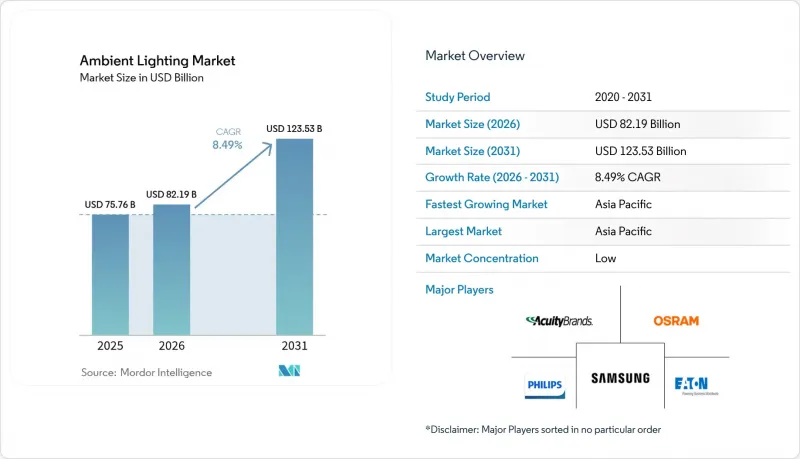
본 보고서는 제품별(램프 및 조명 기구, 조명 제어 기기), 설치 단계별(신축, 개보수·리뉴얼), 유형별(표면 장착형 조명, 트랙 조명 등), 발광량별(3,000 Lm 이하(주거용) 등), 연결 방식별(유선, 무선), 최종 사용자(주택, 자동차 등), 지역별로 분류되어 있습니다. 시장 전망은 금액(달러) 기준으로 제시되어 있습니다.
세계의 앰비언트 조명 시장 동향 및 인사이트
EU 및 호주에서 LED 개조 의무화가 상업시설의 업그레이드를 가속화하고 있습니다.
유럽연합(EU)의 에코디자인 지침이나 호주의 국가건축기준(National Construction Code)과 같은 엄격한 정책 체계로 인해 구형 조명 기구의 단계적 폐지가 시급해지고 있습니다. 현재 투자 회수보다는 규제 준수가 전환점이 되고 있으며, 건물 소유주는 최소 효율 기준을 충족하는 LED 조명 기구의 도입을 강요받고 있습니다. 의무화된 교체와 커넥티드 제어에 대한 수요 증가가 맞물리면서, 상업 부문만으로도 시장 규모는 2024년 170억 7,000만 달러에서 2030년에는 273억 8,000만 달러로 급증할 것으로 예측됩니다. 각 공급업체들은 가동 중단 시간과 인건비를 최소화하는 ‘퀵핏형 램프’, ‘드라이버리스 형광등’, 그리고 ‘현장에서 프로그래밍 가능한 개조 키트’ 등을 출시하여 이에 대응하고 있습니다.
아시아의 스마트시티 투자가 네트워크 지원 가로등 개조를 촉진
중국, 인도, 일본의 국가 차원 스마트 시티 구상에서는 적응형 가로등이 디지털 인프라의 핵심으로 자리 잡고 있습니다. 각 지자체는 기존의 고압 나트륨등을 5G 스몰 셀, 대기질 센서, 교통 카메라를 탑재할 수 있는 네트워크 연결형 LED로 교체하고 있습니다. Zigbee나 BLE Mesh와 같은 무선 프로토콜은 새로운 케이블을 매설하지 않고도 확장성을 제공하며, 이는 인구 밀도가 높은 도심에서 결정적인 요인이 되고 있습니다. 도시가 조명을 광범위한 IoT 서비스와 통합함에 따라, 오픈 API 노드를 제공하는 하드웨어 전문 기업은 유리한 입장에 있습니다.
대규모 LED 스트립 도입 시 발생하는 높은 돌입 전류로 인한 고장
다중 스트링 스트립 시스템에서는 수천 개의 드라이버가 동시에 기동할 때 장비를 손상시킬 수 있는 전류 스파이크가 발생하여, 차단기 트립이나 보증 청구로 이어질 우려가 있습니다. 소프트 스타트 전원이나 순차 제어기는 위험을 줄여주지만, 비용 증가로 이어집니다. 직선형 조명이 수백 미터에 달하는 경우가 많은 물류 허브에서는 신뢰성 문제로 인해 도입이 지연될 가능성이 있습니다.
부문 분석
램프 및 조명 기구는 여전히 수익의 기반이며, 형광등 및 할로겐등에서 LED로의 대규모 전환으로 인해 2025년에는 70.45%의 점유율을 유지할 것으로 예측됩니다. ENERGY STAR 인증 조명 기구는 백열등에 비해 전력 소비가 90% 적고 수명은 15배 길어, 유지보수 비용과 이산화탄소 배출량을 대폭 줄여줍니다. 사무실, 주택, 창고에서의 교체 수요로 인해 단가가 하락하더라도 수요는 안정적입니다.
조명 제어 시스템은 시장 성장을 가속화하는 요인으로, 연평균 9.02%의 성장이 예상됩니다. 개방형 DALI 게이트웨이, 블루투스 LE 네트워크, 클라우드 대시보드에는 에너지 관리의 범위를 넘어선 데이터 인사이트가 통합되어 있습니다. 시그니파이(Signify)의 보고서에 따르면, 2024년에는 커넥티드 시스템 및 서비스가 해당 기업의 매출의 30%를 차지할 것으로 나타나, 소프트웨어 중심의 제안에 대한 고객 수요가 증가하고 있음을 뒷받침하고 있습니다. 건축기준법에서 재실 감지 및 자연광 활용이 의무화됨에 따라, 커넥티드 제어 시스템을 위한 앰비언트 조명 시장 규모는 확대될 전망입니다.
2025년 매출의 62.35%는 소유주가 방대한 수의 구형 조명 기구를 업그레이드한 개보수 및 리노베이션 프로젝트에서 비롯되었습니다. 미국의 주택 리모델링 시장은 2022년에 6,000억 달러를 돌파했으며, 그 지출의 34%가 조명을 포함한 에너지 관련 업그레이드에 사용되었습니다. 뉴욕시의 지방법 97호(Local Law 97)와 같은 도시의 탄소 배출 상한 규제는 2025년부터 비효율성 위반에 대해 벌금을 부과함으로써 그 시급성을 높이고 있습니다. 미국 연방조달청(GSA)의 지침에서는 LED 형광등, 개조 키트 또는 조명 기구의 전면 교체가 승인된 방법으로 제시되어 있으며, 이는 대규모 교체 수요를 촉진하고 있습니다.
신축 건물 시장 규모는 비교적 작지만, 연평균 성장률(CAGR) 8.74%로 리모델링 시장을 웃도는 속도로 성장할 것으로 전망됩니다. 건축가들은 현재 설계 과정의 초기 단계에서 조명 계획을 수립하여 WELL 및 LEED 인증 포인트를 획득하는 동시에, 센서를 통합하고 시운전을 효율화하고 있습니다. 스마트 상업 단지에서는 네트워크 지원 조명 기구가 표준 사양으로 채택되고 있으며, 이를 통해 복합 용도 타워, 데이터센터, 의료시설에서의 앰비언트 조명 시장 침투가 촉진되고 있습니다. 신축 건물에서의 앰비언트 조명 시장 확대는 하드웨어와 소프트웨어를 세트로 제공하는 계약을 가능하게 하는 규모의 경제 효과에 의해서도 뒷받침되고 있습니다.
지역별 분석
아시아태평양은 2025년 매출의 45.65%를 차지했으며, 에너지 절약형 조명에 대한 정부 보조금, 주택 건설 확대, 그리고 LED 부품 생산 분야의 세계적 리더십에 힘입어 2031년까지 연평균 성장률(CAGR) 12.35%로 성장할 전망입니다. 중국은 높은 제조 능력과 커넥티드 가로등 수요를 뒷받침하는 대규모 스마트 시티 시범 프로젝트라는 두 가지 측면에서 선도적인 역할을 하고 있습니다. 인도의 ‘100개 도시 미션’과 일본의 ‘사회 5.0’ 비전은 제어 기기, 센서, 플랫폼 통합에 대한 지역적 수요 전망을 뒷받침하고 있습니다.
북미는 성숙한 시장이지만 혁신이 주도하는 분야입니다. 시그니파이(Signify)의 2024년 데이터에 따르면, 미국은 22억 달러를 차지했으며, 이 회사의 전 세계 매출의 약 3분의 1을 차지하고 있습니다. 주택 리모델링 수요는 여전히 견조하지만, 코로나19 이후 사무실 규모 축소로 인해 일부 개보수 일정이 지연되고 있습니다. WELL 및 LEED 인증 도입으로 인해 인간 중심의 업그레이드에 대한 모멘텀은 유지되고 있으며, 이를 통해 고급 조명 기구와 첨단 제어 시스템의 도입이 정당화되고 있습니다.
유럽은 디자인을 중시하고 규제가 엄격한 시장입니다. ‘에코디자인 지침’에 따라 상업시설 전반에 걸쳐 LED로의 전환이 의무화되어 있으며, 이 지역에서는 시각적 쾌적성을 중시하는 경향에 부합하는 고연색성 제품이 주류를 이루고 있습니다. 독일과 프랑스의 자동차 제조업체들은 앰비언트 조명 패키지를 저가형 차종까지 확대하고 있으며, 이에 따라 부품 공급업체들은 비용 최적화된 RGB 모듈을 제공해야 하는 압박을 받고 있습니다.
남미, 중동 및 아프리카의 합산 시장 점유율은 작지만, 견조한 성장세를 보이고 있습니다. GCC(걸프협력회의) 국가들의 호텔 및 리조트 시설 리모델링에서는 인상적인 분위기 조성이 우선시되는 반면, 아프리카의 인프라 정비 사업에서는 공공 자금이 스마트 시티로의 진입점 역할도 하는 고효율 가로등에 투입되고 있습니다. 각국 정부가 그린 빌딩 기준을 적용하고 외국인 직접 투자를 유치함에 따라, 앰비언트 조명 시장에는 장기적인 성장 여지가 넓어지고 있습니다.
기타 혜택 :
- 엑셀 형식 시장 예측(ME) 시트
- 3개월간의 애널리스트 지원
자주 묻는 질문
목차
제1장 서론
제2장 조사 방법
제3장 주요 요약
제4장 시장 구도
제5장 시장 규모 및 성장 예측
제6장 경쟁 구도
제7장 시장 기회 및 향후 전망
AJY 26.09.09According to Mordor Intelligence, the ambient lighting market size is expected to grow from USD 75.76 billion in 2025 to USD 82.19 billion in 2026 and is forecast to reach USD 123.53 billion by 2031 at 8.49% CAGR over 2026-2031.
This report is Segmented by Offering (Lamps and Luminaires, and Lighting Controls), Installation Phase (New Construction, Retrofit and Renovation), Type (Surface-Mounted Light, Track Light, Sand More), Lumen Output (<=3 000 Lm (Residential), and More), Connectivity (Wired, and Wireless), End User (Residential, Automotive, and More), and Geography. The Market Forecasts are Provided in Terms of Value (USD).
Global Ambient Lighting Market Trends and Insights
LED retrofit mandates accelerating commercial upgrades in EU and Australia
Stringent policy frameworks such as the European Union Ecodesign Directive and Australia's National Construction Code are forcing the phase-out of legacy lamps. Compliance rather than payback is now the tipping point, pushing building owners to adopt LED fixtures that satisfy minimum efficacy thresholds. The commercial segment alone is projected to jump from USD 17.07 billion in 2024 to USD 27.38 billion by 2030 as mandated upgrades converge with rising demand for connected controls. Suppliers are responding with quick-fit lamps, driverless tubes, and field-programmed retrofit kits that minimize downtime and labor costs.
Smart-city investments driving connected street-light retrofits in Asia
National smart-city missions across China, India, and Japan place adaptive street lighting at the core of digital infrastructure. Municipalities are replacing conventional high-pressure sodium fixtures with networked LEDs that can host 5G small cells, air-quality sensors, and traffic cameras. Wireless protocols such as Zigbee and BLE Mesh offer scalability without trenching new cables, a decisive factor in dense urban cores. Hardware specialists that deliver open-API nodes are well-positioned as cities bundle lighting with broader IoT services.
High inrush-current failures in large-scale LED strip deployments
Multi-string strip systems can draw damaging current spikes when thousands of drivers power up simultaneously, triggering breaker trips and warranty claims. Soft-start power supplies and sequential controllers mitigate risk but add cost. Reliability concerns may delay rollouts in logistics hubs where linear lighting often spans hundreds of meters.
Other drivers and restraints analyzed in the detailed report include:
- OEM-triggered ambient packages in mid-segment autos
- WELL and LEED v4 standards pushing human-centric lighting in US offices
- Fragmented wireless protocols elevating control-system integration cost
For complete list of drivers and restraints, kindly check the Table Of Contents.
Segment Analysis
Lamps and luminaires remain the revenue cornerstone, holding 70.45% in 2025 thanks to the mass conversion from fluorescent and halogen to LED. ENERGY STAR-rated fixtures consume 90% less power than incandescent alternatives and last 15 times longer, slashing maintenance budgets and carbon footprints. Replacement activity across offices, homes, and warehouses keeps demand stable even as unit prices fall.
Lighting controls are the market's accelerant, forecast to grow 9.02% annually. Open DALI gateways, Bluetooth LE networks, and cloud dashboards embed data insights that extend beyond energy management. Signify reports that connected systems and services delivered 30% of company sales in 2024, confirming rising customer appetite for software-centric propositions. The ambient lighting market size for connected controls is set to widen as building codes mandate occupancy sensing and daylight harvesting.
Retrofit and renovation projects generated 62.35% of 2025 revenue as owners upgraded vast stocks of outdated fixtures. The United States residential remodeling market surpassed USD 600 billion in 2022, with 34% of spend flowing into energy-related upgrades that include lighting. City carbon caps such as New York Local Law 97 amplify urgency, imposing fines starting in 2025 for inefficiency breaches. Guidance from the U.S. General Services Administration lists LED tubes, retrofit kits, or full luminaire swaps as approved pathways, fueling a deep replacement funnel.
New construction accounts for a smaller base but will outpace retrofits at 8.74% CAGR. Architects now program lighting early in design workflows to capture WELL and LEED credits, integrate sensors, and streamline commissioning. Smart commercial campuses specify network-ready fixtures as baseline, propelling ambient lighting market penetration in mixed-use towers, data centers, and healthcare facilities. Ambient lighting market size gains in new builds are also supported by economies of scale that allow bundled hardware-plus-software contracts.
Complete Report Scope:
- By Offering
- Lamps and Luminaires
- Incandescent Lamps
- Halogen Lamps
- Fluorescent Lamps
- Light-Emitting Diode (LED)
- Lighting Controls
- Lamps and Luminaires
- By Installation Phase
- New Construction
- Retrofit and Renovation
- By Type
- Surface-mounted Light
- Track Light
- Strip Light
- Suspended Light
- Recessed Light
- By Lumen Output
- Sub 3 000 lm (Residential)
- 3 001 - 10 000 lm (Commercial)
- Above10 000 lm (Industrial and Outdoor)
- By Connectivity
- Wired (DALI, KNX)
- Wireless (Zigbee, BLE Mesh, Thread)
- By End User
- Residential
- Automotive
- Hospitality and Retail
- Healthcare
- Industrial and Logistics
- By Geography
- North America
- United States
- Canada
- Mexico
- Europe
- Germany
- United Kingdom
- France
- Italy
- Spain
- Nordics
- Rest of Europe
- Asia-Pacific
- China
- Japan
- South Korea
- India
- South East Asia
- Australia
- Rest of Asia-Pacific
- South America
- Brazil
- Rest of South America
- Middle East and Africa
- Middle East
- United Arab Emirates
- Saudi Arabia
- Rest of Middle East
- Africa
- South Africa
- Rest of Africa
- Middle East
- North America
Geography Analysis
Asia Pacific controls 45.65% of 2025 revenue and will grow at 12.35% CAGR through 2031, driven by state subsidies for efficient lighting, sprawling residential construction, and global leadership in LED component production. China spearheads both manufacturing prowess and giant smart-city pilots that anchor connected street-light demand. India's 100-city mission and Japan's Society 5.0 vision reinforce the regional pipeline for controls, sensors, and platform integration.
North America is a mature but innovation-led arena. Signify's 2024 data show that the United States contributed USD 2.20 billion, roughly one-third of its global sales. Residential remodels remain strong, yet office downsizing after COVID slows some retrofit schedules. WELL and LEED adoption maintains momentum for human-centric upgrades that justify premium fixtures and advanced controls.
Europe occupies a design-centric and regulation-heavy position. The Ecodesign Directive obliges LED transitions across commercial estates, and the region champions high color-rendering products that align with its emphasis on visual comfort. Automakers in Germany and France extend ambient packages downrange, spurring component suppliers to deliver cost-optimized RGB modules.
South America and the Middle East & Africa together contribute a smaller share but post healthy growth. GCC hospitality refurbishments prioritize dramatic ambience, while African infrastructure programs channel public funds into efficient street lighting that doubles as a smart-city gateway. The ambient lighting market gains long-term upside as governments apply green-building codes and attract foreign direct investment.
- Signify N.V. (Philips Lighting)
- Acuity Brands, Inc.
- ams OSRAM AG
- Hubbell Incorporated
- Eaton Corporation plc (Cooper Lighting)
- Cree Lighting (Savant Systems)
- Zumtobel Group
- GE Lighting, a Savant company
- Panasonic Life Solutions
- Wipro Lighting
- Samsung Electronics (LED Division)
- LG Innotek
- Bridgelux, Inc.
- Helvar Oy
- Dialight plc
- Fagerhult Group
- Legrand S.A.
- Lutron Electronics
- SPI Lighting
- Amerlux, LLC
Additional Benefits:
- The market estimate (ME) sheet in Excel format
- 3 months of analyst support
TABLE OF CONTENTS
1 INTRODUCTION
- 1.1 Study Assumptions and Market Definition
- 1.2 Scope of the Study
2 RESEARCH METHODOLOGY
3 EXECUTIVE SUMMARY
4 MARKET LANDSCAPE
- 4.1 Market Overview
- 4.2 Market Drivers
- 4.2.1 LED Retrofit Mandates Accelerating Commercial Up-grades in EU and Australia
- 4.2.2 Smart-city Investments Driving Connected Street-light Retrofits in Asia
- 4.2.3 OEM-Triggered Ambient Packages in Mid-segment Autos (Asia and Europe)
- 4.2.4 WELL and LEED v4 Standards Pushing Human-Centric Lighting in United States Offices
- 4.2.5 Hospitality Re-brand Cycles Increasing Aesthetic Ambient Budgets (Gulf Cooperation Council Countries)
- 4.2.6 Rapid e-commerce Warehouse Build-outs Needing Low-glare Luminaires
- 4.3 Market Restraints
- 4.3.1 High Inrush-Current Failures in Large-scale LED Strip Deployments
- 4.3.2 Fragmented Wireless Protocols Elevating Control-System Integration Cost
- 4.3.3 Post-COVID Office Downsizing Reducing Retrofit Pipelines (NA and EU)
- 4.3.4 Tight Rare-earth Supply Chain Inflating Phosphor and Driver Prices
- 4.4 Industry Ecosystem Analysis
- 4.5 Technological Outlook
- 4.6 Porter's Five Forces Analysis
- 4.6.1 Bargaining Power of Suppliers
- 4.6.2 Bargaining Power of Buyers
- 4.6.3 Threat of New Entrants
- 4.6.4 Threat of Substitutes
- 4.6.5 Competitive Rivalry
5 MARKET SIZE AND GROWTH FORECASTS (VALUES)
- 5.1 By Offering
- 5.1.1 Lamps and Luminaires
- 5.1.1.1 Incandescent Lamps
- 5.1.1.2 Halogen Lamps
- 5.1.1.3 Fluorescent Lamps
- 5.1.1.4 Light-Emitting Diode (LED)
- 5.1.2 Lighting Controls
- 5.1.1 Lamps and Luminaires
- 5.2 By Installation Phase
- 5.2.1 New Construction
- 5.2.2 Retrofit and Renovation
- 5.3 By Type
- 5.3.1 Surface-mounted Light
- 5.3.2 Track Light
- 5.3.3 Strip Light
- 5.3.4 Suspended Light
- 5.3.5 Recessed Light
- 5.4 By Lumen Output
- 5.4.1 Sub 3 000 lm (Residential)
- 5.4.2 3 001 - 10 000 lm (Commercial)
- 5.4.3 Above10 000 lm (Industrial and Outdoor)
- 5.5 By Connectivity
- 5.5.1 Wired (DALI, KNX)
- 5.5.2 Wireless (Zigbee, BLE Mesh, Thread)
- 5.6 By End User
- 5.6.1 Residential
- 5.6.2 Automotive
- 5.6.3 Hospitality and Retail
- 5.6.4 Healthcare
- 5.6.5 Industrial and Logistics
- 5.7 By Geography
- 5.7.1 North America
- 5.7.1.1 United States
- 5.7.1.2 Canada
- 5.7.1.3 Mexico
- 5.7.2 Europe
- 5.7.2.1 Germany
- 5.7.2.2 United Kingdom
- 5.7.2.3 France
- 5.7.2.4 Italy
- 5.7.2.5 Spain
- 5.7.2.6 Nordics
- 5.7.2.7 Rest of Europe
- 5.7.3 Asia-Pacific
- 5.7.3.1 China
- 5.7.3.2 Japan
- 5.7.3.3 South Korea
- 5.7.3.4 India
- 5.7.3.5 South East Asia
- 5.7.3.6 Australia
- 5.7.3.7 Rest of Asia-Pacific
- 5.7.4 South America
- 5.7.4.1 Brazil
- 5.7.4.2 Rest of South America
- 5.7.5 Middle East and Africa
- 5.7.5.1 Middle East
- 5.7.5.1.1 United Arab Emirates
- 5.7.5.1.2 Saudi Arabia
- 5.7.5.1.3 Rest of Middle East
- 5.7.5.2 Africa
- 5.7.5.2.1 South Africa
- 5.7.5.2.2 Rest of Africa
- 5.7.5.1 Middle East
- 5.7.1 North America
6 COMPETITIVE LANDSCAPE
- 6.1 Market Concentration
- 6.2 Strategic Moves
- 6.2.1 Rest of Middle East and Africa
- 6.3 Market Share Analysis
- 6.4 Company Profiles (includes Global-level Overview, Market-level Overview, Core Segments, Financials as available, Strategic Information, Market Rank/Share, Products and Services, Recent Developments)
- 6.4.1 Signify N.V. (Philips Lighting)
- 6.4.2 Acuity Brands, Inc.
- 6.4.3 ams OSRAM AG
- 6.4.4 Hubbell Incorporated
- 6.4.5 Eaton Corporation plc (Cooper Lighting)
- 6.4.6 Cree Lighting (Savant Systems)
- 6.4.7 Zumtobel Group
- 6.4.8 GE Lighting, a Savant company
- 6.4.9 Panasonic Life Solutions
- 6.4.10 Wipro Lighting
- 6.4.11 Samsung Electronics (LED Division)
- 6.4.12 LG Innotek
- 6.4.13 Bridgelux, Inc.
- 6.4.14 Helvar Oy
- 6.4.15 Dialight plc
- 6.4.16 Fagerhult Group
- 6.4.17 Legrand S.A.
- 6.4.18 Lutron Electronics
- 6.4.19 SPI Lighting
- 6.4.20 Amerlux, LLC
7 MARKET OPPORTUNITIES AND FUTURE OUTLOOK
- 7.1 White-space and Unmet-need Assessment