

|
시장보고서
상품코드
2122887
재봉틀 시장 : 시장 점유율 분석, 업계 동향 및 통계, 성장 예측(2026-2031년)Sewing Machines - Market Share Analysis, Industry Trends & Statistics, Growth Forecasts (2026 - 2031) |
||||||
 Mordor Intelligence
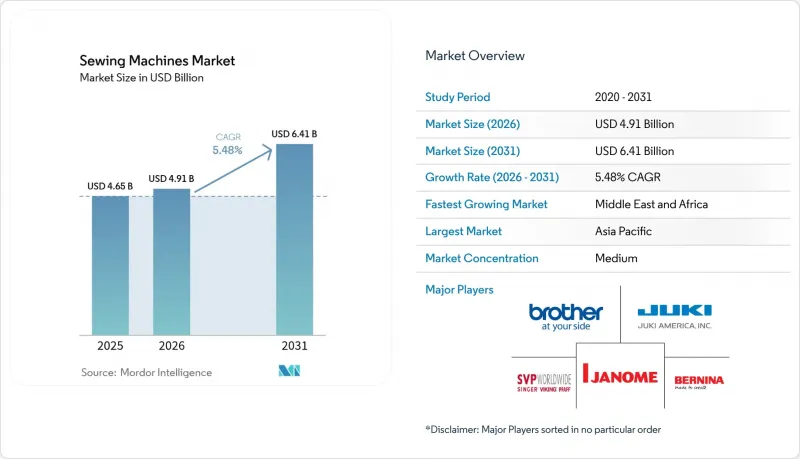
재봉틀 시장 규모는 2026년에 49억 1,000만 달러로 추정되고, 2025년 46억 5,000만 달러에서 확대해, 2031년에는 64억 1,000만 달러에 이를 것으로 예측됩니다.
2026-2031년 연평균 성장률(CAGR) 5.48%로 성장할 것으로 전망됩니다.
본 보고서는 기계 유형별(수동식, 전동식 등), 용도별(의류, 의류 외 섬유 제품 등), 최종 사용자별(가정용, 산업용), 유통 채널별(B2C/소매, B2B/제조업체 직접 판매), 지역별(북미, 남미 등)로 분류되어 있습니다. 시장 전망은 금액(달러) 기준으로 제시되어 있습니다.
세계의 재봉틀 시장 동향 및 인사이트
아시아태평양의 의류 제조 급속한 확대
아시아는 정부의 지원책과 수출 지향적 전략에 힘입어 의류 생산량에서 다른 어떤 지역보다 높은 성장률을 지속적으로 유지하고 있습니다. 인도만 해도 2030년까지 섬유 제품 수출액을 3,500억 달러로 늘리겠다는 목표를 세우고 있으며, 이에 따라 고처리량 재봉틀 라인의 대량 조달이 진행되고 있습니다. 기능성 섬유를 대상으로 한 생산 연계형 지원 제도 덕분에, 수작업이 필요 없고 다양한 원단 중량에 대응할 수 있는 자동화 재봉기의 투자 회수 기간이 단축되고 있습니다. 기존의 저비용 생산 거점에서의 임금 상승으로 인해, 제조업체들은 인건비를 상쇄할 수 있는 서보 모터와 프로그래밍 가능한 스티치 패턴을 갖춘 기종으로의 전환을 추진하고 있습니다. 베트남과 방글라데시에 공장이 집적됨에 따라 애프터서비스 물류가 간소화되고, 공급업체들이 지역 서비스 거점을 설치하는 데 박차를 가하고 있습니다. 주문이 기본적인 티셔츠에서 부가가치가 높은 애슬레저 및 정장 의류로 이동함에 따라, 복잡한 봉제 구조와 디지털 플래튼 조정이 가능한 재봉틀에 대한 수요가 증가하고 있습니다.
성숙한 경제권에서의 DIY·공예 문화의 부활
Z세대 소비자들은 가정에서의 바느질을 나만의 패션을 실현하고 섬유 폐기물을 줄이는 수단으로 여기고 있으며, 소셜 미디어상의 튜토리얼이 이러한 관심을 구체적인 재봉틀 판매로 이어지게 하고 있습니다. 소매업체들은 현재 입문용 재봉틀과 다운로드 가능한 패턴을 결합한 초보자용 세트를 엄선해 제공함으로써 학습 장벽을 낮추고 있습니다. 팬데믹 기간에 확산된 취미 활동은 봉쇄 조치가 해제된 후에도 스트레스 해소 습관으로 자리 잡았으며, 다른 주택 개량 관련 카테고리가 정상화되더라도 소매 판매율은 높은 수준을 유지하고 있습니다. 작은 아파트에도 들어갈 수 있는 컴팩트한 디자인과 스마트폰 같은 터치스크린은 디지털 네이티브 세대의 마음을 사로잡고 있으며, 브랜드는 기계적인 복잡성보다 직관적인 사용자 경험(UX)을 우선시할 수밖에 없게 되었습니다. Etsy와 같은 수공예품 리셀러 플랫폼의 부상은 이러한 취미를 더욱 수익화시키고, 사용자가 기본 기능의 한계를 넘어서면 기기 업그레이드를 촉진하고 있습니다.
산업용 기계에 대한 막대한 초기 투자
벤더가 제공하는 금융 옵션은 존재하지만, 이는 하드웨어에만 적용되며 교육이나 유지보수는 금융 패키지의 대상에서 제외됩니다. 은행은 담보를 요구하는 경우가 많지만, 소규모 공방에는 그럴 여력이 없어 현대화 주기가 지연되고, 생산 현장에서는 10년 전의 록 스티치 재봉틀을 계속 사용하는 상황이 벌어지고 있습니다. 브랜드가 봉제 강도나 디지털 추적성에 대해 엄격한 공차를 요구하는 가운데, 투자를 미루는 것은 경쟁력을 저하시키고 있습니다. 2024년 JUKI가 도입한 리스 프로그램은 베트남에서는 조기에 채택되었으나, 다른 지역에서는 여전히 생소한 개념으로 남아 있습니다. 그 원인 중 하나로, 사업자들이 독자적인 소프트웨어 생태계에 장기적으로 얽매이는 것을 우려하고 있다는 점을 들 수 있습니다.
부문 분석
2025년에는 전동 모델이 매출의 64.35%를 차지했으며, 공장이나 가정을 불문하고 그 높은 범용성이 두드러지고 있습니다. 많은 산업용 구매자들은 이 부문을 완전 자동화를 향한 과도기적 단계로 간주하고 있으며, 서보 드라이브나 반자동 실 자르기 장치를 추가하여 재봉기의 수명을 연장하고 있습니다. 한편, 공장이 안정적인 봉제 품질과 재작업 감소를 추구하는 가운데, 자동 재봉기는 2031년까지 연평균 성장률(CAGR) 6.62%로 성장할 전망입니다. 자동화 시스템용 재봉틀 시장 규모는 확대되고 있으며, 이는 스포츠웨어 및 기능성 섬유 제조 공장 수요 증가를 반영하고 있습니다. 한편, 전력 공급이 불안정한 지역에서는 여전히 수동식 재봉틀이 사용되고 있으며, 촉감을 통한 조작을 중시하는 장인들 사이에서 확고한 틈새 시장을 구축하고 있습니다.
전동식 부문이 계속해서 우위를 점하고 있는 이유는 풍부한 교체 부품과 작업자들 사이에서 널리 친숙하게 여겨져 교육 기간이 단축되기 때문입니다. 싱어(Singer)사의 Wi-Fi 지원 모델 ‘M3330’은 기존 카테고리가 완전한 CNC의 복잡함에 섣불리 뛰어들지 않으면서도 스마트 기능을 어떻게 도입하고 있는지를 보여줍니다. 유압 구동 퀼팅 재봉기는 ‘기타’ 카테고리를 차지하고 있으며, 매트리스 제조 분야에서 성공을 거두며 튀르키예와 폴란드 등으로 지리적 진출 범위를 확대되고 있습니다. 전동식과 보급형 자동화 시스템 간의 가격 차이는 18%까지 좁혀졌으며, 이는 CFO가 업그레이드를 승인하기 시작하는 기준점이 되고 있습니다.
의류 분야는 패스트 패션 대기업 및 유니폼 공급업체로부터의 막대한 수주량 덕분에 2025년 매출에서 57.85%라는 압도적인 점유율을 유지했습니다. 스트레치 소재에는 차동 이송 오버록 재봉틀이 필요하기 때문에 스포츠웨어 부문이 탄력을 받고 있으며, OEM 각사는 전용 압착 발을 세트로 판매하고 있습니다. 커튼과 쿠션 커버를 포함한 홈 텍스타일은 주택 소유자들이 개성 있는 인테리어에 투자하는 경향이 강해짐에 따라 연평균 성장률(CAGR) 6.69%로 가장 빠르게 성장하는 틈새 시장이 되었습니다. 홈 텍스타일 용도에서 재봉기 시장 점유율은 2024년부터 2025년에 걸쳐 120베이시스포인트 상승하여, 가정 내 맞춤 제작으로의 지속적인 전환을 보여주고 있습니다. 자동차 내장재, 의료용 일회용 제품, 산업용 필터가 비의류 분야를 구성하고 있으며, 각각 견고한 바늘과 보강된 작업대가 필요합니다.
지속 가능한 인테리어에 대한 소비자의 선호도가 높아지면서 프리미엄 원사에 대한 수요가 확대되고 있습니다. 이에 따라 친환경 염색 원사를 공급하는 American &Efird와 같은 자회사들이 혜택을 보고 있습니다. 카시트 제조업체들은 초당 40스티치의 바택 기능을 사양으로 요구하고 있어, 고토크 서보 모터를 통합할 수 있는 공급업체들에게 비즈니스 기회가 생기고 있습니다. 의료용 개인보호구(PPE)(PPE) 분야에서는 초음파 봉제의 대체 기술이 부상하고 있지만, 규제 당국의 감사에서는 중요한 가운의 경우 여전히 솔기가 있는 접합부가 선호되고 있습니다. 인도 도시 지역의 가처분 소득 증가에 따라, 사용자가 재택 비즈니스로 수익을 창출할 수 있는 자수 전용 재봉틀 시장이 확대되고 있습니다. 이러한 다각화를 통해 의류 제조 분야의 경기 순환적 침체가 완화되어, 의류 시장이 침체기에 있더라도 OEM의 수익을 안정적으로 유지할 수 있습니다.
지역별 분석
2025년에 아시아태평양이 매출의 50.60%를 차지한 것으로 평가되는 것은 섬유에서 패션에 이르는 밸류체인에서 이 지역의 독보적인 규모와 중산층의 소비 확대를 반영한 것입니다. 인도에서는 설비 투자액의 최대 15%를 환급해 주는 ‘생산 연계형 인센티브(PLI)’ 도입이 계속되고 있으며, 이에 따라 방적 공장은 급속한 현대화를 추진하고 있습니다. 중국의 OEM 제조업체들은 세계 브랜드를 대상으로 서보 부품 및 인간-기계 인터페이스를 점점 더 많이 공급하고 있어, 기능 업데이트 리드타임을 단축하고 있습니다. 베트남의 의류 수출 증가에 힘입어 각 공급업체들은 호치민시에 서비스 창고를 건설하고 있으며, 이를 통해 예비 부품 교체에 소요되는 가동 중단 시간이 단축되고 있습니다. 또한, 이 지역에서는 공예 취미에 대한 소비자의 열기가 높아지고 있어, 자카르타와 방콕의 소매 체인점에서는 보급형 가정용 기기의 매출이 두 자릿수 성장률을 기록하고 있습니다.
중동 및 아프리카는 가장 빠르게 성장하고 있으며, 연평균 성장률(CAGR)은 6.89%로 예측됩니다. 이는 이집트의 수에즈 운하 경제특구와 같이, 산업단지와 관세 면제를 결합한 인프라 회랑에 힘입은 결과입니다. 에티오피아의 하와사 산업단지에는 이미 25개의 의류 제조업체가 입주해 있으며, 세관 데이터에 따르면 2024년에 이들 기업이 총 5,000대 이상의 프로그래머블 락 스티치 재봉기를 수입했습니다. 걸프협력회의(GCC) 회원국들은 ‘비전 2030’ 계획에 따라 섬유 산업 투자를 장려하고 있으며, 사우디아라비아는 통합형 공장을 위해 5억 달러의 자금을 배정했습니다. 아프리카 소비자 시장도 성숙해 가고 있으며, 나이지리아의 전자상거래 플랫폼에서는 현재 중가대의 휴대용 모델이 판매되고 있어, 명절 시즌에는 매진될 정도입니다. 과제는 인재 양성에 있으며, 각 OEM 기업들은 나이로비나 아크라의 직업 훈련 기관과 제휴하여 작업자에게 기본적인 유지보수 자격을 부여하고 있습니다.
북미에서는 현지 생산 의류를 중시하는 소비자와 예측 불가능한 태평양 횡단 운송에 직면한 브랜드를 원동력으로 삼아 국내 생산이 부활하고 있습니다. 나이키 등의 브랜드는 오리건주에서 여러 소재를 재봉할 수 있는 CNC 재봉틀 헤드를 채택한 자동화 라인의 시범 운영을 진행하고 있습니다. 노스캐롤라이나주와 사우스캐롤라이나주에서는 주 차원의 보조금을 통해 스마트 팩토리로의 업그레이드를 추진하는 유서 깊은 공장의 설비 구매를 지원하고 있습니다. 캐나다의 의류 중소기업들은 최종 사용자가 맞춤형 패턴을 디자인할 수 있는 온라인 컨피규레이터를 도입하고 있으며, 이로 인해 디지털 입력 파일을 지원하는 기계에 대한 수요가 간접적으로 증가하고 있습니다. 멕시코는 신속한 대응이 요구되는 소매 모델에 부응하기 위해, 미국 바이어들이 인근 지역에서 조달함으로써 파급 효과를 통해 혜택을 얻고 있습니다.
유럽에서는 성숙한 산업 기반과 설비 사양을 재정의하는 최첨단 지속가능성 정책이 융합되고 있습니다. 2027년까지 시행될 에코디자인 지침에 따라 기계 수준에서 정확한 에너지 소비량 측정이 의무화됨에 따라, 각 OEM 업체들은 고효율 서보 모터로의 전환을 요구받고 있습니다. 독일은 자동차 및 항공우주용 테크니컬 텍스타일 분야에서 계속해서 주도적인 입지를 차지하고 있으며, 이로 인해 내구성이 뛰어난 프로그래밍 가능한 바트타커에 대한 수요가 증가하고 있습니다. 이탈리아의 명품 패션 브랜드들은 ‘메이드 인 이탈리아’의 진정성을 유지하기 위해 자동화 설비와 병행하여 전문 수동 자수기를 운영하고 있습니다. 루마니아와 불가리아 등 동유럽의 공장들은 물류 불안정으로 인해 아시아에서 이전된 주문을 확보하고 있어, 기계 설비의 급속한 확충이 요구되고 있습니다.
남미에서는 브라질 산타카타리나주에 위치한 의류 산업 클러스터가 현대화를 추진하고 있으며, 전기 요금 급등에 따라 서보 모터로 개조하여 에너지 절약을 도모하고 있어 꾸준한 성장세를 보이고 있습니다. 우루과이와 파라과이는 설비 수요의 현지화로 이어지는 ‘면화에서 의류까지’의 일관 생산 복합 시설 건설을 위해 중국 투자자를 유치하고 있습니다. 한편, 칠레에서는 전자상거래의 보급에 따라 좁은 아파트에 맞추어 설계된 소형 가정용 재봉틀을 선호하는 애호가들 수요가 증가하고 있습니다. 환율 변동은 여전히 주요 걸림돌로 작용하고 있으며, 수입 재봉틀 구매 결정은 환율이 안정될 때까지 미뤄지는 경우가 많습니다.
기타 혜택 :
- 엑셀 형식 시장 예측(ME) 시트
- 3개월간의 애널리스트 지원
자주 묻는 질문
목차
제1장 서론
제2장 조사 방법
제3장 주요 요약
제4장 시장 구도
제5장 시장 규모 및 성장 예측
제6장 경쟁 구도
제7장 시장 기회 및 향후 전망
AJY 26.09.09According to Mordor Intelligence, sewing machine market size in 2026 is estimated at USD 4.91 billion, growing from 2025 value of USD 4.65 billion with 2031 projections showing USD 6.41 billion, growing at 5.48% CAGR over 2026-2031.
This report is Segmented by Machine Type (Manual, Electric, and More), by Application (Apparel, Non-Apparel Textiles, and More), by End-User (Residential and Industrial), by Distribution Channel (B2C/Retail and B2B/Directly From the Manufacturers), and by Geography (North America, South America, and More). The Market Forecasts are Provided in Terms of Value (USD).
Global Sewing Machines Market Trends and Insights
Rapid Apparel-Manufacturing Expansion in Asia-Pacific
Asia continues to outpace every other region in apparel output, fueled by public incentives and export-oriented strategies. India alone targets USD 350 billion in textile exports by 2030, stimulating bulk procurement of high-throughput sewing lines . Production-linked schemes covering technical textiles lower the payback period on automated machines that handle multiple fabric weights without manual intervention. Growing wages in legacy low-cost centers push manufacturers toward units with servo motors and programmable stitch patterns that offset labor costs. Factory clustering in Vietnam and Bangladesh simplifies after-sales logistics, encouraging suppliers to embed regional service hubs. As orders shift from basic tees to higher-value athleisure and formalwear, demand tilts toward machines capable of complex seam constructions and digital platen adjustments.
DIY & Craft Culture Revival in Mature Economies
Gen Z consumers view home sewing as a route to personalized fashion and lower textile waste, and social media tutorials convert that interest into measurable hardware sales. Retailers now curate starter bundles that pair entry-level machines with downloadable patterns, easing the learning curve. Pandemic-era hobby adoption has persisted post-lockdown as a stress-relief habit, keeping retail sell-through high even as other home-improvement categories normalize. Compact form factors that fit small apartments and smartphone-like touchscreens resonate with digital natives, forcing brands to prioritize intuitive UX over mechanical complexity. The rising tide of reseller platforms for handmade items, such as Etsy, further monetizes the hobby, reinforcing equipment upgrades once users outgrow basic functions.
High Capital Outlay for Industrial Machines
Vendor financing options exist yet cover only the hardware, leaving training and maintenance outside loan packages. Banks often require collateral that small workshops lack, delaying modernization cycles and leaving production stuck with 10-year-old lockstitch units. Deferred investment saps competitiveness when brands demand tight tolerances on seam strength and digital traceability. Leasing programs introduced by JUKI in 2024 showed early adoption in Vietnam but remain a novelty elsewhere, partly because operators fear long-term commitment to proprietary software ecosystems.
Other drivers and restraints analyzed in the detailed report include:
- Advancements in IoT-Enabled and CNC Sewing Machines
- Industrial Automation Push for Productivity
- Shortage of Skilled Operators
For complete list of drivers and restraints, kindly check the Table Of Contents.
Segment Analysis
Electric models accounted for 64.35% of revenue in 2025, underscoring their versatility for factories and households alike. Many industrial buyers regard the segment as an interim step toward full automation, adding servo drives and semi-automatic thread cutters to stretch machine life cycles. Automated units, meanwhile, are slated to expand at 6.62% CAGR through 2031 as factories chase consistent stitch quality and lower rework. The sewing machine market size for automated systems is growing, reflecting rising demand from sportswear and technical-textile plants. Manual machines linger in regions with unstable electricity grids, carving out a defensible niche among artisans who prize tactile control.
Continued dominance of the electric segment derives from abundant spare parts and universal familiarity among operators, decreasing training periods. Singer's Wi-Fi-ready M3330 illustrates how traditional categories absorb smart features without jumping to full CNC complexity. Hydraulically actuated quilting machines populate the "other" category and find success in mattress manufacturing, expanding geographic penetration into Turkey and Poland. Price gaps between electric and entry-level automated systems have narrowed to 18%, a threshold at which CFOs start green-lighting upgrades.
Apparel retained a commanding 57.85% slice of 2025 revenue due to vast order volumes from fast-fashion giants and uniform suppliers. Sportswear gains traction as stretch fabrics require differential-feed overlockers, prompting OEMs to bundle specialized presser feet. Home textiles, including curtains and cushion covers, represent the fastest-growing niche with a 6.69% CAGR as homeowners invest in personalized decor. The sewing machine market share for home-textile applications rose 120 basis points between 2024 and 2025, signaling a durable shift toward at-home customization. Automotive upholstery, medical disposables, and industrial filters round out the non-apparel group, each demanding heavy-duty needles and reinforced work tables.
Consumer preference for sustainable interiors boosts premium thread demand, benefiting subsidiaries like American & Efird that supply eco-dyed yarns. Car seat makers specify bar-tacking capabilities at 40 stitches per second, creating opportunities for providers that can integrate high-torque servo motors. In medical PPE, ultrasonic sewing alternatives compete, yet regulatory audits still favor stitched seams for critical gowns. Rising disposable income in urban India grows the market for embroidery-only machines that let users monetize home businesses. This diversification smooths cyclical dips in garment manufacturing, cushioning OEM revenue during apparel slowdowns.
Complete Report Scope:
- By Machine Type
- Manual
- Electric
- Automated
- Other Machine Types
- By Application
- Apparel & Fashion
- Non-apparel Textiles (Automotive, Upholstery)
- Footwear & Leather Goods
- Home Textiles & Crafts
- Other Applications
- By End User
- Residential
- Industrial
- By Distribution Channel
- B2C/Retail
- Multi-brand Stores
- Exclusive Brand Outlets
- Online
- Other Distribution Channels
- B2B/Directly from the Manufacturers
- B2C/Retail
- By Geography
- North America
- Canada
- United States
- Mexico
- South America
- Brazil
- Peru
- Chile
- Argentina
- Rest of South America
- Europe
- United Kingdom
- Germany
- France
- Spain
- Italy
- BENELUX (Belgium, Netherlands, Luxembourg)
- NORDICS (Denmark, Finland, Iceland, Norway, Sweden)
- Rest of Europe
- Asia-Pacific
- India
- China
- Japan
- Australia
- South Korea
- South-East Asia (Singapore, Malaysia, Thailand, Indonesia, Vietnam, Philippines)
- Rest of Asia-Pacific
- Middle East and Africa
- United Arab Emirates
- Saudi Arabia
- South Africa
- Nigeria
- Rest of Middle East and Africa
- North America
Geography Analysis
Asia-Pacific's 50.60% revenue leadership in 2025 reflects its unmatched scale in fiber-to-fashion value chains and ascending middle-class consumption. India continues to roll out Production Linked Incentives that reimburse up to 15% of capital investment, prompting mills to modernize quickly . Chinese OEMs increasingly supply servo components and human-machine interfaces to global brands, shortening lead times for feature updates. Vietnam's apparel export growth encourages suppliers to build service warehouses in Ho Chi Minh City, reducing downtime for spare-part replacements. The region also witnesses swelling consumer enthusiasm for craft hobbies, as retail chains in Jakarta and Bangkok report double-digit sales lift for entry-level home units.
The Middle East and Africa grows the fastest, projected at 6.89% CAGR, supported by infrastructure corridors like Egypt's Suez Canal Economic Zone that bundle industrial parks with duty exemptions. Ethiopia's Hawassa Industrial Park already houses 25 apparel manufacturers that collectively imported more than 5,000 programmable lockstitch machines in 2024 according to customs data. Gulf Cooperation Council states encourage textile investments under Vision-2030 plans, with Saudi Arabia earmarking USD 500 million loans for integrated mills. African consumer markets also mature; Nigeria's e-commerce platforms now list mid-range portable models that sell out during festival seasons. The challenge lies in training; OEMs partner with vocational institutes in Nairobi and Accra to certify operators on basic maintenance.
North America experiences a revival in domestic making, powered by consumers who value locally produced garments and by brands facing unpredictable trans-Pacific freight. Brands such as Nike pilot automated lines in Oregon that rely on CNC sewing heads capable of multi-material stitching. State-level grants in North Carolina and South Carolina subsidize equipment purchases for legacy mills upgrading to smart factories. Canada's apparel SMEs embrace online configurators that allow end-users to design custom patterns, indirectly boosting demand for machines that accept digital input files. Mexico secures spill-over benefits as US buyers near-source to comply with quick-response retail models.
Europe blends mature industrial bases with avant-garde sustainability policies that redefine equipment specifications. Eco-design directives coming into force by 2027 will require precise energy-consumption metrics at the machine level, nudging OEMs toward high-efficiency servo motors. Germany continues to lead in technical textiles for automotive and aerospace, prompting demand for heavy-duty programmable bartackers. Italy's luxury fashion houses employ specialized hand-guided embroiderers alongside automated equipment to uphold "Made in Italy" authenticity. Eastern European factories in Romania and Bulgaria win orders redirected from Asia due to logistics volatility, necessitating rapid scale-up in machine fleets.
South America exhibits steady momentum as Brazil's garment cluster in Santa Catarina modernizes, deploying servo-motor retrofits to capture energy savings under rising electricity tariffs. Uruguay and Paraguay court Chinese investors for integrated cotton-to-apparel complexes that could localize equipment demand. Meanwhile, Chile's e-commerce penetration fosters hobbyist uptake of compact home machines designed for small apartments. Currency fluctuations remain the principal headwind, often delaying purchase decisions for imported machines until exchange rates stabilize.
- Brother Industries, Ltd.
- JUKI Corporation
- SVP Worldwide (Singer(R), Husqvarna Viking(R), Pfaff(R))
- Janome Sewing Machine Co., Ltd.
- Bernina International AG
- Mitsubishi Electric Corp. (Industrial Sewing Machinery)
- Jack Sewing Machine Co., Ltd.
- Pegasus Sewing Machine Mfg. Co., Ltd.
- Toyota Industries Corp. (TACHINO)
- Baby Lock / Tacony Corporation
- Zoje Sewing Machine Co., Ltd.
- Feiyue Group Co., Ltd.
- Union Special LLC
- Rimoldi & CF
- SunStar Co., Ltd.
- Yamato Sewing Machine Mfg. Co., Ltd.
- Typical Sewing Machine Co., Ltd.
- Seiko Sewing Machine Co., Ltd.
- Merrow Sewing Machine Company
Additional Benefits:
- The market estimate (ME) sheet in Excel format
- 3 months of analyst support
TABLE OF CONTENTS
1 Introduction
- 1.1 Study Assumptions & Market Definition
- 1.2 Scope of the Study
2 Research Methodology
3 Executive Summary
4 Market Landscape
- 4.1 Market Overview
- 4.2 Market Drivers
- 4.2.1 Rapid apparel-manufacturing expansion in APAC
- 4.2.2 DIY & craft culture revival in mature economies
- 4.2.3 Advancements in IoT-enabled and CNC sewing machines
- 4.2.4 Industrial automation push for productivity
- 4.2.5 Near-shoring boosts demand for small-batch industrial units
- 4.2.6 Sustainability-driven "repair & reuse" consumer movement
- 4.3 Market Restraints
- 4.3.1 High capital outlay for industrial machines
- 4.3.2 Proliferation of low-cost refurbished units
- 4.3.3 Electronics supply-chain bottlenecks (MCUs, servos)
- 4.3.4 Shortage of skilled operators for advanced models
- 4.4 Industry Value Chain Analysis
- 4.5 Porter's Five Forces Analysis
- 4.5.1 Threat of New Entrants
- 4.5.2 Bargaining Power of Suppliers
- 4.5.3 Bargaining Power of Buyers
- 4.5.4 Threat of Substitutes
- 4.5.5 Competitive Rivalry
- 4.6 Insights into the Latest Trends and Innovations in the Market
- 4.7 Insights on Recent Developments (New Product Launches, Strategic Initiatives, Investments, Partnerships, JVs, Expansion, M&As, etc.) in the Market
5 Market Size & Growth Forecasts
- 5.1 By Machine Type
- 5.1.1 Manual
- 5.1.2 Electric
- 5.1.3 Automated
- 5.1.4 Other Machine Types
- 5.2 By Application
- 5.2.1 Apparel & Fashion
- 5.2.2 Non-apparel Textiles (Automotive, Upholstery)
- 5.2.3 Footwear & Leather Goods
- 5.2.4 Home Textiles & Crafts
- 5.2.5 Other Applications
- 5.3 By End User
- 5.3.1 Residential
- 5.3.2 Industrial
- 5.4 By Distribution Channel
- 5.4.1 B2C/Retail
- 5.4.1.1 Multi-brand Stores
- 5.4.1.2 Exclusive Brand Outlets
- 5.4.1.3 Online
- 5.4.1.4 Other Distribution Channels
- 5.4.2 B2B/Directly from the Manufacturers
- 5.4.1 B2C/Retail
- 5.5 By Geography
- 5.5.1 North America
- 5.5.1.1 Canada
- 5.5.1.2 United States
- 5.5.1.3 Mexico
- 5.5.2 South America
- 5.5.2.1 Brazil
- 5.5.2.2 Peru
- 5.5.2.3 Chile
- 5.5.2.4 Argentina
- 5.5.2.5 Rest of South America
- 5.5.3 Europe
- 5.5.3.1 United Kingdom
- 5.5.3.2 Germany
- 5.5.3.3 France
- 5.5.3.4 Spain
- 5.5.3.5 Italy
- 5.5.3.6 BENELUX (Belgium, Netherlands, Luxembourg)
- 5.5.3.7 NORDICS (Denmark, Finland, Iceland, Norway, Sweden)
- 5.5.3.8 Rest of Europe
- 5.5.4 Asia-Pacific
- 5.5.4.1 India
- 5.5.4.2 China
- 5.5.4.3 Japan
- 5.5.4.4 Australia
- 5.5.4.5 South Korea
- 5.5.4.6 South-East Asia (Singapore, Malaysia, Thailand, Indonesia, Vietnam, Philippines)
- 5.5.4.7 Rest of Asia-Pacific
- 5.5.5 Middle East and Africa
- 5.5.5.1 United Arab Emirates
- 5.5.5.2 Saudi Arabia
- 5.5.5.3 South Africa
- 5.5.5.4 Nigeria
- 5.5.5.5 Rest of Middle East and Africa
- 5.5.1 North America
6 Competitive Landscape
- 6.1 Market Concentration
- 6.2 Strategic Moves
- 6.3 Market Share Analysis
- 6.4 Company Profiles (includes Global level Overview, Market level overview, Core Segments, Financials as available, Strategic Information, Market Rank/Share for key companies, Products & Services, and Recent Developments)
- 6.4.1 Brother Industries, Ltd.
- 6.4.2 JUKI Corporation
- 6.4.3 SVP Worldwide (Singer(R), Husqvarna Viking(R), Pfaff(R))
- 6.4.4 Janome Sewing Machine Co., Ltd.
- 6.4.5 Bernina International AG
- 6.4.6 Mitsubishi Electric Corp. (Industrial Sewing Machinery)
- 6.4.7 Jack Sewing Machine Co., Ltd.
- 6.4.8 Pegasus Sewing Machine Mfg. Co., Ltd.
- 6.4.9 Toyota Industries Corp. (TACHINO)
- 6.4.10 Baby Lock / Tacony Corporation
- 6.4.11 Zoje Sewing Machine Co., Ltd.
- 6.4.12 Feiyue Group Co., Ltd.
- 6.4.13 Union Special LLC
- 6.4.14 Rimoldi & CF
- 6.4.15 SunStar Co., Ltd.
- 6.4.16 Yamato Sewing Machine Mfg. Co., Ltd.
- 6.4.17 Typical Sewing Machine Co., Ltd.
- 6.4.18 Seiko Sewing Machine Co., Ltd.
- 6.4.19 Merrow Sewing Machine Company
7 Market Opportunities & Future Outlook
- 7.1 Growing demand for compact and portable sewing machines
- 7.2 Increasing prevalence of smart (integration of IoT and AI) and computerized sewing machines


