|
시장보고서
상품코드
2122904
자동 식별 시스템(AIS) : 시장 점유율 분석, 업계 동향 및 통계, 성장 예측(2026-2031년)Automatic Identification System - Market Share Analysis, Industry Trends & Statistics, Growth Forecasts (2026 - 2031) |
||||||
 Mordor Intelligence
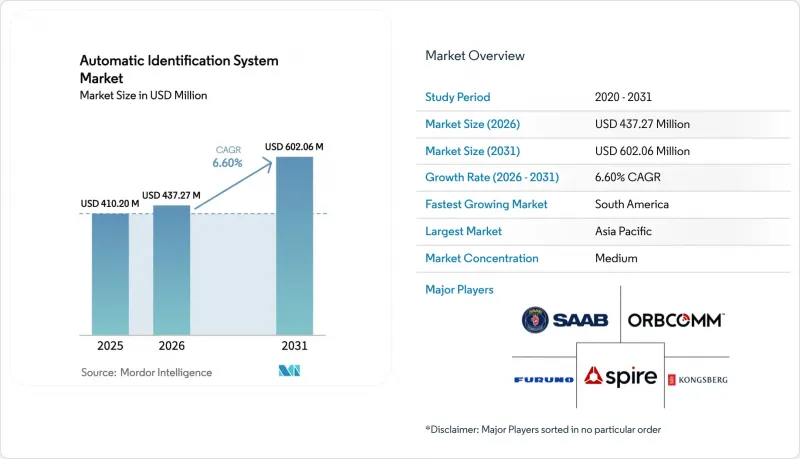
Mordor Intelligence에 의하면, 자동 식별 시스템(AIS) 시장 규모는 2025년 4억 1,020만 달러로 평가되었습니다. 2026년에는 4억 3,727만 달러로 확대되어 2026-2031년에 걸쳐 CAGR 6.6%로 성장을 지속하여, 2031년까지 6억 206만 달러에 이를 것으로 예측됩니다.

본 보고서는 용도(선단 관리, 선박 추적·모니터링, 기타), 플랫폼(선박 탑재형 AIS 트랜스폰더, 지상형 스테이션),구성 요소 등급(클래스 A 트랜스폰더, 클래스 B 트랜스폰더, AIS 기지국, AIS 수신기·게이트웨이), 솔루션(지상형 AIS, 기타), 지역별로 분류되어 있습니다. 시장 예측은 금액(달러)으로 표시되어 있습니다.
세계의 자동 식별 시스템(AIS) 시장 동향 및 인사이트
IMO의 2024년 의무화로 어선의 적용 범위 확대
국제해사기구(IMO)는 현재 전장 24미터를 초과하는 어선에 대해 AIS 탑재를 의무화하고 있으며, 이에 따라 당초 SOLAS 규정의 적용 대상에서 제외되었던 선단도 대상에 포함되게 되었습니다. 규제 준수가 가장 활발한 곳은 대상 선박의 85%가 이미 클래스 B 트랜스폰더를 탑재하고 있는 유럽과, 개조 지연 문제를 해결하기 위해 노력하고 있는 아시아태평양의 조선소입니다. 이 규제는 연간 200억 달러의 손실을 초래하고 있는 불법·미보고·비규제(IUU) 어업에 대한 단속 수단으로 자리매김하고 있습니다. 원양 어선단은 지상 기지국의 통신 범위 내에서 항해하는 경우가 드물기 때문에 위성 통신 사업자들은 혜택을 보고 있습니다. 단계적인 도입이 진행되고 있으며, 비용 효율성을 고려한 장비가 필요한 구형 선박의 도입 대수가 많기 때문에 2025년까지 수요는 높은 수준을 유지할 전망입니다. 또한, 어업 당국이 단순한 위치 정보뿐만 아니라 실시간 지도 및 알림 기능이 탑재된 대시보드를 요구하고 있어, 이러한 성장은 분석 서비스 계약 건수에도 파급되고 있습니다.
해상 무역량 증가가 인프라 디지털화를 촉진
해상 화물 수송량은 팬데믹 이전 수준으로 회복되었으며, 2018년부터 2023년에 걸쳐 아프리카의 컨테이너선 기항 횟수와 전 세계 유조선 기항 횟수는 각각 20%와 38% 증가했습니다. 이러한 회복에 따라 운영상의 사각지대가 드러났습니다. 가뭄으로 인한 파나마 운하의 혼잡이나 홍해에서의 무장 드론 위협 등으로 인해 운항 사업자들은 AIS를 활용한 상황 인식 시스템 도입을 서둘러야 했습니다. 아부다비에서 라고스에 이르는 각 당국은 고밀도 AIS 데이터를 수집하고, 도착 예측 정보를 트럭 운송 포털에 제공하는 선박 교통 관리 시스템을 도입하고 있습니다. 공급업체의 경우, 새로운 타워나 분석 라이선스가 도입될 때마다 엔드포인트당 가치가 높아져 자동 식별 시스템(AIS) 시장 기회가 다시 활성화됩니다. 센티미터 단위의 정확도와 저지연 추적 기능 없이는 항만이 선석 배정을 최적화할 수 없기 때문에 장비 업데이트 주기가 가속화되고 있습니다.
데이터 무결성 관련 문제가 시스템의 신뢰성을 훼손합니다.
제재 회피를 꾀하는 유조선이나 불법 어선단을 위장하는 악의적인 행위자가 증가함에 따라 스푸핑 발생 빈도가 높아졌습니다. AIS에는 기본 암호화 기능이 부족하여 ID 위조나 가상의 선박 삽입에 취약합니다. 싱가포르 해협이나 호르무즈 해협에서 주파수 대역이 혼잡하여 감지가 어렵습니다. 보험사들은 충돌 사고 조사 과정에서 항적 조작이 밝혀질 경우의 배상 책임을 우려하고 있습니다. 미쓰비시 중공업의 ‘AIRIS’와 같은 위성 이미지 융합 도구는 AIS 위치 정보와 선체 실루엣의 불일치를 지적하지만, 도입 비용은 여전히 높은 수준입니다. VDES 업그레이드가 신속하게 전개되지 않는 한, 장기화된 신뢰 부족은 특히 안전성이 극히 중요한 자율 항해 분야에서 자동 식별 시스템(AIS) 시장의 성장을 저해할 가능성이 있습니다.
부문별 분석
2025년, 선박 추적 및 모니터링 시장은 1억 5,605만 달러를 기록하며 자동 식별 시스템(AIS) 시장 전체의 38.05%를 차지했습니다. 운항사는 AIS 데이터와 기관실 원격 측정 데이터를 통합하여 탄소 강도를 벤치마킹하고, 혼잡을 피하기 위해 선박의 항로를 변경함으로써 연료비와 배출량을 동시에 절감하고 있습니다. 이 부문은 정기선 얼라이언스가 수천 개의 컨테이너에 대한 실시간 위치 데이터가 필요한 엔드투엔드 컨트롤 타워를 도입함에 따라 규모 면에서 계속해서 선두를 유지할 전망입니다. 정기선사가 AIS를 예측 스케줄링 및 탈탄소화 대시보드와 결합한 다년 계약형 SaaS(Software-as-a-Service)로 전환함에 따라 자동 식별 시스템(AIS) 시장은 혜택을 보고 있습니다.
해상 보안 및 수색 구조(SAR) 부문은 급속한 성장이 예상되는 부문으로, 2026년부터 탄소 집약도 지표(CII) 보고를 의무화하는 IMO의 온실가스 전략을 배경으로 연평균 성장률(CAGR) 7.55%로 확대될 것으로 예측됩니다. 규제 당국과 선박 용선사는 현재 항해별 상세한 CO2 기준치를 요구하고 있으며, AIS는 이러한 계산식에 반영되는 타임스탬프가 포함된 속도 및 거리 데이터를 기록합니다. 유럽연합(EU)의 배출권 거래 제도와 같은 시장 기반 조치를 채택하는 기국(flag state)이 늘어남에 따라, 배출 규제 대응 도구에 기인한 자동 식별 시스템(AIS) 시장 규모는 3배로 확대될 가능성이 있습니다. 항해별 ‘웰-투-웨이크(Well-to-Wake)’ CO2e를 산출하는 오버레이 API를 판매하는 벤더는 높은 지속적 수익을 확보하고 있으며, 순수 하드웨어 경쟁사와의 차별화를 꾀하고 있습니다.
SOLAS(국제해상인명안전협약) 규정에 따라 300GT를 초과하는 모든 화물선은 최소 6초마다 선박 식별 정보와 위치 정보를 전송해야 하므로, 선박 탑재형 트랜스폰더는 자동 식별 시스템(AIS) 시장 매출의 71.95%를 차지하고 있습니다. 탑재가 의무화되어 있기 때문에 클래스 A 장치의 교체 주기는 약 5년으로 고정되어 있습니다. 각 제조업체는 암호화 칩이 내장된 VDES 지원 모델을 출하하고 있으며, 15-20%의 가격 프리미엄을 붙여 판매하고 있습니다.
육상 기지국 시장 규모는 여전히 3분의 1 이하에 그치고 있지만, 극지 무역의 확대, 해상 풍력 발전소 건설, 국방 모니터링 계약에 힘입어 7.42%라는 견실한 연평균 성장률(CAGR)을 기록하고 있습니다. 새로운 마이크로 위성이 1기 추가될 때마다 재방문 빈도가 높아지며, 자율 항해 선박의 항로에 필수적인 거의 실시간 수준의 서비스에서 지연 시간을 줄이는 효과가 기대됩니다. 하이브리드 방식을 채택하는 사업자에게 위성은 연안의 통신탑이 전파를 포착할 수 없는 ‘통신 사각지대’를 보완합니다. 이러한 하이브리드화를 통해 자동 식별 시스템(AIS) 시장은 하드웨어와 연결성을 모두 갖춘 시장으로 자리매김했으며, 공급업체는 상품화 위험으로부터 보호받고 있습니다.
지역별 분석
아시아태평양은 전 세계 컨테이너 항만 혼잡도 상위 10곳 중 9곳을 차지하고 있으며, ‘일대일로’를 통해 막대한 투자를 디지털 항만 업그레이드에 쏟아붓고 있어, 2025년에는 매출의 41.78%를 차지하며 최대 점유율을 기록했습니다. 중국은 ‘실크로드’의 해상 거점을 따라 연안 기지국을 구축하고 있는 반면, 일본은 AIS 데이터를 수집하여 충돌 회피 알고리즘에 활용하는 AI 제어 페리 조종 시스템에 자금을 지원하고 있습니다. 인도 해군은 1억 2,500만 달러 상당의 연안 감시탑을 미국으로부터 기증받은 데이터 융합 센터에 연결하여, AIS 정보에 대한 국방 수요를 확대되고 있습니다. 유엔 항만 성과 지수에서 1위를 차지한 싱가포르는 15시간 이하의 선석 회전 시간을 목표로 하는 터미널 운영 사업자에게 부가가치 있는 AIS 분석 서비스 라이선스를 제공합니다. 이러한 상업 화물 운송, 해군의 안보, 정부가 의무화한 배출량 추적의 시너지 효과로 인해 아시아태평양은 계속해서 자동 식별 시스템(AIS) 시장의 중심지로 자리매김하고 있습니다.
유럽은 엄격한 안전 기준과 탈탄소화 정책에 힘입어 27.12%의 점유율을 차지하고 있습니다. 향후 시행될 클래스 M 비콘 규정에 따라 유람선 소유주들도 자동 식별 시스템(AIS) 시장에 진입하게 되어, 대상 시장은 상업 해운의 범위를 넘어 확대되고 있습니다. 노르웨이의 아이스서비스(Ice-Service)는 AIS를 레이더 및 광학 위성과 결합하여 극지 항해를 보호함으로써, 유럽의 북극권에서 전문적인 역량을 입증하고 있습니다. EU의 그린딜에 따른 자금 지원은 Windward와 같은 스타트업 기업에 보조금을 제공하고 있으며, 이 회사는 AIS의 행동 패턴을 분석하여 제재 회피를 시도하는 ‘섀도우 플리트’를 식별함으로써, 규정 준수 관련 과제를 소프트웨어 구독 수익으로 전환하고 있습니다.
북미는 미국 해안경비대의 엄격한 AIS 탑재 규정과 해상 상황 파악을 위한 대규모 국방 조달을 배경으로 23.96%의 점유율을 유지하고 있습니다. Saildrone과 Palantir와 같은 기술 제휴는 AIS 지문(fingerprint)에 의존하는 기밀 데이터 레이크에 정보를 공급하고 있습니다. 캐나다의 CII 보고 지침은 IMO의 조사 방법과 일치하며, 규제 요건을 충족하는 데이터 플랫폼의 조달을 촉진하고 있습니다.
남미는 규모는 작지만, 브라질의 해양 시추 시설과 수출 회랑의 디지털화를 추진하는 아르헨티나의 곡물 터미널 덕분에 연평균 성장률(CAGR) 7.47%를 기록하며, 자동 식별 시스템(AIS) 시장에서 가장 빠르게 성장하는 지역이 되었습니다. AD Ports의 차세대 VTMIS를 포함한 중동 및 아프리카의 노력 덕분에 모니터링 타워 설치 수와 분석 라이선스가 점차 증가하고 있습니다.
기타 혜택
- 엑셀 형식 시장 예측(ME) 시트
- 3개월간의 애널리스트 지원
자주 묻는 질문
목차
제1장 서론
제2장 조사 방법
제3장 주요 요약
제4장 시장 구도
제5장 시장 규모 및 성장 예측
제6장 경쟁 구도
제7장 시장 기회 및 향후 전망
KTH 26.09.08According to Mordor Intelligence, the automatic identification system market size is expected to grow from USD 410.2 million in 2025 to USD 437.27 million in 2026 and is forecast to reach USD 602.06 million by 2031 at 6.6% CAGR over 2026-2031.
This report is Segmented by Application (Fleet Management, Vessel Tracking and Monitoring, and More), Platform (Vessel-Based AIS Transponders, and On-Shore-Based Stations), Component/Class (Class A Transponders, Class B Transponders, AIS Base Stations, and AIS Receivers/Gateways), Solution (Terrestrial AIS, and More), and Geography. The Market Forecasts are Provided in Terms of Value (USD).
Global Automatic Identification System Market Trends and Insights
IMO 2024 Mandate Expands Fishing Vessel Coverage
The International Maritime Organization now compels fishing vessels longer than 24 m to carry AIS, capturing a fleet previously outside the original SOLAS rules. Compliance activity is most intense in Europe, where 85% of eligible boats already carry Class B transponders, and in Asia-Pacific yards that are working through retrofit backlogs. The regulation is framed as an enforcement weapon against illegal, unreported, and unregulated fishing that drains USD 20 billion annually. Satellite operators benefit because remote-water fishing fleets seldom sail within range of terrestrial towers. Demand will remain elevated into 2025, given the phased roll-out and the large installed base of older vessels needing cost-sensitive equipment. Growth also ripples into analytics subscriptions because fisheries agencies want real-time maps and alerting dashboards rather than raw positions.
Rising Maritime Trade Volumes Drive Infrastructure Digitalization
Maritime cargo returned to pre-pandemic velocity, and port calls for container ships in Africa and tanker calls worldwide rose 20% and 38%, respectively, between 2018 and 2023. The rebound exposed operational blind spots: drought-fueled congestion at the Panama Canal and armed drone threats in the Red Sea both pushed operators toward AIS-enabled situational awareness. Authorities from Abu Dhabi to Lagos are installing vessel-traffic-management suites that ingest high-density AIS feeds and publish arrival predictions to trucking portals. For suppliers, every new tower and analytics license renews the Automatic Identification System market opportunity at a higher value per endpoint. Equipment refresh cycles accelerate because ports cannot optimize berth allocation without centimeter-accurate, low-latency tracking.
Data Integrity Challenges Undermine System Reliability
Spoofing frequency escalated as bad actors camouflaged sanction-evading tankers and illegal fishing fleets; AIS lacks native encryption, making it vulnerable to identity swaps and phantom ship insertions. Detection is difficult amid spectrum crowding in the Singapore Strait and Strait of Hormuz. Insurers worry about liability when collision investigations reveal falsified tracks. Satellite imagery fusion tools like Mitsubishi Heavy Industries' AIRIS flag discrepancies between AIS position and hull silhouette, but adoption costs remain high. Unless the VDES upgrade rolls out quickly, lingering trust deficits could restrain the Automatic Identification System market, especially for safety-critical autonomous navigation.
Other drivers and restraints analyzed in the detailed report include:
- Port Optimization Analytics: Transform Operational Efficiency
- Arctic Shipping Routes Demand Extended AIS Coverage
- VHF Spectrum Reallocation Threatens Traditional AIS Operations
For complete list of drivers and restraints, kindly check the Table Of Contents.
Segment Analysis
Vessel Tracking and Monitoring accounted for USD 156.05 million, translating into 38.05% of the Automatic Identification System market in 2025. Operators integrate AIS feeds with engine-room telemetry to benchmark carbon intensity and reroute vessels away from congestion, cutting bunker bills and emissions simultaneously. The segment will keep its numerical lead because liner shipping alliances roll out end-to-end control towers that require real-time position data for thousands of boxes. The Automatic Identification System market benefits as liners move from annual license purchases to multi-year software-as-a-service contracts that bundle AIS with predictive scheduling and decarbonization dashboards.
Maritime Security and SAR is the breakout opportunity, projected to expand at a 7.55% CAGR on the back of IMO's greenhouse-gas strategy, which mandates Carbon Intensity Indicator reporting beginning in 2026. Regulators and charterers now demand voyage-granular CO2 baselines; AIS offers the time-stamped speed and distance inputs that populate these formulas. The Automatic Identification System market size attributable to emissions compliance tools could triple as more flag states adopt market-based measures like the European Union's emissions trading scheme. Vendors selling overlay APIs that calculate well-to-wake CO2e per voyage extract high recurring revenue, distancing themselves from pure hardware competitors.
Vessel-based transponders represented 71.95% of the Automatic Identification System market revenue because SOLAS regulations obligate every cargo ship above 300 GT to broadcast identity and position at least every 6 seconds. The mandatory nature of carriage locks in a replacement cycle of roughly five years for Class A units. Manufacturers are shipping VDES-ready models with embedded encryption chips, commanding 15-20% price premiums.
On-Shore-Based Stations, though still less than one-third the size, is charting a robust 7.42% CAGR, propelled by expanding polar trade, offshore wind construction, and defense surveillance contracts. Each new microsatellite adds revisit frequency, lowering latency toward near-real-time service levels essential for autonomous-vessel corridors. For hybrid operators, satellite fills the black holes where coastal towers cannot hear. This hybridization cements the Automatic Identification System market as both a hardware and connectivity play, insulating suppliers from commoditization.
Complete Report Scope:
- By Application
- Fleet Management
- Vessel Tracking and Monitoring
- Maritime Security and SAR
- Other Applications
- By Platform
- Vessel-based AIS Transponders
- On-Shore-based Stations
- By Component / Class
- Class A Transponders
- Class B Transponders
- AIS Base Stations
- AIS Receivers / Gateways
- By Solution
- Terrestrial AIS
- Satellite AIS (Sat-AIS)
- Hybrid AIS Services
- By Geography
- North America
- United States
- Canada
- Mexico
- South America
- Brazil
- Argentina
- Chile
- Rest of South America
- Europe
- United Kingdom
- Germany
- France
- Italy
- Spain
- Rest of Europe
- Asia-Pacific
- China
- Japan
- India
- South Korea
- Australia
- Singapore
- Malaysia
- Rest of Asia-Pacific
- Middle East and Africa
- Middle East
- Saudi Arabia
- United Arab Emirates
- Turkey
- Rest of Middle East
- Africa
- South Africa
- Nigeria
- Rest of Africa
- Middle East
- North America
Geography Analysis
Asia-Pacific generates the largest slice of revenue, 41.78% in 2025, because it hosts nine of the world's ten busiest container ports and channels vast Belt and Road investments into digital-port upgrades. China deploys shore-based towers along Silk Road maritime nodes, while Japan funds AI-steered ferry pilots that ingest AIS feeds for collision-avoidance algorithms. India's Navy is wiring USD 125 million worth of coastal surveillance towers to U.S.-donated data-fusion centers, amplifying defense demand for AIS intelligence. Singapore, ranked top on the UN port-performance index, licenses value-added AIS analytics to terminal operators who target berth-turnaround times below 15 hours. This confluence of commercial freight, naval security, and government-mandated emissions tracking ensures Asia-Pacific remains the anchor of the Automatic Identification System market.
Europe holds a 27.12% share, driven by stringent safety codes and decarbonization policy. The forthcoming Class M beacon rule pushes pleasure-craft owners into the Automatic Identification System market, expanding the addressable base beyond commercial shipping. Norway's Ice Service showcases Europe's specialized Arctic competence, blending AIS with radar and optical satellites to safeguard polar voyages. EU green-deal funding channels grants to start-ups like Windward that analyze AIS behavioral patterns to flag sanctions-evading "shadow fleets," turning compliance pain points into software-subscription revenue.
North America maintains a 23.96% share on the back of the U.S. Coast Guard's strict AIS carriage rules and substantial defense procurement for maritime domain awareness. Tech partnerships, such as Saildrone with Palantir, feed classified data lakes that rely on AIS fingerprints. Canada's CII reporting guidance aligns with IMO methodology and triggers procurement of rule-ready data platforms.
South America, while smaller, is the Automatic Identification System market's fastest-growing geography at 7.47% CAGR, thanks to Brazilian offshore rigs and Argentine grain terminals that digitize export corridors. Middle East and African initiatives, including AD Ports' next-gen VTMIS, add incremental tower installations and analytics licenses.
- Saab AB
- Furuno Electric Co., Ltd.
- Spire Global Inc.
- ORBCOMM Inc.
- Garmin Ltd.
- Kongsberg Gruppen ASA
- True Heading (Shiptron Trading B.V.)
- Japan Radio Co., Ltd.
- CNS Systems AB
- Wartsila Corp.
- Simrad (Brunswick Corp.)
- L3Harris Technologies Inc.
- exactEarth Ltd.
- SRT Marine Systems plc
- MarineTraffic
- Thales Group
- Weatherdock AG
- Comnav Marine Ltd.
- Iridium Communications Inc.
- ACR Electronics (DSG)
Additional Benefits:
- The market estimate (ME) sheet in Excel format
- 3 months of analyst support
TABLE OF CONTENTS
1 INTRODUCTION
- 1.1 Study Assumptions and Market Definition
- 1.2 Scope of the Study
2 RESEARCH METHODOLOGY
3 EXECUTIVE SUMMARY
4 MARKET LANDSCAPE
- 4.1 Market Overview
- 4.2 Market Drivers
- 4.2.1 IMO 2024 mandate for longer than 24 m fishing vessels
- 4.2.2 Rising maritime trade and traffic volumes
- 4.2.3 Port-call optimisation via AIS-analytics
- 4.2.4 Arctic shipping lanes demand long-range AIS
- 4.2.5 AIS-driven dynamic insurance premiums
- 4.2.6 CII/GHG reporting needs AIS?based data
- 4.3 Market Restraints
- 4.3.1 Data congestion and spoofing incidents
- 4.3.2 Range/coverage gaps in dense and remote seas
- 4.3.3 Coastal 5G VHF spectrum re-allocation risk
- 4.3.4 Sat-AIS latency for autonomous navigation
- 4.4 Industry Value Chain Analysis
- 4.5 Regulatory Landscape
- 4.6 Technological Outlook
- 4.7 Porter's Five Forces Analysis
- 4.7.1 Bargaining Power of Suppliers
- 4.7.2 Bargaining Power of Buyers
- 4.7.3 Threat of New Entrants
- 4.7.4 Threat of Substitutes
- 4.7.5 Competitive Rivalry
5 MARKET SIZE AND GROWTH FORECASTS (VALUES)
- 5.1 By Application
- 5.1.1 Fleet Management
- 5.1.2 Vessel Tracking and Monitoring
- 5.1.3 Maritime Security and SAR
- 5.1.4 Other Applications
- 5.2 By Platform
- 5.2.1 Vessel-based AIS Transponders
- 5.2.2 On-Shore-based Stations
- 5.3 By Component / Class
- 5.3.1 Class A Transponders
- 5.3.2 Class B Transponders
- 5.3.3 AIS Base Stations
- 5.3.4 AIS Receivers / Gateways
- 5.4 By Solution
- 5.4.1 Terrestrial AIS
- 5.4.2 Satellite AIS (Sat-AIS)
- 5.4.3 Hybrid AIS Services
- 5.5 By Geography
- 5.5.1 North America
- 5.5.1.1 United States
- 5.5.1.2 Canada
- 5.5.1.3 Mexico
- 5.5.2 South America
- 5.5.2.1 Brazil
- 5.5.2.2 Argentina
- 5.5.2.3 Chile
- 5.5.2.4 Rest of South America
- 5.5.3 Europe
- 5.5.3.1 United Kingdom
- 5.5.3.2 Germany
- 5.5.3.3 France
- 5.5.3.4 Italy
- 5.5.3.5 Spain
- 5.5.3.6 Rest of Europe
- 5.5.4 Asia-Pacific
- 5.5.4.1 China
- 5.5.4.2 Japan
- 5.5.4.3 India
- 5.5.4.4 South Korea
- 5.5.4.5 Australia
- 5.5.4.6 Singapore
- 5.5.4.7 Malaysia
- 5.5.4.8 Rest of Asia-Pacific
- 5.5.5 Middle East and Africa
- 5.5.5.1 Middle East
- 5.5.5.1.1 Saudi Arabia
- 5.5.5.1.2 United Arab Emirates
- 5.5.5.1.3 Turkey
- 5.5.5.1.4 Rest of Middle East
- 5.5.5.2 Africa
- 5.5.5.2.1 South Africa
- 5.5.5.2.2 Nigeria
- 5.5.5.2.3 Rest of Africa
- 5.5.5.1 Middle East
- 5.5.1 North America
6 COMPETITIVE LANDSCAPE
- 6.1 Market Concentration
- 6.2 Strategic Moves
- 6.3 Market Share Analysis
- 6.4 Company Profiles (includes Global level Overview, Market level overview, Core Segments, Financials as available, Strategic Information, Market Rank/Share for key companies, Products and Services, and Recent Developments)
- 6.4.1 Saab AB
- 6.4.2 Furuno Electric Co., Ltd.
- 6.4.3 Spire Global Inc.
- 6.4.4 ORBCOMM Inc.
- 6.4.5 Garmin Ltd.
- 6.4.6 Kongsberg Gruppen ASA
- 6.4.7 True Heading (Shiptron Trading B.V.)
- 6.4.8 Japan Radio Co., Ltd.
- 6.4.9 CNS Systems AB
- 6.4.10 Wartsila Corp.
- 6.4.11 Simrad (Brunswick Corp.)
- 6.4.12 L3Harris Technologies Inc.
- 6.4.13 exactEarth Ltd.
- 6.4.14 SRT Marine Systems plc
- 6.4.15 MarineTraffic
- 6.4.16 Thales Group
- 6.4.17 Weatherdock AG
- 6.4.18 Comnav Marine Ltd.
- 6.4.19 Iridium Communications Inc.
- 6.4.20 ACR Electronics (DSG)
7 MARKET OPPORTUNITIES AND FUTURE OUTLOOK
- 7.1 White-space and Unmet-need Assessment