|
시장보고서
상품코드
2122907
기가비트 이더넷(GbE) 시험 장비 : 시장 점유율 분석, 업계 동향 및 통계, 성장 예측(2026-2031년)Gigabit Ethernet Test Equipment - Market Share Analysis, Industry Trends & Statistics, Growth Forecasts (2026 - 2031) |
||||||
 Mordor Intelligence
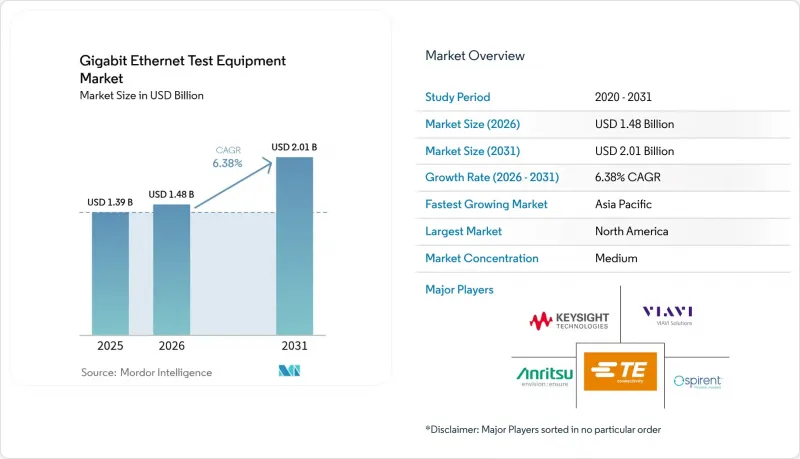
Mordor Intelligence에 의하면, 기가비트 이더넷(GbE) 시험 장비 시장 규모는 2025년 13억 9,000만 달러로 평가되었습니다. 2026년에는 14억 8,000만 달러로 확대되어 2026-2031년에 걸쳐 CAGR 6.38%로 성장을 지속하여, 2031년에는 20억 1,000만 달러에 이를 것으로 예측됩니다.

(1) Spirent Communications, 「2024-2026년 고속 이더넷 전망」, spirent.com 인공지능(AI) 워크로드의 도입 확대에 따라 대역폭에 대한 기대치가 재검토되고 있으며, 검증 팀은 400G를 넘어 새롭게 등장하고 있는 800G 및 1.6T 규격의 도입을 요구받고 있습니다. 본 보고서는 유형별(1GbE, 10GbE, 기타), 최종 사용자 산업별(통신, 데이터센터·클라우드, 기타), 용도별(R&D·연구소, 제조·생산, 기타), 테스트 유형별(기능 테스트·트래픽 생성, 성능·부하, 규정 준수·적합성, 기타), 지역별로 분류되어 있습니다.
세계의 기가비트 이더넷(GbE) 시험 장비 시장 동향 및 인사이트
AI 클러스터 인프라가 800G 테스트 수요를 견인
주요 하이라이트
- 인공지능(AI) 훈련으로 인해 대역폭 요구 사항이 기존 400G를 상회하는 수준에 도달함에 따라, 통신 사업자들은 새로운 검증 전략이 필요한 800G 및 1.6T 링크 도입을 피할 수 없게 되었습니다. 현재 클러스터에서는 xPU당 1Tbps가 필요하며, NRZ에서 PAM4 변조로 전환하는 SerDes 설계에 부담이 가해지고 있습니다. 그 결과, 신호 대 잡음비(SNR) 분석에는 놀라운 수준의 정밀도가 요구되고 있습니다. 각 벤더사는 현재 고속 오실로스코프와 자동 디임베딩 소프트웨어를 번들로 제공하고 있으며, 이를 통해 엔지니어는 10ps 미만의 단위 간격으로 특성 평가를 며칠이 아닌 몇 분 만에 완료할 수 있게 되었습니다. Ultra Ethernet Consortium은 IEEE 802.3의 범위를 넘어, 기존 이더넷에서는 볼 수 없었던 혼잡 관리 테스트를 추가한 v1.0 사양의 최종 조정을 진행하고 있습니다. 1.6T 기능을 제공하는 선도 기업들은 AI 패브릭의 미래성을 확보하고자 하는 하이퍼스케일러들과 수년에 걸친 프레임워크 계약을 체결하고 있습니다. 이러한 프로젝트는 광통신, 트래픽 생성, 분석을 단일 오케스트레이션 계층으로 통합할 수 있는 기업들에게 수익 확대를 가속화할 것입니다.
클라우드 서비스 확장이 멀티 스피드 테스트를 가속화
클라우드 제공업체는 변동하는 워크로드 전반에 걸쳐 성능과 비용의 균형을 맞추기 위해 100G, 400G, 800G가 혼합된 토폴로지를 구축하고 있으며, 이로 인해 여러 속도를 동시에 검증할 수 있는 테스트 장비에 대한 수요가 발생하고 있습니다. 이러한 속도 대역에서는 전방 오류 정정(FEC), 특히 RS-FEC가 필수적이기 때문에 솔루션은 잠재적인 결함을 은폐하지 않고 실시간으로 패리티 블록을 모니터링해야 합니다. 현재 에뮬레이션 엔진은 며칠 분량의 트래픽 로그를 재생하여, 서브 마이크로초 수준의 지연 시간 지표를 유지하면서 마이크로 버스트로 인한 혼잡을 재현할 수 있게 되었습니다. 통신 사업자들은 CI/CD 툴체인과 통합 가능한 프로그래밍 가능한 API를 원하고 있으며, 이를 통해 매일 네트워크 업그레이드에 대한 회귀 테스트를 수행할 수 있게 됩니다. 그 결과, 하드웨어 자본 지출(Capex)을 줄이면서 결정론적인 성능 기준을 제공하는 가상화 테스트 랩에 대한 수요가 증가하고 있습니다.
기술 전문가 부족이 시장 확대를 제약
NRZ에서 PAM4로의 전환에는 데스큐, 심볼 오류 플롯, 224Gbps 채널 모델링에 정통한 엔지니어가 필요하지만, 이러한 기술은 전 세계 노동 시장에서 여전히 희소합니다. 많은 서비스 제공업체는 아이(eye) 높이 및 지터 예산 분석에 자동화된 알고리즘에 의존하고 있지만, 복잡한 장애 해결에는 여전히 인간의 인사이트력이 필요합니다. ‘연결 전 점검(Inspect Before You Connect)’과 같은 광섬유 검사 캠페인은 기술 인력 부족이 설치 오류율을 어떻게 높이는지를 보여줍니다. 교육 체계는 기술 로드맵을 따라가지 못하고 있어, 벤더들은 최소한의 사용자 입력만으로도 계측기를 설정할 수 있는 AI 기반 마법사를 도입할 수밖에 없는 상황입니다. 그럼에도 불구하고, PAM4의 크로스톡, 스큐, FEC 마진에 대한 고급 문제 해결은 여전히 수작업으로 이루어지고 있으며, 프로젝트 일정은 인력 부족의 영향을 받기 쉬운 상태가 지속되고 있습니다.
부문별 분석
10GbE 부문은 2025년에 기가비트 이더넷(GbE) 시험 장비 시장의 41.30% 점유율을 유지하며, 엔터프라이즈 스위칭 백본에서 확고한 입지를 드러냈습니다. 한편, 800GbE 및 1.6TbE 측정 장비는 2031년까지 연평균 성장률(CAGR) 20.10%를 나타낼 것으로 예측되며, 이는 모든 속도 등급 중 가장 빠른 성장세입니다. 이러한 성장은 레인당 224Gbps의 라인 레이트 검증이 필요한 AI 클러스터 아키텍처에 힘입은 것입니다. 키사이트의 AresONE 플랫폼은 6.4Tbps의 테스트 트래픽을 스트리밍할 수 있으며, 이러한 비약적인 발전에 힘입어 키사이트에 따르면 2031년까지 기가비트 이더넷(GbE) 시험 장비 시장에서 초고속 장비 시장 규모는 5억 4,830만 달러에 달할 것으로 예측됩니다. 한편, 25/40/50GbE 및 100GbE는 특히 레거시 광통신 생태계가 전환 위험을 줄여야 하는 상황에서 비용 효율적인 전환 수단으로 기능하고 있습니다. Marvell과 같은 반도체 벤더들은 모듈의 전력 소비를 20% 줄이고 고밀도 섀시 내의 냉각 여유를 확대하는 3nm PAM4 DSP 샘플 제공을 시작함으로써 이러한 전환을 가속화하고 있습니다.
구매자들은 업그레이드의 시기와 표준의 성숙도를 저울질하고 있습니다. 400GbE는 성숙한 RS-FEC 프로파일을 갖추고 있어, 신속한 투자 회수를 목표로 하는 프로젝트에서는 여전히 선호되고 있습니다. 대조적으로, 1.6T를 평가 중인 엔지니어링 연구소에서는 당면한 요구 사항을 충족하는 800G 블레이드와 향후 1.6T 플러그인 지원 모듈을 대비한 빈 케이지를 결합한 혼합 속도 섀시를 주문하고 있습니다. 이러한 유연성 덕분에 자본 계획이 안정화되는 동시에, 초기 도입자들은 기술 노후화로부터 보호받습니다. 하이퍼스케일러들이 6개월마다 스프린트를 통해 패브릭 업그레이드를 전개하는 가운데, 현장 업그레이드가 가능한 하드웨어와 영구 라이선스 소프트웨어를 제공하는 벤더들은 지속적인 수익원을 확보하고 있습니다. 이러한 전환으로 제품 수명 주기가 단축됨에 따라, 경쟁의 초점은 하드웨어 부품 원가에서 프로그래밍 가능한 기능 제공 속도로 이동하고 있습니다.
5G 백홀의 구축으로 2025년 매출의 36.05%를 통신 산업이 차지했지만, 데이터센터와 클라우드 제공업체는 2031년까지 연평균 성장률(CAGR) 17.25%로 확대되어 2027년까지 절대 지출액 측면에서 통신 사업자를 추월할 것으로 전망됩니다. AI 워크로드 밀도가 높아짐에 따라 데이터센터에서는 무손실 패킷 스프레이, 서브 마이크로초 단위의 지터, RoCEv2 혼잡 제어를 동시에 검증해야 할 필요성이 대두되고 있으며, 이 모든 요소는 기존 통신 사업자의 측정 기준을 상회합니다. 자동차 및 운송 분야의 OEM 기업들은 운전 지원 및 자율 주행 스택을 지원하기 위해 이더넷 준수를 가속화하고 있으며, 10GBASE-T1 특성 평가가 가능한 견고한 오실로스코프와 EMI 챔버에 대한 수요를 창출하고 있습니다.
한편, 제조 기업들은 위험 구역 내에서의 이더넷-APL 시범 도입을 가속화하고 있어, 전원 루프 분석기 역할도 수행하는 본질 안전형 테스터가 요구되고 있습니다. 항공우주 및 방위(A&D) 부문의 시스템 통합사업자들은 진동, 극한 온도, 전자기 펄스를 견딜 수 있는 장비를 필요로 하고 있으며, 공급업체들은 군용 등급의 케이스를 채택할 수밖에 없는 상황입니다. 유틸리티 및 의료 분야에서는 결정론적 페일세이프 프로토콜이 규정되어 있어, 손실 제로 보호 전환 및 사이버 내성을 갖춘 펌웨어를 검증하는 테스트 계획이 요구되고 있습니다. 이러한 산업 전반에 걸친 미묘한 차이로 인해 벤더들은 산업별 규정 준수 패키지를 필요에 따라 통합할 수 있는 모듈형 플랫폼을 제공해야 하는 상황에 직면해 있습니다. 이 전략을 통해 다양한 규제 프레임워크에 대응하면서도 연구 개발(R&D)에 드는 간접비를 절감할 수 있습니다.
지역별 분석
북미는 반도체 연구개발이 집중되어 있고, 800G 인증을 사상 최단 기간 내에 의무화하는 적극적인 AI 클러스터 구축으로 인해 매출의 32.70%를 차지하고 있습니다. 미국 클라우드 제공업체가 수주의 대부분을 차지하고 있지만, 캐나다에서는 광대역 활성화와 산업용 이더넷 업그레이드를 통해 수요가 확대되고 있습니다. 멕시코는 니어쇼어링 추세를 활용하여 자동차용 하네스 생산을 확대하고 있으며, T1 컴플라이언스 키트에 대한 수요를 높이고 있습니다. 일부 주에서 낮은 에너지 비용이 데이터센터의 신규 건설을 유도하는 한편, 800G 장비의 높은 전력 소비량은 지속가능성 감사를 초래하여 조달 주기에 영향을 미칠 가능성이 있습니다.
아시아태평양은 중국의 하이퍼스케일 확장과 현지화된 1.6T 광통신 공급망을 배경으로 연평균 성장률(CAGR) 10.05%로 성장을 주도하고 있습니다. 일본 자동차 산업에서는 엄격한 EMC 검증이 필요한 결정론적 이더넷 스택이 주류를 이루고 있는 반면, 한국에서는 반도체 팹이 3nm급으로 전환되면서 초고속 지터 및 크로스톡 프로브에 대한 수요가 증가하고 있습니다. 아세안(ASEAN)에서는 5G 백홀 및 스마트 팩토리의 시범 도입이 진행되고 있어, 멀티 레이트를 지원하는 휴대용 분석기에 대한 수주가 발생하고 있습니다. 인도에서는 정책에 따른 인센티브가 통신 기기 제조 및 소프트웨어 정의 네트워크(SDN) 연구소 설립을 뒷받침하고 있지만, 인프라 정비 현황에 편차가 있고 인력 부족까지 겹치면서 단기적인 보급에는 제약이 따르고 있습니다.
유럽에서는 꾸준한 성장이 예상되며, 독일의 OEM 각사가 자동차 이더넷 테스트 계획을 공식적으로 수립하고, 산업 부문 사업자들이 공정 플랜트 내에서 이더넷-APL을 채택하고 있습니다. 영국에서는 광섬유 백본 네트워크의 현대화가 진행 중이며, 이는 휴대용 OTDR 및 BERT에 대한 수요를 촉진하고 있습니다. 프랑스와 스페인은 확실성이 보장된 변전소 이더넷 테스트가 필요한 재생에너지 송전망 업그레이드에 투자하고 있습니다. 중동에서는 석유 수입을 걸프 지역의 신규 데이터센터 건설에 투입하고 있습니다. 한편, 아프리카의 광산 기업들은 가혹한 환경에 견딜 수 있도록 강화된 PoE 테스터를 도입하고 있습니다. 남미는 브라질의 통신망 업그레이드와 아르헨티나의 자동차용 와이어 하네스 수출에 힘입어, 성장세는 완만하지만 안정적인 추세를 보이고 있습니다.
기타 혜택
- 엑셀 형식 시장 예측(ME) 시트
- 3개월간의 애널리스트 지원
자주 묻는 질문
목차
제1장 서론
제2장 조사 방법
제3장 주요 요약
제4장 시장 구도
제5장 시장 규모 및 성장 예측
제6장 경쟁 구도
제7장 시장 기회 및 향후 전망
KTH 26.09.08According to Mordor Intelligence, the gigabit ethernet test equipment market size is expected to grow from USD 1.39 billion in 2025 to USD 1.48 billion in 2026 and is forecast to reach USD 2.01 billion by 2031 at 6.38% CAGR over 2026-2031.
[1] Spirent Communications, "2024-2026 High-Speed Ethernet Outlook," spirent.com Rising adoption of artificial intelligence workloads is redefining bandwidth expectations, forcing validation teams to move beyond 400G and embrace emerging 800G and 1.6T standards. This report is Segmented by Type (1 GbE, 10 GbE, and More), End-User Industry (Telecommunications, Data Centers and Cloud, and More), Application (R&D/Lab, Manufacturing/Production, and More), Test Type (Functional / Traffic Generation, Performance / Stress, Compliance / Conformance, and More), and Geography.
Global Gigabit Ethernet Test Equipment Market Trends and Insights
AI Cluster Infrastructure Drives 800G Testing Demand
Key Highlights
- Artificial intelligence training pushes bandwidth requirements beyond conventional 400G, compelling operators to adopt 800G and 1.6T links that demand fresh validation strategies. Current clusters need 1 Tbps per xPU, stressing SerDes designs that shift from NRZ to PAM4 modulation, which in turn mandates eye-opening precision for signal-to-noise ratio analysis. Vendors now bundle high-speed oscilloscopes with automated de-embedding software so engineers can characterize sub-10-ps unit intervals in minutes rather than days. The Ultra Ethernet Consortium is finalizing v1.0 specifications that extend beyond IEEE 802.3, adding congestion management tests never seen in legacy Ethernet. Early movers that deliver 1.6T capability are winning multi-year framework deals with hyperscalers eager to future-proof AI fabrics. These projects accelerate revenue for companies able to link optics, traffic generation, and analytics into a single orchestration layer.
Cloud Services Expansion Accelerates Multi-Speed Testing
Cloud providers deploy mixed 100G, 400G, and 800G topologies to balance performance and cost across variable workloads, creating a need for test rigs that validate several speeds concurrently. Forward error correction, particularly RS-FEC, is essential at those rates, so solutions must monitor real-time parity blocks without masking latent defects. Emulation engines now replay days of traffic logs to reproduce microburst congestion while maintaining sub-microsecond latency metrics. Operators request programmable APIs that integrate with CI/CD toolchains, enabling daily regression of network upgrades. The result is rising demand for virtualized test labs that cut hardware capex yet still provide deterministic performance baselines.
Technical Expertise Shortage Constrains Market Expansion
Moving from NRZ to PAM4 demands engineers competent in de-skewing, symbol error plotting, and 224 Gbps channel modeling, skills still rare across global labor pools. Many service providers rely on automated algorithms to interpret eye height and jitter budgets, yet complex failures still need human insight. Fiber inspection campaigns such as "Inspect Before You Connect" show how deficit skills inflate installation error rates. Training pipelines lag behind technology roadmaps, compelling vendors to embed AI-driven wizards that configure instruments based on minimal user input. Nevertheless, advanced troubleshooting of PAM4 crosstalk, skew, and FEC margin remains a manual discipline, keeping project timelines vulnerable to talent shortages.
Other drivers and restraints analyzed in the detailed report include:
- Manufacturing Ethernet Adoption Creates Industrial Testing Opportunities
- Legacy Infrastructure Upgrades Drive Multi-Gigabit Testing
- Measurement Accuracy Limitations Impede High-Speed Validation
For complete list of drivers and restraints, kindly check the Table Of Contents.
Segment Analysis
The 10 GbE category retained 41.30% of the Gigabit Ethernet test equipment market share in 2025, underscoring its entrenched presence in enterprise switching backbones. Yet 800 GbE and 1.6 TbE rigs are set to grow at 20.10% CAGR to 2031, the fastest pace of any speed grade, fueled by AI cluster architectures that need line-rate validation at 224 Gbps per lane. Keysight's AresONE platform streams 6.4 Tbps of test traffic, marking a leap that positions the Gigabit Ethernet test equipment market size for ultra-high-speed gear at USD 548.3 million by 2031, according to Keysight. Meanwhile 25/40/50 GbE and 100 GbE serve as cost-efficient stepping-stones, especially where legacy optics ecosystems lower migration risk. Semiconductor vendors such as Marvell accelerate the shift by sampling 3 nm PAM4 DSPs that drop module power by 20%, extending cooling envelopes inside dense chassis.
Buyers weigh upgrade timing against standards maturity. 400 GbE enjoys mature RS-FEC profiles, so projects chasing rapid returns still favor it. Conversely, engineering labs evaluating 1.6 T are ordering mixed-speed chassis that combine 800 G blades for immediate needs and empty cages ready for future 1.6 T pluggables. This flexibility stabilizes capital planning while protecting early adopters from obsolescence. As hyperscalers roll out fabric upgrades in six-month sprints, vendors that ship field-upgradeable hardware and perpetual software licenses gain recurring revenue streams. The transition compresses product lifecycles, shifting competitive focus from hardware bill-of-materials to programmable feature velocity.
Telecommunications captured 36.05% of 2025 revenue due to 5G backhaul rollouts, yet data centers and cloud providers are expanding at an 17.25% CAGR to 2031, overtaking telcos in absolute spending by 2027. AI workload density drives data centers to validate lossless packet spraying, sub-microsecond jitter, and RoCEv2 congestion control concurrently, all of which exceed traditional telco metrics. Automotive and transport OEMs ramp Ethernet compliance to support driver assistance and autonomous stacks, creating demand for rugged oscilloscopes and EMI chambers capable of 10GBASE-T1 characterization.
Meanwhile, manufacturing outfits accelerate Ethernet-APL pilots within hazardous zones, requiring intrinsically safe testers that double as power loop analyzers. A&D integrators need equipment that withstands vibration, temperature extremes, and electromagnetic pulse, compelling suppliers to adapt military-grade enclosures. Utilities and healthcare specify deterministic fail-safe protocols, pushing test plans to verify zero-loss protection switching and cyber-hardened firmware. These cross-sector nuances pressure vendors to offer modular platforms that slot vertical-specific compliance packages on demand, a strategy that tempers R&D overhead while addressing divergent regulatory frameworks.
Complete Report Scope:
- By Type
- 1 GbE
- 10 GbE
- 25/40/50 GbE
- 100 GbE
- 400 GbE
- 800 GbE and 1.6 TbE
- By End-user Industry
- Telecommunications
- Data Centers and Cloud
- Manufacturing
- Automotive and Transport
- Aerospace and Defense
- Others (Utilities, Healthcare)
- By Application
- RandD/Lab
- Manufacturing/Production
- Field Service and Installation
- Certification and Compliance
- By Test Type
- Functional / Traffic Generation
- Performance / Stress
- Compliance / Conformance
- Network Emulation
- By Geography
- North America
- United States
- Canada
- Mexico
- South America
- Brazil
- Argentina
- Rest of South America
- Europe
- Germany
- United Kingdom
- France
- Italy
- Spain
- Russia
- Rest of Europe
- Asia Pacific
- China
- India
- Japan
- South Korea
- ASEAN
- Rest of Asia Pacific
- Middle East and Africa
- Middle East
- Saudi Arabia
- UAE
- Turkey
- Rest of Middle East
- Africa
- South Africa
- Nigeria
- Rest of Africa
- Middle East
- North America
Geography Analysis
North America holds 32.70% revenue thanks to concentrated semiconductor R&D and aggressive AI cluster deployments that mandate 800G qualification in record time. United States cloud providers anchor most orders, but Canada gains traction through broadband revitalization and industrial Ethernet upgrades. Mexico leverages nearshoring trends to expand automotive harness manufacturing, raising demand for T1 compliance kits. Low energy costs in some states attract additional data center builds, yet the high power draw of 800G rigs prompts sustainability audits that may influence procurement cycles.
Asia Pacific leads growth at 10.05% CAGR on the back of China's hyperscale expansion and localized 1.6 T optics supply chains. Japan's auto sector champions deterministic Ethernet stacks that require stringent EMC validation, while Korea pushes semiconductor fabs into 3 nm class, needing ultra-fast jitter and crosstalk probes. ASEAN states deploy 5G backhaul and smart factory pilots, generating orders for multi-rate handheld analyzers. India's policy incentives spur telco equipment manufacturing and software defined network labs, though patchy infrastructure and a talent shortfall temper near-term adoption.
Europe charts steady gains with German OEMs formalizing in-vehicle Ethernet test plans and industrial operators embracing Ethernet-APL inside process plants. The United Kingdom modernizes fiber backbone networks, fueling demand for portable OTDRs and BERTs. France and Spain invest in renewable energy grid upgrades that require deterministic sub-station Ethernet testing. The Middle East channels oil revenues into greenfield data centers in the Gulf, while African miners commission ruggedized PoE testers for harsh environments. South America remains modest but stable, driven by Brazilian telco upgrades and Argentine automotive wire harness exports.
- Keysight Technologies Inc.
- Anritsu Corp.
- VIAVI Solutions Inc.
- Spirent Communications plc
- EXFO Inc.
- Rohde and Schwarz GmbH and Co KG
- Teledyne LeCroy (Xena)
- Yokogawa Test and Measurement
- VeEX Inc.
- GL Communications Inc.
- Trend Networks
- GigaNet Systems
- Xinertel Technology
- Apposite Technologies
- NetScout Systems Inc.
- Te Connectivity Ltd.
- Aquantia (Marvell)
- GAO Tek Inc.
- IDEAL Industries Inc.
- Veryx Technologies
Additional Benefits:
- The market estimate (ME) sheet in Excel format
- 3 months of analyst support
TABLE OF CONTENTS
1 INTRODUCTION
- 1.1 Study Assumptions and Market Definition
- 1.2 Scope of the Study
2 RESEARCH METHODOLOGY
3 EXECUTIVE SUMMARY
4 MARKET LANDSCAPE
- 4.1 Market Overview
- 4.2 Market Drivers
- 4.2.1 Growth in mobile backhaul
- 4.2.2 Adoption of cloud services and big data
- 4.2.3 Increased Ethernet use in manufacturing
- 4.2.4 2.5 / 5 GbE upgrades on legacy cabling
- 4.2.5 AI cluster demand for 800G/1.6T testing
- 4.2.6 RoCEv2-driven ultra-low-latency validation
- 4.3 Market Restraints
- 4.3.1 Lack of technical expertise
- 4.3.2 Complex measurement accuracy limits
- 4.3.3 Energy and thermal constraints in 800G rigs
- 4.3.4 Supply-chain bottlenecks for PAM-4 optics
- 4.4 Value Chain Analysis
- 4.5 Regulatory Landscape
- 4.6 Technological Outlook
- 4.7 Porter's Five Forces Analysis
- 4.7.1 Bargaining Power of Suppliers
- 4.7.2 Bargaining Power of Buyers
- 4.7.3 Threat of New Entrants
- 4.7.4 Threat of Substitutes
- 4.7.5 Competitive Rivalry
5 MARKET SIZE AND GROWTH FORECASTS (VALUE)
- 5.1 By Type
- 5.1.1 1 GbE
- 5.1.2 10 GbE
- 5.1.3 25/40/50 GbE
- 5.1.4 100 GbE
- 5.1.5 400 GbE
- 5.1.6 800 GbE and 1.6 TbE
- 5.2 By End-user Industry
- 5.2.1 Telecommunications
- 5.2.2 Data Centers and Cloud
- 5.2.3 Manufacturing
- 5.2.4 Automotive and Transport
- 5.2.5 Aerospace and Defense
- 5.2.6 Others (Utilities, Healthcare)
- 5.3 By Application
- 5.3.1 RandD/Lab
- 5.3.2 Manufacturing/Production
- 5.3.3 Field Service and Installation
- 5.3.4 Certification and Compliance
- 5.4 By Test Type
- 5.4.1 Functional / Traffic Generation
- 5.4.2 Performance / Stress
- 5.4.3 Compliance / Conformance
- 5.4.4 Network Emulation
- 5.5 By Geography
- 5.5.1 North America
- 5.5.1.1 United States
- 5.5.1.2 Canada
- 5.5.1.3 Mexico
- 5.5.2 South America
- 5.5.2.1 Brazil
- 5.5.2.2 Argentina
- 5.5.2.3 Rest of South America
- 5.5.3 Europe
- 5.5.3.1 Germany
- 5.5.3.2 United Kingdom
- 5.5.3.3 France
- 5.5.3.4 Italy
- 5.5.3.5 Spain
- 5.5.3.6 Russia
- 5.5.3.7 Rest of Europe
- 5.5.4 Asia Pacific
- 5.5.4.1 China
- 5.5.4.2 India
- 5.5.4.3 Japan
- 5.5.4.4 South Korea
- 5.5.4.5 ASEAN
- 5.5.4.6 Rest of Asia Pacific
- 5.5.5 Middle East and Africa
- 5.5.5.1 Middle East
- 5.5.5.1.1 Saudi Arabia
- 5.5.5.1.2 UAE
- 5.5.5.1.3 Turkey
- 5.5.5.1.4 Rest of Middle East
- 5.5.5.2 Africa
- 5.5.5.2.1 South Africa
- 5.5.5.2.2 Nigeria
- 5.5.5.2.3 Rest of Africa
- 5.5.5.1 Middle East
- 5.5.1 North America
6 COMPETITIVE LANDSCAPE
- 6.1 Market Concentration
- 6.2 Strategic Moves
- 6.3 Market Share Analysis
- 6.4 Company Profiles (includes Global level Overview, Market level overview, Core Segments, Financials as available, Strategic Information, Market Rank/Share for key companies, Products and Services, and Recent Developments)
- 6.4.1 Keysight Technologies Inc.
- 6.4.2 Anritsu Corp.
- 6.4.3 VIAVI Solutions Inc.
- 6.4.4 Spirent Communications plc
- 6.4.5 EXFO Inc.
- 6.4.6 Rohde and Schwarz GmbH and Co KG
- 6.4.7 Teledyne LeCroy (Xena)
- 6.4.8 Yokogawa Test and Measurement
- 6.4.9 VeEX Inc.
- 6.4.10 GL Communications Inc.
- 6.4.11 Trend Networks
- 6.4.12 GigaNet Systems
- 6.4.13 Xinertel Technology
- 6.4.14 Apposite Technologies
- 6.4.15 NetScout Systems Inc.
- 6.4.16 Te Connectivity Ltd.
- 6.4.17 Aquantia (Marvell)
- 6.4.18 GAO Tek Inc.
- 6.4.19 IDEAL Industries Inc.
- 6.4.20 Veryx Technologies
7 MARKET OPPORTUNITIES AND FUTURE OUTLOOK
- 7.1 White-space and Unmet-need Assessment