

|
시장보고서
상품코드
2122913
무선 인터콤 : 시장 점유율 분석, 업계 동향 및 통계, 성장 예측(2026-2031년)Wireless Intercoms - Market Share Analysis, Industry Trends & Statistics, Growth Forecasts (2026 - 2031) |
||||||
 Mordor Intelligence
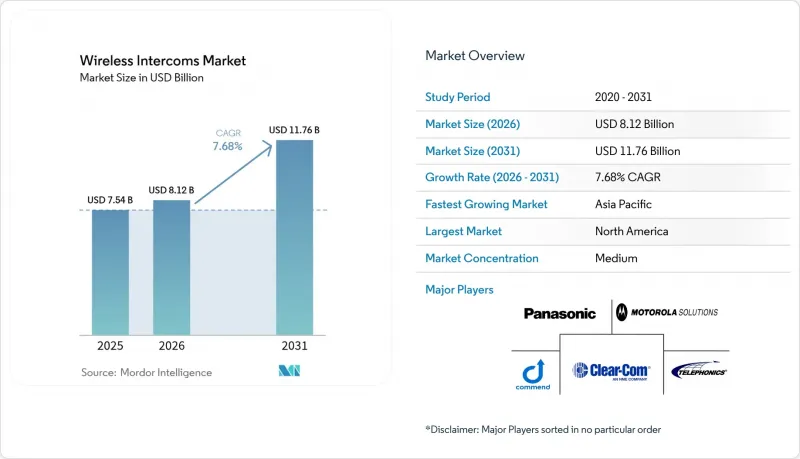
Mordor Intelligence에 의하면, 무선 인터콤 시장 규모는 2025년 75억 4,000만 달러로 평가되었습니다. 2026년에는 81억 2,000만 달러로 확대되어 2026-2031년에 걸쳐 CAGR 7.68%로 성장을 지속하여, 2031년에는 117억 6,000만 달러에 이를 것으로 예측됩니다.

본 보고서는 용도별(보안 모니터링, 이벤트 관리, 호스피탈리티, 운송 및 물류, 헬스케어, 기타), 기술(연결성)별(Wi-Fi/IP, DECT 6.0, 디지털 UHF/VHF(MURS, FRS, 기타), LTE/5G 셀룰러, Zigbee/블루투스), 최종 용도 부문별(주거, 상업, 기업/기업 캠퍼스, 정부·공공 안전, 기타), 지역별로 분류되어 있습니다.
세계의 무선 인터콤 시장 동향 및 인사이트
보안 및 모니터링 솔루션에 대한 수요 증가
통합형 인터콤 플랫폼에서는 음성 스트림이 비디오 분석 콘솔로 직접 전송되므로, 관제실 운영자는 음성 명령과 시각적 경보를 연관 지어 확인할 수 있게 되었습니다. 병원에서는 Zenitel의 시스템이 내장된 음성 엔진이 특정 키워드를 감지하면 자동으로 경비 직원에게 긴급 알림을 전달하고 지정된 출입문을 잠그는 방식으로 이러한 융합이 입증되고 있습니다. 주요 공항에서는 Ericsson의 프라이빗 LTE 백본이 활주로 승무원과 관제탑 직원 간의 미션 크리티컬한 푸시-투-토크(PTT) 통신을 지원하여, 택싱 시간 편차를 줄이고 사고 추적성을 향상시키고 있습니다. 2024년에 발생한 고순도 석영 공급 부족은 공급망의 취약성을 여실히 드러냈으며, 시설 소유주들은 전체 시스템을 재인증할 필요 없이 교체 가능한 모듈식 장치를 선호하게 되었습니다. 음성, 영상, 분석 기능의 긴밀한 연계를 통해 감식 조사 주기가 단축되어, 예산 심사를 받고 있는 사업자에게 결정적인 이점이 되고 있습니다. 그 결과, 보안을 중시한 설비 투자와 무선 인터콤 도입 사이에 강력한 연관성이 형성되고 있습니다.
Wi-Fi/IP 기반 스마트 홈용 인터콤의 보급
주택 건설업체들은 음성 패널과 도어 카메라를 동일한 Wi-Fi 6E 네트워크에 묶어 제공하는 사례가 늘어나고 있으며, 이를 통해 저전압 배선 계획이 간소화되고 시운전 시간이 단축되고 있습니다. CableLabs의 조사에 따르면, 6GHz 대역은 고밀도 공동 주택에서 음성 품질을 저하시키던 기존의 혼잡 현상을 완화하는 것으로 확인되었습니다. ‘AiphoneCloud’를 통해 설치 업체는 원격으로 기기의 문제 해결을 수행할 수 있어 출장 대응 비용을 절감할 수 있으므로, 부동산 관리자에게 구독 모델의 매력이 높아지고 있습니다. 호텔 산업에서도 이러한 IP화 추세가 반영되고 있습니다. Stryker의 ‘Vocera’ 배지는 시설 관리 백엔드 시스템과 연동되어 있어, 직원은 화면 조작이 필요한 모바일 앱 알림 대신 안전한 음성 안내를 통해 하우스키핑 업무 지시를 받을 수 있습니다. 이러한 시너지 효과로 인해 기존 아날로그 도어 스테이션의 교체 주기가 단축되면서, 무선 인터콤 시장 수요가 더욱 증가하고 있습니다.
RF 간섭과 주파수 대역 혼잡
고층 주택에서는 6GHz 대역의 Wi-Fi 채널이 포화 상태에 가까워지고 있으며, 이 문제는 CableLabs의 다층 시뮬레이션을 통해 시각화되었습니다. 이 시뮬레이션에서는 인터콤 음성 등 저지연 트래픽에서 헤드 오브 라인 블로킹이 발생한다는 사실이 밝혀졌습니다. 공유 스펙트럼에 관한 시책은 부분적인 완화책이 되겠지만, 조정에 소요되는 오버헤드가 증가합니다. 일본의 ‘기술 기준 적합 인증’에서는 각 무선 기기가 315MHz, 400MHz, 920MHz, 2.4GHz 대역에서 개별적으로 검사를 통과해야 하므로 승인 주기가 장기화되고 있습니다. 미국의 ‘국가 주파수 대역 연구개발 계획’에서는 해결책으로 다이내믹 센싱을 중시하고 있으나, 대규모 도입에는 아직 수년이 소요될 것으로 예측됩니다. 당분간 각 벤더사는 간섭 제거 안테나를 탑재하고 있으나, 이로 인해 부품 비용이 증가하고 있습니다.
부문별 분석
2025년에는 보안 및 모니터링 부문이 무선 인터콤 시장의 37.60%를 차지하여, 다층 방어 아키텍처에서 이 통신 방식이 수행하는 핵심적인 역할이 부각되었습니다. 이 부문은 공항, 병원, 데이터센터에서 출입 통제 시스템 업그레이드가 의무화된 데 따른 혜택을 받고 있으며, 이러한 시설에서는 현재 생체 인식 스캔에 더해 음성 인증이 활용되고 있습니다. 각 공급업체들은 소음 제거 기능과 운영자의 조작 없이도 경보를 상위 단계로 전달하는 AI 키워드 감지 기능을 탑재하여 차별화를 꾀하고 있습니다. 이벤트 관리 부문은 절대 매출 규모는 작지만, 쇼 디렉터가 조명 신호, 불꽃놀이, 방송 링크를 실시간으로 조정할 수 있는 전이중 메쉬 무전기의 보급에 힘입어 연평균 성장률(CAGR) 9.14%를 나타낼 것으로 예측됩니다. 의료 분야에서는 인터콤을 활용한 워크플로우 자동화가 지속적으로 도입되고 있습니다. Zenitel의 터빈 유닛은 간호사 호출용 미들웨어와 연동되어 있어, 직원이 격리 병동에 들어가기 전에 트리아지를 수행할 수 있으므로 개인보호구(PPE)의 사용량을 줄일 수 있습니다. 물류 기업에서는 계량교 소프트웨어와 연동되는 트럭용 인터콤을 도입하여 대기 시간을 대폭 단축하고, 운전자와 하역장 담당자 간의 소통을 최소화하고 있습니다. 이 기능은 Zenitel과 B-TEK의 파일럿 프로젝트를 통해 입증되었습니다.
이벤트 제작 산업에서 무선 통신의 보급은 강당, 경기장, 가설 텐트를 아우르는 로밍 기능을 명시한 다중 행사장 계약에서 확인할 수 있습니다. 호텔 체인에서는 시설 관리 소프트웨어와 연동되는 눈에 띄지 않는 배지형 기기로의 전환이 진행되고 있어, 객실 청소 직원이 투숙객의 평온을 방해할 가능성이 있는 양방향 무전기를 사용하지 않고도 시설 관리 부서에 연락할 수 있게 되었습니다. 중공업 현장에서는 본질 안전형 하우징과 동일한 통화 채널에 연결된 광역용 경적 장치가 요구되고 있으며, INDUSTRONIC은 이를 ‘하나의 네트워크, 모든 경보’라는 컨셉으로 제공합니다. 교육 기관 캠퍼스에서는 일괄 알림 기능과의 통합이 채택되어, 단일 GUI를 통해 락다운 알림과 인터콤 우선 발신을 동시에 수행할 수 있게 되었습니다. 전반적으로 용도의 다양화로 인해 멀티 프로토콜 지원이 무선 인터콤 시장 전체에서 필수 기능으로 자리 잡아가고 있습니다.
지역별 분석
북미는 2025년 매출의 35.70%를 차지했습니다. 이는 OSHA의 엄격한 규제와, 프라이빗 5G 인터콤의 조기 도입을 뒷받침하는 성숙한 실내 커버리지 인프라에 힘입은 결과입니다. 주요 시스템 통합사업자들은 장기 유지보수 계약을 체결하고 있어, 이를 통해 지속적인 업그레이드 주기가 가능해졌습니다. 2025년도 조달에서는 FAA(연방항공청)의 이륙 중단 조치 사례가 음성 통신의 내결함성 부족을 여실히 드러낸 데 따라, 공항에서는 이중화된 통신 채널을 우선시하는 경향이 나타나고 있습니다. ‘국가 스펙트럼 연구개발 계획’에 따른 동적 공유 실험에 대한 지원은 정책적 확실성을 높이고, 벤더의 연구개발 투자를 촉진하고 있습니다.
아시아태평양은 10.42%라는 가장 높은 연평균 성장률(CAGR)을 기록하고 있습니다. 중국의 ‘신호 업그레이드’ 계획에 따라 12만 곳의 시설에 대한 실내 모바일 통신망 구축에 국가 및 민간 자금이 투입되어, 무선 인터콤 구축에 활용될 기반이 마련되었습니다. 2024 회계연도에 2조 4,000억 루피(290억 달러) 시장 규모에 달한 인도의 통신 부문에서는 규제 당국이 품질 평가 도구를 도입하여 건물 소유주에게 고가용성 연결 환경 구축을 촉진함으로써 인터콤 도입률이 향상되고 있습니다. 일본의 규정 준수 검사를 통해 저방사 기기가 확보되었으며, 국내 공급업체들은 간섭 저감 필터의 탑재를 추진하고 있어, 이는 향후 수출 경쟁력으로 작용하고 있습니다.
유럽에서는 에너지 효율이 뛰어난 스마트 빌딩의 개보수를 배경으로 꾸준한 성장이 나타나고 있습니다. 2030년까지 탄소 중립 달성을 위한 지침에 따른 목표에서는 배선 중복을 줄이는 통합 네트워크가 요구되고 있습니다. EU의 산업 안전 규정에서는 소음이 심한 구역에서의 중요한 관리 조치로 전이중 음성 통신이 지정되어 있어, ATEX 인증 인터콤에 대한 수요가 활발해지고 있습니다. 남미와 중동 및 아프리카에서는 교통 인프라의 현대화에 따라 인터콤 도입이 진행되고 있으며, 상파울루와 리야드의 지하철에서는 승강장 끝부분에 IP 음성 통신의 채택이 의무화되었고, 관광 회랑과 연계된 숙박 시설의 확대도 수요를 뒷받침하고 있습니다.
기타 혜택
- 엑셀 형식 시장 예측(ME) 시트
- 3개월간의 애널리스트 지원
자주 묻는 질문
목차
제1장 서론
제2장 조사 방법
제3장 주요 요약
제4장 시장 구도
제5장 시장 규모 및 성장 예측
제6장 경쟁 구도
제7장 시장 기회 및 향후 전망
KTH 26.09.08According to Mordor Intelligence, the wireless intercoms market size is expected to grow from USD 7.54 billion in 2025 to USD 8.12 billion in 2026 and is forecast to reach USD 11.76 billion by 2031 at 7.68% CAGR over 2026-2031.
This report is Segmented by Application (Security and Surveillance, Event Management, Hospitality, Transportation and Logistics, Healthcare, and More), Technology (Wi-Fi/IP, DECT 6. 0, Digital UHF/VHF [MURS, FRS, Etc. ], LTE/5G Cellular, and Zigbee/Bluetooth), End-Use Sector (Residential, Commercial, Enterprise/Corporate Campuses, Government and Public Safety, and Others), and Geography.
Global Wireless Intercoms Market Trends and Insights
Expanding demand for security and surveillance solutions
Integrated intercom platforms now feed audio streams directly into video analytics consoles so control-room operators can correlate spoken commands with visual alerts. Hospitals illustrate this convergence as Zenitel systems automatically escalate a distress call to security staff and lock designated access doors when embedded speech engines detect specific keywords. At major airports, Ericsson's private LTE backbone supports mission-critical push-to-talk between tarmac crews and tower staff, reducing taxi-time deviations and improving incident traceability. High-purity quartz shortages during 2024 highlighted supply-chain fragility, prompting facility owners to favor modular devices that can be swapped without re-certifying the entire array. Tight pairing of voice, video, and analytics shortens forensic investigation cycles, a decisive benefit for operators facing budget scrutiny. The result is a firm linkage between security-centric capital expenditure and wireless intercom adoption.
Proliferation of Wi-Fi/IP-based smart-home intercoms
Residential builders increasingly bundle voice panels with door cameras on the same Wi-Fi 6E network, simplifying low-voltage wiring plans and cutting commissioning time. CableLabs research confirms that the 6 GHz band alleviates earlier congestion that degraded voice quality in dense apartment blocks. AiphoneCloud lets installers troubleshoot devices remotely, lowering truck-roll costs and making subscription models more attractive to property managers. Hotels echo this IP trend; Stryker's Vocera badge integrates with property-management back-ends, allowing staff to receive housekeeping tasks as secure voice prompts rather than mobile app notifications that require screen interaction. The cumulative effect is faster refresh cycles for legacy analog door stations, reinforcing demand nodes for the wireless intercoms market.
RF interference and spectrum congestion
Six-gigahertz Wi-Fi channels are nearing saturation in high-rise dwellings, a problem visualized in CableLabs multi-floor simulations that reveal head-of-line blocking for low-latency traffic such as intercom voice. Shared-spectrum policies offer partial relief but add coordination overhead. Japan's Technical Regulations Conformity Certification requires each wireless appliance to pass separate band tests at 315 MHz, 400 MHz, 920 MHz, and 2.4 GHz, lengthening approval cycles. The US National Spectrum R&D Plan stresses dynamic sensing as a remedy, but large-scale deployment remains years away. In the interim, vendors integrate interference-rejection antennas that raise the bill of materials.
Other drivers and restraints analyzed in the detailed report include:
- Smart-building and infrastructure modernization wave
- Shift to full-duplex mesh intercoms in live events
- Cyber-security vulnerabilities in IP devices
For complete list of drivers and restraints, kindly check the Table Of Contents.
Segment Analysis
Security and surveillance accounted for 37.60% of the wireless intercoms market in 2025, underscoring the modality's central role in layered defense architectures. The segment benefits from mandatory access-control upgrades in airports, hospitals, and data centers, where voice verification now complements biometric scans. Suppliers differentiate by embedding noise cancellation and AI keyword spotting that escalate alerts without operator input. Event management, while smaller in absolute revenue, is forecast to post a 9.14% CAGR, propelled by full-duplex mesh radios that let show directors coordinate light cues, pyrotechnics, and broadcast links in real time. Healthcare keeps adopting intercom-driven workflow automation; Zenitel's turbine units integrate with nurse-call middleware so staff can triage before entering isolation wards, cutting personal-protective gear use. Logistics firms deploy truck-scale intercoms that pair with weigh-bridge software, slashing idle time and minimizing driver-dock interactions, a feature validated in Zenitel-B-TEK pilots.
Event production's embrace of wireless comms is visible in multi-venue contracts that specify roaming capability across auditoriums, stadiums, and temporary marquees. Hospitality chains gravitate toward discreet badge-style devices that mesh with property-management software, ensuring housekeeping can signal engineering without two-way radios that may disturb guests. Heavy-industry sites demand intrinsically safe housings and wide-area horns linked to the same talk paths, an offering INDUSTRONIC couches as a "one network, all alarms" proposition. Education campuses opt for mass-notification integration, enabling simultaneous lockdown announcements and intercom overrides from a single GUI. Collectively, application diversity cements multiprotocol compatibility as a must-have feature across the wireless intercoms market.
Complete Report Scope:
- By Application
- Security and Surveillance
- Event Management
- Hospitality
- Transportation and Logistics
- Healthcare
- Industrial and Manufacturing
- Education
- Others
- By Technology (Connectivity)
- Wi-Fi/IP
- DECT 6.0
- Digital UHF/VHF (MURS, FRS, etc.)
- LTE/5G Cellular
- Zigbee/Bluetooth
- By End-use Sector
- Residential
- Commercial
- Enterprise/Corporate Campuses
- Government and Public Safety
- Others
- By Geography
- North America
- United States
- Canada
- Mexico
- South America
- Argentina
- Brazil
- Rest of South America
- Europe
- Germany
- United Kingdom
- France
- Russia
- Rest of Europe
- Asia-Pacific
- China
- Japan
- India
- South Korea
- Rest of Asia-Pacific
- Middle East and Africa
- Middle East
- Saudi Arabia
- United Arab Emirates
- Turkey
- Rest of Middle East
- Africa
- South Africa
- Rest of Africa
- Middle East
- North America
Geography Analysis
North America generated 35.70% of 2025 revenue, buoyed by stringent OSHA mandates and mature indoor-coverage infrastructure that favors early adoption of private 5G intercoms. Large system integrators lock in long-term maintenance contracts, enabling sustained upgrade cycles. Fiscal 2025 procurement sees airports prioritizing redundant talk paths after FAA ground-stop incidents underscored voice resiliency gaps. The National Spectrum R&D Plan's backing for dynamic sharing experiments adds policy certainty that encourages vendor R&D spend.
Asia Pacific posts the fastest 10.42% CAGR. China's "Signal Upgrade" mission funnels state and private capital into indoor mobile coverage across 120,000 venues, creating a platform for wireless intercom rollouts. India's telecom sector, worth INR 2.4 trillion (USD 29.0 billion) in FY24, benefits from a regulatory quality-rating tool that prods landlords to install high-availability connectivity, lifting intercom attach rates. Japanese compliance testing ensures low emissions gear, spurring domestic suppliers to embed interference-mitigation filters that later become export advantages.
Europe registers steady growth on the back of energy-efficient smart-building retrofits. Directive-led targets for carbon neutrality by 2030 require converged networks that reduce cabling duplication. EU Worker Safety regulations classify full-duplex voice as a critical control measure in high-noise zones, energizing demand for ATEX-rated intercoms. South America and the Middle East & Africa see intercom adoption ride on transportation upgrades, metros in Sao Paulo and Riyadh specify IP voice along platform edges, and hospitality expansions linked to tourism corridors.
- Aiphone Co. Ltd
- Panasonic Corp.
- Clear-Com (HME)
- Motorola Solutions
- Zenitel NV
- Commend International GmbH
- RTS Intercom Systems (Bosch)
- Riedel Communications
- Sena Technologies
- Telephonics Corp.
- Axis Communications
- Dahua Technology
- Godrej Security Solutions
- Honeywell International
- Hytera Communications
- JVCKenwood Corp.
- 2N Telekomunikace (Axis)
- ButterflyMX
- DoorBird (Bird Home Automation)
- Alpha Communications
- Siedle and Sohne
- Akuvox
Additional Benefits:
- The market estimate (ME) sheet in Excel format
- 3 months of analyst support
TABLE OF CONTENTS
1 INTRODUCTION
- 1.1 Study Assumptions and Market Definition
- 1.2 Scope of the Study
2 RESEARCH METHODOLOGY
3 EXECUTIVE SUMMARY
4 MARKET LANDSCAPE
- 4.1 Market Overview
- 4.2 Market Drivers
- 4.2.1 Expanding demand for security and surveillance solutions
- 4.2.2 Proliferation of Wi-Fi/IP-based smart-home intercoms
- 4.2.3 Smart-building and infrastructure modernization wave
- 4.2.4 Shift to full-duplex mesh intercoms in live events
- 4.2.5 Occupational-safety rules mandating hands-free comms
- 4.2.6 LTE/5G site-based systems for temporary job sites
- 4.3 Market Restraints
- 4.3.1 RF interference and spectrum congestion
- 4.3.2 Cyber-security vulnerabilities in IP devices
- 4.3.3 Shortage of RF-IT skilled installers
- 4.3.4 Global spectrum-licence fragmentation
- 4.4 Value/Supply-Chain Analysis
- 4.5 Regulatory Landscape
- 4.6 Technological Outlook
- 4.7 Porter's Five Forces Analysis
- 4.7.1 Threat of New Entrants
- 4.7.2 Bargaining Power of Buyers
- 4.7.3 Bargaining Power of Suppliers
- 4.7.4 Threat of Substitutes
- 4.7.5 Competitive Rivalry
- 4.8 Investment Analysis
5 MARKET SIZE AND GROWTH FORECASTS (VALUE)
- 5.1 By Application
- 5.1.1 Security and Surveillance
- 5.1.2 Event Management
- 5.1.3 Hospitality
- 5.1.4 Transportation and Logistics
- 5.1.5 Healthcare
- 5.1.6 Industrial and Manufacturing
- 5.1.7 Education
- 5.1.8 Others
- 5.2 By Technology (Connectivity)
- 5.2.1 Wi-Fi/IP
- 5.2.2 DECT 6.0
- 5.2.3 Digital UHF/VHF (MURS, FRS, etc.)
- 5.2.4 LTE/5G Cellular
- 5.2.5 Zigbee/Bluetooth
- 5.3 By End-use Sector
- 5.3.1 Residential
- 5.3.2 Commercial
- 5.3.3 Enterprise/Corporate Campuses
- 5.3.4 Government and Public Safety
- 5.3.5 Others
- 5.4 By Geography
- 5.4.1 North America
- 5.4.1.1 United States
- 5.4.1.2 Canada
- 5.4.1.3 Mexico
- 5.4.2 South America
- 5.4.2.1 Argentina
- 5.4.2.2 Brazil
- 5.4.2.3 Rest of South America
- 5.4.3 Europe
- 5.4.3.1 Germany
- 5.4.3.2 United Kingdom
- 5.4.3.3 France
- 5.4.3.4 Russia
- 5.4.3.5 Rest of Europe
- 5.4.4 Asia-Pacific
- 5.4.4.1 China
- 5.4.4.2 Japan
- 5.4.4.3 India
- 5.4.4.4 South Korea
- 5.4.4.5 Rest of Asia-Pacific
- 5.4.5 Middle East and Africa
- 5.4.5.1 Middle East
- 5.4.5.1.1 Saudi Arabia
- 5.4.5.1.2 United Arab Emirates
- 5.4.5.1.3 Turkey
- 5.4.5.1.4 Rest of Middle East
- 5.4.5.2 Africa
- 5.4.5.2.1 South Africa
- 5.4.5.2.2 Rest of Africa
- 5.4.5.1 Middle East
- 5.4.1 North America
6 COMPETITIVE LANDSCAPE
- 6.1 Market Concentration
- 6.2 Strategic Moves
- 6.3 Market Share Analysis
- 6.4 Company Profiles (includes Global level Overview, Market level overview, Core Segments, Financials as available, Strategic Information, Market Rank/Share, Products and Services, Recent Developments)
- 6.4.1 Aiphone Co. Ltd
- 6.4.2 Panasonic Corp.
- 6.4.3 Clear-Com (HME)
- 6.4.4 Motorola Solutions
- 6.4.5 Zenitel NV
- 6.4.6 Commend International GmbH
- 6.4.7 RTS Intercom Systems (Bosch)
- 6.4.8 Riedel Communications
- 6.4.9 Sena Technologies
- 6.4.10 Telephonics Corp.
- 6.4.11 Axis Communications
- 6.4.12 Dahua Technology
- 6.4.13 Godrej Security Solutions
- 6.4.14 Honeywell International
- 6.4.15 Hytera Communications
- 6.4.16 JVCKenwood Corp.
- 6.4.17 2N Telekomunikace (Axis)
- 6.4.18 ButterflyMX
- 6.4.19 DoorBird (Bird Home Automation)
- 6.4.20 Alpha Communications
- 6.4.21 Siedle and Sohne
- 6.4.22 Akuvox
7 MARKET OPPORTUNITIES AND FUTURE OUTLOOK
- 7.1 White-space and Unmet-Need Assessment


