

|
시장보고서
상품코드
2122916
운송 관리 시스템(TMS) 시장 : 시장 점유율 분석, 업계 동향 및 통계, 성장 예측(2026-2031년)Transportation Management System - Market Share Analysis, Industry Trends & Statistics, Growth Forecasts (2026 - 2031) |
||||||
 Mordor Intelligence
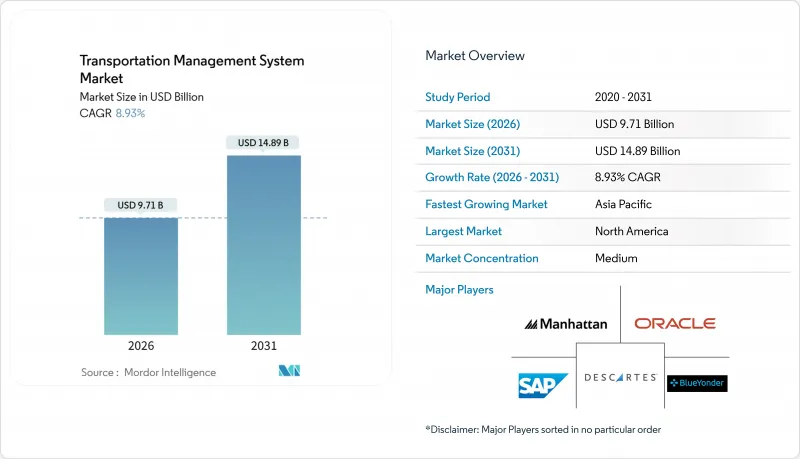
Mordor Intelligence에 의하면, 운송 관리 시스템 시장 규모는 2026년에 97억 1,000만 달러로 추정되고, 2031년까지 148억 9,000만 달러에 이를 것으로 예측되며, CAGR은 8.93%로 추이할 전망입니다.
본 보고서는 운송 수단별(도로 등), 도입 형태별(온프레미스, 클라우드, 하이브리드), 기업 규모별(대기업, 영세 기업 등), 최종 사용자 산업별(제조업, 자동차 산업 등), 구성 요소별(소프트웨어, 서비스), 용도별(주문 관리 등) 및 지역별로 분류되어 있습니다. 시장 예측은 금액(달러) 기준으로 제시되어 있습니다.
세계의 운송 관리 시스템(TMS) 시장 동향 및 인사이트
클라우드 기반 TMS 도입이 가속화되어 서비스 제공 비용 절감을 실현
멀티테넌트형 클라우드 플랫폼은 화주 수요를 통합하고, 실시간 운임 비교를 통한 운송업체 선정을 자동화하며, 성수기에는 컴퓨팅 리소스를 탄력적으로 확장함으로써 운임 비용을 15-25% 절감합니다. 운송 관리 시스템(TMS) 시장은 구독형 가격 책정의 혜택을 받고 있으며, 이를 통해 설비 투자가 불필요해질 뿐만 아니라, 공급업체의 인센티브가 정시적이고 비용 효율적인 업무 수행과 일치하게 됩니다. Oracle과 SAP는 2024년에 라우팅 엔진을 인메모리 아키텍처로 전환하여, 계획에서 실행까지의 지연 시간을 몇 분에서 몇 초로 단축했습니다. 한편, 블루 요더는 수요 예측과 경로 결정을 융합하고, 재고를 선제적으로 이동시킴으로써 품절 위험을 줄였습니다. 신 기능을 연간 단위가 아닌월단위로 출시할 수 있으므로, 규제 변동에 맞추어 기능을 항상 최신 상태로 유지할 수 있습니다. 또한, 기업은 하드웨어 업데이트 주기를 피하고, 그로 인해 절약된 비용을 데이터 사이언스 인재 확보나 지속적인 개선 프로그램에 투자할 수 있습니다.
전자상거래 및 옴니채널 소매 업계에서 실시간 라스트 마일 최적화에 대한 수요
당일 배송 수요로 인해 계획 기간이 며칠에서 몇 시간으로 단축됨에 따라, 소매업체는 운송 관리 시스템(TMS)의 워크플로우에 정교한 경로 재구성 로직을 통합해야 할 필요가 생겼습니다. 2024년 아마존이 배송 서비스 파트너(DSP) 네트워크를 4,500개 계약 업체로 확대함에 따라, 소비자용 추적 페이지와 동기화되는 경량 모바일 인터페이스에 대한 수요가 높아졌습니다. 경로 밀도 알고리즘을 통해 대량 발송 업체의 도시 지역 내 패키지당 배송 비용이 30-40% 절감되었는데, 이는 클라우드의 확장성과 정밀한 텔레메트리 없이는 실현 불가능한 비용 절감입니다. 크라우드소싱형 배송 모델에는 동적 용량 매칭과 실시간 입찰이 필요하지만, 이는 기존의 온프레미스형 플랫폼으로는 대응할 수 없는 기능입니다. 일반적으로 인구 밀집 지역에서 16km 이내에 설치되는 마이크로 풀필먼트 센터에서는 15-30분마다 재고 배치와 배송 결정을 공동으로 최적화하는 시스템의 필요성이 더욱 높아지고 있습니다.
레거시 ERP/WMS 스택과의 통합 비용이 높음
SAP ECC나 Oracle E-Business Suite를 도입한 기업의 경우, 레거시 시스템에 최신 API가 갖춰져 있지 않아 클라우드 TMS를 통합할 때 50만-300만 달러의 비용이 발생합니다. ERP 인스턴스가 하나 늘어날 때마다 고객, 제품, 거점의 마스터 데이터를 양방향으로 매핑해야 하므로 복잡성이 가중됩니다. 맨해튼 어소시에이츠(Manhattan Associates)의 보고서에 따르면, 2024년 통합 프로젝트로 인한 전문 서비스 수익이 전년 대비 18% 증가했으며, 이는 이러한 과제의 심각성을 여실히 드러내고 있습니다. 일부 제조업체는 보다 광범위한 디지털 전환이 완료될 때까지 운송 관리 시스템(TMS) 도입을 미루고 있으며, 그 결과 도입 일정이 수년이나 지연되고 있습니다. 이러한 부담이 가장 크게 가중되고 있는 분야는 자본 집약적인 산업인 반면, 디지털 네이티브 소매업체는 몇 주 만에 클라우드 TMS를 도입할 수 있습니다.
부문 분석
2025년에는 육상 화물 운송이 운송 관리 시스템 시장의 56.91%를 차지한 것으로 평가되었으며, 국내 물류에서 트럭 로드 및 LTL(소량 화물) 서비스의 우위가 계속해서 강할 것임이 드러났습니다. 반면, 항공 화물은 9.83%라는 가장 높은 연평균 성장률(CAGR)을 기록하고 있습니다. 이는 제약사들이 고부가가치 바이오의약품을 항공 운송으로 전환했기 때문이며, 이를 통해 도어 투 도어 운송 시간을 48시간 미만으로 단축하고 온도 편차 위험을 줄이고 있기 때문입니다. 국제항공운송협회(IATA)의 ‘ONE Record’ 표준에 따라 항공사 및 포워더가 예약 및 상태 API를 실시간으로 공개할 수 있게 됨에 따라, 항공 중심의 워크플로우에서 운송 관리 시스템(TMS) 시장 규모는 더욱 확대되고 있습니다. 철도 및 트럭 간 컨테이너 환적을 동기화하는 인터모달 모듈은 1,600km 노선에서 철도의 경쟁력을 유지하는 데 도움이 되고 있지만, 일정 유연성이 낮아 수요 급증에 신속하게 대응하는 데 한계가 있어 그 성장세는 항공 운송에 뒤처지고 있습니다. 해상 운송 이용자들은 선박 일정, 항만 혼잡 상황, 그리고 드레이지(육상 운송) 예약을 단일 컨트롤 타워 내에서 시각화하는 전용 컨테이너 추적 확장 기능에 의존하고 있습니다.
2025년 Amazon Air가 보유 기수를 110대로 확대한 것을 계기로 항공 화물 기술의 도입이 가속화되었으며, 소매업체들은 국경 간 전자상거래 화물에 대한 분 단위 상태 정보 제공을 요구하게 되었습니다. 베를린에 본사를 둔 마켓플레이스 ‘Cargo.one’은 100개 항공사와 제휴하여 주요 TMS 공급업체와 직접 연결된 원클릭 예약 포털을 구축했습니다. 이를 통해 기존 3일이 소요되던 견적 사이클이 몇 초로 단축되었습니다. 규제상의 압박도 도입을 뒷받침하고 있습니다. 국제민간항공기구(ICAO)의 CORSIA 프레임워크에 따라 항공사는 화물 운송에 따른 이산화탄소 배출량을 산정할 의무가 있으며, 비용과 함께 배출량 데이터를 제시하는 TMS 모듈이 현재 항공사 선정에 영향을 미치고 있습니다. 소규모 화주들이 즉각적인 스팟 운송 슬롯을 이용할 수 있게 됨에 따라 네트워크 밀도가 높아지고 적재율이 향상되어, 운송 관리 시스템(TMS) 시장의 가치 제안이 더욱 강화되고 있습니다.
클라우드 솔루션은 2025년에 매출의 61.23%를 차지한 것으로 평가되었으며, 연평균 성장률(CAGR) 9.61%로 다른 대안을 앞지르는 속도로 성장하고 있습니다. 이는 사용량 기반 과금이 화물 수에 따라 확장되기 때문이며, 계절적 변동이 심한 소매업체에게 결정적인 요인이 되고 있습니다. 또한, TMS 고객들은 가동 중단 시간 없이 신속한 규제 대응 및 AI 업그레이드를 실현하는 월별 기능 릴리스를 높이 평가하고 있으며, 이는 기존의 온프레미스형 아키텍처에서는 얻을 수 없는 유연성입니다. 하이브리드 모델은 마스터 데이터를 로컬에 보관하면서 처리는 클라우드에서 수행하기 때문에 데이터 상주성을 입증해야 하는 규제 산업에 매력적이지만, 전반적인 성장세는 여전히 완만합니다. 각 벤더사는 온프레미스용 로드맵을 단계적으로 폐지하기 시작했으며, Oracle은 2025년에 마지막 주요 온프레미스용 기능 팩을 출시하고 엔지니어링 자원을 SaaS 버전으로 전환하고 있습니다.
Blue Yonder는 2024년에 Luminate 제품군을 Microsoft Azure 기반으로 재구축하여, 고객이 6개월 이내에 계획 주기를 40% 단축하고 부하 집중도를 12% 향상시켰다고 발표했습니다. Kuebix와 3Gtms의 프리미엄형 서비스를 통해 엔트리 레벨 기능을 이용할 수 있게 되었고, 프리미엄 분석 기능은 단품 방식으로 판매되게 되었기 때문에 현재 소규모 기업도 현실적인 구매층이 되었습니다. AI 및 머신러닝 워크로드는 클라우드 데이터센터 내의 GPU 가속 클러스터를 활용하여, 리드타임 변동 및 탄소 발자국을 예측하는 출하 유형별 모델을 구현하고 있습니다. 클라우드 제공업체들이 엄격한 감사를 통과하고 있으며, 보안 침해 뉴스에서 패치 적용이 불충분한 온프레미스 서버가 연루된 사례가 증가하고 있어 보안에 대한 우려는 계속해서 줄어들고 있습니다. 그 결과, 운송 관리 시스템(TMS) 시장은 돌이킬 수 없이 SaaS로 기울고 있습니다.
지역별 분석
북미는 전자상거래의 보급이 진행되고 있고, 전자 로그 기록 장치(ELD)의 엄격한 시행, 그리고 조정 복잡성을 가중시키는 분산된 운송업체 기반 덕분에 2025년 운송 관리 시스템 시장에서 42.67%라는 최대 지역 점유율을 차지했습니다. 도입이 포화 상태에 도달하면서 성장은 둔화되고 있지만, 프리미엄 AI 기능, 자율주행차와의 연동, 그리고 탄소 배출량 최적화 모듈 덕분에 매출은 확대되고 있습니다. 아시아태평양은 물류 비용을 10% 절감하라는 중국의 지침과 화물 서류 디지털화를 의무화하는 인도의 e-way bill 시스템에 힘입어 2031년까지 연평균 성장률(CAGR) 9.91%로 성장하고 있습니다. 중국에서는 인증된 TMS를 도입하는 운송업체에 대해 지방 정부가 소프트웨어 비용의 최대 30%를 보조하고 있습니다. 한편, 인도에서는 1,200만 대에 달하는 소규모 트럭 운송업체로 구성된 분산된 차량 군에서 공차율을 40%에서 25%로 낮추는 마켓플레이스와의 연계에 가치가 인정받고 있습니다.
유럽도 큰 점유율을 차지하고 있으며, 독일, 프랑스, 영국에서는 국경을 넘는 통관 절차의 복잡성과 ‘Fit for 55’의 탄소 배출 보고 의무에 대응하기 위해 TMS 도입이 진행되고 있습니다. 네이티브 다국어 인터페이스와 VAT 준수 청구서 발행 기능을 갖춘 공급업체가 우위를 점하고 있습니다. 중동 및 아프리카, 특히 아랍에미리트(UAE)와 사우디아라비아에서는 경제 다각화를 도모하기 위해 통관 절차 자동화에 투자하고 있습니다. DP 월드(DP World)가 2024년 전 세계 터미널에 ‘Oracle Transportation Management’를 도입한 결과, 컨테이너 체류 시간이 18% 단축되었습니다. 남미에서는 시스템 통합 비용 증가와 환율 변동이라는 역풍에 직면해 있지만, 브라질과 아르헨티나의 운송업체들은 디젤 연료 가격 급등을 상쇄하기 위해 경량화된 경로 최적화 앱을 도입하고 있습니다. 일본에서는 운전자의 고령화가 진행됨에 따라, 초과 근무 시간을 줄이기 위해 AI를 활용한 배차 시스템으로의 전환이 진행되고 있으며, 이것이 현지 수요를 뒷받침하고 있습니다.
벤처 캐피털의 자금 유입이 호재로 작용하고 있습니다. 아시아태평양의 물류 기술 스타트업은 2024년에 42억 달러를 조달하여, 지역에 뿌리를 둔 혁신의 파이프라인을 확보했습니다. 말레이시아의 ‘국가 물류 계획’이나 호주의 ‘화물·공급망 전략’과 같은 정부의 청사진은 벤처 캐피털 지원에 더해 보조금 및 세액 공제를 결합함으로써 중소기업의 도입을 가속화하고 있습니다.
기타 혜택 :
- 엑셀 형식 시장 예측(ME) 시트
- 3개월간의 애널리스트 지원
자주 묻는 질문
목차
제1장 서론
제2장 조사 방법
제3장 주요 요약
제4장 시장 구도
제5장 시장 규모 및 성장 예측
제6장 경쟁 구도
제7장 시장 기회 및 향후 전망
AJY 26.09.07According to Mordor Intelligence, the transportation management system market size is USD 9.71 billion in 2026 and is projected to reach USD 14.89 billion by 2031, advancing at an 8.93% CAGR.
This report is Segmented by Mode of Transportation (Roadways, and More), Deployment (On-Premise, Cloud, Hybrid), Enterprise Size (Large Enterprises, Micro Enterprises, and More), End-User Industry (Manufacturing, Automotive, and More), Component (Software, and Services), Application (Order Management, and More), and Geography. The Market Forecasts are Provided in Terms of Value (USD).
Global Transportation Management System Market Trends and Insights
Cloud-Based TMS Adoption Accelerates Cost-to-Serve Savings
Multi-tenant cloud platforms deliver 15-25% freight-cost reductions by pooling shipper demand, automating carrier selection through real-time rate shopping, and scaling compute elastically during peak seasons. The Transportation Management System market benefits from subscription pricing, which eliminates capital expenditure and aligns vendor incentives with on-time, cost-efficient execution. Oracle and SAP migrated their routing engines to in-memory architectures in 2024, cutting plan-to-execute latency from minutes to seconds, while Blue Yonder fused demand sensing with routing decisions to proactively shift inventory, reducing stockout risk. The ability to launch new features monthly rather than annually keeps functionality current as regulations evolve. Enterprises also avoid hardware refresh cycles, channeling savings toward data-science talent and continuous improvement programs.
E-Commerce and Omnichannel Retail Demand Real-Time, Last-Mile Optimisation
Same-day delivery promises shorten planning windows from days to hours, forcing retailers to embed advanced route-resequencing logic into their Transportation Management System workflows. Amazon's expansion of its Delivery Service Partner network to 4,500 contractors in 2024 heightened demand for light mobile interfaces that sync with consumer-facing tracking pages. Route-density algorithms trimmed per-package urban delivery cost by 30-40% for high-volume shippers, a saving impossible without cloud elasticity and granular telemetry. Crowdsourced delivery models require dynamic capacity matching and real-time bidding, capabilities that legacy on-premise platforms cannot meet. Micro-fulfillment centers, typically placed within 16 km of dense population clusters, amplify the need for systems that co-optimize inventory positioning and dispatch decisions every 15-30 minutes.
High Integration Cost with Legacy ERP/WMS Stacks
Enterprises running SAP ECC or Oracle E-Business Suite incur integration bills of USD 500,000 to USD 3 million when layering a cloud TMS, as legacy systems lack modern APIs. Each additional ERP instance increases complexity, as customer, product, and location master data must be bidirectionally mapped. Manhattan Associates reported an 18% year-over-year increase in professional services revenue from integration projects in 2024, underscoring this friction. Some manufacturers postpone adoption of the Transportation Management System market until broader digital transformations are complete, stretching deployment timelines by several years. The burden falls hardest on capital-intensive verticals, leaving digitally native retailers free to implement a cloud TMS in weeks.
Other drivers and restraints analyzed in the detailed report include:
- AI-Driven Predictive ETA Tools Cut Detention/SLA Penalties
- Regulatory Push for ELD and Greenhouse Gas Reporting Digitalises Freight
- Data-Security and Privacy Concerns for Cloud Deployments
For complete list of drivers and restraints, kindly check the Table Of Contents.
Segment Analysis
Road freight dominated in 2025, with a 56.91% share of the Transportation Management System market, underscoring the continued primacy of truckload and less-than-truckload services for domestic distribution. Air freight, however, is recording the fastest 9.83% CAGR because pharmaceutical manufacturers have pivoted high-value biologics onto flights that cut door-to-door transit to below 48 hours, thereby curbing temperature-excursion risk. The Transportation Management System market size for air-centric workflows is expanding further as the International Air Transport Association ONE Record standard enables airlines and forwarders to expose booking and status APIs in real time. Intermodal modules that synchronize container transfers between rail and truck help sustain rail competitiveness on 1,600 km lanes, yet growth lags air because schedule rigidity limits rapid response to demand spikes. Ocean freight users rely on specialized container-tracking extensions that map vessel schedules, port congestion, and drayage appointments within a single control tower.
Air-freight technology adoption accelerated when Amazon Air grew its fleet to 110 aircraft in 2025, prompting retailers to demand minute-level status feeds for cross-border e-commerce packages. Berlin-based marketplace Cargo.one integrated with 100 airlines to create a one-click booking portal linked directly to leading TMS vendors, collapsing the traditional three-day quote cycle to seconds. Regulatory pressure intensifies uptake: the International Civil Aviation Organization CORSIA framework obliges airlines to allocate carbon emissions to shipments, so TMS modules that present emissions data alongside costs now influence carrier selection. As small shippers access instant spot capacity, network density rises, improving load factors and further enhancing the Transportation Management System market value proposition.
Cloud solutions captured 61.23% revenue in 2025 and are outpacing alternatives at a 9.61% CAGR because pay-as-you-go billing scales with shipment counts, a decisive factor for seasonally volatile retailers. TMS customers also value monthly feature releases that deliver rapid regulatory updates and AI upgrades without downtime, a flexibility unavailable in legacy on-premise architectures. Hybrid models retain master data locally but process execution in the cloud, appealing to regulated industries that must prove data residency, yet overall growth remains slower. Vendors have begun sunsetting on-premise roadmaps; Oracle issued its final major on-premise feature pack in 2025, redirecting engineering capacity to its SaaS edition.
Blue Yonder rebuilt its Luminate suite on Microsoft Azure in 2024, stating that customers cut planning cycles by 40% and improved load consolidation by 12% within six months. Microenterprises are now viable buyers because freemium offerings from Kuebix and 3Gtms unlock entry-level functionality, with premium analytics sold a la carte. AI and machine-learning workloads leverage GPU-accelerated clusters in cloud data centers, enabling shipment-type-specific models that predict lead-time variability and carbon footprint. Security concerns continue to diminish as cloud providers pass stringent audits and as breach headlines increasingly implicate poorly patched on-premise servers. Consequently, the Transportation Management System market is tilting irreversibly toward SaaS.
Complete Report Scope:
- By Mode of Transportation
- Roadways
- Railways
- Airways
- Maritime
- By Deployment
- On-Premise
- Cloud
- Hybrid
- By Enterprise Size
- Large Enterprises
- Small and Medium Enterprises
- Micro Enterprises
- By End-User Industry
- Manufacturing
- Retail and E-Commerce
- Food and Beverage
- Healthcare and Pharmaceuticals
- Automotive
- 3PL and Logistics Service Providers
- By Component
- Software
- Services
- Consulting
- Integration and Implementation
- Support and Maintenance
- By Application
- Order Management
- Route Planning and Optimization
- Freight Audit and Payment
- Real-Time Visibility and Tracking
- Inventory and Warehouse Integration
- By Geography
- North America
- United States
- Canada
- Mexico
- Europe
- Germany
- United Kingdom
- France
- Russia
- Rest of Europe
- Asia-Pacific
- China
- Japan
- India
- South Korea
- Australia
- Rest of Asia-Pacific
- Middle East and Africa
- Middle East
- Saudi Arabia
- United Arab Emirates
- Rest of Middle East
- Africa
- South Africa
- Egypt
- Rest of Africa
- Middle East
- South America
- Brazil
- Argentina
- Rest of South America
- North America
Geography Analysis
North America held the largest regional share in 2025 at 42.67% of the Transportation Management System market, thanks to mature e-commerce penetration, stringent enforcement of electronic logging devices, and a fragmented carrier base that intensifies orchestration complexity. Growth steadies as adoption reaches saturation, yet revenue expands from premium AI features, autonomous-vehicle integrations, and carbon-optimization modules. Asia-Pacific advances at a 9.91% CAGR through 2031, led by China's mandate to trim logistics costs by 10% and India's e-way bill system that compels digital freight paperwork. Provincial subsidies in China reimburse up to 30% of software costs for carriers adopting certified TMS, while India's fragmented fleet of 12 million small truckers finds value in marketplace integrations that lower empty-mile ratios from 40% to 25%.
Europe holds a substantial slice, with Germany, France, and the United Kingdom embracing TMS to address cross-border customs complexity and the Fit for 55 carbon-reporting mandates. Vendors with native multilingual interfaces and VAT-compliant invoicing gain an edge. The Middle East and Africa region, particularly the United Arab Emirates and Saudi Arabia, invests in customs-clearance automation to diversify economies; DP World's 2024 rollout of Oracle Transportation Management across global terminals cut container dwell times by 18%. South America confronts integration cost headwinds and currency volatility, yet Brazilian and Argentine carriers adopt lightweight route-optimization apps to offset diesel inflation. Japan's aging driver workforce is pushing fleets toward AI-assisted dispatching to reduce overtime, reinforcing local demand.
Venture capital inflows add fuel: Asia-Pacific logistics-tech startups raised USD 4.2 billion in 2024, ensuring a pipeline of localized innovations. Government blueprints, such as Malaysia's National Logistics Plan and Australia's Freight and Supply Chain Strategy, layer grants and tax deductions on top of venture backing, accelerating small-enterprise adoption.
- SAP SE
- Oracle Corporation
- Blue Yonder Group, Inc.
- Descartes Systems Group
- Manhattan Associates
- MercuryGate International
- Trimble Transportation
- E2open LLC
- Project44, Inc.
- Transplace, LLC
- Infor Nexus
- Kinaxis Inc.
- C.H. Robinson
- BluJay Solutions
- CargoSmart Ltd.
- 3Gtms Inc.
- Alpega Group
- KUEBIX LLC
- WiseTech Global Limited
Additional Benefits:
- The market estimate (ME) sheet in Excel format
- 3 months of analyst support
TABLE OF CONTENTS
1 INTRODUCTION
- 1.1 Study Assumptions and Market Definition
- 1.2 Scope of the Study
2 RESEARCH METHODOLOGY
3 EXECUTIVE SUMMARY
4 MARKET LANDSCAPE
- 4.1 Market Overview
- 4.2 Market Drivers
- 4.2.1 Cloud-Based TMS Adoption Accelerates Cost-to-Serve Savings
- 4.2.2 E-Commerce and Omnichannel Retail Demand Real-Time, Last-Mile Optimisation
- 4.2.3 Regulatory Push for ELD and Greenhouse Gas Reporting Digitalises Freight
- 4.2.4 Freight-Marketplace Convergence Enables Dynamic Capacity Procurement
- 4.2.5 AI-Driven Predictive ETA Tools Cut Detention/SLA Penalties
- 4.2.6 Open-Source Telemetry APIs and Micro-Services Unlock Modular TMS for SMEs
- 4.3 Market Restraints
- 4.3.1 High Integration Cost with Legacy ERP/WMS Stacks
- 4.3.2 Data-Security and Privacy Concerns for Cloud Deployments
- 4.3.3 Shortage of In-House Data-Science Talent to Exploit Analytics Modules
- 4.3.4 Fragmented Carrier-Telematics Standards Hinder Multimodal Visibility
- 4.4 Industry Value Chain Analysis
- 4.5 Regulatory Landscape
- 4.6 Technological Outlook
- 4.7 Impact of Macroeconomic Factors on the Market
- 4.8 Porter's Five Forces Analysis
- 4.8.1 Threat of New Entrants
- 4.8.2 Bargaining Power of Buyers
- 4.8.3 Bargaining Power of Suppliers
- 4.8.4 Threat of Substitutes
- 4.8.5 Competitive Rivalry
5 MARKET SIZE AND GROWTH FORECASTS (VALUE)
- 5.1 By Mode of Transportation
- 5.1.1 Roadways
- 5.1.2 Railways
- 5.1.3 Airways
- 5.1.4 Maritime
- 5.2 By Deployment
- 5.2.1 On-Premise
- 5.2.2 Cloud
- 5.2.3 Hybrid
- 5.3 By Enterprise Size
- 5.3.1 Large Enterprises
- 5.3.2 Small and Medium Enterprises
- 5.3.3 Micro Enterprises
- 5.4 By End-User Industry
- 5.4.1 Manufacturing
- 5.4.2 Retail and E-Commerce
- 5.4.3 Food and Beverage
- 5.4.4 Healthcare and Pharmaceuticals
- 5.4.5 Automotive
- 5.4.6 3PL and Logistics Service Providers
- 5.5 By Component
- 5.5.1 Software
- 5.5.2 Services
- 5.5.2.1 Consulting
- 5.5.2.2 Integration and Implementation
- 5.5.2.3 Support and Maintenance
- 5.6 By Application
- 5.6.1 Order Management
- 5.6.2 Route Planning and Optimization
- 5.6.3 Freight Audit and Payment
- 5.6.4 Real-Time Visibility and Tracking
- 5.6.5 Inventory and Warehouse Integration
- 5.7 By Geography
- 5.7.1 North America
- 5.7.1.1 United States
- 5.7.1.2 Canada
- 5.7.1.3 Mexico
- 5.7.2 Europe
- 5.7.2.1 Germany
- 5.7.2.2 United Kingdom
- 5.7.2.3 France
- 5.7.2.4 Russia
- 5.7.2.5 Rest of Europe
- 5.7.3 Asia-Pacific
- 5.7.3.1 China
- 5.7.3.2 Japan
- 5.7.3.3 India
- 5.7.3.4 South Korea
- 5.7.3.5 Australia
- 5.7.3.6 Rest of Asia-Pacific
- 5.7.4 Middle East and Africa
- 5.7.4.1 Middle East
- 5.7.4.1.1 Saudi Arabia
- 5.7.4.1.2 United Arab Emirates
- 5.7.4.1.3 Rest of Middle East
- 5.7.4.2 Africa
- 5.7.4.2.1 South Africa
- 5.7.4.2.2 Egypt
- 5.7.4.2.3 Rest of Africa
- 5.7.4.1 Middle East
- 5.7.5 South America
- 5.7.5.1 Brazil
- 5.7.5.2 Argentina
- 5.7.5.3 Rest of South America
- 5.7.1 North America
6 COMPETITIVE LANDSCAPE
- 6.1 Market Concentration
- 6.2 Strategic Moves
- 6.3 Market Share Analysis
- 6.4 Company Profiles {(includes Global level Overview, Market level overview, Core Segments, Financials as available, Strategic Information, Market Rank/Share for key companies, Products and Services, and Recent Developments)}
- 6.4.1 SAP SE
- 6.4.2 Oracle Corporation
- 6.4.3 Blue Yonder Group, Inc.
- 6.4.4 Descartes Systems Group
- 6.4.5 Manhattan Associates
- 6.4.6 MercuryGate International
- 6.4.7 Trimble Transportation
- 6.4.8 E2open LLC
- 6.4.9 Project44, Inc.
- 6.4.10 Transplace, LLC
- 6.4.11 Infor Nexus
- 6.4.12 Kinaxis Inc.
- 6.4.13 C.H. Robinson
- 6.4.14 BluJay Solutions
- 6.4.15 CargoSmart Ltd.
- 6.4.16 3Gtms Inc.
- 6.4.17 Alpega Group
- 6.4.18 KUEBIX LLC
- 6.4.19 WiseTech Global Limited
7 MARKET OPPORTUNITIES AND FUTURE OUTLOOK
- 7.1 White-Space and Unmet-Need Assessment


