|
시장보고서
상품코드
2122918
홍채 인증 : 시장 점유율 분석, 업계 동향 및 통계, 성장 예측(2026-2031년)Iris Recognition - Market Share Analysis, Industry Trends & Statistics, Growth Forecasts (2026 - 2031) |
||||||
 Mordor Intelligence
Mordor Intelligence에 의하면, 홍채 인증 시장 규모는 2025년 51억 4,000만 달러로 평가되었습니다. 2026년에는 61억 5,000만 달러로 확대되어 2026-2031년에 걸쳐 CAGR 19.68%로 성장을 지속하여, 2031년에는 150억 9,000만 달러에 이를 것으로 예측됩니다.

본 보고서는 구성 요소(하드웨어, 소프트웨어), 인증 모드(1 : 1 검증, 1 : N 식별),용도(출입 관리·근태 관리, 신분 증명·국경 관리, 기타), 최종 사용자 산업(정부·법 집행 기관, 은행, 금융서비스 및 보험(BFSI), 기타), 지역(북미, 남미, 유럽, 기타)별로 분류되어 있습니다. 시장 예측은 금액(달러)으로 표시되어 있습니다.
세계의 홍채 인증 시장 동향 및 인사이트
아시아의 국민 신분증·전자 여권 프로그램 확대
아시아태평양의 각국 정부는 공공 서비스 제공과 금융 포용성을 효율화하기 위해 홍채 인증 기능을 갖춘 디지털 ID 플랫폼을 지속적으로 확대되고 있습니다. 인도의 ‘DigiLocker’ 업그레이드를 통해 기업들은 ‘Aadhaar’ 데이터베이스를 통해 직원의 신원 정보를 확인할 수 있게 되었으며, 적용 범위가 일반 시민을 넘어 확대되고 있습니다. 태국의 공중보건 당국은 이주 노동자를 위해 다중 모드 등록 키오스크를 도입하여, 홍채 스캔을 백신 접종 및 수당 수급 자격과 연계하고 있습니다. 광학 모듈의 비용은 대량 생산으로 인해 1자리 수의 달러 수준까지 낮아져, 예산이 제한된 기관에게도 도입 장벽이 낮아졌습니다. 등록 열기가 지속되는 가운데, 각 벤더사는 유지보수 계약과 성능 기준 상향에 따른 정기적인 센서 교체 주기를 통해 지속적인 수익을 기대하고 있습니다.
중동 주요 노선에서의 국경 관리 관련 지출 증가
걸프 국가들에서는 주요 공항에서 보안 기준과 여객 처리 목표 간의 균형을 맞추기 위해 홍채 인식을 대규모로 도입하고 있습니다. IDEMIA와 공동으로 진행되고 있는 아랍에미리트의 ‘eGate’ 프로그램에서는 원거리 홍채 촬영 기술을 채택하여, 입국 심사 카운터에 접촉할 필요 없이 거주자 및 방문객의 절차를 처리하고 있습니다. 사우디아라비아의 ‘비전 2030’ 태스크포스는 모든 신규 터미널에 다중 생체 인증을 의무화하고 있으며, 이에 따라 Invixium 등공급업체들은 신속한 맞춤화를 실현하기 위해 현지 조립 라인 구축에 주력하고 있습니다. 그 결과, 조달 동향으로는 시간당 수천 명의 여행자 심사를 처리하면서도 입국 심사관을 위한 감사 기준을 충족하는 증거를 기록할 수 있는 고처리 능력 스캐너와 클라우드 지원 대조 엔진이 중시되고 있습니다.
공항 내 멀티모달 생체 인증 허브에 대한 막대한 설비 투자
공항은 기존 검문소에 홍채, 얼굴, 지문 인증 기능을 갖춘 멀티모달 포드를 사후 도입할 때 막대한 초기 비용에 직면하고 있습니다. 미국 교통안전청(TSA)의 검사 운영에서는 승객 처리 능력의 향상이 확인되고 있지만, 전용 레인, LED 조명, 중앙 대조 엔진을 위한 전용 광섬유 백홀이 필요합니다. 소규모 지방 공항에서는 투자 회수가 예상되는 승객 수에 도달할 때까지 도입을 미루고 있어, 이로 인해 양극화된 도입 곡선이 형성되고 있습니다. 공급업체는 모듈식 및 사용량 기반 과금 가격 모델을 활용하여 이러한 상황을 극복해야 합니다.
부문별 분석
하드웨어는 2025년 매출의 72.25%를 차지했으며, 고정밀 광학 시스템, 제어된 조명, 견고한 케이스가 필요하기 때문에 계속해서 홍채 인식 시장의 기반을 이루고 있습니다. 그러나 클라우드 추론 엔진으로 인해 인식 속도가 향상되고, 대규모 장비 교체를 동반하지 않고도 유연한 기능 업데이트가 가능해짐에 따라 성장의 중심은 소프트웨어로 이동하고 있습니다. 시스템 운영 사업자에 따르면, 카메라의 평균 업그레이드 주기는 4-5년이지만, 끊임없이 변화하는 사용자층에 대응하여 정확도를 높이기 위해 분기마다 알고리즘 패치를 배포하고 있습니다.
2026년부터 2031년에 걸쳐 소프트웨어 부문이 연평균 성장률(CAGR) 22.05%를 나타낼 것으로 예측되는 것은 설비 투자에서 구독 모델로의 전환을 여실히 보여주고 있으며, 중소규모 기업도 종량제 API를 통해 엔터프라이즈 수준의 정확도를 시험적으로 이용할 수 있게 될 것입니다. 이러한 계층형 아키텍처는 새로운 개인정보 보호 규제가 도입될 때 신속한 배포를 가능하게 하며, 이는 의료 및 금융 부문의 조달 위원회에 실질적인 영향을 미치는 요인이 되고 있습니다. 이와 동시에, 부품 공급업체들은 적외선 LED 어레이의 소형화를 추진하며, 자동차 등급의 내열 성능을 채택함으로써 조명 조건이 불안정한 실외에서의 도입 범위를 확대되고 있습니다. 오픈 API를 지원하는 렌즈는 모달리티 간 융합을 가능하게 하여, 사업자가 단일 센서에서 홍채와 얼굴 이미지를 모두 공통 백엔드로 스트리밍할 수 있게 합니다.
2025년에는 1대 N 모드가 홍채 인식 시장 규모의 65.70%를 차지했습니다. 이는 수백만 건의 기록이 등록된 데이터베이스에 대한 1대 다 검색을 필요로 하는 국경 관리, 유권자 등록, 복지 급여 도입에 의해 뒷받침되고 있습니다. 정부는 여행 성수기에 막대한 컴퓨팅 예산을 확보하고 있으며, 이를 통해 동시 쿼리에 대한 아키텍처의 내성이 입증되었습니다.
향후 5년 동안 1대 1 검증은 연평균 성장률(CAGR) 20.15%를 나타낼 것으로 예측됩니다. 이는 기업과 모바일 지갑 사업자들이 종합적인 중복 제거보다 신속한 사용자 인증에 중점을 두고 있기 때문입니다. 결제 포기를 방지하기 위해 지연 시간을 250밀리초 이하로 억제해야 하는 상황에서는 이러한 편의성이 특히 중요하게 여겨집니다. 유럽의 조기 도입 은행에서는 현재 홍채 스캔과 동적 QR 토큰을 결합하여 거래 세션을 연결함으로써, 사용자에게 눈에 띄는 부담을 주지 않으면서 피싱 위험을 줄이고 있습니다. 이러한 포인트 솔루션이 확대됨에 따라 데이터는 적응형 임계값 설정 엔진에 피드백되어, 문화적으로 다양한 사용자층에서 오승인 및 오거부의 균형이 개선되고 있습니다.
지역별 분석
2025년, 아시아태평양은 전 세계 매출의 35.60%를 차지했습니다. 이는 인도의 Aadhaar 제도에 12억 명 이상의 시민이 등록되어 있고, 생체 인증의 일상화를 가능하게 하는 스마트폰의 급속한 보급에 힘입은 결과입니다. 중국의 휴대전화 제조업체들은 알리페이(Alipay)와 위챗 페이(WeChat Pay)를 통한 송금을 지원하기 위해 플래그십 모델에 홍채 인증 기능을 기본 탑재하고 있습니다. 한편, 일본의 NEC는 운송 및 소매점의 셀프 체크아웃 레인을 위해 Bio-IDiom 제품군을 상용화하고 있습니다. 규제의 명확화, 잘 갖춰진 모바일 데이터 통신망, 가격에 민감하면서도 기술에 정통한 소비자의 존재가 도입 건수의 지속적인 성장을 위한 유리한 환경을 조성하고 있습니다.
중동은 걸프 국가 공항의 원활한 승객 동선 도입과 각국의 디지털 ID 도입 계획에 힘입어, 2031년까지 연평균 성장률(CAGR) 20.75%라는 가장 빠른 성장 궤도를 기록하고 있습니다. 아랍에미리트(UAE)가 기존의 물리적 에미레이트 ID 카드를 폐지하고, 얼굴 인식과 홍채 인식을 결합한 인증 수단으로의 전환을 결정한 것은 기존 카드 제도를 뛰어넘겠다는 정책적 의지를 여실히 보여주고 있습니다. 사우디아라비아의 현지화 추진에 따라 각 벤더사는 스캐너의 공동 생산을 요구받고 있으며, 이 지역은 수요의 거점인 동시에 생산 거점으로서의 지위를 확립해 가고 있습니다.
유럽과 북미에서는 성숙 단계에 접어들었음에도 정책에 의해 형성되는 수요 곡선을 볼 수 있습니다. GDPR(EU 개인정보보호규정) 의무에 따라 ‘프라이버시 바이 디자인(Privacy by Design)’ 아키텍처가 요구되고 있으며, 국내 클라우드 노드 및 암호화 오버레이에 대한 투자 확대가 촉진되고 있습니다. 미국 시장에서는 국경 검문소와 항공 허브의 현대화에 연방 정부 자금이 투입되고 있으며, 세관·국경보호국(CBP)은 홍채 인증 시범 사업을 더 많은 국경 검문소로 확대되고 있습니다. 시민의 자유를 옹호하는 단체들이 도입 상황을 모니터링하고 있기 때문에 정확한 생체 인식과 투명성이 높은 감사 추적 기록은 국민의 이해를 얻기 위해 필수적입니다.
기타 혜택
- 엑셀 형식 시장 예측(ME) 시트
- 3개월간 애널리스트 지원
자주 묻는 질문
목차
제1장 서론
제2장 조사 방법
제3장 주요 요약
제4장 시장 구도
제5장 시장 규모 및 성장 예측
제6장 경쟁 구도
제7장 시장 기회 및 향후 전망
KTH 26.09.08According to Mordor Intelligence, the iris recognition market size is expected to grow from USD 5.14 billion in 2025 to USD 6.15 billion in 2026 and is forecast to reach USD 15.09 billion by 2031 at 19.68% CAGR over 2026-2031.
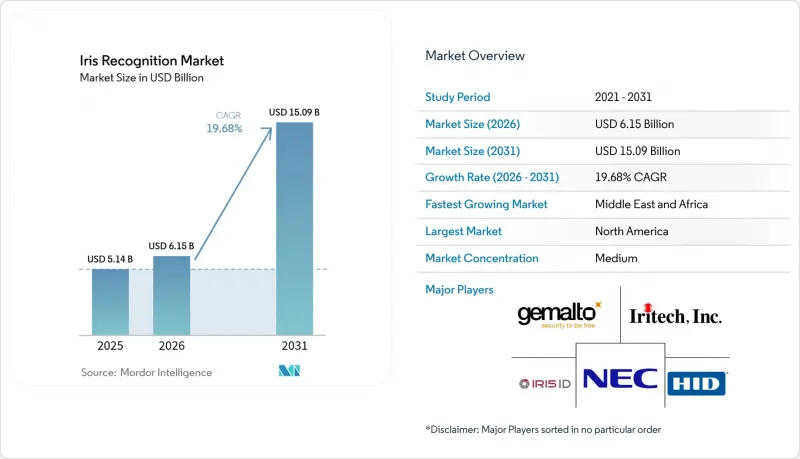
This report is Segmented by Component (Hardware, Software), Authentication Mode (1:1 Verification, 1:N Identification), Application (Access Control and Time-Attendance, ID and Border Control, and More), End-User Industry (Government and Law-Enforcement, BFSI, and More), and Geography (North America, South America, Europe, and More). The Market Forecasts are Provided in Terms of Value (USD).
Global Iris Recognition Market Trends and Insights
Growing National-ID & e-Passport Programs in Asia
Asia-Pacific governments keep scaling iris-enabled digital identity platforms to streamline public-service delivery and financial inclusion. India's DigiLocker upgrade now allows corporate entities to verify staff credentials through the Aadhaar database, widening the addressable base beyond individual citizens.Thailand's public-health authorities have introduced multimodal enrolment kiosks for migrant workers, linking iris scans to vaccination and benefits eligibility. Optical module costs have fallen toward single-digit USD levels in high-volume production, giving budget-constrained agencies an entry point. As enrollment momentum continues, vendors see durable revenue from maintenance contracts and periodic sensor refresh cycles that follow increased performance standards.
Rising Border-Control Spending Across Middle-East Corridors
Gulf states deploy iris recognition at scale to balance security thresholds with passenger-flow targets in flagship airports. The UAE's eGate program, delivered with IDEMIA, employs iris-at-distance capture to process residents and visitors without touching immigration counters. Saudi Arabia's Vision 2030 task force mandates multimodal biometrics for all new terminals, prompting suppliers such as Invixium to commit to local assembly lines for quicker customization. The resulting procurement pipeline favors high-throughput scanners and cloud-ready matching engines that can clear several thousand travelers per hour while logging audit-grade evidence for immigration officials.
High CAPEX of Multimodal Biometric Hubs at Airports
Airports face steep upfront costs when retrofitting existing checkpoints with multimodal pods that include iris, face, and fingerprint options. U.S. Transportation Security Administration trials show passenger throughput gains yet require specialized lanes, LED-safe lighting, and dedicated fiber backhauls to central matching engines. Smaller regional airports postpone rollouts until passenger volumes justify the payback, creating a two-tier adoption curve that suppliers must navigate with modular, pay-per-use pricing models.
Other drivers and restraints analyzed in the detailed report include:
- Smartphone OEM Adoption of On-Device Iris Sensors
- Expansion of Contactless Patient-ID Mandates in U.S. Healthcare
- Data-Sovereignty & Biometric-Template Storage Regulations (EU GDPR)
For complete list of drivers and restraints, kindly check the Table Of Contents.
Segment Analysis
Hardware accounted for 72.25% of 2025 revenue and continues to anchor the iris recognition market, given the need for precision optics, controlled illumination, and rugged housings. Growth, however, shifts toward software as cloud inference engines raise recognition speeds and enable agile feature updates without forklift replacements. System operators report average upgrade cycles of four to five years for cameras, yet deploy quarterly algorithm patches to improve accuracy against evolving demographic mixes.
Software's 22.05% CAGR from 2026-2031 underscores the pivot from capital expenditure to subscription models, letting smaller enterprises trial enterprise-grade accuracy through pay-as-you-go APIs. The layered architecture supports quick rollouts when new privacy mandates emerge, a factor that materially influences procurement committees in health and finance. In parallel, component suppliers miniaturize infrared LED arrays and apply automotive-grade temperature ratings, expanding outdoor deployment windows where lighting is unpredictable. Open-API lenses invite cross-modality fusion, letting operators stream both iris and face images from a single sensor to common back ends.
The 1:N mode represented 65.70% iris recognition market size in 2025, supported by border-control, voter registry, and welfare-benefit rollouts requiring one-to-many searches against multimillion-record galleries. Governments reserve significant compute budgets for peak travel seasons, validating the architecture's resilience for concurrent queries.
Over the next five years, 1:1 verification is expected to record a 20.15% CAGR as corporates and mobile-wallet providers focus on rapid user validation rather than exhaustive de-duplication. The convenience angle resonates where latency must stay below 250 milliseconds to avoid checkout abandonment. Early adopter banks in Europe now pair iris scans with dynamic QR tokens to bind the transaction session, reducing phishing risk without noticeable user friction. As these point solutions scale, they feed data back into adaptive thresholding engines that improve false-accept/false-reject balances across culturally diverse user cohorts.
Complete Report Scope:
- By Component
- Hardware
- Iris Scanners
- Cameras
- Integrated Iris-Recognition Systems
- Other Optical Modules and Illumination
- Software
- Stand-alone Matching Engines
- SDKs and Middleware
- Cloud-based Platforms
- Hardware
- By Authentication Mode
- 1:1 Verification
- 1:N Identification
- By Application
- Access Control and Time-Attendance
- ID and Border Control
- Transaction and Payment Authentication
- Patient Identification and EMR Linkage
- Others (KYC, Surveillance, Automotive Infotainment)
- By End-user Industry
- Government and Law-Enforcement
- Banking, Financial Services and Insurance (BFSI)
- Healthcare and Life Sciences
- Consumer Electronics
- Military and Defense
- Travel and Immigration
- Commercial and Enterprise
- Others (Education, Automotive OEMs)
- By Geography
- North America
- United States
- Canada
- Mexico
- South America
- Brazil
- Argentina
- Rest of South America
- Europe
- United Kingdom
- Germany
- France
- Italy
- Spain
- Rest of Europe
- Asia Pacific
- China
- Japan
- South Korea
- India
- Singapore
- Australia
- New Zealand
- Rest of Asia Pacific
- Middle East and Africa
- Middle East
- Saudi Arabia
- United Arab Emirates
- Turkey
- Rest of Middle East
- Africa
- South Africa
- Nigeria
- Kenya
- Rest of Africa
- Middle East
- North America
Geography Analysis
Asia-Pacific held 35.60% of global revenue in 2025, underpinned by India's Aadhaar enrollment of over 1.2 billion citizens and rapid smartphone penetration that normalizes biometric interactions. Chinese handset vendors bundle iris unlock in flagship models to underpin Alipay and WeChat Pay transfers, while Japan's NEC commercializes its Bio-IDiom suite across transportation and retail self-checkout lanes. Regulatory clarity, strong mobile data coverage, and price-sensitive yet tech-savvy consumers create a fertile setting for sustained installation growth.
The Middle East records the fastest trajectory at 20.75% CAGR through 2031, fueled by Gulf airports' shift to seamless passenger corridors and national digital-ID roadmaps. The UAE's decision to retire physical Emirates ID cards in favor of a facial-and-iris credential highlights the policy's will to leapfrog legacy cards. Saudi Arabia's localization drives push vendors to co-manufacture scanners, positioning the region as both a demand hub and a production base.
Europe and North America display mature yet policy-shaped demand curves. GDPR obligations force privacy-by-design architectures, prompting greater investment in in-country cloud nodes and encryption overlays. The U.S. market banks on federal funding to update border checkpoints and aviation hubs, with Customs and Border Protection extending iris capture pilots to additional crossings. Civil-liberties groups monitor deployments, so accurate liveness detection and transparent audit trails are critical to winning public acceptance.
- NEC Corporation
- IDEMIA
- HID Global (ASSA ABLOY)
- Thales Group (Gemalto)
- Iris ID Inc.
- IriTech Inc.
- EyeLock LLC
- Princeton Identity Inc.
- BioEnable Technologies Pvt. Ltd.
- IrisGuard UK Ltd.
- Aware Inc.
- Vision-Box
- DERMALOG Identification Systems
- Cognitec Systems GmbH
- Smartmatic
- Samsung Electronics Co., Ltd.
- Fujitsu Limited
- CLEAR Inc.
- CMITech Company Ltd.
- SRI International
Additional Benefits:
- The market estimate (ME) sheet in Excel format
- 3 months of analyst support
TABLE OF CONTENTS
1 INTRODUCTION
- 1.1 Study Assumptions and Market Definition
- 1.2 Scope of the Study
2 RESEARCH METHODOLOGY
3 EXECUTIVE SUMMARY
4 MARKET LANDSCAPE
- 4.1 Market Overview
- 4.2 Market Drivers
- 4.2.1 Growing National-ID and e-Passport Programs in Asia
- 4.2.2 Rising Border-Control spending across Middle-East corridors
- 4.2.3 Smartphone OEM Adoption of On-Device Iris Sensors
- 4.2.4 Expansion of Contactless Patient ID mandates in U.S. Healthcare
- 4.2.5 EU Digital Wallet Initiatives accelerating e-KYC demand
- 4.2.6 Cross-Border Money-laundering Compliance in BFSI
- 4.3 Market Restraints
- 4.3.1 High CAPEX of Multimodal Biometric Hubs at Airports
- 4.3.2 Accuracy Degradation under Non-cooperative Capture Scenarios
- 4.3.3 Data-sovereignty and Biometric-template Storage Regulations (EU GDPR)
- 4.3.4 Public Perception and Civil-liberties Backlash in North America
- 4.4 Value / Supply-Chain Analysis
- 4.5 Regulatory and Technological Outlook
- 4.6 Porter's Five Forces Analysis
- 4.6.1 Bargaining Power of Suppliers
- 4.6.2 Bargaining Power of Buyers
- 4.6.3 Threat of New Entrants
- 4.6.4 Threat of Substitutes
- 4.6.5 Competitive Rivalry
- 4.7 Investment Analysis
5 MARKET SIZE AND GROWTH FORECASTS (VALUE)
- 5.1 By Component
- 5.1.1 Hardware
- 5.1.1.1 Iris Scanners
- 5.1.1.2 Cameras
- 5.1.1.3 Integrated Iris-Recognition Systems
- 5.1.1.4 Other Optical Modules and Illumination
- 5.1.2 Software
- 5.1.2.1 Stand-alone Matching Engines
- 5.1.2.2 SDKs and Middleware
- 5.1.2.3 Cloud-based Platforms
- 5.1.1 Hardware
- 5.2 By Authentication Mode
- 5.2.1 1:1 Verification
- 5.2.2 1:N Identification
- 5.3 By Application
- 5.3.1 Access Control and Time-Attendance
- 5.3.2 ID and Border Control
- 5.3.3 Transaction and Payment Authentication
- 5.3.4 Patient Identification and EMR Linkage
- 5.3.5 Others (KYC, Surveillance, Automotive Infotainment)
- 5.4 By End-user Industry
- 5.4.1 Government and Law-Enforcement
- 5.4.2 Banking, Financial Services and Insurance (BFSI)
- 5.4.3 Healthcare and Life Sciences
- 5.4.4 Consumer Electronics
- 5.4.5 Military and Defense
- 5.4.6 Travel and Immigration
- 5.4.7 Commercial and Enterprise
- 5.4.8 Others (Education, Automotive OEMs)
- 5.5 By Geography
- 5.5.1 North America
- 5.5.1.1 United States
- 5.5.1.2 Canada
- 5.5.1.3 Mexico
- 5.5.2 South America
- 5.5.2.1 Brazil
- 5.5.2.2 Argentina
- 5.5.2.3 Rest of South America
- 5.5.3 Europe
- 5.5.3.1 United Kingdom
- 5.5.3.2 Germany
- 5.5.3.3 France
- 5.5.3.4 Italy
- 5.5.3.5 Spain
- 5.5.3.6 Rest of Europe
- 5.5.4 Asia Pacific
- 5.5.4.1 China
- 5.5.4.2 Japan
- 5.5.4.3 South Korea
- 5.5.4.4 India
- 5.5.4.5 Singapore
- 5.5.4.6 Australia
- 5.5.4.7 New Zealand
- 5.5.4.8 Rest of Asia Pacific
- 5.5.5 Middle East and Africa
- 5.5.5.1 Middle East
- 5.5.5.1.1 Saudi Arabia
- 5.5.5.1.2 United Arab Emirates
- 5.5.5.1.3 Turkey
- 5.5.5.1.4 Rest of Middle East
- 5.5.5.2 Africa
- 5.5.5.2.1 South Africa
- 5.5.5.2.2 Nigeria
- 5.5.5.2.3 Kenya
- 5.5.5.2.4 Rest of Africa
- 5.5.5.1 Middle East
- 5.5.1 North America
6 COMPETITIVE LANDSCAPE
- 6.1 Market Concentration
- 6.2 Strategic Moves
- 6.3 Market Share Analysis
- 6.4 Company Profiles (includes Global level Overview, Market level overview, Core Segments, Financials as available, Strategic Information, Market Rank/Share for key companies, Products and Services, and Recent Developments)
- 6.4.1 NEC Corporation
- 6.4.2 IDEMIA
- 6.4.3 HID Global (ASSA ABLOY)
- 6.4.4 Thales Group (Gemalto)
- 6.4.5 Iris ID Inc.
- 6.4.6 IriTech Inc.
- 6.4.7 EyeLock LLC
- 6.4.8 Princeton Identity Inc.
- 6.4.9 BioEnable Technologies Pvt. Ltd.
- 6.4.10 IrisGuard UK Ltd.
- 6.4.11 Aware Inc.
- 6.4.12 Vision-Box
- 6.4.13 DERMALOG Identification Systems
- 6.4.14 Cognitec Systems GmbH
- 6.4.15 Smartmatic
- 6.4.16 Samsung Electronics Co., Ltd.
- 6.4.17 Fujitsu Limited
- 6.4.18 CLEAR Inc.
- 6.4.19 CMITech Company Ltd.
- 6.4.20 SRI International
7 MARKET OPPORTUNITIES AND FUTURE OUTLOOK
- 7.1 White-space and Unmet-Need Assessment