
|
시장보고서
상품코드
2122938
그린 포장 : 시장 점유율 분석, 업계 동향 및 통계, 성장 예측(2026-2031년)Green Packaging - Market Share Analysis, Industry Trends & Statistics, Growth Forecasts (2026 - 2031) |
||||||
 Mordor Intelligence
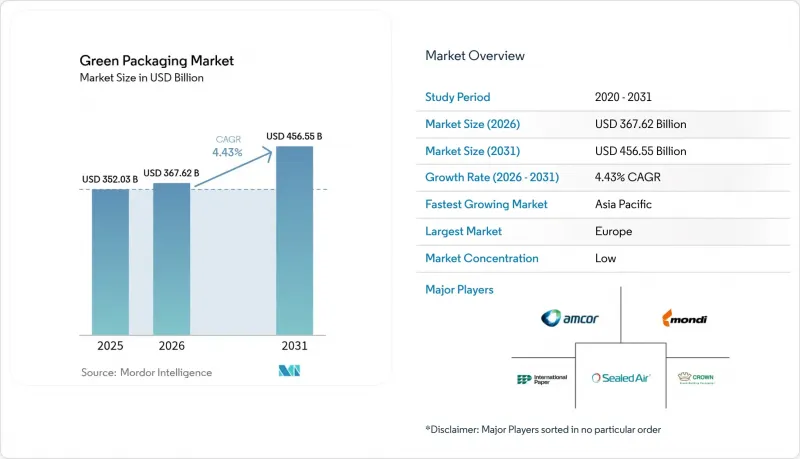
Mordor Intelligence에 의하면, 2026년 그린 포장 시장 규모는 3,676억 2,000만 달러로 추정되고 2025년 3,520억 3,000만 달러에서 확대해, 2031년에는 4,565억 5,000만 달러에 이를 것으로 예측됩니다.
2026-2031년 동안 연평균 성장률(CAGR) 4.43%로 성장할 것으로 전망됩니다. 이러한 꾸준한 성장은 유럽연합(EU)의 PPWR(플라스틱 포장 폐기물 규정)과 같은 법적 규제, 기업의 포장 부문 내 넷제로 목표, 재생 원료를 통한 비용 절감 등의 요인이 복합적으로 작용하여 발생하고 있습니다.

본 보고서는 포장 유형(재활용 소재 함유 포장, 재사용형 포장, 생분해성 포장), 소재(종이 및 판지, 유리, 기타), 포장 기능(1차 포장, 2차 포장, 기타), 최종 사용자 산업(식품, 음료, 기타),지역(북미, 유럽, 아시아태평양, 남미, 중동 및 아프리카)별로 분류되어 있습니다.
세계의 그린 포장 시장 동향 및 인사이트
일회용 플라스틱에 대한 엄격한 규제
유럽연합(EU), 인도, 칠레에서의 정책 도입 가속화로 인해 기존 폴리머의 사용이 대폭 제한되고, 퇴비화 가능한 필름이나 재활용률이 높은 PET로의 즉각적인 전환이 촉진되고 있습니다. 러시아가 2025년 9월부터 특정 PET 제품을 금지하고, EU가 식품 접촉용 포장재에서 비스페놀 A를 전면 금지함에 따라 전체 소재 범주가 배제되면서, 가공업체들은 바이오폴리머의 상용화를 서둘러야만 하는 상황에 처해 있습니다. 인도의 규정에 따르면 2025년부터 식수 병에 30%의 소비 후 재활용 소재 사용이 의무화되며, 한편 칠레는 2060년까지 그 비율을 70%로 높일 방침입니다. 이로 인해 혁신 주기가 단축되고, 해조류 유래 소재나 PHA 혼합에 대한 설비 투자가 촉진되고 있습니다. 한국의 ‘마린 이노베이션’은 이러한 규제가 해양 바이오매스 기판을 특허로 보유한 스타트업을 육성하고, 시장 출시가 가능한 실용성을 입증하고 있음을 보여줍니다. 캘리포니아주의 확대 생산자 책임 제도는 재사용 의무를 부과하고 있어, 소재 대체는 단순한 브랜딩 활동이 아닌 경쟁상의 필수 조건이 되었습니다.
기업의 ESG·넷제로 포장에 관한 공약
각 브랜드 소유 기업들은 현재 지속가능성에 관한 슬로건을 규제 최저 기준을 상회하는 발주 조건으로 구체화하고 있습니다. 볼 코퍼레이션(Ball Corporation)은 2030년까지 재생 재료 사용률을 85%로 높이고, 전 세계 알루미늄 재활용률 90%를 목표로 하고 있으며, 이를 통해 2차 제련소의 생산물에 대한 수요를 사실상 보장하고 있습니다. 유니레버(Unilever)는 2024년 5월, 2025년까지 100% 재활용 가능, 재사용 가능 또는 퇴비화 가능한 포장 형태를 실현하겠다는 공약을 발표했습니다. 이는 설계 변경과 절대적인 소재 감축 목표를 결합한 것으로, 공급업체에 대한 압박을 강화하고 있습니다. 로레알은 현재 재활용률이 49%에 그치고 있음에도 불구하고, 7,200만 유로 규모의 펀드를 통해 재활용 관련 스타트업 기업을 지원하고 있으며, 자본이 점진적인 개선이 아닌 확장 가능한 솔루션으로 이동하고 있음을 보여주고 있습니다. 세븐&아이 홀딩스의 ‘GREEN CHALLENGE 2050’에서는 2030년까지 지속가능한 원료 사용률을 50%로 하겠다고 명시하고 있으며, 이를 바탕으로 PHA 및 바이오 PE 전용 생산 라인 설치를 정당화하는 다국에 걸친 공급 계약이 체결되었습니다. 이러한 다국적 기업이 기준 사양을 정하면, 2차 공급업체는 인증 벤더 목록에 남기 위해 해당 기준을 준수해야 합니다.
바이오 유래 원료공급 제약
PLA, PHA, 전분 유도체는 식량 및 바이오연료 수요와 경쟁하는 농업 원료에 의존하고 있습니다. SK케미칼과 네이처웍스는 수지 가격을 좌우하는 옥수수 및 설탕 가격 변동에 직면해 있으며, 상품 가격이 급등하는 시기에는 바이오 폴리머의 경쟁력이 떨어집니다. 북미와 유럽의 발효 및 정제 설비 부족은 병목 현상을 초래하여 일시적인 공급 부족을 야기하고 있습니다. 이로 인해 가공업체들은 조달처를 여러 곳으로 분산시키거나 재생 PET로 회귀할 수밖에 없는 상황에 처해 있습니다. 대규모 생산 능력 확충에는 수억 달러 규모의 플랜트 건설과 10년 이상의 감가상각이 필요하기 때문에 수요 급증에 대한 신속한 대응이 저해되고 있습니다. 수확 주기가 연간 처리량을 좌우하기 때문에 계절성이 리스크를 더욱 증대시켜 재고 및 현금 흐름 관리를 복잡하게 만들고 있습니다.
부문별 분석
2025년, 종이, 금속, 유리, PET의 성숙한 회수 시스템에 힘입어 재생 소재를 활용한 솔루션은 그린 포장 시장의 59.84%를 차지했습니다. 생분해성 소재는 현재 시장 점유율이 작지만 연평균 성장률(CAGR) 7.58%로 성장하고 있으며, 일회용 플라스틱에 대한 임박한 금지 조치의 혜택을 받고 있습니다. 현재 그린 포장 시장은 재활용이 즉각적인 비용 이점을 가져다주는 반면, 생분해성 제품은 향후 더욱 엄격해질 사용 후 제품 처리 규제에 대비할 수 있기 때문에 두 부문 모두에 대한 투자를 촉진하고 있습니다. FMCG(일용소비재) 산업의 주요 도입 기업들은 ‘병에서 병으로(bottle-to-bottle)’ 순환을 위해 재생 PET를 채택하고 있는 반면, QSR(패스트푸드) 체인들은 해양 환경에서 분해되는 해조류 유래 빨대를 시험 도입하고 있습니다. 산업 부문의 기업들은 재사용형 드럼통과 크레이트를 활용하고 있으며, 내구성과 소재의 순환성이 단일 그린 포장 시장의 틀 안에서 공존할 수 있음을 입증하고 있습니다.
리필 물류 부문의 스타트업 기업들은 IoT 태그가 부착된 컨테이너를 도입하고 있으며, 이 컨테이너들은 30회 사용 후 재활용 처리되므로 인구 밀도가 높은 도시 지역의 총비용 절감을 촉진하고 있습니다. 재사용형 시스템을 대상으로 한 그린 포장 시장 규모는 독일의 ‘PFAND’ 제도와 같은 대규모 소매업의 노력에 힘입어 확대될 것으로 예측됩니다. 이와 동시에, ‘Loop’와 ‘Pa(fyll)’는 보증금 반환 모델을 미용 및 가정용품 부문으로 확대하고 있으며, 이는 소비자의 편의성과 순환 경제의 요건이 양립할 수 있음을 보여줍니다. 전반적으로, 재활용 소재, 생분해성 소재, 재사용형 디자인의 상호 작용을 통해 수익원이 다양화되는 동시에 원자재 가격의 급격한 변동에 대한 헤지 수단도 구축되고 있습니다.
재활용 가능한 PET, HDPE, PP는 가정 쓰레기 수거망의 광범위한 보급과 대형 음료 제조업체의 병 등급 rPET 수요에 힘입어 2025년 매출의 67.71%를 차지할 것으로 전망됩니다. Indorama와 Eastman이 발표한 기계적 및 화학적 재활용의 확대에 따라, EU의 재활용 함유율 기준을 달성하는 데 필요한 원료가 공급될 것입니다. 한편, PLA와 PHA는 정책에 따른 금지 조치, 기업의 시범 사업, 냉동고 대응 배리어 성능을 실현하는 새로운 배합 제품의 등장으로 뒷받침되어 연평균 성장률(CAGR) 8.06%로 성장을 지속하고 있습니다. 종이 및 판지는 기름과 물을 튕겨내는 나노셀룰로오스 코팅을 통해 시장 점유율을 회복하고 있으며, 패스트푸드점에 불소계 화학 물질을 대체할 수 있는 대안을 제공합니다. 고급 섬유 기재를 사용한 그린 포장 시장 규모는 시각적인 진열 매력보다 치수 정밀도가 중시되는 전자상거래 채널에서 가장 빠르게 확대될 것으로 예측됩니다.
유리와 금속은 무한히 재활용 가능한 특성 덕분에, 브랜드 가치가 무게의 단점을 상쇄하는 프리미엄 음료 및 화장품 부문에서 틈새 시장을 확보하고 있습니다. 볼 코퍼레이션이 내건 ‘재활용 소재 함유율 85%’라는 목표가 계약을 통한 수요를 보장하고 있어, 알루미늄의 사용은 증가 추세를 보이고 있습니다. 반면, 다층 라미네이트는 분해 비용이 재활용 가치를 초과하기 때문에 시장 점유율을 잃고 있으며, 브랜드 소유주들은 단일 소재인 PE나 PP 솔루션으로의 전환을 가속화하고 있습니다. 따라서 소재 대체에 관한 결정은 각 그린 포장 시장의 용도에서 기능, 비용, 규제 준수의 균형을 맞추는 데 따라 좌우됩니다.
지역별 분석
유럽은 2025년에도 36.21%의 점유율을 유지했습니다. 이는 2030년까지 완전한 재활용 가능성과 30%의 재활용 플라스틱 함유율을 의무화하는 PPWR 규제의 뒷받침 덕분입니다. 독일의 보증금 환급률은 98%를 넘어, 병에서 병으로의 순환(bottle-to-bottle loop)을 위한 고품질 PET를 확보하고 있습니다. 한편, 프랑스의 2025년 재사용법은 리필 인프라 구축을 가속화하고 있습니다. 북유럽의 혁신 기업들은 섬유 기반 배리어 소재와 디지털 워터마크를 도입하여, 해당 지역의 정교한 소매 네트워크에서 기능적 벤치마크를 확립하고 있습니다. 그러나 복잡한 국경 간 규정 준수는 27개 관할 구역에 걸쳐 표시, 재활용 플라스틱 함유율, 보고 기준을 일치시켜야 하는 중소기업에게 부담이 되고 있습니다.
아시아태평양에서는 인구 밀도와 도시 소비가 급증함에 따라 2031년까지 연평균 성장률(CAGR) 7.95%라는 가장 높은 성장률이 예상됩니다. 인도의 포장 산업은 2025년까지 2,048억 1,000만 달러 규모를 달성했으며, 비공식적인 재활용 관행을 억제하기 위해 QR 코드를 통한 추적성을 의무화했습니다. 일본에서는 명품 브랜드들이 화장품 병에 바이오 PET를 채택하고 있는 반면, 한국에서는 식품 폐기물 분리수거율이 90%를 넘어 퇴비화가 가능한 포장재의 폐기 처리가 가능해졌습니다. 중국의 수출 지향형 가공업체들은 시장 접근성을 유지하기 위해 EU 규정을 준수하고 있으며, 그 엄격한 규격이 지역 공급 거점을 통해 파급되고 있습니다. 그러나 급속한 보급으로 인해 바이오 수지 공급이 부족해지고 있으며, 태국과 인도네시아에서는 PLA 생산 능력을 현지화하기 위한 합작 사업이 진행되고 있습니다.
북미에서는 그 추이에 편차가 나타나고 있습니다. 캘리포니아주의 EPR(생산자 책임 회수) 규정은 2030년까지 제품의 50%를 재활용 가능하거나 재사용 가능한 방식으로 설계할 것을 의무화하고 있으며, 대형 소매업체의 리필 시범 사업을 장려하고 있습니다. 캐나다의 ‘플라스틱 협정’에서는 재활용을 고려한 설계 비율이 50%에 달하지만, 하류 단계의 분리수거 인프라 구축에는 여전히 과제가 남아 있습니다. 한편, Novolex와 Pactiv Evergreen의 합병 등을 통해 주마다 다른 법률에 대응하는 데 규모의 경제가 활용되고 있습니다. 멕시코가 미국공급망에 통합됨에 따라 재생지 공장에 대한 투자가 유치되고 있으며, 비용과 지속가능성이라는 두 가지 요건을 동시에 충족해 나가고 있습니다. 이러한 동향으로 인해 북미 대륙은 선택적으로 전진할 태세를 갖추고 있으며, 규제, 소비자 인식, 인프라가 교차하는 지역에서 리더십을 발휘하는 거점이 집중되고 있습니다.
기타 혜택
- 엑셀 형식 시장 예측(ME) 시트
- 3개월간 애널리스트 지원
자주 묻는 질문
목차
제1장 서론
제2장 조사 방법
제3장 주요 요약
제4장 시장 구도
제5장 시장 규모 및 성장 예측
제6장 경쟁 구도
제7장 시장 기회 및 향후 전망
KTH 26.09.08According to Mordor Intelligence, green packaging market size in 2026 is estimated at USD 367.62 billion, growing from 2025 value of USD 352.03 billion with 2031 projections showing USD 456.55 billion, growing at 4.43% CAGR over 2026-2031.This steady growth results from converging forces: binding regulations such as the European Union's PPWR, corporate net-zero packaging targets, and cost reduction from recycled feedstocks.
This report is Segmented by Packaging Type (Recycled Content Packaging, Reusable Packaging, Degradable Packaging), Material (Paper and Paperboard, Glass and More), Packaging Function (Primary, Secondary, and More), End User Industry (Food, Beverage, and More), and Geography (North America, Europe, Asia-Pacific, South America, Middle East and Africa).
Global Green Packaging Market Trends and Insights
Stringent bans on single-use plastics
Accelerated policy roll-outs across the European Union, India, and Chile sharply limit legacy polymers and stimulate immediate switches to compostable films and high-recycled-content PET. Russia's September 2025 prohibition on specific PET items and the EU's blanket ban on Bisphenol A in food contact packaging wipe out entire material categories, forcing converters to fast-track biopolymer commercialisation. Indian rules introduce 30% post-consumer recycled content for beverage bottles in 2025, while Chile pushes the requirement to 70% by 2060, compressing innovation cycles and redirecting CAPEX toward seaweed-based and PHA blends. South Korea's Marine Innovation illustrates how these rules nurture startups that hold patents for ocean-biomass substrates, proving market-ready viability. California's extended producer responsibility regime layers on reuse mandates, turning material substitution into a competitive necessity rather than a branding exercise.
Corporate ESG and net-zero packaging pledges
Brand owners now translate sustainability rhetoric into purchase orders that exceed regulatory floors. Ball Corporation is moving to 85% recycled content by 2030 and targets a 90% global aluminum recycling rate, effectively guaranteeing demand for secondary smelter output. Unilever's May 2024 pledge to achieve 100% recyclable, reusable, or compostable formats by 2025 combines design changes with absolute material reduction targets, amplifying pressure on suppliers. L'Oreal's EUR 72 million fund backs recycling start-ups despite the company only hitting 49% recyclability so far, indicating that capital is migrating toward scalable solutions rather than incremental tweaks. Seven & i Holdings' GREEN CHALLENGE 2050 specifies 50% sustainable inputs by 2030, anchoring multi-country offtake agreements that justify dedicated production lines for PHA or bio-PE. Once these multinationals set baseline specifications, tier-2 suppliers must comply to remain on approved vendor lists.
Bio-based feedstock supply constraints
PLA, PHA, and starch derivatives hinge on agricultural inputs that compete with food and biofuel demand. SK Chemicals and NatureWorks face corn and sugar price volatility that dictates resin pricing, making biopolymers less competitive during commodity spikes. Limited fermentation and purification assets in North America and Europe create bottlenecks that lead to spot shortages, forcing converters to dual-source or revert to recycled PET. Large-scale capacity additions require multi-hundred-million-dollar plants with decade-long depreciation, dampening rapid response to demand surges. Seasonality compounds risk as harvest cycles shape annual throughput, complicating inventory and cash-flow management.
Other drivers and restraints analyzed in the detailed report include:
- Cost savings from light-weighting and recycling
- Digital watermarking enabling high-speed sortation
- Higher unit costs vs. legacy packaging
For complete list of drivers and restraints, kindly check the Table Of Contents.
Segment Analysis
Recycled-content solutions retained 59.84% of the green packaging market in 2025, supported by mature collection systems for paper, metal, glass, and PET. Degradable formats, while smaller now, are pacing a 7.58% CAGR and benefit from imminent bans on single-use plastics. The current green packaging market supports investment in both streams because recycling delivers immediate cost advantages whereas degradables future-proof against stricter end-of-life rules. Primary adopters in FMCG select recycled PET for bottle-to-bottle loops, while QSR chains pilot seaweed-based straws that degrade in marine settings. Industrial players leverage reusable drums and crates, demonstrating that longevity and material circularity can coexist within a single green packaging market architecture.
Start-ups in refill logistics deploy IoT-tagged containers that cycle through 30 uses before refurbishment, driving total cost downward across high-density urban corridors. The green packaging market size for reusable systems is projected to climb alongside mass-retail initiatives such as Germany's PFAND scheme. In parallel, Loop and Pa(fyll) extend deposit-and-return models into beauty and household segments, evidence that consumer convenience can align with circularity mandates. Collectively, the interplay of recycled, degradable, and reusable designs diversifies revenue pools while creating hedges against raw-material shocks.
Recyclable PET, HDPE, and PP combine for 67.71% of 2025 revenue thanks to wide curbside coverage and bottle-grade rPET demand from beverage majors. Mechanical and chemical recycling expansions announced by Indorama and Eastman supply the feedstock required to reach EU recycled-content thresholds. However, PLA and PHA post an 8.06% CAGR, leveraged by policy bans, corporate pilots, and new blends that achieve freezer-grade barrier properties. Paper and paperboard regain share via nano-cellulose coatings that repel grease and water, giving quick-service restaurants an alternative to fluorinated chemistries. The green packaging market size for advanced fibre substrates is projected to expand fastest in e-commerce channels where dimensional quality outranks visual shelf appeal.
Glass and metal's infinite recyclability secures niche positions in premium beverages and cosmetics where brand equity offsets weight penalties. Aluminum trends up as Ball Corporation's 85% recycled-content target guarantees contracted demand. Conversely, multilayer laminates lose share because disassembly costs outweigh recycling value, propelling brand owners to mono-material PE or PP solutions. Material substitution decisions thus hinge on balancing functionality, cost, and compliance within each green packaging market application.
Complete Report Scope:
- By Packaging Type
- Recycled-Content Packaging
- Paper
- Metal
- Plastic
- Glass
- Reusable Packaging
- Drums
- Plastic Crates and IBCs
- Pallets and Dunnage
- Degradable Packaging
- Compostable Biopolymers
- Edible and Water-soluble Films
- Recycled-Content Packaging
- By Material
- Paper and Paperboard
- Glass
- Metals (Al, Steel)
- Rigid and Flexible Recyclable Plastics
- Biopolymers (PLA, PHA, Starch blends)
- By End-User Industry
- Food
- Beverage
- Pharmaceutical
- Personal Care and Cosmetics
- E-commerce and Retail
- Other End-User Industry
- By Packaging Function
- Primary
- Secondary
- Tertiary / Transport
- By Geography
- North America
- United States
- Canada
- Mexico
- Europe
- Germany
- United Kingdom
- France
- Italy
- Spain
- Russia
- Rest of Europe
- Asia-Pacific
- China
- India
- Japan
- South Korea
- Australia and New Zealand
- Rest of Asia-Pacific
- Middle East and Africa
- Middle East
- United Arab Emirates
- Saudi Arabia
- Turkey
- Rest of Middle East
- Africa
- South Africa
- Nigeria
- Egypt
- Rest of Africa
- Middle East
- South America
- Brazil
- Argentina
- Rest of South America
- North America
Geography Analysis
Europe maintained a 36.21% share in 2025, propelled by the PPWR mandate that compels full recyclability by 2030 and 30% recycled plastic content. Germany's deposit return rate surpasses 98%, ensuring high-quality PET for bottle-to-bottle loops, while France's 2025 reuse legislation accelerates refill infrastructure. Nordic innovators deploy fibre-based barriers and digital watermarks, setting functional benchmarks for the region's sophisticated retail networks. Complex cross-border compliance, however, burdens SMEs that must align labelling, recycled-content, and reporting standards across 27 jurisdictions.
Asia-Pacific delivers the fastest 7.95% CAGR through 2031 as population density and urban consumption surge. India's packaging sector aims for USD 204.81 billion by 2025 and enforces QR-code traceability to curb informal recycling practices. Japan's premium brands adopt bio-PET in cosmetic bottles, while South Korea records over 90% food-waste separation, enabling compostable packaging end-of-life processing. China's export-oriented converters move to meet EU compliance so they can retain market access, cascading stricter specifications through regional supply bases. Rapid uptake, though, strains bio-resin supply, fostering joint ventures in Thailand and Indonesia to localise PLA capacity.
North America shows mixed momentum. California's EPR rules mandate 50% recyclable or reusable design by 2030 and incentivise refill pilots from big-box retailers. Canada's Plastics Pact reaches 50% design-for-recycling but still struggles with downstream sorting infrastructure. Meanwhile, mergers such as Novolex-Pactiv Evergreen embed scale advantages in navigating disparate state laws. Mexico's integration into US supply chains draws investment in recycled-paper mills, aligning cost and sustainability imperatives. These dynamics position the continent to advance selectively, with leadership pockets clustered where regulation, consumer sentiment, and infrastructure intersect.
- Amcor PLC
- Mondi Group
- Tetra Pak International SA
- International Paper Co. (DS Smith PLC)
- Smurfit WestRock
- Ball Corporation
- Crown Holdings Inc.
- Ardagh Group SA
- Sealed Air Corporation
- Sonoco Products Co.
- Uflex Ltd.
- Plastipak Holdings Inc.
- Brambles Ltd. (CHEP)
- IFCO Systems
- Menasha Corporation
- Emerald Packaging
- Elopak ASA
Additional Benefits:
- The market estimate (ME) sheet in Excel format
- 3 months of analyst support
TABLE OF CONTENTS
1 INTRODUCTION
- 1.1 Study Assumptions and Market Definition
- 1.2 Scope of the Study
2 RESEARCH METHODOLOGY
3 EXECUTIVE SUMMARY
4 MARKET LANDSCAPE
- 4.1 Market Overview
- 4.2 Market Drivers
- 4.2.1 Stringent bans on single-use plastics
- 4.2.2 Corporate ESG and net-zero packaging pledges
- 4.2.3 Cost savings from light-weighting and recycling
- 4.2.4 Digital watermarking enabling high-speed sortation
- 4.2.5 Rapid roll-out of closed-loop refill logistics
- 4.3 Market Restraints
- 4.3.1 Bio-based feedstock supply constraints
- 4.3.2 Higher unit costs vs. legacy packaging
- 4.3.3 Barrier-property limitations in compostables
- 4.3.4 Patchy composting / anaerobic-digestion infra
- 4.4 Supply-Chain Analysis
- 4.5 Regulatory Landscape
- 4.6 Technological Outlook
- 4.7 Porter's Five Forces Analysis
- 4.7.1 Bargaining Power of Suppliers
- 4.7.2 Bargaining Power of Buyers
- 4.7.3 Threat of New Entrants
- 4.7.4 Threat of Substitutes
- 4.7.5 Intensity of Competitive Rivalry
5 MARKET SIZE AND GROWTH FORECASTS (VALUE)
- 5.1 By Packaging Type
- 5.1.1 Recycled-Content Packaging
- 5.1.1.1 Paper
- 5.1.1.2 Metal
- 5.1.1.3 Plastic
- 5.1.1.4 Glass
- 5.1.2 Reusable Packaging
- 5.1.2.1 Drums
- 5.1.2.2 Plastic Crates and IBCs
- 5.1.2.3 Pallets and Dunnage
- 5.1.3 Degradable Packaging
- 5.1.3.1 Compostable Biopolymers
- 5.1.3.2 Edible and Water-soluble Films
- 5.1.1 Recycled-Content Packaging
- 5.2 By Material
- 5.2.1 Paper and Paperboard
- 5.2.2 Glass
- 5.2.3 Metals (Al, Steel)
- 5.2.4 Rigid and Flexible Recyclable Plastics
- 5.2.5 Biopolymers (PLA, PHA, Starch blends)
- 5.3 By End-User Industry
- 5.3.1 Food
- 5.3.2 Beverage
- 5.3.3 Pharmaceutical
- 5.3.4 Personal Care and Cosmetics
- 5.3.5 E-commerce and Retail
- 5.3.6 Other End-User Industry
- 5.4 By Packaging Function
- 5.4.1 Primary
- 5.4.2 Secondary
- 5.4.3 Tertiary / Transport
- 5.5 By Geography
- 5.5.1 North America
- 5.5.1.1 United States
- 5.5.1.2 Canada
- 5.5.1.3 Mexico
- 5.5.2 Europe
- 5.5.2.1 Germany
- 5.5.2.2 United Kingdom
- 5.5.2.3 France
- 5.5.2.4 Italy
- 5.5.2.5 Spain
- 5.5.2.6 Russia
- 5.5.2.7 Rest of Europe
- 5.5.3 Asia-Pacific
- 5.5.3.1 China
- 5.5.3.2 India
- 5.5.3.3 Japan
- 5.5.3.4 South Korea
- 5.5.3.5 Australia and New Zealand
- 5.5.3.6 Rest of Asia-Pacific
- 5.5.4 Middle East and Africa
- 5.5.4.1 Middle East
- 5.5.4.1.1 United Arab Emirates
- 5.5.4.1.2 Saudi Arabia
- 5.5.4.1.3 Turkey
- 5.5.4.1.4 Rest of Middle East
- 5.5.4.2 Africa
- 5.5.4.2.1 South Africa
- 5.5.4.2.2 Nigeria
- 5.5.4.2.3 Egypt
- 5.5.4.2.4 Rest of Africa
- 5.5.4.1 Middle East
- 5.5.5 South America
- 5.5.5.1 Brazil
- 5.5.5.2 Argentina
- 5.5.5.3 Rest of South America
- 5.5.1 North America
6 COMPETITIVE LANDSCAPE
- 6.1 Market Concentration
- 6.2 Strategic Moves
- 6.3 Market Share Analysis
- 6.4 Company Profiles (includes Global level Overview, Market level overview, Core Segments, Financials as available, Strategic Information, Market Rank/Share for key companies, Products and Services, and Recent Developments)
- 6.4.1 Amcor PLC
- 6.4.2 Mondi Group
- 6.4.3 Tetra Pak International SA
- 6.4.4 International Paper Co. (DS Smith PLC)
- 6.4.5 Smurfit WestRock
- 6.4.6 Ball Corporation
- 6.4.7 Crown Holdings Inc.
- 6.4.8 Ardagh Group SA
- 6.4.9 Sealed Air Corporation
- 6.4.10 Sonoco Products Co.
- 6.4.11 Uflex Ltd.
- 6.4.12 Plastipak Holdings Inc.
- 6.4.13 Brambles Ltd. (CHEP)
- 6.4.14 IFCO Systems
- 6.4.15 Menasha Corporation
- 6.4.16 Emerald Packaging
- 6.4.17 Elopak ASA
7 MARKET OPPORTUNITIES AND FUTURE OUTLOOK
- 7.1 White-space and Unmet-Need Assessment