

|
시장보고서
상품코드
2122950
접선유동여과(TFF) : 시장 점유율 분석, 업계 동향 및 통계, 성장 예측(2026-2031년)Tangential Flow Filtration - Market Share Analysis, Industry Trends & Statistics, Growth Forecasts (2026 - 2031) |
||||||
 Mordor Intelligence
Mordor Intelligence에 의하면, 2026년 접선유동여과(TFF) 시장 규모는 30억 1,000만 달러로 추정되고 2025년 26억 9,000만 달러에서 확대해, 2031년에는 52억 9,000만 달러에 이를 것으로 예측됩니다.
2026-2031년 동안의 연평균 성장률(CAGR)은 11.92%를 나타낼 전망입니다.

본 보고서는 제품 유형(시스템, 막 필터, 부속품), 기술(한외여과, 미세여과, 역삼투·나노여과), 용도(백신·단일클론 항체), 최종 사용자(바이오의약품 제조업체, 기타),지역(북미, 유럽, 아시아태평양, 중동 및 아프리카, 남미)별로 분류되어 있습니다. 시장 예측은 금액(달러) 기준으로 제시되어 있습니다.
세계의 접선유동여과(TFF) 시장 동향 및 인사이트
일회용 시스템을 통한 전환 시간 대폭 단축
일회용 접선류 여과 시스템은 기존에 다제품 제조 시설의 제약 요인이었던 4-8시간의 세척 검증 기간을 제거하여, 개발 단계에서의 생산성을 27% 향상시킨다는 것이 입증되었습니다. 그 도입은 기존 단일클론 항체 제조 공장에 그치지 않고, 전용 제조 캠페인에서 오염에 대한 우려가 높아지고 있는 세포 및 유전자 치료 시설로까지 확대되고 있습니다. 무균성이 본질적으로 보장되고, 검증 문서도 간소화되기 때문에 규제 당국은 일회용 어셈블리로의 전환을 점점 더 권장하고 있으며, 이러한 입장은 최근 FDA의 시설 검사 동향에도 반영되고 있습니다. 그러나 지속가능성에 대한 논의가 격화되고 있으며, 수명 주기 평가가 구매 결정의 판단 기준이 됨에 따라 공급업체들은 생분해성 막 및 폐쇄형 플라스틱 회수 체계의 개발을 가속화하고 있습니다.
연속 바이오프로세스 채택 확대
연속 바이오프로세스으로 인해 접선유동여과(TFF)는 영구적인 온라인 운영으로 재정의되어, 수 주간 안정된 생산 상태를 유지합니다. 이를 통해 시설의 점유 면적을 통상보다 50-70% 줄이면서, 배치 간 품질 편차를 줄일 수 있습니다. 1억 세포/mL를 초과하는 밀도로 배양되는 관류 배양에는 견고한 세포 보유 모듈이 필요합니다. 체류 시간이 짧아지면 벡터의 분해가 억제되므로, 이 기능은 유전자 치료 제조업체들로부터 강력한 지지를 받고 있습니다. 삼성바이오로직스의 파일럿 라인에서 입증된 바와 같이, 디지털 트윈 모델링을 통해 유량, 전단력, 막 투과압을 실시간으로 미세 조정할 수 있게 되었습니다.
전단에 민감한 방식에 의한 투과 유량 제한
바이러스 벡터와 같은 복잡한 바이오의약품은 높은 전단력을 견디지 못하기 때문에 사업자는 단일클론 항체 기준보다 50-75% 낮은 처리량 수준에서 필터를 가동할 수밖에 없습니다. 응력 지점을 줄여주는 표면 개질 막을 사용하더라도 물리적 제약으로 인해 캡시드 파열 위험을 감수하지 않고는 유속을 높이는 것이 어렵기 때문에 결과적으로 사이클 타임이 길어지고 시설의 생산 능력이 압박받고 있습니다.
부문별 분석
2025년, 이 시스템은 접선 흐름 여과 시장 점유율의 45.78%를 차지했으며, 이는 펌프, 컨트롤러, 실시간 센서를 단일 검증 범위 내에서 통합한 턴키 어셈블리에 대한 사용자의 선호도를 반영합니다. 다국적 기업들은 점점 더 엄격해지는 데이터 일관성 및 자동화 요건을 준수하기 위해 이미 도입된 스키드를 정기적으로 업그레이드하고 있어 수요는 견조한 추세를 보이고 있습니다. 이와 동시에, 일회용 프로그램에서는 각 캠페인마다 새로운 카세트가 필요하기 때문에 멤브레인 필터에 할당되는 접선류 여과 시장 규모는 2031년까지 연평균 성장률(CAGR) 14.38%로 확대되고 있습니다. 특히 유전자 치료 시설에서는 교차 오염의 위험을 용납하기 어렵고, 전환 속도가 극히 중요하게 여겨지기 때문에 일회용 막 필터의 채택이 급속히 진행되고 있습니다.
프리컨디셔너, 유량 센서, 일회용 전도도 프로브 등의 부속품은 금액 기준으로는 가장 규모가 작은 부문이지만, 꾸준한 한 자릿수 중반대의 성장을 기록하고 있습니다. 공급업체들은 이러한 부속품을 서비스 계약에 묶음 판매함으로써 하드웨어 이외의 수익원을 확대되고 있습니다. Repligen이 최근 출시한 ‘SoloVPE Plus’ 시스템은 통합형 분석으로의 전환을 상징하는 것으로, 농축 검사 시간을 70% 단축하고 그 데이터를 자동 필터 제어 루프에 피드백합니다. 이러한 하드웨어와 분석 기능의 융합은 벤더에게는 더 높은 이익률을 가져다주는 한편, 사용자에게는 배치 실패의 위험을 줄여줍니다.
한외여과는 기존 바이오의약품의 완충액 교환 및 농축 공정에 확고히 자리 잡은 덕분에 2025년에도 매출의 56.98%를 차지했습니다. 그럼에도 불구하고, 미세 여과는 엄격한 세포 보유 컷오프 값이 필요한 고세포 밀도 관류 배양에 힘입어 2031년까지 연평균 성장률(CAGR) 14.51%로 확대될 것으로 예측됩니다. 따라서 미세 여과 모듈에 할당되는 접선류 여과 시장 규모는 파편 제거를 위해 정밀한 기공 분포가 필요한 바이러스 벡터 시설에 힘입어 전체 시장 성장률을 상회하는 속도로 확대되고 있습니다. 고분자 화학, 특히 폴리에테르설폰 혼합 및 재생 셀룰로오스 코팅 분야의 기술적 진보로 인해, 장기간의 퍼퓨전 운전 중 유수율의 안정성과 파울링 내성이 향상되고 있습니다. 또한, 높은 보유물 선택성과 낮은 막 투과압을 동시에 실현하는 구배 기공 구조에서도 혁신이 나타나고 있으며, 이러한 특성은 새로운 생물학적 제제의 전단 민감도와 부합합니다. 역삼투와 나노여과는 여전히 틈새 시장 부문에 머물러 있으며, 주로 산업용수의 정제에 이용되고 있어, 예측 기간 동안 그 점유율이 크게 변동할 가능성은 낮을 것으로 보입니다.
지역별 분석
북미는 첨단 연구개발(R&D) 클러스터, 명확하게 정의된 FDA 검증 절차, 백신, 항체, 바이러스 벡터 부문의 대규모 설비 용량을 바탕으로 2025년 접선유동여과(TFF) 시장의 매출의 39.15%를 차지했습니다. Thermo Fisher Scientific이 Solventum의 정제 사업을 41억 달러에 인수한 것과 같은 합병 사례는 이 지역이 기술 통합의 중심지 역할을 하고 있음을 여실히 보여줍니다. 그러나 만성적인 인력 부족과 원자재 리드타임의 급증으로 인해 일부 제조업체들은 두 대륙에 걸친 공급망 구축을 검토하기 시작했습니다.
아시아태평양은 2031년까지 연평균 성장률(CAGR) 13.22%를 기록할 전망이며, 이는 전 세계에서 가장 빠른 지역적 성장을 의미합니다. 삼성바이오로직스의 60억 달러 규모 ‘플랜트 5’ 건설과 롯데바이오로직스의 33억 달러 규모 그린필드 복합 시설 등 몇 가지 주목할 만한 프로젝트로 인해 대용량 여과 스키드에 대한 현지 수요가 증가하고 있습니다. WuXi Biologics나 Chime Biologics와 같은 중국의 CDMO 기업들도 마찬가지로 바이러스 벡터용 시설을 확충하고 있어 수주 잔고를 더욱 끌어올리고 있습니다. 유리한 세제 혜택, 비교적 낮은 인건비, 폴리머 수지의 운송 거리가 짧다는 점 등이 이 지역의 경쟁력을 높이고 있지만, 지적재산권이나 규제 정합성에 관한 과제가 여전히 남아 있어 일부 다국적 스폰서의 도입은 소극적인 상황입니다.
유럽에서는 견고한 제약 기반과 물 재이용 및 생분해성 필터 엘리먼트를 장려하는 엄격한 환경 규제로 인해 한 자릿수 중반의 꾸준한 성장이 나타나고 있습니다. 브렉시트로 인한 국경 간 마찰과 치솟는 에너지 가격은 운영 비용을 상승시키고 있지만, 동시에 전력 소비 1kW당 제품 수율을 높이는 연속 처리 방식의 도입을 촉진하는 요인이 되고 있습니다. 중동 및 아프리카와 남미는 아직 발전 단계에 있지만, 성장이 기대되는 지역입니다. 두 지역 모두 정부의 생명과학 부문 자금 지원 프로그램의 혜택을 받고 있지만, 성숙한 시장에서 볼 수 있는 것과 같은 탄탄한 공급업체 및 인재 생태계는 아직 구축되지 않았습니다.
기타 혜택
- 엑셀 형식 시장 예측(ME) 시트
- 3개월간의 애널리스트 지원
자주 묻는 질문
목차
제1장 서론
제2장 조사 방법
제3장 주요 요약
제4장 시장 구도
제5장 시장 규모 및 성장 예측
제6장 경쟁 구도
제7장 시장 기회 및 향후 전망
KTH 26.09.08According to Mordor Intelligence, tangential flow filtration market size in 2026 is estimated at USD 3.01 billion, growing from 2025 value of USD 2.69 billion with 2031 projections showing USD 5.29 billion, growing at 11.92% CAGR over 2026-2031.
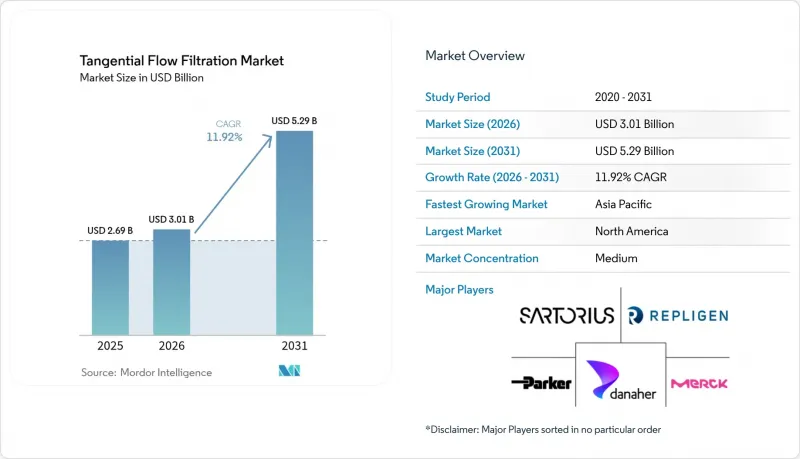
This report is Segmented by Product Type (Systems, Membrane Filters, and Accessories), Technology (Ultrafiltration, Microfiltration, and Reverse Osmosis/ Nanofiltration), Application (Vaccines & MAbs), End-User (Biopharma Manufacturers, and More), Geography (North America, Europe, Asia-Pacific, The Middle East and Africa, and South America). The Market Forecasts are Provided in Terms of Value (USD).
Global Tangential Flow Filtration Market Trends and Insights
Single-Use Systems Slash Change-Over Time
Single-use tangential flow filtration systems eliminate the 4-8-hour cleaning validation windows that previously limited multiproduct facilities, delivering a documented 27% uplift in development-stage productivity. Adoption has broadened beyond traditional monoclonal antibody plants to cell and gene therapy suites, where dedicated run campaigns heighten contamination concerns. Regulators increasingly guide toward disposable assemblies because sterility assurance is inherent and validation files are slimmer, a position mirrored across recent FDA facility inspection trends. Yet the sustainability conversation is intensifying; life-cycle assessments now inform purchasing decisions, spurring suppliers to advance biodegradable membranes and closed-loop plastic reclamation schemes.
Growing Adoption of Continuous Bioprocessing
Continuous bioprocessing repositions tangential flow filtration as a permanently online operation that maintains steady-state production for weeks, cutting the typical facility footprint by 50-70% while tightening quality variance among lots. Perfusion cultures running above 100 million cells/mL require robust cell-retention modules, a capability strongly favored by gene therapy producers because shorter residence times curb vector degradation. Digital-twin modeling now fine-tunes flux, shear, and trans-membrane pressure in real time, as demonstrated by Samsung Biologics' pilot lines.
Shear-Sensitive Modalities Limit Flux Rates
Complex biologics such as viral vectors cannot tolerate high shear, forcing operators to run filters at throughput levels that are 50-75% lower than monoclonal antibody norms. Even with surface-modified membranes that reduce stress points, core physics restrict the ability to accelerate flows without risking capsid rupture, thus prolonging cycle times and squeezing facility capacity.
Other drivers and restraints analyzed in the detailed report include:
- High-Throughput Screening Cassettes for Gene-Therapy Vectors
- Biopharma Shift to High-Cell-Density Perfusion
- Scarcity of GMP-Grade Hollow-Fiber Supply
For complete list of drivers and restraints, kindly check the Table Of Contents.
Segment Analysis
Systems accounted for a 45.78% tangential flow filtration market share in 2025, reflecting user preference for turnkey assemblies that couple pumps, controllers, and real-time sensors under a single validation envelope. Demand remains resilient because multinationals routinely upgrade installed skids to align with tightening data-integrity and automation mandates. In parallel, the tangential flow filtration market size allocated to membrane filters is climbing at a 14.38% CAGR to 2031 as single-use programs require fresh cassettes for each campaign. Disposable membrane uptake is particularly sharp in gene therapy suites, where cross-contamination risk is less acceptable and changeover speed carries premium value.
Accessories such as pre-conditioners, flow-path sensors, and disposable conductivity probes are the smallest dollar segment yet record steady, mid-single-digit growth. Suppliers bundle these add-ons with service agreements, expanding revenue beyond hardware. Repligen's recently launched SoloVPE Plus system exemplifies the push toward integrated analytics, shortening concentration tests by 70% and feeding back to automated filter-control loops. This convergence of hardware and analytics delivers higher margins to vendors while reducing batch-failure risk for users.
Ultrafiltration retained 56.98% revenue in 2025 given its entrenchment in buffer-exchange and concentration steps for classical biologics. Nevertheless, microfiltration is projected to expand at a 14.51% CAGR through 2031, propelled by high-cell-density perfusion cultures that depend on tight cell-retention cutoffs. The tangential flow filtration market size apportioned to microfiltration modules is therefore growing faster than the macroscale figure, stimulated by viral vector facilities that demand precise pore distribution for debris removal.Breakthroughs in polymer chemistry, specifically polyethersulfone blends and regenerated-cellulose coatings, are boosting flux stability and fouling resistance during long perfusion runs. Innovations are also surfacing in gradient-pore architectures that pair high retentate selectivity with low trans-membrane pressure, features that align with the shear-sensitivity of new biologic entities. Reverse osmosis and nanofiltration remain niche, handling mainly utility water polishing, and their share is unlikely to budge materially across the forecast window.
Complete Report Scope:
- By Product Type
- Systems
- Single-use Tangential Flow Filtration Systems
- Re-usable Tangential Flow Filtration Systems
- Membrane Filters
- Polyethersulfone
- Regenerated Cellulose
- Other Membranes
- Accessories
- Systems
- By Technology
- Ultrafiltration
- Microfiltration
- Reverse Osmosis / Nanofiltration
- By Application
- Vaccines & mAbs
- Cell & Gene-Therapy Vectors
- Plasma-derived Proteins
- Other Applications
- By End-User
- Biopharma Manufacturers
- Contract Development & Manufacturing Organisations (CDMOs)
- Other End-Users
- Geography
- North America
- United States
- Canada
- Mexico
- Europe
- Germany
- United Kingdom
- France
- Italy
- Spain
- Rest of Europe
- Asia-Pacific
- China
- Japan
- India
- Australia
- South Korea
- Rest of Asia-Pacific
- Middle East & Africa
- GCC
- South Africa
- Rest of Middle East & Africa
- South America
- Brazil
- Argentina
- Rest of South America
- North America
Geography Analysis
North America generated 39.15% of 2025 revenue in the tangential flow filtration market, supported by advanced R&D clusters, a well-defined FDA validation pathway, and deep installed capacity across vaccines, antibodies, and viral vectors. Mergers such as Thermo Fisher Scientific's USD 4.1 billion purchase of Solventum's purification business underscore the region's role as the gravitational center for technology consolidation. Persistent talent shortages and raw-material lead-time spikes, however, are prompting some producers to weigh dual-continental supply chains.
Asia-Pacific is on track to post a 13.22% CAGR through 2031, translating into the fastest regional expansion worldwide. Several headline projects, including Samsung Biologics' USD 6 billion "Plant 5" build and Lotte Biologics' USD 3.3 billion greenfield complex, are raising local demand for high-capacity filtration skids. Chinese CDMOs such as WuXi Biologics and Chime Biologics are similarly scaling viral-vector suites, further inflating order books. Favorable tax incentives, comparatively low labor costs, and short shipping lanes for polymer resins amplify the region's competitiveness, although lingering IP and regulatory alignment challenges moderate uptake among some multinational sponsors.
Europe enjoys steady mid-single-digit growth owing to a robust pharmaceutical base and strict environmental statutes that encourage water-reuse and biodegradable filter elements. Brexit-related cross-border friction and high energy prices inflate operating costs but simultaneously bolster the case for continuous processing that squeezes more product out per kilowatt consumed. Middle East & Africa and South America are nascent yet viewable growth pockets; both benefit from government life-science funding programs but still lack the dense supplier and talent ecosystems found in mature markets.
- Danaher
- Merck
- Sartorius
- Repligen Corp.
- Parker Hannifin
- Alfa Laval
- Andritz Group
- Meissner Filtration
- Sterlitech Corp.
- Solaris Biotechnology
- Thermo Fisher Scientific
- 3M
- Cytiva
- GE Healthcare
- Asahi Kasei
- Koch Membrane Systems
- Donaldson Company
- Miltenyi Biotec
- Graver Technologies
- Cobetter Filtration
Additional Benefits:
- The market estimate (ME) sheet in Excel format
- 3 months of analyst support
TABLE OF CONTENTS
1 Introduction
- 1.1 Study Assumptions & Market Definition
- 1.2 Scope of the Study
2 Research Methodology
3 Executive Summary
4 Market Landscape
- 4.1 Market Overview
- 4.2 Market Drivers
- 4.2.1 Single-Use Systems Slash Change-Over Time
- 4.2.2 Growing Adoption of Continuous Bioprocessing
- 4.2.3 High-Throughput Screening Cassettes for Gene-Therapy Vectors
- 4.2.4 Biopharma Shift to High-Cell-Density Perfusion
- 4.2.5 CAPEX-Light CDMO Build-Outs in Emerging Asia
- 4.2.6 ESG-Driven Water-Recycling Mandates
- 4.3 Market Restraints
- 4.3.1 Shear-Sensitive Modalities Limit Flux Rates
- 4.3.2 Scarcity Of GMP-Grade Hollow-Fiber Supply
- 4.3.3 Learning-Curve Risk in Process-Automation Adoption
- 4.3.4 Export-Control Rules on Single-Use Plastics
- 4.4 Regulatory Landscape
- 4.5 Porter's Five Forces Analysis
- 4.5.1 Threat of New Entrants
- 4.5.2 Bargaining Power of Buyers
- 4.5.3 Bargaining Power of Suppliers
- 4.5.4 Threat of Substitutes
- 4.5.5 Competitive Rivalry
5 Market Size & Growth Forecasts (Value, USD)
- 5.1 By Product Type
- 5.1.1 Systems
- 5.1.1.1 Single-use Tangential Flow Filtration Systems
- 5.1.1.2 Re-usable Tangential Flow Filtration Systems
- 5.1.2 Membrane Filters
- 5.1.2.1 Polyethersulfone
- 5.1.2.2 Regenerated Cellulose
- 5.1.2.3 Other Membranes
- 5.1.3 Accessories
- 5.1.1 Systems
- 5.2 By Technology
- 5.2.1 Ultrafiltration
- 5.2.2 Microfiltration
- 5.2.3 Reverse Osmosis / Nanofiltration
- 5.3 By Application
- 5.3.1 Vaccines & mAbs
- 5.3.2 Cell & Gene-Therapy Vectors
- 5.3.3 Plasma-derived Proteins
- 5.3.4 Other Applications
- 5.4 By End-User
- 5.4.1 Biopharma Manufacturers
- 5.4.2 Contract Development & Manufacturing Organisations (CDMOs)
- 5.4.3 Other End-Users
- 5.5 Geography
- 5.5.1 North America
- 5.5.1.1 United States
- 5.5.1.2 Canada
- 5.5.1.3 Mexico
- 5.5.2 Europe
- 5.5.2.1 Germany
- 5.5.2.2 United Kingdom
- 5.5.2.3 France
- 5.5.2.4 Italy
- 5.5.2.5 Spain
- 5.5.2.6 Rest of Europe
- 5.5.3 Asia-Pacific
- 5.5.3.1 China
- 5.5.3.2 Japan
- 5.5.3.3 India
- 5.5.3.4 Australia
- 5.5.3.5 South Korea
- 5.5.3.6 Rest of Asia-Pacific
- 5.5.4 Middle East & Africa
- 5.5.4.1 GCC
- 5.5.4.2 South Africa
- 5.5.4.3 Rest of Middle East & Africa
- 5.5.5 South America
- 5.5.5.1 Brazil
- 5.5.5.2 Argentina
- 5.5.5.3 Rest of South America
- 5.5.1 North America
6 Competitive Landscape
- 6.1 Market Concentration
- 6.2 Market Share Analysis
- 6.3 Company Profiles (includes Global level Overview, Market level overview, Core Business Segments, Financials, Headcount, Key Information, Market Rank, Market Share, Products and Services, and analysis of Recent Developments)
- 6.3.1 Danaher Corporation
- 6.3.2 Merck KGaA
- 6.3.3 Sartorius AG
- 6.3.4 Repligen Corp.
- 6.3.5 Parker Hannifin Corporation
- 6.3.6 Alfa Laval
- 6.3.7 Andritz Group
- 6.3.8 Meissner Filtration
- 6.3.9 Sterlitech Corp.
- 6.3.10 Solaris Biotechnology
- 6.3.11 Thermo Fisher Scientific
- 6.3.12 3M Company
- 6.3.13 Cytiva
- 6.3.14 GE HealthCare
- 6.3.15 Asahi Kasei
- 6.3.16 Koch Membrane Systems
- 6.3.17 Donaldson Company
- 6.3.18 Miltenyi Biotec
- 6.3.19 Graver Technologies
- 6.3.20 Cobetter Filtration
7 Market Opportunities & Future Outlook
- 7.1 White-space & Unmet-Need Assessment


