|
시장보고서
상품코드
2122972
접착 테이프 시장 : 시장 점유율 분석, 업계 동향 및 통계, 성장 예측(2026-2031년)Adhesive Tapes - Market Share Analysis, Industry Trends & Statistics, Growth Forecasts (2026 - 2031) |
||||||
 Mordor Intelligence
Mordor Intelligence에 의하면, 접착 테이프 시장 규모는 2025년 585억 5,000만 평방미터로 평가되었고, 2026년에는 609억 8,000만 평방미터로 추정되고, 2026-2031년 CAGR 4.15%로 성장을 지속할 전망이며, 2031년에는 747억 3,000만 평방미터에 이를 것으로 예측됩니다.
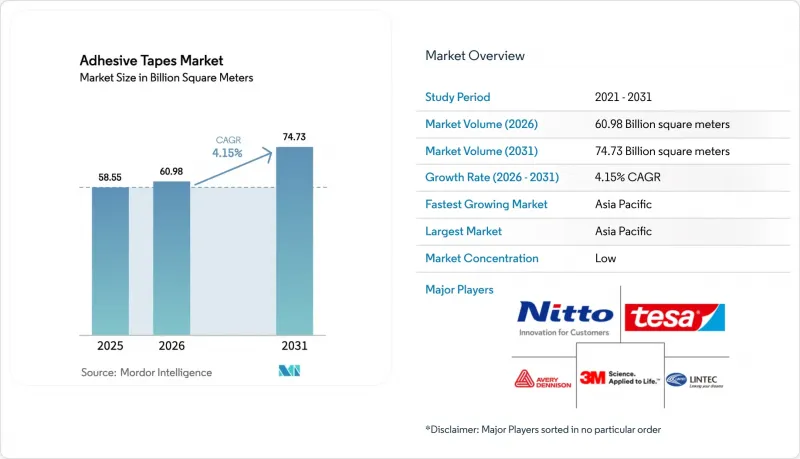
본 보고서는 수지별(아크릴, 고무계, 실리콘, 에폭시, 폴리우레탄), 기술별(수성, 용제계, 핫멜트, 반응성), 제품 유형별(감압 테이프, 수분 활성화 테이프, 감열 테이프, 특수 테이프), 최종 이용 산업별(포장, 자동차, 기타), 지역별(아시아태평양, 기타)로 분류되어 있습니다. 시장 예측은 수량(제곱미터) 단위로 제시되어 있습니다.
세계의 접착 테이프 시장 동향 및 인사이트
전자상거래용 포장 자재 붐에 따른 접착 테이프 수요 증가
2025년, 아마존과 같은 대형 물류 기업들은 기존 소매 유통을 훨씬 능가하는 양의 감압성 포장용 테이프를 소비했습니다. 브랜드화된 프리프린트 롤은 컨버터가 최소 주문 수량을 낮춤에 따라 소규모 판매업체도 단일 밀봉재로 ‘무단 개봉 방지 기능’과 ‘마케팅 기능’을 모두 활용할 수 있게 되어 전년 대비 견조한 성장을 보였습니다. 입법 기관도 소재 선택에 영향을 미치고 있습니다. 예를 들어, 유럽연합(EU)의 포장 폐기물 규정에서는 섬유 재활용 흐름을 오염시킬 가능성이 낮은 ‘수분 활성화 크라프트 테이프’가 권장되고 있습니다. 한편, 인도나 동남아시아의 습도가 높은 물류 거점에서는 합성 고무로 만든 핫멜트 테이프로의 전환이 진행되고 있습니다. 이러한 테이프는 상대 습도가 80%를 초과하는 환경에서도 접착력을 유지하며, 접착제가 번지지 않고 골판지를 확실하게 밀봉합니다. 이러한 동향이 맞물려, 출하되는 각 소포에서 골판지 밀봉 테이프의 보급률을 높일 뿐만 아니라, 접착 테이프 시장의 장기적인 성장도 뒷받침하고 있습니다.
OEM을 통한 경량 와이어 하네스 테이프로의 전환
자동차 제조업체들은 기존 PVC 재질의 전기용 래핑 테이프보다 가볍으면서도 동등한 절연 내력을 갖춘 아크릴 천 테이프의 채택을 추진하고 있습니다. 이러한 전환을 통해 차량 1대당 무게가 줄어들어 상당한 비용 절감으로 이어집니다. 이러한 비용 절감은 EU의 차량 배출 규제를 준수하고, CO₂ 배출량 초과에 따른 벌금을 피하는 데 매우 중요합니다. 이러한 추세를 여실히 보여주는 테슬라의 ‘모델 Y’에서는 와이어 하네스에 이 새로운 테이프가 채택되었습니다. 2025년, 일본공급업체들은 엄격한 ISO 6722 클래스 D 내마모성 기준을 충족할 뿐만 아니라, 할로겐을 포함하지 않는 난연성 폴리에스터 테이프를 도입하여 재활용 관련 규정을 준수하도록 했습니다. 2025년, 중국에서는 신에너지 차량이 도입되면서 각 차량에 하네스 테이프가 필요하게 되었습니다. 이러한 수요의 급증은 내연기관 차량에 비해 더 많은 케이블을 수용해야 하는 배터리 플랫폼에서 기인합니다. 자동차 산업에서 경량화와 안전성에 대한 집중이 자동차 배선용 접착 테이프 시장의 성장을 뒷받침하고 있습니다.
석유 유래 원자재 가격 변동
2024-2025년 아크릴산의 현물 가격이 크게 변동하여, 그 결과 컨버터의 이익률이 압박을 받았습니다. 부타디엔 가격은 크래커 유지보수로 인한 공급 제약의 영향을 받았습니다. 헨켈(Henkel)사의 2025년 보고서에서는 원자재 가격 급등이 비용 증가의 한 원인이 되었다고 지적하고 있습니다. 그러나 아크릴 폴리머 배합량을 줄임으로써 그 영향은 다소 완화되었습니다. 원자재 가격 변동과 헤지 대책 미실시를 이유로 소규모 컨버터가 범용 부문에서 철수한 것은 접착 테이프 시장에서 단기적인 사업 확장에 대한 과제를 부각시키고 있습니다.
부문 분석
2025년에는 아크릴계가 접착 테이프 시장에서 41.12%의 점유율을 유지했으나, 고무계 화학제품은 2026-2031년 연평균 성장률(CAGR) 4.29%를 나타낼 것으로 예측되며, 이는 수지 부문 중 가장 높은 성장률입니다. 고속 물류 분야에서는 천연 고무와 스티렌-부타디엔 고무가 필수적이며, 먼지가 많은 표면에서도 즉시 접착력을 발휘합니다. 한편, 실리콘 수지는 아크릴이나 고무 계열 시스템에 비해 생산량은 적지만, 의료 분야나 고온 용도에서는 비용보다 투명성과 생체 적합성이 중시되기 때문에 선호되고 있습니다. 또한, 높은 전단 강도로 알려진 틈새 시장인 에폭시계 구조용 테이프에 대한 관심도 높아지고 있으며, 이는 항공우주 용도나 풍력 발전용 블레이드에 최적입니다. 바이오 유래의 톨 오일이나 대두 유래의 화학 물질은 비용 면에서 프리미엄이 장벽이 되고 있지만, 파일럿 프로젝트의 결과에 따르면 향후 몇 년 동안 점차 시장에 진입할 가능성이 시사되고 있습니다.
아크릴계는 자외선 안정성과 낮은 아웃가스 특성 덕분에 고급 자동차 및 전자 제품 부문에서 입지를 계속 유지하고 있으며, 접착 테이프 시장에서 확고한 점유율을 확보하고 있습니다. 가격에 민감한 부문에서는 불규칙한 형태의 골판지 상자나 먼지가 많은 작업 현장에서도 견딜 수 있는 고무계 배합이 선호됩니다. ISO 10993-10 프로토콜에 따른 30일간의 피부 접촉에 대한 실리콘의 승인으로 의료용 사례가 확대되고 있는 한편, 반응성 폴리우레탄 핫멜트는 연질 포장 분야에서 가공 용이성과 구조적 강도를 모두 갖추고 있습니다. 전반적으로, 원자재 가격 변동이 지속되는 가운데에서도 수지의 다양화가 꾸준한 가치 창출을 뒷받침하고 있습니다.
수성 기술은 2025년 수량 기준으로 45.19%를 차지한 것으로 평가되었으며, VOC 규제 강화 및 브랜드의 지속가능성 노력을 반영하여 4.51%라는 가장 높은 연평균 성장률(CAGR)을 보일 것으로 전망됩니다. 최신 아크릴 에멀전은 더 적은 도포량으로도 용제계 제품과 동등한 박리 강도와 전단 강도를 실현하고 있어, 컨버터는 용제식 건조로를 중단하고 에너지 사용량을 절감할 수 있게 되었습니다. 초고속 포장 라인에서는 순간적으로 접착할 수 있는 특성 덕분에 핫멜트 시스템이 선호되고 있습니다. 에너지 비용을 고려할 때, 이러한 시스템은 수성 시스템보다 경제적인 것으로 입증되었습니다. 한편, 용제 기반 기술은 자동차 및 항공우주 부문에서 여전히 주류를 이루고 있습니다. 이 부문에서는 건조 속도와 낮은 표면 에너지에 대한 접착력이 중시되며, 이는 규제상의 과제를 상회합니다.
반응성 플랫폼(UV 경화형 아크릴계 및 습기 경화형 폴리우레탄계)은 시장 점유율은 작지만, 전자기기 및 의료기기 부문에서 고가 시장을 차지하고 있습니다. 수성 캐리어와 UV 가교제를 결합한 하이브리드 제품이 등장하고 있으며, 1액 처리임에도 불구하고 구조적인 최종 특성을 발휘할 것으로 기대됩니다. 이러한 부문들이 융합됨에 따라, 예측 기간 동안 수성 및 핫멜트 계열 제품과 관련된 접착 테이프 시장의 총 규모가 가장 빠르게 확대될 전망입니다.
지역별 분석
아시아태평양은 2025년에 전 세계 수량 기준의 58.91%를 차지했으며, 연평균 성장률(CAGR) 5.15%로 확대될 것으로 예측되는데, 이는 다른 어떤 지역보다 빠른 속도입니다. 주요 시장인 중국에서는 주요 전자기기 클러스터와 자동차 산업의 거점이 집중된 광둥성, 장쑤성, 절강성이 견인 역할을 하며 큰 수요가 나타났습니다. 한편, 인도 시장에서는 견조한 자동차 생산과 급성장하는 전자상거래 산업의 뒷받침을 받아 골판지 봉합 테이프 사용량이 급증하는 등 강력한 성장이 나타났습니다.
일본은 광학용 및 반도체용 테이프 시장을 지속적으로 주도하며, 동아시아 전역에 고품질 롤 테이프를 수출하고 있습니다. 한국에서는 삼성 및 LG의 디스플레이 제조 공장과 밀접하게 관련된 수요가 특수 테이프 시장에서 여전히 큰 비중을 차지하고 있습니다. 아세안, 특히 베트남, 태국, 말레이시아에서는 외국인 직접 투자를 통해 중국에서 조립 라인이 이전됨에 따라 연중 내내 강력한 성장이 나타나, 해당 지역이 접착 테이프 시장에서 우위를 공고히 했습니다.
북미는 기존 포장 시장이 성숙기에 접어든 반면, 전기차 생산 확대와 소포 물류의 급증에 힘입어 2025년 세계 소비량에서 두드러진 점유율을 차지했습니다. 유럽에서는 재활용 규제에 대한 대응이 진행되면서, 단일 소재 라미네이트 분야에서 PP 뒷면 코팅 테이프에서 크라프트지 대체품으로의 전환이 진행되었습니다. 남미에서는 브라질의 견조한 자동차 산업이 수요를 견인했으나, 아르헨티나의 통화 문제로 인해 수입이 제한되는 제약도 있었습니다. 중동 및 아프리카는 사우디아라비아와 아랍에미리트의 메가 프로젝트에 더해 남아프리카공화국의 자동차 생산의 혜택을 받아 중기적으로 안정적인 성장률을 유지했습니다.
기타 혜택
- 엑셀 형식 시장 예측(ME) 시트
- 3개월간의 애널리스트 지원
자주 묻는 질문
목차
제1장 서론
제2장 조사 방법
제3장 주요 요약
제4장 시장 구도
제5장 시장 규모 및 성장 예측
제6장 경쟁 구도
제7장 시장 기회 및 향후 전망
AJY 26.09.09According to Mordor Intelligence, the adhesive tapes market size is expected to grow from 58.55 Billion square meters in 2025 to 60.98 Billion square meters in 2026 and is forecast to reach 74.73 Billion square meters by 2031 at 4.15% CAGR over 2026-2031.

This report is Segmented by Resin (Acrylic, Rubber-Based, Silicone, Epoxy, and Polyurethane), Technology (Water-Based, Solvent-Based, Hot-Melt, and Reactive), Product Type (Pressure-Sensitive, Water-Activated, Heat-Sensitive, and Specialty), End-Use Industry (Packaging, Automotive, and More), and Geography (Asia-Pacific, and More). The Market Forecasts are Provided in Terms of Volume (Square Meters).
Global Adhesive Tapes Market Trends and Insights
E-commerce Packaging Boom Boosting Adhesive Tapes Demand
Fulfillment giants like Amazon consumed significant volumes of pressure-sensitive packaging tape in 2025, a volume much higher than that of traditional retail distribution. Branded pre-printed rolls saw strong year-on-year growth, as converters reduced minimum order quantities to levels that empowered smaller sellers to utilize both tamper-evident and marketing features in a single closure. Legislative bodies are influencing material choices; for instance, the European Union's waste-packaging regulations favor water-activated kraft tapes, which are less likely to contaminate fiber recycling streams. Meanwhile, in humid logistics hubs across India and Southeast Asia, there is a shift towards synthetic-rubber hot-melt tapes. These tapes maintain tack at relative humidity above 80%, ensuring cartons are sealed without adhesive bleed. Collectively, these dynamics are not only increasing the penetration of carton-sealing tape in each shipped parcel but also bolstering the long-term growth of the adhesive tapes market.
OEM Shift to Lightweight Wire-Harness Tapes
Automakers are turning to acrylic cloth tapes, which are lighter than traditional PVC electrical wraps but offer the same dielectric strength. This switch results in a weight reduction per vehicle, translating to significant savings. These savings are crucial as they help automakers sidestep penalties for excess CO2, in compliance with EU fleet regulations. Tesla's Model Y, a testament to this trend, incorporates the new tape in its harness. In 2025, Japanese suppliers introduced flame-retardant polyester tapes that not only meet the stringent ISO 6722 Class D abrasion resistance standards but also do so without halogens, ensuring alignment with recyclability mandates. In 2025, China rolled out new-energy vehicles, each requiring harness tapes. This demand surge is attributed to battery platforms accommodating more cables than their combustion counterparts. The automotive industry's focus on lightweighting and safety propels the adhesive tapes market forward in automotive wiring.
Petro-Derived Raw-Material Price Volatility
Between 2024 and 2025, acrylic acid spot prices fluctuated significantly, which in turn squeezed converter margins. Butadiene prices were influenced by supply constraints due to cracker maintenance. A 2025 report from Henkel highlighted that raw-material inflation contributed to increased costs. However, this was somewhat mitigated by a reduction in acrylic polymer loadings. The exit of smaller converters from commodity segments, due to feedstock volatility and without hedging, underscores the challenges in short-term expansion within the adhesive tapes market.
Other drivers and restraints analyzed in the detailed report include:
- Wearable and Flexible Electronics Adoption Increasing Tapes Usage
- Construction Boom in ASEAN and Middle East Region Boosting Adhesive Tape Usage
- VOC and Hazardous-Solvent Regulations
For complete list of drivers and restraints, kindly check the Table Of Contents.
Segment Analysis
Rubber-based chemistries are projected to compound at 4.29% between 2026 and 2031, the highest rate in the resin spectrum, even though acrylic maintained 41.12% adhesive tapes market share in 2025. For high-speed logistics, natural and styrene-butadiene rubbers are crucial, achieving instant tack even on dusty surfaces. On the other hand, silicone resins, though smaller in volume than acrylic and rubber-based systems, are favored in the medical field and for high-temperature applications, prioritizing clarity and biocompatibility over cost. There's also a rising interest in epoxy-based structural tapes, a niche known for providing high shear strength, making them ideal for aerospace applications and wind blades. While bio-based tall-oil and soy chemistries face a hurdle with cost premiums, pilot projects suggest a potential gradual market entry in the coming years.
Acrylic continues to own premium automotive and electronics slots thanks to UV stability and low outgassing, anchoring its large slice of the adhesive tapes market. Still, price-sensitive sectors lean toward rubber formulations that tolerate irregular cartons and dusty worksites. Silicone approvals for 30-day skin contact under ISO 10993-10 protocols widen medical use cases, while reactive polyurethane hot-melts bridge processing ease and structural strength in flexible packaging. Collectively, resin diversification supports steady value creation even as commodity pricing stays volatile.
Water-based technology held 45.19% of the 2025 volume and is forecast to clock the fastest 4.51% CAGR, reflecting tightening VOC norms and brand sustainability pledges. Modern acrylic emulsions now match solvent grades on peel and shear at lower coat weights, enabling converters to shut down solvent ovens and cut energy use. Ultra-fast packaging lines favor hot-melt systems due to their instant bonding capabilities. When factoring in energy costs, these systems prove to be more economical than their water-based counterparts. Meanwhile, solvent-based technology continues to dominate the automotive and aerospace sectors. Here, the emphasis on drying speed and low-surface-energy adhesion outweighs any regulatory challenges.
Reactive platforms-UV-curable acrylics and moisture-cure polyurethanes-collect a small share yet command premium prices in electronics and medical devices. Hybrids that co-package water-based carriers with UV crosslinkers are emerging, promising one-part processing with structural final properties. As these camps converge, the total adhesive tapes market size attached to water-based and hot-melt lines will expand most rapidly across the forecast window.
Complete Report Scope:
- By Resin
- Acrylic
- Rubber-based
- Silicone
- Epoxy
- Polyurethane
- By Technology
- Water-based
- Solvent-based
- Hot-melt
- Reactive
- By Product Type
- Pressure-Sensitive Tapes
- Water-Activated Tapes
- Heat-Sensitive Tapes
- Specialty Tapes
- By End-use Industry
- Packaging
- Automotive
- Electrical and Electronics
- Healthcare
- Consumer/DIY
- Others (Building and Construction, etc.)
- By Geography
- Asia-Pacifc
- China
- India
- Japan
- South Korea
- ASEAN Countries
- Rest of Asia-Pacific
- North America
- United States
- Canada
- Mexico
- Europe
- Germany
- United Kingdom
- France
- Italy
- Russia
- Rest of Europe
- South America
- Brazil
- Argentina
- Rest of South America
- Middle-East and Africa
- Saudi Arabia
- South Africa
- Rest of Middle-East and Africa
- Asia-Pacifc
Geography Analysis
Asia-Pacific held 58.91% of global volume in 2025 and is projected to expand at a 5.15% CAGR, the fastest of any region. China, a significant player, saw major demand driven by the provinces of Guangdong, Jiangsu, and Zhejiang-home to major electronics clusters and auto hubs. Meanwhile, India's market witnessed robust growth, fueled by a strong vehicle output and a booming e-commerce sector, leading to a surge in carton-sealing tape usage.
Japan continues to spearhead the market for optical and semiconductor tapes, exporting premium rolls throughout East Asia. South Korea's demand, closely tied to the display fabs of Samsung and LG, remained significant for specialty tapes. ASEAN countries, notably Vietnam, Thailand, and Malaysia, experienced strong annual growth as foreign direct investment shifted assembly lines from China, solidifying the region's dominance in the adhesive tapes market.
North America accounted for a notable share of global consumption in 2025, buoyed by the rise of electric vehicle production and a surge in parcel logistics, even as traditional packaging faced maturity. Europe adapted to recycling mandates, transitioning from PP-backed tapes to kraft paper alternatives in mono-material laminates. South America saw Brazil's robust automotive sector driving demand, albeit constrained by Argentina's currency challenges, limiting imports. The Middle East and Africa reaped benefits from mega projects in Saudi Arabia and the UAE, alongside South Africa's automotive output, maintaining a steady medium-term growth rate.
- 3M
- Adchem Corporation
- Amcor
- Avery Dennison Corporation
- CCT (Coating and Converting Technologies, LLC)
- DuPont
- H.B. Fuller Company
- Henkel AG and Co. KGaA
- IPG
- LINTEC Corporation
- Lohmann
- Mativ
- Nitto Denko Corporation
- Oji Holdings Corporation
- Rogers Corporation
- Saint-Gobain
- Scapa Group Ltd
- Sekisui Chemical Co., Ltd.
- Shurtape Technologies, LLC
- Sika AG
- tesa SE - A Beiersdorf Company
Additional Benefits:
- The market estimate (ME) sheet in Excel format
- 3 months of analyst support
TABLE OF CONTENTS
1 Introduction
- 1.1 Study Assumptions and Market Definition
- 1.2 Scope of the Study
2 Research Methodology
3 Executive Summary
4 Market Landscape
- 4.1 Market Overview
- 4.2 Market Drivers
- 4.2.1 E-commerce packaging boom boosting adhesive tapes demand
- 4.2.2 OEM shift to lightweight wire-harness tapes
- 4.2.3 Wearable and flexible electronics adoption increasing tapes usage
- 4.2.4 Construction boom in ASEAN and Middle-East region boosting adhesive tape usage
- 4.2.5 EV battery-pack thermal/EMI tape integration
- 4.3 Market Restraints
- 4.3.1 Petro-derived raw-material price volatility
- 4.3.2 VOC and hazardous-solvent regulations
- 4.3.3 PFAS-free reformulation disrupting fluoropolymer tapes
- 4.4 Value Chain Analysis
- 4.5 Porter's Five Forces
- 4.5.1 Bargaining Power of Suppliers
- 4.5.2 Bargaining Power of Consumers
- 4.5.3 Threat of New Entrants
- 4.5.4 Threat of Substitutes
- 4.5.5 Degree of Competition
5 Market Size and Growth Forecasts (Volume)
- 5.1 By Resin
- 5.1.1 Acrylic
- 5.1.2 Rubber-based
- 5.1.3 Silicone
- 5.1.4 Epoxy
- 5.1.5 Polyurethane
- 5.2 By Technology
- 5.2.1 Water-based
- 5.2.2 Solvent-based
- 5.2.3 Hot-melt
- 5.2.4 Reactive
- 5.3 By Product Type
- 5.3.1 Pressure-Sensitive Tapes
- 5.3.2 Water-Activated Tapes
- 5.3.3 Heat-Sensitive Tapes
- 5.3.4 Specialty Tapes
- 5.4 By End-use Industry
- 5.4.1 Packaging
- 5.4.2 Automotive
- 5.4.3 Electrical and Electronics
- 5.4.4 Healthcare
- 5.4.5 Consumer/DIY
- 5.4.6 Others (Building and Construction, etc.)
- 5.5 By Geography
- 5.5.1 Asia-Pacifc
- 5.5.1.1 China
- 5.5.1.2 India
- 5.5.1.3 Japan
- 5.5.1.4 South Korea
- 5.5.1.5 ASEAN Countries
- 5.5.1.6 Rest of Asia-Pacific
- 5.5.2 North America
- 5.5.2.1 United States
- 5.5.2.2 Canada
- 5.5.2.3 Mexico
- 5.5.3 Europe
- 5.5.3.1 Germany
- 5.5.3.2 United Kingdom
- 5.5.3.3 France
- 5.5.3.4 Italy
- 5.5.3.5 Russia
- 5.5.3.6 Rest of Europe
- 5.5.4 South America
- 5.5.4.1 Brazil
- 5.5.4.2 Argentina
- 5.5.4.3 Rest of South America
- 5.5.5 Middle-East and Africa
- 5.5.5.1 Saudi Arabia
- 5.5.5.2 South Africa
- 5.5.5.3 Rest of Middle-East and Africa
- 5.5.1 Asia-Pacifc
6 Competitive Landscape
- 6.1 Market Concentration
- 6.2 Strategic Moves
- 6.3 Market Share(%)/Ranking Analysis
- 6.4 Company Profiles {(includes Global level Overview, Market level overview, Core Segments, Financials as available, Strategic Information, Market Rank/Share for key companies, Products and Services, and Recent Developments)}
- 6.4.1 3M
- 6.4.2 Adchem Corporation
- 6.4.3 Amcor
- 6.4.4 Avery Dennison Corporation
- 6.4.5 CCT (Coating and Converting Technologies, LLC)
- 6.4.6 DuPont
- 6.4.7 H.B. Fuller Company
- 6.4.8 Henkel AG and Co. KGaA
- 6.4.9 IPG
- 6.4.10 LINTEC Corporation
- 6.4.11 Lohmann
- 6.4.12 Mativ
- 6.4.13 Nitto Denko Corporation
- 6.4.14 Oji Holdings Corporation
- 6.4.15 Rogers Corporation
- 6.4.16 Saint-Gobain
- 6.4.17 Scapa Group Ltd
- 6.4.18 Sekisui Chemical Co., Ltd.
- 6.4.19 Shurtape Technologies, LLC
- 6.4.20 Sika AG
- 6.4.21 tesa SE - A Beiersdorf Company
7 Market Opportunities and Future Outlook
- 7.1 White-Space and Unmet-Need Assessment
- 7.2 Increasing innovation in efficient manufacturing technology