
|
시장보고서
상품코드
2122979
유럽의 전기자동차 배터리 관리 시스템 시장 : 시장 점유율 분석, 업계 동향 및 통계, 성장 예측(2026-2031년)Europe Electric Vehicle Battery Management System - Market Share Analysis, Industry Trends & Statistics, Growth Forecasts (2026 - 2031) |
||||||
 Mordor Intelligence
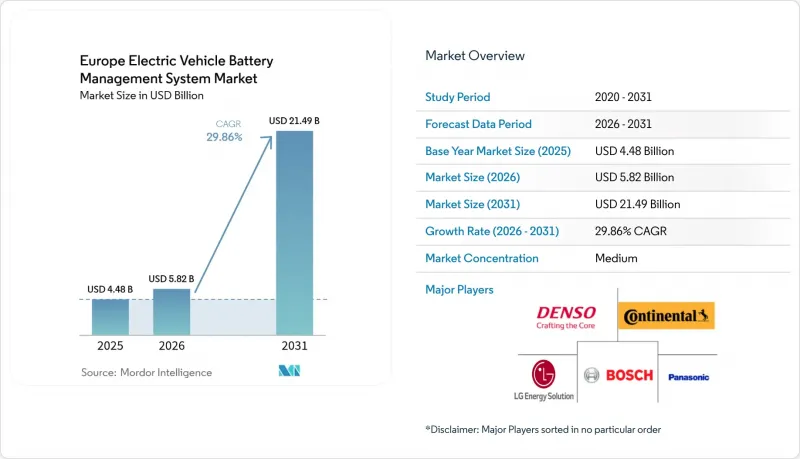
Mordor Intelligence에 의하면, 유럽의 전기자동차 배터리 관리 시스템 시장 규모는 2025년에 44억 8,000만 달러로 평가되었고, 2026년 58억 2,000만 달러에서 2031년까지 214억 9,000만 달러에 이를 것으로 예측되며, 예측 기간(2026-2031년) CAGR은 29.86%를 나타낼 전망입니다.
본 보고서는 구동 방식별(플러그인 하이브리드 차량 및 배터리식 전기자동차), 차종별(승용차, 상용차 등), 배터리 화학 조성별(리튬이온, 전고체 배터리 등), 토폴로지별(집중형, 분산형 등) 및 국가별로 분류되어 있습니다. 시장 전망은 금액(달러) 기준으로 제시되어 있습니다.
유럽의 전기자동차 배터리 관리 시스템 시장 동향 및 인사이트
2035년을 향한 전기자동차 전용 CO₂ 배출 규제
2035년까지 판매되는 차량의 100%를 무공해 차량으로 의무화하는 유럽연합(EU)의 규제는 자동차 제조업체가 CO2 배출량 상한선을 초과할 경우 1그램당 95유로의 벌금이 부과되므로, 첨단 BMS 솔루션에 대한 수요를 촉진하는 돌이킬 수 없는 요인이 되고 있습니다. 이 규제 체계로 인해 제조업체들은 BEV(배터리식 전기자동차) 생산을 현재 시장 침투율인 13.5%를 넘어 가속화할 수밖에 없게 되어, 연간 14%의 성장률이 요구됩니다. 이를 위해서는 더 대형의 배터리 팩과 높은 에너지 밀도에 대응할 수 있는 첨단 배터리 관리 능력이 필수적입니다. 이 규제의 부수적 효과로 보험사가 종합적인 배터리 모니터링 시스템 도입을 의무화하게 되면서, 고장 예측 감지 및 보증 비용 절감을 입증할 수 있는 BMS 공급업체에게 새로운 수익원이 생겨나고 있습니다. 각 고급차 제조업체들은 보다 정교한 열 관리 및 셀 밸런싱 알고리즘이 필요한 800V 아키텍처에 막대한 투자를 통해 대응하고 있으며, 이는 첨단 전력 전자 공학 전문 지식을 보유한 BMS 공급업체에 직접적인 이익을 가져다주고 있습니다. 규제 준수를 위한 일정에 따라 공급망의 병목 현상이 발생하고 있으며, BMS 인증이 핵심 경로가 되기 때문에 ISO 26262 기능 안전 인증을 취득한 기존 기업들은 신규 진출기업에 비해 큰 경쟁 우위를 점하고 있습니다.
OEM의 800V 아키텍처로의 급속한 전환
자동차 업계의 800V 전기 아키텍처로의 전환은 근본적인 변화를 의미하며, 더 높은 전압 차이와 더 복잡한 열 동역학을 관리할 수 있는 완전히 새로운 BMS 설계가 요구되고 있습니다. 차세대 배터리 팩을 위한 BMW와 Rimac Technology의 제휴, 그리고 볼보와 Vitesco Technologies의 협력은 고급차 제조업체들이 고도의 전압 모니터링 및 셀 밸런스 조정 알고리즘이 필요한 급속 충전 기능을 얼마나 우선시하고 있는지를 보여줍니다. 이러한 아키텍처 전환은 고전압에 대한 전문 지식이 부족한 BMS 공급업체에게 큰 진입 장벽이 됩니다. 800V 작동 수준에서는 ISO 26262에 기반한 인증 요건이 비약적으로 복잡해지기 때문입니다. 이러한 전환을 통해 200마일의 주행 거리를 10분 만에 충전할 수 있게 되지만, 기존 BMS 설계로는 적절히 관리할 수 없을 정도의 극심한 열적 스트레스가 배터리 셀에 가해지기 때문에 공급업체들은 고도의 냉각 알고리즘과 예측 열 모델링을 통합할 수밖에 없습니다. 유럽의 자동차 제조업체들은 주로 400V 시스템을 채택하고 있는 중국 경쟁사들과의 차별화를 도모하기 위해 이러한 전환을 활용하고 있으며, 첨단 전력 전자 기술을 보유한 현지 BMS 공급업체들에게 이익을 가져다주는 일시적인 기술적 우위를 구축하고 있습니다.
반도체 공급망의 병목 현상
세계적인 반도체 부족은 여전히 BMS 생산 능력을 제약하고 있으며, 자동차용 칩의 리드타임이 26주를 초과하여 유럽의 전체 전기자동차 생산 일정에 연쇄적인 지연을 초래하고 있습니다. 이러한 제약은 800V 아키텍처와 복잡한 열 알고리즘을 처리할 수 있는 특수 전원 관리 IC 및 마이크로컨트롤러가 필요한 첨단 BMS 설계에 특히 큰 영향을 미치고 있습니다. 유럽의 BMS 공급업체들은 제한된 칩 할당량을 놓고 가전 제조업체들과 경쟁하고 있어 추가적인 압박에 직면해 있습니다. 스마트폰이나 컴퓨팅 용도에 비해 생산량 약속이 적기 때문에 우선순위가 낮아지는 경우가 빈번하게 발생합니다. 이러한 부족으로 인해 제조업체들은 입수 가능한 부품에 맞추어 BMS 아키텍처를 재설계할 수밖에 없게 되며, 그 결과 성능 최적화가 저해되거나 개발 주기가 12-18개월 연장될 가능성이 있습니다. 공급망의 회복력이 중요한 경쟁 요인으로 대두되면서, 각 기업은 생산의 연속성을 확보하기 위해 전략적인 재고 완충량을 유지하고 대체 조달처와의 관계를 구축하고 있습니다. 이러한 제약은 유럽의 반도체 제조업체들에게 아시아 공급업체로부터 시장 점유율을 빼앗을 기회를 제공합니다. 하지만 이를 위해서는 막대한 설비 투자와 2-3년의 개발 기간이 필요하며, 당장공급 수요를 충족하지 못할 가능성이 있습니다.
부문 분석
2025년에는 배터리 전기자동차(BEV)가 71.83%의 시장 점유율을 차지한 것으로 평가되었으며, 2031년까지 연평균 성장률(CAGR) 31.10%로 성장할 것으로 전망됩니다. 이는 자동차 제조업체들이 플랫폼 단순화를 우선시하며 하이브리드 전략에서 철수하는 가운데, 시장이 순수 전기 파워트레인으로 결정적으로 전환되고 있음을 반영합니다. BEV 부문의 우위는 EU의 CO2 배출 규제에 따른 압박과 플러그인 하이브리드의 복잡성으로 인한 주행 거리 불안이 없으며, 단순화된 소유 경험을 추구하는 소비자의 선호에서 기인합니다. PHEV는 운영상의 유연성이 여전히 중요한 상업용 분야에서 그 존재 의의를 유지하고 있습니다. 하지만 제조업체들이 뛰어난 규모의 경제를 가져다주는 BEV 플랫폼으로 연구개발(R&D) 자원을 재분배하고 있기 때문에 PHEV 부문에 대한 투자는 감소 추세를 보이고 있습니다. 이 부문의 동향에서는 추진 방식에 따라 BMS(배터리 관리 시스템)의 요구 사항이 크게 달라지는 중요한 전환점이 부각되고 있습니다. BEV의 경우, 대용량 배터리 팩에 대응할 수 있는 고도의 열 관리가 요구됩니다. 반면, PHEV에서는 듀얼 파워트레인의 협동 운전을 위해 복잡한 전력 분배 알고리즘이 필요합니다.
BEV용 첨단 BMS 아키텍처에는 예측 열 모델링을 위한 머신러닝 알고리즘이 점점 더 많이 통합되고 있습니다. LG 에너지 솔루션의 ‘B.around’ 플랫폼은 13만 개 이상의 배터리 셀에서 수집된 데이터를 분석하여 충전 프로파일을 최적화하고, 팩 수명을 연장하고 있습니다. 이러한 기술의 고도화는 소프트웨어 전문 지식이 부족한 기존 자동차 부품 공급업체에게는 진입 장벽이 되고 있으며, 뮌헨 일렉트리피케이션(Munich Electrification)과 같은 신규 진출기업이 최대 1,500V의 에너지 저장 시스템용 전문 BMS 솔루션을 통해 시장 점유율을 확보할 수 있게 하고 있습니다. 추진 방식별 세분화는 BEV 플랫폼을 둘러싼 업계 전반의 통합을 점점 더 반영하고 있으며, BMS 공급업체들은 축소되는 PHEV 시장에 대응할지, 아니면 차세대 BEV 기술에 막대한 투자를 할지 선택해야 하는 상황에 직면하게 될 것입니다.
2025년 차종별 수요 중 승용차가 67.12%를 차지한 것으로 평가되었습니다. 한편, 이륜차 및 마이크로모빌리티 부문은 도시 물류의 변혁과 유럽 각 도시에서 공유 모빌리티 플랫폼의 확대를 배경으로 2031년까지 31.25%라는 놀라운 연평균 성장률(CAGR)을 보일 전망입니다. 상용차는 전략적인 중간 영역을 차지하고 있으며, BMS 요구 사항으로는 성능 최적화보다 내구성과 예측 유지보수가 중시되기 때문에 총 소유 비용(TCO)의 우위를 보여줄 수 있는 공급업체에게 비즈니스 기회가 생기고 있습니다. 마이크로모빌리티의 급증은 도시 교통 패턴의 근본적인 변화를 반영하고 있으며, 사용 주기가 빠르고 다양한 환경 조건에 노출되는 공유 차량 용도의 경우, 경량 BMS 설계가 비용 제약과 안전 요건의 균형을 맞추는 것이 요구됩니다.
차량 운영 사업자들 사이에서는 예측 유지보수 및 운영 최적화를 위한 고도화된 배터리 분석에 대한 수요가 높아지고 있으며, 이에 따라 차량군 전체의 성능 데이터를 집계하여 서비스 가용성에 영향을 미치기 전에 새로운 고장 패턴을 식별하는 클라우드 연결형 BMS 솔루션의 도입이 촉진되고 있습니다. 다임러 트럭이 배터리 시스템과 관련해 BMZ 폴란드와 제휴한 사례는 상용차 제조업체들이 단순한 하드웨어 솔루션이 아닌, 종합적인 수명 주기 관리를 제공할 수 있는 BMS 공급업체를 우선시하고 있음을 여실히 보여줍니다. 차종별 세분화를 살펴보면 기술적 요구 사항에 차이가 나타납니다. 승용차용 BMS는 성능과 사용자 경험에 중점을 두는 반면, 상용차 시스템은 신뢰성과 비용 효율성을 중시합니다. 동시에 마이크로모빌리티 용도에서는 차량 관리 시스템과의 통합을 가능하게 하는 무선 연결 기능을 갖춘 초소형 설계가 요구되고 있습니다.
기타 혜택 :
- 엑셀 형식 시장 예측(ME) 시트
- 3개월간의 애널리스트 지원
자주 묻는 질문
목차
제1장 서론
제2장 조사 방법
제3장 주요 요약
제4장 시장 구도
제5장 시장 규모 및 성장 예측
제6장 경쟁 구도
제7장 시장 기회 및 향후 전망
AJY 26.09.07According to Mordor Intelligence, the Europe electric vehicle battery management system market size was valued at USD 4.48 billion in 2025 and estimated to grow from USD 5.82 billion in 2026 to reach USD 21.49 billion by 2031, at a CAGR of 29.86% during the forecast period (2026-2031).
This report is Segmented by Propulsion Type (Plug-In Hybrid Electric Vehicle and Battery Electric Vehicle), Vehicle Type (Passenger Cars, Commercial Vehicles, and More), Battery Chemistry (Lithium-Ion, Solid-State, and More), Topology (Centralized, Distributed, and More), and Country. The Market Forecasts are Provided in Terms of Value (USD).
Europe Electric Vehicle Battery Management System Market Trends and Insights
EV-only CO2-fleet Rules for 2035
The European Union's mandate requiring 100% zero-emission vehicle sales by 2035 creates an irreversible demand catalyst for sophisticated BMS solutions, as automakers face EUR 95 per gram penalties for exceeding CO2 thresholds. This regulatory framework forces manufacturers to accelerate BEV production beyond the current 13.5% market penetration, requiring a 14% annual growth rate that necessitates advanced battery management capabilities for larger pack sizes and higher energy densities. The regulation's secondary effect drives insurance companies to mandate comprehensive battery monitoring systems, creating additional revenue streams for BMS providers who can demonstrate predictive failure detection and warranty cost reduction. Premium automakers are responding by investing heavily in 800V architectures that require more sophisticated thermal management and cell balancing algorithms, directly benefiting BMS suppliers with advanced power electronics expertise. The compliance timeline creates a supply chain bottleneck where BMS certification becomes the critical path item, giving established players with ISO 26262 functional safety credentials significant competitive advantages over new entrants.
Rapid OEM Shift to 800-V Architectures
The automotive industry's migration to 800V electrical architectures represents a fundamental shift that demands entirely new BMS designs capable of managing higher voltage differentials and more complex thermal dynamics. BMW's partnership with Rimac Technology for next-generation battery packs and Volvo's collaboration with Vitesco Technologies demonstrate how premium manufacturers prioritize fast-charging capabilities requiring sophisticated voltage monitoring and cell balancing algorithms. This architectural transition creates significant barriers to entry for BMS suppliers lacking high-voltage expertise, as certification requirements under ISO 26262 become exponentially more complex at 800V operating levels. The shift enables 10-minute charging sessions for 200-mile range, but places extreme thermal stress on battery cells that traditional BMS designs cannot adequately manage, forcing suppliers to integrate advanced cooling algorithms and predictive thermal modeling. European automakers are leveraging this transition to differentiate from Chinese competitors who predominantly use 400V systems, creating a temporary technological moat that benefits local BMS suppliers with advanced power electronics capabilities.
Semiconductor Supply-chain Squeezes
The global semiconductor shortage continues to constrain BMS production capacity, with automotive-grade chips experiencing lead times exceeding 26 weeks and creating cascading delays across European EV manufacturing schedules. This constraint particularly impacts advanced BMS designs that require specialized power management ICs and microcontrollers capable of handling 800V architecture and complex thermal algorithms. European BMS suppliers face additional pressure as they compete with consumer electronics manufacturers for limited chip allocation, often losing priority due to lower volume commitments than smartphone and computing applications. The shortage forces manufacturers to redesign BMS architecture around available components, potentially compromising performance optimization and extending development cycles by 12-18 months. Supply chain resilience becomes a critical competitive factor, with companies maintaining strategic inventory buffers and developing alternative sourcing relationships to ensure production continuity. The constraint creates opportunities for European semiconductor manufacturers to capture market share from Asian suppliers. Still, it requires significant capital investment and 2-3 year development timelines that may not address immediate supply needs.
Other drivers and restraints analyzed in the detailed report include:
- Surging Gigafactory Build-out in Central Europe
- Cyber-secure Over-the-air (OTA) BMS Updates
- High-voltage BMS Certification Bottlenecks
For complete list of drivers and restraints, kindly check the Table Of Contents.
Segment Analysis
Battery Electric Vehicles command a 71.83% market share in 2025 and lead growth projections at 31.10% CAGR through 2031, reflecting the market's decisive shift toward pure electric powertrains as automakers abandon hybrid strategies in favor of platform simplification. The BEV segment's dominance stems from regulatory pressure under EU CO2 fleet rules and consumer preference for simplified ownership experiences without range anxiety associated with plug-in hybrid complexity. Plug-in Hybrid Electric Vehicles (PHEVs) maintain relevance in commercial applications where operational flexibility remains critical. Still, face declining investment as manufacturers reallocate R&D resources toward BEV platforms that offer superior economies of scale. The segment dynamics reveal a critical inflection point where BMS requirements diverge significantly between propulsion types, with BEVs demanding sophisticated thermal management for larger battery packs. At the same time, PHEVs require complex power arbitration algorithms for dual-powertrain coordination.
Advanced BMS architectures for BEVs increasingly incorporate machine learning algorithms for predictive thermal modeling. LG Energy Solution's B.around platform analyzes data from over 130,000 battery cells to optimize charging profiles and extend pack life. This technological sophistication creates barriers to entry for traditional automotive suppliers lacking software expertise, enabling new entrants like Munich Electrification to capture market share through specialized BMS solutions for energy storage systems up to 1500V. The propulsion type segmentation increasingly reflects broader industry consolidation around BEV platforms, with implications for BMS suppliers who must choose between serving declining PHEV markets or investing heavily in next-generation BEV technologies.
Passenger cars represent 67.12% of vehicle type demand in 2025. Still, the two-wheeler and micro-mobility segment exhibits a remarkable 31.25% CAGR growth through 2031, driven by urban logistics transformation and shared mobility platform expansion across European cities. Commercial vehicles occupy a strategic middle ground where BMS requirements emphasize durability and predictive maintenance over performance optimization, creating opportunities for suppliers who can demonstrate total cost of ownership advantages. The micro-mobility surge reflects fundamental changes in urban transportation patterns, where lightweight BMS designs must balance cost constraints with safety requirements for shared vehicle applications that experience intensive usage cycles and varied environmental conditions.
Fleet operators increasingly demand sophisticated battery analytics for predictive maintenance and operational optimization, driving the adoption of cloud-connected BMS solutions that aggregate performance data across vehicle populations and identify emerging failure patterns before they impact service availability. Daimler Truck's partnership with BMZ Poland for battery systems exemplifies how commercial vehicle manufacturers prioritize BMS suppliers who can provide comprehensive lifecycle management rather than standalone hardware solutions. The vehicle type segmentation reveals diverging technology requirements, where passenger car BMS focuses on performance and user experience while commercial vehicle systems emphasize reliability and cost efficiency. At the same time, micro-mobility applications demand ultra-compact designs with wireless connectivity for fleet management integration.
Complete Report Scope:
- By Propulsion Type
- Plug-in Hybrid Electric Vehicle (PHEV)
- Battery Electric Vehicle (BEV)
- By Vehicle Type
- Passenger Cars
- Commercial Vehicles
- Two-Wheeler and Micro-mobility
- By Battery Chemistry
- Lithium-ion
- Solid-state (pre-commercial)
- Other Chemistries
- By Topology
- Centralized
- Distributed
- Modular
- By Country
- Germany
- United Kingdom
- France
- Italy
- Norway
- Netherlands
- Sweden
- Rest of Europe
List of Companies Covered in this Report:
- Robert Bosch GmbH
- Denso Corporation
- LG Energy Solution
- Panasonic Holdings Corp.
- Marelli
- Continental AG
- Hitachi Astemo
- Mitsubishi Electric Corp.
- Lithium Balance
- Preh GmbH
- NXP Semiconductors
- Renesas Electronics
- Analog Devices Inc.
- Texas Instruments
- Infineon Technologies
- Sensata Technologies
- Johnson Matthey Battery Systems
- CATL (Europe)
- BYD Europe
- Rimac Technology
Additional Benefits:
- The market estimate (ME) sheet in Excel format
- 3 months of analyst support
TABLE OF CONTENTS
1 Introduction
- 1.1 Study Assumptions and Market Definition
- 1.2 Scope of the Study
2 Research Methodology
3 Executive Summary
4 Market Landscape
- 4.1 Market Overview
- 4.2 Market Drivers
- 4.2.1 EV-only CO2-fleet rules for 2035
- 4.2.2 Rapid OEM shift to 800-V architectures
- 4.2.3 Surging gigafactory build-out in Central Europe
- 4.2.4 Cyber-secure over-the-air (OTA) BMS updates
- 4.2.5 Insurance-mandated battery traceability platforms
- 4.2.6 EU battery passport pilots (under CSRD)
- 4.3 Market Restraints
- 4.3.1 Semiconductor supply-chain squeezes
- 4.3.2 High-voltage BMS certification bottlenecks
- 4.3.3 Thermal-runaway recalls hurting consumer trust
- 4.3.4 Scarcity of functional-safety engineers
- 4.4 Value / Supply-Chain Analysis
- 4.5 Regulatory Landscape
- 4.6 Technological Outlook
- 4.7 Porter's Five Forces
- 4.7.1 Threat of New Entrants
- 4.7.2 Bargaining Power of Buyers
- 4.7.3 Bargaining Power of Suppliers
- 4.7.4 Threat of Substitutes
- 4.7.5 Intensity of Rivalry
5 Market Size and Growth Forecasts (Value (USD))
- 5.1 By Propulsion Type
- 5.1.1 Plug-in Hybrid Electric Vehicle (PHEV)
- 5.1.2 Battery Electric Vehicle (BEV)
- 5.2 By Vehicle Type
- 5.2.1 Passenger Cars
- 5.2.2 Commercial Vehicles
- 5.2.3 Two-Wheeler and Micro-mobility
- 5.3 By Battery Chemistry
- 5.3.1 Lithium-ion
- 5.3.2 Solid-state (pre-commercial)
- 5.3.3 Other Chemistries
- 5.4 By Topology
- 5.4.1 Centralized
- 5.4.2 Distributed
- 5.4.3 Modular
- 5.5 By Country
- 5.5.1 Germany
- 5.5.2 United Kingdom
- 5.5.3 France
- 5.5.4 Italy
- 5.5.5 Norway
- 5.5.6 Netherlands
- 5.5.7 Sweden
- 5.5.8 Rest of Europe
6 Competitive Landscape
- 6.1 Market Concentration
- 6.2 Strategic Moves
- 6.3 Market Share Analysis
- 6.4 Company Profiles (includes Global level Overview, Market level overview, Core Segments, Financials as available, Strategic Information, Market Rank/Share, Products and Services, Recent Developments)
- 6.4.1 Robert Bosch GmbH
- 6.4.2 Denso Corporation
- 6.4.3 LG Energy Solution
- 6.4.4 Panasonic Holdings Corp.
- 6.4.5 Marelli
- 6.4.6 Continental AG
- 6.4.7 Hitachi Astemo
- 6.4.8 Mitsubishi Electric Corp.
- 6.4.9 Lithium Balance
- 6.4.10 Preh GmbH
- 6.4.11 NXP Semiconductors
- 6.4.12 Renesas Electronics
- 6.4.13 Analog Devices Inc.
- 6.4.14 Texas Instruments
- 6.4.15 Infineon Technologies
- 6.4.16 Sensata Technologies
- 6.4.17 Johnson Matthey Battery Systems
- 6.4.18 CATL (Europe)
- 6.4.19 BYD Europe
- 6.4.20 Rimac Technology
7 Market Opportunities and Future Outlook
- 7.1 White-space and Unmet-Need Assessment