

|
시장보고서
상품코드
2122981
자동 액체 핸들러 시장 : 시장 점유율 분석, 업계 동향 및 통계, 성장 예측(2026-2031년)Automated Liquid Handlers - Market Share Analysis, Industry Trends & Statistics, Growth Forecasts (2026 - 2031) |
||||||
 Mordor Intelligence
Mordor Intelligence에 의하면, 자동 액체 핸들러 시장 규모는 2025년 12억 4,000만 달러로 평가되었고, 2026년에는 13억 1,000만 달러로 추정되고, 2026-2031년 CAGR 5.81%로 성장을 지속할 전망이며, 2031년에는 17억 4,000만 달러에 이를 것으로 예측됩니다.
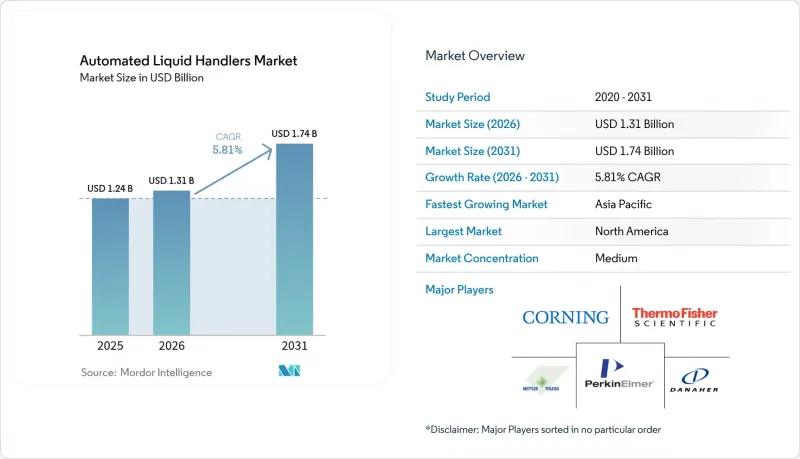
본 보고서는 제품 유형별(로봇식 액체 핸들링 워크스테이션 등), 처리 능력별(저, 중, 고), 플랫폼 구성별(독립형 벤치탑 시스템, 통합형 모듈식 플랫폼), 용도별(신약 개발, 유전체학 등), 최종 사용자별(CRO 및 CMO 등), 지역별로 분류되어 있습니다. 시장 예측은 금액(달러) 기준으로 제시되어 있습니다.
세계의 자동 액체 핸들러 시장 동향 및 인사이트
AI 기반 신약 개발 플랫폼과의 통합을 통해 히트에서 리드로의 타임라인이 가속화
머신러닝 알고리즘과 연동되는 자동 워크스테이션은 현재 인간의 개입 없이 ‘설계·실행·분석’의 반복 루프를 수행하고 있습니다. 19F NMR 센서를 탑재한 로봇은 21개의 반응을 동시에 평가할 수 있어, 이를 통해 신약 개발 팀은 히트에서 리드로의 주기를 75% 단축할 수 있습니다. 아스트라제네카 및 웨일 코넬 대학의 사례 연구에 따르면, 이러한 폐쇄 루프 시스템은 시너지 효과를 내는 화합물의 예측 정확도를 향상시키는 동시에 딥러닝 모델에 공급되는 상세한 분석 메타데이터를 수집하고 있습니다. 시간 절약과 풍부한 데이터는 특허 출원의 조기화 및 임상적 성공 가능성 향상으로 직결되며, 이를 통해 자동 액체 핸들러 시장은 제약 업계의 디지털화와 긴밀하게 발맞추고 있습니다.
대량 유전체 스크리닝에 대한 처리량 요구 사항 증가(북미)
팬데믹 기간 동안 규모를 확장한 미국의 레퍼런스 연구소에서는 현재 하루에 수천 건의 임상 유전체 데이터를 처리하고 있습니다. 'Biomek Echo One'과 같은 로봇 피펫팅 솔루션을 통해 시료 전처리 시간이 2시간에서 10분으로 단축되었습니다. 시퀀싱 1건당 비용을 100달러 미만으로 억제할 수 있는 검사실에는 경제적 이점이 있으며, 이는 워크플로가 완전히 자동화되어야만 실현 가능합니다. 보험사들이 차세대 시퀀싱에 대한 보험 적용 범위를 확대함에 따라, 대용량 시스템이 표준 구매 대상으로 자리 잡으며, 자동 액체 핸들러 시장에서 북미의 선도적 입지를 더욱 공고히 하고 있습니다.
신흥 시장에서 유연한 데크형 워크스테이션의 높은 초기 설비 투자
수입 관세와 다층적인 유통 구조로 인해 정가는 최대 116%까지 치솟아, 아프리카 일부 지역에서는 35만 달러짜리 시스템이 75만 달러를 넘는 가격에 판매되고 있습니다. 보조금이 교육이나 유지보수를 충당하는 경우는 거의 없어, 연구소들은 고액의 서비스 계약을 체결할 수밖에 없습니다. 그 결과, 기술력 격차가 확대되고 신흥 시장이 세계 유전체 컨소시엄에서 배제될 위험이 발생하며, 이로 인해 해당 지역의 자동 액체 핸들러 시장 성장이 둔화되고 있습니다.
부문 분석
로봇 워크스테이션은 자동 액체 핸들러 시장에서 가장 큰 점유율을 차지하고 있으며, 2025년에는 45.72%의 시장 점유율을 유지할 것으로 전망됩니다. 이는 연구소들이 여전히 재현성이 높은 피펫팅을 위해 기계적 정밀도를 우선시하고 있기 때문입니다. 반면, 실행 일정 설정 및 팁 사용량 예측을 수행하는 AI 모듈이 즉각적인 비용 절감을 가져오기 때문에 소프트웨어 및 서비스 분야는 연평균 성장률(CAGR) 7.59%를 나타낼 것으로 예측됩니다. 로봇 도입 대수가 증가함에 따라 소모품에 대한 지속적인 수요가 확보되고 있으며, 윤활제가 주입된 팁은 점도가 높은 시료에서 캐리오버를 줄여줍니다.
제품 구성은 워크플로우 라이브러리 및 클라우드 분석 기능을 이용할 수 있게 해주는 플랫폼 라이선스로 전환되고 있습니다. 각 벤더는 현재 가동 시간을 모니터링하고 이상을 감지하는 구독형 대시보드를 번들로 제공하고 있으며, 이를 통해 소프트웨어 수익이 더욱 향상되고 있습니다. 이러한 전환은 경쟁 구도를 변화시키고 생태계 파트너십을 촉진하는 동시에, 코드 라이브러리를 자동 액체 처리 장치 시장의 핵심 차별화 요소로 만들고 있습니다.
한 번의 실행으로 100-1,000개의 샘플을 처리하는 중용량 시스템은 2025년 자동 액체 핸들러 시장 규모의 53.12%를 차지했습니다. 이는 임상 실험실이나 중규모 생명공학 기업의 일반적인 배치 처리량에 부합하며, 속도와 가격의 균형을 잘 맞추고 있습니다. 1,000개 이상의 시료를 처리하는 고처리량 장치는 하루 10만 건 이상의 분석을 수행하는 신약 개발 분야의 대규모 스크리닝 캠페인 덕분에 6.21%라는 가장 높은 연평균 성장률(CAGR)을 기록하고 있습니다.
일일 처리 플레이트 수가 5,000장을 초과하면 단위당 경제성이 비약적으로 향상되므로, CRO(의약품 개발 수탁 기관)는 처리 능력의 병목 현상이 발생하기 전에 장비 업그레이드를 진행하고 있습니다. 이러한 추세로 인해 멀티암 구성이나 확장형 칩 랙을 갖춘 로봇 데크의 가격 프리미엄이 뒷받침되고 있습니다. 또한, 예측 유지보수 분야의 서비스 기회도 확대되면서 자동 액체 핸들러 시장의 수익원 안정성이 높아지고 있습니다.
지역별 분석
북미는 확고한 분자진단 인프라와 집중된 제약 클러스터를 바탕으로 2025년 자동 액체 핸들러 시장에서 38.10%의 점유율을 차지했습니다. 미국에 본사를 둔 서모피셔는 국내 제조에 20억 달러를 투자하여 공급망 단축과 규정 준수 지원을 확보했습니다. 캐나다는 유전체 연구 분야에서 강점을 보이고 있으며, 멕시코는 농업 유전체학 분야에서 자동화를 도입하고 있습니다. 이 지역은 AI를 활용한 실험실 기술 스타트업에 자금을 지원하는 벤처 캐피털의 혜택을 받고 있지만, 로봇 프로그래밍 인력 부족이 여전히 사업 규모 확대를 제약하고 있습니다.
아시아태평양은 2031년까지 연평균 성장률(CAGR)이 6.82%로 가장 빠르게 성장하는 지역이며, 중국의 1조 위안 규모 로봇 공학 이니셔티브와 한국의 1억 2,800만 달러 규모 지능형 로봇 프로그램에 힘입어 성장하고 있습니다. 일본은 수십 년에 걸친 자동화 전통을 활용하고 있으며, 호주는 연방 정부의 보조금을 활용하여 GMP 준수 바이오프로세스 시설을 건설하고 있습니다. 현지화된 서비스 센터는 가동 중단 시간을 줄이고, 기존 수입 기술자에 대한 의존을 극복하고 있습니다. 국내 공급업체를 우대하는 정부의 조달 정책이 도입 대수 확대를 가속화하여, 아시아태평양을 자동 액체 핸들러 시장의 주요 매출 성장원으로 확고히 자리매김하고 있습니다.
유럽은 독일, 영국, 프랑스의 안정적인 제약 파이프라인을 통해 자동 액체 핸들러 시장에서 확고한 입지를 유지하고 있습니다. EU 전역의 규제 조화로 국경을 초월한 기술 이전이 원활해지는 한편, 지속가능성 관련 규제로 인해 CO₂ 배출량이 검증된 로봇이 우선적으로 채택되고 있습니다. 남유럽의 연구소에서는 식품 및 환경 시험에 자동화를 도입하여 관련 수요를 확대되고 있습니다. 장비 공급업체와 연계된 견습 제도를 통해 기술 격차가 완화되어, 안정적인 가동률 유지와 서비스 비용 절감이 가능해졌습니다.
기타 혜택 :
- 엑셀 형식 시장 예측(ME) 시트
- 3개월간의 애널리스트 지원
자주 묻는 질문
목차
제1장 서론
제2장 조사 방법
제3장 주요 요약
제4장 시장 구도
제5장 시장 규모 및 성장 예측
제6장 경쟁 구도
제7장 시장 기회 및 향후 전망
AJY 26.09.07According to Mordor Intelligence, the automated liquid handlers market size is expected to grow from USD 1.24 billion in 2025 to USD 1.31 billion in 2026 and is forecast to reach USD 1.74 billion by 2031 at 5.81% CAGR over 2026-2031.
This report is Segmented by Product Type (Robotic Liquid-Handling Workstations, and More), Throughput Capability (Low, Medium, and High), Platform Configuration (Stand-Alone Benchtop Systems, and Integrated Modular Platforms), Application (Drug Discovery, Genomics, and More), End User (CROs and CMOs, and More), and Geography. The Market Forecasts are Provided in Terms of Value (USD).
Global Automated Liquid Handlers Market Trends and Insights
Integration with AI-Driven Drug-Discovery Platforms Accelerating Hit-to-Lead Timelines
Automated workstations that pair with machine-learning algorithms now run iterative design-execute-analyse loops without human intervention. Robots equipped with 19F NMR sensors can evaluate 21 reactions in parallel, enabling discovery teams to compress hit-to-lead cycles by 75%. Case studies at AstraZeneca and Weill Cornell show these closed-loop systems improving predictive accuracy for synergistic compounds while capturing granular assay metadata that feeds deep-learning models. The time savings and data richness directly translate into earlier patent filings and a better probability of clinical success, keeping the automated liquid handlers market firmly aligned with pharmaceutical digitalization.
Growing Throughput Requirements in High-Volume Genomic Screening (North America)
US reference labs that scaled up during the pandemic now process thousands of clinical genomes daily. Robotic pipetting solutions like the Biomek Echo One trim sample-prep from two hours to 10 minutes. The underlying economics reward laboratories able to push the cost per sequence below USD 100, which is only feasible when workflows are fully automated. As insurers broaden reimbursement for next-generation sequencing, high-capacity systems become default purchases, reinforcing North American leadership in the automated liquid handlers market.
High Initial CapEx for Flexible Deck Workstations in Emerging Markets
Import duties and multi-layer distribution inflate list prices by up to 116%, pushing a USD 350,000 system above USD 750,000 in parts of Africa. Grants rarely cover training or maintenance, leaving labs with unaffordable service contracts. The result is a widening capability gap that risks excluding emerging markets from global genomics consortia, dampening the automated liquid handlers market in these regions.
Other drivers and restraints analyzed in the detailed report include:
- Adoption of Miniaturized Assay Formats Reducing Reagent Costs
- Expansion of Personalized Medicine Driving High-Accuracy Liquid Handling
- Skill Gap in Programming and Maintenance of Robotic Systems
For complete list of drivers and restraints, kindly check the Table Of Contents.
Segment Analysis
Robotic workstations represent the largest slice of the automated liquid handlers market, holding 45.72% market share in 2025, because laboratories still prioritize mechanical precision for repeatable pipetting. Software and services, however, are forecast to grow at 7.59% CAGR as AI modules that schedule runs and predict tip usage deliver immediate cost savings. A growing installed base of robots ensures a recurring stream of consumables, and lubricant-infused tips reduce carry-over in viscous samples.
The product mix is shifting toward platform licences that unlock workflow libraries and cloud analytics. Vendors now bundle subscription dashboards that monitor uptime and flag anomalies, which further elevate software revenue. This pivot transforms competitive dynamics, encouraging ecosystem partnerships and making code libraries a core differentiator in the automated liquid handlers market.
Medium-throughput systems processing 100-1,000 samples per run accounted for 53.12% of the automated liquid handlers market size in 2025. They match typical batch volumes at clinical labs and mid-sized biotechs, offering balanced speed and price. High-throughput units that exceed 1,000 samples log the fastest 6.21% CAGR, thanks to large screening campaigns in drug discovery that surpass 100,000 assays a day.
Unit economics improve sharply once workflows cross 5,000 daily plates, prompting CROs to upgrade ahead of capacity bottlenecks. This trend anchors price premiums for robotic decks with multi-arm configurations and expanded tip racks. It also widens service opportunities in predictive maintenance, adding stability to revenue streams within the automated liquid handlers market.
Complete Report Scope:
- By Product Type
- Robotic Liquid-Handling Workstations
- Pipetting Systems
- Reagent Dispensers
- Consumables (Tips, Plates, Reagents)
- Software and Services
- By Throughput Capability
- Low Throughput (Less than 100 samples/run)
- Medium Throughput (100-1000 samples/run)
- High Throughput (Above 1 000 samples/run)
- By Platform Configuration
- Stand-Alone Benchtop Systems
- Integrated Modular Platforms
- By Application
- Drug Discovery and Lead Optimization
- Genomics and Proteomics
- Clinical Diagnostics
- Cell Biology and Stem-Cell Research
- Synthetic Biology and Bioprocess Development
- Other Applications
- By End User
- Pharmaceutical and Biotechnology Companies
- CROs and CMOs
- Academic and Research Institutes
- Clinical and Diagnostic Laboratories
- Forensic and Environmental Testing Labs
- By Geography
- North America
- United States
- Canada
- Mexico
- Europe
- Germany
- United Kingdom
- France
- Italy
- Spain
- Rest of Europe
- Asia-Pacific
- China
- Japan
- South Korea
- India
- South East Asia
- Rest of Asia-Pacific
- South America
- Brazil
- Rest of South America
- Middle East and Africa
- Middle East
- United Arab Emirates
- Saudi Arabia
- Rest of Middle East
- Africa
- South Africa
- Rest of Africa
- Middle East
- North America
Geography Analysis
North America commanded 38.10% share of the automated liquid handlers market in 2025 on the back of permanent molecular diagnostic infrastructure and concentrated pharmaceutical clusters. US-based Thermo Fisher invested USD 2 billion in domestic manufacturing, ensuring short supply chains and compliance support. Canada adds strength in genomics research, while Mexico adopts automation for agrigenomics. The region benefits from venture capital that funds AI-driven lab-tech start-ups, though staffing shortages in robot programming still constrain scale.
Asia-Pacific is the fastest-growing region with a 6.82% CAGR through 2031, boosted by China's 1 trillion yuan robotics initiative and Korea's USD 128 million intelligent-robot program. Japan leverages decades of automation heritage, and Australia uses federal grants to build GMP-grade bioprocessing sites. Localized service centers cut downtime, overcoming historic reliance on imported technicians. Government procurement policies that favor domestic suppliers accelerate installed-base expansion, cementing Asia-Pacific as the primary incremental revenue source for the automated liquid handlers market.
Europe maintains a firm foothold in the automated liquid handlers market through stable pharma pipelines in Germany, the United Kingdom, and France. Regulatory alignment across the EU smooths cross-border tech transfer, while sustainability mandates drive preference for robots with validated CO2 footprints. Southern European labs deploy automation in food and environmental testing, enlarging the addressable demand. Skills gaps are mitigated by apprenticeship programs tied to equipment suppliers, enabling consistent uptime and moderating service costs.
- Thermo Fisher Scientific Inc.
- Danaher Corp. (Beckman Coulter Life Sciences)
- Tecan Group Ltd.
- Hamilton Company
- PerkinElmer Inc. (Revvity)
- Agilent Technologies Inc.
- Mettler-Toledo International Inc.
- Becton, Dickinson and Company
- Eppendorf AG
- Formulatrix Inc.
- Aurora Biomed Inc.
- Sartorius AG (Biohit)
- Synchron Lab Automation
- Hudson Robotics Inc.
- Analytik Jena AG (Endress + Hauser)
- Opentrons Labworks Inc.
- Biosero Inc. (BICO Group)
- Gilson Inc.
- Lab Services B.V.
- Andrew Alliance S.A. (Waters)
- Integra Biosciences AG
- Corning Incorporated
- SPT Labtech Ltd.
- Festo AG and Co. KG
- Starlab International GmbH
Additional Benefits:
- The market estimate (ME) sheet in Excel format
- 3 months of analyst support
TABLE OF CONTENTS
1 INTRODUCTION
- 1.1 Study Assumptions and Market Definition
- 1.2 Scope of the Study
2 RESEARCH METHODOLOGY
3 EXECUTIVE SUMMARY
4 MARKET LANDSCAPE
- 4.1 Market Overview
- 4.2 Market Drivers
- 4.2.1 Growing Throughput Requirements in High-Volume Genomic Screening (North America)
- 4.2.2 Adoption of Miniaturized Assay Formats Reducing Reagent Costs
- 4.2.3 Integration with AI-Driven Drug-Discovery Platforms Accelerating Hit-to-Lead Timelines
- 4.2.4 Expansion of Personalized Medicine Driving High-Accuracy Liquid Handling (Europe and US)
- 4.2.5 Permanent Molecular-Diagnostic capacity Post-COVID-19 (Global Reference Labs)
- 4.2.6 Government Funding for Automated Bioprocessing (Asia-Pacific)
- 4.3 Market Restraints
- 4.3.1 High Initial CapEx for Flexible Deck Workstations in Emerging Markets
- 4.3.2 Skill Gap in Programming and Maintenance of Robotic Systems
- 4.3.3 Sample Cross-Contamination Risks in High-Viscosity Liquids
- 4.3.4 Legacy LIMS Integration Challenges in Big-Pharma Labs
- 4.4 Industry Ecosystem Analysis
- 4.5 Technological Outlook
- 4.6 Porter's Five Forces Analysis
- 4.6.1 Bargaining Power of Suppliers
- 4.6.2 Bargaining Power of Buyers
- 4.6.3 Threat of New Entrants
- 4.6.4 Threat of Substitutes
- 4.6.5 Intensity of Competitive Rivalry
5 MARKET SIZE AND GROWTH FORECASTS (VALUE)
- 5.1 By Product Type
- 5.1.1 Robotic Liquid-Handling Workstations
- 5.1.2 Pipetting Systems
- 5.1.3 Reagent Dispensers
- 5.1.4 Consumables (Tips, Plates, Reagents)
- 5.1.5 Software and Services
- 5.2 By Throughput Capability
- 5.2.1 Low Throughput (Less than 100 samples/run)
- 5.2.2 Medium Throughput (100-1000 samples/run)
- 5.2.3 High Throughput (Above 1 000 samples/run)
- 5.3 By Platform Configuration
- 5.3.1 Stand-Alone Benchtop Systems
- 5.3.2 Integrated Modular Platforms
- 5.4 By Application
- 5.4.1 Drug Discovery and Lead Optimization
- 5.4.2 Genomics and Proteomics
- 5.4.3 Clinical Diagnostics
- 5.4.4 Cell Biology and Stem-Cell Research
- 5.4.5 Synthetic Biology and Bioprocess Development
- 5.4.6 Other Applications
- 5.5 By End User
- 5.5.1 Pharmaceutical and Biotechnology Companies
- 5.5.2 CROs and CMOs
- 5.5.3 Academic and Research Institutes
- 5.5.4 Clinical and Diagnostic Laboratories
- 5.5.5 Forensic and Environmental Testing Labs
- 5.6 By Geography
- 5.6.1 North America
- 5.6.1.1 United States
- 5.6.1.2 Canada
- 5.6.1.3 Mexico
- 5.6.2 Europe
- 5.6.2.1 Germany
- 5.6.2.2 United Kingdom
- 5.6.2.3 France
- 5.6.2.4 Italy
- 5.6.2.5 Spain
- 5.6.2.6 Rest of Europe
- 5.6.3 Asia-Pacific
- 5.6.3.1 China
- 5.6.3.2 Japan
- 5.6.3.3 South Korea
- 5.6.3.4 India
- 5.6.3.5 South East Asia
- 5.6.3.6 Rest of Asia-Pacific
- 5.6.4 South America
- 5.6.4.1 Brazil
- 5.6.4.2 Rest of South America
- 5.6.5 Middle East and Africa
- 5.6.5.1 Middle East
- 5.6.5.1.1 United Arab Emirates
- 5.6.5.1.2 Saudi Arabia
- 5.6.5.1.3 Rest of Middle East
- 5.6.5.2 Africa
- 5.6.5.2.1 South Africa
- 5.6.5.2.2 Rest of Africa
- 5.6.5.1 Middle East
- 5.6.1 North America
6 COMPETITIVE LANDSCAPE
- 6.1 Market Concentration
- 6.2 Strategic Moves
- 6.3 Market Share Analysis
- 6.4 Company Profiles {(includes Global-level Overview, Market-level Overview, Core Segments, Financials, Strategic Information, Market Rank/Share, Products and Services, Recent Developments)}
- 6.4.1 Thermo Fisher Scientific Inc.
- 6.4.2 Danaher Corp. (Beckman Coulter Life Sciences)
- 6.4.3 Tecan Group Ltd.
- 6.4.4 Hamilton Company
- 6.4.5 PerkinElmer Inc. (Revvity)
- 6.4.6 Agilent Technologies Inc.
- 6.4.7 Mettler-Toledo International Inc.
- 6.4.8 Becton, Dickinson and Company
- 6.4.9 Eppendorf AG
- 6.4.10 Formulatrix Inc.
- 6.4.11 Aurora Biomed Inc.
- 6.4.12 Sartorius AG (Biohit)
- 6.4.13 Synchron Lab Automation
- 6.4.14 Hudson Robotics Inc.
- 6.4.15 Analytik Jena AG (Endress + Hauser)
- 6.4.16 Opentrons Labworks Inc.
- 6.4.17 Biosero Inc. (BICO Group)
- 6.4.18 Gilson Inc.
- 6.4.19 Lab Services B.V.
- 6.4.20 Andrew Alliance S.A. (Waters)
- 6.4.21 Integra Biosciences AG
- 6.4.22 Corning Incorporated
- 6.4.23 SPT Labtech Ltd.
- 6.4.24 Festo AG and Co. KG
- 6.4.25 Starlab International GmbH
7 MARKET OPPORTUNITIES AND FUTURE OUTLOOK
- 7.1 White-Space and Unmet-Need Assessment


