|
시장보고서
상품코드
2122988
화염 감지기 시장 : 시장 점유율 분석, 업계 동향 및 통계, 성장 예측(2026-2031년)Flame Detectors - Market Share Analysis, Industry Trends & Statistics, Growth Forecasts (2026 - 2031) |
||||||
 Mordor Intelligence
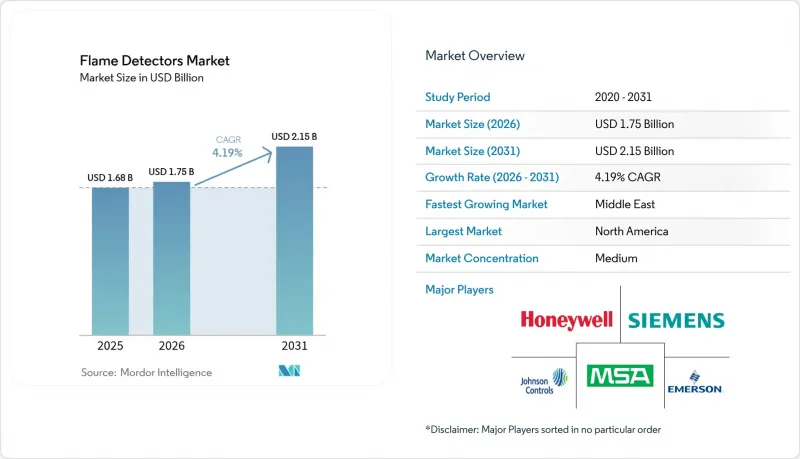
Mordor Intelligence에 의하면, 2026년 화염 감지기 시장 규모는 17억 5,000만 달러로 추정되고, 2025년 16억 8,000만 달러에서 확대해, 2031년에는 21억 5,000만 달러에 이를 것으로 예측됩니다.
2026-2031년 연평균 성장률(CAGR) 4.19%로 성장할 것으로 전망됩니다.
본 보고서는 제품 유형별(자외선(UV), 적외선(IR) 등), 설치 유형별(고정식 화염 감지기 등), 서비스별(설계, 설치 및 시운전 등), 통신 및 루프별(주소 지정형(스마트) 감지기 등), 최종 사용자 산업별(석유 및 가스, 제조·공정 산업 등) 및 지역별로 분류되어 있습니다. 시장 전망은 금액(달러) 기준으로 제시되어 있습니다.
세계의 화염 감지기 시장 동향 및 인사이트
LNG 메가트레인 건설이 다중 스펙트럼 IR 도입을 촉진
노스 필드 확장 및 자프라가스 개발과 같은 중동의 LNG 프로젝트에서는 광범위한 분리기 및 저장 탱크 전체에 걸친 탄화수소 화재를 추적할 수 있는 감지기가 요구되고 있습니다. 플랜트 소유주는 태양 복사에 의한 간섭을 극복하기 위해 다중 스펙트럼 IR 장비를 지정하고 있으며, 이러한 요구 사항으로 인해 다중 대역 광학 어레이 및 내장 진단 기능을 갖춘 고급 공급업체의 입지가 강화되고 있습니다. 무인화된 공정 구역에서는 장치의 가동률 99.9%가 요구되며, 자산 유지보수 팀은 내장형 상태 모니터링에 의존하는 시간 기반 유지보수 모델에서 상태 기반 유지보수 모델로 전환하고 있습니다.
FM 5560에 기반한 리튬 이온 배터리 데이터센터 수요
FM 5560에서는 에너지 저장 어레이에 대한 감지 규정이 새롭게 제정되었으며, 하이퍼스케일 사업자는 열 폭주가 심각해지기 전에 전해액의 오프가스 특성을 인식할 수 있는 다기준식 화염 감지기를 기존 시설에 후설치해야 합니다. 2024년판 국제 방화 규정(IFC)에서는 NFPA 855의 의무가 추가되어, 설치 용량이 50kWh를 초과하는 에너지 저장 설비에 대한 규정 준수 기한이 엄격해졌습니다. 각 시스템 통합 업체들은 정상적인 배터리 모듈의 열 프로파일을 학습하는 AI 분류기를 탑재하여, 수익에 필수적인 컴퓨팅 클러스터를 중단시킬 수 있는 오작동을 방지하고 있습니다.
저가형 중국산 적외선 카메라가 프리미엄 수익을 잠식
중국의 적외선 카메라 공급업체들은 유럽 및 미국의 동급 제품보다 40-60% 저렴한 가격의 적외선 화염 감지기를 출시하여, SIL-2 규격이 필수적이지 않은 중규모 산업 시설에서 지지를 넓히고 있습니다. 서유럽 제조업체들은 오경보 감소 및 점검 주기 연장을 통한 비용 절감 효과를 산출한 수명 주기 비용 모델을 제시하며 대응하고 있습니다.
부문 분석
적외선 장치는 2025년 매출의 41.32%를 차지했으며, 탄화수소 화재에 대한 오랜 신뢰성 실적을 바탕으로 화염 감지기 시장을 지탱하고 있습니다. 정유시설, 터미널, 석유화학 플랜트에서는 검증된 단일 채널 광학 시스템을 중시하는 사용자들로 인해 계속해서 도입이 확대되고 있습니다. 한편, 다중 스펙트럼 적외선(IR) 하위 카테고리는 3개 이상의 파장대를 조합하여 햇빛의 눈부심이나 고온 표면에서의 반사를 제거할 수 있기 때문에 연평균 성장률(CAGR) 5.02%로 확대될 것으로 예측됩니다. 무인 LNG 플랜트 운영자들은 고액의 설비 투자라 하더라도, 비용이 많이 드는 공정 중단을 방지하기 위한 정당한 보험으로 간주하고 있습니다. 알고리즘의 성숙과 가격 하락에 따라 가시 화염 이미징이 가장 빠르게 성장하고 있으며, 감지와 근본 원인 분석을 동시에 수행할 수 있게 되었습니다. UV 감지기는 수소나 금속의 연소 위험에 대한 틈새 솔루션으로 남아 있지만, UV/IR 복합 유닛은 혼합 연료 설비에서 성능과 비용의 균형을 맞추고 있습니다.
이와 병행하여, AI 지원 센서 펌웨어를 통해 감지기는 렌즈의 김서림이나 광학 성능 저하를 자가 진단하는 엣지 컴퓨팅 노드로 변모하고 있습니다. 원격 펌웨어 업그레이드를 통해 유지보수 주기는 더욱 단축되고 있습니다. 이러한 추세로 인해 사이버 보안에 대한 우려에도 불구하고, 설계·조달·시공(EPC) 팀은 클라우드 연결형 장치 채택을 지정하고 있습니다. 화염 감지기 시장은 예측 분석이 보증 기간을 초과하여 제공되는 부가가치 서비스 계약의 기반이 됨으로써 혜택을 보고 있으며, 통합된 소프트웨어 로드맵을 보유한 제조업체의 애프터마켓 이익률을 끌어올리고 있습니다.
고정식 감지기는 2025년 매출의 86.05%를 차지했으며, 공정 구역, 부두 하역 지점, 압축기 스테이션에서 지속적인 구역 커버리지의 기반을 계속해서 제공합니다. 자산의 수명 주기 동안 레이아웃이 변경되는 경우는 거의 없기 때문에 수요는 신규 프로젝트보다는 교체나 규제 준수를 위한 업그레이드에 의존하고 있습니다. 한편, 운영자가 ‘접촉 전 검사’라는 안전 절차를 채택함에 따라 휴대용 감지기 시장은 연평균 성장률(CAGR) 5.84%로 확대되고 있습니다. 점검 팀은 생산을 중단하지 않고 턴어라운드 기간 동안 고정 시스템의 건전성을 검증하며, 최초 대응자는 휴대용 장비를 휴대하여 상황이 불분명한 현장을 신속하게 평가합니다.
배터리 밀도 향상으로 인해 고정식 플랫폼과 동등한 감도를 유지하면서도 휴대용 기기의 작동 시간은 2배로 연장되었습니다. 견고한 케이스와 본질 안전 방폭 규격 덕분에 존 1(Zone 1) 구역에서도 안전하게 사용할 수 있게 되었습니다. 그 결과, 두 기기의 관계는 경쟁 관계가 아닌 상호 보완적인 관계가 되었습니다. 휴대용 기기의 보급이 확대되어도 고정식 기기 수요를 잠식하지 않으며, 오히려 유지보수 주기마다 추가 수익을 창출합니다. 따라서 화염 감지기 시장은 동일한 도입 기반을 통해 두 가지 수익원을 확보하게 됩니다. 즉, 고정 설치 지점에 대한 설비 투자와 휴대용 검증 기기에 대한 운영비입니다.
지역별 분석
북미는 보험료를 극히 낮은 오경보율에 연동시키는 보험 규제의 뒷받침을 받아 2025년 매출의 31.88%를 차지했으며, 화염 감지기 시장을 주도했습니다. 성숙한 정유시설 및 화학 플랜트가 꾸준한 교체 주기를 촉진하고 있으며, FM 5560에 기반한 새로운 규정에 따라 시설당 감지기 설치 대수가 증가하고 있습니다. 또한, 이 지역은 보험사 및 규제 당국에 네트워크의 내결함성을 보장하는 사이버 보안 프레임워크에 힘입어, 주소 지정 가능한 스마트 루프의 도입을 선도하고 있습니다.
중동은 2031년까지의 예측 기간 동안 5.96%라는 가장 높은 연평균 성장률(CAGR)을 보일 것으로 전망됩니다. 이는 열차, 저장 시설, 부두 구역 전반에 걸쳐 엄격한 화염 감시가 필요한 2,000억 달러 규모의 LNG 확장 프로젝트 덕분입니다. 가혹한 사막 환경에서는 스테인리스 스틸 하우징, 윈도우 히터, 그리고 모래로 인한 마모를 예측하는 광학 진단 기술이 적합합니다. 카타르에서의 성공적인 도입 사례는 인근 GCC 국가들로 확산되어, 전 세계 사양을 형성하는 ‘기술의 등대 효과’를 창출하고 있습니다.
유럽에서는 개정된 ATEX Zone-0 및 SIL-2 요건을 준수하기 위해 감지기 개조에 대한 투자가 계속되고 있습니다. 다국적 석유화학 기업들은 전 세계 거점에서 동일한 인증 모델을 표준화하고 있으며, 이로 인해 유럽 대륙을 넘어 교체 수요가 확대되고 있습니다. 아시아태평양의 성장은 산업 전기화 계획, 특히 일본과 한국의 수소 로드맵에 힘입고 있으며, 이에 따라 전해조 홀 내 UV/IR 감지기의 설치 대수가 증가하고 있습니다. 남미의 프레솔트층 해저 유전 발견에 따라, 심해 생산 데크에서 플레어 번들을 식별하기 위해 AI를 활용한 시각적 이미지 처리 기술이 요구되고 있습니다.
기타 혜택 :
- 엑셀 형식 시장 예측(ME) 시트
- 3개월간의 애널리스트 지원
자주 묻는 질문
목차
제1장 서론
제2장 조사 방법
제3장 주요 요약
제4장 시장 구도
제5장 시장 규모 및 성장 예측
제6장 경쟁 구도
제7장 시장 기회 및 향후 전망
AJY 26.09.07According to Mordor Intelligence, flame detector market size in 2026 is estimated at USD 1.75 billion, growing from 2025 value of USD 1.68 billion with 2031 projections showing USD 2.15 billion, growing at 4.19% CAGR over 2026-2031.
This report is Segmented by Product Type (Ultraviolet (UV), Infrared (IR), and More), Mounting Type (Fixed Flame Detectors, and More), Service (Design, Installation and Commissioning, and More), Communication/Loop (Addressable (Smart) Detectors, and More), End-User Industry (Oil and Gas, Manufacturing and Process Industries, and More), and Geography. The Market Forecasts are Provided in Terms of Value (USD).
Global Flame Detectors Market Trends and Insights
LNG mega-train construction boosting multi-spectrum IR adoption
Middle Eastern LNG projects such as the North Field expansion and Jafurah gas development require detectors that can track hydrocarbon fires across wide separators and storage tanks. Plant owners are specifying multi-spectrum IR units to overcome solar radiation interference, a mandate that is elevating premium vendors with multi-band optical arrays and built-in diagnostics. Unmanned process areas reinforce the need for 99.9% device availability, and asset-integrity teams are migrating from time-based to condition-based maintenance models that rely on embedded health monitoring.
Lithium-ion battery data-center demand under FM 5560
FM 5560 now sets detection rules for energy-storage arrays, prompting hyperscale operators to retrofit existing sites with multi-criteria flame detectors that recognise electrolyte off-gas signatures before thermal runaway escalates. The 2024 International Fire Code adds NFPA 855 obligations, tightening compliance timelines for facilities exceeding 50 kWh of installed storage. System integrators are embedding AI classifiers that learn normal battery-module heat profiles to avoid spurious trips that may sideline revenue-critical compute clusters.
Low-cost Chinese IR cameras eroding premium revenue
Thermal-imaging vendors from China are releasing IR flame detectors priced 40-60% lower than Western equivalents, gaining traction in mid-tier industrial sites that do not mandate SIL-2 ratings . Western manufacturers are countering with lifecycle cost models that monetise false-alarm reductions and longer service intervals.
Other drivers and restraints analyzed in the detailed report include:
- ATEX and IECEx Zone-0 revisions mandating SIL-2 detectors
- Offshore FPSO retrofits adopting AI-enabled visual imaging
- Dirty-optics downtime limiting underground-mining uptake
For complete list of drivers and restraints, kindly check the Table Of Contents.
Segment Analysis
Infrared devices captured 41.32% of 2025 revenue, underpinning the flame detector market with a long record of hydrocarbon-fire reliability. Adoption persists in refineries, terminals and petrochemical plants where users value proven single-channel optics. Yet the multi-spectrum IR sub-category is forecast to expand at 5.02% CAGR because it blends three or more wavelength bands to reject solar glare and hot-surface reflections. Operators in unmanned LNG trains see the higher capital spend as justifiable insurance against costly process shutdowns. Visual flame imaging is growing fastest as algorithms mature and price points fall, allowing simultaneous detection and root-cause analytics. UV detectors remain the niche solution for hydrogen or metal-combustion risks, while combined UV/IR units balance performance and cost in mixed-fuel installations.
In tandem, AI-ready sensor firmware is turning detectors into edge-computing nodes that self-diagnose lens obscuration and optical degradation. Remote firmware upgrades further shorten maintenance cycles. This trend is nudging engineering, procurement and construction (EPC) teams to specify cloud-connected devices despite cybersecurity reservations. The flame detector market benefits because predictive analytics underpin value-added service agreements that stretch beyond warranty periods, boosting aftermarket margins for manufacturers with integrated software roadmaps.
Fixed detectors delivered 86.05% of 2025 billings and remain the backbone for continuous zone coverage in process areas, jetty off-loading points and compressor stations. Layouts rarely change over asset lifecycles, keeping demand tied to replacement and regulatory upgrades rather than greenfield projects. Portable detectors, however, are accelerating at a 5.84% CAGR as operators adopt test-before-touch safety procedures. Inspection teams validate fixed-system integrity during turnarounds without halting production, and first responders carry handheld units to quickly assess unknown scenes.
Battery density improvements have doubled mission time for portable devices while maintaining sensitivity parity with fixed platforms. Rugged enclosures and intrinsically safe ratings now enable safe use in Zone-1 locations. The result is a complementary relationship rather than a competitive one: rising portable uptake does not cannibalise fixed demand but instead banks additional revenue on every maintenance cycle. The flame detector market therefore gains two revenue streams from the same installed base: capital expenditure on fixed points and operational expenditure on portable verification equipment.
Complete Report Scope:
- By Product Type
- Ultraviolet (UV)
- Infrared (IR)
- Ultraviolet/Infrared (UV/IR)
- Multi-Spectrum IR (Triple/Quad)
- Visual Flame Imaging
- Combined Gas and Flame Detectors
- By Mounting Type
- Fixed Flame Detectors
- Portable/Hand-held Flame Detectors
- By Service
- Design, Installation and Commissioning
- Inspection, Testing and Maintenance
- Retrofit and Replacement
- By Communication/Loop
- Addressable (Smart) Detectors
- Conventional Detectors
- By End-User Industry
- Oil and Gas (Up-, Mid-, Down-stream)
- Chemicals and Petrochemicals
- Energy and Power Generation
- Manufacturing and Process Industries
- Mining and Metals
- Aerospace and Defense
- Warehousing, Logistics and Data-Centers
- Marine and Offshore
- Commercial and Public Infrastructure
- By Geography
- North America
- United States
- Canada
- Mexico
- Europe
- Germany
- United Kingdom
- France
- Nordics
- Rest of Europe
- South America
- Brazil
- Rest of South America
- Asia-Pacific
- China
- Japan
- India
- South-East Asia
- Rest of Asia-Pacific
- Middle East and Africa
- Middle East
- Gulf Cooperation Council Countries
- Turkey
- Rest of Middle East
- Africa
- South Africa
- Rest of Africa
- Middle East
- North America
Geography Analysis
North America led the flame detector market with 31.88% of 2025 revenue, supported by insurance mandates that link policy premiums to ultra-low false-alarm rates. Mature refining and chemical assets drive steady replacement cycles, and new rules under FM 5560 are expanding detector counts per facility. The region also pioneers addressable smart loops, backed by cybersecurity frameworks that assure underwriters and regulators of network resilience.
The Middle East shows the highest 5.96% CAGR forecast to 2031 thanks to USD 200 billion in LNG expansions that require stringent flame supervision across train, storage and jetty areas. Harsh desert conditions favour stainless-steel housings, window heaters and optical diagnostics that predict sand abrasion. Successful deployments in Qatar are migrating to neighbouring GCC states, creating a technology lighthouse effect that shapes global specifications.
Europe continues to invest in detector retrofits to comply with the updated ATEX Zone-0 and SIL-2 mandates. Multinational petrochemical operators are standardising on the same certified model across global sites, amplifying replacement demand beyond the continent. Asia-Pacific's growth rests on industrial electrification agendas, notably Japan and South Korea's hydrogen roadmaps that elevate UV/IR detector counts in electrolyser halls.. South America's offshore pre-salt finds need AI-enabled visual imaging to discriminate flare bundles from deep-sea production decks.
- Honeywell International Inc.
- Emerson Electric Co. (Det-Tronics, Spectrex)
- Johnson Controls plc (Tyco)
- MSA Safety Inc.
- Siemens AG
- Bosch Security Systems B.V.
- Dragerwerk AG and Co. KGaA
- Teledyne Gas and Flame (Simtronics, Oldham)
- 3M Co. (Scott Safety)
- Micropack Engineering Ltd.
- FLIR Systems (Teledyne)
- Hochiki Corporation
- Crowcon Detection Instruments Ltd.
- Fike Corporation
- Minimax Viking GmbH
- Firefly AB
- Sense-WARE Fire and Gas Detection B.V.
- Omniguard Flame Detectors
- General Monitors (now part of MSA)
- Kidde Fire Safety (Carrier)
Additional Benefits:
- The market estimate (ME) sheet in Excel format
- 3 months of analyst support
TABLE OF CONTENTS
1 INTRODUCTION
- 1.1 Study Assumptions and Market Definition
- 1.2 Scope of the Study
2 RESEARCH METHODOLOGY
3 EXECUTIVE SUMMARY
4 MARKET LANDSCAPE
- 4.1 Market Overview
- 4.2 Market Drivers
- 4.2.1 LNG Mega-train Construction in Middle East Accelerating Multi-Spectrum IR Detector Demand
- 4.2.2 Rapid Deployment of Flame Detectors in Lithium-ion Battery Data-Centers to Meet FM 5560
- 4.2.3 ATEX and IECEx Zone-0 Revisions Mandating SIL-2 Certified Detectors (Europe)
- 4.2.4 Offshore FPSO Retrofits Adopting AI-Enabled Visual Flame Imaging (Brazil and North Sea)
- 4.2.5 Green-Hydrogen Electrolyser Installations Driving UV/IR Detector Sales (Asia)
- 4.2.6 Insurance Underwriters Requiring Ultra-Low False-Alarm Specifications (United States and Canada)
- 4.3 Market Restraints
- 4.3.1 Low-Cost Chinese IR Cameras Cannibalising Premium Detector Revenue
- 4.3.2 Dirty-Optics Maintenance Downtime Limiting Uptake in Underground Mining
- 4.3.3 Lengthy FM and EN54-10 Certification Cycles Delaying Product Launch
- 4.3.4 Cybersecurity Concerns over Networked Detectors in Critical Infrastructure
- 4.4 Industry Ecosystem Analysis
- 4.5 Regulatory and Technological Outlook
- 4.6 Porter's Five Forces Analysis
- 4.6.1 Threat of New Entrants
- 4.6.2 Bargaining Power of Buyers
- 4.6.3 Bargaining Power of Suppliers
- 4.6.4 Threat of Substitutes
- 4.6.5 Competitive Rivalry
5 MARKET SIZE AND GROWTH FORECASTS (VALUES)
- 5.1 By Product Type
- 5.1.1 Ultraviolet (UV)
- 5.1.2 Infrared (IR)
- 5.1.3 Ultraviolet/Infrared (UV/IR)
- 5.1.4 Multi-Spectrum IR (Triple/Quad)
- 5.1.5 Visual Flame Imaging
- 5.1.6 Combined Gas and Flame Detectors
- 5.2 By Mounting Type
- 5.2.1 Fixed Flame Detectors
- 5.2.2 Portable/Hand-held Flame Detectors
- 5.3 By Service
- 5.3.1 Design, Installation and Commissioning
- 5.3.2 Inspection, Testing and Maintenance
- 5.3.3 Retrofit and Replacement
- 5.4 By Communication/Loop
- 5.4.1 Addressable (Smart) Detectors
- 5.4.2 Conventional Detectors
- 5.5 By End-User Industry
- 5.5.1 Oil and Gas (Up-, Mid-, Down-stream)
- 5.5.2 Chemicals and Petrochemicals
- 5.5.3 Energy and Power Generation
- 5.5.4 Manufacturing and Process Industries
- 5.5.5 Mining and Metals
- 5.5.6 Aerospace and Defense
- 5.5.7 Warehousing, Logistics and Data-Centers
- 5.5.8 Marine and Offshore
- 5.5.9 Commercial and Public Infrastructure
- 5.6 By Geography
- 5.6.1 North America
- 5.6.1.1 United States
- 5.6.1.2 Canada
- 5.6.1.3 Mexico
- 5.6.2 Europe
- 5.6.2.1 Germany
- 5.6.2.2 United Kingdom
- 5.6.2.3 France
- 5.6.2.4 Nordics
- 5.6.2.5 Rest of Europe
- 5.6.3 South America
- 5.6.3.1 Brazil
- 5.6.3.2 Rest of South America
- 5.6.4 Asia-Pacific
- 5.6.4.1 China
- 5.6.4.2 Japan
- 5.6.4.3 India
- 5.6.4.4 South-East Asia
- 5.6.4.5 Rest of Asia-Pacific
- 5.6.5 Middle East and Africa
- 5.6.5.1 Middle East
- 5.6.5.1.1 Gulf Cooperation Council Countries
- 5.6.5.1.2 Turkey
- 5.6.5.1.3 Rest of Middle East
- 5.6.5.2 Africa
- 5.6.5.2.1 South Africa
- 5.6.5.2.2 Rest of Africa
- 5.6.5.1 Middle East
- 5.6.1 North America
6 COMPETITIVE LANDSCAPE
- 6.1 Market Concentration
- 6.2 Strategic Moves
- 6.3 Market Share Analysis
- 6.4 Company Profiles (includes Global-level Overview, Market-level Overview, Core Segments, Financials as available, Strategic Information, Market Rank/Share for key companies, Products and Services, and Recent Developments)
- 6.4.1 Honeywell International Inc.
- 6.4.2 Emerson Electric Co. (Det-Tronics, Spectrex)
- 6.4.3 Johnson Controls plc (Tyco)
- 6.4.4 MSA Safety Inc.
- 6.4.5 Siemens AG
- 6.4.6 Bosch Security Systems B.V.
- 6.4.7 Dragerwerk AG and Co. KGaA
- 6.4.8 Teledyne Gas and Flame (Simtronics, Oldham)
- 6.4.9 3M Co. (Scott Safety)
- 6.4.10 Micropack Engineering Ltd.
- 6.4.11 FLIR Systems (Teledyne)
- 6.4.12 Hochiki Corporation
- 6.4.13 Crowcon Detection Instruments Ltd.
- 6.4.14 Fike Corporation
- 6.4.15 Minimax Viking GmbH
- 6.4.16 Firefly AB
- 6.4.17 Sense-WARE Fire and Gas Detection B.V.
- 6.4.18 Omniguard Flame Detectors
- 6.4.19 General Monitors (now part of MSA)
- 6.4.20 Kidde Fire Safety (Carrier)
7 MARKET OPPORTUNITIES AND FUTURE OUTLOOK
- 7.1 White-space and Unmet-Need Assessment