

|
시장보고서
상품코드
2122998
프라이빗 LTE 시장 : 점유율 분석, 업계 동향과 통계, 성장 예측(2026-2031년)Private LTE - Market Share Analysis, Industry Trends & Statistics, Growth Forecasts (2026 - 2031) |
||||||
 Mordor Intelligence
Mordor Intelligence에 의하면, 프라이빗 LTE 시장 규모는 2025년 52억 4,000만 달러에서 2026년에는 65억 4,000만 달러로 확대되어 2026-2031년까지 CAGR 24.77%로 성장을 지속하여, 2031년까지 197억 6,000만 달러에 이를 것으로 예측됩니다.
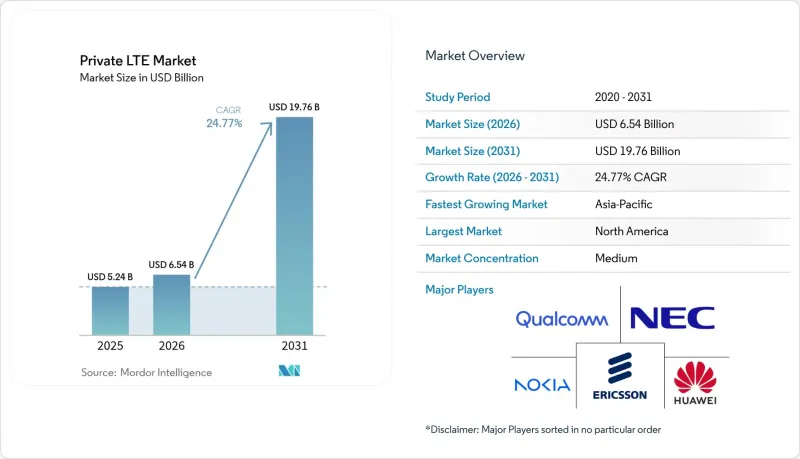
본 보고서는 구성 요소(인프라, 서비스), 기술(주파수 분할 다중 접속(FDD), 시분할 다중 접속(TDD)), 구축 모델(중앙 집중형(C-RAN), 분산형), 최종 사용자 산업(제조업, 에너지·유틸리티, 기타), 지역별로 분류되어 있습니다. 시장 예측은 금액(달러) 기준으로 제시되어 있습니다.
세계 프라이빗 LTE 시장 동향 및 인사이트
주파수 대역 자유화가 기업 내 도입 급증을 촉진
주요 하이라이트
- 규제 당국은 미드밴드 주파수를 재할당하고 있으며, CBRS와 같은 프레임워크 하에서 기업들은 그 어느 때보다 고품질의 주파수 대역에 접근할 수 있게 되었습니다. 2023년 말까지 약 37만 대의 CBRS 단말기가 도입되었으며, 공유 대역이 라이선스 취득의 장벽을 낮추고 네트워크 소유의 민주화를 촉진하고 있음이 부각되고 있습니다. 합리적인 가격에 간섭이 관리된 접속이 가능해짐에 따라, 이전에는 독점 라이선스를 취득할 자원이 부족했던 중견 기업들에게도 프라이빗 LTE 시장에 진입할 수 있는 길이 열렸습니다. 미국 외에도 독일, 일본, 호주에서는 공장, 항만, 유틸리티자가 독자적인 커버리지 영역을 구축할 수 있도록 지역 라이선스가 발급되고 있습니다. 이러한 정책 전환으로 인해 벤더 생태계가 확대되고 스몰셀 혁신이 촉진되는 동시에, 향후 3년 내에 프라이빗 LTE 네트워크 도입이 예상되는 새로운 산업 시설의 파이프라인이 형성되고 있습니다.
산업용 IoT가 제조업의 변혁을 주도
스마트 팩토리 도입은 현재 30밀리초 이하의 지연 시간으로 수천 개의 센서를 유지할 수 있는 신뢰성 높은 무선 백본에 의존하고 있습니다. 얼리 어답터의 79% 가까이가 무인 운반 차량(AGV), AR을 활용한 유지보수, 디지털 트윈을 지원하기 위해 프라이빗 LTE를 도입한 후 6개월 이내에 ROI(투자 수익률)를 달성했다고 응답했습니다. 변동이 적은 연결성 덕분에 생산 라인의 균형 효율이 향상되며, 이는 결과적으로 예측 유지보수, 품질 분석, 공장 전체의 에너지 최적화를 촉진합니다. 제조업체들은 초기 네트워크가 가동되기 시작하면 야드 관리나 작업자 안전을 보장하기 위한 웨어러블 단말기 등 새로운 이용 사례를 끊임없이 발견하고 있으며, 이로 인해 프라이빗 LTE 시장 내에서 자기 강화적인 도입 곡선이 형성되고 있습니다.
자본 집약성이 도입의 장벽이 됨
프라이빗 LTE 도입에는 무선 및 코어 장비, 내결함성이 높은 백홀, 설치 공사, 지역에 따라 주파수 사용료 등이 수반됩니다. 특히 중견 기업의 경우, 초기 비용이 사내 투자 수익성 기준을 초과하는 경우가 많습니다. NaaS(Network-as-a-Service) 계약에 대한 관심이 높아지고 있는 이유는 운영비(OPEX) 기반의 구독 계약을 통해 자본 지출에 따른 부담을 경감하고, 지출을 생산성 향상에 맞출 수 있기 때문입니다. 사이버 보안 강화나 가동 중단 방지 같은 무형의 이점을 정량화하는 것은 여전히 과제로 남아 있어, 예산 수립 주기를 장기화시키고 있습니다. 오픈 RAN 하드웨어는 단가 인하가 기대되지만, 셀룰러 기술에 대한 전문 지식이 없는 조직에서는 통합에 따른 오버헤드로 인해 비용 절감 효과가 상쇄될 가능성이 있습니다.
부문 분석
2025년, 인프라 부문은 프라이빗 LTE 시장의 62.40%를 차지하고 있으며, 이는 스몰 셀, 패킷 코어, 전송 장비에 대한 막대한 투자를 반영합니다. 그러나 조직들이 사내 기술 인력 부족을 해소하기 위해 시스템 통합 업체에 의존하고 있기 때문에 서비스 수익은 연평균 성장률(CAGR) 17.85%라는 더 빠른 속도로 증가하고 있습니다. 관리형 서비스는 설계, 통합, 연중무휴 24시간 운영을 패키지로 제공하여 공장 및 유틸리티자에게 예측 가능한 예산을 제공하는 동시에 가치 실현까지 걸리는 시간을 단축하고 있습니다. 그린필드 프로젝트에서는 전문 서비스에 대한 수요가 여전히 높지만, 신규 수주 중 지속적인 매니지드 계약이 차지하는 비중이 증가하고 있습니다.
무선 액세스 네트워크는 여전히 설비 투자의 가장 큰 비중을 차지하고 있지만, 기업들은 보안 대책을 철저히 하기 위해 온사이트 코어 시스템을 점점 더 중요시하고 있습니다. 여러 플랜트 구역을 클라우드 대시보드에 연결할 때, 전송 백홀의 업그레이드는 필수적입니다. 각 벤더사는 현재 코어와 스몰 셀이 사전 구성된 ‘네트워크 인 어 박스(Network-in-a-Box)’ 키트를 추진하고 있으며, 이를 통해 당일 가동이 가능합니다. Pente Networks의 이러한 키트 중 하나는 2025년 로스앤젤레스 산불 당시 긴급 대응팀의 통신을 유지하는 데 기여했습니다. 이는 턴키 방식의 패키징이 기술에 정통한 구매자층을 넘어 프라이빗 LTE 시장을 확대하고 있음을 여실히 보여줍니다.
2025년에는 시분할 다중 접속(TDD)이 매출의 54.30%를 차지하며, 16.55%라는 가장 높은 연평균 성장률(CAGR)을 유지할 것으로 예측됩니다. 비디오 모니터링 및 원격 측정 분야의 비대칭 트래픽은 TDD의 동적 할당에 유리하게 작용하여, 제한된 미드밴드 채널 내에서 처리량을 극대화합니다. 또한, TDD는 CBRS 대역 할당과도 부합하여, 새로운 프라이빗 LTE 시장 도입에 있어 기본 선택지로서의 입지를 공고히 하고 있습니다.
주파수 분할 다중 접속(FDD)은 업링크와 다운링크의 엄격한 분리가 중시되는 지연에 민감한 제어 시스템에서 여전히 확고한 입지를 유지하고 있습니다. 그러나 최신 스케줄러를 통해 TDD의 지터가 10밀리초 이하로 감소함에 따라, 기존에 존재하던 차이는 줄어들고 있습니다. 향후 예정된 5G 출시에서는 TDD의 수치 사양이 더욱 정교해질 것이며, 기업이 5G NR의 캐리어 어그리게이션으로 전환하더라도 현재의 투자가 계속해서 유효할 것으로 보장될 것으로 보입니다.
지역별 분석
북미는 CBRS 프레임워크와 무선 장비, 디바이스, 통합 파트너로 구성된 성숙한 생태계 덕분에 2025년 매출의 37.50%를 차지하며 1위를 차지하고 있습니다. 2024년 말 현재, 전 세계적으로 4,700개 이상의 프라이빗 LTE 및 5G 네트워크가 가동 중이며, 그 상당 부분이 미국에 집중되어 있습니다. 제조, 의료, 공공 서비스 부문의 로컬 5G 시범 프로젝트가 수요를 견인하는 한편, 하이퍼스케일러의 엣지 존 덕분에 주요 대도시권 전반에 걸쳐 저지연 워크로드 오프로드가 용이해지고 있습니다.
아시아태평양은 2026년부터 2031년까지 12.6%라는 가장 높은 연평균 성장률(CAGR)을 기록하고 있습니다. 중국에서는 국가가 지원하는 공장 및 광산용 네트워크가 구축되고 있으며, 일본에서는 mm파 대역과 미드밴드에서 로컬 5G 라이선스가 발급되었고, 한국에서는 고밀도 광섬유 백본을 활용하여 캠퍼스 코어를 호스팅하고 있습니다. 인도에서는 최근 주파수 정책 변경으로 인해 자동차 및 제약 공장에서의 실증 실험이 가능해졌습니다. 호주에서는 이미 50개 이상의 프라이빗 LTE 시스템이 운영되고 있으며, 주로 외딴 지역에서 철광석 및 리튬 채굴의 효율화를 위해 활용되고 있습니다. ACMA에 따르면, 호주 시장 규모는 2027년까지 6억 9,500만 호주 달러에 달할 것으로 예측됩니다.
GSMA에 따르면, 유럽은 도입 건수에서 2위를 차지하고 있으며, 2023년 중반 기준으로 전 세계 프라이빗 네트워크 도입 건수의 약 40%를 차지하고 있습니다. 독일의 3.7-3.8GHz 대역 지역 라이선스는 제조업 분야의 도입을 촉진하고 있으며, 영국의 ‘공유 액세스(Shared Access)’ 프레임워크는 항만 및 농장에서의 라이선스 취득 절차를 간소화하고 있습니다. 유럽 5G 관측소의 보고서에 따르면, 2024년 3월까지 선구적인 주파수 대역의 73%가 할당되어 산업용 네트워크를 위한 견고한 주파수 기반이 마련되었습니다. Vodafone이 2,500곳에서 오픈 RAN을 구축하겠다는 공약은 유럽 대륙 전체의 설비 비용을 절감할 것으로 예상되며, 턴키 방식의 프라이빗 LTE 프로젝트를 원하는 기업 고객에게 간접적인 혜택을 가져다줄 것으로 보입니다.
기타 혜택
- 엑셀 형식 시장 예측(ME) 시트
- 3개월간의 애널리스트 지원
자주 묻는 질문
목차
제1장 서론
제2장 조사 방법
제3장 주요 요약
제4장 시장 구도
제5장 시장 규모와 성장 예측
제6장 경쟁 구도
제7장 시장 기회와 향후 전망
JHS 26.09.09According to Mordor Intelligence, the private LTE market size is expected to grow from USD 5.24 billion in 2025 to USD 6.54 billion in 2026 and is forecast to reach USD 19.76 billion by 2031 at 24.77% CAGR over 2026-2031.
This report is Segmented by Component (Infrastructure and Services), Technology (Frequency-Division Duplexing (FDD) and Time Division Duplex (TDD)), Deployment Model (Centralized (C-RAN), Distributed), End-User Industry (Industrial (Manufacturing, Energy and Utilities, Mining and Oil and Gas), and More), and Geography. The Market Forecasts are Provided in Terms of Value (USD).
Global Private LTE Market Trends and Insights
Spectrum Liberalization Unlocks Enterprise Deployment Surge
Key Highlights
- Regulators are reallocating mid-band frequencies, giving enterprises unprecedented access to high-quality spectrum under frameworks such as CBRS. Around 370,000 CBRS devices had been deployed by end-2023, underscoring how shared bands reduce licensing hurdles and democratize network ownership.Affordable, interference-managed access has opened the private LTE market to mid-sized firms that previously lacked resources for exclusive licences. Beyond the United States, Germany, Japan, and Australia have issued local licences that let factories, ports, and utilities implement bespoke coverage footprints. The policy shift is expanding vendor ecosystems, stimulating small-cell innovation, and creating a pipeline of new industrial sites expected to deploy private LTE networks over the next three years.
Industrial IoT Drives Manufacturing Transformation
Smart-factory rollouts now hinge on reliable wireless backbones capable of sustaining thousands of sensors with latencies below 30 ms. Nearly 79% of early adopters said they achieved positive ROI within six months after installing private LTE to support automated guided vehicles, AR-assisted maintenance, and digital twins. Low-variance connectivity improves line-balance efficiency, which in turn drives predictive maintenance, quality analytics, and plant-wide energy optimisation. Manufacturers consistently discover incremental use cases, such as yard management and worker-safety wearables, once the initial network is live, creating a self-reinforcing adoption curve inside the private LTE market.
Capital Intensity Creates Adoption Barriers
Private LTE deployments involve radio and core equipment, resilient backhaul, site works and, in some regions, spectrum fees. Upfront costs often exceed internal hurdle rates, especially for mid-tier firms. Interest in network-as-a-service contracts is rising because OPEX subscriptions reduce capital shock and match spending to productivity gains. Quantifying intangible benefits such as cyber-hardening and downtime avoidance remains challenging, prolonging budget cycles. Open RAN hardware promises lower unit prices, yet integration overheads can erase savings for organisations lacking cellular expertise.
Other drivers and restraints analyzed in the detailed report include:
- Mission-Critical Communications Enable Remote Operations
- Seamless Migration Path Toward 5G SA
- Integration Complexity Slows Implementation Velocity
For complete list of drivers and restraints, kindly check the Table Of Contents.
Segment Analysis
The infrastructure segment held 62.40% of the private LTE market in 2025, reflecting heavy spending on small cells, packet cores, and transport gear. Yet, services revenue is rising faster at a 17.85% CAGR because organisations lean on system integrators to sidestep internal skills shortages. Managed offerings bundle design, integration, and 24/7 operations, giving factories and utilities predictable budgets while accelerating time-to-value. Professional services demand remains high during greenfield projects, but recurring managed contracts are capturing a larger share of new bookings.
Radio access networks still account for the biggest slice of capital, though enterprises increasingly emphasise onsite core systems to enforce security policies. Transport backhaul upgrades are non-negotiable when connecting multiple plant zones to cloud dashboards. Vendors now promote "network-in-a-box" kits-pre-configured core plus small cells-capable of same-day activation. One such kit from Pente Networks maintained communications for emergency crews during the 2025 Los Angeles wildfires, highlighting how turnkey packaging broadens the private LTE market beyond technically-savvy buyers.
Time-division duplexing captured 54.30% of revenue in 2025 and is projected to sustain the highest 16.55% CAGR. Asymmetric traffic in video surveillance and telemetry favours TDD's dynamic allocation, maximising throughput within scarce mid-band channels. TDD also aligns with CBRS band allocations, reinforcing its position as the default in new private LTE market deployments.
Frequency-division duplexing retains a foothold in latency-sensitive control systems where strict separation of uplink and downlink is prized. However, modern schedulers reduce TDD jitter to sub-10 ms, narrowing the historical gap. Upcoming 5G releases will further refine TDD numerologies, assuring enterprises that today's investment will remain relevant once they transition to 5G NR carrier aggregation.
Complete Report Scope:
- By Component
- Infrastructure
- Radio Access (RAN)
- Core (EPC/5GC)
- Backhaul and Transport
- Services
- Professional Services
- Managed Services
- Infrastructure
- By Technology
- Frequency-Division Duplexing (FDD)
- Time-Division Duplexing (TDD)
- By Deployment Model
- Centralised (C-RAN)
- Distributed
- By Spectrum
- Licensed
- Unlicensed (MulteFire, 5 GHz)
- Shared (CBRS, LAA)
- By End-user Industry
- Manufacturing
- Energy and Utilities
- Mining and Oil and Gas
- Transportation and Logistics
- Public Safety and Defense
- Healthcare
- Enterprise / Campuses
- Others
- By Geography
- North America
- United States
- Canada
- South America
- Brazil
- Argentina
- Rest of South America
- Europe
- Germany
- United Kingdom
- France
- Italy
- Spain
- Rest of Europe
- Asia Pacific
- China
- Japan
- India
- South Korea
- Rest of Asia Pacific
- Middle East and Africa
- Middle East
- United Arab Emirates
- Saudi Arabia
- Qatar
- Israel
- Rest of Middle East
- Africa
- South Africa
- Nigeria
- Rest of Africa
- Middle East
- North America
Geography Analysis
North America led with 37.50% of 2025 revenue thanks to the CBRS framework and a mature ecosystem of radio, device, and integrator partners. More than 4,700 private LTE and 5G networks were operational worldwide by end-2024, and a substantial share was in the United States. Local 5G pilots in manufacturing, healthcare, and utilities amplify demand, while hyperscaler edge zones make low-latency workload offload straightforward across major metros.
Asia-Pacific records the fastest 12.6% CAGR from 2026 to 2031. China deploys state-backed factory and mine networks, Japan issues local 5G licences in millimetre and mid-bands, and South Korea capitalises on its dense fibre backbone to host campus cores. India's recent spectrum policy changes have unlocked trials in automotive and pharmaceutical plants. Australia already operates more than 50 private LTE systems, primarily to streamline remote-area iron ore and lithium extraction, and its market is forecast to hit AUD 695 million by 2027, according to ACMA.
Europe ranks second in deployment count, holding roughly 40% of global private installations by mid-2023, according to GSMA. Germany's 3.7-3.8 GHz local licences spur manufacturing adoption; the United Kingdom's Shared Access framework simplifies licences for ports and farms. The European 5G Observatory reports that 73% of pioneer bands were assigned by March 2024, forming a solid spectral foundation for industrial networks. Vodafone's pledge to roll out open RAN on 2,500 sites is expected to reduce equipment costs across Continental Europe, indirectly benefiting enterprise buyers seeking turnkey private LTE projects.
- Nokia
- Ericsson
- Huawei Technologies
- NEC Corp.
- Qualcomm
- Druid Software
- Sierra Wireless
- JMA Wireless
- Ruckus Networks (CommScope)
- Celona
- Airspan Networks
- Cisco Systems
- ZTE Corp.
- Samsung Electronics
- Airspan Networks
- Athonet (HPE)
- Motorola Solutions
- Mavenir Systems
- Amazon AWS Private 5G
- Verizon Business
- General Dynamics Mission Systems
Additional Benefits:
- The market estimate (ME) sheet in Excel format
- 3 months of analyst support
TABLE OF CONTENTS
1 INTRODUCTION
- 1.1 Study Assumptions and Market Definition
- 1.2 Scope of the Study
2 RESEARCH METHODOLOGY
3 EXECUTIVE SUMMARY
4 MARKET LANDSCAPE
- 4.1 Market Overview
- 4.2 Market Drivers
- 4.2.1 Spectrum liberalization and CBRS commercialization
- 4.2.2 Industrial IoT and Industry 4.0 uptake
- 4.2.3 Mission-critical URLLC demand in harsh sites
- 4.2.4 Seamless migration path toward 5G SA
- 4.2.5 On-prem edge-AI bandwidth requirements
- 4.2.6 Lower TCO via Open RAN small-cell ecosystems
- 4.3 Market Restraints
- 4.3.1 High CAPEX and uncertain ROI
- 4.3.2 Scarcity of integration talent
- 4.3.3 Fragmented device-band support
- 4.3.4 Budget cannibalisation by private 5G pilots
- 4.4 Value Chain Analysis
- 4.5 Regulatory Landscape
- 4.6 Technological Outlook
- 4.7 Porter's Five Forces Analysis
- 4.7.1 Bargaining Power of Suppliers
- 4.7.2 Bargaining Power of Buyers/Consumers
- 4.7.3 Threat of New Entrants
- 4.7.4 Threat of Substitutes
- 4.7.5 Intensity of Competitive Rivalry
- 4.8 Investment Analysis
5 MARKET SIZE AND GROWTH FORECASTS (VALUE)
- 5.1 By Component
- 5.1.1 Infrastructure
- 5.1.1.1 Radio Access (RAN)
- 5.1.1.2 Core (EPC/5GC)
- 5.1.1.3 Backhaul and Transport
- 5.1.2 Services
- 5.1.2.1 Professional Services
- 5.1.2.2 Managed Services
- 5.1.1 Infrastructure
- 5.2 By Technology
- 5.2.1 Frequency-Division Duplexing (FDD)
- 5.2.2 Time-Division Duplexing (TDD)
- 5.3 By Deployment Model
- 5.3.1 Centralised (C-RAN)
- 5.3.2 Distributed
- 5.4 By Spectrum
- 5.4.1 Licensed
- 5.4.2 Unlicensed (MulteFire, 5 GHz)
- 5.4.3 Shared (CBRS, LAA)
- 5.5 By End-user Industry
- 5.5.1 Manufacturing
- 5.5.2 Energy and Utilities
- 5.5.3 Mining and Oil and Gas
- 5.5.4 Transportation and Logistics
- 5.5.5 Public Safety and Defense
- 5.5.6 Healthcare
- 5.5.7 Enterprise / Campuses
- 5.5.8 Others
- 5.6 By Geography
- 5.6.1 North America
- 5.6.1.1 United States
- 5.6.1.2 Canada
- 5.6.2 South America
- 5.6.2.1 Brazil
- 5.6.2.2 Argentina
- 5.6.2.3 Rest of South America
- 5.6.3 Europe
- 5.6.3.1 Germany
- 5.6.3.2 United Kingdom
- 5.6.3.3 France
- 5.6.3.4 Italy
- 5.6.3.5 Spain
- 5.6.3.6 Rest of Europe
- 5.6.4 Asia Pacific
- 5.6.4.1 China
- 5.6.4.2 Japan
- 5.6.4.3 India
- 5.6.4.4 South Korea
- 5.6.4.5 Rest of Asia Pacific
- 5.6.5 Middle East and Africa
- 5.6.5.1 Middle East
- 5.6.5.1.1 United Arab Emirates
- 5.6.5.1.2 Saudi Arabia
- 5.6.5.1.3 Qatar
- 5.6.5.1.4 Israel
- 5.6.5.1.5 Rest of Middle East
- 5.6.5.2 Africa
- 5.6.5.2.1 South Africa
- 5.6.5.2.2 Nigeria
- 5.6.5.2.3 Rest of Africa
- 5.6.5.1 Middle East
- 5.6.1 North America
6 COMPETITIVE LANDSCAPE
- 6.1 Market Concentration
- 6.2 Strategic Moves
- 6.3 Market Share Analysis
- 6.4 Company Profiles (includes Global level Overview, Market level overview, Core Segments, Financials as available, Strategic Information, Market Rank/Share for key companies, Products and Services, and Recent Developments)
- 6.4.1 Nokia
- 6.4.2 Ericsson
- 6.4.3 Huawei Technologies
- 6.4.4 NEC Corp.
- 6.4.5 Qualcomm
- 6.4.6 Druid Software
- 6.4.7 Sierra Wireless
- 6.4.8 JMA Wireless
- 6.4.9 Ruckus Networks (CommScope)
- 6.4.10 Celona
- 6.4.11 Airspan Networks
- 6.4.12 Cisco Systems
- 6.4.13 ZTE Corp.
- 6.4.14 Samsung Electronics
- 6.4.15 Airspan Networks
- 6.4.16 Athonet (HPE)
- 6.4.17 Motorola Solutions
- 6.4.18 Mavenir Systems
- 6.4.19 Amazon AWS Private 5G
- 6.4.20 Verizon Business
- 6.4.21 General Dynamics Mission Systems
7 MARKET OPPORTUNITIES AND FUTURE OUTLOOK
- 7.1 White-space and Unmet-need Assessment


