|
시장보고서
상품코드
2123005
선택적 레이저 소결 시장 : 점유율 분석, 업계 동향과 통계, 성장 예측(2026-2031년)Selective Laser Sintering - Market Share Analysis, Industry Trends & Statistics, Growth Forecasts (2026 - 2031) |
||||||
 Mordor Intelligence
Mordor Intelligence에 의하면, 선택적 레이저 소결(SLS) 시장 규모는 2025년에 48억 1,000만 달러로 평가되었고 2026년 57억 3,000만 달러에서 2031년까지 134억 8,000만 달러에 이를 것으로 예측되며, 예측 기간(2026-2031년) CAGR은 18.69%를 나타낼 전망입니다.
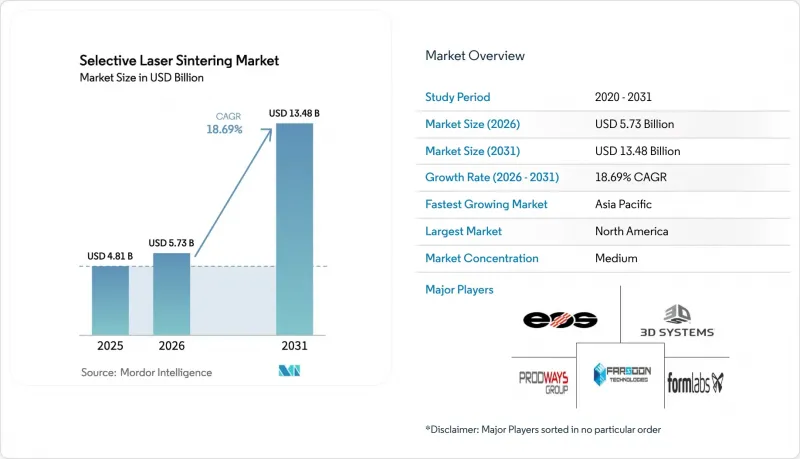
본 보고서는 소재(금속, 플라스틱, 복합재료·첨단 폴리머, 생체재료), 구성 요소(하드웨어, 소프트웨어, 서비스), 최종 사용자 산업(자동차, 항공우주 및 방위, 헬스케어,전자기기, 기타), 프린터 유형(분말 베드 폴리머 SLS, 금속 SLS/DMLS, 기타), 지역별로 분류되어 있습니다. 시장 예측은 금액(달러) 기준으로 제시되어 있습니다.
전 세계 선택적 레이저 소결(SLS) 시장 동향 및 인사이트
디지털화에 따른 예비 부품 창고로의 전환 가속화
각 제조업체는 판매 부진한 재고를 클라우드 라이브러리에 저장된 암호화된 CAD 파일로 대체하고, 고장이 발생한 후에만 부품을 프린팅하고 있습니다. ABB는 이 전략을 통해 터보차저의 리드 타임을 9주에서 1주로 단축하고, 가동 중단으로 인한 손실을 줄였습니다. SLS는 50개 이하의 생산량에서는 결코 투자 비용을 회수할 수 없는 고가의 금형이 필요하지 않기 때문에 생산 대수가 적은 항공우주 및 철도용 부품이 가장 큰 혜택을 보고 있습니다. 안전에 중대한 결함에 대해 파일 관리자와 프린팅 작업자 중 누가 책임을 질지에 대해서는 규제 당국이 판단을 내릴 때까지 책임 소재가 미해결 상태이지만, 보험사들은 검증된 빌드 로그와 연계된 보상을 시범적으로 제공하고 있으며, 보험 수리학적 벤치마크가 성숙해지면 도입이 가속화될 가능성이 있습니다.
EV용 경량 부품 분야에서 SLS 기술의 주류화
전기차(EV) OEM 각사는 열효율을 향상시키면서 질량을 20-30% 절감하는 PA12-CF 재질의 브래킷이나 컨포멀 쿨링 방식의 하우징 채택을 점점 더 많이 지정하고 있습니다. SLS는 금형이 필요 없고 72시간 이내에 검증된 부품을 납품할 수 있으므로, 과거 6-9개월이 소요되던 설계 주기를 대폭 단축합니다. 부품당 경제성 측면에서는 5,000개 단위를 초과하는 경우 여전히 사출 성형이 유리하지만, EV 부문에서 플랫폼이 증가함에 따라 SKU당 연간 생산량은 감소 추세를 보이고 있어 SLS의 대상 시장은 확대되고 있습니다. 배터리 팩의 재설계 주기는 현재 평균 18개월이며, 주기마다 새로운 금형을 준비할 필요가 없다는 점은 SLS의 가치 제안을 더욱 높여줍니다.
1회 빌드 사이클당 높은 에너지 소비량
폴리머 SLS 플랫폼은 12시간 가동 시 60-70kWh의 전력을 소비하며, 이는 동등한 생산량을 성형하는 사출 성형에 필요한 에너지의 3배에 해당합니다. kWh당 0.22유로를 지불하는 유럽의 사업자들은 비수기 가동 일정이나 태양광 발전 설비와의 병설을 통해 이러한 위험을 완화하고 있습니다. 금속 DMLS 장비는 아르곤 가스 주입 및 응력 제거로 추가에 따른 부담이 증가하여, 항공우주 부문 이외의 용도에서는 손익분기점 생산 대수가 500대 이상으로 밀려나고 있습니다. EU 그린딜에 따른 에너지세가 확대될 경우, 지역 간 운영 비용 격차가 확대되어 대량 생산 프로젝트의 대서양 횡단 이전이 촉진될 가능성이 있습니다.
부문별 분석
2025년, 항공우주 규격에 부합하는 티타늄 및 인코넬 부품이 시제품에서 실용기용 하드웨어로 전환됨에 따라, 금속 부문은 선택적 레이저 소결(SLS) 시장에서 45.71%의 점유율을 유지했습니다. 한편, 생체 재료는 단위당 2,000-5,000달러의 가격대에서 유리한 환급 체계에 힘입은 흡수성 두개골 및 척추 임플란트 수요에 힘입어 연평균 성장률(CAGR) 19.43%로 다른 모든 부문을 능가하는 성장을 보일 것으로 전망됩니다. 병원의 조달 파이프라인이 현재 속도로 지속된다면, 생체 재료용 선택적 레이저 소결(SLS) 시장은 2031년까지 10억 달러를 돌파할 전망입니다.
플라스틱, 주로 PA12와 PA11은 분말 비용이 60달러/kg 미만이며, 50%의 재활용 함유율에서도 가공 안전성이 확보되어 있기 때문에 기능성 프로토타이핑 부문에서 여전히 주류를 차지하고 있습니다. 탄소섬유로 보강된 복합 나일론은 드론 프레임 용도로 진출하고 있으며, 알루미늄과 동등한 강성을 가지면서도 밀도는 40% 더 낮습니다. 한편, 바인더젯 방식의 금속 프린터는 범용 제품 부문에서 금속 SLS에 위협이 되고 있지만, 밀도 99.5% 이상이나 피로 수명이 중시되는 부문에서는 SLS가 여전히 우위를 점하고 있습니다.
하드웨어는 2025년 매출의 73.27%를 차지했으나, 프린터의 평균 판매 가격(ASP) 하락과 2만 달러 이하의 데스크톱용 보급형 모델의 등장으로 인해 이 부문은 압박을 받고 있습니다. 기업들이 분말 물류, ISO-13485 준수 문서화, 증기 평활화 작업을 외부에 위탁함에 따라, 서비스와 관련된 선택적 레이저 소결(SLS) 시장 규모는 급속히 확대될 것으로 예측됩니다. 서비스 부문은 이미 26.73%의 점유율을 차지하고 있으며, 하드웨어의 평균 판매 가격(ASP) 하락이 가속화되는 한편, 연간 약 1%씩 점유율을 확대해 나갈 전망입니다.
소프트웨어 부문은 금액 기준으로는 뒤처지고 있지만, 가치의 기반이 되고 있습니다. 스크랩을 줄여주는 AI 구독 번들은 15-25%의 이익률 변동을 가져오며, 연간 5,000-2만 달러의 라이선스 비용을 정당화하고 있습니다. 산업용 OEM 기업들은 현재 슬라이서, 원격 모니터링, 예측 유지보수를 묶어 제공하고, 사용자를 생태계에 정착시킴으로써 데스크톱 시장으로의 진출을 완화하고 있습니다.
지역별 분석
북미는 2025년 시장 규모의 36.34%를 차지하고 있으며, 시애틀이나 로스앤젤레스와 같은 항공우주 산업 거점에 2,000대 이상 도입된 산업용 프린터가 주도적인 역할을 하고 있습니다. 매사추세츠주의 한 병원에서는 FDA 승인을 받은 시스템을 도입하여 48-72시간 이내에 수술용 가이드를 인쇄함으로써 수술 전 계획 주기를 2주 단축하고 있습니다. 숙련된 인력 부족이 심각해지고 있으며, 채용 공고가 평균 60일 동안 공석 상태로 지속됨에 따라 분말 처리 및 CT 스캔 분야의 자동화에 대한 투자가 촉진되고 있습니다. 캐나다의 비즈니스 제트기 프로그램과 멕시코의 자동차용 지그 라인은 수요를 서서히 늘리고 있지만, 규모를 확대하기 위한 충분한 엔지니어링 파이프라인이 부족합니다.
아시아태평양에서는 중국의 200억 위안 규모의 적층 가공 이니셔티브가 생산 공장에 자금을 지원하고, 인도가 운영자 교육에 4,800만 달러를 투입함에 따라 연평균 성장률(CAGR) 19.11%를 나타낼 것으로 예측됩니다. 중국의 각 전기차 제조업체들은 PA12-CF 재질의 브래킷을 활용해 중량을 수 Kg 줄이고 주행 거리를 연장하고 있는 반면, 일본의 병원에서는 MRI 아티팩트를 저감하는 PEEK 재질의 두개골 플레이트 시범 도입이 진행되고 있습니다. 한국의 주요 전자기기 제조업체들은 스마트 워치 케이스용으로 SLS를 평가하고 있으나, 증기 평활화 공정으로 인해 부품 1개당 20-50달러의 비용이 추가되어 비용 절감 효과를 상쇄할 가능성이 있습니다.
바덴뷔르템베르크주에 위치한 유럽 자동차 산업 클러스터에서는 유엔 유럽경제위원회(UN ECE) R100의 가연성 기준을 충족하는 유리섬유 강화 PA12 재질의 매니폴드가 지정되어 있습니다. 영국에서는 터빈 블레이드용 티타늄 DMLS 생산 능력을 유지하고 있으나, 브렉시트 이후 분말 수입 관세로 인해 재료비가 8-12% 상승할 전망입니다. 프랑스의 DRG 코드에서는 3D 프린팅된 척추 케이지에 대한 보험 급여가 이미 인정되고 있으며, 리옹의 의료 기관이 자체 프린팅 도입을 추진하고 있습니다. 중동의 석유 생산 기업과 호주의 광산 회사에서는 시범 프로그램을 실시하고 있으나, 주변 온도가 높다는 문제로 인해 도입 대수는 각각 50대 이하에 그치고 있습니다.
기타 혜택
- 엑셀 형식 시장 예측(ME) 시트
- 3개월간의 애널리스트 지원
자주 묻는 질문
목차
제1장 서론
제2장 조사 방법
제3장 주요 요약
제4장 시장 구도
제5장 시장 규모와 성장 예측
제6장 경쟁 구도
제7장 시장 기회와 향후 전망
JHS 26.09.09According to Mordor Intelligence, the selective laser sintering market size was valued at USD 4.81 billion in 2025 and estimated to grow from USD 5.73 billion in 2026 to reach USD 13.48 billion by 2031, at a CAGR of 18.69% during the forecast period (2026-2031).
This report is Segmented by Material (Metal, Plastics, Composite and Advanced Polymers, and Biomaterials), Component (Hardware, Software, and Services), End-User Industry (Automotive, Aerospace and Defense, Healthcare, Electronics, and More), Printer Type (Powder-Bed Polymer SLS, Metal SLS/DMLS, and More), and Geography. The Market Forecasts are Provided in Terms of Value (USD).
Global Selective Laser Sintering Market Trends and Insights
Digital Spare-Parts Warehousing
Manufacturers are replacing slow-moving stock with encrypted CAD files stored in cloud libraries and printing parts only after failure events. ABB cut turbocharger lead time from nine weeks to one week under this strategy, reducing downtime penalties. Low-runner aerospace and railway components benefit most because SLS removes the need for expensive molds that never amortize at volumes below 50 units. Liability remains unsettled as regulators decide whether file custodians or print operators bear responsibility for safety-critical failures, yet insurers are piloting coverage tied to verified build logs, which could accelerate adoption once actuarial benchmarks mature.
Mainstream Adoption for Lightweight EV Components
Electric-vehicle OEMs increasingly specify PA12-CF brackets and conformal-cooled housings that reduce mass by 20-30% while improving thermal efficiency. SLS eliminates tooling and delivers validated parts within 72 hours, truncating design cycles that once spanned six to nine months. Although per-part economics still favor injection molding above 5 000 units, platform proliferation in the EV sector is driving lower annual volumes per SKU, broadening SLS's addressable market. Battery-pack redesign frequency now averages 18 months; avoiding new tooling each cycle amplifies the value proposition.
High Energy Consumption per Build Cycle
Polymer SLS platforms draw 60-70 kWh over a 12-hour run, triple the energy required for comparable injection-molded volumes. European operators paying EUR 0.22/kWh mitigate exposure with off-peak scheduling or colocating alongside solar arrays. Metal DMLS machines intensify the burden by adding argon floods and stress-relief furnaces, pushing breakeven volumes above 500 units in non-aerospace applications. Energy taxes under the EU Green Deal, if expanded, could widen regional operating-cost gaps and encourage trans-Atlantic relocation of large-volume projects.
Other drivers and restraints analyzed in the detailed report include:
- AI-Driven Process Monitoring
- Expansion of Medical-Grade Polymer Powders
- Skilled Operator Shortage in Emerging Economies
For complete list of drivers and restraints, kindly check the Table Of Contents.
Segment Analysis
Metal retained 45.71 of % selective laser sintering market share in 2025 as aerospace-qualified titanium and Inconel parts transitioned from prototypes to flight hardware. Biomaterials, however, are projected to outpace all peers at a 19.43% CAGR, fueled by demand for resorbable cranial and spinal implants that command USD 2,000-5,000 per unit and ride favorable reimbursement frameworks. The selective laser sintering market for biomaterials is set to surpass USD 1 billion before 2031 if hospital procurement pipelines continue at current rates.
Plastics, chiefly PA12 and PA11, still dominate functional prototyping because powder costs stay below USD 60/kg and 50% recycled content remains process-safe. Composite nylons reinforced with carbon fibers are moving into drone frames, providing aluminum-like stiffness at 40% lower density. Meanwhile, binder-jet metal lines threaten metal SLS in commodity brackets, but SLS preserves an edge where >99.5% density and fatigue life matter.
Hardware contributed 73.27% of 2025 sales, but declining printer ASPs and desktop entry models under USD 20 000 pressure the segment. The selective laser sintering market size associated with services is forecast to jump as enterprises outsource powder logistics, ISO-13485 documentation, and vapor smoothing. Services already capture 26.73% share and will gain roughly one percentage point annually, whereas hardware ASP erosion accelerates.
Software lags in dollar terms yet underpins value; AI-subscription bundles that trim scrap unlock 15-25% margin swings and justify USD 5,000-20,000 annual licenses. Industrial OEMs now bundle slicers, remote monitoring, and predictive maintenance to lock users into ecosystems, blunting desktop cannibalization.
Complete Report Scope:
- By Material
- Metal
- Plastics
- Composite and Advanced Polymers
- Biomaterials
- By Component
- Hardware
- Software
- Services
- By End-User Industry
- Automotive
- Aerospace and Defense
- Healthcare
- Electronics
- Energy and Industrial Equipment
- Education and Research
- By Printer Type
- Powder-Bed Polymer SLS
- Metal SLS / DMLS
- High-Speed Sintering
- Hybrid SLS Systems
- By Geography
- North America
- United States
- Canada
- Mexico
- South America
- Brazil
- Argentina
- Rest of South America
- Europe
- Germany
- United Kingdom
- France
- Italy
- Spain
- Rest of Europe
- Asia-Pacific
- China
- India
- Japan
- South Korea
- Australia and New Zealand
- Rest of Asia-Pacific
- Middle East
- Saudi Arabia
- United Arab Emirates
- Turkey
- Rest of Middle East
- Africa
- South Africa
- Nigeria
- Egypt
- Rest of Africa
- North America
Geography Analysis
North America represented 36.34% of 2025 value, anchored by over 2 000 installed industrial printers in aerospace hubs of Seattle and Los Angeles. Hospitals in Massachusetts run FDA-cleared systems that print surgical guides within 48-72 hours, trimming pre-operative planning cycles by two weeks. Skilled-labor deficits intensify as vacancies linger for 60 days on average, driving automation investments in powder handling and CT scanning. Canada's business-jet programs and Mexico's automotive jig lines add incremental volumes but lack sufficient engineering pipelines to scale.
Asia-Pacific is forecast to post a 19.11% CAGR as China's CNY 20 billion additive-manufacturing initiative funds production plants, and India dedicates USD 48 million toward operator training. Chinese EV OEMs exploit PA12-CF brackets to shave kilograms and extend range, while Japan's hospitals trial PEEK cranial plates that reduce MRI artifacts. South Korean electronics majors evaluate SLS for smartwatch shells, although vapor-smooth steps add USD 20-50 per part and can offset cost gains.
Europe's automotive corridor in Baden-Wurttemberg specifies glass-filled PA12 manifolds that meet UN ECE R100 flammability rules. The United Kingdom maintains titanium DMLS capacity for turbine blades but faces 8-12% material-cost hikes after powder-import tariffs post-Brexit. France's DRG codes already reimburse 3D-printed spinal cages, spurring Lyon clinics to internalize printing. Middle Eastern oil producers and Australian miners run pilot programs, yet installed bases remain below 50 machines each due to high ambient-temperature challenges.
- 3D Systems Inc.
- EOS GmbH Electro Optical Systems
- Farsoon Technologies
- Prodways Group
- Formlabs Inc.
- Ricoh Company Ltd.
- Concept Laser GmbH (General Electric)
- Renishaw PLC
- Sinterit Sp. z o.o.
- Sintratec AG
- Sharebot S.r.l.
- Red Rock SLS
- HP Inc.
- Stratasys Ltd.
- SLM Solutions Group AG
- GE Additive
- Velo3D Inc.
- Desktop Metal Inc.
- Xact Metal
- Natural Robotics
- Z Rapid Tech
- Aerosint
- Eplus3D
- XYZ Printing Inc.
Additional Benefits:
- The market estimate (ME) sheet in Excel format
- 3 months of analyst support
TABLE OF CONTENTS
1 INTRODUCTION
- 1.1 Study Assumptions and Market Definition
- 1.2 Scope of the Study
2 RESEARCH METHODOLOGY
3 EXECUTIVE SUMMARY
4 MARKET LANDSCAPE
- 4.1 Market Overview
- 4.2 Market Drivers
- 4.2.1 Accelerating Shift Toward Digital Spare-Parts Warehousing
- 4.2.2 Mainstream Adoption of SLS for Lightweight EV Components
- 4.2.3 Government Grants Fueling Additive Manufacturing R&D
- 4.2.4 Integration of AI-Driven Process Monitoring in SLS Printers
- 4.2.5 Expansion of Medical-Grade Polymer Powders Portfolio
- 4.2.6 Near-Net-Shape Production Reducing Material Waste
- 4.3 Market Restraints
- 4.3.1 High Energy Consumption per Build Cycle
- 4.3.2 Skilled Operator Shortage in Emerging Economies
- 4.3.3 Powder Supply Chain Volatility Amid Trade Tariffs
- 4.3.4 Surface-Finish Limitations Requiring Costly Post-Processing
- 4.4 Industry Value-Chain Analysis
- 4.5 Regulatory Landscape
- 4.6 Technological Outlook
- 4.7 Porter's Five Forces Analysis
- 4.7.1 Bargaining Power of Buyers
- 4.7.2 Bargaining Power of Suppliers
- 4.7.3 Threat of New Entrants
- 4.7.4 Threat of Substitutes
- 4.7.5 Competitive Rivalry
5 MARKET SIZE AND GROWTH FORECASTS (VALUE)
- 5.1 By Material
- 5.1.1 Metal
- 5.1.2 Plastics
- 5.1.3 Composite and Advanced Polymers
- 5.1.4 Biomaterials
- 5.2 By Component
- 5.2.1 Hardware
- 5.2.2 Software
- 5.2.3 Services
- 5.3 By End-User Industry
- 5.3.1 Automotive
- 5.3.2 Aerospace and Defense
- 5.3.3 Healthcare
- 5.3.4 Electronics
- 5.3.5 Energy and Industrial Equipment
- 5.3.6 Education and Research
- 5.4 By Printer Type
- 5.4.1 Powder-Bed Polymer SLS
- 5.4.2 Metal SLS / DMLS
- 5.4.3 High-Speed Sintering
- 5.4.4 Hybrid SLS Systems
- 5.5 By Geography
- 5.5.1 North America
- 5.5.1.1 United States
- 5.5.1.2 Canada
- 5.5.1.3 Mexico
- 5.5.2 South America
- 5.5.2.1 Brazil
- 5.5.2.2 Argentina
- 5.5.2.3 Rest of South America
- 5.5.3 Europe
- 5.5.3.1 Germany
- 5.5.3.2 United Kingdom
- 5.5.3.3 France
- 5.5.3.4 Italy
- 5.5.3.5 Spain
- 5.5.3.6 Rest of Europe
- 5.5.4 Asia-Pacific
- 5.5.4.1 China
- 5.5.4.2 India
- 5.5.4.3 Japan
- 5.5.4.4 South Korea
- 5.5.4.5 Australia and New Zealand
- 5.5.4.6 Rest of Asia-Pacific
- 5.5.5 Middle East
- 5.5.5.1 Saudi Arabia
- 5.5.5.2 United Arab Emirates
- 5.5.5.3 Turkey
- 5.5.5.4 Rest of Middle East
- 5.5.6 Africa
- 5.5.6.1 South Africa
- 5.5.6.2 Nigeria
- 5.5.6.3 Egypt
- 5.5.6.4 Rest of Africa
- 5.5.1 North America
6 COMPETITIVE LANDSCAPE
- 6.1 Market Concentration
- 6.2 Strategic Moves
- 6.3 Market Share Analysis
- 6.4 Company Profiles (includes Global Level Overview, Market Level Overview, Core Segments, Financials as available, Strategic Information, Market Rank/Share, Products and Services, Recent Developments)
- 6.4.1 3D Systems Inc.
- 6.4.2 EOS GmbH Electro Optical Systems
- 6.4.3 Farsoon Technologies
- 6.4.4 Prodways Group
- 6.4.5 Formlabs Inc.
- 6.4.6 Ricoh Company Ltd.
- 6.4.7 Concept Laser GmbH (General Electric)
- 6.4.8 Renishaw PLC
- 6.4.9 Sinterit Sp. z o.o.
- 6.4.10 Sintratec AG
- 6.4.11 Sharebot S.r.l.
- 6.4.12 Red Rock SLS
- 6.4.13 HP Inc.
- 6.4.14 Stratasys Ltd.
- 6.4.15 SLM Solutions Group AG
- 6.4.16 GE Additive
- 6.4.17 Velo3D Inc.
- 6.4.18 Desktop Metal Inc.
- 6.4.19 Xact Metal
- 6.4.20 Natural Robotics
- 6.4.21 Z Rapid Tech
- 6.4.22 Aerosint
- 6.4.23 Eplus3D
- 6.4.24 XYZ Printing Inc.
7 MARKET OPPORTUNITIES AND FUTURE OUTLOOK
- 7.1 White-Space and Unmet-Need Assessment