

|
시장보고서
상품코드
2123006
항바이러스 치료제 시장 : 시장 점유율 분석, 업계 동향 및 통계, 성장 예측(2026-2031년)Anti-Viral Therapeutics - Market Share Analysis, Industry Trends & Statistics, Growth Forecasts (2026 - 2031) |
||||||
 Mordor Intelligence
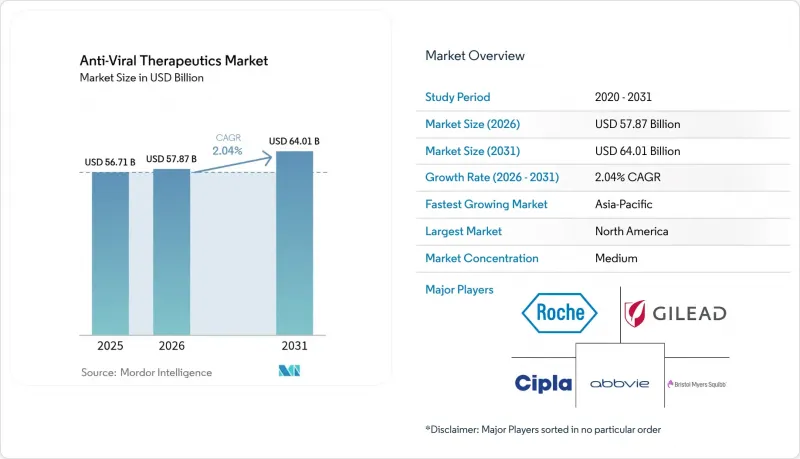
Mordor Intelligence에 의하면, 2026년 항바이러스 치료제 시장 규모는 578억 7,000만 달러로 추정되고, 2025년 567억 1,000만 달러에서 확대해, 2031년에는 640억 1,000만 달러에 이를 것으로 예측됩니다.
2026-2031년 연평균 성장률(CAGR)은 2.04%가 될 것으로 전망됩니다.
본 보고서는 바이러스 유형별(HIV·에이즈, B형 간염, C형 간염 등), 약물 분류별(역전사효소 억제제, 프로테아제 억제제, 중합효소/뉴클레오시드 아날로그 억제제 등), 투여 경로별(경구, 주사제 등), 지역별(북미, 유럽 등)로 세분화되어 있습니다. 시장 예측은 금액(달러)으로 제시되어 있습니다.
세계의 항바이러스 치료제 시장 동향 및 인사이트
확대되는 지속형 주사제 파이프라인
연 2회 투여하는 레나카파비르는 2025년 항바이러스 치료제 시장에 진입하여, 자원이 부족한 환경에서 주요 장벽인 내원 횟수를 줄임으로써 복약 순응도에 대한 기대를 즉시 재정의했습니다. 독자적인 나노 결정 캐리어를 통해 약물 농도가 최대 6개월 동안 유지되어 바이러스 억제 지속성이 향상될 뿐만 아니라 모니터링 비용도 절감됩니다. 이러한 실적을 바탕으로, 머크사의월1회 투여 경구약 MK-8527은 서방형 캡슐이 편의성 측면에서 주사제와 어깨를 나란히 하는 새로운 흐름의 도래를 시사하고 있습니다. 과부하 상태인 진료소가 매일 복용 프로그램을 방해하는 지역에서는 의료 시스템의 대응 능력 향상이 가장 중요합니다. 복용 누락이 줄어들면 이후 치료 비용 절감으로 이어지기 때문에 보험사들도 이러한 투여 방식을 점점 더 지지하고 있습니다. 제조 기술이 성숙해짐에 따라 매일 복용하는 경구용 약물과 동등한 가격 책정이 예상되며, 현재 판매량의 기반을 이루고 있는 얼리 어답터 시장을 넘어 전 세계적인 보급이 가속화될 것으로 전망됩니다.
HIV 병용 요법의 급격한 확산
임상 현장에서는 3제 기본 요법에서 누적 독성을 억제하면서 바이러스 양을 검출 한계 이하로 유지할 수 있는 2제 병용 요법이나 장시간 작용형 약제의 조합으로 전환되고 있습니다. 레나카파비르와 이슬라트라비르를 조합한 복합제는 내성에 대한 다중 기전 커버리지를 확보하는 것을 목표로 하고 있으며, GSK-ViiV의 VH499/VH184 프로그램도 새로운 표적 영역에서 유사한 전략을 반영하고 있습니다. 규제 당국은 복약 순응도 향상을 통해 공중보건상의 이점이 발생한다는 점을 고려하여, 이러한 고정 용량 복합제를 우선 심사 대상으로 지정하고 있습니다. 구형 프로테아제 억제제의 제네릭 의약품에 의한 시장 잠식을 겪고 있는 기존 제약 기업들에게 차세대 복합제는 견실한 이익률을 확보하고 브랜드 제품의 수명 주기를 연장해 줍니다. 항바이러스 치료 시장은 환자 1인당 가치 향상이라는 혜택을 누리는 한편, 환자의 경우 노화에 따른 합병증을 앓고 있더라도 복용해야 하는 알약의 수가 줄어들고 약물 상호작용의 위험이 감소합니다.
AI를 활용한 뉴클레오시드(티드) 아날로그 설계
바이러스 폴리머라제의 구조를 기반으로 학습된 머신러닝 모델은 인실리코(in silico)에서 결합 친화도 및 대사적 위험을 예측함으로써, 아날로그 화합물의 최적화에 소요되는 시간을 수년 단축하고 있습니다. Exscientia사의 파이프라인은 AI 주도적 반복 과정을 통해 코로나바이러스, 인플루엔자, 파라믹소바이러스 각 계열에 걸쳐 효능을 유지하는 화합물을 특정함으로써, 광범위한 스펙트럼 커버리지 실현을 뒷받침할 수 있음을 보여주고 있습니다. 알고리즘을 통한 내성 예측은 병용 요법의 설계를 이끌어내며, 조기 교차 내성이 발생할 가능성을 줄여줍니다. 그 결과, 규제 당국과 보험사 양측을 모두 설득할 수 있는 풍부한 데이터를 갖춘 신청 자료가 작성됩니다. 초기 계산 비용은 높지만, 개발 주기 단축과 임상시험 중 탈락률 감소를 통해 그 비용이 충분히 상쇄되어 항바이러스 치료제 업계 전체의 연구개발 수익률(ROI)을 향상시킵니다.
부문 분석
인플루엔자용 항바이러스제는 2025년에 259억 7,000만 달러의 매출을 기록한 것으로 평가되었으며, 이는 항바이러스 치료제 시장 규모의 45.78%에 해당하여, 확고한 계절적 수요와 임상 현장에서의 높은 인지도를 뒷받침합니다. 폴리메라제 산성(PA) 및 폴리메라제 염기성(PB2) 억제제를 위한 파이프라인의 꾸준한 진전은 치료 선택의 폭을 넓히고, 뉴라미니다제 내성에 대한 대책이 될 가능성이 있습니다. 한편, COVID-19/SARS-CoV-2 치료제는 팬데믹이라는 비상사태를 계기로 개발되었으나, 특히 면역결핍 환자층에서 노출 후 예방이 지지를 얻음에 따라 2031년까지의 연평균 성장률(CAGR)은 3.78%로 성장을 지속하고, 있습니다. B형 및 C형 간염의 성숙한 부문은 완치 또는 기능적 완치를 가져오는 치료법으로 인해 치료 기간이 단축되면서 정체 상태를 보이고 있지만, 아시아와 아프리카의 질병 부담을 고려할 때 여전히 큰 시장 규모를 유지하고 있습니다. 헤르페스 치료제는 우수한 병변 제어 효과가 기대되는 마이크로니들 패치와 국소용 젤 제제의 혜택을 받고 있습니다. RSV 및 CMV 프로그램에서는 단일클론 항체와 저분자 융합 억제제가 활용되고 있으며, 소아 적응증이 성장 여지를 제공합니다.
항바이러스 치료제 시장은 단일 병원체에 대한 전략에서 팬데믹 대비책으로 자리매김하는 숙주 표적형 또는 광범위 스펙트럼 약제로 전환되고 있습니다. 이러한 프로그램은 희석 효과 없이 공공 자금을 확보할 수 있으며, 유행의 정점이 제한적인 시기를 극복할 수 있습니다. CMV 치료제는 여전히 이식 환자와 같은 틈새 시장을 대상으로 하고 있어 높은 가격 책정이 가능하지만, 판매량은 제한적입니다. 향후 경쟁 양상은 급속한 집단 감염에 대한 대응 능력과 바이러스과를 아우르는 효능에 따라 좌우될 것이며, 예측 기간 동안 바이러스 유형별 우위 순위가 재편될 것입니다.
지역별 분석
북미는 2025년 매출의 34.42%를 차지했으며, FDA의 지정 절차 효율화와 고가 항바이러스제의 비용을 상환하는 지급 기관의 풍부한 자금력에 힘입고 있습니다. 미국을 중심으로 한 연구 개발 거점은 ‘퍼스트 인 클래스(First-in-Class)’ 자산을 신속하게 개발하고 있으며, 통합된 전문 약국의 물류 체계를 통해 전국으로의 신속한 유통이 보장되고 있습니다. 그러나 메디케어의 의약품 가격 협상으로 인해 FOB 가격에 압박이 가해짐에 따라, 기업들은 실제 환경에서의 바이러스학적 결과를 중시하는 가치 기반 계약으로 전환하게 될 것입니다.
아시아태평양은 중국, 인도, 동남아시아가 국내 제약 생산 능력과 국민건강보험 제도에 막대한 투자를 하고 있기 때문에 4.06%라는 가장 높은 연평균 성장률(CAGR)을 기록하고 있습니다. 2024년 중국에서 228건의 신약 승인이 이루어진 것은 규제 당국이 유럽 및 미국과 맞먹는 심사 속도를 목표로 하고 있음을 보여주는 것으로, 다국적 기업들을 현지 공동 개발 파트너십으로 끌어들이고 있습니다. 인도는 비용 최적화된 생산 체제를 활용하여 지역 수요에 대응하고 있으며, 일본의 고령화되는 인구 구조는 재활성화 대상포진 및 RSV에 대한 항바이러스제의 지속적인 사용을 뒷받침하고 있습니다. 동시에 콜드체인 체제의 개선으로 생물학적 제제에 대한 접근성이 확대되어, 지역 항바이러스 치료제 시장을 더욱 성장시키고 있습니다.
유럽에서는 시장 규모가 견조하게 유지되고 있지만, 가격 협상은 더욱 치열해지고 있으며, 의료 기술 평가를 활용하여 비용 대비 효과 기준을 엄격하게 적용하고 있습니다. EMA(유럽의약품청)의 중앙 심사 절차는 EU 역내 동시 진출이라는 점에서 여전히 매력적이지만, 브렉시트 이후의 이중 신청으로 인해 절차가 복잡해지고 있습니다. 남유럽 및 동유럽 국가에서는 EU의 헬스케어 재편 기금의 지원을 받아 백신 및 항바이러스제에 대한 인지도가 높아짐에 따라 판매량이 더욱 증가할 것으로 예측됩니다. 전반적으로 지리적 분산은 수익 위험을 분산시키지만, 규정 준수 비용도 증가시키기 때문에 세계 규제 대응 능력은 이 분야의 선도 기업들에게 핵심적인 경쟁력이 됩니다.
기타 혜택 :
- 엑셀 형식 시장 예측(ME) 시트
- 3개월간의 애널리스트 지원
자주 묻는 질문
목차
제1장 서론
제2장 조사 방법
제3장 주요 요약
제4장 시장 구도
제5장 시장 규모 및 성장 예측
제6장 경쟁 구도
제7장 시장 기회 및 향후 전망
AJY 26.09.07According to Mordor Intelligence, the anti-Viral therapeutics market size in 2026 is estimated at USD 57.87 billion, growing from 2025 value of USD 56.71 billion with 2031 projections showing USD 64.01 billion, growing at 2.04% CAGR over 2026-2031.
This report is Segmented by Virus Type (HIV & AIDS, Hepatitis B, Hepatitis C, and More), Drug Class (Reverse Transcriptase Inhibitors, Protease Inhibitors, Polymerase/Nucleoside Analog Inhibitors, and More), Route of Administration (Oral, Injectable, and More), and Geography (North America, Europe, and More). The Market Forecasts are Provided in Terms of Value (USD).
Global Anti-Viral Therapeutics Market Trends and Insights
Expanding Long-Acting Injectable Pipelines
Twice-yearly lenacapavir entered the Anti-Viral Therapeutics market in 2025 and immediately reframed adherence expectations by reducing clinic visits, a key barrier in low-resource settings. Proprietary nanocrystal carriers maintain drug levels for up to six months, improving viral suppression persistence and cutting monitoring costs. Building on this proof point, Merck's once-monthly oral MK-8527 flags a next wave where modified-release capsules rival injectables for convenience. Health-system capacity gains matter most in regions where over-burdened clinics hinder daily pill programs. Payers increasingly favor these regimens because fewer missed doses translate to lower progression-of-care costs. As manufacturing matures, pricing parity with daily orals is anticipated, accelerating global uptake beyond the early adopter markets that currently anchor volumes.
Surge in HIV Combination-Therapy Adoption
Clinical practice is pivoting from three-drug backbones toward dual or long-acting pairings that limit cumulative toxicity while sustaining undetectable viral loads . Co-formulations such as lenacapavir plus islatravir seek to lock in multi-mechanism coverage against resistance, and GSK-ViiV's VH499/VH184 program echoes the same strategy in a novel target space. Regulators are rewarding these fixed-dose combinations with priority reviews because the adherence upside generates downstream public-health benefits. For pharmaceutical incumbents that face generic erosion on older protease inhibitors, next-generation combos deliver a defendable margin and extend brand lifecycles. The Anti-Viral Therapeutics market benefits from higher per-patient values, while patients see fewer pills and reduced drug-drug interaction risk as they age with comorbidities.
AI-Enabled Nucleos(t)ide Analog Design
Machine-learning models trained on viral polymerase structures are cutting years from analog optimization by predicting binding affinity and metabolic liabilities in silico. Exscientia's pipeline showcases how AI-directed iterations can identify compounds that retain potency across coronavirus, influenza, and paramyxovirus families, supporting the push for broad-spectrum coverage. Algorithmic resistance forecasting guides combination-therapy design, reducing the likelihood of early cross-resistance. The result is a data-rich dossier that impresses regulators and payers alike. Although upfront computational investment is high, cycle-time savings and lower clinical attrition more than offset costs, boosting return on R&D across the Anti-Viral Therapeutics industry.
Other drivers and restraints analyzed in the detailed report include:
- COVID-19-Driven Antiviral R&D Spill-Over
- Rising Antiviral-Resistance Mutations
- Price-Control & Reimbursement Headwinds
For complete list of drivers and restraints, kindly check the Table Of Contents.
Segment Analysis
Influenza antivirals delivered USD 25.97 billion in 2025, equal to 45.78% of the Anti-Viral Therapeutics market size, underscoring entrenched seasonal demand and clinical familiarity. Steady pipeline progress toward polymerase acidic (PA) and polymerase basic (PB2) inhibitors broadens therapeutic options and may counter neuraminidase resistance. Meanwhile, COVID-19/SARS-CoV-2 treatments, though originating from pandemic urgency, now post a 3.78% CAGR through 2031 as post-exposure prophylaxis gains favor, especially among immunocompromised cohorts. Mature hepatitis B and C segments plateau because cure or functional-cure regimens shorten treatment durations, yet remain sizeable given disease burden in Asia and Africa. Herpes therapies are benefiting from micro-needle patches and in-situ gel formulations that promise superior lesion control. RSV and CMV programs leverage monoclonal antibodies and small-molecule fusion inhibitors, with pediatric indications offering growth headroom.
The Anti-Viral Therapeutics market shifts from single-pathogen strategies to host-targeted or broad-spectrum agents poised for pandemic readiness. Such programs attract non-dilutive public funding and can bypass narrow epidemiological peaks. CMV assets still address niche transplant populations, leading to premium pricing but limited volumes. Future competitive landscapes will hinge on rapid outbreak response capacity and cross-family efficacy, redrawing the virus-type hierarchy over the forecast horizon.
Complete Report Scope:
- By Virus Type
- HIV & AIDS
- Hepatitis B
- Hepatitis C
- Influenza
- Herpes (HSV)
- Respiratory Syncytial Virus (RSV)
- Cytomegalovirus (CMV)
- Other & Emerging Viruses
- By Drug Class / Mechanism
- Reverse Transcriptase Inhibitors (NRTI/NNRTI)
- Protease Inhibitors
- Polymerase / Nucleoside Analog Inhibitors
- RNAi & Antisense Therapeutics
- Broad-spectrum Small-molecule Antivirals
- Capsid Inhibitors
- Others
- By Route of Administration
- Oral
- Injectable (incl. Long-Acting)
- Topical
- Others
- By Region
- North America
- United States
- Canada
- Mexico
- Europe
- Germany
- United Kingdom
- France
- Italy
- Spain
- Rest of Europe
- Asia-Pacific
- China
- India
- Japan
- South Korea
- Australia
- Rest of Asia-Pacific
- South America
- Brazil
- Argentina
- Rest of South America
- Middle East and Africa
- GCC
- South Africa
- Rest of Middle East and Africa
- North America
Geography Analysis
North America represented 34.42% of 2025 sales, buoyed by the FDA's streamlined designations and deep payer wallets that reimburse premium antivirals. US-centric R&D hubs fast-track first-in-class assets, and integrated specialty-pharmacy logistics ensure prompt nationwide distribution. However, Medicare's drug-price negotiations are set to pressure free-on-board prices, nudging firms toward value-based contracts that hinge on real-world virologic outcomes.
Asia-Pacific posts the fastest 4.06% CAGR as China, India, and Southeast Asia invest heavily in domestic pharmaceutical capacity and universal insurance schemes. China's 2024 tally of 228 novel drug approvals signals regulator intent to match Western review speeds, drawing multinationals into local co-development partnerships. India leverages cost-optimized production to supply regional demand, and Japanese aging demographics support sustained antivirals usage for reactivated herpes zoster and RSV. Simultaneously, improving cold-chain frameworks unlock broader biologics access, further expanding the regional Anti-Viral Therapeutics market.
Europe maintains steady value but negotiates harder on price, using health technology assessments to enforce cost-effectiveness thresholds. EMA's centralized procedure remains attractive for simultaneous bloc entry, yet post-Brexit dual filings add complexity. Southern and Eastern European nations, supported by EU healthcare restructuring funds, offer incremental volume upside as vaccine and antiviral awareness climbs. Collectively, geographic diversification spreads revenue risk but raises compliance costs, making global regulatory mastery a core competence for sector leaders.
- Gilead Sciences
- GlaxoSmithKline
- Merck
- Roche
- Abbvie
- Johnson & Johnson
- Bristol-Myers Squibb
- Pfizer
- Novartis
- AstraZeneca
- Cipla
- Dr. Reddy's Laboratories
- Aurobindo Pharma Ltd.
- Lupin
- Sun Pharmaceutical Inds.
- Shionogi & Co., Ltd.
- Takeda Pharmaceutical Co.
- Vir Biotechnology, Inc.
- Regeneron Pharmaceuticals
- Eli Lilly and Company
Additional Benefits:
- The market estimate (ME) sheet in Excel format
- 3 months of analyst support
TABLE OF CONTENTS
1 Introduction
- 1.1 Study Assumptions & Market Definition
- 1.2 Scope of the Study
2 Research Methodology
3 Executive Summary
4 Market Landscape
- 4.1 Market Overview
- 4.2 Market Drivers
- 4.2.1 Expanding long-acting injectable pipelines
- 4.2.2 Surge in HIV combination-therapy adoption
- 4.2.3 COVID-19-driven antiviral R&D spill-over
- 4.2.4 AI-enabled nucleos(t)ide analog design
- 4.2.5 Public-sector funding for broad-spectrum agents
- 4.2.6 mRNA platforms pivoting to antivirals
- 4.3 Market Restraints
- 4.3.1 Rising antiviral-resistance mutations
- 4.3.2 Price-control & reimbursement headwinds
- 4.3.3 Biosafety-grade manufacturing bottlenecks
- 4.3.4 Cold-chain gaps in low-income regions
- 4.4 Value / Supply-Chain Analysis
- 4.5 Regulatory Landscape
- 4.6 Technological Outlook
- 4.7 Porter's Five Forces
- 4.7.1 Bargaining Power of Buyers
- 4.7.2 Bargaining Power of Suppliers
- 4.7.3 Threat of New Entrants
- 4.7.4 Threat of Substitutes
- 4.7.5 Industry Rivalry
5 Market Size & Growth Forecasts (Value, USD)
- 5.1 By Virus Type
- 5.1.1 HIV & AIDS
- 5.1.2 Hepatitis B
- 5.1.3 Hepatitis C
- 5.1.4 Influenza
- 5.1.5 Herpes (HSV)
- 5.1.6 Respiratory Syncytial Virus (RSV)
- 5.1.7 Cytomegalovirus (CMV)
- 5.1.8 Other & Emerging Viruses
- 5.2 By Drug Class / Mechanism
- 5.2.1 Reverse Transcriptase Inhibitors (NRTI/NNRTI)
- 5.2.2 Protease Inhibitors
- 5.2.3 Polymerase / Nucleoside Analog Inhibitors
- 5.2.4 RNAi & Antisense Therapeutics
- 5.2.5 Broad-spectrum Small-molecule Antivirals
- 5.2.6 Capsid Inhibitors
- 5.2.7 Others
- 5.3 By Route of Administration
- 5.3.1 Oral
- 5.3.2 Injectable (incl. Long-Acting)
- 5.3.3 Topical
- 5.3.4 Others
- 5.4 By Region
- 5.4.1 North America
- 5.4.1.1 United States
- 5.4.1.2 Canada
- 5.4.1.3 Mexico
- 5.4.2 Europe
- 5.4.2.1 Germany
- 5.4.2.2 United Kingdom
- 5.4.2.3 France
- 5.4.2.4 Italy
- 5.4.2.5 Spain
- 5.4.2.6 Rest of Europe
- 5.4.3 Asia-Pacific
- 5.4.3.1 China
- 5.4.3.2 India
- 5.4.3.3 Japan
- 5.4.3.4 South Korea
- 5.4.3.5 Australia
- 5.4.3.6 Rest of Asia-Pacific
- 5.4.4 South America
- 5.4.4.1 Brazil
- 5.4.4.2 Argentina
- 5.4.4.3 Rest of South America
- 5.4.5 Middle East and Africa
- 5.4.5.1 GCC
- 5.4.5.2 South Africa
- 5.4.5.3 Rest of Middle East and Africa
- 5.4.1 North America
6 Competitive Landscape
- 6.1 Market Concentration
- 6.2 Market Share Analysis
- 6.3 Company Profiles (includes Global level Overview, Market level overview, Core Segments, Financials as available, Strategic Information, Market Rank/Share for key companies, Products & Services, and Recent Developments)
- 6.3.1 Gilead Sciences Inc.
- 6.3.2 GlaxoSmithKline plc (ViiV Healthcare)
- 6.3.3 Merck & Co., Inc.
- 6.3.4 F. Hoffmann-La Roche AG
- 6.3.5 AbbVie Inc.
- 6.3.6 Johnson & Johnson (Janssen)
- 6.3.7 Bristol Myers Squibb Co.
- 6.3.8 Pfizer Inc.
- 6.3.9 Novartis AG
- 6.3.10 AstraZeneca plc
- 6.3.11 Cipla Ltd.
- 6.3.12 Dr. Reddy's Laboratories
- 6.3.13 Aurobindo Pharma Ltd.
- 6.3.14 Lupin Ltd.
- 6.3.15 Sun Pharmaceutical Inds.
- 6.3.16 Shionogi & Co., Ltd.
- 6.3.17 Takeda Pharmaceutical Co.
- 6.3.18 Vir Biotechnology, Inc.
- 6.3.19 Regeneron Pharmaceuticals
- 6.3.20 Eli Lilly and Company
7 Market Opportunities & Future Outlook
- 7.1 White-space & Unmet-need Assessment


