
|
시장보고서
상품코드
2123010
무선 네트워크 보안 시장 : 점유율 분석, 업계 동향과 통계, 성장 예측(2026-2031년)Wireless Network Security - Market Share Analysis, Industry Trends & Statistics, Growth Forecasts (2026 - 2031) |
||||||
 Mordor Intelligence
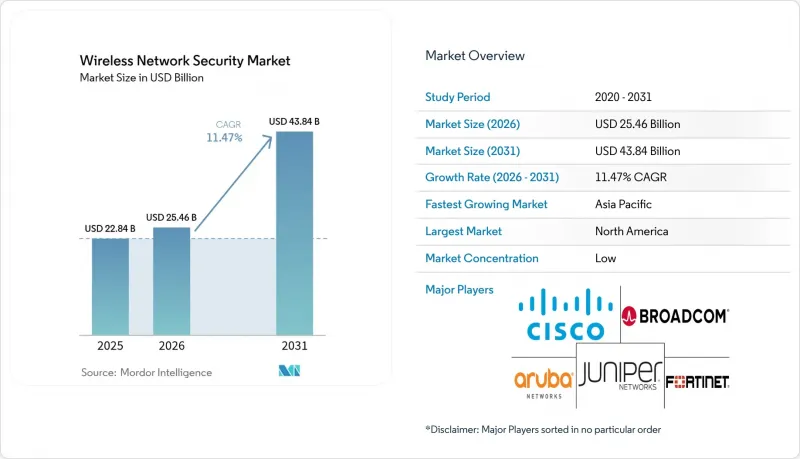
Mordor Intelligence에 의하면, 무선 네트워크 보안 시장 규모는 2025년에 228억 4,000만 달러로 평가되었고 2026년 254억 6,000만 달러에서 2031년까지 438억 4,000만 달러에 이를 것으로 예측되며, 예측 기간(2026-2031년) CAGR은 11.47%를 나타낼 전망입니다.
본 보고서는 솔루션별(방화벽, 암호화, 기타), 배포 방식별(On-Premise, 클라우드), 최종 사용자 산업별(은행, 금융서비스 및 보험(BFSI), 헬스케어, 기타), 조직 규모별(대기업, 중소기업), 지역별로 분류되어 있습니다. 시장 예측은 금액(달러) 기준으로 제시되어 있습니다.
세계 무선 네트워크 보안 시장 동향 및 인사이트
Wi-Fi 6E/7 이후 무선 트래픽의 기하급수적인 증가
Wi-Fi 7에서 WPA3 암호화의 의무화, 320MHz 채널, 멀티링크 작동으로 인해 총 처리량이 30Gbps를 초과하여 기존 검사 어플라이언스로는 처리할 수 없는 상황이 되었으며, 기업들은 6GHz 대역에서 실시간 분석이 가능한 보안 하드웨어로 업데이트해야 할 필요성에 직면해 있습니다. 실지 시험에서는 40피트 거리에서 1Gbps의 지속적인 통신 속도가 확인되었습니다(Wi-Fi 6E의 2배). 이에 따라 벤더들은 고속 TLS 오프로드 기능과 하드웨어 가속을 통한 패턴 매칭 기능을 탑재해야 할 필요성이 대두되고 있습니다. 자동 주파수 조정을 통해 2.4GHz, 5GHz, 6GHz 각 대역에서 위협 대응의 일관성을 유지해야 하기 때문에 정책의 복잡성이 증가하고 있습니다. 따라서 조직은 사용자 경험을 유지하면서 계산 부하가 높은 작업을 오프로드할 수 있는 확장 가능하고 클라우드 기반 방화벽에 투자하고 있습니다. 엔지니어들이 확정적인 스케줄링, 멀티링크 스택 구성, 보다 세밀한 QoS(서비스 품질) 적용에 적응해 감에 따라 직원 재교육이 필수적입니다.
클라우드 전환과 모바일 우선 엔터프라이즈 아키텍처
경계의 붕괴로 인해 기업은 액세스 포인트 내에 상태 기반 검사 및 암호화를 직접 통합해야 합니다. 그 대표적인 예가 외부 어플라이언스 없이 인라인 방화벽 기능을 제공하는 HPE의 CX 10040 스위치입니다. 엣지 기반 보안은 백홀 비용과 지연을 줄이고, 장소에 구애받지 않는 액세스를 원하는 직원의 요구를 충족시킵니다. SD-WAN과 WLAN 보안의 융합은 매니지드 서비스의 성장을 가속하고 있습니다. 이는 하이브리드 클라우드 전반에 걸친 정책 오케스트레이션이 사내 팀에게 과제로 대두되고 있기 때문입니다. 그러나 관리자가 On-Premise 무선 장비, 퍼블릭 IaaS, 엣지 컴퓨팅 노드에 걸쳐 있는 규칙 세트를 동기화함에 따라 변경 관리에 드는 오버헤드가 증가하고, AI를 활용한 구성 검증의 필요성이 높아지고 있습니다.
도입 및 통합에 드는 높은 비용
대규모 무선 보안 프로젝트의 경우, 규정 준수를 유지하면서 액세스 포인트 펌웨어, NAC 서버, SIEM 분석을 조율해야 하기 때문에 초기 비용이 1,000만 달러를 초과하는 경우도 있습니다. Advantech의 FWA-6183과 같은 하이엔드 어플라이언스는 192코어를 탑재하고 있어, 멀티 기가비트 검사에 고성능 하드웨어가 필요함을 보여줍니다. 전문 서비스, 연간 유지보수, 직원 역량 강화 비용이 더해지면 총 소유 비용이 크게 증가하므로, 중소기업은 구독형 매니지드 서비스를 선호하는 경향이 있습니다.
부문 분석
2025년, 방화벽 제품은 무선 네트워크 보안 시장 점유율의 34.62%를 차지하며, 기반이 되는 제어 수단으로서의 역할을 재확인했습니다. 그러나 SASE 솔루션은 연평균 성장률(CAGR) 15.93%로 확대될 전망이며, 조직이 게이트웨이, CASB, ZTNA 기능을 통합한 싱글 패스 아키텍처로 전환함에 따라 무선 네트워크 보안 시장의 양상을 완전히 바꿀 것으로 보입니다. Fortinet의 ‘FortiGate 700G’는 처리량이 7배 향상되었으며, 포스트 양자암호화 지원 기능도 갖추고 있어 이러한 변화를 여실히 보여주고 있습니다. 통합 위협 관리(UTM)는 모놀리식 설계가 클라우드 네이티브 스택과 같은 확장성을 갖추지 못해 시장 점유율이 하락하고 있습니다. 암호화 제품군은 규제 요건으로 인해 여전히 중요하게 여겨지고 있지만, 한편으로 ID 기반 세분화은 제로 트러스트 프로그램 하에서 탄력을 받고 있습니다. SASE 도입이 가속화되는 가운데, 각 벤더들은 AI를 활용한 상관 분석 엔진과 체류 시간을 단축하는 엔드투엔드 정책 가시화 기능을 통해 차별화를 꾀하고 있습니다.
기업들이 노후화된 VPN 컨센트레이터를 클라우드를 통해 제공되는 엣지 노드로 교체함에 따라, SASE 플랫폼용 무선 네트워크 보안 시장 규모는 급격히 확대될 것으로 예측됩니다. 2030년까지 Palo Alto Networks의 ‘Prisma SASE 5G’와 같이 SIM 기반 ID를 정책 트리에 통합하는 서비스 제공업체용 솔루션에 힘입어, SASE는 절대 매출액 측면에서 방화벽에 필적하는 존재가 될 전망입니다. 한편, 양자 내성 암호화 및 블록체인 인증을 통한 온보딩은 ‘기타 솔루션’으로 분류되며, 예측 기간 후반에 성숙할 가능성이 있는 초기 단계의 수익원이 되고 있습니다.
2025년 시점에서는 금융 서비스 및 공공 부문 사업자들이 기밀 데이터에 대한 직접적인 관리를 중시함에 따라 On-Premise형 도입이 무선 네트워크 보안 시장 규모의 57.12%를 차지했습니다. 그러나 미국 연방통신위원회(FCC) 등 공공 기관이 2억 달러 규모의 시범 프로그램을 통해 SaaS 보안을 추진함에 따라, 클라우드 기반 솔루션은 연평균 성장률(CAGR) 15.55%의 속도로 확대되고 있습니다. 유연한 용량, 시그니처 자동 업데이트, 종량제 요금제는 자본 지출(CapEx) 감축을 목표로 하는 IT 관리자들로부터 강력한 지지를 얻고 있습니다.
하이브리드 배포 모델은 복잡한 기업 환경에서 주류 설계로 자리 잡아가고 있습니다. 핵심 데이터센터에서는 높은 신뢰성의 검사를 로컬에서 유지하는 한편, 지사나 모바일 근무자는 확장성을 확보하기 위해 클라우드 게이트웨이를 경유합니다. 공급망 리스크로 인해 특정 워크로드는 On-Premise로 복귀하고 있지만, 검사가 컨텐츠의 발생원에 가까워짐에 따라 전반적인 성장 추세는 클라우드를 뒷받침하고 있습니다. 클라우드 콘솔을 통해 라우팅되는 텔레메트리 데이터는 벤더 전반의 머신 러닝 모델을 강화하여, 사일로화된 어플라이언스의 데이터와 비교했을 때 감지 정확도를 높이고 있습니다.
지역별 분석
북미는 2025년, 연방 시스템 전반에 걸쳐 다단계 인증 및 제로 트러스트 도입을 의무화하는 대통령령 14028호의 뒷받침을 받아 전 세계 매출의 37.54%를 계속 차지했습니다. 이 지역의 무선 네트워크 보안 시장 규모는 30억 달러 규모의 ‘Rip-and-Replace’ 프로그램을 통해 전국적으로 취약한 하드웨어가 철거됨에 따라 계속 확대될 전망입니다. 캐나다와 멕시코는 미국의 기준을 따르며, FIPS 인증을 받은 암호화 기술과 NIST의 포스트 양자 알고리즘을 중심으로 조달을 표준화하고 있습니다.
아시아태평양은 모바일 가입자 수 증가와 대규모 사설 5G 제조 거점 확대를 배경으로 세계 최고 수준인 연평균 성장률(CAGR) 15.18%를 나타낼 것으로 예측됩니다. 중국, 일본, 인도는 안전한 캠퍼스 네트워크 구축을 위한 재정적 인센티브를 배정하고 있는 반면, 한국에서는 스마트 시티 분석을 지원하는 전국 규모의 Wi-Fi 7 구축이 진행되고 있습니다. 각 지역 정부는 현지 데이터 주권 규정에 맞춘 사이버 규범을 법제화하고 있으며, 이에 따라 여러 관할 구역에 걸쳐 적용되는 컴플라이언스 모듈에 대한 수요가 증가하고 있습니다.
유럽에서는 GDPR(EU 개인정보보호규정)의 시행과 정보 유출 보고 의무를 확대하는 NIS2 지침에 힘입어 꾸준한 성장세를 보이고 있습니다. 각 벤더사는 금융 기관용 EU DORA 등 산업별 규제에 특화된 정책 템플릿을 패키지화하고 있습니다. 한편, 중동 및 아프리카와 남미는 통신 사업자들이 오픈 RAN을 통해 현대화를 추진하고, 각국 정부가 중요 인프라 방어에 경제 부양책을 투입하고 있어 신흥 시장임에도 불구하고 여전히 유망한 지역으로 남아 있습니다.
기타 혜택
- 엑셀 형식 시장 예측(ME) 시트
- 3개월간의 애널리스트 지원
자주 묻는 질문
목차
제1장 서론
제2장 조사 방법
제3장 주요 요약
제4장 시장 구도
제5장 시장 규모와 성장 예측
제6장 경쟁 구도
제7장 시장 기회와 향후 전망
JHS 26.09.09According to Mordor Intelligence, the wireless network security market size was valued at USD 22.84 billion in 2025 and estimated to grow from USD 25.46 billion in 2026 to reach USD 43.84 billion by 2031, at a CAGR of 11.47% during the forecast period (2026-2031).
This report is Segmented by Solution (Firewall, Encryption, and More), Deployment, End-User Industry (BFSI, Healthcare, and More), Organization Size (Large Enterprises, Smes), and Geography. The Market Forecasts are Provided in Terms of Value (USD).
Global Wireless Network Security Market Trends and Insights
Exponential Growth of Wireless Traffic Post-Wi-Fi 6E/7
Mandatory WPA3 encryption, 320 MHz channels and multi-link operation in Wi-Fi 7 lift aggregate throughput beyond 30 Gbps, overwhelming legacy inspection appliances and prompting enterprises to refresh security hardware capable of real-time analytics at 6 GHz. Field trials confirmed sustained 1 Gbps at 40 feet-double Wi-Fi 6E-forcing vendors to embed high-speed TLS off-load and hardware-accelerated pattern matching. Automated Frequency Coordination adds policy complexity because threat controls must remain consistent across 2.4, 5 and 6 GHz bands. Organizations therefore allocate capital toward scalable, cloud-managed firewalls that off-load compute-intensive tasks while preserving user experience. Staff retraining becomes essential as engineers adapt to deterministic scheduling, multi-link stack configuration and more granular quality-of-service enforcement.
Cloud Migration & Mobile-First Enterprise Architectures
Collapsing perimeters oblige enterprises to embed stateful inspection and encryption directly inside access points, exemplified by HPE's CX 10040 switch that furnishes inline firewalling without external appliances. Edge-based security reduces backhaul costs and latency, aligning with employee demand for location-agnostic access. The fusion of SD-WAN and WLAN security fuels managed-service growth because policy orchestration across hybrid clouds challenges internal teams. However, change-control overhead rises as administrators synchronize rulesets spanning on-premises radios, public IaaS and edge compute nodes, elevating the need for AI-driven configuration validation.
High Implementation & Integration Costs
Large-scale wireless security undertakings can exceed USD 10 million upfront because enterprises must align access-point firmware, NAC servers and SIEM analytics while maintaining compliance. High-end appliances such as Advantech's FWA-6183 wield 192 cores, underscoring the premium hardware required for multi-gigabit inspection. Total ownership balloons once professional services, annual maintenance and workforce upskilling are added, prompting SMEs to prefer subscription-based managed offerings.
Other drivers and restraints analyzed in the detailed report include:
- Proliferation of IoT/IIoT Devices Requiring Micro-Segmentation
- Private-5G & Wi-Fi 7 Rollouts Accelerating Zero-Trust Wireless Spend
- Cyber-Skills Shortage
For complete list of drivers and restraints, kindly check the Table Of Contents.
Segment Analysis
Firewall products captured 34.62% of the wireless network security market share in 2025, reaffirming their role as foundational controls. However, SASE offerings are slated to expand at a 15.93% CAGR, reshaping the wireless network security market as organizations pivot toward single-pass architectures that consolidate gateway, CASB and ZTNA features. Fortinet's FortiGate 700G underscores the shift with 7-fold throughput gains and post-quantum readiness. Unified Threat Management is slipping because monolithic designs lack the elasticity of cloud-native stacks. Encryption suites remain relevant due to regulatory mandates, whereas identity-driven segmentation gains traction under zero-trust programs. As SASE adoption accelerates, suppliers differentiate on AI-powered correlation engines and end-to-end policy visualizations that cut dwell time.
The wireless network security market size for SASE platforms is forecast to climb steeply as enterprises replace aging VPN concentrators with cloud-delivered edge nodes. By 2030, SASE is positioned to rival firewalls in absolute revenue, buoyed by service-provider variants such as Palo Alto Networks' Prisma SASE 5G that inject SIM-based identity into policy trees. Meanwhile, quantum-resistant encryption and blockchain-authenticated onboarding sit in the "Other Solutions" bucket, offering early-stage revenue streams that may mature late in the forecast horizon.
On-premises implementations represented 57.12% of the wireless network security market size in 2025 because financial-services and public-sector operators favour direct control over sensitive data. Yet cloud variants are pacing at a 15.55% CAGR after public agencies such as the U.S. FCC promoted SaaS security in a USD 200 million pilot program. Elastic capacity, automatic signature updates and consumption-based pricing resonate strongly with IT managers seeking lower capex.
Hybrid deployment models crystallize as the dominant design for complex enterprises: core data centers keep high-assurance inspection local, while branch sites and mobile workforces traverse cloud gateways for scale. Supply-chain risks push certain workloads back on-premises, but overall growth trajectory favours cloud as inspection moves closer to content sources. Routed telemetry from cloud consoles fuels vendor-wide machine-learning models, lifting detection fidelity compared with siloed appliance data.
Complete Report Scope:
- By Solution
- Firewall
- Encryption
- Identity and Access Management
- Unified Threat Management
- Intrusion Prevention / Detection System
- Secure Access Service Edge (SASE)
- Other Solutions
- By Deployment
- On-premise
- Cloud
- By End-user Industry
- BFSI
- Healthcare
- Retail
- Manufacturing
- IT and Telecom
- Government
- Aerospace and Defense
- Other End-user Industries
- By Organization Size
- Large Enterprises
- Small and Medium-sized Enterprises (SMEs)
- By Geography
- North America
- United States
- Canada
- Mexico
- Europe
- United Kingdom
- Germany
- France
- Italy
- Rest of Europe
- Asia-Pacific
- China
- Japan
- India
- South Korea
- Rest of Asia-Pacific
- Middle East
- Israel
- Saudi Arabia
- United Arab Emirates
- Turkey
- Rest of Middle East
- Africa
- South Africa
- Egypt
- Rest of Africa
- South America
- Brazil
- Argentina
- Rest of South America
- North America
- Key Performance Indicators
- Total Addressable Market (TAM)
- Average Deal Size per Secure AP
- Mean Time to Detect (MTTD)
- Mean Time to Respond (MTTR)
- % Zero-Trust WLAN Deployments
- Device Density per Secure AP
Geography Analysis
North America maintained a 37.54% slice of global revenue in 2025, catalysed by Executive Order 14028 mandating multifactor authentication and zero-trust implementation across federal systems. The wireless network security market size in the region will keep expanding as the USD 3 billion Rip-and-Replace program removes vulnerable hardware nation-wide. Canada and Mexico piggyback on U.S. standards, standardizing procurement around FIPS-validated cryptography and NIST post-quantum algorithms.
Asia-Pacific is projected to clock a 15.18% CAGR, the highest globally, on the back of swelling mobile-subscriber counts and large-scale private-5G manufacturing corridors. China, Japan and India allocate fiscal incentives for secure campus networks, while South Korea showcases nationwide Wi-Fi 7 rollouts supporting smart-city analytics. Regional governments codify cyber norms tailored to local data-sovereignty rules, driving demand for multi-jurisdictional compliance modules.
Europe shows steady momentum anchored by GDPR enforcement and the NIS2 directive that broadens mandatory breach-reporting. Vendors package policy templates specific to sectoral rules like EU DORA for financial institutions. Meanwhile, Middle East & Africa and South America remain emerging yet promising pockets as telcos modernize with open-RAN and governments channel stimulus into critical infrastructure defense.
- Cisco Systems, Inc.
- Aruba Networks (HPE)
- Juniper Networks, Inc.
- Fortinet, Inc.
- Motorola Solutions (Zebra Technologies)
- Sophos Ltd.
- Broadcom Inc. (Symantec)
- Aerohive Networks, Inc.
- SonicWall, Inc.
- Pwnie Express
- Palo Alto Networks, Inc.
- Check Point Software Technologies Ltd.
- Huawei Technologies Co., Ltd.
- Zscaler, Inc.
- Trend Micro Incorporated
- Dell Technologies Inc. (VMware NSX)
- WatchGuard Technologies, Inc.
- Barracuda Networks, Inc.
- IBM Corporation
- Ubiquiti Inc.
Additional Benefits:
- The market estimate (ME) sheet in Excel format
- 3 months of analyst support
TABLE OF CONTENTS
1 INTRODUCTION
- 1.1 Study Assumptions and Market Definition
- 1.2 Scope of the Study
2 RESEARCH METHODOLOGY
3 EXECUTIVE SUMMARY
4 MARKET LANDSCAPE
- 4.1 Market Overview
- 4.2 Market Drivers
- 4.2.1 Exponential growth of wireless traffic post-Wi-Fi 6E/7
- 4.2.2 Cloud migration and mobile-first enterprise architectures
- 4.2.3 Proliferation of IoT / IIoT devices requiring micro-segmentation
- 4.2.4 Private-5G and Wi-Fi 7 roll-outs accelerating zero-trust wireless spend
- 4.2.5 SASE and edge compute forcing integrated WLAN-security stacks
- 4.2.6 AI-driven autonomous pen-testing boosting demand for adaptive defense
- 4.3 Market Restraints
- 4.3.1 High implementation and integration costs
- 4.3.2 Cyber-skills shortage
- 4.3.3 Privacy-law pushback on deep-packet inspection
- 4.3.4 Energy footprint of always-on security appliances
- 4.4 Value / Supply-Chain Analysis
- 4.5 Regulatory Landscape
- 4.6 Technological Outlook
- 4.7 Porter's Five Forces Analysis
- 4.7.1 Bargaining Power of Suppliers
- 4.7.2 Bargaining Power of Buyers/Consumers
- 4.7.3 Threat of New Entrants
- 4.7.4 Threat of Substitute Products
- 4.7.5 Intensity of Competitive Rivalry
- 4.8 Technology Snapshot
5 MARKET SIZE AND GROWTH FORECASTS (VALUE)
- 5.1 By Solution
- 5.1.1 Firewall
- 5.1.2 Encryption
- 5.1.3 Identity and Access Management
- 5.1.4 Unified Threat Management
- 5.1.5 Intrusion Prevention / Detection System
- 5.1.6 Secure Access Service Edge (SASE)
- 5.1.7 Other Solutions
- 5.2 By Deployment
- 5.2.1 On-premise
- 5.2.2 Cloud
- 5.3 By End-user Industry
- 5.3.1 BFSI
- 5.3.2 Healthcare
- 5.3.3 Retail
- 5.3.4 Manufacturing
- 5.3.5 IT and Telecom
- 5.3.6 Government
- 5.3.7 Aerospace and Defense
- 5.3.8 Other End-user Industries
- 5.4 By Organization Size
- 5.4.1 Large Enterprises
- 5.4.2 Small and Medium-sized Enterprises (SMEs)
- 5.5 By Geography
- 5.5.1 North America
- 5.5.1.1 United States
- 5.5.1.2 Canada
- 5.5.1.3 Mexico
- 5.5.2 Europe
- 5.5.2.1 United Kingdom
- 5.5.2.2 Germany
- 5.5.2.3 France
- 5.5.2.4 Italy
- 5.5.2.5 Rest of Europe
- 5.5.3 Asia-Pacific
- 5.5.3.1 China
- 5.5.3.2 Japan
- 5.5.3.3 India
- 5.5.3.4 South Korea
- 5.5.3.5 Rest of Asia-Pacific
- 5.5.4 Middle East
- 5.5.4.1 Israel
- 5.5.4.2 Saudi Arabia
- 5.5.4.3 United Arab Emirates
- 5.5.4.4 Turkey
- 5.5.4.5 Rest of Middle East
- 5.5.5 Africa
- 5.5.5.1 South Africa
- 5.5.5.2 Egypt
- 5.5.5.3 Rest of Africa
- 5.5.6 South America
- 5.5.6.1 Brazil
- 5.5.6.2 Argentina
- 5.5.6.3 Rest of South America
- 5.5.1 North America
- 5.6 Key Performance Indicators
- 5.6.1 Total Addressable Market (TAM)
- 5.6.2 Average Deal Size per Secure AP
- 5.6.3 Mean Time to Detect (MTTD)
- 5.6.4 Mean Time to Respond (MTTR)
- 5.6.5 % Zero-Trust WLAN Deployments
- 5.6.6 Device Density per Secure AP
6 COMPETITIVE LANDSCAPE
- 6.1 Market Concentration
- 6.2 Strategic Moves
- 6.3 Market Share Analysis
- 6.4 Company Profiles (includes Global level Overview, Market level overview, Core Segments, Financials as available, Strategic Information, Market Rank/Share for key companies, Products and Services, and Recent Developments)
- 6.4.1 Cisco Systems, Inc.
- 6.4.2 Aruba Networks (HPE)
- 6.4.3 Juniper Networks, Inc.
- 6.4.4 Fortinet, Inc.
- 6.4.5 Motorola Solutions (Zebra Technologies)
- 6.4.6 Sophos Ltd.
- 6.4.7 Broadcom Inc. (Symantec)
- 6.4.8 Aerohive Networks, Inc.
- 6.4.9 SonicWall, Inc.
- 6.4.10 Pwnie Express
- 6.4.11 Palo Alto Networks, Inc.
- 6.4.12 Check Point Software Technologies Ltd.
- 6.4.13 Huawei Technologies Co., Ltd.
- 6.4.14 Zscaler, Inc.
- 6.4.15 Trend Micro Incorporated
- 6.4.16 Dell Technologies Inc. (VMware NSX)
- 6.4.17 WatchGuard Technologies, Inc.
- 6.4.18 Barracuda Networks, Inc.
- 6.4.19 IBM Corporation
- 6.4.20 Ubiquiti Inc.
7 MARKET OPPORTUNITIES AND FUTURE OUTLOOK
- 7.1 White-space and Unmet-Need Assessment