

|
시장보고서
상품코드
2123023
매니지드 프린트 서비스 시장 : 점유율 분석, 업계 동향과 통계, 성장 예측(2026-2031년)Managed Print Services - Market Share Analysis, Industry Trends & Statistics, Growth Forecasts (2026 - 2031) |
||||||
 Mordor Intelligence
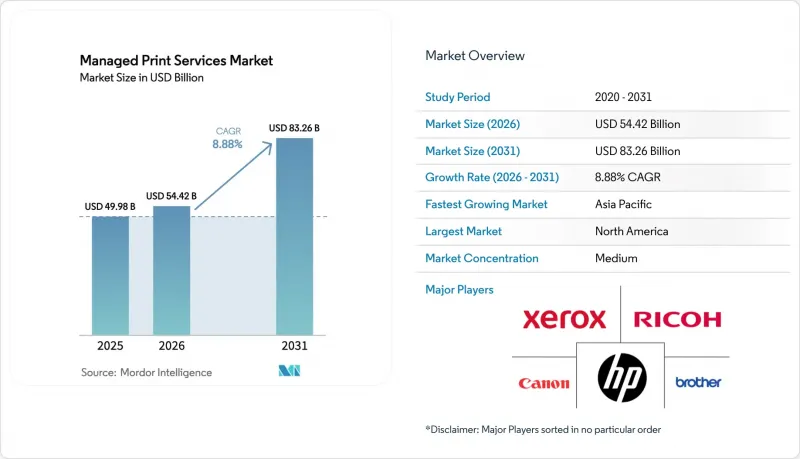
Mordor Intelligence에 의하면, 매니지드 프린트 서비스(MPS) 시장 규모는 2026년에 544억 2,000만 달러에 이르고, 2031년까지 832억 6,000만 달러에 이를 것으로 예측되며, 2026-2031년까지 CAGR 8.88%를 기록할 전망입니다.
본 보고서는 채널 유형(프린터·복사기 제조업체, 기타), 서비스 유형(인쇄 인프라 평가, 기타), 배포 방식(On-Premise, 클라우드 기반), 조직 규모(중소기업(SME), 대기업), 최종 사용자 산업(은행, 금융서비스 및 보험(BFSI), 헬스케어, IT 및 통신, 기타), 지역별로 분류되어 있습니다. 시장 전망은 금액(달러) 기준으로 제시되어 있습니다.
세계 매니지드 프린트 서비스(MPS) 시장 동향 및 인사이트
북미 MPS 도입을 촉진하는 원격 근무용 인쇄 인프라 최적화
하이브리드 근무 모델로 인해 자택, 코워킹 스페이스, 일부만 운영 중인 본사 등 기기 배치의 분산이 진행되면서 IT 부서는 고정된 기기 pool에서 사용량에 따른 프로비저닝으로 전환할 수밖에 없었습니다. 보안 인쇄 릴리스, ID 인증을 통한 액세스, VPN이 필요 없는 작업 전송이 기본 요건이 되었으며, 매니지드 프린트 서비스(MPS) 시장은 단순한 비용 센터가 아닌 보안 솔루션으로 재포지셔닝되었습니다. Xerox사의 ‘Virtual Print Management’ 서비스를 이용하면, 직원은 어디서든 인쇄 작업을 전송하고 가장 가까운 인증된 기기에서 수령할 수 있어 On-Premise 서버나 전용 VPN 터널이 필요 없어집니다. 기업들은 현재 제로 트러스트(Zero Trust)형 인쇄 아키텍처와 온디맨드 용량 최적화를 중시하고 있으며, 이것이 클라우드 기반 계약이 상대적으로 높은 사용자 요금을 부과함에도 불구하고 여전히 시장 전체의 성장 곡선을 상회하는 이유입니다.
지속가능성 및 탄소 발자국 관련 규제로 인한 EU 기업의 MPS 도입 가속화
유럽연합(EU)의 ‘기업 지속가능성 보고 지침’에 따라, 직원 수 250명 이상의 기업은 2025년부터 인쇄에 따른 배출량을 포함한 스코프 3 배출량 공개가 의무화됩니다. 이에 따라 프린트 플리트 관리는 규정 준수 영역으로 전환되었습니다. 리코(Ricoh)의 보고에 따르면, 2025년에는 오피스 서비스 고객의 36%가 탄소 회계 모듈에 가입할 것으로 예상되며, 이는 전년 대비 10포인트 증가한 수치입니다. 또한, 2027년까지 유럽 내 신규 수주의 50% 이상이 지속가능성과 연계된 계약이 될 것으로 전망됩니다. 독일, 프랑스, 북유럽 국가들의 조달 지침에서는 페이지 단위의 배출량 데이터를 제공할 수 있는 공급업체가 우선적으로 선정되며, 상세한 텔레메트리 데이터가 부족한 공급업체는 사실상 배제되는 상황이 되고 있습니다.
디지털 전환의 진전에 따른 사무실 내 인쇄량 감소
전자 서명, 전자 청구서, 클라우드 협업이 종이 기반 워크플로우를 대체한 결과, 성숙한 경제권의 기업에서는 2020년부터 2025년까지 사무실 내 인쇄 사용량이 최대 20% 감소했습니다. 페이지 수의 감소는 기존 계약에 포함되어 있던 ‘클릭당 단가’형 수익 모델을 잠식하고 있으며, 공급업체는 워크플로우 자동화나 규정 준수 대시보드와 같은 부가가치가 높은 모듈로 전환할 수밖에 없는 상황에 처해 있습니다. 매니지드 프린트 서비스(MPS) 시장 전반에서 인쇄 장비의 안전한 관리에 대한 수요가 높아지고 있음에도 불구하고, 사용량 기반 과금 방식을 고수하는 벤더들은 이익률 압박 위험에 직면해 있습니다.
부문 분석
독립 소프트웨어 벤더(ISV)는 HP, Canon, Xerox, Ricoh 등에 걸쳐 있는 프린터 플릿을 관리하는 ‘클라우드 우선’이자 벤더 독립적인 플랫폼을 판매함으로써 기존 벤더의 시장 점유율을 잠식하고 있습니다. 2025년에도 프린터 및 복사기 제조업체가 채널 기여도 측면에서 여전히 가장 큰 점유율을 차지하고 있지만, ISV 그룹의 성장률은 매니지드 프린트 서비스(MPS) 시장 전체의 성장률을 연간 1% 이상 상회하고 있습니다. 제록스의 렉스마크 인수는 OEM 각사가 소프트웨어 역량을 확보해야 한다는 절박감을 여실히 드러냈습니다. 한편, 캐논은 구독 서비스에 번들로 제공되는 ‘imageFORCE’ 제품군을 통해 중견 기업 구매자들을 수직 통합형 스택에 묶어두려 하고 있습니다. 그럼에도 불구하고, 이종 혼합 플릿을 보유한 대기업들은 전환 비용을 절감하고 기능 배포를 가속화하는 ISV에 매력을 느끼고 있습니다. 그 결과, OEM의 서비스 부가율은 하락하고 있으며, 존재 의의를 유지하기 위해 리셀러와 ISV 간의 채널 제휴가 급증하고 있습니다.
각 ISV는 신속한 클라우드 출시, 개방형 API, 이종 혼합 플릿 전체의 사용 현황을 벤치마킹하는 분석 기능을 통해 차별화를 꾀하며, 지속적인 개선 주기를 촉진하고 있습니다. 각 OEM 업체는 기기에 내장된 텔레메트리 및 하드웨어-소프트웨어 번들로 대응하고 있지만, 가격과 가치 간의 격차는 여전히 남아 있습니다. 기업들은 계약 갱신의 유연성이 벤더의 균질성보다 중요하다는 점을 인식하고 있으며, 이로 인해 매니지드 프린트 서비스(MPS) 시장은 양극화된 구조로 나아가고 있습니다. 벤더에 의존하지 않는 오케스트레이션은 거버넌스를 일원화하는 세계 기업들로부터 지지를 받는 반면, 통합된 OEM 제품군은 책임 소재가 명확한 ‘원 스로트 투 초크(one throat to choke)’ 체제를 추구하는 단일 브랜드의 중견 기업들로부터 여전히 지지를 받고 있습니다. 하이퍼스케일러의 마켓플레이스를 통해 전 세계 IT 구매 담당자들이 독립형 인쇄 관리 앱을 발견할 수 있게 됨에 따라 경쟁은 더욱 치열해질 것으로 보입니다.
클라우드 프린트 서비스는 Microsoft Universal Print가 사실상 엔터프라이즈 표준이 된 것을 발판으로, 매니지드 프린트 서비스(MPS) 시장 전체보다 빠르게 성장하고 있습니다. 매니지드 프린트 운영은 장치 모니터링 및 고장 수리 지원을 포함하기 때문에 여전히 큰 점유율을 유지하고 있지만, 클라우드 제공 모델을 통해 On-Premise 서버 비용이 절감되고 도입 주기가 몇 주에서 몇 시간으로 단축됩니다. Universal Print와의 통합을 통해 IT 부서의 드라이버 관리 부담이 경감되고, VPN 설정 없이도 원격 근무 직원이 안전한 인쇄를 이용할 수 있게 됩니다.
문서 워크플로우 최적화는 현재로서는 매출 규모가 가장 작은 부문이지만, 캡처, 라우팅, 아카이빙을 자동화함으로써 구조적인 비용 절감을 실현합니다. 코니카 미놀타의 AI 탑재 ‘Workplace Hub’는 중복 인쇄를 줄이고 인사 및 재무 관련 문서의 처리 시간을 단축함으로써, 디바이스 관리에서 프로세스 혁신으로의 전환을 여실히 보여주고 있습니다. 플릿 분석과 워크플로우 재설계를 융합하는 제공업체는 페이지 수 감소와 수익을 분리하여 이익률을 지킬 수 있습니다. 이는 매니지드 프린트 서비스(MPS) 시장에서 인쇄 매수가 감소하는 반면 복잡성은 증가하는 상황에서 매우 중요한 전략입니다.
지역별 분석
북미는 하이브리드 근무의 조기 도입과 엄격한 사이버 보안 규제 덕분에 2025년 매출이 가장 높았습니다. 기업들은 제로 트러스트 인쇄와 고급 분석 기능을 중시하고 있으며, 이는 사용자 1인당 평균 수익을 세계 평균을 상회하는 수준으로 끌어올리고 있습니다. 캐나다는 미국의 추세와 유사하지만, 멕시코 기업들은 니어쇼어링을 통한 제조 확대의 일환으로 프린트 플릿 현대화를 추진하고 있습니다.
한편, 아시아태평양은 연평균 성장률(CAGR) 10.48%를 기록하며 가장 빠르게 성장하는 지역입니다. 중국, 인도, 일본, 한국의 제조업체들은 IoT 원격 측정 기술을 통합하여 가동 중지 시간을 최소화하고, 프린터의 가동률과 생산 처리량을 직접 연계하고 있습니다. 현지 데이터 주권 관련 법률로 인해 순수한 클라우드 도입은 주춤하고 있지만, 지역 내에서 호스팅되는 분석 기능을 기반으로 한 하이브리드 도입은 촉진되고 있습니다. 인도 정부의 디지털화 추진 정책과 중국의 스마트 팩토리 장려 정책이 수요를 더욱 끌어올리며, 매니지드 프린트 서비스(MPS) 시장의 성장에 이 지역이 기여하는 비중이 매우 크다는 점을 확고히 하고 있습니다.
유럽의 동향은 탄소 배출량 산정 규제에 달려 있습니다. 독일, 프랑스, 북유럽 기업들은 수명 주기 배출량 추적을 공급업체 평가 기준에 포함시키고, 지속가능성 대시보드를 포함한 계약을 빠르게 확대되고 있습니다. 중동과 남미에서는 디지털 정부 프로그램 및 기업 현대화 프로젝트가 진전됨에 따라 한 자릿수 중반대의 꾸준한 성장을 기록하고 있습니다. 아프리카 시장은 여전히 발전 단계에 있지만, 인프라의 불균형을 고려한 저설비 투자형 구독 번들을 제공하려는 공급업체에게는 풍부한 기회를 내포하고 있습니다. 전반적으로 이러한 동향은 매니지드 프린트 서비스(MPS) 시장에서 세계 공급업체의 수익원을 다각화하고 환율 위험을 헤지하는 역할을 하고 있습니다.
기타 혜택
- 엑셀 형식 시장 예측(ME) 시트
- 3개월간의 애널리스트 지원
자주 묻는 질문
목차
제1장 서론
제2장 조사 방법
제3장 주요 요약
제4장 시장 구도
제5장 시장 규모와 성장 예측
제6장 경쟁 구도
제7장 시장 기회와 향후 전망
JHS 26.09.09According to Mordor Intelligence, the managed print services market size reached USD 54.42 billion in 2026 and is forecast to advance to USD 83.26 billion by 2031, registering an 8.88% CAGR over 2026-2031.
This report is Segmented by Channel Type (Printer/Copier Manufacturers, and More), Service Type (Print Infrastructure Assessment, and More), Deployment Mode (On-Premise, and Cloud-Based), Organization Size (Small and Medium Enterprises (SMEs), and Large Enterprises), End-User Vertical (BFSI, Healthcare, IT and Telecom, and More), and Geography. The Market Forecasts are Provided in Terms of Value (USD).
Global Managed Print Services Market Trends and Insights
Remote Work Print Infrastructure Optimisation Driving MPS Adoption In North America
Hybrid work models fragmented device footprints across homes, co-working sites, and partially occupied headquarters, forcing IT departments to swap static fleets for usage-based provisioning. Secure print release, identity-aware access, and VPN-free job submission became baseline requirements, repositioning the Managed Print Services market as a security solution rather than a cost-center. Xerox's Virtual Print Management service allows workers to send a job from any location and collect it at the nearest authenticated device, eliminating on-premise servers and bespoke VPN tunnels. Enterprises now value zero-trust print architecture and on-demand capacity rightsizing, which explains why cloud-based contracts command premium seat fees while still outpacing the overall growth curve.
Sustainability And Carbon Footprint Mandates Accelerating EU Corporate MPS
The European Union's Corporate Sustainability Reporting Directive compels companies with over 250 employees to disclose Scope 3 emissions, including those from printing, starting in 2025. Print fleet management therefore shifted into the compliance domain. Ricoh reported that 36% of its Office Services clients subscribed to carbon-accounting modules in 2025, a 10-point leap year-over-year, and expects sustainability-linked contracts to exceed 50% of new European bookings by 2027. Procurement guidelines in Germany, France, and the Nordic region now prefer providers that supply page-level emissions data, effectively sidelining vendors lacking granular telemetry.
Declining Office Print Volumes Amid Digital Transformation
Companies in mature economies cut office print usage by up to 20% between 2020 and 2025 as e-signatures, electronic invoicing, and cloud collaboration displaced paper workflows. Lower page counts erode per-click revenue models embedded in legacy contracts, forcing providers to pivot toward value-added modules such as workflow automation and compliance dashboards. Vendors that cling to volume-based billing risk margin compression even as the need for secure fleet oversight increases across the Managed Print Services market.
Other drivers and restraints analyzed in the detailed report include:
- Subscription-Based Everything-As-A-Service Adoption Among SMEs
- Print-Device Security And Compliance Requirements In Regulated Sectors
- Data Sovereignty Concerns Hindering Cloud-Based MPS
For complete list of drivers and restraints, kindly check the Table Of Contents.
Segment Analysis
Independent software vendors erode incumbent share by selling cloud-first, vendor-agnostic platforms that manage fleets spanning HP, Canon, Xerox, Ricoh, and more. Printer and copier makers still generated the largest 2025 channel contribution, but the ISV cohort is outgrowing the total Managed Print Services market by more than one percentage point annually. The Xerox-Lexmark acquisition underscored OEM urgency to acquire software muscle, while Canon's subscription-bundled imageFORCE suite tries to lock mid-market buyers into vertically integrated stacks. Still, large enterprises with heterogeneous fleets gravitate toward ISVs that reduce switching costs and accelerate feature rollouts. As a result, OEM service attach rates are slipping, and channel alliances between resellers and ISVs are proliferating to defend relevance.
ISVs differentiate through rapid cloud releases, open APIs, and analytics that benchmark utilization across mixed fleets, feeding continuous improvement loops. OEMs counter with device-embedded telemetry and hardware-software bundles, but price-to-value gaps remain. Enterprises recognize that renewal flexibility outweighs vendor homogeneity, pushing the Managed Print Services market toward a bifurcated structure. Vendor-agnostic orchestration appeals to global corporations that centralize governance, while integrated OEM suites still resonate with single-brand midsize operations seeking one-throat-to-choke accountability. Competitive intensity will deepen as hyperscaler marketplaces make independent print-management apps discoverable to IT buyers worldwide.
Cloud Print Services are expanding faster than the overall Managed Print Services market, bolstered by Microsoft Universal Print becoming the de facto enterprise standard. Managed Print Operations retain sizeable share because they encompass device monitoring and break-fix support, but cloud delivery models remove on-premise server costs and shrink deployment cycles from weeks to hours. Universal Print integration cuts driver management overhead for IT departments and unlocks secure printing for remote employees without VPN configurations.
Document workflow optimization, though the smallest current revenue pool, unlocks structural savings by automating capture, routing, and archiving. Konica Minolta's AI-enabled Workplace Hub trims redundant prints and reduces processing time for HR and finance documents, illustrating the pivot from device management to process transformation. Providers that marry fleet analytics with workflow re-engineering can decouple earnings from declining page volumes and defend margins, a critical maneuver as print counts fall yet complexity rises across the Managed Print Services market size.
Complete Report Scope:
- By Channel Type
- Printer/Copier Manufacturers
- System Integrators/Resellers
- Independent Software Vendors (ISVs)
- By Service Type
- Print Infrastructure Assessment
- Managed Print Operations
- Device and Fleet Management
- Document Workflow Optimisation
- Cloud Print Services
- By Deployment Mode
- On-Premise
- Cloud-Based
- By Organisation Size
- Small and Medium Enterprises (SMEs)
- Large Enterprises
- By End-User Vertical
- BFSI
- Healthcare
- IT and Telecom
- Government
- Education
- Other End-User Verticals
- By Geography
- North America
- United States
- Canada
- Mexico
- South America
- Brazil
- Argentina
- Rest of South America
- Europe
- Germany
- United Kingdom
- France
- Nordics
- Rest of Europe
- Asia Pacific
- China
- Japan
- India
- South Korea
- Rest of Asia Pacific
- Middle East
- GCC (Saudi Arabia, United Arab Emirates, Qatar)
- Turkey
- Rest of Middle East
- Africa
- South Africa
- Nigeria
- Rest of Africa
- North America
Geography Analysis
North America generated the largest 2025 revenue thanks to early hybrid-work adoption and stringent cybersecurity mandates. Enterprises value zero-trust prints and advanced analytics, lifting average revenue per user above the global mean. Canada mirrors U.S. patterns, while Mexican corporations modernize fleets as part of near-shoring manufacturing expansions.
Asia Pacific, however, is the fastest-growing region with a 10.48% CAGR. Chinese, Indian, Japanese, and South Korean manufacturers integrate IoT telemetry to minimize downtime, directly linking printer availability to production throughput. Local data-sovereignty laws slow pure cloud adoption but boost hybrid deployments supported by regionally hosted analytics. Government digitization agendas in India and smart-factory incentives in China further elevate demand, solidifying the region's outsized contribution to Managed Print Services market growth.
Europe's trajectory hinges on carbon-accounting regulations. German, French, and Nordic enterprises embed lifecycle emissions tracking into vendor scorecards, rapidly expanding contracts that include sustainability dashboards. The Middle East and South America log steady, mid-single-digit expansion as digital government programs and corporate modernization projects unfold. Africa remains nascent yet opportunity-rich for vendors willing to offer low-capex subscription bundles that accommodate infrastructure variability. Collectively, these dynamics diversify revenue sources and hedge currency exposure for global providers in the Managed Print Services market.
- Xerox Corporation
- Ricoh Company, Ltd.
- HP Inc.
- Canon Inc.
- Brother Industries, Ltd.
- Lexmark International, Inc.
- Konica Minolta, Inc.
- Kyocera Document Solutions Inc.
- Sharp Corporation
- Epson (Seiko Epson Corporation)
- Toshiba Tec Corporation
- Fujifilm Business Innovation Corp.
- Dell Technologies Inc.
- EFI (Electronics For Imaging, Inc.)
- PrintFleet (ECI Software Solutions)
- PaperCut Software International
- Quadient SA
- Arc Document Solutions, Inc.
- FlexPrint Managed Print Solutions
- OKI Electric Industry Co., Ltd.
- Pitney Bowes Inc.
- Wipro Ltd.
Additional Benefits:
- The market estimate (ME) sheet in Excel format
- 3 months of analyst support
TABLE OF CONTENTS
1 INTRODUCTION
- 1.1 Study Assumptions and Market Definition
- 1.2 Scope of the Study
2 RESEARCH METHODOLOGY
3 EXECUTIVE SUMMARY
4 MARKET LANDSCAPE
- 4.1 Market Overview
- 4.2 Market Drivers
- 4.2.1 Remote Work Print Infrastructure Optimization Driving MPS Adoption in North America
- 4.2.2 Sustainability and Carbon Footprint Mandates Accelerating EU Corporate MPS
- 4.2.3 Subscription-Based Everything-as-a-Service Adoption Among SMEs
- 4.2.4 Print-Device Security and Compliance Requirements in Regulated Sectors
- 4.2.5 IoT-Enabled Fleet Analytics Reducing Downtime in Large Asian Enterprises
- 4.2.6 Generative-AI-Driven Predictive Maintenance and Auto-Replenishment
- 4.3 Market Restraints
- 4.3.1 Declining Office Print Volumes Amid Digital Transformation
- 4.3.2 Data Sovereignty Concerns Hindering Cloud-Based MPS
- 4.3.3 Vendor Lock-In Perception and Contract Complexity Discouraging SMEs
- 4.3.4 Complexity of Edge Zero-Trust Print Architectures
- 4.4 Industry Value Chain Analysis
- 4.5 Regulatory Outlook
- 4.6 Technological Outlook
- 4.7 Porter's Five Forces Analysis
- 4.7.1 Bargaining Power of Buyers
- 4.7.2 Bargaining Power of Suppliers
- 4.7.3 Threat of New Entrants
- 4.7.4 Threat of Substitutes
- 4.7.5 Intensity of Competitive Rivalry
- 4.8 Impact of Macroeconomic Factors on the Market
5 MARKET SIZE AND GROWTH FORECASTS (VALUE)
- 5.1 By Channel Type
- 5.1.1 Printer/Copier Manufacturers
- 5.1.2 System Integrators/Resellers
- 5.1.3 Independent Software Vendors (ISVs)
- 5.2 By Service Type
- 5.2.1 Print Infrastructure Assessment
- 5.2.2 Managed Print Operations
- 5.2.3 Device and Fleet Management
- 5.2.4 Document Workflow Optimisation
- 5.2.5 Cloud Print Services
- 5.3 By Deployment Mode
- 5.3.1 On-Premise
- 5.3.2 Cloud-Based
- 5.4 By Organisation Size
- 5.4.1 Small and Medium Enterprises (SMEs)
- 5.4.2 Large Enterprises
- 5.5 By End-User Vertical
- 5.5.1 BFSI
- 5.5.2 Healthcare
- 5.5.3 IT and Telecom
- 5.5.4 Government
- 5.5.5 Education
- 5.5.6 Other End-User Verticals
- 5.6 By Geography
- 5.6.1 North America
- 5.6.1.1 United States
- 5.6.1.2 Canada
- 5.6.1.3 Mexico
- 5.6.2 South America
- 5.6.2.1 Brazil
- 5.6.2.2 Argentina
- 5.6.2.3 Rest of South America
- 5.6.3 Europe
- 5.6.3.1 Germany
- 5.6.3.2 United Kingdom
- 5.6.3.3 France
- 5.6.3.4 Nordics
- 5.6.3.5 Rest of Europe
- 5.6.4 Asia Pacific
- 5.6.4.1 China
- 5.6.4.2 Japan
- 5.6.4.3 India
- 5.6.4.4 South Korea
- 5.6.4.5 Rest of Asia Pacific
- 5.6.5 Middle East
- 5.6.5.1 GCC (Saudi Arabia, United Arab Emirates, Qatar)
- 5.6.5.2 Turkey
- 5.6.5.3 Rest of Middle East
- 5.6.6 Africa
- 5.6.6.1 South Africa
- 5.6.6.2 Nigeria
- 5.6.6.3 Rest of Africa
- 5.6.1 North America
6 COMPETITIVE LANDSCAPE
- 6.1 Market Concentration
- 6.2 Strategic Moves
- 6.3 Market Share Analysis
- 6.4 Company Profiles (includes Global Level Overview, Market Level Overview, Core Segments, Financials as Available, Strategic Information, Market Rank/Share for Key Companies, Products and Services, and Recent Developments)
- 6.4.1 Xerox Corporation
- 6.4.2 Ricoh Company, Ltd.
- 6.4.3 HP Inc.
- 6.4.4 Canon Inc.
- 6.4.5 Brother Industries, Ltd.
- 6.4.6 Lexmark International, Inc.
- 6.4.7 Konica Minolta, Inc.
- 6.4.8 Kyocera Document Solutions Inc.
- 6.4.9 Sharp Corporation
- 6.4.10 Epson (Seiko Epson Corporation)
- 6.4.11 Toshiba Tec Corporation
- 6.4.12 Fujifilm Business Innovation Corp.
- 6.4.13 Dell Technologies Inc.
- 6.4.14 EFI (Electronics For Imaging, Inc.)
- 6.4.15 PrintFleet (ECI Software Solutions)
- 6.4.16 PaperCut Software International
- 6.4.17 Quadient SA
- 6.4.18 Arc Document Solutions, Inc.
- 6.4.19 FlexPrint Managed Print Solutions
- 6.4.20 OKI Electric Industry Co., Ltd.
- 6.4.21 Pitney Bowes Inc.
- 6.4.22 Wipro Ltd.
7 MARKET OPPORTUNITIES AND FUTURE OUTLOOK
- 7.1 White-Space and Unmet-Need Assessment


