|
시장보고서
상품코드
2123027
물리적 신원 및 액세스 관리(PIAM) 소프트웨어 시장 : 점유율 분석, 업계 동향과 통계, 성장 예측(2026-2031년)Physical Identity And Access Management (PIAM) Software - Market Share Analysis, Industry Trends & Statistics, Growth Forecasts (2026 - 2031) |
||||||
 Mordor Intelligence
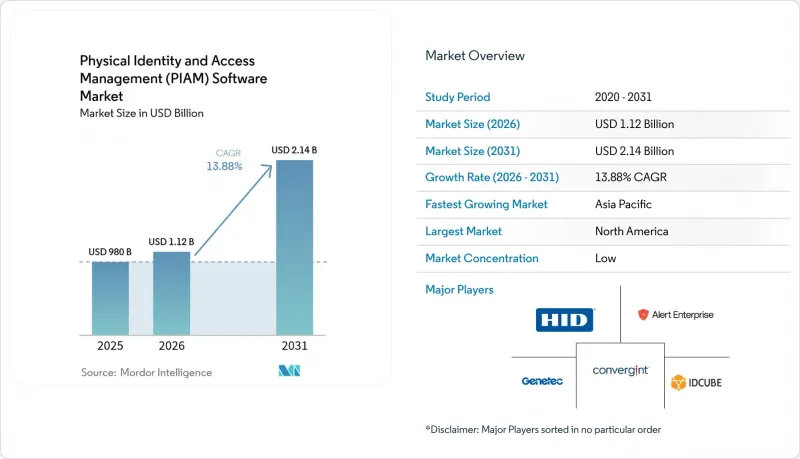
Mordor Intelligence에 의하면, 2026년 물리적 신원 및 액세스 관리(PIAM) 소프트웨어 시장 규모는 11억 2,000만 달러로 추정되고 있어 2025년 9억 8,000만 달러에서 확대해, 2031년에는 21억 4,000만 달러에 이를 것으로 예측됩니다.
2026-2031년 동안의 연평균 성장률(CAGR)은 13.88%가 될 것으로 전망됩니다.
본 보고서는 구성 요소(소프트웨어, 서비스), 배포 방식(On-Premise, 클라우드), 조직 규모(중소기업, 대기업), 최종 사용자 산업(은행 및 금융 서비스·보험(BFSI), 정부·국방, 헬스케어, 기타), 지역별로 분류되어 있습니다. 시장 예측은 금액(달러)으로 표시되어 있습니다.
세계 물리적 신원 및 액세스 관리(PIAM) 소프트웨어 시장 동향 및 인사이트
정부의 규정 준수 요건
정부 규제로 인해 ID 시스템의 업데이트 주기가 단축되고 있습니다. 호주의 ‘2024년 디지털 ID법’은 정부 기관에 대해 시민이 디지털 서비스와 물리적 서비스 모두에서 단일 인증 정보를 사용할 수 있도록할 것을 의무화하고 있으며, 이에 따라 모바일 배지를 발급하고 사이버 보안 및 물리적 액세스 제어 정책을 연계할 수 있는 상호 운용 가능한 플랫폼의 도입이 진행되고 있습니다. 미국에서는 사이버보안·인프라보안청(CISA)의 ‘제로 트러스트 성숙도 모델’에 따라 건물 입구에서의 지속적인 검증이 요구되고 있으며, 정부 기관은 정적인 스와이프 카드에서 위험 점수에 따른 판단으로 전환하고 있습니다. ISO/IEC 27001:2022에서는 부록 A에 물리적 통제가 포함되었으며, 다국적 기업들에게 건물 보안을 기업의 거버넌스 프로그램에 통합할 것을 권장하고 있습니다. 이러한 요구 사항들이 결합되면서, 감사 대응 수준의 방문자 로그 및 인증 정보 만료와 같은 기본 기능이 ‘필수’ 영역으로 격상되었으며, 물리적 신원 및 액세스 관리(PIAM) 시장을 사이버와 물리적 요소를 통합한 정책 엔진으로 이끌고 있습니다.
스마트 빌딩 및 IoT 지원 시설의 급속한 확대
스마트 시티 메가 프로젝트에서는 재실자 카운터부터 HVAC 밸브에 이르기까지 수천 개의 센서가 통합된 운영 네트워크에 연결되어 있습니다. 이러한 엔드포인트에는 고유 ID와 최소 권한 부여가 필요하므로, 소유자는 기기의 온보딩을 사람에 대한 프로비저닝과 동일하게 취급해야 합니다. 아시아태평양에서는 NEOM의 생체 인식 e-게이트가 서류 없이 여행하는 여행객의 수속을 처리하고, 건물 관리 시스템과 인증 정보를 동기화함으로써 원활한 이동을 실현하고 있습니다. 중국 웅안 신구의 기획 담당자들은 설계 단계부터 PIAM 체계를 통합하여, 실시간 점유 현황에 기반한 예측 유지보수를 가능하게 하고 있습니다. Genetec의 보고서에 따르면, 보안 담당자의 77%가 현재 이 센서의 난립을 관리하기 위해 IT 팀과 협력하고 있으며, 43%는 IoT 텔레메트리 데이터를 통합하면서도 문 제어 결정을 엣지 측에서 유지하는 하이브리드 클라우드 설계를 선호합니다. 이러한 노력을 통해 PIAM 소프트웨어는 스마트 빌딩 운영 체제의 핵심으로 자리매김하고 있으며, 대상 지출 범위는 문뿐만 아니라 네트워크에 연결된 모든 자산으로 확대되고 있습니다.
타사(클라우드) 데이터 저장소의 보안에 대한 우려
국방 기관은 데이터 주권에 관한 규정과 공급망 위험을 이유로 멀티테넌트형 클라우드에 생체 인증 템플릿을 저장하는 데 소극적입니다. 미국 국방부의 사이버 보안 성숙도 모델 인증(CMMC)은 계약업체에게 PIAM을 FedRAMP 인증 환경 또는 On-Premise에서 호스팅할 것을 의무화하고 있어, 사실상 많은 퍼블릭 클라우드가 제외되고 있습니다. 유럽의 GDPR(EU 개인정보보호규정)에서는 생체 인증 데이터가 ‘특별한 범주’로 분류되어 있으며, 동의 및 암호화 요건이 다층적으로 부과됨에 따라 세계 전개 시 규정 준수 비용이 증가하고 있습니다. AWS와 같은 공급자가 고객 관리형 키나 리전별 인스턴스를 제공하고 있음에도 불구하고, 많은 기관은 여전히 클라우드를 ‘추가적인 공격 표면’으로 간주하고 있습니다. 이러한 인식으로 인해 정부 및 기밀 프로젝트 분야에서 클라우드의 단기 시장 점유율이 억제되고 있으며, 해당 부문에서 물리적 신원 및 액세스 관리(PIAM) 시장의 성장 속도가 둔화되고 있습니다.
부문 분석
서비스 부문은 2025년 매출에서 차지하는 비중은 작지만, 프로젝트가 다중 사이트화 및 다중 벤더화로 진행됨에 따라 소프트웨어 부문보다 빠르게 확대되고 있습니다. 기업들이 독자적인 프로토콜로 인해 수십 년에 걸친 기술적 부채에 직면함에 따라, 물리적 신원 및 액세스 관리(PIAM) 시장에서 서비스 부문의 규모는 확대되고 있습니다. Convergint Technologies에 따르면, 수주 프로젝트의 62%에서 클라우드 콘솔과 On-Premise 도어 컨트롤러가 병용되고 있으며, 엔지니어에게는 REST API와 레거시 배선 모두에 정통할 것이 요구되고 있습니다. 현재 프리미엄 컨설팅 패키지에는 정책 템플릿 라이브러리, 변경 관리 워크숍, 관리형 서비스 등이 포함되어 있어 지속적인 수익원을 창출하고 있습니다. 모듈식 마이크로서비스 기반으로 구축된 HID Global의 ‘Origo’ 소프트웨어는 설정을 간소화하는 한편, 워크플로우에 맞춘 전문적인 맞춤화에 대한 수요를 높이고 있습니다. 고객이 라이선스, 업그레이드, 모니터링을 묶은 성과 기반 계약을 선택함에 따라, 서비스 제공업체는 가치 실현까지의 시간을 단축하면서 추가 지출의 상당 부분을 확보하고 있습니다.
클라우드 소프트웨어는 모든 도입이 라이선스에서 시작되기 때문에 물리적 신원 및 액세스 관리(PIAM) 시장에서 여전히 지배적인 점유율을 차지하고 있습니다. 그러나 구독형 벤더들이 도입 비용을 다년 계약에 포함시키면서, 2031년에 이르기까지 서비스의 비중은 더욱 높아질 것으로 예측됩니다. 레거시 환경에서 미들웨어 브리지가 필요한 부문, 예를 들어 위건드식 리더기를 운영하는 병원이나 직렬 컨트롤러로 보호되는 은행 금고 등에서는 여전히 가장 강력한 성장이 예상됩니다. 신흥 시장에서 인증된 PIAM 전문가의 부족은 서비스 수요를 더욱 부추길 것이며, 교육 아카데미와 24시간 운영되는 원격 지원 센터를 보유한 통합 업체들이 주요 수혜자가 될 것으로 보입니다.
2025년 시점에서도 On-Premise형 도입은 매출의 56.75%를 차지했습니다. 그러나 모바일 인증 정보의 보급과 FedRAMP, ISO 27001, SOC 2 인증 요건의 개선을 뒷받침으로, 하이브리드형과 클라우드 기반 모델이 더욱 빠르게 성장하고 있습니다. 중소기업이 서버 유지보수를 피하기 위해 SaaS를 선택하고, 대기업이 영상 분석이나 행동 위험 점수 산정을 위해 탄력적인 컴퓨팅을 활용함에 따라, 클라우드 관련 물리적 신원 및 액세스 관리(PIAM) 시장 규모는 확대되고 있습니다.
엣지 게이트웨이는 현재 결정 내용을 로컬에 캐시하고 있어, 인터넷 연결이 끊긴 경우에도 문 기능을 유지하면서 연결이 복구되는 즉시 로그를 동기화할 수 있습니다. 이 아키텍처는 데이터 주권에 대한 우려를 완화하고, 정부 기관이 비기밀 워크로드를 외부에 위탁하도록 촉진하고 있습니다. 각 벤더는 지역 고정형 데이터센터, 고객 관리형 암호화 키, 모든 API 호출을 감사하는 역할 기반 관리 대시보드를 제공함으로써 이에 대응하고 있으며, 이에 대한 거부감을 점차 해소하고 있습니다. On-Premise형 솔루션은 에어 갭이 적용된 방어 연구소나 초고도 보안이 갖춰진 데이터센터에서는 계속해서 채택되고 있지만, 신규 구축 사이트의 대부분에서는 현재 하이브리드형 토폴로지가 표준이 되었습니다.
지역별 분석
북미는 SaaS의 조기 도입과 성숙한 통합업체 네트워크에 힘입어 2025년 매출의 36.02%를 차지했습니다. NIST SP 800-217 및 사이버 보안 성숙도 모델 인증(CMMC)과 같은 연방 지침에 따라 기능에 대한 최소 기준이 높아졌으며, 정부, 국방 및 중요 인프라 부문에서의 지출이 촉진되었습니다. 캐나다는 미국의 추세를 반영하여, 국영 기업들이 네트워크 및 시설 접근 모두에 제로 트러스트 프레임워크를 채택하고 있습니다.
아시아태평양은 각국의 스마트 시티 구상에 힘입어 지역별 가장 높은 연평균 성장률(CAGR) 15.98%를 나타낼 것으로 예측됩니다. 사우디아라비아 NEOM 공항의 e-게이트는 생체 인증 도입 의지를 보여주는 좋은 사례이며, 한편 인도의 ‘스마트 시티 미션’에서는 지자체 보조금을 활용하여 교통 거점 및 병원에 통합된 IoT 지원 액세스 노드가 구축되고 있습니다. 중국의 옌안 신구에서는 PIAM API를 건물 관리 시스템에 통합하여, 이용 현황에 기반한 실시간 에너지 최적화를 실현하고 있습니다. 현지 시스템 통합사업자는 PIAM을 영상 모니터링 및 엘리베이터 제어와 결합하여, 부동산 개발업체에 턴키 패키지를 제공합니다.
유럽은 매출액 기준 2위, 성장률 기준 3위를 기록하고 있습니다. eIDAS 2.0에서는 회원국에 대해 도어 인증 정보와 연동되는 디지털 지갑의 표준화를 의무화하고 있으며, 이로 인해 페더레이티드 PIAM 소프트웨어에 대한 수요가 감소하고 있습니다. 독일의 자동차 공장에서는 저스트-인-타임(JIT) 생산을 지원하기 위해 하청업체용 프로비저닝 모듈이 도입되었습니다. 영국과 프랑스에서는 대형 하이퍼스케일러가 운영하는 현지 데이터센터를 활용하여 공공 부문의 클라우드 도입을 가속화하고 있습니다. GDPR(EU 개인정보보호규정)의 엄격한 생체 인증 데이터 관련 규정으로 인해, 기밀성이 높은 템플릿은 특정 지역에 고정된 클러스터나 On-Premise 스토리지에 저장되게 되어 하이브리드 설계가 형성되고 있습니다.
남미 시장은 브라질과 아르헨티나를 중심으로 전개되고 있습니다. 은행과 국경 관리 당국은 얼굴 인식 키오스크에 투자하고 있는 반면, 정유시설에서는 관리상의 부담을 줄이기 위해 카드 리더기를 모바일 배지 지원 방식으로 업그레이드하는 개보수 작업을 진행하고 있습니다. 중동의 성장은 아랍에미리트와 사우디아라비아에 크게 의존하고 있으며, 이들 국가에서는 국부펀드가 초기 단계부터 모바일 액세스를 통합한 메가 프로젝트에 자금을 지원하고 있습니다. 아프리카에서는 도입이 아직 초기 단계이지만, 남아프리카공화국의 광산에서는 광산 입구에 내구성이 뛰어난 리더기가 채택되고 있으며, 나이지리아의 은행에서는 분산된 지점을 모니터링하기 위해 클라우드 콘솔이 도입되고 있습니다. 현재 규모는 작지만, 규제 현대화에 따라 이러한 도입은 향후 확장을 위한 기반을 마련하고 있습니다.
기타 혜택
- 엑셀 형식 시장 예측(ME) 시트
- 3개월간의 애널리스트 지원
자주 묻는 질문
목차
제1장 서론
제2장 조사 방법
제3장 주요 요약
제4장 시장 구도
제5장 시장 규모와 성장 예측
제6장 경쟁 구도
제7장 시장 기회와 향후 전망
JHSAccording to Mordor Intelligence, physical identity and access management (PIAM) software market size in 2026 is estimated at USD 1.12 billion, growing from 2025 value of USD 980 million with 2031 projections showing USD 2.14 billion, growing at 13.88% CAGR over 2026-2031.
This report is Segmented by Component (Software, and Services), Deployment Mode (On-Premises, and Cloud), Organization Size (Small and Medium Enterprises, and Large Enterprises), End-User Industry (Banking Financial Services and Insurance, Government and Defense, Healthcare, and More), and Geography. The Market Forecasts are Provided in Terms of Value (USD).
Global Physical Identity And Access Management (PIAM) Software Market Trends and Insights
Compliance Mandates From Governments
Government regulations are shortening refresh cycles for identity systems. Australia's Digital ID Act 2024 requires agencies to enable citizens to use a single credential for both digital and physical services, prompting the procurement of interoperable platforms that can issue mobile badges and bridge cyber and door-access policies. In the United States, the Cybersecurity and Infrastructure Security Agency's Zero Trust Maturity Model requires continuous verification at the building entry point, moving agencies away from static swipe cards toward risk-scored decisions. ISO/IEC 27001:2022 now embeds physical controls in Annex A, nudging multinational firms to integrate building security into their enterprise governance programs. Collectively, these mandates elevate baseline functionality, such as audit-grade visitor logs and credential revocation, to "must-have" territory, driving the physical identity and access management market toward unified cyber-physical policy engines.
Rapid Growth of Smart Buildings and IoT-Enabled Facilities
Smart-city mega-projects are wiring thousands of sensors, from occupancy counters to HVAC valves, into converged operational networks. These endpoints require unique identities and least-privileged permissions, so owners should treat device onboarding similarly to human provisioning. In the Asia-Pacific region, NEOM's biometric eGates process travelers without documents and sync credentials with building-management systems for frictionless movement. China's Xiong'an planners embed PIAM hooks at the blueprint stage, enabling predictive maintenance based on real-time occupancy. Genetec reports that 77% of security leaders now collaborate with IT teams to manage this sensor sprawl, and 43% prefer hybrid cloud designs that ingest IoT telemetry while keeping door decisions at the edge. These practices place PIAM software at the heart of smart-building operating systems, expanding addressable spend beyond doors to every networked asset.
Concerns Over Security of Third-Party (Cloud) Data Storage
Defense agencies are hesitant to store biometric templates in multi-tenant clouds, citing data sovereignty rules and supply chain risks. The United States Department of Defense's Cybersecurity Maturity Model Certification requires contractors to host PIAM either on FedRAMP-authorized environments or on-premises, effectively excluding many public clouds. Europe's GDPR labels biometric data as a "special category," layering consent and encryption requirements that increase compliance costs for global rollouts. Although providers such as AWS offer customer-managed keys and regional instances, many agencies still view the cloud as an extra attack surface. This perception dampens near-term cloud share in government and classified projects, slowing the trajectory of the physical identity and access management market in those segments.
Other drivers and restraints analyzed in the detailed report include:
- Rising Adoption of Cloud-Based PIAM Platforms by SMEs
- Convergence of Cyber and Physical Identity Governance
- High Up-Front Integration Costs for Legacy Infrastructure
For complete list of drivers and restraints, kindly check the Table Of Contents.
Segment Analysis
Services contributed a smaller portion of 2025 revenue but are expanding faster than software as projects grow multi-site and multi-vendor. The physical identity and access management market size for services is widening because enterprises face decades of technical debt from proprietary protocols. Convergint Technologies notes that 62% of engagements blend cloud consoles with on-premises door controllers, requiring engineers to be versed in both REST APIs and legacy wiring. Premium consultative packages now include policy template libraries, change management workshops, and managed administration, creating recurring revenue streams. HID Global's Origo software, built on modular microservices, simplifies configuration while increasing the demand for professional tailoring to match workflows. As clients opt for outcome-based contracts that bundle licenses, upgrades, and monitoring, service providers capture a disproportionate share of incremental spending while reducing the time to value.
Cloud software still dominates the physical identity and access management market share because every deployment starts with a license. However, the mix will continue to tilt toward services through 2031 as subscription vendors embed implementation fees into multi-year commitments. Growth remains strongest where legacy estates require middleware bridges, such as hospitals running Wiegand readers or bank vaults protected by serial controllers. The shortage of certified PIAM specialists in emerging markets further boosts demand for services, positioning integrators with training academies and 24-hour remote support centers as key beneficiaries.
On-premises deployments retained 56.75% of revenue in 2025. Yet hybrid and cloud models are growing faster, propelled by mobile credential adoption and improved FedRAMP, ISO 27001, and SOC 2 attestations. The physical identity and access management market size associated with cloud is rising as SMEs choose SaaS to bypass server maintenance, and large enterprises leverage elastic compute for video analytics and behavioral risk scoring.
Edge gateways now cache decisions locally, allowing doors to continue functioning during internet loss, while logs are synced back once the links are restored. This architecture alleviates sovereignty concerns and encourages government agencies to offload non-classified workloads. Vendors respond with region-pinned data centers, customer-managed encryption keys, and role-based administration dashboards that audit every API call, chipping away at resistance. On-premises solutions will persist in air-gapped defense labs and ultra-secure data centers, but most green-field sites now default to hybrid topologies.
Complete Report Scope:
- By Component
- Software
- Services
- By Deployment Mode
- On-Premises
- Cloud
- By Organization Size
- Small and Medium Enterprises
- Large Enterprises
- By End-User Industry
- Banking Financial Services and Insurance (BFSI)
- Government and Defense
- Healthcare
- Information Technology and Telecommunications
- Energy and Utilities
- Education
- Other End-user Industries
- By Geography
- North America
- United States
- Canada
- Mexico
- South America
- Brazil
- Argentina
- Rest of South America
- Europe
- Germany
- United Kingdom
- France
- Italy
- Spain
- Rest of Europe
- Asia-Pacific
- China
- India
- Japan
- South Korea
- ASEAN
- Rest of Asia-Pacific
- Middle East and Africa
- Middle East
- Saudi Arabia
- United Arab Emirates
- Rest of Middle East
- Africa
- South Africa
- Nigeria
- Rest of Africa
- Middle East
- North America
Geography Analysis
North America generated 36.02% of 2025 revenue, buoyed by early SaaS adoption and mature integrator networks. Federal guidelines, such as NIST SP 800-217 and the Cybersecurity Maturity Model Certification, raised the baseline functionality, spurring spending in government, defense, and critical infrastructure. Canada mirrors the United States' patterns, with Crown corporations adopting zero-trust frameworks for both network and facility access.
The Asia-Pacific region is forecast to grow at a 15.98% CAGR, the fastest among regions, driven by national smart-city initiatives. Saudi Arabia's NEOM airport eGates exemplify biometric ambitions, while India's Smart Cities Mission channels municipal grants into IoT-ready access nodes embedded in traffic hubs and hospitals. China's Xiong'an New Area hardwires PIAM APIs into building-management systems, ensuring real-time energy optimization based on occupancy. Local system integrators bundle PIAM with video surveillance and elevator control, offering turnkey packages to property developers.
Europe ranks second in revenue and third in growth. eIDAS 2.0 requires member states to standardize digital wallets that link to door credentials, thereby reducing demand for federated PIAM software. Germany's automotive plants deploy contractor provisioning modules to support just-in-time manufacturing. The United Kingdom and France are accelerating cloud adoption in the public sector, leveraging local data centers operated by major hyperscalers. Strict GDPR biometric-data rules steer sensitive templates into region-pinned clusters or on-premises stores, shaping hybrid designs.
South America's market centers on Brazil and Argentina. Banks and border authorities invest in facial-recognition kiosks, while oil refineries retrofit card readers with mobile badge upgrades to reduce administrative overhead. Middle East growth relies heavily on the United Arab Emirates and Saudi Arabia, where sovereign funds fund mega-projects that incorporate mobile access from the outset. Africa shows nascent traction: South African mines adopt ruggedized readers at shafts, and Nigerian banks deploy cloud consoles to monitor distributed branches. Although smaller today, these deployments lay the groundwork for future expansion as regulations modernize.
- HID Global Corporation
- AlertEnterprise Inc.
- Genetec Inc.
- Convergint Technologies LLC
- IDCUBE Identification Systems Private Limited
- BioConnect Systems Inc.
- Gallagher Group Limited
- Cross IdentityPlus Pvt Ltd
- Brivo Systems LLC
- Johnson Controls International PLC
- Honeywell International Inc.
- Motorola Solutions Inc. (Avigilon)
- SAASPASS Inc.
- Wipro Limited
- Amazon Web Services Inc.
- IBM Corporation
Additional Benefits:
- The market estimate (ME) sheet in Excel format
- 3 months of analyst support
TABLE OF CONTENTS
1 INTRODUCTION
- 1.1 Study Assumptions and Market Definition
- 1.2 Scope of the Study
2 RESEARCH METHODOLOGY
3 EXECUTIVE SUMMARY
4 MARKET LANDSCAPE
- 4.1 Market Overview
- 4.2 Market Drivers
- 4.2.1 Compliance Mandates from Governments
- 4.2.2 Increasing Need to Manage On-Site Visitors and Contractors
- 4.2.3 Rapid Growth of Smart Buildings and IoT-Enabled Facilities
- 4.2.4 Rising Adoption of Cloud-Based PIAM Platforms by SMEs
- 4.2.5 Integration of PIAM with Physical Security Information Management (PSIM)
- 4.2.6 Convergence of Cyber and Physical Identity Governance
- 4.3 Market Restraints
- 4.3.1 Concerns Over Security of Third-Party (Cloud) Data Storage
- 4.3.2 High Up-Front Integration Costs for Legacy Infrastructure
- 4.3.3 Shortage of Skilled PIAM Implementation Specialists
- 4.3.4 Fragmented Global Regulatory Landscape
- 4.4 Industry Value Chain Analysis
- 4.5 Regulatory Landscape
- 4.6 Technological Outlook
- 4.7 Porter's Five Forces Analysis
- 4.7.1 Bargaining Power of Suppliers
- 4.7.2 Bargaining Power of Buyers
- 4.7.3 Threat of New Entrants
- 4.7.4 Threat of Substitutes
- 4.7.5 Intensity of Competitive Rivalry
- 4.8 Assessment of Macro-economic Trends on the Market
5 MARKET SIZE AND GROWTH FORECASTS (VALUE)
- 5.1 By Component
- 5.1.1 Software
- 5.1.2 Services
- 5.2 By Deployment Mode
- 5.2.1 On-Premises
- 5.2.2 Cloud
- 5.3 By Organization Size
- 5.3.1 Small and Medium Enterprises
- 5.3.2 Large Enterprises
- 5.4 By End-User Industry
- 5.4.1 Banking Financial Services and Insurance (BFSI)
- 5.4.2 Government and Defense
- 5.4.3 Healthcare
- 5.4.4 Information Technology and Telecommunications
- 5.4.5 Energy and Utilities
- 5.4.6 Education
- 5.4.7 Other End-user Industries
- 5.5 By Geography
- 5.5.1 North America
- 5.5.1.1 United States
- 5.5.1.2 Canada
- 5.5.1.3 Mexico
- 5.5.2 South America
- 5.5.2.1 Brazil
- 5.5.2.2 Argentina
- 5.5.2.3 Rest of South America
- 5.5.3 Europe
- 5.5.3.1 Germany
- 5.5.3.2 United Kingdom
- 5.5.3.3 France
- 5.5.3.4 Italy
- 5.5.3.5 Spain
- 5.5.3.6 Rest of Europe
- 5.5.4 Asia-Pacific
- 5.5.4.1 China
- 5.5.4.2 India
- 5.5.4.3 Japan
- 5.5.4.4 South Korea
- 5.5.4.5 ASEAN
- 5.5.4.6 Rest of Asia-Pacific
- 5.5.5 Middle East and Africa
- 5.5.5.1 Middle East
- 5.5.5.1.1 Saudi Arabia
- 5.5.5.1.2 United Arab Emirates
- 5.5.5.1.3 Rest of Middle East
- 5.5.5.2 Africa
- 5.5.5.2.1 South Africa
- 5.5.5.2.2 Nigeria
- 5.5.5.2.3 Rest of Africa
- 5.5.5.1 Middle East
- 5.5.1 North America
6 COMPETITIVE LANDSCAPE
- 6.1 Market Concentration
- 6.2 Strategic Moves
- 6.3 Market Share Analysis
- 6.4 Company Profiles (includes Global level Overview, Market level overview, Core Segments, Financials as available, Strategic Information, Market Rank/Share for key companies, Products and Services, and Recent Developments)
- 6.4.1 HID Global Corporation
- 6.4.2 AlertEnterprise Inc.
- 6.4.3 Genetec Inc.
- 6.4.4 Convergint Technologies LLC
- 6.4.5 IDCUBE Identification Systems Private Limited
- 6.4.6 BioConnect Systems Inc.
- 6.4.7 Gallagher Group Limited
- 6.4.8 Cross IdentityPlus Pvt Ltd
- 6.4.9 Brivo Systems LLC
- 6.4.10 Johnson Controls International PLC
- 6.4.11 Honeywell International Inc.
- 6.4.12 Motorola Solutions Inc. (Avigilon)
- 6.4.13 SAASPASS Inc.
- 6.4.14 Wipro Limited
- 6.4.15 Amazon Web Services Inc.
- 6.4.16 IBM Corporation
7 MARKET OPPORTUNITIES AND FUTURE OUTLOOK
- 7.1 White-space and Unmet-Need Assessment