

|
시장보고서
상품코드
2123036
산업용 자동화 소프트웨어 시장 : 점유율 분석, 업계 동향과 통계, 성장 예측(2026-2031년)Industrial Automation Software - Market Share Analysis, Industry Trends & Statistics, Growth Forecasts (2026 - 2031) |
||||||
 Mordor Intelligence
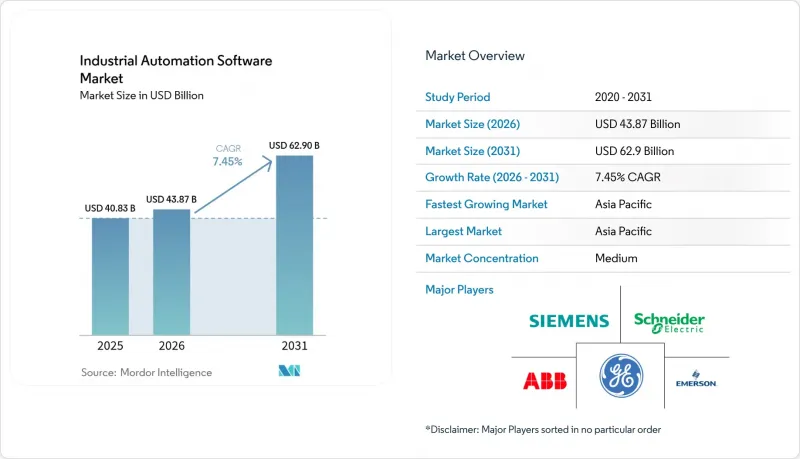
Mordor Intelligence에 의하면, 산업용 자동화 소프트웨어 시장 규모는 2025년에 408억 3,000만 달러로 평가되었고 2026년 438억 7,000만 달러에서 2031년까지 629억 달러에 이를 것으로 예측되며, 예측 기간(2026-2031년) CAGR은 7.45%를 나타낼 전망입니다.
본 보고서는 솔루션 유형(제조 실행 시스템(MES), SCADA, 분산 제어 시스템(DCS), 기타), 배포 모드(On-Premise, 클라우드 기반, 하이브리드), 최종 사용자 산업(자동차 및 운송 산업, 식음료, 기타), 기업 규모(대기업, 중소기업), 지역별로 분류되어 있습니다. 시장 예측은 금액(달러) 기준으로 제시되어 있습니다.
세계 산업용 자동화 소프트웨어 시장 동향 및 인사이트
인더스트리 4.0 및 스마트 제조의 급속한 확산
제조업체들은 고립된 자동화 아일랜드를 소프트웨어가 컨트롤러와 엣지 디바이스 간에 자유롭게 이동할 수 있는 개방형 아키텍처 생태계로 대체하고 있습니다. ExxonMobil에 의한 IEC 61499 런타임의 상용화는 개방형 프로세스 자동화가 벤더 종속 비용을 대폭 절감하면서 1밀리초 미만의 응답 시간을 실현하는 좋은 예입니다. 현재 엣지 노드가 실시간 제어를 담당하고 클라우드 계층이 설비 전체에 걸친 최적화를 처리함으로써, 공장은 하드웨어 업데이트 주기와 소프트웨어 혁신을 분리할 수 있게 되었습니다. 화학 플랜트에서는 모놀리식 분산 제어 시스템에서 모듈식 노드로의 전환이 진행되고 있어, 라인을 중단하지 않고도 신속하게 레시피를 변경할 수 있게 되었습니다. 벤더에 구애받지 않는 프레임워크는 경쟁 입찰을 촉진하고 가치 실현까지의 시간을 단축함으로써, 기존 플랜트(브라운필드)와 신규 플랜트(그린필드) 모두에서 도입을 뒷받침하고 있습니다.
실시간 데이터 분석 및 IIoT 연결에 대한 수요 증가
OPC UA와 통합된 시간 민감형 네트워킹(TSN)은 마이크로초 단위의 정밀도로 분산형 컨트롤러를 동기화하여, 지금까지 지연 제약으로 인해 방해받았던 폐쇄 루프 최적화를 가능하게 합니다. 자동차 차체 공장에서 기가바이트 단위의 용접 품질 데이터를 AI 모델로 스트리밍하고, 다음 사이클에서 용접 건의 압력을 조정함으로써 불량률을 낮추고 있습니다. 에너지 집약적 공정에서는 실시간 전력 가격 신호를 제어 알고리즘에 반영하여 몇 초 이내에 부하를 전환함으로써 비용을 절감하고 있습니다. 엣지 분석을 통해 이상 감지를 로컬에서 수행하고 예외 사항만 클라우드로 전송함으로써 대역폭 요구 사항을 줄이고 있습니다. 이러한 분산형 인텔리전스 접근 방식을 통해 품질 관리가 강화되고 네트워크 장애에 대한 내성도 높아집니다.
막대한 초기 설비 투자(CAPEX)와 레거시 시스템 통합의 복잡성
다중 벤더 제어실을 사후 개조할 경우, 독자적인 프로토콜을 지원하는 맞춤형 게이트웨이가 필요하기 때문에 대부분의 경우 새로운 소프트웨어 도입 비용보다 더 많은 비용이 듭니다. 공장에서는 가동 중단을 방지하기 위해 단계적으로 도입하고 있어, ROI 달성까지의 기간이 길어지고 있습니다. 가상화는 비용 절감이 기대되지만, 많은 사업자는 안전상 중요한 루프의 가상화를 주저하고 있습니다. 중소기업은 전환을 관리할 사내 리소스가 부족하여, 효율화를 통한 이득이 있음에도 불구하고 업그레이드를 미루고 있습니다. 하이브리드 통합 툴킷이 등장하고 있지만, 미션 크리티컬 환경에서의 신뢰성 위험이 우려되어 그 도입은 제한되고 있습니다.
부문 분석
2025년, SCADA 플랫폼은 산업용 자동화 소프트웨어 시장 점유율의 33.92%를 차지하며, 지리적으로 분산된 자산을 통합적으로 모니터링하는 데 있어 그 역할을 부각시켰습니다. 유틸리티자들은 변전소 및 재생에너지 발전소를 관리하기 위해 이러한 시스템에 의존하고 있으며, 공급량이 변동하는 상황에서도 전력망의 안정성을 확보하고 있습니다. 산업용 자동화 소프트웨어 시장에서는 입증된 신뢰성과 벤더 생태계 덕분에 여전히 SCADA가 선호되고 있지만, 수요는 운영 데이터를 해석하고 예측 유지보수 워크플로를 실행하는 풍부한 분석 기능을 갖춘 오버레이로 이동하고 있습니다. 연평균 성장률(CAGR) 8.12%로 성장하고 있는 플랜트 자산 관리 및 분석 솔루션은 데이터 계층에서의 가치 창출로 전환되는 추세를 상징합니다.
프로세스 플랜트에서는 분산 제어 시스템이 개방형 API를 통해 현대화되어, 타사 용도이 독자적인 사양으로 인한 사일로화 현상 없이 상호 운용될 수 있게 되었습니다. HMI(Human Machine Interface) 도구에는 증강현실(AR) 기능이 통합되어 있어, 복잡한 배치 공정에서 운영자의 숙련 기간을 단축하고 있습니다. 제조 실행 시스템(MES)은 자동차 차체 공장의 실시간 스케줄링에서 여전히 매우 중요한 역할을 하고 있지만, 한편 ‘기타’ 범주에 속하는 디지털 트윈 및 AI 최적화 모듈은 가동 중지 시간을 최소화하면서 시설이 새로운 레시피를 시뮬레이션, 테스트, 배포하는 방식을 재정의하고 있습니다.
2025년, 안전성이 극히 중요한 산업에서는 결정론적 지연과 완전한 데이터 주권이 중시되기 때문에 On-Premise 도입이 산업용 자동화 소프트웨어 시장 규모의 55.86%를 계속 차지했습니다. 그럼에도 불구하고 하이브리드 아키텍처로 인해 그 경계가 모호해지고 있습니다. 엣지 어플라이언스가 제어 로직을 로컬에서 호스팅하는 한편, 클라우드 계층은 플릿 분석 및 전사적 자원 계획(ERP)의 동기화 처리를 수행하고 있습니다. 산업용 자동화 소프트웨어 시장에서는 자본 예산에서 운영 예산으로 지출을 전환하는 구독 모델에 힘입어, 순수 클라우드 도입이 연평균 성장률(CAGR) 8.31%로 성장을 지속하고, 있습니다.
중소기업은 이산형 제조용 워크플로가 미리 설정되어 있고 서버 유지보수가 필요 없는 SaaS형 MES 플랫폼을 선호합니다. 반면, 대기업은 벤더 종속을 피하고 국경을 넘는 데이터 규제를 준수하기 위해 멀티 클라우드 전략을 시범적으로 도입하고 있습니다. 보안 터널링 및 실시간 스트리밍 프로토콜의 발전으로 원격 연결에 대한 우려가 완화되면서, 마이크로초 단위의 지연 시간이 중요하지 않은 히스토리안 및 품질 분석 워크로드의 클라우드 전환이 가속화되고 있습니다.
지역별 분석
아시아태평양은 2025년에 매출의 38.22%를 차지하며 연평균 성장률(CAGR) 8.09%를 기록할 전망입니다. 이는 중국, 인도, 일본, 한국에서의 정책 주도적 도입을 반영한 것입니다. 중국의 ‘중국 제조 2025’ 로드맵에서는 AI를 활용한 시각 검사와 실시간 스케줄링을 융합한 스마트 공장 시범 사업에 공동 투자하고 있습니다. 인도의 ‘생산 연계 인센티브(PLI)’ 제도는 전자 및 자동차 산업 클러스터 내 자동화 라인 도입을 촉진하고 있습니다. 일본의 로봇 공학 전통은 음성 명령과 혼합 현실(MR)을 활용한 작업 지시를 융합한 HMI(휴먼-머신 인터페이스)의 혁신적인 기술 보급을 가속화하고 있습니다. 한국의 주요 반도체 기업들은 정밀한 공정 제어의 한계에 도전하고 있는 반면, 호주의 광업 부문은 외딴 지역에서의 가동 시간을 극대화하기 위해 광석 처리 라인용 디지털 트윈에 투자하고 있습니다.
북미에서는 생산 능력 확대보다 사이버 보안과 AI의 통합이 중시되고 있습니다. 미국은 기밀성이 높은 워크로드를 On-Premise에서 처리할 수 있도록 보장하기 위해 방위 산업 공급망에 엣지 컴퓨팅 노드를 도입하고 있는 반면, 캐나다의 유틸리티자들은 재생에너지 통합을 위해 SCADA 현대화를 추진하고 있습니다. 유럽에서는 효율성과 지속가능성의 균형이 이루어지고 있습니다. 독일은 오픈 자동화 컨소시엄을 주도하고 있으며, 프랑스는 모델 기반 시스템 엔지니어링을 활용하여 항공우주 부문의 조립 공정을 현대화하고 있고, 영국은 제품 개발 주기를 단축하기 위해 레거시 라인의 업그레이드를 추진하고 있습니다. EU 사이버 복원력법(Cyber Resilience Act)과 같은 규제 요건이 공급업체의 로드맵을 형성하고 있으며, 규정 준수 기능이 소프트웨어 커널에 통합되고 있습니다.
남미 경제권, 특히 브라질에서는 거시경제의 변동으로 인해 그 기세가 다소 둔화되고 있지만, 농업 비즈니스의 처리 공정 자동화가 시작되고 있습니다. 중동 및 아프리카에서는 석유 및 가스 수입을 정유시설의 디지털화 프로젝트에 투자하고 있으며, 위험 구역에서의 사용이 검증된 예측 유지보수 모듈이 도입되고 있습니다. 각 지역에서 신규 건설 시설은 가동 초기부터 개방형 클라우드 지원 자동화 아키텍처를 채택함으로써 기존 방식의 제약을 뛰어넘고 있으며, 이로 인해 산업용 자동화 소프트웨어 시장 규모가 확대되고 있습니다.
기타 혜택
- 엑셀 형식 시장 예측(ME) 시트
- 3개월간의 애널리스트 지원
자주 묻는 질문
목차
제1장 서론
제2장 조사 방법
제3장 주요 요약
제4장 시장 구도
제5장 시장 규모와 성장 예측
제6장 경쟁 구도
제7장 시장 기회와 향후 전망
JHS 26.09.09According to Mordor Intelligence, the industrial automation software market size was valued at USD 40.83 billion in 2025 and estimated to grow from USD 43.87 billion in 2026 to reach USD 62.9 billion by 2031, at a CAGR of 7.45% during the forecast period (2026-2031).
This report is Segmented by Solution Type (Manufacturing Execution System, SCADA, Distributed Control System, and More), Deployment Mode (On-Premises, Hybrid, and More), End-User Industry (Automotive and Transportation, Food and Beverage, and More), Enterprise Size (Large Enterprises, and Small and Medium Enterprises), and Geography. The Market Forecasts are Provided in Terms of Value (USD).
Global Industrial Automation Software Market Trends and Insights
Rapid adoption of Industry 4.0 and smart manufacturing
Manufacturers are replacing isolated automation islands with open-architecture ecosystems that let software move freely across controllers and edge devices. ExxonMobil's commercialization of an IEC 61499 runtime exemplifies how open process automation delivers sub-millisecond response while slashing vendor lock-in costs. Edge nodes now host real-time control, whereas cloud layers handle fleet-wide optimization, allowing plants to decouple hardware refresh cycles from software innovation. Chemical processors are migrating from monolithic distributed-control systems to modular nodes, enabling rapid recipe changes without line shutdowns. Vendor-agnostic frameworks foster competitive bidding and accelerate time-to-value, reinforcing adoption across both brownfield and greenfield sites.
Increasing demand for real-time data analytics and IIoT connectivity
Time-sensitive networking (TSN) integrated with OPC UA synchronizes distributed controllers at microsecond resolution, empowering closed-loop optimization previously hindered by latency constraints. Automotive body-shops stream gigabytes of weld-quality data to AI models that adjust gun force on the next cycle, reducing scrap rates. Energy-intensive processes feed live power-pricing signals into control algorithms that shift loads within seconds to cut costs. Edge analytics execute anomaly detection locally, sending only exceptions to the cloud, shrinking bandwidth needs. This distributed-intelligence approach tightens quality control and reinforces resilience against network outages.
High upfront CAPEX and legacy-system integration complexity
Retrofitting multi-vendor control rooms often costs more than the new software because proprietary protocols demand custom gateways. Plants adopt phased rollouts to avoid downtime, stretching ROI timelines. Virtualization promises savings but many operators hesitate to virtualize safety-critical loops. SMEs lack in-house resources to manage migration, so they delay upgrades despite potential efficiency paybacks. Hybrid integration toolkits are emerging, yet their adoption is constrained by perceived reliability risks in mission-critical environments.
Other drivers and restraints analyzed in the detailed report include:
- Rising labor cost and need for operational efficiency
- Growing focus on cybersecurity in critical infrastructure
- Shortage of skilled automation-software engineers
For complete list of drivers and restraints, kindly check the Table Of Contents.
Segment Analysis
SCADA platforms captured 33.92% of the industrial automation software market share in 2025, underlining their role in centralized monitoring of geographically dispersed assets. Utilities lean on these systems to manage substations and renewable-generation sites, ensuring grid stability during fluctuating supply. The industrial automation software market continues to favor SCADA for its proven reliability and vendor ecosystem, yet demand is gravitating toward analytics-rich overlays that interpret operational data and trigger predictive maintenance workflows. Plant asset management and analytics solutions, growing at an 8.12% CAGR, exemplify this transition toward value-at-the-data-layer.
In process plants, distributed control systems are being modernized with open APIs, enabling third-party applications to interoperate without proprietary silos. Human-machine interface (HMI) tools are integrating augmented-reality features, cutting operator learning curves for complex batch processes. Manufacturing execution systems remain pivotal for real-time scheduling in automotive body-shops, while digital-twin and AI-optimization modules in the "Others" category are redefining how facilities simulate, test and deploy new recipes with minimum downtime.
On-premises installations maintained 55.86% of the industrial automation software market size in 2025 as safety-critical industries prefer deterministic latency and full data sovereignty. Even so, hybrid architectures are blurring distinctions: edge appliances host control logic locally, while cloud layers perform fleet analytics and enterprise resource planning synchronization. The industrial automation software market is witnessing an 8.31% CAGR for pure-cloud deployments, powered by subscription models that shift spending from capital budgets to operating budgets.
SMEs favor SaaS MES platforms that pre-configure workflows for discrete manufacturing and require no server maintenance. Large enterprises, meanwhile, pilot multi-cloud strategies that hedge vendor lock-in and comply with cross-border data regulations. Advances in secure tunneling and real-time streaming protocols are easing concerns about remote connectivity, accelerating cloud migration for historian and quality-analytics workloads where microsecond latency is non-critical.
Complete Report Scope:
- By Solution Type
- Manufacturing Execution System (MES)
- Supervisory Control and Data Acquisition (SCADA)
- Distributed Control System (DCS)
- Human-Machine Interface (HMI) Software
- Programmable Logic Controller (PLC) Software
- Plant Asset Management and Analytics
- Other Solution Types
- By Deployment Mode
- On-Premises
- Cloud-Based
- Hybrid
- By End-User Industry
- Automotive and Transportation
- Food and Beverage
- Oil and Gas
- Chemicals and Pharmaceuticals
- Electronics and Semiconductors
- Metals and Mining
- Energy and Utilities
- Other End-User Industries
- By Enterprise Size
- Large Enterprises
- Small and Medium Enterprises (SMEs)
- By Geography
- North America
- United States
- Canada
- South America
- Brazil
- Argentina
- Rest of South America
- Europe
- Germany
- France
- United Kingdom
- Italy
- Russia
- Rest of Europe
- Asia Pacific
- China
- Japan
- India
- South Korea
- Australia and New Zealand
- Rest of Asia Pacific
- Middle East and Africa
- Middle East
- Saudi Arabia
- United Arab Emirates
- Turkey
- Rest of Middle East
- Africa
- South Africa
- Nigeria
- Rest of Africa
- Middle East
- North America
Geography Analysis
Asia Pacific contributed 38.22% revenue in 2025 and is on track for an 8.09% CAGR, reflecting policy-driven adoption across China, India, Japan and South Korea. China's Made in China 2025 roadmap co-funds smart-factory pilots that intertwine AI vision inspection with real-time scheduling. India's Production-Linked Incentive schemes incentivize automated lines in electronics and automotive clusters. Japan's robotics heritage accelerates uptake of HMI innovations that blend voice commands with mixed-reality work instructions. South Korea's semiconductor giants push the envelope on precision process control, while Australia's mining sector invests in digital twins for ore-processing lines to maximize uptime in remote locations.
North America emphasizes cybersecurity and AI integration over capacity expansion. The United States deploys edge computing nodes in defense supply chains to guarantee on-premises processing of sensitive workloads, while Canadian utilities modernize SCADA for renewable integration. Europe balances efficiency with sustainability; Germany anchors open-automation consortia, France modernizes aerospace assembly with model-based systems engineering, and the United Kingdom upgrades legacy lines to shorten product-development cycles. Regulatory imperatives such as the EU Cyber Resilience Act shape vendor roadmaps, embedding compliance features into software kernels.
South American economies, notably Brazil, begin automating agribusiness processing, albeit tempered by macroeconomic volatility. The Middle East and Africa channel oil-and-gas revenue into refinery digitization projects that deploy predictive-maintenance modules validated for hazardous areas. Across regions, greenfield facilities leapfrog legacy constraints by specifying open, cloud-ready automation architectures from day one, broadening the footprint of the industrial automation software market.
- Siemens Aktiengesellschaft
- ABB Ltd.
- Rockwell Automation, Inc.
- Schneider Electric SE
- Emerson Electric Co.
- Honeywell International Inc.
- Mitsubishi Electric Corporation
- Yokogawa Electric Corporation
- General Electric Company
- OMRON Corporation
- FANUC Corporation
- Bosch Rexroth AG
- Beckhoff Automation GmbH and Co. KG
- Aspen Technology, Inc.
- Dassault Systemes SE
- PTC Inc.
- SAP SE
- Oracle Corporation
- AVEVA Group plc
- Hexagon AB
- Siemens Digital Industries Software
- Schneider Electric Software, LLC
- Inductive Automation, LLC
Additional Benefits:
- The market estimate (ME) sheet in Excel format
- 3 months of analyst support
TABLE OF CONTENTS
1 INTRODUCTION
- 1.1 Study Assumptions and Market Definition
- 1.2 Scope of the Study
2 RESEARCH METHODOLOGY
3 EXECUTIVE SUMMARY
4 MARKET LANDSCAPE
- 4.1 Market Overview
- 4.2 Market Drivers
- 4.2.1 Rapid adoption of Industry 4.0 and smart manufacturing
- 4.2.2 Increasing demand for real-time data analytics and IIoT connectivity
- 4.2.3 Rising labor cost and need for operational efficiency
- 4.2.4 Growing focus on cybersecurity in critical infrastructure
- 4.2.5 Convergence of low-code/no-code platforms with industrial automation
- 4.2.6 AI-driven autonomous process optimization via reinforcement learning
- 4.3 Market Restraints
- 4.3.1 High upfront CAPEX and legacy-system integration complexity
- 4.3.2 Shortage of skilled automation-software engineers
- 4.3.3 Interoperability issues from proprietary vendor protocols
- 4.3.4 Data-sovereignty barriers limiting cloud deployment in regulated sectors
- 4.4 Regulatory Landscape
- 4.5 Technological Outlook
- 4.6 Porter's Five Forces Analysis
- 4.6.1 Threat of New Entrants
- 4.6.2 Bargaining Power of Suppliers
- 4.6.3 Bargaining Power of Buyers
- 4.6.4 Threat of Substitutes
- 4.6.5 Competitive Rivalry
5 MARKET SIZE AND GROWTH FORECASTS (VALUE)
- 5.1 By Solution Type
- 5.1.1 Manufacturing Execution System (MES)
- 5.1.2 Supervisory Control and Data Acquisition (SCADA)
- 5.1.3 Distributed Control System (DCS)
- 5.1.4 Human-Machine Interface (HMI) Software
- 5.1.5 Programmable Logic Controller (PLC) Software
- 5.1.6 Plant Asset Management and Analytics
- 5.1.7 Other Solution Types
- 5.2 By Deployment Mode
- 5.2.1 On-Premises
- 5.2.2 Cloud-Based
- 5.2.3 Hybrid
- 5.3 By End-User Industry
- 5.3.1 Automotive and Transportation
- 5.3.2 Food and Beverage
- 5.3.3 Oil and Gas
- 5.3.4 Chemicals and Pharmaceuticals
- 5.3.5 Electronics and Semiconductors
- 5.3.6 Metals and Mining
- 5.3.7 Energy and Utilities
- 5.3.8 Other End-User Industries
- 5.4 By Enterprise Size
- 5.4.1 Large Enterprises
- 5.4.2 Small and Medium Enterprises (SMEs)
- 5.5 By Geography
- 5.5.1 North America
- 5.5.1.1 United States
- 5.5.1.2 Canada
- 5.5.2 South America
- 5.5.2.1 Brazil
- 5.5.2.2 Argentina
- 5.5.2.3 Rest of South America
- 5.5.3 Europe
- 5.5.3.1 Germany
- 5.5.3.2 France
- 5.5.3.3 United Kingdom
- 5.5.3.4 Italy
- 5.5.3.5 Russia
- 5.5.3.6 Rest of Europe
- 5.5.4 Asia Pacific
- 5.5.4.1 China
- 5.5.4.2 Japan
- 5.5.4.3 India
- 5.5.4.4 South Korea
- 5.5.4.5 Australia and New Zealand
- 5.5.4.6 Rest of Asia Pacific
- 5.5.5 Middle East and Africa
- 5.5.5.1 Middle East
- 5.5.5.1.1 Saudi Arabia
- 5.5.5.1.2 United Arab Emirates
- 5.5.5.1.3 Turkey
- 5.5.5.1.4 Rest of Middle East
- 5.5.5.2 Africa
- 5.5.5.2.1 South Africa
- 5.5.5.2.2 Nigeria
- 5.5.5.2.3 Rest of Africa
- 5.5.5.1 Middle East
- 5.5.1 North America
6 COMPETITIVE LANDSCAPE
- 6.1 Market Concentration
- 6.2 Strategic Moves
- 6.3 Market Share Analysis
- 6.4 Company Profiles {(includes Global level Overview, Market level overview, Core Segments, Financials as available, Strategic Information, Market Rank/Share for key companies, Products and Services, and Recent Developments)}
- 6.4.1 Siemens Aktiengesellschaft
- 6.4.2 ABB Ltd.
- 6.4.3 Rockwell Automation, Inc.
- 6.4.4 Schneider Electric SE
- 6.4.5 Emerson Electric Co.
- 6.4.6 Honeywell International Inc.
- 6.4.7 Mitsubishi Electric Corporation
- 6.4.8 Yokogawa Electric Corporation
- 6.4.9 General Electric Company
- 6.4.10 OMRON Corporation
- 6.4.11 FANUC Corporation
- 6.4.12 Bosch Rexroth AG
- 6.4.13 Beckhoff Automation GmbH and Co. KG
- 6.4.14 Aspen Technology, Inc.
- 6.4.15 Dassault Systemes SE
- 6.4.16 PTC Inc.
- 6.4.17 SAP SE
- 6.4.18 Oracle Corporation
- 6.4.19 AVEVA Group plc
- 6.4.20 Hexagon AB
- 6.4.21 Siemens Digital Industries Software
- 6.4.22 Schneider Electric Software, LLC
- 6.4.23 Inductive Automation, LLC
7 MARKET OPPORTUNITIES AND FUTURE OUTLOOK
- 7.1 White-space and Unmet-Need Assessment


