|
시장보고서
상품코드
2123051
음향 광학 디바이스 시장 : 점유율 분석, 업계 동향과 통계, 성장 예측(2026-2031년)Acousto Optic Devices - Market Share Analysis, Industry Trends & Statistics, Growth Forecasts (2026 - 2031) |
||||||
 Mordor Intelligence
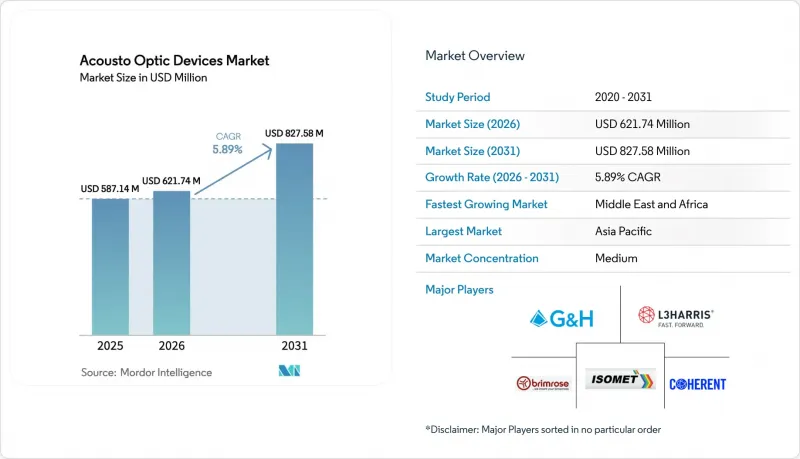
Mordor Intelligence에 의하면, 음향 광학 디바이스 시장 규모는 2025년에 5억 8,714만 달러로 평가되었고 2026년 6억 2,174만 달러에서 2031년까지 8억 2,758만 달러에 이를 것으로 예측되며, 예측 기간(2026-2031년) CAGR은 5.89%를 나타낼 전망입니다.
본 보고서는 디바이스 유형(음향 광학 변조기, 편향기, 기타), 재료(이산화텔루르(TeO₂), 리튬니오브산(LiNbO₃), 기타), 파장 범위(자외선, 가시광선, 기타),재구성 속도(저(1kHz 이하), 중(1-10kHz), 고(10kHz 이상)), 용도(재료 가공, 기타), 산업 분야(항공우주 및 방위, 기타), 지역별로 분류되어 있습니다. 시장 전망은 금액(달러) 기준으로 제시되어 있습니다.
세계 음향 광학 디바이스 시장 동향 및 인사이트
아시아 반도체 제조 공장에서의 초고속 레이저 마이크로 머시닝 생산 능력 확대
아시아의 주요 파운드리에서 초고속 레이저 워크스테이션 도입이 급증하고 있으며, 이는 나노초 규모의 펄스 게이팅을 구현하는 변조기 및 Q-스위치에 대한 수요를 촉진하고 있습니다. 중국의 장비 제조업체들은 첨단 패키징 라인이 더욱 미세한 재배선 층으로 전환됨에 따라 2024년 TeO2 변조기 출하량이 27% 증가했다고 보고하고 있습니다. 음향 광학 디바이스를 통한 서브미크론 수준의 빔 제어는 실리콘 관통 비아(TSV) 드릴링 및 웨이퍼 다이싱에서 수율 향상을 가능하게 하여, 해당 지역 전체에서 음향 광학 디바이스 시장의 지속적인 수요 증가가 예상됩니다.
5G·400G 광네트워크의 급속한 확산에 따른 AO 변조기 수요 견인
북미의 통신 사업자들은 기존 100G 링크를 400G 코히런트 광 디바이스로 교체하고 있으며, 이러한 전환에는 멀티 기가헤르츠의 심볼 레이트에서 높은 소광 성능을 발휘할 수 있는 변조기가 필요합니다. 음향 광학 위상 변조기는 처프가 작고 신뢰성 높은 열 성능을 갖추고 있어, 새로운 메트로 및 장거리 회선 구축에 최적의 구성 요소로 자리 잡고 있습니다. 데이터센터 상호 연결 제공업체들도 트래픽 밀도 증가에 따라 신호 무결성을 유지하기 위해 AO 기술을 선호하고 있으며, 이로 인해 2027년까지 음향 광학 디바이스 시장의 점진적인 성장이 뒷받침되고 있습니다.
광학용 이산화텔루르 결정의 만성적인 공급 부족
TeO₂는 구리 제련의 부산물로 생성되기 때문에 그 공급 상황은 포토닉스 부문 수요가 아닌 광업 사이클에 좌우됩니다. 정제 능력 확대가 지연되고 있으며, 결정 추출 시 수율 저하로 인해 리드 타임이 길어지고 가격도 변동하기 쉬운 상황이 지속되고 있습니다. 디바이스 제조업체들은 리튬니오브산염이나 칼코게나이드 유리와 같은 대체 소재를 채택하여 리스크 헤지를 도모하고 있지만, 이러한 전환에는 대개 설계 변경이 필요하며, 이는 음향 광학 디바이스 시장의 단기적인 이익률을 압박하게 됩니다.
부문 분석
음향 광학 디바이스 시장에서는 2025년 매출의 34.15%를 변조기가 차지하며, 이는 레이저 가공 장비 및 광 스위치에서의 보급 현황을 반영합니다. 최근 설계에서는 회절 효율이 83%에 달하여, 레이저 미세 가공 및 광섬유 통신 허브의 처리량 향상에 기여하고 있습니다.
연평균 성장률(CAGR) 6.09%로 성장하고 있는 AOTF(음향 광학 파장 가변 필터)는 하이퍼스펙트럼 탑재 기기 및 체외 진단 기기의 부상으로 혜택을 보고 있으며, 이러한 부문에서는 가동 부품이 없는 파장 선택 덕분에 유지보수가 최소화됩니다. 디플렉터, 주파수 변환기, Q-스위치는 꾸준한 수요를 뒷받침하고 있으며, 특히 Q-스위치는 플루언스의 균일성이 필수적인 의료용 펄스에서 선호되고 있습니다.
TeO2는 뛰어난 성능 지표와 넓은 투과 대역 덕분에 2025년 매출의 47.92%를 차지했으나, 공급 제약으로 인해 시스템 통합사업자들은 대체 소재로의 전환을 강요받고 있습니다. 리튬 니오브산염(LiNbO3) 솔루션용 음향 광학 디바이스 시장 규모는 박막 증착법을 통해 온칩 AO 변조기에 적합한 저손실 도파관이 제조됨에 따라 급속히 확대될 것으로 예측됩니다.
융합 실리카는 UV 포토리소그래피 부문에서 여전히 확고한 입지를 유지하고 있으며, Ge-Sb-Se 칼코겐화물 유리의 경우 실험 데이터를 통해 음향 광학 응답에서 석영보다 270배 높은 이득이 확인됨에 따라 관심이 높아지고 있습니다.
지역별 분석
아시아태평양은 2025년에 전 세계 매출의 35.94%를 차지하며, 이는 해당 지역의 전자기기 생산 우위와 웨이퍼 제조 능력 확대를 반영한 것입니다. 정책 입안자들은 국내 포토닉스 공급망에 대한 보조금 투자를 추진하고 있으며, 이는 절단, 천공, 검사용 툴에 사용되는 AO 부품의 소비를 촉진하고 있습니다. 5G 백홀 회선의 단기적 확대와 양자 보안 통신에 대한 연구가 이 지역의 음향 광학 디바이스 시장 내 주도적 위치를 더욱 공고히 하고 있습니다.
북미는 통신 사업자들이 광섬유망을 고밀도화하고, 클라우드 제공업체들이 장거리 대역폭을 업그레이드하고 있기 때문에 2위를 차지하고 있습니다. 지향성 에너지 및 LiDAR 시스템에 관한 국방 계약이 안정적인 수요를 창출하는 한편, 연방 정부의 자금 지원으로 파장 가변형 AO 소자에 의존하는 양자 포토닉스 프로젝트가 가속화되고 있습니다. 음향 광학 디바이스 시장 규모는 수직 통합형 공급업체 및 대학 연구 클러스터의 존재로 인해 더욱 강화되고 있습니다.
유럽은 고정밀 제조 및 의료 기술 채택을 기반으로 견실한 시장 점유율을 유지하고 있습니다. 독일, 영국, 프랑스는 초음속 모니터링용 고속 AO 디플렉터에 대한 연구 개발을 주도하고 있습니다. 우주에서의 지구관측 임무에 대한 규제 측면의 지원으로 인해 방사선 내성 AOTF에 대한 수요가 지속되고 있으며, 이는 음향 광학 디바이스 시장에 전문성이 높고 수익성이 뛰어난 수주를 가져오고 있습니다.
중동 및 아프리카는 현재 시장 규모는 작지만, 2031년까지 연평균 성장률(CAGR) 5.98%라는 업계 최고 수준의 성장이 예상됩니다. 경제 다각화를 도모하기 위한 각국의 포토닉스 제조 및 5G 인프라 구축 노력이 AO 변조기 및 Q-스위치에 대한 안정적인 수요를 창출하고 있습니다. 이스라엘과 남아프리카공화국에서 부상하고 있는 연구 거점에서는 물과 토양 모니터링을 위한 AO를 활용한 분광법이 연구되고 있어, 과학 부문에서 수요층도 확대되고 있습니다.
기타 혜택
- 엑셀 형식 시장 예측(ME) 시트
- 3개월간 애널리스트 지원
자주 묻는 질문
목차
제1장 서론
제2장 조사 방법
제3장 주요 요약
제4장 시장 구도
제5장 시장 규모와 성장 예측
제6장 경쟁 구도
제7장 시장 기회와 향후 전망
JHS 26.09.09According to Mordor Intelligence, the acousto optic devices market size was valued at USD 587.14 million in 2025 and estimated to grow from USD 621.74 million in 2026 to reach USD 827.58 million by 2031, at a CAGR of 5.89% during the forecast period (2026-2031).
This report is Segmented by Device Type (Acousto-Optic Modulators, Deflectors, and More), Material (Tellurium Dioxide Lithium Niobate, and More), Wavelength Range (Ultraviolet, Visible, and More), Reconfiguration Speed (Low, Medium, High), Application (Material Processing, and More), Vertical (Aerospace and Defense, and More) and Geography. The Market Forecasts are Provided in Terms of Value (USD).
Global Acousto Optic Devices Market Trends and Insights
Expanding Ultrafast-Laser Micro-Machining Capacity in Asian Semiconductor Fabs
Surging adoption of ultrafast-laser workstations across leading Asian foundries is feeding demand for modulators and Q-switches that supply nanosecond-scale pulse gating. Chinese tool builders reported a 27% rise in TeO2 modulator shipments during 2024 as advanced packaging lines shifted to finer redistribution layers. Sub-micron beam control delivered by acousto-optic devices enables higher yield in through-silicon-via drilling and wafer dicing, positioning the acousto optic devices market for sustained pull-through across the region.
Rapid 5G/400G Optical Network Roll-outs Driving AO Modulator Demand
North American carriers are replacing legacy 100 G links with 400 G coherent optics, a migration that requires modulators capable of high extinctions at multi-gigahertz symbol rates. Acousto-optic phase modulators offer low chirp and reliable thermal performance, making them the component of choice for new metro and long-haul builds. Data-center interconnect providers also favor AO technology to maintain signal integrity as traffic density rises, supporting incremental growth for the acousto optic devices market through 2027.
Persistent Shortage of Optical-Grade Tellurium Dioxide Crystals
TeO2 is grown as a by-product of copper smelting, linking availability to mining cycles rather than photonics demand. Slow ramp-ups in purification capacity and yield losses during crystal pull keep lead times extended and prices volatile. Device makers hedge by pursuing lithium niobate or chalcogenide glass alternatives, but such shifts often require redesigns that dilute near-term margins within the acousto optic devices market.
Other drivers and restraints analyzed in the detailed report include:
- Defense-Grade LiDAR Adoption for Hypersonic Threat Detection
- Growth of Hyperspectral Imaging Cubesats Fueling Space-Qualified AOTF Sales
- Complex RF-Driver Integration in Above 10 kHz Beam-Steering Systems
For complete list of drivers and restraints, kindly check the Table Of Contents.
Segment Analysis
The acousto optic devices market recorded 34.15% revenue from modulators in 2025, reflecting their ubiquity in laser processing tools and optical switches. Recent designs reach 83% diffraction efficiency, boosting throughput in laser micromachining and fiber communication hubs.
AOTFs, advancing at 6.09% CAGR, benefit from the rise of hyperspectral payloads and in-vitro diagnostics where motionless wavelength selection minimizes maintenance. Deflectors, frequency shifters, and Q-switches contribute resilient demand, with Q-switches favored for medical pulses where fluence uniformity is mandatory.
TeO2 delivered 47.92% of 2025 sales thanks to its superior figure-of-merit and broad transmission window, yet constrained supply pushes integrators toward substitutes. The acousto optic devices market size for lithium niobate solutions is projected to expand swiftly as thin-film deposition methods produce low-loss waveguides suitable for on-chip AO modulators.
Fused silica keeps a foothold in UV photolithography, and interest in Ge-Sb-Se chalcogenide glass is stirring after lab data showed a 270-fold gain over quartz in acousto-optic response.
Complete Report Scope:
- By Device Type
- Acousto-Optic Modulators
- Deflectors
- Frequency Shifters
- Q-Switches
- Tunable Filters (AOTF)
- Mode Lockers
- Pulse Pickers/Cavity Dumpers
- RF Drivers
- Other Device Types
- By Material
- Tellurium Dioxide (TeO?)
- Lithium Niobate (LiNbO?)
- Fused Silica
- Crystal Quartz
- Calcium Molybdate and Others
- By Wavelength Range
- Ultraviolet (200-400 nm)
- Visible (400-700 nm)
- Near-Infrared (700-1500 nm)
- Mid-Infrared (1500-3000 nm)
- Far-Infrared (Above 3000 nm)
- By Reconfiguration Speed
- Low (Less than 1 kHz)
- Medium (1-10 kHz)
- High (Above 10 kHz)
- By Application
- Material Processing
- Laser Macro-Processing
- Laser Micro-Processing
- Spectroscopy and Hyperspectral Imaging
- Optical Signal Processing
- Biomedical Imaging and Diagnostics
- Other Emerging (LiDAR, Quantum Photonics)
- Material Processing
- By Vertical
- Aerospace and Defense
- Telecommunications
- Semiconductor and Electronics Manufacturing
- Industrial Manufacturing
- Life Sciences and Scientific Research
- Medical
- Oil and Gas
- Others
- By Geography
- North America
- United States
- Canada
- Mexico
- Europe
- Germany
- United Kingdom
- France
- Italy
- Spain
- Nordics (Denmark, Sweden, Norway, Finland)
- Rest of Europe
- Asia-Pacific
- China
- Japan
- South Korea
- India
- Southeast Asia
- Australia
- Rest of Asia-Pacific-Pacific
- South America
- Brazil
- Argentina
- Rest of South America
- Middle East
- Gulf Cooperation Council Countries
- Turkey
- Rest of Middle East
- Africa
- South Africa
- Nigeria
- Rest of Africa
- North America
Geography Analysis
Asia Pacific generated 35.94% of global revenue in 2025, reflecting dominant electronics production and expanded wafer-fab capacity. Policymakers channel subsidies toward domestic photonics supply chains, lifting consumption of AO components in cutting, drilling, and inspection tools. Near-term expansion of 5G backhaul links and research into quantum secure communication further cements regional leadership in the acousto optic devices market.
North America ranks second as telecom carriers densify fiber and cloud providers upgrade long-haul bandwidth. Defense contracts for directed-energy and LiDAR systems add dependable volume, while federal funding accelerates quantum photonics projects that depend on tunable AO elements. The acousto optic devices market size is reinforced by the presence of vertically integrated suppliers and university research clusters.
Europe commands a solid share built on high-precision manufacturing and medical technology adoption. Germany, the UK, and France spearhead R&D into high-speed AO deflectors for hypersonic surveillance. Regulatory support for space-based Earth-observation missions keeps demand flowing for radiation-hardened AOTFs, enriching the acousto optic devices market with specialized high-margin orders.
The Middle East and Africa hold a smaller base today yet post a leading 5.98% CAGR through 2031. National initiatives to diversify economies into photonics fabrication and 5G infrastructure create steady pipelines for AO modulators and Q-switches. Emerging research hubs in Israel and South Africa explore AO-driven spectroscopy for water and soil monitoring, adding scientific demand layers.
- Gooch and Housego PLC
- Brimrose Corporation of America
- Isomet Corporation
- Coherent Corp.
- L3Harris Technologies Inc.
- AA Opto Electronics Ltd.
- Lightcomm Technology Co., Ltd.
- IntraAction Corporation
- AMS Technologies AG
- APE Angewandte Physik and Elektronik GmbH
- CASTECH Inc.
- Sintec Optronics Pte Ltd.
- Hamamatsu Photonics K.K.
- Ushio Inc.
- Excelitas Technologies Corp.
- Holo/Or Ltd.
- PhotonTec Berlin GmbH
- Neos Technologies
- A*P*E China
- Glen Optics
- MPB Communications Inc.
- OptoSigma Corporation
Additional Benefits:
- The market estimate (ME) sheet in Excel format
- 3 months of analyst support
TABLE OF CONTENTS
1 INTRODUCTION
- 1.1 Study Assumptions and Market Definition
- 1.2 Scope of the Study
2 RESEARCH METHODOLOGY
3 EXECUTIVE SUMMARY
4 MARKET LANDSCAPE
- 4.1 Market Overview
- 4.2 Market Drivers
- 4.2.1 Expanding Ultrafast-Laser Micro-Machining capacity in Asian Semiconductor Fabs
- 4.2.2 Rapid 5G/ 400 G Optical Network Roll-outs Driving AO Modulator Demand in North America
- 4.2.3 Defense-Grade LiDAR Adoption for Hypersonic Threat Detection in Europe
- 4.2.4 Growth of Hyperspectral Imaging Cubesats Fueling Space-Qualified AOTF Sales
- 4.2.5 Demand Surge for TeO?-Based AO Q-Switches in High-Energy Medical Lasers
- 4.2.6 Increasing Adoption of AO-Enabled Tunable Light Sources for Quantum Photonics R&D
- 4.3 Market Restraints
- 4.3.1 Persistent Shortage of Optical-Grade Tellurium Dioxide Crystals
- 4.3.2 Complex RF-Driver Integration in Above 10 kHz Beam-Steering Systems
- 4.3.3 Limited Thermal-Management Window in High-Power Mid-IR AO Devices
- 4.3.4 Fragmented Export-Control Regimes for Dual-Use AO Components
- 4.4 Industry Ecosystem Analysis
- 4.5 Technological Outlook
- 4.6 Porter's Five Forces Analysis
- 4.6.1 Threat of New Entrants
- 4.6.2 Bargaining Power of Buyers
- 4.6.3 Bargaining Power of Suppliers
- 4.6.4 Threat of Substitutes
- 4.6.5 Intensity of Competitive Rivalry
5 MARKET SIZE AND GROWTH FORECASTS (VALUE)
- 5.1 By Device Type
- 5.1.1 Acousto-Optic Modulators
- 5.1.2 Deflectors
- 5.1.3 Frequency Shifters
- 5.1.4 Q-Switches
- 5.1.5 Tunable Filters (AOTF)
- 5.1.6 Mode Lockers
- 5.1.7 Pulse Pickers/Cavity Dumpers
- 5.1.8 RF Drivers
- 5.1.9 Other Device Types
- 5.2 By Material
- 5.2.1 Tellurium Dioxide (TeO?)
- 5.2.2 Lithium Niobate (LiNbO?)
- 5.2.3 Fused Silica
- 5.2.4 Crystal Quartz
- 5.2.5 Calcium Molybdate and Others
- 5.3 By Wavelength Range
- 5.3.1 Ultraviolet (200-400 nm)
- 5.3.2 Visible (400-700 nm)
- 5.3.3 Near-Infrared (700-1500 nm)
- 5.3.4 Mid-Infrared (1500-3000 nm)
- 5.3.5 Far-Infrared (Above 3000 nm)
- 5.4 By Reconfiguration Speed
- 5.4.1 Low (Less than 1 kHz)
- 5.4.2 Medium (1-10 kHz)
- 5.4.3 High (Above 10 kHz)
- 5.5 By Application
- 5.5.1 Material Processing
- 5.5.1.1 Laser Macro-Processing
- 5.5.1.2 Laser Micro-Processing
- 5.5.2 Spectroscopy and Hyperspectral Imaging
- 5.5.3 Optical Signal Processing
- 5.5.4 Biomedical Imaging and Diagnostics
- 5.5.5 Other Emerging (LiDAR, Quantum Photonics)
- 5.5.1 Material Processing
- 5.6 By Vertical
- 5.6.1 Aerospace and Defense
- 5.6.2 Telecommunications
- 5.6.3 Semiconductor and Electronics Manufacturing
- 5.6.4 Industrial Manufacturing
- 5.6.5 Life Sciences and Scientific Research
- 5.6.6 Medical
- 5.6.7 Oil and Gas
- 5.6.8 Others
- 5.7 By Geography
- 5.7.1 North America
- 5.7.1.1 United States
- 5.7.1.2 Canada
- 5.7.1.3 Mexico
- 5.7.2 Europe
- 5.7.2.1 Germany
- 5.7.2.2 United Kingdom
- 5.7.2.3 France
- 5.7.2.4 Italy
- 5.7.2.5 Spain
- 5.7.2.6 Nordics (Denmark, Sweden, Norway, Finland)
- 5.7.2.7 Rest of Europe
- 5.7.3 Asia-Pacific
- 5.7.3.1 China
- 5.7.3.2 Japan
- 5.7.3.3 South Korea
- 5.7.3.4 India
- 5.7.3.5 Southeast Asia
- 5.7.3.6 Australia
- 5.7.3.7 Rest of Asia-Pacific-Pacific
- 5.7.4 South America
- 5.7.4.1 Brazil
- 5.7.4.2 Argentina
- 5.7.4.3 Rest of South America
- 5.7.5 Middle East
- 5.7.5.1 Gulf Cooperation Council Countries
- 5.7.5.2 Turkey
- 5.7.5.3 Rest of Middle East
- 5.7.6 Africa
- 5.7.6.1 South Africa
- 5.7.6.2 Nigeria
- 5.7.6.3 Rest of Africa
- 5.7.1 North America
6 COMPETITIVE LANDSCAPE
- 6.1 Market Concentration
- 6.2 Strategic Moves
- 6.3 Market Share Analysis
- 6.4 Company Profiles (includes Global level Overview, Market level overview, Core Segments, Financials as available, Strategic Information, Market Rank/Share, Products and Services, Recent Developments)
- 6.4.1 Gooch and Housego PLC
- 6.4.2 Brimrose Corporation of America
- 6.4.3 Isomet Corporation
- 6.4.4 Coherent Corp.
- 6.4.5 L3Harris Technologies Inc.
- 6.4.6 AA Opto Electronics Ltd.
- 6.4.7 Lightcomm Technology Co., Ltd.
- 6.4.8 IntraAction Corporation
- 6.4.9 AMS Technologies AG
- 6.4.10 APE Angewandte Physik and Elektronik GmbH
- 6.4.11 CASTECH Inc.
- 6.4.12 Sintec Optronics Pte Ltd.
- 6.4.13 Hamamatsu Photonics K.K.
- 6.4.14 Ushio Inc.
- 6.4.15 Excelitas Technologies Corp.
- 6.4.16 Holo/Or Ltd.
- 6.4.17 PhotonTec Berlin GmbH
- 6.4.18 Neos Technologies
- 6.4.19 A*P*E China
- 6.4.20 Glen Optics
- 6.4.21 MPB Communications Inc.
- 6.4.22 OptoSigma Corporation
7 MARKET OPPORTUNITIES AND FUTURE OUTLOOK
- 7.1 White-Space and Unmet-Need Assessment