

|
시장보고서
상품코드
2123071
컴퓨터 지원 제조 시장 : 시장 점유율 분석, 업계 동향 및 통계, 성장 예측(2026-2031년)Computer Aided Manufacturing - Market Share Analysis, Industry Trends & Statistics, Growth Forecasts (2026 - 2031) |
||||||
 Mordor Intelligence
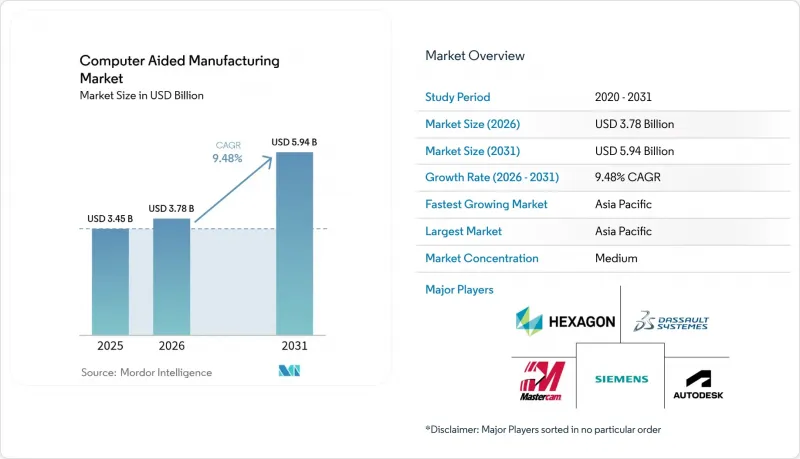
Mordor Intelligence에 의하면, 컴퓨터 지원 제조(CAM) 시장 규모는 2025년 34억 5,000만 달러로 평가되었고, 2026년에는 37억 8,000만 달러로 추정되고, 2026-2031년 CAGR 9.48%로 성장을 지속할 전망이며, 2031년에는 59억 4,000만 달러에 이를 것으로 예측됩니다.
본 보고서는 도입 모델별(온프레미스 및 클라우드 기반), 최종 사용자 산업별(항공우주 및 방위, 자동차, 의료기기 등), 구성 요소별(소프트웨어 및 서비스), 제조 공정별(밀링 가공, 선반 가공, 드릴링 가공 등), 그리고 지역별(북미, 남미, 유럽, 아시아태평양 등)별로 분류되어 있습니다. 시장 예측은 금액(달러) 기준으로 제시되어 있습니다.
세계의 컴퓨터 지원 제조(CAM) 시장 동향 및 인사이트
하이브리드 머시닝 센터의 부상이 생산 경제성을 혁신
하이브리드 시스템은 레이저 또는 지향성 에너지 적층과 고속 마무리 가공을 하나의 섀시 내에 통합하여, 2차 세팅이 불필요하게 하고 원자재 폐기물을 최대 40%까지 줄여줍니다. Siemens NX는 현재 ‘비드 온 월(벽면 비드 형성)’ 방식의 적층 및 마무리 가공 툴패스를 자동화하고 있어, 제조업체는 필요한 부위에만 재료를 적층한 뒤 항공우주 등급의 표면 마감을 구현할 수 있으며, 복잡한 티타늄 부품의 전체 사이클 타임을 25-30% 단축하고 있습니다. 실제 환경에서의 도입은 여전히 마이크로초 단위의 시간 범위 내에서 적층 가공과 절삭 가공의 동작을 동기화하도록 훈련받은 작업자에 의존하고 있으며, 이러한 기술은 대부분의 주문 생산 공장에서 부족한 실정입니다.
인더스트리 4.0의 디지털 스레드가 예측형 제조를 실현
폐루프형 플랫폼은 CAM 프로그래밍 매개변수를 스핀들의 출력, 진동 및 공구 마모에 대한 실시간 센서 데이터와 연동합니다. Hexagon의 알고리즘은 공구 고장을 15-20분 전에 감지하고, 표면 품질을 공차 범위 내로 유지하도록 이송 속도를 자동 조정함으로써, 파손되기 쉬운 항공우주용 합금의 스크랩을 줄입니다. 이러한 솔루션은 고밀도 센서 네트워크와 높은 처리량의 분석 처리가 필요하기 때문에 부품의 가치가 설비 투자를 정당화할 수 있는 공장에만 도입이 제한됩니다.
오픈소스 CAM 대체 도구가 상용 가격 모델에 도전장을 내밀다.
FreeCAD PathWorkbench는 라이선스 비용 없이 2.5축 G 코드를 출력할 수 있게 되어, 학교나 소규모 작업장에 신뢰할 수 있는 보급형 선택지가 되었습니다. 상용 벤더들은 AI 기반 최적화 및 클라우드 협업과 같은 기능을 묶어 제공함으로써 이에 대응하고 있습니다. 이러한 기능들은 대부분의 커뮤니티 프로젝트의 계산 능력을 능가하지만, 기본 모듈이 범용화되는 추세에 대한 대책도 마련해야 합니다.
부문 분석
클라우드 호스팅형 제품군은 컴퓨터 지원 제조(CAM) 시장 전체에서는 여전히 소수이지만, 2031년까지 연평균 성장률(CAGR)이 10.72%에 달한다는 점은 이러한 추세가 돌이킬 수 없음을 뒷받침합니다. 3개 대륙에 공장을 두고 있는 항공우주 기업 그룹은 브라우저 기반 툴패스 편집 기능을 활용하여 하룻밤 사이에 작업을 인계받고, 리드 타임을 20-25% 단축하고 있습니다. 방위 관련 계약업체들은 ITAR 규정에 따라 현장 데이터 주권이 요구되기 때문에 완전한 전환에는 소극적입니다. 그 결과, 클라우드 솔버에 연결된 로컬 포스트프로세서로 구성된 하이브리드 스택이 그 가교 역할을 수행하고 있습니다. 엣지 게이트웨이는 OPC-UA나 MTConnect를 지원하지 않는 구형 기계에 사후 적용하여, 컨트롤러를 교체하지 않고도 암호화된 데이터를 스트리밍할 수 있게 해줍니다. 구독 모델을 통해 비용이 자본 예산에서 운영비로 전환됨에 따라, 그동안 소프트웨어 업그레이드를 미루어 왔던 소규모 공장에게는 큰 혜택이 되고 있습니다. 또한 클라우드 분석을 통해 벤더는 익명화된 기계군 전체의 스핀들 가동률을 벤치마킹할 수 있게 되었으며, 해당 데이터는 예측 유지보수 대시보드에 반영되어 예기치 않은 가동 중지 시간을 대폭 줄여줍니다. 제로 트러스트 아키텍처가 성숙해짐에 따라, 보수적인 업계조차 2027년까지 시범 전환을 계획하고 있으며, 이는 컴퓨터 지원 제조(CAM) 시장이 다음 예산 주기 내에 클라우드 도입에 대한 심리적 장벽을 극복할 것임을 시사합니다.
그렇지만 에어 갭이 적용된 네트워크나 독자적인 합금 배합을 사용하는 공장의 경우, 온프레미스 기반은 여전히 필수적입니다. 각 벤더는 방화벽 내부에 배치되어 있으면서도 선별된 메타데이터를 클라우드 저장소에 동기화하여 원격지의 전문가가 이용할 수 있도록 하는 ‘디지털 스레드’ 모듈의 라이선스 제공을 통해 이러한 고객을 확보하기 위해 노력하고 있습니다. 이러한 이중 전략을 통해 고객이 하이브리드 분석으로 전환함에 따라 라이선스 갱신이 안정화되는 동시에 지속적인 수익도 증가합니다. 향후에는 플랫폼의 구독 계층에 따라 클라우드 컴퓨팅 크레딧의 유효·무효가 전환되게 될 것이므로, 도입 모드별 개별 가격 책정은 사라질 가능성이 있습니다. 현재 공작기계의 네트워크 노출이 사이버 보험료에 반영됨에 따라, CFO들은 총 소유 비용(TCO) 산정에 보안 인증을 점점 더 많이 반영하고 있습니다. 그 결과, 컴퓨터 지원 제조(CAM) 시장은 ‘클라우드 대 온프레미스’라는 이분법적 선택이 아닌, 유연한 테넌트 모델로 진화하고 있습니다.
2025년에는 자동차 산업이 매출의 35.85%를 차지했으며, 광의의 컴퓨터 지원 제조 시장의 핵심 부문이 될 전망입니다. 그러나 내연기관용 가공에서 전기차용 부품으로의 전환은 오랫동안 사용되어 온 툴패스 라이브러리에 과제를 안겨주고 있습니다. 배터리 트레이의 밀링 가공에는 고실리콘 알루미늄에서 처리량을 유지하면서 채터링을 억제하는 얇은 두께 가공 전략이 요구됩니다. 한편, 항공우주 및 방위 분야는 규모는 작지만 5축 가공 및 복합재 가공용 프리미엄 라이선스가 필요합니다. 의료기기 제조업체는 ISO 13485의 추적성 요건을 충족하기 위해 AI를 활용한 파라미터 조정을 도입하고 있으며, 이를 통해 단일 작업자가 수행하는 셀 생산에서도 수동 편집 없이 10µm 미만의 공차를 달성할 수 있게 되었습니다. 전자기기 및 반도체 패키징 작업자는 10만 rpm에서 비아 홀 가공 중 구리 박리를 방지하기 위해 열을 고려한 드릴 순서가 필요합니다. 이는 틈새 분야이지만, 최신 CAM 모듈은 물리 솔버를 통해 이 요구 사항을 충족하고 있습니다. 분야 간의 상호 영향도 커지고 있습니다. 의료기기 제조업체는 항공우주 분야의 표면 마감 공정을 채택하고 있으며, 자동차 부품 공급업체는 배터리 모듈을 위해 웨이퍼 제조 공장의 클린룸 기준을 도입하고 있어, 이로 인해 컴퓨터 지원 제조(CAM)의 총 잠재 시장이 확대되고 있습니다.
자동차 제조 업계 내부의 다양화도 마찬가지로 두드러집니다. 구조 부품의 기가 캐스팅으로 인해 수십 유형의 프레스 부품이 불필요해지지만, 반면 다이캐스팅 알루미늄의 대량의 CNC 마감 가공이 필요해지며, 높은 재료 제거율과 견고한 공구 수명 모델이 요구됩니다. 이러한 생산 라인에 투자하는 공급업체들은 20시간의 무인 교대 근무 동안 공구 마모로 인한 위치 편차를 자동으로 보정하는 소프트웨어를 요구하고 있습니다. 대조적으로, 틈새 시장을 공략하는 하이퍼카 제조업체들은 탄소섬유 트림에 주력하고 있으며, 5축 라우터를 사용하여 생산 주기마다 프로브를 통해 가공 경로를 갱신하고 있습니다. 이러한 다양화로 인해 하나의 수직 시장이 여러 CAM 라이선스 계층에 걸쳐 있게 되어, 자동차 총 생산 대수가 정체되더라도 컴퓨터 지원 제조(CAM) 시장의 깊이가 유지될 것이 보장됩니다.
지역별 분석
아시아태평양의 46.75%라는 점유율은 이 지역의 제조업에서 그 존재감을 두드러지게 하고 있지만, 이 지역은 여전히 CNC 프로토콜의 파편화로 인해 어려움을 겪고 있으며, 이로 인해 플러그 앤 플레이 방식의 상호 운용성이 복잡해지고 있습니다. 중국의 정책은 국산 컨트롤러에 연계된 독자적인 CAM 알고리즘을 우대하고 있어, 이로 인해 병행된 생태계가 형성되고 있습니다. 세계 벤더들은 이중 언어 지원 포스트 프로세서 및 개방형 API 툴 라이브러리를 통해 이러한 격차를 해소해야 합니다. 일본의 공작기계 OEM 업체들은 CAM을 제어 펌웨어에 직접 통합하고 있어, 이로 인해 툴 패스 로딩 시간은 단축되지만 고객은 독자적인 사양의 스택에 얽매이게 됩니다. 인도의 ‘생산 연계형 인센티브(PLI)’ 제도에서는 노동력의 기술 향상과 연계될 경우 CAM 라이선스에 대한 보조금이 지급되므로, 벤더는 2030년까지 기존 거대 기업에 필적할 가능성이 있는 신흥 중견 시장에 발판을 마련할 수 있습니다.
북미 사용자들은 클라우드 도입에 앞서 있습니다. 그 원인 중 하나로, ‘CHIPS 법’에 따라 520억 달러가 지역 팹에 투입되고 있어, 시설용량이 완성되기보다 앞서 분산형 프로그래밍이 필요하게 된 점을 들 수 있습니다. 유럽은 에너지 효율이 높은 가공을 추진하고 있으며, 압축 공기 절감 및 공구 재사용에 관한 목표를 의무화하고 있습니다. 이에 반해, CAM 전략 시뮬레이터는 현재 부품 1개당 kW시 단위로 모델링을 수행하고 있습니다. 데이터 주권에 관한 규제는 장벽이 되지만, Tier 1 공급업체들은 공장 간 최적화 알고리즘의 활용을 대가로 지역별 데이터 레이크를 수용하고 있습니다. 이러한 지역별 미묘한 차이로 인해 컴퓨터 지원 제조(CAM) 시장은 폭넓은 다양성을 유지하고 있으며, 특정 지역의 경기 침체 영향을 완화하고 있습니다.
기타 혜택 :
- 엑셀 형식 시장 예측(ME) 시트
- 3개월간의 애널리스트 지원
자주 묻는 질문
목차
제1장 서론
제2장 조사 방법
제3장 주요 요약
제4장 시장 구도
제5장 시장 규모 및 성장 예측
제6장 경쟁 구도
제7장 시장 기회 및 향후 전망
AJY 26.09.07According to Mordor Intelligence, the computer aided manufacturing market size is expected to grow from USD 3.45 billion in 2025 to USD 3.78 billion in 2026 and is forecast to reach USD 5.94 billion by 2031 at 9.48% CAGR over 2026-2031.
This report is Segmented by Deployment Model (On-Premises, and Cloud-Based), End-User Industry (Aerospace and Defense, Automotive, Medical Devices, and More), Component (Software, and Services), Manufacturing Process (Milling, Turning, Drilling, and More), and Geography (North America, South America, Europe, Asia-Pacific, and More). The Market Forecasts are Provided in Terms of Value (USD).
Global Computer Aided Manufacturing Market Trends and Insights
Rise in Hybrid Machining Centers Transforms Production Economics
Hybrid systems integrate laser or directed-energy deposition with high-speed finishing inside one enclosure, eliminating secondary setups and cutting raw-material waste by up to 40%. Siemens NX now automates bead-on-wall deposition and finishing toolpaths so manufacturers deposit material only where needed before achieving aerospace-grade surface finish, reducing overall cycle time for complex titanium parts by 25-30%. Real-world rollouts still hinge on operators trained to synchronize additive and subtractive motions within microsecond windows, a skill set in short supply across most job shops.
Industry 4.0 Digital Threads Enable Predictive Manufacturing
Closed-loop platforms connect CAM programming parameters to real-time spindle power, vibration, and tool-wear sensors. Hexagon algorithms detect impending tool failure 15-20 minutes in advance and auto-adjust feed rates to hold surface quality within tolerance, mitigating scrap on fragile aerospace alloys. These solutions require dense sensor networks and high-throughput analytics, restricting adoption to plants where part value justifies the capital outlay.
Open-Source CAM Alternatives Challenge Commercial Pricing Models
FreeCAD PathWorkbench now outputs 2.5-axis G-code at no license cost, making it a credible entry-level choice for schools and micro-workshops. Commercial vendors counter by bundling AI-driven optimization and cloud collaboration, features that exceed the computing means of most community projects, yet must guard against basic modules edging toward commoditization.
Other drivers and restraints analyzed in the detailed report include:
- Ultra-Precision Packaging Lines Drive CAM Innovation
- EV Platform Localization Accelerates Precision Machining Demand
- Skills Gap in CNC Programming Constrains Market Expansion
For complete list of drivers and restraints, kindly check the Table Of Contents.
Segment Analysis
Cloud-hosted suites still represent a minority of the overall Computer Aided Manufacturing market, but their 10.72% CAGR through 2031 underscores an irreversible direction. Aerospace groups with plants on three continents rely on browser-based toolpath editing to hand off jobs overnight, trimming lead times by 20-25%. Defense contractors resist full migration because ITAR rules demand onsite data sovereignty; consequently, hybrid stacks local post-processors linked to cloud solvers form the bridge. Edge gateways retrofit older machines lacking OPC-UA or MTConnect, letting them stream encrypted data without controller replacement. Subscription models shift costs from capital budgets to operating expenses, a boon for small shops that previously deferred software upgrades. Cloud analytics also enable vendors to benchmark spindle utilization across an anonymized fleet, feeding predictive-maintenance dashboards that slash unscheduled downtime. As zero-trust architectures mature, even conservative sectors plan pilot migrations by 2027, suggesting the Computer Aided Manufacturing market will cross a psychological cloud-adoption threshold within the next budget cycle.
The on-premises base nevertheless remains indispensable for plants with air-gapped networks and proprietary alloy formulations. Vendors court these accounts by licensing digital-thread modules that reside behind the firewall yet sync selected metadata to a cloud vault for remote experts. This twin-track strategy stabilizes license renewals while boosting recurring revenue as customers graduate to hybrid analytics. Over time, discrete pricing between deployment modes may vanish as platform subscription tiers simply toggle cloud compute credits on or off. With cyber-insurance premiums now reflecting machine-tool network exposure, CFOs increasingly factor security accreditation into total cost of ownership. Consequently, the Computer-Aided Manufacturing market is evolving toward flexible tenancy rather than binary cloud-versus-on-site choices.
Automotive held 35.85% revenue in 2025, making it the anchor segment of the broader Compute Aided Manufacturing market. Yet the shift from internal-combustion machining to electric-vehicle parts challenges long-standing toolpath libraries. Battery tray milling demands thin-wall strategies that manage chatter while sustaining throughput in high-silicon aluminum. Meanwhile, aerospace and defense, though smaller, command premium licenses for 5-axis and composite machining. Medical-device firms adopt AI-assisted parameter tuning to meet ISO 13485 traceability, letting single-operator cells hit sub-10 µm tolerances without manual edits. Electronics and semiconductor packaging operators require thermal-aware drill sequencing to prevent copper delamination during 100,000-rpm via drilling, a niche that the latest CAM modules fulfill through physics solvers. Cross-pollination is rising: medical device shops replicate aerospace surface-finish routines, while automotive tiers import wafer-fab cleanliness protocols for battery modules, expanding the total addressable market of Computer Aided Manufacturing.
Diversification inside automaking is equally profound. Gigacasting of structural components eliminates dozens of stamped parts, but introduces massive CNC finishing of die-cast aluminum, requiring high material-removal rates and robust tool-life models. Suppliers investing in these cells demand software that auto-compensates for tool-wear drift across 20-hour unmanned shifts. In contrast, niche hypercar builders focus on carbon-fiber trim, using 5-axis routers and probe-based path updates each production cycle. Such divergence means one vertical now spans multiple CAM license tiers, ensuring that the Computer Aided Manufacturing market retains depth even if overall car volumes level off.
Complete Report Scope:
- By Deployment Model
- On-Premises
- Cloud-Based
- By End-User Industry
- Aerospace and Defence
- Automotive
- Medical Devices
- Energy and Utilities
- Electronics and Semiconductor
- Industrial Machinery
- By Component
- Software
- Services
- By Manufacturing Process
- Milling
- Turning
- Drilling
- Multi-Axis / 5-Axis
- Additive Manufacturing
- By Geography
- North America
- United States
- Canada
- Mexico
- South America
- Brazil
- Argentina
- Rest of South America
- Europe
- Germany
- United Kingdom
- France
- Russia
- Rest of Europe
- Asia-Pacific
- China
- Japan
- India
- South Korea
- South-East Asia
- Rest of Asia-Pacific
- Middle East and Africa
- Middle East
- Saudi Arabia
- United Arab Emirates
- Rest of Middle East
- Africa
- South Africa
- Egypt
- Rest of Africa
- Middle East
- North America
Geography Analysis
Asia-Pacific's 46.75% share underscores its manufacturing heft, yet the region still wrestles with CNC protocol fragmentation that complicates plug-and-play interoperability. Chinese policy favors indigenous CAM algorithms tied to homegrown controllers, spurring parallel ecosystems that global vendors must bridge through dual-language post-processors and open-API tool libraries. Japan's machine OEMs integrate CAM directly into control firmware, shortening toolpath load times but locking customers into proprietary stacks. India's Production Linked Incentive schemes subsidize CAM licenses if tied to workforce upskilling, giving vendors a foothold in an emerging mid-market that could rival traditional giants by 2030.
North American users lead in cloud adoption, partly because the CHIPS Act funnels USD 52 billion into regional fabs that require distributed programming sooner than brick-and-mortar capacity is completed. Europe champions energy-efficient machining, mandating compressed-air reduction and tool reuse targets that CAM strategy simulators now model in kilowatt-hours per part. Data-sovereignty rules add friction, but tier-one suppliers accept localized data lakes in exchange for cross-plant optimization algorithms. These regional nuances ensure the Computer Aided Manufacturing market maintains broad diversification, cushioning it against localized downturns.
- Autodesk Inc.
- Siemens Digital Industries Software (Siemens AG)
- Dassault Systemes SE
- Hexagon AB (Hexagon Manufacturing Intelligence)
- CNC Software LLC (Mastercam)
- HCL Technologies Ltd.
- OPEN MIND Technologies AG
- SolidCAM Ltd.
- Cimatron Ltd.
- NTT Data Engineering Systems Corp.
- BobCAD-CAM Inc.
- MecSoft Corporation
- PTC Inc.
- ZWSOFT Co. Ltd.
- SmartCAMcnc Inc.
- GibbsCAM (3D Systems Corp.)
- Hypertherm Inc.
- SprutCAM Tech Ltd.
Additional Benefits:
- The market estimate (ME) sheet in Excel format
- 3 months of analyst support
TABLE OF CONTENTS
1 INTRODUCTION
- 1.1 Study Assumptions and Market Definition
- 1.2 Scope of the Study
2 RESEARCH METHODOLOGY
3 EXECUTIVE SUMMARY
4 MARKET LANDSCAPE
- 4.1 Market Overview
- 4.2 Market Drivers
- 4.2.1 Rise in hybrid (subtractive + additive) machining centres
- 4.2.2 Expanding adoption of Industry 4.0-ready digital threads
- 4.2.3 Demand for ultra-precision parts in advanced packaging lines
- 4.2.4 Agile production needs for EV platform localisation
- 4.2.5 Shift toward cloud-native CAM for multi-site collaboration
- 4.2.6 Government re-shoring incentives for strategic sectors
- 4.3 Market Restraints
- 4.3.1 Proliferation of open-source / low-cost CAM alternatives
- 4.3.2 Persistent skills gap in NC programming and post-processing
- 4.3.3 IP-security concerns with cloud adoption in defence firms
- 4.3.4 Fragmented machine-tool controller standards
- 4.4 Industry Value Chain Analysis
- 4.5 Regulatory Landscape
- 4.6 Technological Outlook
- 4.7 Impact of Macroeconomic Factors
- 4.8 Porter's Five Forces Analysis
- 4.8.1 Bargaining Power of Suppliers
- 4.8.2 Bargaining Power of Buyers
- 4.8.3 Threat of New Entrants
- 4.8.4 Threat of Substitutes
- 4.8.5 Intensity of Competitive Rivalry
5 MARKET SIZE AND GROWTH FORECASTS (VALUE)
- 5.1 By Deployment Model
- 5.1.1 On-Premises
- 5.1.2 Cloud-Based
- 5.2 By End-User Industry
- 5.2.1 Aerospace and Defence
- 5.2.2 Automotive
- 5.2.3 Medical Devices
- 5.2.4 Energy and Utilities
- 5.2.5 Electronics and Semiconductor
- 5.2.6 Industrial Machinery
- 5.3 By Component
- 5.3.1 Software
- 5.3.2 Services
- 5.4 By Manufacturing Process
- 5.4.1 Milling
- 5.4.2 Turning
- 5.4.3 Drilling
- 5.4.4 Multi-Axis / 5-Axis
- 5.4.5 Additive Manufacturing
- 5.5 By Geography
- 5.5.1 North America
- 5.5.1.1 United States
- 5.5.1.2 Canada
- 5.5.1.3 Mexico
- 5.5.2 South America
- 5.5.2.1 Brazil
- 5.5.2.2 Argentina
- 5.5.2.3 Rest of South America
- 5.5.3 Europe
- 5.5.3.1 Germany
- 5.5.3.2 United Kingdom
- 5.5.3.3 France
- 5.5.3.4 Russia
- 5.5.3.5 Rest of Europe
- 5.5.4 Asia-Pacific
- 5.5.4.1 China
- 5.5.4.2 Japan
- 5.5.4.3 India
- 5.5.4.4 South Korea
- 5.5.4.5 South-East Asia
- 5.5.4.6 Rest of Asia-Pacific
- 5.5.5 Middle East and Africa
- 5.5.5.1 Middle East
- 5.5.5.1.1 Saudi Arabia
- 5.5.5.1.2 United Arab Emirates
- 5.5.5.1.3 Rest of Middle East
- 5.5.5.2 Africa
- 5.5.5.2.1 South Africa
- 5.5.5.2.2 Egypt
- 5.5.5.2.3 Rest of Africa
- 5.5.5.1 Middle East
- 5.5.1 North America
6 COMPETITIVE LANDSCAPE
- 6.1 Market Concentration
- 6.2 Strategic Moves
- 6.3 Market Share Analysis
- 6.4 Company Profiles (includes Global level Overview, Market level overview, Core Segments, Financials as available, Strategic Information, Market Rank/Share for key companies, Products and Services, and Recent Developments)
- 6.4.1 Autodesk Inc.
- 6.4.2 Siemens Digital Industries Software (Siemens AG)
- 6.4.3 Dassault Systemes SE
- 6.4.4 Hexagon AB (Hexagon Manufacturing Intelligence)
- 6.4.5 CNC Software LLC (Mastercam)
- 6.4.6 HCL Technologies Ltd.
- 6.4.7 OPEN MIND Technologies AG
- 6.4.8 SolidCAM Ltd.
- 6.4.9 Cimatron Ltd.
- 6.4.10 NTT Data Engineering Systems Corp.
- 6.4.11 BobCAD-CAM Inc.
- 6.4.12 MecSoft Corporation
- 6.4.13 PTC Inc.
- 6.4.14 ZWSOFT Co. Ltd.
- 6.4.15 SmartCAMcnc Inc.
- 6.4.16 GibbsCAM (3D Systems Corp.)
- 6.4.17 Hypertherm Inc.
- 6.4.18 SprutCAM Tech Ltd.
7 MARKET OPPORTUNITIES AND FUTURE OUTLOOK
- 7.1 White-space and Unmet-Need Assessment


