|
시장보고서
상품코드
2123089
탄소 포집 및 저장 시장 : 점유율 분석, 업계 동향과 통계, 성장 예측(2026-2031년)Carbon Capture And Storage - Market Share Analysis, Industry Trends & Statistics, Growth Forecasts (2026 - 2031) |
||||||
 Mordor Intelligence
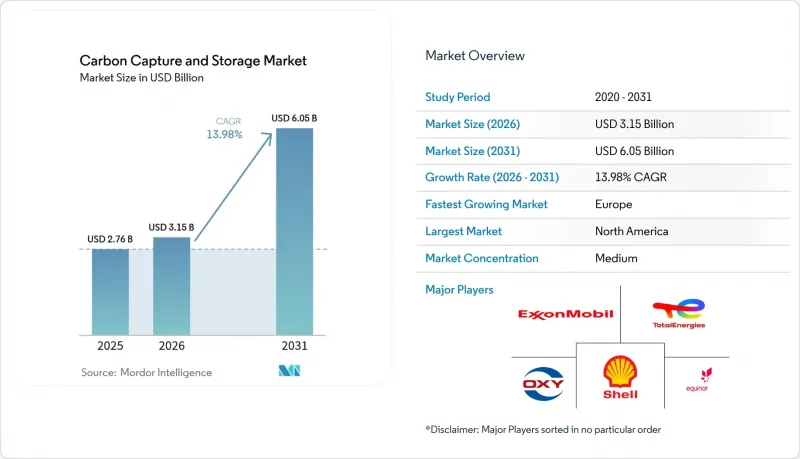
Mordor Intelligence에 의하면, 탄소 포집 및 저장(CCS) 시장 규모는 2025년 27억 6,000만 달러에서 2026년에는 31억 5,000만 달러로 확대되어 2026년부터 2031년까지 CAGR 13.98%로 성장을 지속하여, 2031년까지 60억 5,000만 달러에 이를 것으로 예측됩니다.
본 보고서는 기술별(연소 전 포집, 연소 후 포집, 산소 연료 연소 포집), 최종 사용자 산업별(석유 및 가스, 석탄·바이오매스 발전소, 철강, 시멘트, 화학), 지역별(아시아태평양, 북미, 유럽, 남미, 중동 및 아프리카)로 분류되어 있습니다. 시장 전망은 금액(달러) 기준으로 제시되어 있습니다.
전 세계 탄소 포집 및 저장(CCS) 시장 동향과 인사이트
CO2-EOR 프로젝트에 대한 수요 증가
석유 증진 회수(EOR)는 회수된 탄소를 수익화함과 동시에 성숙한 유전의 생산 기간을 연장하는 이중 수익원을 창출하기 때문에 다시 주목을 받고 있습니다. 주요 석유 기업들은 비료, 철강, 석유화학 분야의 배출원을 고갈된 유전과 연계하여, 도입 초기 단계에서 회수 거점을 수익을 창출하는 자산으로 전환하고 있습니다. 이러한 접근 방식을 통해 투자 회수 기간이 단축되고, 주요 고객을 확보할 수 있으며, 이미 광범위한 파이프라인망을 보유한 지역에서의 인프라 구축이 가속화됩니다. 또한, 대량의 CO₂를 다루는 실무 경험도 얻을 수 있어, EOR 수요가 시간이 지남에 따라 감소해 가는 가운데 순수한 저장 프로젝트로 이어지는 가교 역할을 할 수 있습니다. 증산분에 따른 수익 전망이 서게 됨에 따라, 투자자는 회수 플랜트나 주입정에 필요한 막대한 초기 투자를 정당화할 수 있으며, 독립적인 격리 서비스로의 전환을 원활하게 진행할 수 있습니다.
탄소 가격 책정 및 배출권 거래(ETS) 제도의 확대
탄소 시장은 현재 배출권 거래제를 넘어 국경 조정 및 부문별 과세까지 확대되고 있으며, 규제 대상 지역으로 수출하는 제조업체의 경제적 계산 방식을 변화시키고 있습니다. EU의 ‘탄소 국경 조정 메커니즘(CBAM)’은 배출량이 많은 수입품에 그림자 가격을 적용하여 해외 생산자들에게 CCS 투자를 강요하고, 그렇지 않을 경우 시장 점유율을 잃을 위험을 안기게 합니다. 캘리포니아주는 배출권 거래제를 2030년까지 연장하고 배출권 할당 기준을 강화했습니다. 이로 인해 CCS는 기업의 사회적 책임(CSR)을 위한 부가적인 노력이라기보다는 규정 준수 비용을 회피하기 위한 수단이 되고 있습니다. 자발적 탄소 시장은 성숙해 가고 있으며, 추가성에 대한 의문은 남아 있지만, 검증된 저장 톤수에 대해 2차 수익 창출의 길을 열어주고 있습니다. 이러한 정책 수단들은 각각 배출 감축의 최저 가격을 끌어올려, 회수 비용과 시장 인센티브 간의 경제적 격차를 좁히고 있습니다.
CCS 플랜트의 높은 CAPEX 및 OPEX
산업 규모의 시설에는 일반적으로 5억-8억 달러의 선행 투자가 필요하기 때문에 정책의 확실성이 낮은 상황에서는 자기자본 조달을 확보하기 어렵습니다. 회수 비용을 톤당 30달러까지 낮추는 Carbon Clean의 CycloneCC와 같은 혁신적인 용매 시스템조차도 아직 상업적 규모의 경제성을 입증하지 못하고 있습니다. 게다가 운영 비용에는 플랜트의 기준 효율을 15-30% 저하시키는 에너지 손실이 크게 부담으로 작용하고 있어, 사업자는 추가 전력을 구매하거나 생산량 감소를 감수해야 하는 선택의 기로에 서 있습니다. 개발도상국에서는 우대 대출 이용이 여전히 제한적이기 때문에 상당한 배출 감축이 필요함에도 불구하고 도입이 지연되고 있습니다. 따라서 높은 자본 집약성으로 인해 투자 회수 기간이 길어지며, 위험을 감당할 수 있는 대기업이나 국영 기업으로만 조기 도입자의 범위가 제한되고 있습니다.
부문별 분석
2025년, 연소 전 포집은 탄소 포집 및 저장(CCS) 시장 점유율의 81.45%를 차지했습니다. 이는 정유시설나 화학 단지에 이미 널리 보급된 증기 메탄 개질 장치나 바이오매스 가스화 장치와 호환성이 좋기 때문입니다. 이 부문은 수십 년에 걸친 운영 데이터와 그린필드 건설 시 도입할 경우 발생하는 증분 비용이 낮다는 장점이 있습니다. 그러나 이 공정에는 20-25%의 에너지 손실이 수반되며, 용매 재생에는 여전히 막대한 자본이 필요합니다. 산소 연소법은 브레비크 시멘트 공장과 같이 대규모 배가스 분리가 필요 없이 공정 배출 가스를 회수하는 프로젝트에 힘입어, 2031년까지 연평균 성장률(CAGR) 18.21%를 나타낼 것으로 예측됩니다. 순수 산소 속에서 연료를 연소시킴으로써 배기 가스는 거의 순수한 CO₂가 되며, 다운스트림 공정에서의 압축이 간소화됩니다. 각 기술 공급업체들은 기존 설비에 도입하기에 적합한 모듈식 산소 연소 유닛을 출시하고 있으며, 공기 분리 기술의 경제성 향상으로 인해 연소 후 회수 방식에 대한 경쟁력이 강화되고 있습니다. 중공업 부문이 효율 저하를 최소화하면서 대폭적인 배출 감축을 목표로 하는 가운데, 산소 연소 방식 시장 점유율은 급속히 확대될 것으로 예상되며, 탄소 포집 및 저장(CCS) 시장에서 오랫동안 선두를 달려온 연소 전 포집 방식에 도전하게 될 것으로 전망됩니다.
지역별 분석
2025년에는 북미가 탄소 포집 및 저장(CCS) 시장 점유율의 50.72%를 차지하며 1위를 차지할 전망입니다. 이는 직접 공기 포집(DAC)에 대해 톤당 85달러, 점원 포집에 대해 60달러를 제공하는 넉넉한 ‘45Q’ 세액 공제에 힘입은 결과입니다. 미국 멕시코만 연안 지역에는 배출원, 파이프라인 회랑, 염수 대수층이 집중되어 있어, 엑슨모빌(ExxonMobil)이 제안한 1,000억 달러 규모의 휴스턴 선박 운하 네트워크와 같은 허브 구상의 실현이 가능해졌습니다. 캐나다는 DAC(직접 대기 포집) 설비에 대해 60%, 기타 포집 시스템에 대해 50%의 투자 세액 공제를 마련하여 이 지역을 보완하고 있으며, Strathcona Resources와 Canada Growth Fund의 20억 달러 규모의 파트너십과 같은 합작 투자를 촉진하고 있습니다. 멕시코는 국경을 넘는 운송 파트너로서의 입지를 확립하고, 고갈된 해상 유전에 대한 공동 저장 솔루션을 검토하고 있습니다.
유럽은 혁신 기금, EU 배출권 거래 제도(EU ETS),그리고 2025년 노던 라이츠에서 CO₂ 주입을 시작한 노르웨이의 선구적인 ‘롱십(Longship)’ 프로젝트에 힘입어, 2026년부터 2031년까지 26.05%라는 가장 높은 연평균 성장률(CAGR)을 나타낼 전망입니다. 독일의 CCS 법안 초안에서는 육상 저장의 금지가 철회되어 북독일 분지가 이용 가능해집니다. 한편, 네덜란드는 ‘Porthos’ 허브를 추진하고 있으며, 영국은 ‘HyNet’ 및 ‘Teesside’ 클러스터를 추진하고 있습니다. 국경을 넘는 수송 협정이 성숙해감에 따라, 인프라 공유를 통해 소규모 산업 배출 사업자의 단위 비용이 낮아지고 있습니다. 탄소 가격 책정, 국경세, 전용 공공 보조금의 조합이 민간 투자를 가속화하여, 유럽이 앞서가는 북미와의 격차를 확실히 좁히는 데 기여할 것입니다.
아시아태평양은 중국의 2060년 탄소 중립 공약과 2025년에 실시된 최초의 산소 연소 시멘트 실증 실험(이 실험을 통해 해당 지역의 공정 산업에 적합한 기술임이 입증되었습니다)에 힘입어 장기적으로 가장 큰 성장 잠재력을 지니고 있습니다. 일본은 호주와 액화 CO₂ 수송 경로를 공동 개발하고 있으며, 중공업 지대와 보나파르트 분지의 해상 저장 시설을 연결하고 있습니다. 인도네시아는 풍부한 심층 염수 대수층을 활용하여 2030년까지 15건의 CCS 프로젝트 시행을 목표로 하고 있는 반면, 한국의 ‘그린 뉴딜’에서는 철강 및 석유화학 산업 분야의 CCS에 대한 지출이 계상되어 있습니다. 그러나 이 지역은 규제 불균일성과 저렴한 자금 조달의 어려움과 같은 과제에 직면해 있으며, 이러한 요인으로 인해 본격적인 보급이 2030년 이후로 지연될 가능성이 있습니다.
기타 혜택:
- 엑셀 형식 시장 예측(ME) 시트
- 3개월간의 애널리스트 지원
자주 묻는 질문
목차
제1장 서론
제2장 조사 방법
제3장 주요 요약
제4장 시장 구도
제5장 시장 규모와 성장 예측
제6장 경쟁 구도
제7장 시장 기회와 향후 전망
JHS 26.09.09According to Mordor Intelligence, the carbon capture and storage market size is expected to grow from USD 2.76 billion in 2025 to USD 3.15 billion in 2026 and is forecast to reach USD 6.05 billion by 2031 at 13.98% CAGR over 2026-2031.

This report is Segmented by Technology (Pre-Combustion Capture, Post-Combustion Capture, and Oxy-Fuel Combustion Capture), End-User Industry (Oil and Gas, Coal and Biomass Power Plant, Iron and Steel, Cement, and Chemical), and Geography (Asia-Pacific, North America, Europe, South America, and Middle-East and Africa). The Market Forecasts are Provided in Terms of Value (USD).
Global Carbon Capture And Storage Market Trends and Insights
Emerging Demand for CO2-EOR Projects
Enhanced oil recovery is regaining prominence because it creates dual revenue streams-monetizing captured carbon while extending production from mature reservoirs. Oil majors are pairing fertiliser, steel, and petrochemical emitters with depleted fields, turning capture hubs into profit-generating assets during the early adoption stage. The approach lowers payback periods, secures anchor customers, and accelerates infrastructure build-out in regions that already possess extensive pipeline networks. It also provides practical experience in handling large CO2 volumes, establishing a bridge to pure storage projects as EOR demand tails off over time. Revenue visibility from incremental barrels helps investors justify the high upfront capital required for capture plants and injection wells, smoothing the transition toward stand-alone sequestration services.
Expansion of Carbon-Pricing and ETS Schemes
Carbon markets now extend beyond cap-and-trade to include border adjustments and sector-specific levies, changing the economic calculus for manufacturers that export into regulated regions. The EU's Carbon Border Adjustment Mechanism applies a shadow price to imported emissions-intensive goods, forcing foreign producers to invest in CCS or risk losing market share. California extended its cap-and-trade through 2030 and tightened allowance allocations, making CCS a compliance cost-avoidance tool rather than a corporate social responsibility add-on. Voluntary carbon markets are maturing, and though questions around additionality persist, they still create secondary monetization routes for verified storage tonnes. Each of these policy levers lifts the floor price for abatement, narrowing the economic gap between capture costs and market incentives.
High CAPEX and OPEX of CCS Plants
Industrial-scale facilities routinely require USD 500 million-800 million in upfront investment, making equity financing challenging where policy certainty is weak. Even innovative solvent systems such as Carbon Clean's CycloneCC, which lowers capture cost to USD 30 per tonne, have yet to demonstrate economies of scale at commercial rates . Operating cost is further burdened by energy penalties that trim baseline plant efficiency 15-30%, forcing operators either to buy additional electricity or accept lower output. Access to concessional finance remains limited in developing economies, delaying uptake despite substantial emissions reduction needs. Capital intensity therefore prolongs payback periods and narrows the pool of early adopters to large corporations or state-owned enterprises capable of absorbing risk.
Other drivers and restraints analyzed in the detailed report include:
- Stricter National Net-Zero Legislation
- Scale-Up of Low-Carbon Synthetic-Fuel Projects
- Growing Attractiveness of Cheaper Renewables
For complete list of drivers and restraints, kindly check the Table Of Contents.
Segment Analysis
Pre-combustion capture accounted for 81.45% of carbon capture and storage market share in 2025 because it dovetails with steam-methane reformers and biomass gasifiers already common in refineries and chemical complexes . The segment benefits from decades of operational data and lower incremental cost when installed during greenfield builds. However, the process imposes a 20-25% energy penalty, and solvent regeneration remains capital intensive. Oxy-fuel combustion is projected to grow 18.21% CAGR to 2031, propelled by projects such as the Brevik cement plant that capture process emissions without extensive flue-gas separation. By burning fuel in pure oxygen, the exhaust stream is nearly pure CO2, simplifying downstream compression. Technology providers are introducing modular oxy-fuel units suited for retrofit, and improved air-separation economics reinforce competitiveness against post-combustion alternatives. As heavy industries seek deep cuts with minimal efficiency loss, oxy-fuel's market share is expected to expand quickly, challenging pre-combustion's long-held lead in the carbon capture and storage market.
Complete Report Scope:
- By Technology
- Pre-combustion Capture
- Post-combustion Capture
- Oxy-fuel Combustion Capture
- By End-user Industry
- Oil and Gas
- Coal and Biomass Power Plant
- Iron and Steel
- Cement
- Chemical
- By Geography
- Asia-Pacific
- China
- India
- Japan
- Australia
- South Korea
- Rest of Asia-Pacific
- North America
- United States
- Canada
- Mexico
- Europe
- Germany
- United Kingdom
- France
- Norway
- Netherlands
- Russia
- Rest of Europe
- South America
- Brazil
- Argentina
- Rest of South America
- Middle-East and Africa
- Saudi Arabia
- South Africa
- Rest of Middle-East and Africa
- Asia-Pacific
Geography Analysis
North America led with 50.72% carbon capture and storage market share in 2025, supported by generous 45Q tax credits that provide USD 85 per tonne for direct air capture and USD 60 for point-source capture. The U.S. Gulf Coast concentrates emitters, pipeline corridors, and saline aquifers, enabling hub concepts like ExxonMobil's proposed USD 100 billion Houston Ship Channel network. Canada complements the region with an investment tax credit of 60% for DAC equipment and 50% for other capture systems, spurring joint ventures such as Strathcona Resources and Canada Growth Fund's USD 2 billion partnership. Mexico positions itself as a cross-border transport partner, exploring shared storage solutions in depleted offshore fields.
Europe is projected to post the fastest CAGR at 26.05% between 2026-2031, underpinned by the Innovation Fund, the EU ETS, and Norway's pioneering Longship project, which began CO2 injection at Northern Lights in 2025. Germany's draft CCS law removes the onshore storage ban and unlocks the North German Basin, while the Netherlands advances the Porthos hub and the UK pushes HyNet and Teesside clusters. Cross-border transport agreements are maturing, and shared infrastructure lowers unit costs for smaller industrial emitters. The combination of carbon pricing, border tariffs, and dedicated public grants accelerates private investment, ensuring that Europe closes the gap with early-moving North America.
Asia-Pacific represents the largest long-term upside, driven by China's 2060 neutrality pledge and the first oxy-fuel cement demonstration in 2025, which validated technology fit for regional process industries. Japan is co-developing shipping routes with Australia for liquefied CO2, linking heavy industrial zones with offshore storage in the Bonaparte Basin . Indonesia targets 15 CCS projects by 2030, leveraging abundant deep-saline aquifers, while South Korea's Green New Deal earmarks CCS expenditure across steel and petrochemicals. The region, however, grapples with fragmented regulations and access to affordable finance, factors that may delay full-scale take-off until post-2030.
- Air Liquide
- Aker Solutions
- Baker Hughes
- Carbon Clean
- CF Industries Holdings, Inc.
- Climeworks
- Dakota Gasification Company
- ENEOS Xplora Inc.
- Equinor ASA
- Exxon Mobil Corporation
- Fluor Corporation
- General Electric Company
- Halliburton
- Honeywell International LLC
- Linde plc
- MITSUBISHI HEAVY INDUSTRIES, LTD.
- Occidental Petroleum Corporation
- Shell plc
- Siemens Energy
- SLB Capturi
- Svante Technologies Inc
- TotalEnergies
Additional Benefits:
- The market estimate (ME) sheet in Excel format
- 3 months of analyst support
TABLE OF CONTENTS
1 Introduction
- 1.1 Study Assumptions and Market Definition
- 1.2 Scope of the Study
2 Research Methodology
3 Executive Summary
4 Market Landscape
- 4.1 Market Overview
- 4.2 Market Drivers
- 4.2.1 Emerging Demand for CO2-EOR Projects
- 4.2.2 Expansion of Carbon-Pricing and ETS Schemes
- 4.2.3 Stricter National Net-Zero Legislation
- 4.2.4 Scale-Up of Low-Carbon Synthetic-Fuel Projects
- 4.2.5 Direct-Air-Capture (DAC) Build-Outs Needing Storage
- 4.3 Market Restraints
- 4.3.1 High CAPEX And OPEX Of CCS Plants
- 4.3.2 Growing Attractiveness of Cheaper Renewables
- 4.3.3 Public Opposition to On-Shore CO2 Pipelines
- 4.4 Value Chain Analysis
- 4.5 Porter's Five Forces
- 4.5.1 Bargaining Power of Suppliers
- 4.5.2 Bargaining Power of Buyers
- 4.5.3 Threat of New Entrants
- 4.5.4 Threat of Substitutes
- 4.5.5 Degree of Competition
5 Market Size and Growth Forecasts (Value)
- 5.1 By Technology
- 5.1.1 Pre-combustion Capture
- 5.1.2 Post-combustion Capture
- 5.1.3 Oxy-fuel Combustion Capture
- 5.2 By End-user Industry
- 5.2.1 Oil and Gas
- 5.2.2 Coal and Biomass Power Plant
- 5.2.3 Iron and Steel
- 5.2.4 Cement
- 5.2.5 Chemical
- 5.3 By Geography
- 5.3.1 Asia-Pacific
- 5.3.1.1 China
- 5.3.1.2 India
- 5.3.1.3 Japan
- 5.3.1.4 Australia
- 5.3.1.5 South Korea
- 5.3.1.6 Rest of Asia-Pacific
- 5.3.2 North America
- 5.3.2.1 United States
- 5.3.2.2 Canada
- 5.3.2.3 Mexico
- 5.3.3 Europe
- 5.3.3.1 Germany
- 5.3.3.2 United Kingdom
- 5.3.3.3 France
- 5.3.3.4 Norway
- 5.3.3.5 Netherlands
- 5.3.3.6 Russia
- 5.3.3.7 Rest of Europe
- 5.3.4 South America
- 5.3.4.1 Brazil
- 5.3.4.2 Argentina
- 5.3.4.3 Rest of South America
- 5.3.5 Middle-East and Africa
- 5.3.5.1 Saudi Arabia
- 5.3.5.2 South Africa
- 5.3.5.3 Rest of Middle-East and Africa
- 5.3.1 Asia-Pacific
6 Competitive Landscape
- 6.1 Market Concentration
- 6.2 Strategic Moves
- 6.3 Market Share(%)/Ranking Analysis
- 6.4 Company Profiles (includes Global level Overview, Market level overview, Core Segments, Financials as available, Strategic Information, Market Rank/Share for key companies, Products and Services, and Recent Developments)
- 6.4.1 Air Liquide
- 6.4.2 Aker Solutions
- 6.4.3 Baker Hughes
- 6.4.4 Carbon Clean
- 6.4.5 CF Industries Holdings, Inc.
- 6.4.6 Climeworks
- 6.4.7 Dakota Gasification Company
- 6.4.8 ENEOS Xplora Inc.
- 6.4.9 Equinor ASA
- 6.4.10 Exxon Mobil Corporation
- 6.4.11 Fluor Corporation
- 6.4.12 General Electric Company
- 6.4.13 Halliburton
- 6.4.14 Honeywell International LLC
- 6.4.15 Linde plc
- 6.4.16 MITSUBISHI HEAVY INDUSTRIES, LTD.
- 6.4.17 Occidental Petroleum Corporation
- 6.4.18 Shell plc
- 6.4.19 Siemens Energy
- 6.4.20 SLB Capturi
- 6.4.21 Svante Technologies Inc
- 6.4.22 TotalEnergies
7 Market Opportunities and Future Outlook
- 7.1 White-space and unmet-need assessment