

|
시장보고서
상품코드
2123091
실내 무선 시장 : 점유율 분석, 업계 동향과 통계, 성장 예측(2026-2031년)In Building Wireless - Market Share Analysis, Industry Trends & Statistics, Growth Forecasts (2026 - 2031) |
||||||
 Mordor Intelligence
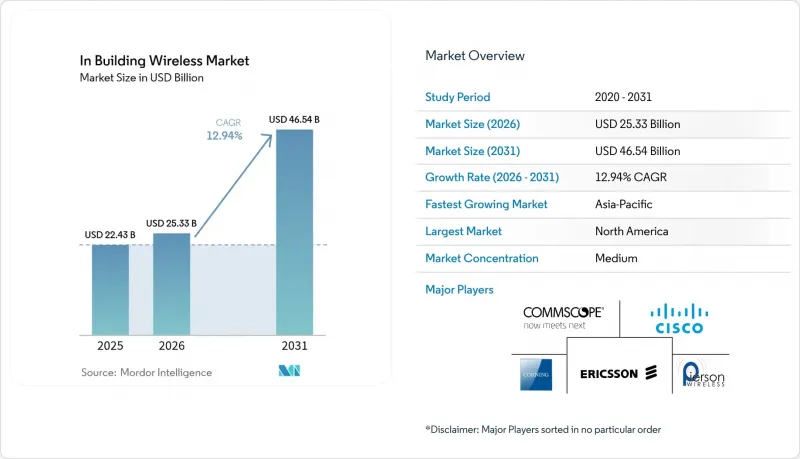
Mordor Intelligence에 의하면, 실내 무선 시장 규모는 2025년 224억 3,000만 달러에서 2026년에는 253억 3,000만 달러로 확대되어 2026년부터 2031년까지 CAGR 12.94%로 성장을 지속하여, 2031년에는 465억 4,000만 달러에 이를 것으로 예측됩니다.
본 보고서는 구성 요소 유형(안테나, 분산 안테나 시스템, 케이블, 리피터,스몰 셀), 기술(4G/LTE, 5G NR, Wi-Fi 6/6E, Wi-Fi 7), 주파수 대역(1GHz 미만, 1-6GHz, 6GHz 초과), 최종 사용자 산업(상업, 주거, 산업, 공공 안전·정부), 지역별로 분류되어 있습니다.
전 세계 실내 무선 시장 동향 및 인사이트
실내 모바일 데이터 소비량 증가
현재 전체 모바일 트래픽의 약 80%가 실내에서 발생하고 있으며, 동영상, AR 교육 또는 고밀도 IoT 워크로드가 급증할 때마다 기존의 Wi-Fi로는 감당하기 어려운 상황이 되고 있습니다. Tractor Supply와 같은 소매 체인은 Wi-Fi로는 실시간 재고 관리 및 고객 참여 용도를 지원할 수 없었기 때문에 2,000개 이상의 매장에 5G를 도입했습니다. 의료 분야에서는 한 소아 병원이 환자에게 지장을 주지 않으면서 원격 의료 및 영상 진단 트래픽을 확보하기 위해 900대의 트라이라디오 AP를 도입했습니다. 이는 실내용 5G와 Wi-Fi 6E의 조합이 메우고 있는 용량 격차를 여실히 보여줍니다. 화상 협업 및 엣지 분석 워크로드 증가는 수요 곡선을 더욱 가파르게 만들어, 실내 무선 시장의 수익 전망을 뒷받침할 것입니다.
실내용 5G 주파수 대역 할당
규제 당국은 실내 전용 주파수 대역을 확보하고 있으며, 기업의 설계는 초기에는 실외에서 실내로 오버레이 방식을 적용하던 것에서 프라이빗 셀룰러 방식으로 점차 전환되고 있습니다. 미국에서는 CBRS 경매를 통해 기업 및 시설 도입을 목적으로 한 3.5GHz 대역 라이선스에 46억 달러가 투입되었으며, 한 대형 통신사만으로도 18억 9,000만 달러를 지출했습니다. 유럽에서는 6GHz 대역의 480-500 MHz가 승인되어, 경기장, 공항, 대학에 필수적인 320 MHz 폭의 채널을 이용할 수 있게 되었습니다. 차이나 모바일(China Mobile)은 대규모 공장 자동화를 가속화하기 위해 300개 도시에 걸친 5G-Advanced 구축에 4억 1,600만 달러를 배정했습니다. 이러한 주파수 할당을 통해 장기적인 주파수 이용의 확실성이 보장됨에 따라, 실내 무선 시장 전반에 걸쳐 신뢰감이 높아지고 설비 투자에 대한 의지가 강화되고 있습니다.
데이터 개인정보 보호 및 사이버 보안에 대한 우려
기업들은 업무 트래픽을 광범위한 셀룰러 생태계에 공개하는 것에 대해 여전히 신중한 태도를 유지하고 있습니다. GDPR(EU 개인정보보호규정)(일반 데이터 보호 규정) 준수로 인해 유럽에서는 위치 추적 기능에 대한 심사가 강화되고 있으며, 스마트 오피스 프로젝트의 조달 주기가 장기화되고 있습니다. 의료 서비스 제공업체는 환자 데이터가 동일한 무선 인터페이스를 통해 전송되기 때문에 새로운 무선 장비를 승인하기 전에 보호 관리 프레임워크(PMF) 및 고급 암호화를 의무화하고 있습니다. 미국에서 보안 조치가 불충분한 기기에 대한 ‘리핑 앤 리플레이스(rip-and-replace)’ 규정은 예상치 못한 교체 비용을 초래하지만, 궁극적으로는 실내 무선 시장의 보안 체계를 강화하게 될 것입니다.
부문 분석
분산형 안테나 시스템(DAS)은 2025년 매출의 37.45%를 차지하며, 경기장, 공항, A급 오피스에 높은 보급률을 통해 실내 무선 시장의 기반을 다지고 있습니다. 한편, 프라이빗 5G 스몰 셀은 연평균 성장률(CAGR) 13.52%로 확대되고 있으며, 기업이 소유 및 관리할 수 있는 민첩한 셀룰러 네트워크로의 전환을 시사하고 있습니다. 광섬유 및 동축 케이블 가격의 급등으로 인해, 통합 업체들은 배선 거리를 최소화하고 원격 소프트웨어 업그레이드를 용이하게 하는 액티브 DAS 및 스몰 셀 아키텍처를 선호하고 있습니다.
안테나 기술 혁신의 측면에서는 Wi-Fi와 셀룰러 커버리지를 단일 폼 팩터로 통합하여 옥상 공간 요구 사항을 줄이는 멀티밴드·멀티캐리어 지원 설계가 우선시되고 있습니다. 스몰 셀 클러스터가 RF 노이즈를 악화시키지 않으면서 더 강력한 업링크를 제공할 수 있게 됨에 따라, 리피터의 사용은 감소하는 추세입니다. 앰페놀(Amphenol)이 콤스코프(CommScope)의 모빌리티 자산을 21억 달러에 인수한 사례에서 볼 수 있듯이, 벤더 통합을 통해 케이블, 커넥터, 무선 부품이 통합되어 조달 프로세스가 합리화되고 있습니다. 중립 호스트에 대한 수요가 증가하는 가운데, 퍼블릭 슬라이스와 프라이빗 슬라이스를 동시에 전송할 수 있는 단일 백본 인프라가 실내 무선 시장 전체의 자본 배분 패턴을 재구성하게 될 것입니다.
4G/LTE는 성숙한 디바이스 생태계와 음성 및 데이터 통신 분야에서 입증된 안정성에 힘입어 2025년에도 64.20%의 점유율을 유지했습니다. 한편, 5G NR은 10밀리초 미만의 결정론적 지연 시간이 필요한 산업용 자동화 프로젝트에 힘입어 연평균 성장률(CAGR) 14.10%로 확대되고 있습니다. Wi-Fi 6E도 보급이 진행되고 있지만, Wi-Fi 7에서는 320 MHz 채널, 멀티링크 작동, 4K-QAM이 도입되어 기업에 비셀룰러 방식을 통한 초고속 처리량을 실현할 수 있는 길을 열어줍니다.
5G와 Wi-Fi 7을 융합한 하이브리드 구축은 병원, 스마트 팩토리, 고등교육 기관 캠퍼스에서 표준 아키텍처로 부상하고 있습니다. 제조 공장에서는 모바일 로보틱스나 안전상 중요한 원격 측정(텔레메트리)에 5G가 활용되는 한편, Wi-Fi는 태블릿이나 노트북에서 발생하는 대량의 데이터 오프로드를 처리하고 있습니다. 중국의 ‘5G-Advanced’ 구축은 이 기술이 실내 광대역에 대응할 수 있음을 입증하고 있으며, 액티브 DAS 및 스몰 셀 공급업체의 부품 수요를 뒷받침하고 있습니다. 사설 라이선스가 추가로 부여될 때마다 실내 무선 시장은 통신 사업자 주도 네트워크에서 기업 주도 네트워크로의 전환을 더욱 가속화하고 있습니다.
지역별 분석
2025년, 북미는 실내 무선 시장을 주도하며 매출 점유율 33.60%를 차지했습니다. 이는 CBRS 주파수 대역의 자유화와 1,000곳의 신규 기지국 건설에 자금을 지원한 FirstNet의 80억 달러 규모의 공공 안전 투자가 뒷받침한 결과입니다. 미국 기업들은 통신 사업자와의 관계를 통합하고, 미래를 내다보는 사설 네트워크 구축을 실현하기 위해 중립 호스트 아키텍처를 채택하고 있습니다. 여러 벤더의 Wi-Fi 7 출시가 업데이트 주기를 가속화하는 한편, 캐나다와 멕시코는 자동차 및 항공우주 산업 클러스터를 활용하여 공장 내 전용 셀룰러 구축을 정당화하고 있습니다.
아시아태평양은 2031년까지 연평균 성장률(CAGR) 14.12%로 확대되고 있습니다. 중국은 이미 440만 개의 5G 기지국을 보유하고 있으며, 제조 및 물류의 디지털화를 추진함에 따라 예측 기간 내에 450만 개를 넘어설 것으로 계획하고 있습니다. 일본의 라이선싱 제도는 스마트 팩토리에서 서브 6GHz와 mm파의 하이브리드 구성을 지원하고 있으며, 한국에서는 반도체 팹의 캠퍼스 네트워크에 국가 차원의 인센티브가 투입되고 있습니다. 인도의 전자기기 제조 촉진은 수입 비용을 절감하고 도입 리드타임을 단축하는 안테나 현지 생산 파트너십에 의해 뒷받침되고 있습니다.
유럽에서는 데이터 개인정보 보호 및 건축물 배출 가스에 관한 엄격한 규제의 영향으로 꾸준한 보급이 진행되고 있습니다. 6GHz 대역의 주파수 할당으로 인해 인파가 많은 장소에서의 Wi-Fi 용량이 확대되고 있으며, 프랑스의 각 도시에서는 시정용 카메라의 백홀 통신에서 프라이빗 5G의 비용 면에서의 우위가 입증되고 있습니다. 독일, 영국, 프랑스의 기업들이 도입을 주도하는 한편, 중동부 유럽의 제조업체들은 ‘인더스트리 4.0’을 지원하기 위해 프라이빗 5G 시범 운영을 진행하고 있습니다. 엄격한 GDPR(EU 개인정보보호규정)(일반 데이터 보호 규정) 준수 요건으로 인해 구매자들은 On-Premise 코어 네트워크 및 안전한 디바이스 ID 프레임워크로 유도되고 있으며, 실내 무선 시장에서 ‘보안 우선’ 접근 방식이 형성되고 있습니다.
기타 혜택:
- 엑셀 형식 시장 예측(ME) 시트
- 3개월간의 애널리스트 지원
자주 묻는 질문
목차
제1장 서론
제2장 조사 방법
제3장 주요 요약
제4장 시장 구도
제5장 시장 규모와 성장 예측
제6장 경쟁 구도
제7장 시장 기회와 향후 전망
JHS 26.09.09According to Mordor Intelligence, the in building wireless market size is expected to grow from USD 22.43 billion in 2025 to USD 25.33 billion in 2026 and is forecast to reach USD 46.54 billion by 2031 at 12.94% CAGR over 2026-2031.
This report is Segmented by Component Type (Antenna, Distributed Antenna Systems, Cables, Repeaters, and Small Cells), Technology (4G/LTE, 5G NR, Wi-Fi 6/6E, and Wi-Fi 7), Frequency Band (Less Than 1 GHz, 1 - 6 GHz, and More Than 6 GHz), End-User Industry (Commercial, Residential, Industrial, and Public-Safety and Government), and Geography.
Global In Building Wireless Market Trends and Insights
Rising mobile-data consumption indoors
Roughly 80% of all mobile traffic now originates inside buildings, overwhelming legacy Wi-Fi whenever video, AR training, or high-density IoT workloads spike. Retail chains such as Tractor Supply adopted 5G across more than 2,000 outlets after Wi-Fi could not support real-time inventory and customer-engagement applications. In healthcare, a single children's hospital installed 900 tri-radio APs to safeguard tele-medicine and imaging traffic without patient disruption, underscoring the capacity gap that indoor 5G plus Wi-Fi 6E is filling. Growing video collaboration and edge analytics workloads will intensify the demand curve, reinforcing the revenue outlook for the In-Building Wireless market.
5G spectrum allocations for indoor use
Regulators are carving out dedicated indoor spectrum, shifting enterprise design from outdoor-to-indoor overlay to private cellular from day one. In the United States, the CBRS auction channelled USD 4.6 billion into 3.5 GHz licences aimed at enterprise and venue deployments, with one Tier-1 carrier alone spending USD 1.89 billion. Europe authorised 480-500 MHz in the 6 GHz band, enabling 320 MHz-wide channels critical for stadiums, airports, and universities. China Mobile earmarked USD 416 million for 5G-Advanced rollouts across 300 cities to accelerate factory automation at scale. Such allocations ensure long-term spectrum certainty, lifting confidence and capex commitment across the In-Building Wireless market.
Data-privacy and cybersecurity concerns
Enterprises remain cautious about exposing operational traffic to broader cellular ecosystems. GDPR compliance elevates scrutiny of location-tracking functions in Europe, prolonging procurement cycles for smart-office projects. Healthcare providers mandate Protected Management Frames and advanced encryption before approving new radios because patient data moves over the same air interface. The US "rip-and-replace" rules for insecure equipment add unexpected swap-out costs but ultimately harden the security posture of the In-Building Wireless market.
Other drivers and restraints analyzed in the detailed report include:
- Demand for uninterrupted enterprise connectivity
- Smart-building mandates for gigabit Wi-Fi
- High capex of multi-operator DAS deployments
For complete list of drivers and restraints, kindly check the Table Of Contents.
Segment Analysis
Distributed Antenna Systems held 37.45% of 2025 revenue, anchoring the In-Building Wireless market through deep penetration in stadiums, airports, and Class-A offices. Private-5G small cells, however, are advancing at a 13.52% CAGR, signaling a pivot toward agile cellular networks that enterprises can own and manage. Rising fibre and coax prices push integrators to favour active DAS or small-cell architectures that minimise cabling runs and facilitate remote software upgrades.
Antenna innovation now prioritises multi-band, multi-operator designs that collapse Wi-Fi and cellular coverage into one form factor, trimming roof-space requirements. Repeater use is declining as small-cell clusters deliver stronger uplinks without RF noise penalties. Vendor consolidation, illustrated by Amphenol's USD 2.1 billion acquisition of CommScope's mobility assets, bundles cabling, connectors, and radio components to streamline procurement. As neutral-host demand grows, single backbone infrastructures capable of carrying public and private slices simultaneously will reshape capital-allocation patterns across the In-Building Wireless market.
4G/LTE retained 64.20% share in 2025, underpinned by a mature device ecosystem and proven stability for voice and data. Yet 5G NR is expanding at a 14.10% CAGR, driven by industrial automation projects that need deterministic latency below 10 ms. Wi-Fi 6E is also scaling, but Wi-Fi 7 introduces 320 MHz channels, multi-link operation, and 4K-QAM, giving enterprises a non-cellular path to ultra-high throughput.
Hybrid deployments blending 5G and Wi-Fi 7 are emerging as the reference architecture in hospitals, smart factories, and higher-education campuses. Manufacturing plants use 5G for mobile robotics and safety-critical telemetry, while Wi-Fi handles bulk data offload for tablets and laptops. China's 5G-Advanced roll-out validates the technology's readiness for indoor broadband, fuelling component demand from active DAS and small-cell vendors. With each additional private licence granted, the In-Building Wireless market deepens its shift from operator-led to enterprise-controlled networks.
Complete Report Scope:
- By Component Type
- Antenna
- Distributed Antenna Systems (Active DAS, Passive DAS)
- Cables (Coax, Fiber)
- Repeaters
- Small Cells (Femtocell, Picocell, Microcell)
- By Technology
- 4G/LTE
- 5G NR
- Wi-Fi 6/6E
- Wi-Fi 7
- By Frequency Band
- Less than 1 GHz (Low-band)
- 1 - 6 GHz (Mid-band incl. CBRS)
- More than 6 GHz (mmWave)
- By End-user Industry
- Commercial
- Offices
- Retail
- Healthcare
- Hospitality
- Residential
- MDU
- Single-family
- Industrial
- Manufacturing
- Warehousing
- Oil and Gas
- Public-Safety and Government
- Commercial
- By Geography
- North America
- United States
- Canada
- Mexico
- South America
- Brazil
- Argentina
- Rest of South America
- Europe
- Germany
- United Kingdom
- France
- Italy
- Spain
- Russia
- Rest of Europe
- Asia-Pacific
- China
- Japan
- South Korea
- India
- Rest of Asia-Pacific
- Middle East
- Saudi Arabia
- United Arab Emirates
- Turkey
- Rest of Middle East
- Africa
- South Africa
- Egypt
- Nigeria
- Rest of Africa
- North America
Geography Analysis
North America led the In-Building Wireless market with 33.60% revenue share in 2025, aided by CBRS spectrum liberalisation and FirstNet's USD 8 billion public-safety investment that funded 1,000 new cell sites. Enterprises in the United States adopt neutral-host architectures to consolidate carrier relationships and future-proof private-network ambitions. Wi-Fi 7 launches from multiple vendors accelerate refresh cycles, while Canada and Mexico leverage their automotive and aerospace clusters to justify private cellular rollouts inside plants.
Asia-Pacific is expanding at a 14.12% CAGR to 2031. China already hosts 4.4 million 5G base stations and plans to exceed 4.5 million within the forecast horizon as it digitalises manufacturing and logistics. Japan's licence regime supports sub-6 and mmWave hybrids in smart factories, and South Korea channels state incentives into campus networks at semiconductor fabs. India's electronic-manufacturing drive is supported by antenna localisation partnerships that trim import costs and shorten deployment lead times.
Europe shows steady uptake influenced by regulatory stringency around data privacy and building emissions. The 6 GHz allocation enlarges Wi-Fi capacity for dense venues, and French cities demonstrate the cost advantage of private 5G for municipal camera backhaul. German, British, and French enterprises lead adoption, while Central-Eastern manufacturers pilot private 5G to support Industry 4.0. Strict GDPR compliance requirements nudge buyers toward on-premises core networks and secure device-identity frameworks, shaping a security-first approach within the In-Building Wireless market.
- CommScope Holding Co.
- Cisco Systems Inc.
- Corning Inc.
- Ericsson AB
- Nokia Corp.
- ATandT Inc.
- Verizon Communications Inc.
- Pierson Wireless Corp.
- Cobham PLC
- Cambium Networks
- TE Connectivity Ltd.
- Dali Wireless Inc.
- Airspan Networks
- American Tower Corp.
- Boingo Wireless Inc.
- Extreme Networks Inc.
- Juniper Networks Inc.
- HPE (Aruba Networks)
- Samsung Electronics (Co. Networks)
- Huawei Technologies Co. Ltd.
Additional Benefits:
- The market estimate (ME) sheet in Excel format
- 3 months of analyst support
TABLE OF CONTENTS
1 INTRODUCTION
- 1.1 Study Assumptions and Market Definition
- 1.2 Scope of the Study
2 RESEARCH METHODOLOGY
3 EXECUTIVE SUMMARY
4 MARKET LANDSCAPE
- 4.1 Market Overview
- 4.2 Market Drivers
- 4.2.1 Rising mobile data consumption indoors
- 4.2.2 5G spectrum allocations for indoor use
- 4.2.3 Growing demand for uninterrupted enterprise connectivity
- 4.2.4 Smart-building mandates for gigabit-grade Wi-Fi
- 4.2.5 Corporate net-zero targets driving low-power neutral-host DAS
- 4.2.6 Retail media networks monetising in-store footfall analytics
- 4.3 Market Restraints
- 4.3.1 Data-privacy and cybersecurity concerns
- 4.3.2 High capex of multi-operator DAS deployments
- 4.3.3 Skilled-labour shortage for CBRS/Private-5G integration
- 4.3.4 Radio-frequency transparency rules in heritage buildings
- 4.4 Value/Supply-Chain Analysis
- 4.5 Regulatory Landscape
- 4.6 Technological Outlook
- 4.7 Porter's Five Forces Analysis
- 4.7.1 Bargaining Power of Suppliers
- 4.7.2 Bargaining Power of Buyers
- 4.7.3 Threat of New Entrants
- 4.7.4 Threat of Substitutes
- 4.7.5 Intensity of Competitive Rivalry
- 4.8 Investment Analysis
5 MARKET SIZE AND GROWTH FORECASTS (VALUE)
- 5.1 By Component Type
- 5.1.1 Antenna
- 5.1.2 Distributed Antenna Systems (Active DAS, Passive DAS)
- 5.1.3 Cables (Coax, Fiber)
- 5.1.4 Repeaters
- 5.1.5 Small Cells (Femtocell, Picocell, Microcell)
- 5.2 By Technology
- 5.2.1 4G/LTE
- 5.2.2 5G NR
- 5.2.3 Wi-Fi 6/6E
- 5.2.4 Wi-Fi 7
- 5.3 By Frequency Band
- 5.3.1 Less than 1 GHz (Low-band)
- 5.3.2 1 - 6 GHz (Mid-band incl. CBRS)
- 5.3.3 More than 6 GHz (mmWave)
- 5.4 By End-user Industry
- 5.4.1 Commercial
- 5.4.1.1 Offices
- 5.4.1.2 Retail
- 5.4.1.3 Healthcare
- 5.4.1.4 Hospitality
- 5.4.2 Residential
- 5.4.2.1 MDU
- 5.4.2.2 Single-family
- 5.4.3 Industrial
- 5.4.3.1 Manufacturing
- 5.4.3.2 Warehousing
- 5.4.3.3 Oil and Gas
- 5.4.4 Public-Safety and Government
- 5.4.1 Commercial
- 5.5 By Geography
- 5.5.1 North America
- 5.5.1.1 United States
- 5.5.1.2 Canada
- 5.5.1.3 Mexico
- 5.5.2 South America
- 5.5.2.1 Brazil
- 5.5.2.2 Argentina
- 5.5.2.3 Rest of South America
- 5.5.3 Europe
- 5.5.3.1 Germany
- 5.5.3.2 United Kingdom
- 5.5.3.3 France
- 5.5.3.4 Italy
- 5.5.3.5 Spain
- 5.5.3.6 Russia
- 5.5.3.7 Rest of Europe
- 5.5.4 Asia-Pacific
- 5.5.4.1 China
- 5.5.4.2 Japan
- 5.5.4.3 South Korea
- 5.5.4.4 India
- 5.5.4.5 Rest of Asia-Pacific
- 5.5.5 Middle East
- 5.5.5.1 Saudi Arabia
- 5.5.5.2 United Arab Emirates
- 5.5.5.3 Turkey
- 5.5.5.4 Rest of Middle East
- 5.5.6 Africa
- 5.5.6.1 South Africa
- 5.5.6.2 Egypt
- 5.5.6.3 Nigeria
- 5.5.6.4 Rest of Africa
- 5.5.1 North America
6 COMPETITIVE LANDSCAPE
- 6.1 Market Concentration
- 6.2 Strategic Moves
- 6.3 Market Share Analysis
- 6.4 Company Profiles (includes Global level Overview, Market level overview, Core Segments, Financials as available, Strategic Information, Market Rank/Share, Products and Services, Recent Developments)
- 6.4.1 CommScope Holding Co.
- 6.4.2 Cisco Systems Inc.
- 6.4.3 Corning Inc.
- 6.4.4 Ericsson AB
- 6.4.5 Nokia Corp.
- 6.4.6 ATandT Inc.
- 6.4.7 Verizon Communications Inc.
- 6.4.8 Pierson Wireless Corp.
- 6.4.9 Cobham PLC
- 6.4.10 Cambium Networks
- 6.4.11 TE Connectivity Ltd.
- 6.4.12 Dali Wireless Inc.
- 6.4.13 Airspan Networks
- 6.4.14 American Tower Corp.
- 6.4.15 Boingo Wireless Inc.
- 6.4.16 Extreme Networks Inc.
- 6.4.17 Juniper Networks Inc.
- 6.4.18 HPE (Aruba Networks)
- 6.4.19 Samsung Electronics (Co. Networks)
- 6.4.20 Huawei Technologies Co. Ltd.
7 MARKET OPPORTUNITIES AND FUTURE OUTLOOK
- 7.1 White-space and Unmet-need Assessment


