
|
시장보고서
상품코드
2123103
행동 생체인식 시장 : 시장 점유율 분석, 업계 동향 및 통계, 성장 예측(2026-2031년)Behavioral Biometrics - Market Share Analysis, Industry Trends & Statistics, Growth Forecasts (2026 - 2031) |
||||||
 Mordor Intelligence
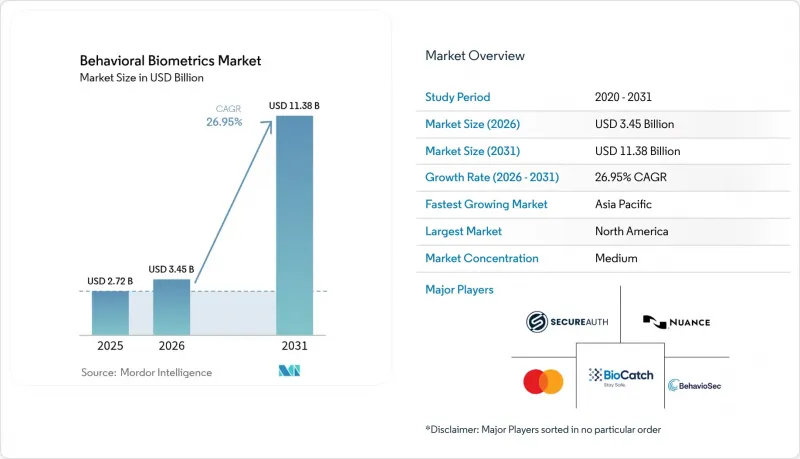
Mordor Intelligence에 의하면, 행동 생체인식 시장 규모는 2025년 27억 2,000만 달러로 평가되었고, 2026년에는 34억 5,000만 달러로 추정되고, 2026-2031년 CAGR 26.95%로 성장을 지속할 전망이며, 2031년에는 113억 8,000만 달러에 이를 것으로 예측됩니다.
본 보고서는 유형별(서명 분석, 키스트로크 역학 등), 도입 형태별(온프레미스, 클라우드), 용도별(신원 확인, 지속적 인증, 리스크 관리 및 규정 준수, 부정 감지·방지), 최종 사용자별(소매 및 전자상거래, 의료, 정부·공공 부문 등) 및 지역별로 분류되어 있습니다. 시장 예측은 금액(달러) 기준으로 제시되어 있습니다.
세계의 행동 생체 인식 시장 동향 및 인사이트
모바일 뱅킹에서의 수동형 생체 인식 보급
모바일 뱅킹에서는 사용자의 명시적인 조작 없이 본인 확인을 수행하기 위해, 타이핑 리듬, 터치 압력, 기기 조작 방식을 관찰하는 수동형 생체 인식 기능이 탑재되어 있습니다. 이러한 기능을 도입한 금융 기관에 따르면, 오감지 알림이 최대 85% 감소했고, 온보딩이 원활해짐에 따라 고객 만족도가 향상되었다고 합니다. 도입 비용은 부정행위로 인한 손실 감소와 다중 인증에 따른 번거로움 완화로 상쇄되므로, 북미와 유럽의 각 은행들은 네이티브 앱에 행동 분석 기능을 통합하기 위해 적극적으로 나서고 있습니다.
전자상거래에서 계정 탈취 사기의 급증
2024년, 전 세계 전자상거래 분야의 부정 거래로 인한 손실액은 64억 달러를 넘어섰으며, 이에 따라 판매업체들은 비정상적인 마우스 움직임이나 결제 과정을 밀리초 단위로 감지하는 행동 분석 도입을 서두르고 있습니다. 행동 생체 인식 기술을 통합한 플랫폼의 경우, 쇼핑 성수기에도 전환율을 유지하면서 크레덴셜 스태핑 공격을 70% 감소시켰습니다고 보고되어, 이 기술이 수익 보호에 기여하는 가치가 부각되고 있습니다.
GDPR(EU 개인정보보호규정) 및 CCPA에 따른 소비자 개인정보 보호 소송 증가
행동 데이터는 생체 인식 정보에 해당하므로, 명시적인 동의와 엄격한 최소화 조치가 요구됩니다. 2024년에는 이러한 데이터의 부적절한 취급으로 인해 5,000만 유로가 넘는 벌금이 부과되었으며, 리스크 회피 성향이 강한 기업들은 개인정보 영향 평가 및 데이터 보호 책임자의 승인이 완료될 때까지 도입을 연기하고 있습니다. 규정 준수 대책으로 인해, 특히 다국적 사업 전개 시 일정과 프로젝트 비용이 증가하고 있습니다.
부문 분석
키스트로크 다이내믹스는 2025년 매출의 39.25%를 차지했으며, 그 성숙도와 기존 키보드 및 터치스크린과의 호환성을 입증하고 있습니다. 기업들이 리스크 관리 엔진과 병행하여 웹 및 모바일 채널에 타이핑 분석을 통합함에 따라, 키스트로크 솔루션의 행동 생체 인식 시장 규모는 계속해서 확대되고 있습니다. 하드웨어 업그레이드가 필요하지 않고, 알고리즘이 이미 기업 데이터 세트에서 2% 미만의 오인식률을 달성하고 있기 때문에 성장은 꾸준합니다.
보행 분석은 2031년까지 연평균 성장률(CAGR) 27.45%로 가장 높은 성장세를 보이고 있습니다. 스마트폰의 가속도 센서와 웨어러블 기기는 일상적인 동작 중에도 안정적인 보행 특성을 파악할 수 있게 되어, 모바일 지갑, 티켓 발급, 시설에 대한 안전한 접근에서 수동적인 신원 확인을 가능하게 하고 있습니다. 각 벤더들은 신원 도용을 방지하고 환경 소음의 영향을 줄이기 위해 보행 특성과 음성 및 타이핑 특성을 융합하고 있으며, 이를 통해 행동 생체 인식 시장 전체에서 다중 모드 방식의 채택이 촉진되고 있습니다.
조직들이 지속적으로 업데이트되고 지역을 초월해 확장 가능한 SaaS 인증으로 전환함에 따라, 클라우드 플랫폼은 2025년 매출의 55.85%를 차지했습니다. 마이크로서비스 아키텍처와 API 게이트웨이를 통해 디지털 뱅킹,소매, 헬스 포털 내 도입이 간소화됨에 따라 클라우드 배포에서 행동 생체 인증 시장 점유율은 상승할 것으로 예측됩니다. 구독 모델은 설비 투자를 줄이고, 전 세계 부정 감지 데이터를 기반으로 알고리즘을 신속하게 조정할 수 있게 해줍니다.
온프레미스형 솔루션은 생체 인증 데이터에 대한 주권적 관리를 필요로 하는 정부 기관이나 규제가 엄격한 산업 분야에 여전히 필수적입니다. 개인정보 보호와 성능을 모두 충족시키기 위해 하이브리드형 설계가 등장하고 있습니다. 이는 원시 이벤트를 로컬에서 처리하는 동시에, 익명화된 특징량을 클라우드 분석으로 전송하여 위협의 상관 분석을 수행하는 방식입니다. 이러한 균형 잡힌 접근 방식은 온프레미스형의 중요성을 유지하면서도, 클라우드 벤더가 행동 생체 인식 시장에 가져다주는 비용 및 민첩성 측면의 우위를 부각시키고 있습니다.
지역별 분석
북미는 조기 도입과 적극적인 사이버 보안 규제를 배경으로 2025년 매출의 37.20%를 차지했습니다. 미국의 금융 규제 당국은 다층 방어 체계의 일환으로 행동 지표를 권장하고 있으며, 이에 따라 은행, 보험사, 카드 네트워크 각사가 도입을 확대되고 있습니다. 연방 정부 기관은 특권 액세스용 워크스테이션에 키 입력 및 마우스 조작 패턴을 통합하고 있어, 지속적인 신원 확인에 대한 정부의 이니셔티브을 엿볼 수 있습니다. 캐나다에서의 도입은 의료 현대화와 개인정보 보호를 위한 클라우드 인증을 중심으로 진행되고 있습니다.
아시아태평양은 2031년까지 연평균 성장률(CAGR) 27.10%로 가장 높은 성장세를 보일 전망입니다. 중국의 슈퍼앱에서는 보행 분석 및 음성 분석을 QR 코드 기반 결제에 융합하고 있는 반면, 인도의 핀테크 붐에서는 키스트로크의 동적 분석을 활용하여 통합 결제 인터페이스(UPI) 거래의 보안을 확보하고 있습니다. 싱가포르, 한국, 호주의 각 정부는 모바일 기기나 IoT 센서를 통해 수집된 행동 신호에 의존하는 디지털 ID의 연구 개발에 대해 보조금을 지급하고 있습니다. 일본의 전자기기 제조업체는 주력 스마트폰에 행동 분석용 SDK를 사전 설치하여, 행동 생체 인식 시장의 지역적 확대를 위한 하드웨어 기반을 제공합니다.
유럽에서는 PSD2 및 GDPR(EU 개인정보보호규정)에 힘입어 견조한 성장이 유지되고 있습니다. 은행은 사용자의 편의성을 저해하지 않으면서 엄격한 고객 규정을 충족하기 위해 행동 인증을 통합하고 있으며, 통신 사업자는 부정 방지 목적으로 SIM 등록에 행동 프로파일을 추가하고 있습니다. 개인정보 보호 관련 소송 위험이 도입 속도를 둔화시키고 있지만, 각 벤더는 지역 기준에 부합하는 단말기 내 처리 및 개인정보 보호 강화형 암호화 기술을 통해 이에 대응하고 있습니다. 독일과 영국은 금융, 소매, 공공 서비스 분야의 기업 대상 시범 사업을 주도하고 있습니다.
기타 혜택 :
- 엑셀 형식 시장 예측(ME) 시트
- 3개월간의 애널리스트 지원
자주 묻는 질문
목차
제1장 서론
제2장 조사 방법
제3장 주요 요약
제4장 시장 구도
제5장 시장 규모 및 성장 예측
제6장 경쟁 구도
제7장 시장 기회 및 향후 전망
AJY 26.09.07According to Mordor Intelligence, the behavioral biometrics market size is expected to grow from USD 2.72 billion in 2025 to USD 3.45 billion in 2026 and is forecast to reach USD 11.38 billion by 2031 at 26.95% CAGR over 2026-2031.
This report is Segmented by Type (Signature Analysis, Keystroke Dynamics, and More), Deployment (On-Premise, and On-Cloud), Application (Identity Proofing, Continuous Authentication, Risk and Compliance, Fraud Detection and Prevention), End-User (Retail and E-Commerce, Healthcare, Government and Public Sector, and More), and Geography. The Market Forecasts are Provided in Terms of Value (USD).
Global Behavioral Biometrics Market Trends and Insights
Proliferation of passive liveness detection in mobile banking
Mobile banks embed passive liveness detection that observes typing cadence, touch pressure, and device handling to confirm identity without explicit user action. Financial institutions deploying these capabilities cite up to 85% cuts in false positive alerts and smoother onboarding that enhances customer satisfaction. Deployment costs are offset by lower fraud losses and reduced multi-factor friction, encouraging banks across North America and Europe to incorporate behavioral analysis into native apps.
Surge in account takeover fraud in e-commerce
Global e-commerce fraud losses exceeded USD 6.4 billion in 2024, pushing merchants to adopt behavioral analytics that flags anomalous mouse paths and checkout flows in milliseconds. Platforms integrating behavioral biometrics report 70% reductions in credential-stuffing attacks during peak shopping seasons while preserving conversion rates, underscoring the technology's revenue-protection value.
Rising consumer privacy litigation under GDPR and CCPA
Behavioral data qualifies as biometric information, demanding explicit consent and strict minimization. Fines surpassing EUR 50 million were imposed in 2024 for mishandling such data, prompting risk-averse firms to delay rollouts until privacy impact assessments and data officer sign-offs conclude. Compliance steps inflate timelines and project costs, especially for multinational deployments.
Other drivers and restraints analyzed in the detailed report include:
- Integration of behavioral biometrics into passwordless authentication standards (FIDO2)
- Expansion of remote workforce and zero trust security adoption
- High false rejection rates in multi-cultural user bases
For complete list of drivers and restraints, kindly check the Table Of Contents.
Segment Analysis
Keystroke dynamics held 39.25% of 2025 revenue, underscoring its maturity and compatibility with existing keyboards and touchscreens. The behavioral biometrics market size for keystroke solutions continues to grow as enterprises integrate typing analytics into web and mobile channels alongside risk engines. Growth is steady because retrofitting requires no hardware upgrades and algorithms already achieve sub-2% false accept rates on enterprise datasets.
Gait analysis posts the highest 27.45% CAGR through 2031. Smartphone accelerometers and wearables now capture stable gait signatures during normal movements, enabling passive verification for mobile wallets, ticketing, and secure facility access. Vendors fuse gait with voice or typing traits to curb spoofing and to mitigate environmental noise, propelling multimodal adoption within the broader behavioral biometrics market.
Cloud platforms commanded 55.85% of 2025 revenue as organizations pivot to SaaS authentication that updates continuously and scales across geographies. The behavioral biometrics market share for cloud deployment is projected to climb as microservices architectures and API gateways simplify rollout within digital banking, retail, and health portals. Subscription models cut capital expenditure and allow rapid tuning of algorithms based on global fraud telemetry.
On-premise solutions remain vital to governments and highly regulated sectors that demand sovereign control over biometric data. Hybrid designs emerge to reconcile privacy and performance, processing raw events locally while sending anonymized features to cloud analytics for threat correlation. This balanced approach sustains on-premise relevance yet underscores the cost and agility advantage cloud vendors deliver to the behavioral biometrics market.
Complete Report Scope:
- By Type
- Signature Analysis
- Keystroke Dynamics
- Voice Recognition
- Gait Analysis
- By Deployment
- On-premise
- On-cloud
- By Application
- Identity Proofing
- Continuous Authentication
- Risk and Compliance
- Fraud Detection and Prevention
- By End-User
- BFSI
- Retail and E-commerce
- Healthcare
- Government and Public Sector
- Other End-User
- By Geography
- North America
- United States
- Canada
- Mexico
- Europe
- Germany
- United Kingdom
- France
- Italy
- Spain
- Rest of Europe
- Asia-Pacific
- China
- Japan
- India
- South Korea
- Australia
- Rest of Asia-Pacific
- Middle East and Africa
- Middle East
- Saudi Arabia
- United Arab Emirates
- Rest of Middle East
- Africa
- South Africa
- Egypt
- Rest of Africa
- Middle East
- South America
- Brazil
- Argentina
- Rest of South America
- North America
Geography Analysis
North America generated 37.20% of 2025 revenue on the back of early adoption and proactive cybersecurity mandates. U.S. financial regulators endorse behavioral metrics within layered defenses, spurring banks, insurers, and card networks to scale deployments. Federal agencies incorporate keystroke and mouse patterns into privileged-access workstations, illustrating government commitment to continuous verification. Canadian adoption centers on healthcare modernization and privacy-preserving cloud authentication.
Asia-Pacific displays the steepest 27.10% CAGR through 2031. China's super-apps fuse gait and voice analytics into QR-based payments, while India's fintech boom leverages keystroke dynamics to secure Unified Payments Interface transactions. Governments in Singapore, South Korea, and Australia issue grants for digital identity R and D that rely on behavioral signals collected via mobile devices and IoT sensors. Japanese electronics makers preinstall behavioral SDKs on flagship smartphones, providing a hardware base for regional expansion of the behavioral biometrics market.
Europe upholds strong growth owing to PSD2 and GDPR. Banks integrate behavioral authentication to satisfy strong customer rules without sacrificing user convenience, and telecom operators add behavioral profiles to SIM registration for fraud control. Privacy litigation risk moderates adoption speed, yet vendors counter with on-device processing and privacy-enhancing cryptography that comply with regional standards. Germany and the United Kingdom spearhead enterprise pilots across funding, retail, and public services.
- BioCatch Ltd.
- Mastercard Incorporated (NuData Security)
- Nuance Communications Inc.
- SecureAuth Corporation
- BehavioSec Inc.
- ThreatMark S.R.O.
- UnifyID Inc.
- Zighra Inc.
- Plurilock Security Solutions Inc.
- SecuredTouch Inc.
- TypingDNA Inc.
- Callsign Inc.
- Deepnet Security Ltd.
- DataVisor Inc.
- Experian PLC (CrossCore)
- OneSpan Inc.
- IBM Corporation
- NEC Corporation
- Samsung SDS Co. Ltd.
- HID Global Corporation
Additional Benefits:
- The market estimate (ME) sheet in Excel format
- 3 months of analyst support
TABLE OF CONTENTS
1 INTRODUCTION
- 1.1 Study Assumptions and Market Definition
- 1.2 Scope of the Study
2 RESEARCH METHODOLOGY
3 EXECUTIVE SUMMARY
4 MARKET LANDSCAPE
- 4.1 Market Overview
- 4.2 Market Drivers
- 4.2.1 Proliferation of Passive Liveness Detection in Mobile Banking
- 4.2.2 Surge in Account Takeover Fraud in E-Commerce
- 4.2.3 Integration of Behavioral Biometrics into Passwordless Authentication Standards (FIDO2)
- 4.2.4 Expansion of Remote Workforce and Zero Trust Security Adoption
- 4.2.5 Regulatory Push for Strong Customer Authentication in Europe and Asia
- 4.2.6 Increased Processing Power of Edge AI Chips Enabling Real-Time Behavioral Analytics
- 4.3 Market Restraints
- 4.3.1 Rising Consumer Privacy Litigation Under GDPR and CCPA
- 4.3.2 High False Rejection Rates in Multi-Cultural User Bases
- 4.3.3 Limited Awareness Among SME Security Teams
- 4.3.4 Integration Complexity with Legacy Authentication Infrastructure
- 4.4 Industry Value Chain Analysis
- 4.5 Impact of Macroeconomic Factors
- 4.6 Technological Outlook
- 4.7 Regulatory Landscape
- 4.8 Porter's Five Forces Analysis
- 4.8.1 Threat of New Entrants
- 4.8.2 Bargaining Power of Buyers/Consumers
- 4.8.3 Bargaining Power of Suppliers
- 4.8.4 Threat of Substitute Products
- 4.8.5 Intensity of Competitive Rivalry
- 4.9 Investment Analysis
5 MARKET SIZE AND GROWTH FORECASTS (VALUE)
- 5.1 By Type
- 5.1.1 Signature Analysis
- 5.1.2 Keystroke Dynamics
- 5.1.3 Voice Recognition
- 5.1.4 Gait Analysis
- 5.2 By Deployment
- 5.2.1 On-premise
- 5.2.2 On-cloud
- 5.3 By Application
- 5.3.1 Identity Proofing
- 5.3.2 Continuous Authentication
- 5.3.3 Risk and Compliance
- 5.3.4 Fraud Detection and Prevention
- 5.4 By End-User
- 5.4.1 BFSI
- 5.4.2 Retail and E-commerce
- 5.4.3 Healthcare
- 5.4.4 Government and Public Sector
- 5.4.5 Other End-User
- 5.5 By Geography
- 5.5.1 North America
- 5.5.1.1 United States
- 5.5.1.2 Canada
- 5.5.1.3 Mexico
- 5.5.2 Europe
- 5.5.2.1 Germany
- 5.5.2.2 United Kingdom
- 5.5.2.3 France
- 5.5.2.4 Italy
- 5.5.2.5 Spain
- 5.5.2.6 Rest of Europe
- 5.5.3 Asia-Pacific
- 5.5.3.1 China
- 5.5.3.2 Japan
- 5.5.3.3 India
- 5.5.3.4 South Korea
- 5.5.3.5 Australia
- 5.5.3.6 Rest of Asia-Pacific
- 5.5.4 Middle East and Africa
- 5.5.4.1 Middle East
- 5.5.4.1.1 Saudi Arabia
- 5.5.4.1.2 United Arab Emirates
- 5.5.4.1.3 Rest of Middle East
- 5.5.4.2 Africa
- 5.5.4.2.1 South Africa
- 5.5.4.2.2 Egypt
- 5.5.4.2.3 Rest of Africa
- 5.5.4.1 Middle East
- 5.5.5 South America
- 5.5.5.1 Brazil
- 5.5.5.2 Argentina
- 5.5.5.3 Rest of South America
- 5.5.1 North America
6 COMPETITIVE LANDSCAPE
- 6.1 Market Concentration
- 6.2 Strategic Moves
- 6.3 Market Share Analysis
- 6.4 Company Profiles (includes Global level Overview, Market level overview, Core Segments, Financials as available, Strategic Information, Market Rank/Share for key companies, Products and Services, and Recent Developments)
- 6.4.1 BioCatch Ltd.
- 6.4.2 Mastercard Incorporated (NuData Security)
- 6.4.3 Nuance Communications Inc.
- 6.4.4 SecureAuth Corporation
- 6.4.5 BehavioSec Inc.
- 6.4.6 ThreatMark S.R.O.
- 6.4.7 UnifyID Inc.
- 6.4.8 Zighra Inc.
- 6.4.9 Plurilock Security Solutions Inc.
- 6.4.10 SecuredTouch Inc.
- 6.4.11 TypingDNA Inc.
- 6.4.12 Callsign Inc.
- 6.4.13 Deepnet Security Ltd.
- 6.4.14 DataVisor Inc.
- 6.4.15 Experian PLC (CrossCore)
- 6.4.16 OneSpan Inc.
- 6.4.17 IBM Corporation
- 6.4.18 NEC Corporation
- 6.4.19 Samsung SDS Co. Ltd.
- 6.4.20 HID Global Corporation
7 MARKET OPPORTUNITIES AND FUTURE OUTLOOK
- 7.1 White-space and Unmet-need Assessment