|
시장보고서
상품코드
2123107
손바닥 정맥 생체인식 시장 : 시장 점유율 분석, 업계 동향 및 통계, 성장 예측(2026-2031년)Palm Vein Biometrics - Market Share Analysis, Industry Trends & Statistics, Growth Forecasts (2026 - 2031) |
||||||
 Mordor Intelligence
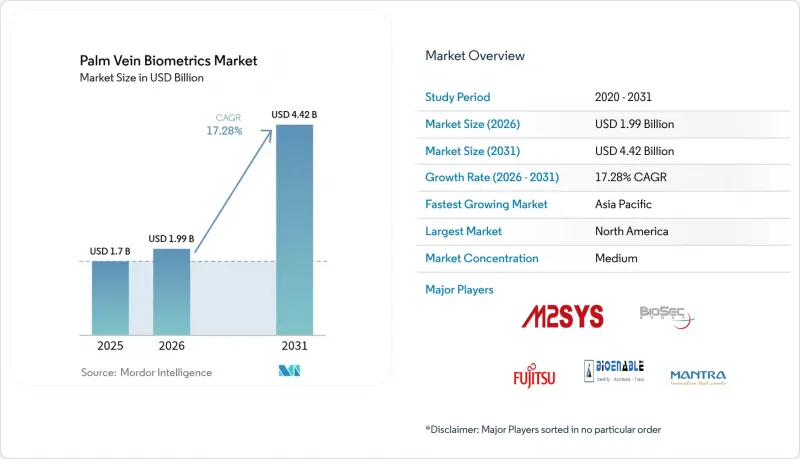
Mordor Intelligence에 의하면, 손바닥 정맥 인증 시장 규모는 2025년 17억 달러로 평가되었고, 2026년에는 19억 9,000만 달러로 추정되고, 2026-2031년 CAGR 17.28%로 성장을 지속할 전망이며, 2031년에는 44억 2,000만 달러에 이를 것으로 예측됩니다.
본 보고서는 구성 요소별(하드웨어, 소프트웨어 및 솔루션, 서비스), 기술별(근적외선 이미징, 광학 이미징, 열화상 이미징, 하이브리드 이미징), 최종 사용자 산업별(은행 및 금융 기관, 의료 기관, 정부 기관, 상업 및 산업 기업) 및 지역별로 분류되어 있습니다. 시장 전망은 금액(달러) 기준으로 제시되어 있습니다.
세계의 손바닥 정맥 생체인식 시장 동향 및 인사이트
BFSI 부문에서의 비접촉 인증 도입 확대
각 은행은 1초 미만의 거래 시간을 실현하고 카드 제시형 사기를 근절하기 위해 POS 단말기에 손바닥 스캔 기능을 직접 탑재하고 있습니다. J.P. 모건이 경기장에서 실시한 파일럿 프로젝트에서는 2024년 F1 마이애미 그랑프리 기간 동안 모든 결제가 1초 미만으로 완료되었습니다. 마스터카드는 2024년 6월, 우루과이의 ‘티엔다 잉그레시아’ 매장에서 손바닥 결제를 도입했습니다. 이는 그동안 얼굴 인증에 의존해 온 해당 프로그램에서 처음으로 손바닥 인증이 도입된 사례입니다. 미국의 신용협동조합 대상 결제 처리 업체인 PSCU와 Co-op Solutions는 2024년 4월, 4,000개의 발행 기관을 대상으로 8주간의 도입 기간 내에 ‘손바닥 결제’ 기능을 추가할 수 있도록 했습니다. UAE 규제 당국은 2026년까지 ‘Palm ID’를 해당 지역의 사실상 대중교통 및 ATM 인증 수단으로 만드는 것을 목표로 하고 있습니다. 금융 부문의 이러한 전환에 따라 손바닥 인증은 단순한 부정 방지 도구가 아닌, 고객 충성도를 중시하는 개인화 자산으로 자리매김하고 있습니다.
생체인식 업그레이드를 의무화하는 엄격한 데이터 개인정보 보호 규정
EU의 GDPR(EU 개인정보보호규정), 중국의 PIPL, 인도의 DPDPA에서는 혈관 패턴이 민감한 데이터로 분류되어 있으며, 명시적인 동의, 데이터 최소화, 그리고 국경을 넘는 전송이 이루어지는 경우에는 추가적인 암호화 조치가 요구됩니다. ‘슈레姆斯 II’ 판결에 따라 EU-미국 프라이버시 실드가 무효화됨에 따라, 유럽 기업들은 로컬 또는 소버린 클라우드를 통한 데이터 저장을 채택할 수밖에 없게 되었습니다. 중국의 ‘개인정보보호법(PIPL)’에서는 100만 명 이상의 데이터 주체가 관련된 데이터 전송에 대해 중국 사이버공간관리국의 보안 평가가 의무화되어 있습니다. ISO/IEC TS 22604:2024는 기업에 템플릿 보호의 청사진을 제시함과 동시에, 기기 내 암호화 검증으로의 전환을 권장하고 있습니다. 이는 Amazon One이 채택하고 있는 모델로, 리더기 본체가 아닌 안전한 AWS 도메인 내에 서명을 저장하는 방식입니다. 따라서 규정 준수 압박으로 인해, 비밀번호 시스템에서 암호화로 보호되는 생체인식으로의 전환이 가속화되고 있습니다.
초기 하드웨어 및 통합 작업에 드는 높은 비용
근적외선 센서 어레이의 비용은 범용 지문 리더기의 3-5배에 달할 전망입니다. 퀄컴과 텔포(Telpo)의 P105 단말기는 듀얼 RGB+IR 카메라와 생체인식 광학 시스템을 통합하고 있으며, 소규모 소매업체가 부정 방지에 따른 비용 절감 효과를 통해 도입의 정당성을 입증해야 하는 프리미엄 기기로 자리매김하고 있습니다. 또한, 레거시 시스템에 혈관 인증 드라이버가 없는 경우, 통합에 5,000-2만 달러의 전문 서비스 비용이 추가로 발생하기 때문에 신흥 시장의 이익률이 낮은 사업자는 도입이 어렵습니다.
부문 분석
2025년에는 인증 지점마다 전용 리더기가 필요하기 때문에 하드웨어가 손바닥 정맥 생체인식 시장의 67.52% 점유율을 차지했습니다. 병원, 공항, 경기장에는 수백 대의 장비가 도입되어 있으며, 하드웨어 수익은 도입 규모에 비례하고 있습니다. 한편, 서비스 부문은 연평균 성장률(CAGR) 18.77%를 기록할 전망이며, 이는 템플릿 데이터베이스 유지 관리, 알고리즘 재조정 및 규정 준수 감사를 반영한 것입니다. 마스터카드가 우루과이에 결제 시스템을 도입하기 위해 디지털 센스(Digital Sense)와 진행한 통합 작업은 미들웨어가 손바닥 정맥 리더기와 레거시 POS 소프트웨어를 어떻게 연결하는지를 보여줍니다. 클라우드 플랫폼은 수익을 정기 구독 모델로 전환하고 있지만, 높은 처리량을 요구하는 게이트에서는 리더기가 여전히 필수적이며, 2031년까지 하드웨어 매출이 50% 이상을 차지할 것으로 확실시되고 있습니다.
소프트웨어 로열티 수익도 증가하고 있습니다. 벤더는 기기당 요금으로 매칭 엔진 라이선스를 제공하고 있으며, ISO/IEC 30107-3:2023의 ‘프레젠테이션 공격 감지’ 요건에 따라 펌웨어의 정기적인 업데이트가 의무화되어 있습니다. 소규모 소매업체의 경우, 오거절 문제 해결이나 개인정보 영향 평가를 수행할 수 있는 훈련을 받은 인력이 부족하기 때문에 관리형 서비스 제공업체가 번창하고 있습니다. SaaS의 경우에도 기업들은 로그 검토, 암호화 키 로테이션, 그리고 데이터 현지화법이 적용되는 주권 클라우드 호스팅에 대해월사용료를 지불하고 있으며, 이로 인해 서비스의 성장이 공고해지고 있습니다.
지역별 분석
북미는 2025년 손바닥 정맥 생체인식 시장에서 39.78%의 점유율을 차지했습니다. 이는 Amazon One이 500개 Whole Foods 매장과 150개의 제3자 시설에 도입되어 800만 건 이상의 거래가 기록되었고, 재이용률이 80%에 달한 데 기인합니다. 미국 소비자들은 생체인식에 대한 수용도가 높으며, PYMNTS 보고서에 따르면 52%가 비밀번호보다 생체인식을 선호하는 것으로 나타났습니다. 캐나다에서는 식료품 체인점에서 손바닥 정맥 결제 시범 운영이 진행 중이며, 멕시코시티에서는 지하철 개찰구 도입이 검토되고 있습니다. 이 지역은 명시적인 동의보다는 정보 공개를 중시하는 유연한 규제의 혜택을 받고 있어 도입 장벽이 낮습니다.
아시아태평양은 가장 빠르게 성장하는 지역으로, 2031년까지 연평균 성장률(CAGR) 17.62%를 기록할 전망입니다. 히타치의 ‘SAKULaLa’는 소매점 및 철도 등 100곳 이상으로 확대되었으며, 텐센트의 ‘PalmAI Service’는 베이징 공항 익스프레스, 선전 대학, 세븐일레븐 매장 등에서 1억 명의 사용자를 확보한 것으로 알려져 있습니다. 중국의 ‘개인정보보호법(PIPL)’은 국경을 넘는 데이터 유통을 복잡하게 만들고 있지만, 국내 데이터 양은 유럽 및 미국 시장을 훨씬 능가하고 있습니다. 인도의 새로운 데이터 보호법에서는 블랙리스트에 등재되지 않은 한 국경을 넘는 데이터 전송이 허용되어, 클라우드 SaaS 벤더들에게 기회가 열리고 있습니다. 다만, 금융 및 의료 분야의 규제 당국은 더 엄격한 규정을 마련할 가능성이 있습니다. 한국, 호주, 싱가포르에서는 은행과 병원에서 실증 실험이 진행되고 있으며, 인도네시아에서는 2억 7,000만 명의 국민을 대상으로 한 국민 ID 시스템 개편을 위해 손바닥 지문 스캔 기술 도입을 검토하고 있습니다.
유럽은 GDPR(EU 개인정보보호규정)의 제약으로 인해 뒤처지고 있습니다. 생체인식 데이터는 제9조의 ‘특별 범주’ 보호 대상에 해당하며, 명시적인 동의가 필요합니다. Visa와 Feedzai의 조사에 따르면, 영국 소비자의 40%가 은행 거래에 생체인식을 이용하는 데 긍정적인 태도를 보이고 있지만, ‘슈렘스 II 판결’로 인해 미국의 클라우드 벤더들은 EU 내 데이터센터를 채택할 수밖에 없어 비용이 증가하고 있습니다. 프랑스, 독일, 이탈리아에서는 병원이나 공항에서 손바닥 인증 리더기의 시범 도입이 진행되고 있지만, 템플릿 저장은 국내로 제한되어 있습니다. 중동은 밝은 전망을 보이고 있습니다. UAE는 2026년까지 전국 규모의 손바닥 인증 인프라 구축을 목표로 하고 있으며, 두바이에 거점을 둔 AstraTech사는 2024년, 손을 대는 것만으로 결제가 가능한 소매점용 결제 서비스 ‘Palm Pay’를 출시했습니다. 사우디아라비아는 국경 관리 시범 사업을 검토 중이며, 이는 걸프 지역 전체에서 이러한 추세가 가속화되고 있음을 보여줍니다.
아프리카와 남미에서는 아직 도입 초기 단계에 머물러 있습니다. 브라질의 LGPD(개인정보보호법)에서는 생체인식 정보를 기밀 정보로 분류하고, 데이터 전송 시 표준 계약 조항을 의무화하고 있지만, 남아프리카공화국에서는 난민의 신원 확인을 위해 손바닥 정맥 인증 도입을 검토하고 있습니다. 자금 부족과 하드웨어 비용이 보급을 저해하고 있지만, 마스터카드가 우루과이에서 진행하는 시범 사업이 지역 전체의 관심을 불러일으키는 계기가 될 가능성이 있습니다.
기타 혜택 :
- 엑셀 형식 시장 예측(ME) 시트
- 3개월간의 애널리스트 지원
자주 묻는 질문
목차
제1장 서론
제2장 조사 방법
제3장 주요 요약
제4장 시장 구도
제5장 시장 규모 및 성장 예측
제6장 경쟁 구도
제7장 시장 기회 및 향후 전망
AJY 26.09.07According to Mordor Intelligence, the palm vein biometrics market size is expected to grow from USD 1.7 billion in 2025 to USD 1.99 billion in 2026 and is forecast to reach USD 4.42 billion by 2031 at 17.28% CAGR over 2026-2031.
This report is Segmented by Component (Hardware, Software and Solution, Services), Technology (Near-Infrared Imaging, Optical Imaging, Thermal Imaging, and Hybrid Imaging), End-User Industry (Banking and Financial Institutions, Healthcare Providers, Government Agencies, and Commercial and Industrial Enterprises), and Geography. The Market Forecasts are Provided in Terms of Value (USD).
Global Palm Vein Biometrics Market Trends and Insights
Rising Adoption of Contactless Authentication in BFSI Sector
Banks are embedding palm scans directly into point-of-sale rails to hit sub-one-second transaction times and eliminate card-present fraud. J.P. Morgan's stadium-based pilot completed every payment in under a second during the 2024 Formula 1 Miami Grand Prix. Mastercard rolled out palm checkout in Uruguay's Tienda Inglesa stores in June 2024, its first palm deployment in the program that had relied on facial recognition. U.S. credit-union processors PSCU and Co-op Solutions enabled 4,000 issuers to add pay-by-palm in April 2024 with eight-week implementation timelines. UAE regulators aim to make Palm ID the region's de-facto metro and ATM credential by 2026. The financial sector's pivot frames palm authentication as a loyalty-driven personalization asset rather than a narrow fraud-control tool.
Stringent Data Privacy Regulations Mandating Biometric Upgrades
The EU's GDPR, China's PIPL, and India's DPDPA classify vascular templates as sensitive data that require explicit consent, data minimization, and, where cross-border transfers occur, supplementary encryption measures. Schrems II invalidated the EU-U.S. Privacy Shield, forcing European companies to adopt local or sovereign-cloud storage. China's PIPL mandates the Cyberspace Administration of China security assessments for transfers that involve over 1 million data subjects. ISO/IEC TS 22604:2024 now provides enterprises with a template-protection blueprint and encourages moves toward encrypted on-device matching, a model Amazon One follows by storing signatures within a secure AWS domain rather than on the reader itself. Compliance pressure, therefore, accelerates the migration from password systems to cryptographically protected biometrics.
High Upfront Hardware and Integration Costs
Near-infrared sensor arrays cost three-to-five times more than commodity fingerprint readers. Qualcomm and Telpo's P105 terminal integrate dual RGB + IR cameras plus liveness optics, positioning it as a premium device that small retailers must justify through fraud savings. Integration adds USD 5,000-20,000 in professional services when legacy systems lack vascular drivers, locking out low-margin merchants in emerging markets.
Other drivers and restraints analyzed in the detailed report include:
- Post-Pandemic Demand for Hygienic Touch-Free Patient Identification in Healthcare
- Cloud-Based Palm ID SaaS Models Shrinking Total Cost of Ownership for SMEs
- Limited Interoperability Standards Across Vendors
For complete list of drivers and restraints, kindly check the Table Of Contents.
Segment Analysis
Hardware captured 67.52% of palm vein biometrics market share in 2025 as every authentication point needs a dedicated reader. Hospitals, airports, and stadiums deploy hundreds of units, keeping hardware revenue proportional to footprint. Services, however, will log a 18.77% CAGR, reflecting template-database maintenance, algorithm retuning, and compliance audits. Digital Sense's integration work for Mastercard's Uruguay checkout launch demonstrates how middleware bridges palm readers to legacy POS software. Cloud platforms shift value toward recurring subscriptions, yet readers remain indispensable for high-throughput gates, ensuring hardware stays above 50% of revenue through 2031.
Software royalties are also rising. Vendors license matching engines under per-device fees, and ISO/IEC 30107-3:2023 presentation-attack-detection mandates guarantee constant firmware refreshes. Managed-service providers flourish because small retailers lack staff trained to troubleshoot false rejects or conduct privacy-impact assessments. Even with SaaS, enterprises pay monthly for log review, encryption-key rotation, and sovereign-cloud hosting where data-localization laws apply, locking in services growth.
Complete Report Scope:
- By Component
- Hardware
- Software and Solution
- Services
- By Technology
- Near-Infrared Imaging
- Optical Imaging
- Thermal Imaging
- Hybrid Imaging
- By End-User Industry
- Banking and Financial Institutions
- Healthcare Providers
- Government Agencies
- Commercial and Industrial Enterprises
- By Geography
- North America
- United States
- Canada
- Mexico
- Europe
- United Kingdom
- Germany
- France
- Italy
- Rest of Europe
- Asia-Pacific
- China
- Japan
- India
- South Korea
- Rest of Asia
- Middle East
- Israel
- Saudi Arabia
- United Arab Emirates
- Turkey
- Rest of Middle East
- Africa
- South Africa
- Egypt
- Rest of Africa
- South America
- Brazil
- Argentina
- Rest of South America
- North America
Geography Analysis
North America held a 39.78% palm vein biometrics market share in 2025, underpinned by Amazon One's rollout to 500 Whole Foods stores and 150 third-party venues that have logged more than 8 million transactions with an 80% repeat rate. U.S. consumers show high biometric acceptance, with PYMNTS reporting 52% prefer biometrics over passwords. Canada pilots palm payments in grocery chains, while Mexico City explores the modality for metro fare gates. The region benefits from permissive regulations that rely on disclosure rather than explicit consent, lowering deployment friction.
Asia Pacific is the fastest-growing geography, posting a 17.62% CAGR toward 2031. Hitachi's SAKULaLa expanded to 100 plus venues across retail and rail, and Tencent's PalmAI Service claims 100 million users across Beijing Airport Express, Shenzhen University, and 7-Eleven stores. China's PIPL complicates cross-border data flows, yet domestic volumes dwarf Western markets. India's new data law allows cross-border transfers unless on a blacklist, creating opportunity for cloud SaaS vendors, although sectoral regulators may issue tighter rules for finance or health. South Korea, Australia, and Singapore run pilots in banks and hospitals, while Indonesia studies palm scans for its 270 million-citizen national ID upgrade.
Europe trails due to GDPR constraints; biometric data sits under Article 9's special-category protections requiring explicit consent. Visa and Feedzai found 40% of UK consumers willing to use biometrics for banking, but Schrems II forces U.S. cloud vendors to adopt EU data centers, inflating costs. France, Germany, and Italy test palm readers in hospitals and airports but keep template storage local. The Middle East emerges as a bright spot: the UAE targets nationwide palm infrastructure by 2026, and Dubai-based AstraTech launched Palm Pay in 2024 for hover-to-pay retail checkouts. Saudi Arabia explores border-control pilots, signalling Gulf-wide momentum.
Africa and South America remain nascent. Brazil's LGPD classifies biometrics as sensitive and requires standard contractual clauses for transfers, while South Africa studies palm vein for refugee identity. Funding gaps and hardware costs restrain volume, though Mastercard's Uruguay pilot may seed regional interest.
- Fujitsu Limited
- Hitachi Ltd.
- NEC Corporation
- M2SYS Technology LLC
- BioSec Group Ltd.
- BioEnable Technologies Private Limited
- Imprivata Inc.
- Mantra Softech (India) Private Limited
- IdentyTech Solutions Ltd.
- Matrix Comsec Private Limited
- Keyo Inc.
- Tencent Cloud Computing (Beijing) Company Limited
- Amazon Web Services, Inc.
- ZKTECO Co., Ltd.
- Idemia France SAS
- Recogtech B.V.
- Shenzhen Huifan Technology Co., Ltd.
- Hikvision Digital Technology Co., Ltd.
- Thales Group
- Mofiria Corporation
Additional Benefits:
- The market estimate (ME) sheet in Excel format
- 3 months of analyst support
TABLE OF CONTENTS
1 INTRODUCTION
- 1.1 Study Assumptions and Market Definition
- 1.2 Scope of the Study
2 RESEARCH METHODOLOGY
3 EXECUTIVE SUMMARY
4 MARKET LANDSCAPE
- 4.1 Market Overview
- 4.2 Market Drivers
- 4.2.1 Rising Adoption of Contactless Authentication in BFSI Sector
- 4.2.2 Stringent Data Privacy Regulations Mandating Biometric Upgrades
- 4.2.3 Post-Pandemic Demand for Hygienic Touch-Free Patient Identification in Healthcare
- 4.2.4 Cloud-Based Palm ID SaaS Models Shrinking Total Cost of Ownership for SMEs
- 4.2.5 Smartphone-Enabled Remote Enrollment Unlocking Decentralized User Acquisition
- 4.2.6 Tariff-Driven Nearshoring of Sensor Production Lowering Supply-Chain Risk
- 4.3 Market Restraints
- 4.3.1 High Upfront Hardware and Integration Costs
- 4.3.2 Limited Interoperability Standards Across Vendors
- 4.3.3 Rising Scrutiny of Biometric Cloud Storage by Data Sovereignty Laws
- 4.3.4 Scaling Latency Issues in Large-Scale Vein Template Databases
- 4.4 Industry Value Chain Analysis
- 4.5 Regulatory Landscape
- 4.6 Technological Outlook
- 4.7 Impact of Macroeconomic Factors on the Market
- 4.8 Porter's Five Forces Analysis
- 4.8.1 Threat of New Entrants
- 4.8.2 Bargaining Power of Buyers
- 4.8.3 Bargaining Power of Suppliers
- 4.8.4 Threat of Substitute Products
- 4.8.5 Intensity of Competitive Rivalry
5 MARKET SIZE AND GROWTH FORECASTS (VALUE)
- 5.1 By Component
- 5.1.1 Hardware
- 5.1.2 Software and Solution
- 5.1.3 Services
- 5.2 By Technology
- 5.2.1 Near-Infrared Imaging
- 5.2.2 Optical Imaging
- 5.2.3 Thermal Imaging
- 5.2.4 Hybrid Imaging
- 5.3 By End-User Industry
- 5.3.1 Banking and Financial Institutions
- 5.3.2 Healthcare Providers
- 5.3.3 Government Agencies
- 5.3.4 Commercial and Industrial Enterprises
- 5.4 By Geography
- 5.4.1 North America
- 5.4.1.1 United States
- 5.4.1.2 Canada
- 5.4.1.3 Mexico
- 5.4.2 Europe
- 5.4.2.1 United Kingdom
- 5.4.2.2 Germany
- 5.4.2.3 France
- 5.4.2.4 Italy
- 5.4.2.5 Rest of Europe
- 5.4.3 Asia-Pacific
- 5.4.3.1 China
- 5.4.3.2 Japan
- 5.4.3.3 India
- 5.4.3.4 South Korea
- 5.4.3.5 Rest of Asia
- 5.4.4 Middle East
- 5.4.4.1 Israel
- 5.4.4.2 Saudi Arabia
- 5.4.4.3 United Arab Emirates
- 5.4.4.4 Turkey
- 5.4.4.5 Rest of Middle East
- 5.4.5 Africa
- 5.4.5.1 South Africa
- 5.4.5.2 Egypt
- 5.4.5.3 Rest of Africa
- 5.4.6 South America
- 5.4.6.1 Brazil
- 5.4.6.2 Argentina
- 5.4.6.3 Rest of South America
- 5.4.1 North America
6 COMPETITIVE LANDSCAPE
- 6.1 Market Concentration
- 6.2 Strategic Moves
- 6.3 Market Share Analysis
- 6.4 Company Profiles (includes Global Level Overview, Market Level Overview, Core Segments, Financials as available, Strategic Information, Market Rank/Share for key companies, Products and Services, and Recent Developments)
- 6.4.1 Fujitsu Limited
- 6.4.2 Hitachi Ltd.
- 6.4.3 NEC Corporation
- 6.4.4 M2SYS Technology LLC
- 6.4.5 BioSec Group Ltd.
- 6.4.6 BioEnable Technologies Private Limited
- 6.4.7 Imprivata Inc.
- 6.4.8 Mantra Softech (India) Private Limited
- 6.4.9 IdentyTech Solutions Ltd.
- 6.4.10 Matrix Comsec Private Limited
- 6.4.11 Keyo Inc.
- 6.4.12 Tencent Cloud Computing (Beijing) Company Limited
- 6.4.13 Amazon Web Services, Inc.
- 6.4.14 ZKTECO Co., Ltd.
- 6.4.15 Idemia France SAS
- 6.4.16 Recogtech B.V.
- 6.4.17 Shenzhen Huifan Technology Co., Ltd.
- 6.4.18 Hikvision Digital Technology Co., Ltd.
- 6.4.19 Thales Group
- 6.4.20 Mofiria Corporation
7 MARKET OPPORTUNITIES AND FUTURE OUTLOOK
- 7.1 White-Space and Unmet-Need Assessment