
|
시장보고서
상품코드
2123117
디지털 트윈(DT) 시장 : 점유율 분석, 산업 동향 및 통계 데이터, 성장 예측(2026-2031년)Digital Twin (DT) - Market Share Analysis, Industry Trends & Statistics, Growth Forecasts (2026 - 2031) |
||||||
 Mordor Intelligence
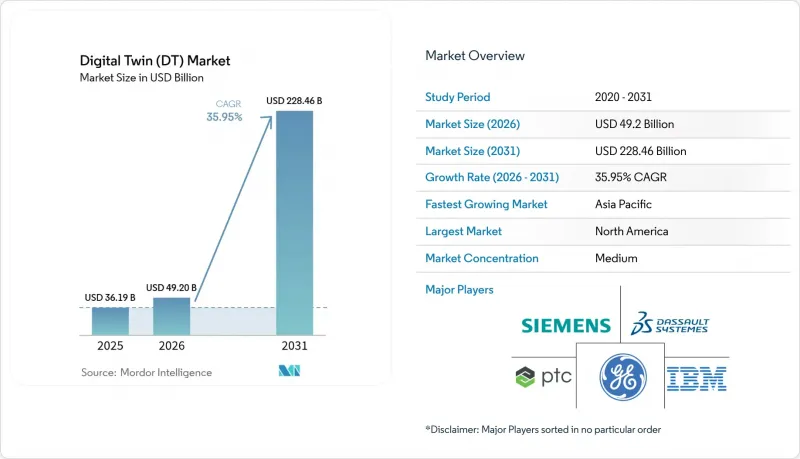
Mordor Intelligence에 의하면, 디지털 트윈(DT) 시장 규모는 2025년에 361억 9,000만 달러로 평가되었고 2026년 492억 달러에서 2031년까지 2,284억 6,000만 달러에 이를 것으로 예측되며, 예측 기간(2026-2031년) CAGR은 35.95%를 나타낼 전망입니다.
본 보고서는 용도별(제조업, 에너지 및 전력, 항공우주 및 방위, 석유 및 가스, 자동차, 기타), 구성 요소별(솔루션/플랫폼, 서비스), 배포 방식별(On-Premise, 클라우드), 기업 규모별(대기업, 중소기업(SME)), 지역별로 분류되어 있습니다.
세계 디지털 트윈(DT) 시장 동향 및 인사이트
산업용 IoT(IIoT) 플랫폼의 급속한 성장
IIoT의 광범위한 도입으로 인해 디지털 모델과 공장 현장의 동기화를 유지하는 실시간 데이터가 제공되고 있습니다. 지멘스는 Xcelerator 생태계의 강점을 바탕으로 2024년 디지털 사업 매출이 90억 유로(97억 2,000만 달러)에 달하고, 전년 대비 22% 증가를 기록했다고 보고했습니다. 하네웰의 Forge 플랫폼은 하루 30억 건 이상의 데이터 포인트를 처리하여 고객의 공장에서 발생하는 예기치 않은 가동 중단 시간을 35% 줄이고 있습니다. OPC UA 및 MQTT와 같은 표준화된 프로토콜을 통해 시스템 통합의 장벽이 낮아져, 공장에서는 몇 달이 아닌 몇 주 만에 디지털 트윈을 도입할 수 있게 되었습니다. 그 결과, 지속적인 비용 절감, 신속한 근본 원인 분석, 그리고 보다 예측 가능한 생산 능력 계획이 가능해졌습니다.
엣지/디바이스 수준에서의 엣지/AI 추론 확대
분석 처리를 클라우드에서 엣지로 이전함으로써 지연 시간이 단축되고 데이터 주권이 유지됩니다. 마이크로소프트와 지멘스는 공동으로 자산 수준에서 추론을 수행하는 ‘Industrial Foundation Models’를 개발하여 이상 감지 시 밀리초 단위의 응답을 가능하게 했습니다. 아우디는 현재 엣지에 배포된 트윈을 통해 가상 PLC를 운영하며, 실제 생산 라인의 사이클 타임을 최적화하고 있습니다. 로컬 시뮬레이션을 통해 예외 데이터만 업스트림로 전송되므로 대역폭 소비도 억제됩니다. 전용 칩과 컨테이너화된 런타임을 통해 Tier 2 공급업체의 도입 비용이 더욱 절감되어, 밸류체인 전반에 걸쳐 AI 지원 트윈의 보급이 가속화되고 있습니다.
IT/OT 스택 전반에 걸친 사이버-물리적 보안의 취약점
스페인 국립 사이버 보안 연구소는 IT와 OT를 연결하는 트윈이 공격 대상 영역을 확대하여 프로세스 컨트롤러를 데이터 무결성 위협에 노출시키고 있다고 지적하고 있습니다. 최근 랜섬웨어 공격으로 인해 제조업체들은 트윈의 데이터 레이크를 정리하는 동안 며칠 동안 생산을 중단할 수밖에 없었습니다. 기업들이 제로 트러스트 아키텍처를 통합하고 직원을 교육하는 과정에서 도입까지의 지연 기간은 평균 18개월에 달하고 있습니다. 멀티테넌트형 트윈의 경우, 협업 속도를 저하시키지 않으면서 파트너에 대한 접근을 세분화해야 하기 때문에 복잡성이 가중되고 있습니다.
부문 분석
2025년, 제조업은 임베디드 IIoT 센서, 예측 유지보수 프로그램, 지속적인 개선 문화 덕분에 디지털 트윈 시장의 35.10%를 차지했습니다. 자동차 및 전자 제품 공장에서는 라인 수준의 디지털 트윈을 도입하여 택트 타임의 변동과 품질 및 수율 패턴을 분석함으로써 스크랩률을 두 자릿수까지 줄이고 있습니다. 에너지 효율 향상은 특히 자원을 대량으로 소비하는 야금 및 시멘트 사업에서 투자 회수를 가속화하는 요인이 됩니다. 이 부문은 꾸준히 확대될 것으로 예상되며, 다른 업종이 따라잡더라도 규모 면에서의 우위를 유지할 것으로 전망됩니다.
석유 및 가스 분야는 현재 규모가 작고, 해양 사업자들이 원격 검사 및 고장 부위 특정 기능을 필요로 하고 있기 때문에 2031년까지 연평균 성장률(CAGR) 28.1%를 나타낼 것으로 예측됩니다. 업스트림 부문에서는 지진 탐사 데이터와 생산 로그를 통합한 저류층 트윈이 도입되어, 이를 통해 엔지니어는 시추 장비를 동원하기 전에 유정 개량 시나리오를 시뮬레이션할 수 있게 되었습니다. 미드스트림 기업들은 누출 감지에 파이프라인 트윈을 적용하고 있는 반면, 쉘(Shell)과 같은 다운스트림 정유시설에서는 DNV 규격으로 검증된 트윈을 활용하여 예정에 없던 가동 중단 시간을 20% 줄인 실적이 있습니다. 트윈이 플레어 방출을 최소화하고 열 통합 전략을 최적화함으로써, 정부의 탈탄소화 목표가 도입을 더욱 촉진하고 있습니다. 두 부문 모두에서 AI를 활용한 시나리오 테스트를 통해 트윈은 단순한 모니터링 시스템에서 의사결정 지원 시스템으로 진화하며, 총 도입 수에서 차지하는 비중을 확대되고 있습니다.
솔루션 카테고리(소프트웨어 플랫폼, 물리 엔진, 연결형 하드웨어)는 기업들이 핵심 기능을 도입한 결과, 2025년 지출의 62.85%를 차지했습니다. 벤더들은 모델링 라이브러리와 시각화 엔진을 번들로 제공하여, 프로세스 엔지니어가 처음부터 코딩할 필요 없이 레플리카를 구축할 수 있게 했습니다. 라이선싱 모델은 사용량 기반의 계층형으로 전환되고 있으며, Tier 2 공급업체의 활용 범위도 확대되고 있습니다.
한편, 서비스 분야는 연평균 성장률(CAGR) 30%라는 빠른 속도로 확대되고 있습니다. 도입 컨설팅 기업은 데이터 파이프라인의 일관성을 확보하고, 시맨틱 모델을 구축하며, 시뮬레이션의 정확도를 검증합니다. 매니지드 서비스 계약을 통해 트윈의 건전성 지표를 모니터링하고, 패치를 적용하며, 드리프트에 대응하여 알고리즘을 조정함으로써 자산 소유자에게 예측 가능한 운영 비용(OPEX)을 실현합니다. 성과 기반 계약이 보편화되는 가운데-롤스로이스의 ‘TotalCare’는 트윈 분석을 바탕으로 엔진 가동 시간을 보장하고 있습니다-서비스 파트너는 더 많은 위험을 감수하며, 요금을 청구 가능한 시간 수가 아닌 효율성 향상에 연동하도록 하고 있습니다. 이 모델은 고객 충성도를 강화하고 플랫폼의 지속적인 기능 향상을 촉진합니다.
지역별 분석
북미는 인더스트리 4.0의 조기 도입, 대규모 항공우주 프로그램, 그리고 산업용 SaaS에 대한 견실한 벤처 자금 조달에 힘입어 2025년 디지털 트윈 시장 매출의 37.95%를 차지했습니다. 미국 항공 규제 당국의 시뮬레이션 기반 인증 승인은 항공기 OEM 및 1차 공급업체들 사이에서 디지털 트윈에 대한 투자를 광범위하게 촉진했습니다. 캐나다와 미국의 주요 에너지 기업들은 강화되는 환경 정책에 발맞추어 메탄 누출률을 줄이기 위해 파이프라인 및 LNG 터미널에 디지털 트윈을 도입하고 있습니다. 사이버 보험 체계가 성숙해지고 데이터 보호 규제가 표준화됨에 따라 클라우드 도입이 특히 활발히 진행되고 있습니다.
아시아태평양은 정부 주도의 메가 프로젝트에 힘입어 26.0%라는 가장 높은 연평균 성장률(CAGR)을 기록하고 있습니다. 중국의 ‘디지털 차이나 건설(Digital China Construction)’ 계획에서는 신규 인프라에 도시 디지털 트윈 도입을 의무화하고 있어, 국내외 벤더들에게 대규모 조달 기회가 창출되고 있습니다. 인도의 ‘상감 디지털 트윈’ 구상에서는 인도가 6G 대응을 향해 나아가는 가운데 전국적인 통신망 업그레이드에 네트워크 트윈 기능을 통합하고 있습니다. 일본의 ‘NTT 디지털 트윈 컴퓨팅 이니셔티브’는 교통 및 재난 대응 알고리즘에 정보를 제공하는 도시 규모의 복제 모델을 지원하고 있습니다. 한국과 싱가포르는 스마트 팩토리 및 스마트 항만 시범 사업을 추진하며, 실시간 탄소 발자국 추적을 중시하고 있습니다. 이 지역이 공급망의 중심지인 만큼, 여기서 얻은 인사이트는 전 세계 OEM 기업들에 신속하게 확산됩니다.
유럽에서는 규제 요구 사항이 핵심 과제로 대두되는 가운데, 착실하게 진전을 보이고 있습니다. ‘디지털 제품 여권’에 따라 제조업체는 제품의 전체 수명 주기에 걸친 추적성을 확보해야 할 의무가 있으며, 사실상 대량 생산품에 대해 경량 디지털 트윈의 도입이 필수적입니다. 독일의 ‘Plattform Industrie 4.0’은 표준화된 관리 셸에 대한 지침을 제공함으로써 중소기업의 통합 부담을 경감시키고 있습니다. 프랑스는 조선 분야의 경쟁력을 유지하기 위해 가상 조선소 트윈에 투자하고 있는 반면, 북유럽 국가들은 넷제로 규제를 충족하기 위해 건물 트윈을 활용하고 있습니다. 중동 및 아프리카은 아직 발전 단계에 있지만, 미래가 기대되고 있습니다. 아랍에미리트(UAE)와 사우디아라비아는 대규모 확장에 앞서 효율성과 지속가능성의 이점을 추구하기 위해 유전 트윈 및 기가 프로젝트 수준의 도시 트윈 시범 사업을 추진하고 있습니다.
기타 혜택:
- Excel 형식 시장 예측(ME) 시트
- 3개월간의 애널리스트 지원
자주 묻는 질문
목차
제1장 서론
제2장 분석 방법
제3장 주요 요약
제4장 시장 구도
제5장 시장 구분
제6장 경쟁 구도
제7장 시장 기회와 향후 전망
JHS 26.09.09According to Mordor Intelligence, the digital twin market size was valued at USD 36.19 billion in 2025 and estimated to grow from USD 49.2 billion in 2026 to reach USD 228.46 billion by 2031, at a CAGR of 35.95% during the forecast period (2026-2031).
This report is Segmented by Application (Manufacturing, Energy and Power, Aerospace and Defense, Oil and Gas, Automotive, and Others), Component (Solutions/Platforms, and Services), Deployment Mode (On-Premises, and Cloud), Enterprise Size (Large Enterprises, and Small and Medium Enterprises (SMEs)), and Geography.
Global Digital Twin (DT) Market Trends and Insights
Rapid growth of industrial IoT platforms
Widespread IIoT deployment supplies real-time data that keeps digital models synchronized with factory floors. Siemens reported EUR 9 billion (USD 9.72 billion) digital business revenue in 2024, up 22% on the strength of its Xcelerator ecosystem. Honeywell's Forge platform processes 3 billion+ datapoints daily, cutting unplanned downtime by 35% in client plants. Standardized protocols such as OPC UA and MQTT reduce integration friction, enabling plants to deploy twins in weeks rather than months. The result is steady cost avoidance, quicker root-cause analysis, and more predictable capacity planning.
Expansion of edge/AI inference at the device level
Moving analytics from cloud to edge trims latency and preserves data sovereignty. Microsoft and Siemens co-developed Industrial Foundation Models that run inference at the asset, allowing millisecond-level responses for anomaly detection. Audi now operates virtual PLCs through edge-deployed twins that optimize cycle times in real manufacturing lines. Local simulation also limits bandwidth consumption because only exception of data moves upstream. Specialized chips and containerized runtimes further cut deployment costs for tier-two suppliers, accelerating the spread of AI-ready twins throughout value chains.
Cyber-physical security vulnerabilities across IT/OT stacks
The Spanish National Cybersecurity Institute notes that twins bridging IT and OT widen attack surfaces, exposing process controllers to data-integrity threats. Recent ransomware events forced manufacturers to halt production for days while cleansing twin data lakes. Average deployment delays of 18 months arise as firms integrate zero-trust architectures and train staff. Multi-tenant twins add complexity because partner access must be segmented without slowing collaboration.
Other drivers and restraints analyzed in the detailed report include:
- Regulatory push for asset-intensive industries to digitise safety-critical infrastructure
- Demand for virtual commissioning to cut CAPEX
- Shortage of domain-specific physics-based modelling expertise
For complete list of drivers and restraints, kindly check the Table Of Contents.
Segment Analysis
Manufacturing contributed 35.10% of the digital twin market in 2025 thanks to embedded IIoT sensors, predictive maintenance programs, and continuous-improvement cultures. Automotive and electronics plants deploy line-level twins to analyze takt-time fluctuations and quality-yield patterns, trimming scrap rates by double digits. Energy-efficiency gains add another payback layer, particularly in resource-intensive metallurgy and cement operations. The segment is forecast to expand steadily, preserving its quantitative edge even as other verticals catch up.
Oil and Gas, though smaller today, is projected to grow at a 28.1% CAGR to 2031 as offshore operators require remote inspection and fault-isolation capabilities. The upstream segment deploys reservoir twins that integrate seismic data and production logs, allowing engineers to simulate well-workover scenarios before mobilizing rigs. Midstream companies apply pipeline twins for leak detection, while downstream refineries like Shell have documented 20% unplanned downtime reductions using twins verified by DNV standards. Government decarbonization targets further propel adoption as twins optimize flare minimization and heat-integration strategies. Across both segments, AI-assisted scenario testing elevates twins from monitoring to decision-support systems, reinforcing their share of total deployments.
The solutions category-software platforms, physics engines, and connected hardware-accounted for 62.85% of spending in 2025 as companies acquired core capabilities. Vendors bundle modeling libraries with visualization engines so process engineers can assemble replicas without coding from scratch. Licensing models are shifting to consumption-based tiers, broadening access among tier-two suppliers.
Services, however, are scaling faster at a 30% CAGR. Implementation consultancies align data pipelines, create semantic models, and validate simulation fidelity. Managed-service contracts monitor twin health metrics, apply patches, and tune algorithms for drift, yielding predictable OPEX for asset owners. As outcome-based agreements proliferate-Rolls-Royce TotalCare guarantees engine uptime backed by twin analytics-service partners assume more risk, tying fees to efficiency gains rather than billable hours. This model strengthens customer loyalty and encourages continuous platform enhancements.
Complete Report Scope:
- By Application
- Manufacturing
- Energy and Power
- Aerospace and Defense
- Oil and Gas
- Automotive
- Others
- By Component
- Solutions/Platforms
- Services
- By Deployment Mode
- On-premises
- Cloud
- By Enterprise Size
- Large Enterprises
- Small and Medium Enterprises (SMEs)
- By Geography
- North America
- United States
- Canada
- Mexico
- South America
- Brazil
- Argentina
- Rest of South America
- Europe
- United Kingdom
- Germany
- France
- Italy
- Spain
- Nordics
- Rest of Europe
- Middle East and Africa
- Middle East
- Saudi Arabia
- United Arab Emirates
- Turkey
- Rest of Middle East
- Africa
- South Africa
- Egypt
- Nigeria
- Rest of Africa
- Middle East
- Asia-Pacific
- China
- India
- Japan
- South Korea
- ASEAN
- Australia
- New Zealand
- Rest of Asia-Pacific
- North America
Geography Analysis
North America commanded 37.95% of digital twin market revenue in 2025 driven by early Industry 4.0 rollouts, extensive aerospace programs, and robust venture funding for industrial SaaS. U.S. aviation regulators' acceptance of simulation-based certification has spurred widespread twin investment among aircraft OEMs and Tier-1 suppliers. Energy majors in Canada and the United States deploy pipeline and LNG terminal twins to cut methane leak rates, aligning with tightening environmental policy. Cloud adoption is particularly strong due to mature cyber-insurance frameworks and standardized data-protection mandates.
Asia-Pacific posts the highest CAGR at 26.0%, supported by government megaprojects. China's Digital China Construction plan mandates urban digital twins for new infrastructure, creating large procurement pipelines for domestic and foreign vendors. India's Sangam Digital Twin scheme integrates network twin capability into nationwide telecom upgrades as the country moves toward 6G readiness. Japan's NTT Digital Twin Computing Initiative supports city-scale replicas that feed transportation and disaster-response algorithms. South Korea and Singapore push smart-factory and smart-port pilots, emphasizing real-time carbon-footprint tracking. The region's supply-chain centrality means lessons learned here propagate quickly to global OEMs.
Europe advances steadily as regulatory imperatives take center stage. The digital product passport forces manufacturers to embed traceability across product life cycles, effectively making a lightweight twin mandatory for high-volume goods. Germany's Plattform Industrie 4.0 provides standardized administration shell guidelines, reducing integration overhead for SMEs. France invests in virtual shipyard twins to maintain competitive edge in naval construction, while the Nordics use building twins to meet net-zero codes. The Middle East and Africa remain nascent but promising: the UAE and Saudi Arabia are piloting oil-field twins and giga-project city twins, seeking efficiency and sustainability benefits prior to large-scale expansion.
- ANSYS, Inc.
- AVEVA Group plc
- Bentley Systems, Incorporated
- Cal-Tek S.R.L.
- Cityzenith, Inc.
- Dassault Systemes SE
- General Electric Company
- Hexagon AB
- International Business Machines Corporation
- Lanner Group Limited (Royal HaskoningDHV)
- Mevea Ltd.
- Microsoft Corporation
- Oracle Corporation
- PTC Inc.
- Rescale, Inc.
- Robert Bosch GmbH (Bosch.IO)
- SAP SE
- Schneider Electric SE
- Siemens AG
- Amazon Web Services, Inc.
Additional Benefits:
- The market estimate (ME) sheet in Excel format
- 3 months of analyst support
TABLE OF CONTENTS
1 INTRODUCTION
- 1.1 Study Assumptions and Market Definition
- 1.2 Scope of the Study
2 RESEARCH METHODOLOGY
3 EXECUTIVE SUMMARY
4 MARKET LANDSCAPE
- 4.1 Market Overview
- 4.2 Market Drivers
- 4.2.1 Rapid growth of industrial IoT platforms
- 4.2.2 Expansion of edge/AI inference at the device level
- 4.2.3 Regulatory push for asset-intensive industries to digitise safety-critical infrastructure
- 4.2.4 Demand for virtual commissioning to cut CAPEX in brownfield projects
- 4.2.5 Rise of outcome-based service contracts needing real-time asset replica data
- 4.2.6 Proliferation of digital product passports in EU and U.S.
- 4.3 Market Restraints
- 4.3.1 Cyber-physical security vulnerabilities across IT/OT stacks
- 4.3.2 Shortage of domain-specific physics-based modelling expertise
- 4.3.3 Opaque IP ownership of data generated in federated twins
- 4.3.4 Fragmentation of simulation standards limiting interoperability
- 4.4 Evaluation of Critical Regulatory Framework
- 4.5 Value Chain Analysis
- 4.6 Technological Outlook
- 4.7 Porter's Five Forces
- 4.7.1 Bargaining Power of Suppliers
- 4.7.2 Bargaining Power of Buyers
- 4.7.3 Threat of New Entrants
- 4.7.4 Threat of Substitutes
- 4.7.5 Competitive Rivalry
- 4.8 Impact Assessment of Key Stakeholders
- 4.9 Key Use Cases and Case Studies
- 4.10 Impact on Macroeconomic Factors of the Market
- 4.11 Investment Analysis
5 MARKET SEGMENTATION
- 5.1 By Application
- 5.1.1 Manufacturing
- 5.1.2 Energy and Power
- 5.1.3 Aerospace and Defense
- 5.1.4 Oil and Gas
- 5.1.5 Automotive
- 5.1.6 Others
- 5.2 By Component
- 5.2.1 Solutions/Platforms
- 5.2.2 Services
- 5.3 By Deployment Mode
- 5.3.1 On-premises
- 5.3.2 Cloud
- 5.4 By Enterprise Size
- 5.4.1 Large Enterprises
- 5.4.2 Small and Medium Enterprises (SMEs)
- 5.5 By Geography
- 5.5.1 North America
- 5.5.1.1 United States
- 5.5.1.2 Canada
- 5.5.1.3 Mexico
- 5.5.2 South America
- 5.5.2.1 Brazil
- 5.5.2.2 Argentina
- 5.5.2.3 Rest of South America
- 5.5.3 Europe
- 5.5.3.1 United Kingdom
- 5.5.3.2 Germany
- 5.5.3.3 France
- 5.5.3.4 Italy
- 5.5.3.5 Spain
- 5.5.3.6 Nordics
- 5.5.3.7 Rest of Europe
- 5.5.4 Middle East and Africa
- 5.5.4.1 Middle East
- 5.5.4.1.1 Saudi Arabia
- 5.5.4.1.2 United Arab Emirates
- 5.5.4.1.3 Turkey
- 5.5.4.1.4 Rest of Middle East
- 5.5.4.2 Africa
- 5.5.4.2.1 South Africa
- 5.5.4.2.2 Egypt
- 5.5.4.2.3 Nigeria
- 5.5.4.2.4 Rest of Africa
- 5.5.4.1 Middle East
- 5.5.5 Asia-Pacific
- 5.5.5.1 China
- 5.5.5.2 India
- 5.5.5.3 Japan
- 5.5.5.4 South Korea
- 5.5.5.5 ASEAN
- 5.5.5.6 Australia
- 5.5.5.7 New Zealand
- 5.5.5.8 Rest of Asia-Pacific
- 5.5.1 North America
6 COMPETITIVE LANDSCAPE
- 6.1 Market Concentration
- 6.2 Strategic Moves
- 6.3 Market Share Analysis
- 6.4 Company Profiles (includes Global level Overview, Market level overview, Core Segments, Financials as available, Strategic Information, Market Rank/Share for key companies, Products and Services, and Recent Developments)
- 6.4.1 ANSYS, Inc.
- 6.4.2 AVEVA Group plc
- 6.4.3 Bentley Systems, Incorporated
- 6.4.4 Cal-Tek S.R.L.
- 6.4.5 Cityzenith, Inc.
- 6.4.6 Dassault Systemes SE
- 6.4.7 General Electric Company
- 6.4.8 Hexagon AB
- 6.4.9 International Business Machines Corporation
- 6.4.10 Lanner Group Limited (Royal HaskoningDHV)
- 6.4.11 Mevea Ltd.
- 6.4.12 Microsoft Corporation
- 6.4.13 Oracle Corporation
- 6.4.14 PTC Inc.
- 6.4.15 Rescale, Inc.
- 6.4.16 Robert Bosch GmbH (Bosch.IO)
- 6.4.17 SAP SE
- 6.4.18 Schneider Electric SE
- 6.4.19 Siemens AG
- 6.4.20 Amazon Web Services, Inc.
7 MARKET OPPORTUNITIES AND FUTURE OUTLOOK
- 7.1 White-space and Unmet-need Assessment