
|
시장보고서
상품코드
2123147
대형 트럭 시장 : 시장 점유율 분석, 업계 동향 및 통계, 성장 예측(2026-2031년)Heavy Duty Trucks - Market Share Analysis, Industry Trends & Statistics, Growth Forecasts (2026 - 2031) |
||||||
 Mordor Intelligence
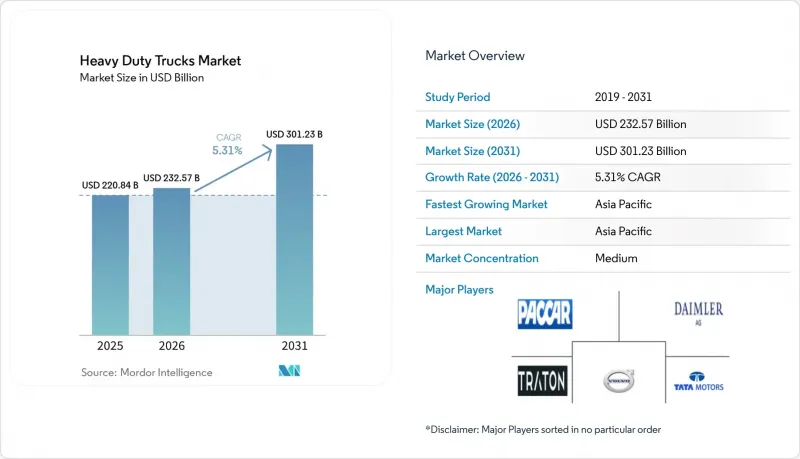
Mordor Intelligence에 의하면, 대형 트럭 시장 규모는 2025년 2,208억 4,000만 달러로 평가되었고, 2026년에는 2,325억 7,000만 달러로 추정되고, 2026-2031년 CAGR 5.31%로 성장을 지속할 전망이며, 2031년에는 3,012억 3,000만 달러에 이를 것으로 예측됩니다.
본 보고서는 적재량별(10-15톤 및 15톤 초과), 등급별(클래스 7 및 클래스 8), 구동 방식별(디젤, 배터리식 전기, 기타), 용도별(건설 및 광업 등), 트럭 차체 유형별(트랙터 트레일러 등), 판매 채널별(OEM 등), 지역별(북미 등)로 분류되어 있습니다. 시장 전망은 금액(달러) 및 수량(대)으로 제시되어 있습니다.
세계의 대형 트럭 시장 동향 및 인사이트
확대되는 전자상거래 화물량
전자상거래로 인한 화물량 증가는 라스트 마일 배송의 최적화와 지역 배송 네트워크의 밀도 향상을 통해 대형 트럭 수요를 견인하고 있습니다. 온라인 소매의 급증은 제로 배출 규제로 인해 디젤 차량의 운용이 점점 더 제한되고 있는 도시 지역에서 중형 전기 트럭 수요를 창출하고 있습니다. 온라인 소매의 보급이 진전됨에 따라 소포 및 소량 화물(LTL) 운송이 차량 구성을 변화시키고 있습니다. 미국 트럭 운송 협회(ATA)는 미국의 화물 운송 톤수가 2024년 112억 7,000만 톤에서 2035년까지 139억 9,000만 톤으로 증가할 것으로 예측하고 있으며, 이로 인해 지역 운송용 차량에 지속적인 압박이 가해지고 있습니다. 캘리포니아주, 뉴욕주 및 유럽의 여러 도시에서 무공해 구역이 도입됨에 따라, 사업자들은 클래스 7 및 더 가벼운 클래스 8 트랙터로 전환해야 하는 상황에 직면해 있으며, 이들의 운행 주기는 현재 배터리 주행 거리인 200-300킬로미터와 일치합니다. 아마존이 2030년까지 10만 대의 전기 배송 차량을 도입하겠다고 공약한 것은 규정 준수 및 브랜드 포지셔닝을 위해 추가 자본 비용을 감수하려는 얼리 어답터들의 의지를 여실히 보여줍니다. 또한 사업자에게는 시간 엄수가 요구되는 화물에 대한 할증 운임도 이점으로 작용하여, 차량 가격 상승분을 일부 상쇄하고 있습니다. 고부가가치 화물로 전환함에 따라 가동 시간을 극대화하는 텔레매틱스 및 예측 유지보수에 대한 투자가 더욱 촉진되고 있습니다.
전 세계의 엄격한 배기가스 규제가 차량 교체를 가속화
주요 시장의 규제 체계는 차량의 전동화에 전례 없는 압력을 가하고 있으며, 미국 환경보호청(EPA)의 3단계 기준에 따르면 2032년까지 상업용 차량의 50%를 무공해 차량으로 전환해야 합니다. 규제 당국은 NOx 및 CO2 배출 제한을 강화함으로써 차량 교체 주기를 단축하고 있습니다. 미국 EPA의 ‘클린 트럭 계획’은 2032년 모델 연도까지 클래스 8 트랙터의 신차 판매 대수 중 40%를 무공해 차량으로할 것을 규정하고 있으며, 2027년부터 단계적인 조치가 시작됩니다. 2027년에 시행되는 유로 VII 기준에서는 실제 주행 시험 및 차량 진단 시스템의 도입이 의무화되며, 이로 인해 디젤 엔진의 비용이 10-15% 증가하여 배터리식 전기차와의 가격 차이가 좁혀지게 됩니다. 전동화를 미루는 차량 운영 사업자는 규제 구역 내에서 구형 디젤 차량의 재판매 가치가 하락할 위험에 직면해 있으며, 이러한 경향은 캘리포니아주의 ‘어드밴스드 클린 트럭(ACT)’ 규정에 의해 더욱 강화되고 있습니다. 전 세계 전기 트럭 판매 대수의 80% 이상을 차지하는 중국에서 제로 에미션 대형 차량의 급속한 보급은 정책이 시장의 변화를 얼마나 가속화할 수 있는지를 보여주고 있습니다.
무공해 대형 트럭의 높은 초기 비용
클래스 8 배터리식 전기 트랙터는 여전히 동급 디젤 차량에 비해 2-3배의 비용이 들며, 2025년 정가는 35만-40만 달러인 반면, 기존 디젤 차량은 15만-18만 달러입니다. 캘리포니아주의 HVIP 바우처 등, 1대당 최대 24만 달러에 달하는 보조금으로 인해 가격 차이는 완화되지만, 완전히 해소되지는 않습니다. 가격에 민감한 경제권에서는 현금 흐름의 제약으로 인해 소규모 차량 운영 사업자는 보조금을 적용한 가격 차이조차 감당할 수 없습니다. 또한 금융 기관도 불확실한 잔존 가치와 7년째를 넘긴 배터리의 성능 저하를 상쇄하기 위해 더 높은 금리 스프레드를 요구하고 있습니다.
부문 분석
15톤 이상의 대형 트럭 시장 규모는 2025년에도 매출 점유율 61.40%를 차지했으며, 여전히 지배적인 위치를 유지했습니다. 이는 장거리 운송과 건설 물류가 여전히 중요한 역할을 하고 있음을 반영합니다. 이 부문은 인프라 투자에 힘입어 성장을 이어가고 있지만, 배터리 중량 증가로 인한 불이익이 커지면서 그 성장세는 억제되고 있습니다. 한편, 10-15톤급은 연평균 성장률(CAGR) 9.50%로 확대되고 있습니다. 총 차량 중량이 가벼운 차량에 배송 특권을 인정하는 도시가 늘어나고 있는 것이 이러한 호조를 뒷받침하고 있습니다. 유럽에서 제안되고 있는 배터리식 전기 리지드 트럭에 대한 1톤의 허용 중량은 적재량의 균형을 유지하기 위한 것으로, 각 OEM사의 제품 라인업 확충을 촉진하고 있습니다.
사업자들 사이에서는 중량급이 주행 거리, 적재량, 섀시 비용의 균형이 ‘딱 알맞다’고 보고되고 있습니다. 다임러의 ‘eActros 300’은 스위스에서 진행된 실증 시험에서 실제 주행 거리 220킬로미터를 달성했으며, 야간 충전을 통해 하루 2교대 근무를 완전히 소화해 냈습니다. 2026년에는 배터리 가격이 kW시당 110달러에 근접할 전망이며, 이로 인해 3년 이내의 투자 회수 기간 내에 중형급 차량의 전기화가 경제적으로 매력적으로 되고 있습니다. 2030년 이후, 도심 내에서 12톤을 초과하는 디젤 차량의 주행을 금지하겠다는 캘리포니아주와 파리의 정책적 신호도 수요를 더욱 뒷받침하고 있습니다. 그 결과, 10-15톤 부문은 2031년까지 대형 트럭 시장에서 점유율을 약 30%까지 끌어올릴 전망입니다.
클래스 8은 주간 운송 및 대규모 건설 수요에 힘입어 2025년에도 70.8%라는 압도적인 점유율을 유지했습니다. 연평균 성장률(CAGR) 8.30%로 예측되는 클래스 7은 중간 충전 없이 현재 배터리 주행 거리에 부합하는 150-200마일의 운행 주기로부터 혜택을 받고 있습니다. 캘리포니아주 대기자원국(CARB)은 2032년까지 클래스 7 트랙터 판매 대수의 40%를 제로 에미션 차량으로할 것을 의무화하고 있으며, 이에 따라 각 OEM사의 로드맵이 가속화되고 있습니다.
맥(Mac)사의 ‘MD Electric’은 150kW시의 배터리 팩과 140마일의 주행 거리를 갖추고 있으며, 경로가 예측 가능하고 계획적인 충전이 가능한 음료·외식 산업의 차량군에서 성공을 거두고 있습니다. 클래스 8의 전동화는 여전히 실험 단계이지만, 미래성은 높다고 할 수 있습니다. 미국 I-5 고속도로나 독일의 아우토반에 도입이 진행 중인 메가와트급 충전기를 통해 45분 만에 충전이 완료될 수 있습니다. 중형 트럭의 보급이 가속화됨에 따라, 클래스 8 대형 트럭 시장 점유율은 2031년까지 68% 미만으로 떨어질 것으로 예측됩니다.
지역별 분석
아시아태평양은 2025년에 매출 점유율 47.21%로 1위를 차지했으며, 중국의 제조 규모와 지역적 수소 회랑에 힘입어 2031년까지 연평균 성장률(CAGR) 9.30%를 나타낼 것으로 예측됩니다. 중국 국 VI 기준과 베이징·상하이 지방 정부의 인센티브가 도시 지역의 전기화를 가속화한 결과, Sinotruk, FAW, 동풍자동차(Dongfeng)가 해당 지역 판매 대수의 60% 이상을 차지했습니다. 인도의 타타 모터스는 2024년에 ‘프리마 EV’를 출시하여 대도시권의 화물 운송 및 특정 광업 고객을 대상으로 하고 있습니다. 한편, 델리 주와 마하라슈트라 주의 주 정부 보조금 제도는 2028년까지 8,000대의 무공해 트럭 도입을 목표로 하고 있습니다. 일본의 ‘후쿠시마 수소 고속도로’는 연료전지 트럭 실증 사업을 지원하고 있으며, 호주의 포트 에스크 메탈스 그룹은 스코프 1 배출량을 감축하기 위해 수소 운송 사업에 투자하고 있습니다.
북미는 28%의 점유율을 차지하고 있으며, 미국 환경보호청(EPA)의 ‘클린 트럭 계획’과 연방 정부의 충전 인프라 보조금이 그 원동력이 되고 있습니다. 캘리포니아주의 ‘어드밴스드 클린 트럭’ 규제와 차량당 최대 24만 달러에 달하는 인센티브 덕분에 미국 최대 규모의 무공해 차량 도입 계획이 뒷받침되고 있습니다. 캐나다에서는 최대 20만 캐나다 달러의 리베이트 제도가 윈저-퀘벡 간 노선에서의 보급을 뒷받침하고 있는 반면, 멕시코 국경을 넘는 운송업체들은 캘리포니아주로의 접근성을 유지하기 위해 전동화를 추진하고 있습니다. 유럽은 2025년에 18%를 차지할 전망이며, 유로 VII 기준과 독일 아우토반에 설치된 메가와트급 충전기가 도입을 촉진하고 있습니다. 영국은 2030년까지 트럭 판매의 10%를 제로 배출 차량으로할 것을 의무화하고, 2040년까지 100%로 확대할 방침입니다. 프랑스와 이탈리아는 과도기적 연료로 LNG를 지원하고 있는 반면, 스칸디나비아 국가들은 모든 등급에서 배터리식 전기 트럭을 추진하고 있습니다.
중동 및 아프리카는 합쳐서 7%를 차지하며, 두바이와 리야드에서는 도시 내 배송용으로 중국의 배터리식 전기 트럭이 시범 도입되고 있습니다. 극심한 기온으로 인해 정교한 열 관리가 필수적이기 때문에 보급 확대는 더딘 양상을 보이고 있습니다. 라틴아메리카의 칠레와 페루에 위치한 광업 지역에서는 수소 연료전지에 대한 수요가 조기에 발생하고 있지만, 자금 조달 비용과 인프라 부족으로 인해 시장 전체의 성장은 제약을 받고 있습니다.
기타 혜택 :
- 엑셀 형식 시장 예측(ME) 시트
- 3개월간의 애널리스트 지원
자주 묻는 질문
목차
제1장 서론
제2장 조사 방법
제3장 주요 요약
제4장 시장 구도
제5장 시장 규모 및 성장 예측
제6장 경쟁 구도
제7장 시장 기회 및 향후 전망
AJY 26.09.07According to Mordor Intelligence, the heavy-duty trucks market size is expected to grow from USD 220.84 billion in 2025 to USD 232.57 billion in 2026 and is forecast to reach USD 301.23 billion by 2031 at a 5.31% CAGR over 2026-2031.
This report is Segmented by Tonnage Type (10 To 15 T and More Than 15 T), Class (Class 7 and Class 8), Propulsion Type (Diesel, Battery-Electric, and More), Application (Construction and Mining, and More), Truck Body Type (Tractor-Trailer, and More), Sales Channel (OEM, and More), and Geography (North America, and More). The Market Forecasts are Provided in Terms of Value (USD) and Volume (Units).
Global Heavy Duty Trucks Market Trends and Insights
Expanding E-commerce Freight Volumes
E-commerce freight expansion drives heavy-duty truck demand through last-mile delivery optimization and regional distribution network densification. The surge in online retail creates demand for medium-duty electric trucks in urban environments, where zero-emission mandates increasingly restrict diesel operations. Parcel and less-than-truckload shipments are reshaping fleet composition as online retail penetration deepens. The American Trucking Associations projects U.S. freight tonnage will rise from 11.27 billion tons in 2024 to 13.99 billion tons by 2035, placing sustained pressure on regional haul assets. Zero-emission zones in California, New York, and several European cities push operators toward Class 7 and lighter Class 8 tractors, duty cycles that align with the current battery range of 200-300 kilometers. Amazon's pledge to field 100,000 electric delivery vehicles by 2030 illustrates early-adopter willingness to absorb capital premiums for compliance and brand positioning. Operators also benefit from premium freight rates on time-sensitive cargo, partially offsetting higher vehicle prices. The shift toward higher-value goods further incentivizes investments in telematics and predictive maintenance that maximize uptime.
Strict Global Emission Mandates Driving Fleet Renewal
Regulatory frameworks across major markets create unprecedented pressure for fleet electrification, with the EPA's Phase 3 standards requiring 50% of vocational vehicles to be zero-emission by 2032. Regulators are compressing replacement cycles by tightening NOx and CO2 limits. The U.S. EPA Clean Trucks Plan stipulates that zero-emission models must reach 40% of new Class 8 tractor sales by model year 2032, with interim steps beginning in 2027. Euro VII standards entering force in 2027 impose real-world testing and onboard diagnostics that add 10-15% to diesel engine costs, narrowing the price gap with battery-electric alternatives. Fleets delaying electrification risk stranded assets as resale values for older diesels fall in restricted zones, a trend amplified by California's Advanced Clean Trucks rule. China's rapid adoption of zero-emission heavy-duty vehicles, with over 80% of global electric truck sales, demonstrates how policy can accelerate market transformation.
High Upfront Cost of Zero-emission Heavy Trucks
Battery-electric Class 8 tractors still cost two to three times more than diesel equivalents, with 2025 list prices of USD 350,000-400,000 versus USD 150,000-180,000 for conventional units. Subsidies such as California's HVIP vouchers, which can reach USD 240,000 per truck, ease but do not eliminate the premium. In price-sensitive economies, cash-flow constraints prevent smaller fleets from absorbing even subsidized differentials. Financiers also demand higher interest spreads to compensate for uncertain residual values and battery degradation beyond year 7.
Other drivers and restraints analyzed in the detailed report include:
- Infrastructure Stimulus Packages
- Hydrogen Corridor Pilot Programs in Asia Pacific
- Volatile Diesel Price Environment Impacting Purchase Cycles
For complete list of drivers and restraints, kindly check the Table Of Contents.
Segment Analysis
The heavy-duty trucks market size for vehicles above 15 tons stayed dominant with a 61.40% revenue share in 2025, reflecting the still-critical role of long-haul and construction logistics. The segment continues to grow, supported by infrastructure spending but tempered by higher battery mass penalties. Conversely, the 10-15 ton bracket is advancing at a 9.50% CAGR; cities granting delivery privileges to lighter gross vehicle weights foster this outperformance. Europe's proposed 1-ton allowance for battery-electric rigids aims to preserve payload parity and is catalyzing OEM portfolio additions.
Operators report that the "Goldilocks" mid-weight class balances range, payload, and chassis cost. Daimler's eActros 300 achieved a 220-kilometer real-world range in Swiss pilots, covering a full double-shift with overnight charging. Battery prices nearing USD 110 per kilowatt-hour in 2026 are making mid-weight electrification financially attractive within three-year payback windows. Policy signals in California and Paris that prohibit diesels over 12 tons inside city limits after 2030 further anchor demand. As a result, the 10-15 ton segment is set to raise its share of the heavy-duty trucks market to roughly 30% by 2031.
Class 8 maintained a commanding 70.8% presence in 2025, driven by interstate haulage and heavy construction. With an 8.30% CAGR forecast, Class 7 gains from duty cycles of 150-200 miles that match current battery ranges without en-route charging. CARB requires 40% zero-emission sales for Class 7 tractors by 2032, accelerating OEM roadmaps.
Mack's MD Electric offers a 150-kilowatt-hour pack and 140-mile range, succeeding in beverage and food-service fleets where predictable routes enable scheduled charging. Class 8 electrification remains experimental but promising; megawatt chargers rolling out on U.S. I-5 and German Autobahns enable 45-minute turnarounds. The heavy-duty trucks market share for Class 8 is projected to slip below 68% by 2031 as medium-duty adoption accelerates.
Complete Report Scope:
- By Tonnage Type
- 10 to 15 T
- More Than 15 T
- By Class
- Class 7
- Class 8
- By Propulsion Type
- Diesel
- Battery-Electric
- Fuel-Cell Electric (FCEV)
- Alternative Fuels (CNG, LNG, Biodiesel)
- By Application
- Construction and Mining
- Freight and Logistics
- Municipal and Utilities
- Others
- By Truck Body Type
- Tractor-Trailer
- Rigid Dump
- Tanker
- Others
- By Sales Channel
- OEM/First Purchase
- Lease and Rental
- After-market Retrofit
- By Geography
- North America
- United States
- Canada
- Rest of North America
- South America
- Brazil
- Argentina
- Rest of South America
- Europe
- Germany
- United Kingdom
- France
- Italy
- Russia
- Rest of Europe
- Asia-Pacific
- China
- India
- Japan
- South Korea
- Australia and New Zealand
- Rest of Asia-Pacific
- Middle East and Africa
- Saudi Arabia
- United Arab Emirates
- Egypt
- Turkey
- South Africa
- Rest of Middle East and Africa
- North America
Geography Analysis
Asia-Pacific led with a 47.21% revenue share in 2025 and is projected to grow at a 9.30% CAGR to 2031, buoyed by China's manufacturing scale and regional hydrogen corridors. Sinotruk, FAW, and Dongfeng captured over 60% of regional volumes as the National VI standard and municipal incentives in Beijing and Shanghai accelerated urban electrification. India's Tata Motors launched the Prima EV in 2024, addressing metropolitan freight and select mining customers, while state subsidies in Delhi and Maharashtra target 8,000 zero-emission trucks by 2028. Japan's Fukushima Hydrogen Highway underpins fuel-cell pilots, and Australia's Fortescue Metals Group invests in hydrogen haulage to cut Scope 1 emissions.
North America held a 28% share, animated by the U.S. EPA Clean Trucks Plan and federal charging grants. California's Advanced Clean Trucks rule and incentives reaching USD 240,000 per vehicle sustain the nation's largest zero-emission fleet pipeline. Canada's up-to-CAD 200,000 rebates drive uptake along the Windsor-Quebec corridor, while Mexico's cross-border carriers electrify to maintain California access. Europe contributed 18% in 2025, with Euro VII standards and Germany's Autobahn megawatt chargers catalyzing adoption. The United Kingdom mandates 10% zero-emission truck sales by 2030, scaling to 100% by 2040. France and Italy support LNG as a bridge fuel, whereas Scandinavia pushes battery-electric solutions across all classes.
The Middle East and Africa collectively accounted for 7%, with Dubai and Riyadh piloting Chinese battery-electric rigs for urban deliveries. Extreme temperatures necessitate advanced thermal management, slowing broader adoption. Latin America's mining belts in Chile and Peru represent early hydrogen fuel-cell demand, but broader market growth is constrained by financing costs and infrastructure gaps.
- Daimler Truck Holding AG
- Traton SE
- Volvo Group
- PACCAR Inc.
- Dongfeng Motor Corporation
- Tata Motors Ltd.
- FAW Group Corp.
- CNHTC (Sinotruk)
- Ashok Leyland Ltd
- Isuzu Motors Ltd.
- Hino Motors Ltd.
- Navistar International
- Iveco Group N.V.
- Hyundai Motor Co.
- Nikola Corporation
- JAC Motors
- Kamaz PJSC
- Foton Motor Co. Ltd.
Additional Benefits:
- The market estimate (ME) sheet in Excel format
- 3 months of analyst support
TABLE OF CONTENTS
1 Introduction
- 1.1 Study Assumptions and Market Definition
- 1.2 Scope of the Study
2 Research Methodology
3 Executive Summary
4 Market Landscape
- 4.1 Market Overview
- 4.2 Market Drivers
- 4.2.1 Expanding E-Commerce Freight Volumes
- 4.2.2 Strict Global Emission Mandates Driving Fleet Renewal
- 4.2.3 Infrastructure Stimulus Packages
- 4.2.4 Hydrogen Corridor Pilot Programs in Asia Pacific
- 4.2.5 OTA-Enabled TCO Optimization for Fleet Managers
- 4.2.6 Mining Sector Electrification Commitments in South America
- 4.3 Market Restraints
- 4.3.1 High Upfront Cost of Zero-Emission Heavy Trucks
- 4.3.2 Volatile Diesel Price Environment Impacting Purchase Cycles
- 4.3.3 Semiconductor Shortages Delaying ADAS/EV Production
- 4.3.4 Stricter EU Axle-Weight Rules Limiting Payload Economics
- 4.4 Value/Supply-Chain Analysis
- 4.5 Regulatory Landscape
- 4.6 Technological Outlook
- 4.7 Porter's Five Forces Analysis
- 4.7.1 Bargaining Power of Suppliers
- 4.7.2 Bargaining Power of Consumers
- 4.7.3 Threat of New Entrants
- 4.7.4 Threat of Substitute Products
- 4.7.5 Intensity of Competitive Rivalry
5 Market Size and Growth Forecasts (Value (USD) and Volume (Units))
- 5.1 By Tonnage Type
- 5.1.1 10 to 15 T
- 5.1.2 More Than 15 T
- 5.2 By Class
- 5.2.1 Class 7
- 5.2.2 Class 8
- 5.3 By Propulsion Type
- 5.3.1 Diesel
- 5.3.2 Battery-Electric
- 5.3.3 Fuel-Cell Electric (FCEV)
- 5.3.4 Alternative Fuels (CNG, LNG, Biodiesel)
- 5.4 By Application
- 5.4.1 Construction and Mining
- 5.4.2 Freight and Logistics
- 5.4.3 Municipal and Utilities
- 5.4.4 Others
- 5.5 By Truck Body Type
- 5.5.1 Tractor-Trailer
- 5.5.2 Rigid Dump
- 5.5.3 Tanker
- 5.5.4 Others
- 5.6 By Sales Channel
- 5.6.1 OEM/First Purchase
- 5.6.2 Lease and Rental
- 5.6.3 After-market Retrofit
- 5.7 By Geography
- 5.7.1 North America
- 5.7.1.1 United States
- 5.7.1.2 Canada
- 5.7.1.3 Rest of North America
- 5.7.2 South America
- 5.7.2.1 Brazil
- 5.7.2.2 Argentina
- 5.7.2.3 Rest of South America
- 5.7.3 Europe
- 5.7.3.1 Germany
- 5.7.3.2 United Kingdom
- 5.7.3.3 France
- 5.7.3.4 Italy
- 5.7.3.5 Russia
- 5.7.3.6 Rest of Europe
- 5.7.4 Asia-Pacific
- 5.7.4.1 China
- 5.7.4.2 India
- 5.7.4.3 Japan
- 5.7.4.4 South Korea
- 5.7.4.5 Australia and New Zealand
- 5.7.4.6 Rest of Asia-Pacific
- 5.7.5 Middle East and Africa
- 5.7.5.1 Saudi Arabia
- 5.7.5.2 United Arab Emirates
- 5.7.5.3 Egypt
- 5.7.5.4 Turkey
- 5.7.5.5 South Africa
- 5.7.5.6 Rest of Middle East and Africa
- 5.7.1 North America
6 Competitive Landscape
- 6.1 Market Concentration
- 6.2 Strategic Moves
- 6.3 Market Share Analysis
- 6.4 Company Profiles (Includes Global level Overview, Market level overview, Core Segments, Financials as available, Strategic Information, Market Rank/Share for key companies, Products and Services, and Recent Developments)
- 6.4.1 Daimler Truck Holding AG
- 6.4.2 Traton SE
- 6.4.3 Volvo Group
- 6.4.4 PACCAR Inc.
- 6.4.5 Dongfeng Motor Corporation
- 6.4.6 Tata Motors Ltd.
- 6.4.7 FAW Group Corp.
- 6.4.8 CNHTC (Sinotruk)
- 6.4.9 Ashok Leyland Ltd
- 6.4.10 Isuzu Motors Ltd.
- 6.4.11 Hino Motors Ltd.
- 6.4.12 Navistar International
- 6.4.13 Iveco Group N.V.
- 6.4.14 Hyundai Motor Co.
- 6.4.15 Nikola Corporation
- 6.4.16 JAC Motors
- 6.4.17 Kamaz PJSC
- 6.4.18 Foton Motor Co. Ltd.
7 Market Opportunities and Future Outlook
- 7.1 White-space and Unmet-Need Assessment