|
시장보고서
상품코드
2123152
매니지드 파일 전송 시장 : 시장 점유율 분석, 업계 동향 및 통계, 성장 예측(2026-2031년)Managed File Transfer - Market Share Analysis, Industry Trends & Statistics, Growth Forecasts (2026 - 2031) |
||||||
 Mordor Intelligence
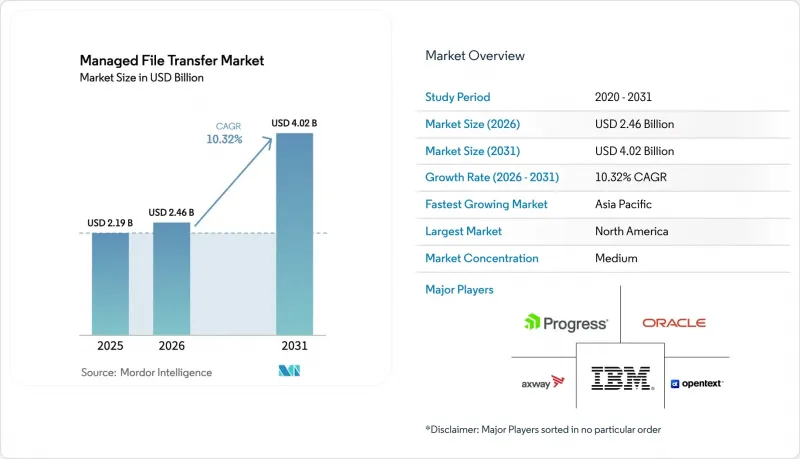
Mordor Intelligence에 의하면, 매니지드 파일 전송 시장 규모는 2025년 21억 9,000만 달러로 평가되었고, 2026년에는 24억 6,000만 달러로 추정되고, 2026-2031년 CAGR 10.32%로 성장을 지속할 전망이며, 2031년에는 40억 2,000만 달러에 이를 것으로 예측됩니다.
본 보고서는 조직 규모별(대기업, 중소기업), 도입 형태별(클라우드 기반, 온프레미스형), 전송 유형별(시스템 중심 파일 전송 등), 솔루션별(실시간 모니터링 및 제어, 용도 전송 자동화 등), 최종 사용자 산업별(의료, 소매 등) 및 지역별로 분류되어 있습니다. 시장 예측은 금액(달러)으로 제시되어 있습니다.
세계의 매니지드 파일 전송 시장 동향 및 인사이트
제로 트러스트 아키텍처로의 전환 가속화
CISA가 2024년에 발표한 ‘리빙 오프 더 랜드(LOTL)’ 기법에 관한 권고에서 공격자가 신뢰할 수 있는 파일 전송 유틸리티를 악용하여 경계 방어를 우회하는 방법이 부각되었습니다. 그 결과, 조직들은 암묵적인 신뢰 구역을 철폐하고 모든 파일에 대해 지속적인 ID 검증, 장치 상태 확인 및 컨텐츠 검사를 수행하는 플랫폼을 요구하고 있습니다. 매니지드 파일 전송 시장의 벤더들은 ID 제공업체 및 DLP 도구와 연동된 정책 엔진을 통합하여 미들웨어 지연 없이 적응형 액세스 제어를 구현하고 있습니다. 사이버 보험사는 현재 제로 트러스트 인증을 필수 조건으로 삼고 있으며, 이로 인해 플랫폼 교체 주기가 더욱 가속화되고 있습니다. 제로 트러스트 MFT를 도입한 기업들은 감지까지 걸리는 평균 시간을 며칠에서 몇 분으로 단축하고, 침해로 인한 영향을 최소화하며, 보험료를 절감할 수 있었습니다.
규정 위반에 대한 벌금의 급증
Uber와 TikTok에 부과된 사상 최고액의 GDPR(EU 개인정보보호규정) 과징금은 국경을 넘는 데이터 전송에 관한 거버넌스가 미흡할 경우 최고 수준의 제재가 부과될 수 있음을 보여줍니다. FTC(연방거래위원회)가 개정된 ‘의료 정보 유출 통지 규정’에서는 공개 의무의 대상이 HIPAA 적용 대상 외 조직으로 확대되었으며, 헬스케어 앱에 대해 감사 추적 기록 유지 및 저장 시 암호화가 의무화되었습니다. 이에 대응하여 기업들은 GDPR(EU 개인정보보호규정), HIPAA, SOC 2, ISO 27001 템플릿이 사전 탑재된 플랫폼을 도입함으로써 인증 취득까지 소요되는 기간을 단축하고 있습니다. 실시간 로그 기록과 자동화된 사고 대응을 통해 정보 유출 통지에 소요되는 비용이 절감되고 브랜드 가치가 보호됩니다. 이에 따라 규제 대상 산업 전반에서 수요가 증가하며, 매니지드 파일 전송 시장이 활성화되고 있습니다.
안전한 자동화 워크플로우의 기술 격차
2024년 ISC2의 조사에 따르면, 480만 명에 달하는 사이버 보안 인력이 부족한 것으로 드러났으며, 92%의 기업이 자동화 기술을 갖추지 못한 것으로 나타났습니다. 복잡한 스크립트 작성, API 오케스트레이션, 정책 조정이 MFT 도입을 지연시키고 있습니다. 중소기업은 기본 설정을 그대로 채택하여 제어력을 약화시키거나, 고액의 컨설턴트 비용을 지불함으로써 투자 회수 기간을 연장하는 경우가 많습니다. 각 벤더사는 인터페이스를 간소화하고 매니지드 서비스 플랜을 전개하고 있지만, 정기적인 이용료로 인해 비용 이점이 약화되면서 매니지드 파일 전송 시장의 단기적인 성장세가 둔화되고 있습니다.
부문 분석
중소기업 부문은 연평균 성장률(CAGR) 10.07%를 나타낼 것으로 예측되며, 이는 매니지드 파일 전송 시장 전체의 성장률을 상회합니다. 딜로이트(Deloitte)의 조사에 따르면, 중소기업의 68%가 예산 압박에 직면해 있음에도 불구하고 2025년에는 사이버 보안 지출이 15% 증가했습니다. 구독형 MFTPaaS는 서버나 6자리 수의 라이선스 비용을 필요로 하지 않아, 소규모 IT 팀도 며칠 만에 도입할 수 있습니다. 2025년 10월에 출시될 ‘Automate MFT’는 TCO를 50% 절감하겠다고 약속하며, 이 계층을 타겟으로 하고 있습니다. 대기업은 확고히 자리 잡은 온프레미스 환경 덕분에 70.24%의 점유율을 유지하고 있지만, 하이브리드 전략의 도입으로 SaaS 커넥터로의 점진적인 전환이 진행되고 있습니다. 중견 기업에서의 도입이 진행됨에 따라, 매니지드 파일 전송 시장은 그동안 엔터프라이즈급 보안의 가격이 너무 비싸서 이용할 수 없었던 신규 고객층으로 확대되고 있습니다.
포춘 500대 기업은 메인프레임 연결을 위해 온프레미스 게이트웨이를 유지하면서, 원활한 클라우드 간 마이그레이션을 실현하기 위해 MFTPaaS를 활용하고 있습니다. 이러한 전략적 조합을 통해 데이터 거주지 규정을 준수하면서도 정책의 일관된 적용과 세계 확장을 보장합니다. 바로 이러한 적응성이 경제 변동 속에서도 매니지드 파일 전송 시장의 견고함을 뒷받침하고 있습니다.
2025년 매출 중 온프레미스 도입이 64.69%를 차지한 반면, 클라우드 도입은 2031년까지 연평균 성장률(CAGR) 10.13%를 나타낼 것으로 예측됩니다. 탄력적인 확장을 통해 휴가철 소매 수요의 급증이나 의료 분야의 가입 접수 피크에 대응하며, 용량 오버헤드를 30-40% 절감하고 있습니다. OMB 각서 M-24-15에서는 FedRAMP 인증이 의무화되어 있으며, 이는 안전한 클라우드 서비스가 기관 차원에서 수용되고 있음을 나타냅니다.
2024년 Kiteworks가 획득한 FedRAMP High 인증은 MFTPaaS가 엄격한 관리 요건을 충족할 수 있음을 입증했습니다. 중국이나 러시아 등 엄격한 데이터 현지화 법이 적용되는 지역에서는 여전히 온프레미스형 허브가 선호되고 있습니다. 그러나 지역 게이트웨이와 클라우드 오케스트레이션을 결합한 하이브리드 아키텍처를 통해 규정 준수 관련 마찰을 완화할 수 있습니다. 이러한 전환 생태계는 매니지드 파일 전송 시장 규모를 확대하는 동시에 수익원을 정기 구독 모델로 재분배합니다.
지역별 분석
2025년, 북미는 매출의 37.82%를 차지했습니다. 이는 엄격한 규제 조치, 사이버 보험 도입 확대, 그리고 사이버 보안 위협에 대한 인식 제고 등이 원동력이 되었습니다. CISA가 ‘리빙 오프 더 랜드(LOCL)’ 공격을 중시하고 있는 데 대응하여, 연방 정부 기관은 FTP 환경의 현대화를 위한 중요한 조치를 취함으로써 보안 및 규정 준수를 강화했습니다. 이러한 추세는 견고한 사이버 보안 프레임워크를 도입한 캐나다의 은행 규제 당국, 사업 운영을 보호하기 위해 고도화된 대책을 마련하고 있는 멕시코의 니어쇼어링 부문 제조업체에서도 확인할 수 있습니다. 이러한 추세들은 전반적으로 사이버 보안 과제에 대처하는 해당 지역의 추진력을 뒷받침하고 있습니다.
아시아태평양은 11.46%라는 가장 높은 연평균 성장률(CAGR)을 나타낼 전망입니다. ‘디지털 인디아’와 일본의 개혁 의제에 힘입은 클라우드 투자는 안전한 하이브리드 전환을 필요로 합니다. 그러나 중국의 ‘개인정보보호법(PIPL)’과 러시아의 현지화 법은 국내 저장을 의무화하고 있어, 벤더들이 국내 데이터센터로 향하도록 하고 있습니다. 유럽에서는 사업 확장과 엄격한 규정 준수 압박 간의 균형이 잡혀 있습니다. 우버(Uber)와 틱톡(TikTok)에 대한 과징금 처분은 타협 없는 법 집행을 보여주고 있으며, 이는 감사 대응이 가능한 플랫폼에 대한 수요를 부추기고 있습니다. EU-미국 데이터 개인정보 보호 프레임워크는 일정한 구제책을 제공하고 있지만, 법적 검증을 받고 있습니다.
사우디아라비아의 2024년 개인 데이터 보호법은 GDPR(EU 개인정보보호규정)과 밀접하게 부합하며, 브라질에서는 LGPD의 집행이 강화되고 벌금 액수도 인상되고 있습니다. 중동 및 아프리카, 남미가 새로운 개척지로 부상하는 가운데, 이들 지역의 인프라 격차는 클라우드 솔루션에 대한 의존도를 점점 더 높이고 있습니다. 이러한 추세는 해당 지역에 PoP(Point of Presence)를 보유한 벤더들이 매니지드 파일 전송 시장의 미개척 분야에 진출할 수 있는 길을 열어주고 있습니다.
기타 혜택 :
- 엑셀 형식 시장 예측(ME) 시트
- 3개월간 애널리스트 지원
자주 묻는 질문
목차
제1장 서론
제2장 조사 방법
제3장 주요 요약
제4장 시장 구도
제5장 시장 규모 및 성장 예측
제6장 경쟁 구도
제7장 시장 기회 및 향후 전망
AJY 26.09.07According to Mordor Intelligence, the managed file transfer market size is expected to grow from USD 2.19 billion in 2025 to USD 2.46 billion in 2026 and is forecast to reach USD 4.02 billion by 2031 at 10.32% CAGR over 2026-2031.
This report is Segmented by Organization Size (Large Enterprises, and Small and Medium Enterprises), Deployment Mode (Cloud-Based, and On-Premise), Transfer Type (System-Centric File Transfer, and More), Solution (Real-Time Monitoring and Control, Automate Application Transfers, and More), End-User Industry (Healthcare, Retail, and More), and Geography. Market Forecasts are Provided in Value (USD).
Global Managed File Transfer Market Trends and Insights
Accelerated Shift to Zero-Trust Architectures
CISA's 2024 advisory on living-off-the-land techniques highlighted how attackers exploit trusted file-transfer utilities to circumvent perimeter defenses. As a result, organizations are dismantling implicit-trust zones and demanding platforms that enforce continuous identity validation, device-posture checks, and content inspection for every file. Managed file transfer market vendors embed policy engines tied to identity providers and DLP tools, delivering adaptive access controls without the latency of middleware. Cyber-insurance carriers now require zero-trust attestations, further accelerating platform refresh cycles. Enterprises that adopted zero-trust MFT reduced mean-time-to-detect from days to minutes, limiting breach impact and lowering premiums.
Escalating Financial Penalties for Non-Compliance
The record GDPR fines imposed on Uber and TikTok demonstrate that weak governance around cross-border transfers can trigger top-tier penalties. The FTC's updated Health Breach Notification Rule extended disclosure mandates to non-HIPAA entities, making audit trails and encryption-at-rest mandatory for health apps. Enterprises respond by adopting platforms pre-loaded with GDPR, HIPAA, SOC 2, and ISO 27001 templates, cutting certification timelines. Real-time logs and automated incident response reduce breach-notification costs and protect brand equity, which lifts demand across regulated industries and bolsters the managed file transfer market.
Skills Gap in Secure Automation Workflows
The 2024 ISC2 study highlighted a 4.8 million-person cybersecurity shortfall, with 92% of firms lacking automation skills. Complex scripting, API orchestration, and policy tuning slow MFT rollouts. SMEs often accept default settings, weakening controls, or pay for costly consultants that prolong payback periods. Vendors simplify interfaces and launch managed-services tiers, but recurring fees erode the cost benefits, tempering the near-term growth of the managed file transfer market.
Other drivers and restraints analyzed in the detailed report include:
- Multi-Cloud and Hybrid Integration Demand Surge
- AI-Powered Threat Detection in File Transfers
- Legacy System Lock-In and Integration Complexity
For complete list of drivers and restraints, kindly check the Table Of Contents.
Segment Analysis
Small and medium enterprises are forecast to grow at a 10.07% CAGR, outstripping the overall managed file transfer market. Deloitte found 68% of SMEs face budget pressure, yet cybersecurity spend climbed 15% in 2025. Subscription MFTPaaS eliminates servers and six-figure licenses, letting lean IT teams deploy within days. The October 2025 launch of Automate MFT targets this cohort with a promised 50% TCO cut. Large enterprises retain a 70.24% share due to entrenched on-premises estates, but hybrid strategies signal a gradual pivot toward SaaS connectors. As mid-market adoption increases, the managed file transfer market expands into greenfield accounts that were previously priced out of enterprise-grade security.
Fortune 500 companies are harnessing MFTPaaS for seamless cloud-to-cloud transitions, all the while upholding on-premises gateways for their mainframe connections. This strategic combination ensures uniform policy application and a worldwide presence, all while adhering to data-residency regulations. This adaptability underscores the managed file transfer market's robustness, even amidst economic fluctuations.
On-premises installations accounted for 64.69% of 2025 revenue, while cloud deployments are expected to register a 10.13% CAGR through 2031. Elastic scaling addresses holiday retail surges and healthcare open enrollment peaks, trimming 30-40% of capacity overhead. OMB Memorandum M-24-15 now mandates FedRAMP authorization, signaling institutional acceptance of secure cloud services.
Kiteworks' FedRAMP High certification in 2024 proved that MFTPaaS can satisfy stringent controls. Regions with strict localization laws, notably China and Russia, still favor on-premises hubs; yet, hybrid architectures with regional gateways and cloud orchestration mitigate compliance friction. This transition ecosystem widens the managed file transfer market size while rebalancing revenue streams toward recurring subscriptions.
Complete Report Scope:
- By Organization Size
- Large Enterprises
- Small and Medium Enterprises
- By Deployment Mode
- Cloud-Based
- On-Premise
- By Transfer Type
- System-Centric File Transfer
- People-Centric File Transfer
- Extreme File Transfer
- By Solution
- Real-Time Monitoring and Control
- Fast Partner Onboarding and Collaboration
- Automate Application Transfers
- Other Solutions
- By End-User Industry
- BFSI
- IT and Telecommunications
- Healthcare
- Retail
- Media and Entertainment
- Government and Public Sector
- By Geography
- North America
- United States
- Canada
- Mexico
- Europe
- Germany
- United Kingdom
- France
- Russia
- Rest of Europe
- Asia-Pacific
- China
- Japan
- India
- South Korea
- Australia
- Rest of Asia-Pacific
- Middle East and Africa
- Middle East
- Saudi Arabia
- United Arab Emirates
- Rest of Middle East
- Africa
- South Africa
- Egypt
- Rest of Africa
- Middle East
- South America
- Brazil
- Argentina
- Rest of South America
- North America
Geography Analysis
In 2025, North America captured 37.82% of the revenue, driven by strict regulatory measures, increasing adoption of cyber-insurance, and heightened awareness of cybersecurity threats. Responding to CISA's emphasis on "living-off-the-land" attacks, federal agencies took significant steps to modernize their FTP estates, ensuring enhanced security and compliance. This trend is mirrored by Canada's banking regulator, which has implemented robust cybersecurity frameworks, and manufacturers in Mexico's nearshoring sector, who are adopting advanced measures to safeguard their operations. These developments collectively reinforce the region's momentum in addressing cybersecurity challenges.
Asia-Pacific is forecast to post the fastest 11.46% CAGR. Cloud investments driven by Digital India and Japan's reform agenda demand secure hybrid transfers. However, China's PIPL and Russia's localization laws enforce domestic storage, nudging vendors toward in-country data centers. Europe balances expansion with high compliance pressure. Uber and TikTok fines illustrate uncompromising enforcement that fuels demand for audit-ready platforms. The EU-U.S. Data Privacy Framework offers partial relief yet faces legal scrutiny.
Saudi Arabia's 2024 Personal Data Protection Law aligns closely with the GDPR, and Brazil intensifies its LGPD enforcement with heightened fines. As the Middle East, Africa, and South America emerge as new frontiers, infrastructure gaps in these regions are increasingly leaning towards cloud solutions. This trend is paving the way for vendors with regional Points of Presence (PoPs) to tap into the previously uncharted segments of the managed file transfer market.
- IBM Corporation
- Axway Software SA
- OpenText Corporation
- Progress Software Corporation
- Fortra, LLC
- Oracle Corporation
- TIBCO Software Inc.
- Cleo Communications Inc.
- QlikTech (Attunity)
- Coviant Software
- Seeburger AG
- Signiant Inc.
- JSCAPE LLC
- Primeur Group
- Software AG
- Micro Focus International plc
- Broadcom Inc. (CA XCOM)
- Kiteworks (Accellion)
- South River Technologies
- Safe-T Group
Additional Benefits:
- The market estimate (ME) sheet in Excel format
- 3 months of analyst support
TABLE OF CONTENTS
1 INTRODUCTION
- 1.1 Study Assumptions and Market Definition
- 1.2 Scope of the Study
2 RESEARCH METHODOLOGY
3 EXECUTIVE SUMMARY
4 MARKET LANDSCAPE
- 4.1 Market Overview
- 4.2 Market Drivers
- 4.2.1 Accelerated Shift to Zero-Trust Architectures
- 4.2.2 Escalating Financial Penalties for Non-Compliance
- 4.2.3 Multi-Cloud and Hybrid Integration Demand Surge
- 4.2.4 AI-Powered Threat Detection in File Transfers
- 4.2.5 Real-Time Supply-Chain Data Synchronization Needs
- 4.2.6 Growing Adoption of MFTPaaS by Mid-Market Firms
- 4.3 Market Restraints
- 4.3.1 Skills Gap in Secure Automation Workflows
- 4.3.2 Legacy System Lock-In and Integration Complexity
- 4.3.3 Rising Cross-Border Data-Localization Barriers
- 4.3.4 Budget Constraints for SMEs Amid Macroeconomic Volatility
- 4.4 Impact of Macroeconomic Factors on the Market
- 4.5 Industry Value Chain Analysis
- 4.6 Regulatory Landscape
- 4.7 Technological Outlook
- 4.8 Investment Analysis
- 4.9 Porter's Five Forces Analysis
- 4.9.1 Threat of New Entrants
- 4.9.2 Bargaining Power of Buyers
- 4.9.3 Bargaining Power of Suppliers
- 4.9.4 Threat of Substitutes
- 4.9.5 Intensity of Competitive Rivalry
5 MARKET SIZE AND GROWTH FORECASTS (VALUE)
- 5.1 By Organization Size
- 5.1.1 Large Enterprises
- 5.1.2 Small and Medium Enterprises
- 5.2 By Deployment Mode
- 5.2.1 Cloud-Based
- 5.2.2 On-Premise
- 5.3 By Transfer Type
- 5.3.1 System-Centric File Transfer
- 5.3.2 People-Centric File Transfer
- 5.3.3 Extreme File Transfer
- 5.4 By Solution
- 5.4.1 Real-Time Monitoring and Control
- 5.4.2 Fast Partner Onboarding and Collaboration
- 5.4.3 Automate Application Transfers
- 5.4.4 Other Solutions
- 5.5 By End-User Industry
- 5.5.1 BFSI
- 5.5.2 IT and Telecommunications
- 5.5.3 Healthcare
- 5.5.4 Retail
- 5.5.5 Media and Entertainment
- 5.5.6 Government and Public Sector
- 5.6 By Geography
- 5.6.1 North America
- 5.6.1.1 United States
- 5.6.1.2 Canada
- 5.6.1.3 Mexico
- 5.6.2 Europe
- 5.6.2.1 Germany
- 5.6.2.2 United Kingdom
- 5.6.2.3 France
- 5.6.2.4 Russia
- 5.6.2.5 Rest of Europe
- 5.6.3 Asia-Pacific
- 5.6.3.1 China
- 5.6.3.2 Japan
- 5.6.3.3 India
- 5.6.3.4 South Korea
- 5.6.3.5 Australia
- 5.6.3.6 Rest of Asia-Pacific
- 5.6.4 Middle East and Africa
- 5.6.4.1 Middle East
- 5.6.4.1.1 Saudi Arabia
- 5.6.4.1.2 United Arab Emirates
- 5.6.4.1.3 Rest of Middle East
- 5.6.4.2 Africa
- 5.6.4.2.1 South Africa
- 5.6.4.2.2 Egypt
- 5.6.4.2.3 Rest of Africa
- 5.6.4.1 Middle East
- 5.6.5 South America
- 5.6.5.1 Brazil
- 5.6.5.2 Argentina
- 5.6.5.3 Rest of South America
- 5.6.1 North America
6 COMPETITIVE LANDSCAPE
- 6.1 Market Concentration
- 6.2 Strategic Moves
- 6.3 Market Share Analysis
- 6.4 Company Profiles (includes Global Level Overview, Market Level Overview, Core Segments, Financials as Available, Strategic Information, Market Rank/Share for Key Companies, Products and Services, and Recent Developments)
- 6.4.1 IBM Corporation
- 6.4.2 Axway Software SA
- 6.4.3 OpenText Corporation
- 6.4.4 Progress Software Corporation
- 6.4.5 Fortra, LLC
- 6.4.6 Oracle Corporation
- 6.4.7 TIBCO Software Inc.
- 6.4.8 Cleo Communications Inc.
- 6.4.9 QlikTech (Attunity)
- 6.4.10 Coviant Software
- 6.4.11 Seeburger AG
- 6.4.12 Signiant Inc.
- 6.4.13 JSCAPE LLC
- 6.4.14 Primeur Group
- 6.4.15 Software AG
- 6.4.16 Micro Focus International plc
- 6.4.17 Broadcom Inc. (CA XCOM)
- 6.4.18 Kiteworks (Accellion)
- 6.4.19 South River Technologies
- 6.4.20 Safe-T Group
7 MARKET OPPORTUNITIES AND FUTURE OUTLOOK
- 7.1 White-Space and Unmet-Need Assessment