

|
시장보고서
상품코드
2123157
클라우드 무선 액세스 네트워크 시장 : 시장 점유율 분석, 업계 동향 및 통계, 성장 예측(2026-2031년)Cloud Radio Access Network - Market Share Analysis, Industry Trends & Statistics, Growth Forecasts (2026 - 2031) |
||||||
 Mordor Intelligence
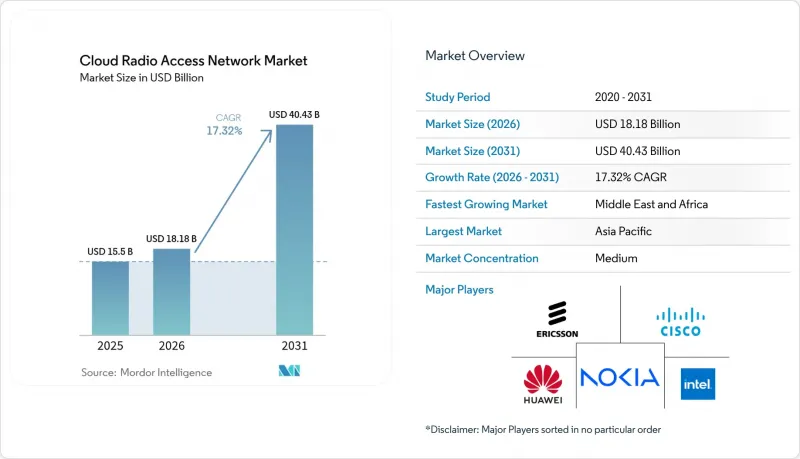
Mordor Intelligence에 의하면, 클라우드 무선 액세스 네트워크(CRAN) 시장 규모는 2025년 155억 달러로 평가되었고, 2026년에는 181억 8,000만 달러로 추정되고, 2026-2031년 CAGR 17.32%로 성장을 지속할 전망이며, 2031년에는 404억 3,000만 달러에 이를 것으로 예측됩니다.
본 보고서는 구성 요소별(솔루션 및 서비스), 네트워크 유형별(5G, 4G, LTE, 3G), 구축 모델별(중앙 집중형 RAN(C-RAN), 가상화 RAN별(vRAN), 오픈 RAN(O-RAN), 하이브리드 클라우드 RAN), 최종 사용자별(모바일 네트워크 사업자, 기업, 정부·공공 안전, 중립 호스트/타워 기업), 그리고 지역별로 분류되어 있습니다. 시장 전망은 금액(달러) 기준으로 제시되어 있습니다.
세계의 클라우드 무선 액세스 네트워크 시장 동향 및 인사이트
5G의 급속한 확산과 고밀도화가 아키텍처의 변혁을 주도
세계 통신 사업자들은 미드밴드 5G 계층을 가동하고, 커버리지 사각지대를 메우기 위해 스몰 셀을 추가하고 있습니다. 이러한 환경에서 클라우드 무선 액세스 네트워크 시장은 하드웨어 중복 없이 수천 대의 무선 장비를 관리하는 데 필요한 중앙 집중식 컴퓨팅 풀을 제공합니다. 도쿄, 서울, 뉴욕에서 실시된 현장 테스트에서는 베이스밴드 워크로드를 동적으로 전환함으로써 가동률을 30% 향상시키고, 피크 시간대의 셀 처리량을 25% 향상시킬 수 있음이 입증되었습니다. 상용 5G 독립형 코어는 현재 가상 베이스밴드 기능과의 시간 의존성이 높은 스케줄링을 조정하고 있으며, 이는 클라우드 네이티브 원칙이 기능 출시 주기를 어떻게 단축하는지를 여실히 보여줍니다. 중국과 미국의 대규모 도입 사례를 통해 동일한 클라우드 사이트에서 여러 세대의 무선 장비를 호스팅할 수 있음이 밝혀졌으며, 이를 통해 주파수 재할당 결정이 용이해지고 단계적인 전환 경로가 지원되고 있습니다. 이러한 이점들은 특히 실내 커버리지 의무로 인해 고밀도 무선 그리드가 요구되는 지역에서 지속적인 투자를 촉진하고 있습니다.
CAPEX 및 OPEX 절감이 비즈니스 타당성을 뒷받침합니다.
가상화된 베이스밴드 풀의 경제적 매력은 즉시 드러납니다. 풀링을 통해 하드웨어 중복이 줄어들고, 시설 비용이 절감되며, 업그레이드가 간소화됩니다. 북미 벤더의 사례 연구에 따르면, 3가지 유형의 레거시 베이스밴드를 단일 클라우드 클러스터로 통합한 통신 사업자는 도입 첫해에 CAPEX를 3분의 1 가까이 절감했습니다. 자동화 도구를 통해 예방적 유지보수 및 원격 소프트웨어 업데이트가 확대됨에 따라 OPEX도 절감됩니다. AI 스케줄러가 이용률이 낮은 무선 장비를 비피크 시간대에 딥 슬립 모드로 전환함으로써 네트워크의 전력 효율이 향상되고, 전기요금이 절감됩니다. 이러한 비용 절감은 특히 배당금 지급 의무와 서비스 품질 향상이라는 두 마리 토끼를 잡아야 하는 통신 사업자에게 있어 적극적인 5G 확장 계획을 뒷받침하는 기반이 됩니다. 퍼블릭 클라우드에서 사용량 기반 요금 모델이 보급됨에 따라, 사업자는 트래픽 피크에 맞추어 지출을 조정할 수 있는 유연성을 더욱 높일 수 있게 되어 클라우드 아키텍처의 매력이 더욱 커지고 있습니다.
주파수 대역 부족과 규제상의 제약이 추진력을 약화시키고 있다.
중파 대역 주파수의 적시 확보와 경매 실시가 여전히 전국 규모의 5G 구축에 있어 병목 현상으로 작용하고 있습니다. 2024년 미국 연방통신위원회(FCC)의 경매 실시 권한이 만료됨에 따라 향후 주파수 확보에 대한 불확실성이 발생하여, 일부 통신 사업자의 투자 주기가 둔화되고 있습니다. 많은 신흥 시장에서도 불투명하거나 정치적 요인에 좌우되는 주파수 할당 절차로 인해 어려움을 겪고 있어, 클라우드 RAN에 최적화된 5G 레이어의 턴키 도입이 지연되고 있습니다. 라이선스를 이미 취득한 경우에도 가드밴드 조건이나 출력 레벨 상한으로 인해 네트워크 레이아웃이 제한되어, 통신 사업자는 파편화된 주파수 보유에 의존할 수밖에 없으며, 이로 인해 무선 계획이 복잡해지고 있습니다. 이러한 현실이 구축 속도를 둔화시키고, 주파수 풀의 경제성이 매력적으로 다가올 시기를 늦출 가능성이 있습니다.
부문 분석
Solutions의 데이터에 따르면, 클라우드 무선 액세스 네트워크 시장 규모는 2025년에 112억 2,000만 달러에 달했으며, 부문 매출의 72.40%를 차지했습니다. 그러나 멀티 벤더 환경이 표준화됨에 따라 서비스 시장의 성장률은 연평균 성장률(CAGR) 18.02%로 더욱 빠르게 확대되고 있습니다. 초기 그린필드 도입에서는 주로 하드웨어와 가상화 베이스밴드 라이선스가 필요했으나, 현재의 브라운필드 업그레이드에서는 통합, 네트워크 최적화 및 라이프사이클 지원이 요구되고 있습니다. 유럽의 통신 사업자들은 AI를 활용한 성능 분석과 DevOps 도입을 결합한 다년간의 매니지드 서비스 계약을 체결하고 있으며, 이를 통해 사내 팀은 새로운 서비스 설계에 우선순위를 둘 수 있게 되었습니다. 현재 컨설팅 팀은 스펙트럼 재조합, 기능 분할 선정 및 전환 순서 수립을 지도하고 있으며, 이는 레거시 4G 트래픽과 신흥 프라이빗 5G 이용 사례 간의 균형을 맞추어야 하는 기존 통신 사업자에게 매우 중요한 역할입니다. 이에 대응하여 하드웨어 공급업체는 개방형 인터페이스와 참조 자동화 워크플로를 통합함으로써 제품과 전문 서비스의 경계를 모호하게 만들고 있습니다. 그 결과, 2031년이 다가옴에 따라 이러한 융합으로 인해 서비스 부문이 클라우드 무선 액세스 네트워크 시장의 수익 풀에서 더 큰 비중을 차지하게 되었습니다.
끊임없는 혁신의 흐름이 솔루션 사업에 활력을 불어넣고 있습니다. 주요 반도체 제조업체들은 빔 포밍 및 전방 오류 정정을 위한 통합 가속 기능을 도입하여, 2023년 모델에 비해 랙 유닛당 베이스밴드 용량을 2배 이상 향상시켰습니다. 무선 장비 공급업체들은 옥상 및 실내 환경에 최적화된 경량 Massive MIMO 어레이를 제공함으로써 이러한 성과를 보완하고 있습니다. 이러한 진보는 총 소유 비용(TCO)을 절감하는 동시에 대상 고객 기반을 확대하여, 솔루션 부문에서 꾸준하고 완만한 수익 성장을 뒷받침하고 있습니다. 그 결과, 소프트웨어, 실리콘, 서비스가 각각 통합적으로 오케스트레이션되는 무선 계층으로의 전환을 촉진하는 균형 잡힌 시장 환경이 형성되었으며, 클라우드 무선 액세스 네트워크 시장의 기존 사업자 및 엔터프라이즈 부문 전반에 걸쳐 채택이 확대되고 있습니다.
2025년에는 통신 사업자들이 미드밴드 주파수 대역 활용에 자본을 투자한 결과, 5G 부문이 클라우드 무선 액세스 네트워크 시장 전체 매출의 61.80%를 차지했습니다. 통신 사업자들은 인더스트리 4.0 워크로드에 필수적인 슬라이싱 및 초저지연 파이프라인을 가능하게 하는 독립형(SA) 아키텍처로 신속하게 전환했습니다. 가상화된 베이스밴드 풀을 통해 비스탠드얼론(NSA) 방식의 5G, LTE, NR을 공통 서버에서 실행할 수 있게 되어, 통신 사업자는 3G를 단계적으로 폐지하고 용량 증강에 집중할 수 있게 되었습니다. 4G LTE는 여전히 상당한 수익을 창출하고 있지만, 데이터 사용량이 많은 소비자 이용이 단말기 보조금이 포함된 5G 번들 요금제로 전환됨에 따라 그 점유율은 해마다 감소하고 있습니다.
Open RAN은 공급망의 다양화를 열망하는 북미 및 아시아의 Tier 1 사업자들의 높은 관심과 약속에 힘입어, 2031년까지 연평균 성장률(CAGR) 26.4%라는 가장 빠른 성장 궤도를 보이고 있습니다. 이 모델의 개방형 인터페이스는 각 분야에서 최고의 조합을 촉진하지만, 통합에 따른 오버헤드는 여전히 상당히 큽니다. 그러나 댈러스와 서울의 실제 운영 네트워크에서 진행된 파일럿 테스트 결과에 따르면, 통합된 클라우드 플랫폼을 통해 오케스트레이션을 수행함으로써 멀티 벤더 Massive MIMO 스택이 모놀리식 시스템과 동등한 스펙트럼 효율을 달성할 수 있는 것으로 나타났습니다. 미국 정부의 보조금 프로그램 등 규제 측면의 지원도 추가적인 호재로 작용하고 있습니다. 이러한 요인들이 결합되어 Open RAN은 중요한 변혁의 원동력으로 자리매김하고 있으며, 공급업체의 다양성을 확대하는 동시에 클라우드 무선 액세스 네트워크 시장 전체의 경쟁을 심화시키고 있습니다.
지역별 분석
아시아태평양은 2025년에 매출 점유율 38.60%를 차지하며 클라우드 무선 액세스 네트워크 시장을 주도했으며, 연평균 성장률(CAGR) 22.4%로 성장을 이끌고 있습니다. 중국, 일본, 한국의 적극적인 5G 구축은 대규모 지역 데이터센터에 연결된 고밀도 스몰 셀 네트워크에 의해 뒷받침되고 있습니다. 선전과 서울의 통신 사업자들은 이미 주요 비즈니스 지구에서 상용 오픈 인터페이스 클러스터를 운영하고 있으며, 성수기 축제 기간 동안 동영상 스트리밍을 위한 실시간 주파수 풀링을 시연하고 있습니다. 각국 정부는 가상화에 대한 투자에 대한 주파수 사용료 환급 등 지원적인 정책 체계를 제공합니다. 오픈 테스트베드를 중심으로 벤더 생태계가 활성화되고 있으며, OREX 이니셔티브와 같은 합작 사업은 수출 기회를 목표로 하여 이 지역의 리더십을 공고히 하고 있습니다.
북미는 매출액 기준으로 2위를 차지했습니다. 미국의 통신 사업자들은 2026년까지 레거시 하드웨어를 개방형 무선 장비로 교체하기 위해 수십억 달러 규모의 예산을 편성했습니다. ‘CHIPS and Science Act’에 따른 연방 정부의 보조금은 AI 기반 스케줄링 엔진을 뒷받침하는 반도체 연구에 공동 투자하고 있으며, 국내 공급망의 회복력을 높이고 있습니다. 라스베이거스와 시애틀의 초기 도입 사례는 GPU 가속형 클라우드 노드가 XR 게임 및 산업 자동화 분야에서 밀리초 수준의 엄격한 지연 목표를 달성할 수 있음을 입증하고 있습니다. 캐나다 통신 사업자와 핀란드 및 한국의 벤더간의 제휴는 지역 혁신 생태계를 확대하고 있으며, 더 광범위한 클라우드 무선 액세스 네트워크 시장을 뒷받침하는 국경을 초월한 기술 교류를 부각시키고 있습니다.
유럽에서는 규제상의 의무와 경쟁상의 필요성이 맞물려 도입이 가속화되고 있습니다. 영국, 독일, 스페인의 통신 사업자들은 무선 장비, 베이스밴드, 관리 시스템 간의 상호 운용성을 인증하는 공인 시험 기관의 지원을 받아 최초의 상용 5G 오픈 RAN 매크로 사이트를 구축했습니다. 유럽연합(EU)은 5G 및 6G 네트워크 연구 개발에 예산을 배정하고 있으며, 이를 통해 RAN 소프트웨어 인재를 양성하는 산학 협력 체계가 강화되고 있습니다. 스탠드얼론형 5G의 커버리지 확대는 다소 뒤처지고 있지만, 기존 통신 사업자들은 총소유비용(TCO) 절감과 서비스 혁신 가속화를 주요 동기로 삼아 무선 계층의 클라우드화를 위한 신속한 계획을 추진하고 있습니다. 현재 진행 중인 인프라 구축 프로그램에서는 지방 회랑을 통해 광섬유 백본 업그레이드가 진행되고 있으며, 이를 통해 오랫동안 지속되어 온 병목 현상이 해소되어 지역 전체의 클라우드 무선 액세스 네트워크 시장 확대가 더욱 가속화될 전망입니다.
기타 혜택 :
- 엑셀 형식 시장 예측(ME) 시트
- 3개월간의 애널리스트 지원
자주 묻는 질문
목차
제1장 서론
제2장 조사 방법
제3장 주요 요약
제4장 시장 구도
제5장 시장 규모 및 성장 예측
제6장 경쟁 구도
제7장 시장 기회 및 향후 전망
AJY 26.09.07According to Mordor Intelligence, the cloud radio access network market size is expected to grow from USD 15.5 billion in 2025 to USD 18.18 billion in 2026 and is forecast to reach USD 40.43 billion by 2031 at 17.32% CAGR over 2026-2031.
This report is Segmented by Component (Solution and Services), Network Type (5G, 4G, LTE, 3G ), Deployment Model (Centralised RAN [C-RAN], Virtualised RAN [vRAN], Open RAN [O-RAN], and Hybrid Cloud RAN), End User (Mobile Network Operators, Enterprises, Government and Public-Safety, and Neutral Host/TowerCos) and Geography. The Market Forecasts are Provided in Terms of Value (USD).
Global Cloud Radio Access Network Market Trends and Insights
Rapid 5G Rollouts and Densification Drive Architectural Change
Global operators are lighting up mid-band 5G layers and adding small cells to fill coverage gaps. In this environment, the cloud radio access network market delivers the centralized compute pools needed to manage thousands of radios without duplicating hardware. Field trials in Tokyo, Seoul, and New York show that dynamically shifting baseband workloads can raise utilisation by 30% and boost peak cell throughput by 25%. Commercial 5G standalone cores are now coordinating time-sensitive scheduling with virtual baseband functions, underscoring how cloud-native principles shorten feature release cycles. Large-scale deployments in China and the United States reveal that the same cloud site can host multiple radio generations, easing spectrum-refarming decisions and supporting progressive migration paths. These advantages spur continued investment, particularly where indoor coverage obligations require dense radio grids.
CAPEX and OPEX Savings Sustain the Business Case
The economic attraction of virtualized baseband pools is immediate: pooling reduces hardware duplication, trims real-estate expense, and simplifies upgrades. Vendor case studies from North America indicate that operators consolidating three legacy baseband types into a single cloud cluster recorded CAPEX cuts nearing one-third during year-one rollouts. OPEX declines follow as automation tools scale preventive maintenance and remote software updates. Energy bills fall when AI schedulers place lightly loaded radios in deep-sleep modes during off-peak periods, improving the network's power-efficiency profile. These savings underpin aggressive 5G expansion plans, especially for carriers balancing dividend commitments with the need to enhance the quality of service. As consumption-based pricing models for public cloud gain traction, operators gain added flexibility to align spending with traffic peaks, reinforcing the appeal of cloud architecture.
Spectrum Scarcity and Regulatory Limits Dent Momentum
Timely clearance and auction of mid-band spectrum remains a gating factor for nationwide 5G builds. The expiry of auction authority at the United States Federal Communications Commission in 2024 introduced uncertainty around future releases, slowing some carrier investment cycles. Many emerging markets also grapple with opaque or politically driven allocation processes that delay turnkey deployment of 5G layers optimized for cloud RAN. Even where licenses are in place, guard-band conditions and power-level caps can restrict network layouts, forcing operators to rely on fragmented holdings that complicate radio planning. These realities moderate roll-out velocity and can postpone the point when pooling economics become compelling.
Other drivers and restraints analyzed in the detailed report include:
- Exponential Mobile-Data Growth Necessitates Architectural Innovation
- Network Virtualization and SDN Adoption Reshape Strategies
- Limited Fronthaul Fibre and Latency Challenges Constrain Deployment
For complete list of drivers and restraints, kindly check the Table Of Contents.
Segment Analysis
The cloud radio access network market size derived from Solutions hit USD 11.22 billion in 2025, equal to 72.40% of segment revenue. Yet the Services market is expanding faster at an 18.02% CAGR as multi-vendor environments become the norm. Early greenfield installations chiefly required hardware and virtualized baseband licenses, but current brownfield upgrades demand integration, network optimization, and lifecycle support. Operators in Europe are signing multi-year managed-service contracts that bundle AI-driven performance analytics with DevOps enablement, letting internal teams prioritise new-service design. Consulting teams now guide spectrum-refarming, functional-split selection, and migration sequencing, roles critical for incumbent carriers balancing legacy 4G traffic and emerging private 5G use cases. Hardware providers respond by embedding open interfaces and reference automation workflows, blurring the line between product and professional service. In turn, this mix pushes the Services slice to account for a deeper share of the cloud radio access network market revenue pool as 2031 approaches.
A steady flow of innovation keeps the Solutions business vibrant. Silicon majors introduced integrated acceleration for beamforming and forward-error correction, lifting baseband capacity per rack unit by over 2X compared with 2023 blades. Radio suppliers complement these gains with lightweight Massive MIMO arrays tailored for rooftop and indoor settings. Such advancements compress the total cost of ownership while widening the addressable customer base, supporting consistent though moderate revenue growth on the Solutions side. The net result is a balanced landscape where software, silicon, and services each reinforce the transition to centrally orchestrated radio layers, widening adoption across incumbent and enterprise segments of the cloud radio access network market.
In 2025, the 5G tier commanded 61.80% of the overall cloud radio access network market revenue as carriers devoted capital to harness mid-band spectrum. Operators pivoted quickly to standalone architectures, which permit slicing and ultra-low-latency pipelines critical for Industry 4.0 workloads. Virtualized baseband pools make it feasible to run non-standalone 5G, LTE, and NR on common servers, letting carriers phase out 3G in favor of capacity upgrades. While 4G LTE still generates meaningful returns, its share declines each year as data-heavy consumer usage gravitates toward 5G bundles with subsidized devices.
Open RAN exhibits the fastest trajectory at a 26.4% CAGR through 2031, buoyed by high-profile commitments from North American and Asian tier-ones keen to diversify supply chains. The model's open interfaces encourage best-of-breed combinations, but integration overhead remains considerable. Nevertheless, pilot results from live networks in Dallas and Seoul show that multi-vendor Massive MIMO stacks can reach spectral-efficiency parity with monolithic systems when orchestrated from a unified cloud platform. Regulatory support, such as grant programs from the United States government, offers added momentum. Collectively, these forces position Open RAN as a key disruptor, widening supplier diversity while intensifying competitive dynamics across the cloud radio access network market.
Complete Report Scope:
- By Component
- Solution
- Services
- Professional
- Managed
- By Network Type
- 5G
- 4G
- LTE
- 3G (EDGE)
- By Deployment Model
- Centralised RAN (C-RAN)
- Virtualised RAN (vRAN)
- Open RAN (O-RAN)
- Hybrid Cloud RAN
- By End User
- Mobile Network Operators
- Enterprises
- Government and Public-Safety
- Neutral Host/TowerCos
- By Geography
- North America
- United States
- Canada
- Mexico
- Europe
- United Kingdom
- Germany
- France
- Rest of Europe
- Asia-Pacific
- China
- Japan
- South Korea
- India
- Rest of Asia-Pacific
- South America
- Brazil
- Argentina
- Rest of South America
- Middle East and Africa
- Middle East
- UAE
- Saudi Arabia
- Rest of the Middle East
- Africa
- South Africa
- Rest of Africa
- Middle East
- North America
Geography Analysis
Asia Pacific dominates the cloud radio access network market with 38.60% revenue share in 2025 and leads in growth with a 22.4% CAGR. Aggressive 5G rollouts in China, Japan, and South Korea rely on high-density small-cell grids linked to large regional data centres. Operators in Shenzhen and Seoul already operate commercial open-interface clusters in core business districts, showcasing real-time spectrum pooling for video streaming during peak festivals. Governments provide supportive policy frameworks, such as spectrum fee rebates for virtualisation investments. Vendor ecosystems flourish around open testbeds, and joint ventures like the OREX initiative target export opportunities, cementing the region's leadership.
North America ranks second in terms of revenue. United States carriers earmarked multibillion-dollar budgets to swap legacy hardware for open-capable radios by 2026. Federal grants under the CHIPS and Science Act co-fund silicon research that empowers AI-based scheduling engines, giving domestic supply chains greater resilience. Early deployments in Las Vegas and Seattle prove that GPU-accelerated cloud nodes can meet stringent millisecond-level latency targets for XR gaming and industrial automation. Canadian operator collaborations with Finnish and Korean vendors extend the regional innovation sphere, highlighting cross-border technology exchange that supports the wider cloud radio access network market.
Europe accelerates adoption through a blend of regulatory mandates and competitive necessity. Operators in the United Kingdom, Germany, and Spain rolled out the first commercial 5G Open RAN macro sites, supported by public test labs that certify interoperability among radios, basebands, and management systems. The European Union dedicates funding tranches to 5G and 6G network R&D, which bolsters an academic-industry pipeline for RAN software talent. Despite lagging standalone 5G coverage, incumbents pursue fast-track plans to cloudify their radio layers, citing lower total cost of ownership and faster service innovation as key motivators. Ongoing infrastructure programs upgrade fibre backbones through rural corridors, which will remove a historic bottleneck and further expand the cloud radio access network market footprint across the region.
- Huawei Technologies Co. Ltd.
- Nokia Corporation
- Telefonaktiebolaget LM Ericsson
- Cisco Systems Inc.
- Samsung Electronics Co. Ltd.
- ZTE Corporation
- Intel Corporation
- Fujitsu Limited
- NEC Corporation
- Mavenir Systems Inc.
- Parallel Wireless Inc.
- Rakuten Symphony
- Altiostar (Rakuten)
- CommScope Holding Co. Inc.
- Casa Systems Inc.
- Airspan Networks Inc.
- Hewlett Packard Enterprise (HPE)
Additional Benefits:
- The market estimate (ME) sheet in Excel format
- 3 months of analyst support
TABLE OF CONTENTS
1 INTRODUCTION
- 1.1 Study Assumptions and Market Definition
- 1.2 Scope of the Study
2 RESEARCH METHODOLOGY
3 EXECUTIVE SUMMARY
4 MARKET LANDSCAPE
- 4.1 Market Overview
- 4.2 Market Drivers
- 4.2.1 Rapid 5G rollout and densification
- 4.2.2 CAPEX-OPEX savings via centralized baseband
- 4.2.3 Exponential mobile-data growth
- 4.2.4 Network virtualization and SDN demand
- 4.2.5 AI-driven RAN optimisation adoption
- 4.2.6 Energy-efficiency regulations push cloud RAN
- 4.3 Market Restraints
- 4.3.1 Spectrum scarcity and regulatory limits
- 4.3.2 Limited fronthaul fibre and latency challenges
- 4.3.3 Security and privacy risks in centralised architecture
- 4.3.4 Uncertain ROI in emerging markets
- 4.4 Value/Supply-Chain Analysis
- 4.5 Regulatory Landscape
- 4.6 Technological Outlook
- 4.7 Porter's Five Forces Analysis
- 4.7.1 Threat of New Entrants
- 4.7.2 Bargaining Power of Buyers
- 4.7.3 Bargaining Power of Suppliers
- 4.7.4 Threat of Substitute Products
- 4.7.5 Intensity of Competitive Rivalry
- 4.8 Investment Analysis
5 MARKET SIZE AND GROWTH FORECASTS (VALUE)
- 5.1 By Component
- 5.1.1 Solution
- 5.1.2 Services
- 5.1.2.1 Professional
- 5.1.2.2 Managed
- 5.2 By Network Type
- 5.2.1 5G
- 5.2.2 4G
- 5.2.3 LTE
- 5.2.4 3G (EDGE)
- 5.3 By Deployment Model
- 5.3.1 Centralised RAN (C-RAN)
- 5.3.2 Virtualised RAN (vRAN)
- 5.3.3 Open RAN (O-RAN)
- 5.3.4 Hybrid Cloud RAN
- 5.4 By End User
- 5.4.1 Mobile Network Operators
- 5.4.2 Enterprises
- 5.4.3 Government and Public-Safety
- 5.4.4 Neutral Host/TowerCos
- 5.5 By Geography
- 5.5.1 North America
- 5.5.1.1 United States
- 5.5.1.2 Canada
- 5.5.1.3 Mexico
- 5.5.2 Europe
- 5.5.2.1 United Kingdom
- 5.5.2.2 Germany
- 5.5.2.3 France
- 5.5.2.4 Rest of Europe
- 5.5.3 Asia-Pacific
- 5.5.3.1 China
- 5.5.3.2 Japan
- 5.5.3.3 South Korea
- 5.5.3.4 India
- 5.5.3.5 Rest of Asia-Pacific
- 5.5.4 South America
- 5.5.4.1 Brazil
- 5.5.4.2 Argentina
- 5.5.4.3 Rest of South America
- 5.5.5 Middle East and Africa
- 5.5.5.1 Middle East
- 5.5.5.1.1 UAE
- 5.5.5.1.2 Saudi Arabia
- 5.5.5.1.3 Rest of the Middle East
- 5.5.5.2 Africa
- 5.5.5.2.1 South Africa
- 5.5.5.2.2 Rest of Africa
- 5.5.5.1 Middle East
- 5.5.1 North America
6 COMPETITIVE LANDSCAPE
- 6.1 Market Concentration
- 6.2 Strategic Moves
- 6.3 Market Share Analysis
- 6.4 Company Profiles (includes Global level Overview, Market level overview, Core Segments, Financials as available, Strategic Information, Market Rank/Share for key companies, Products and Services, and Recent Developments)
- 6.4.1 Huawei Technologies Co. Ltd.
- 6.4.2 Nokia Corporation
- 6.4.3 Telefonaktiebolaget LM Ericsson
- 6.4.4 Cisco Systems Inc.
- 6.4.5 Samsung Electronics Co. Ltd.
- 6.4.6 ZTE Corporation
- 6.4.7 Intel Corporation
- 6.4.8 Fujitsu Limited
- 6.4.9 NEC Corporation
- 6.4.10 Mavenir Systems Inc.
- 6.4.11 Parallel Wireless Inc.
- 6.4.12 Rakuten Symphony
- 6.4.13 Altiostar (Rakuten)
- 6.4.14 CommScope Holding Co. Inc.
- 6.4.15 Casa Systems Inc.
- 6.4.16 Airspan Networks Inc.
- 6.4.17 Hewlett Packard Enterprise (HPE)
7 MARKET OPPORTUNITIES AND FUTURE OUTLOOK
- 7.1 White-space and unmet-need assessment


