

|
시장보고서
상품코드
2123245
DNA 시퀀싱 시장 : 점유율 분석, 업계 동향과 통계, 성장 예측(2026-2031년)DNA Sequencing - Market Share Analysis, Industry Trends & Statistics, Growth Forecasts (2026 - 2031) |
||||||
 Mordor Intelligence
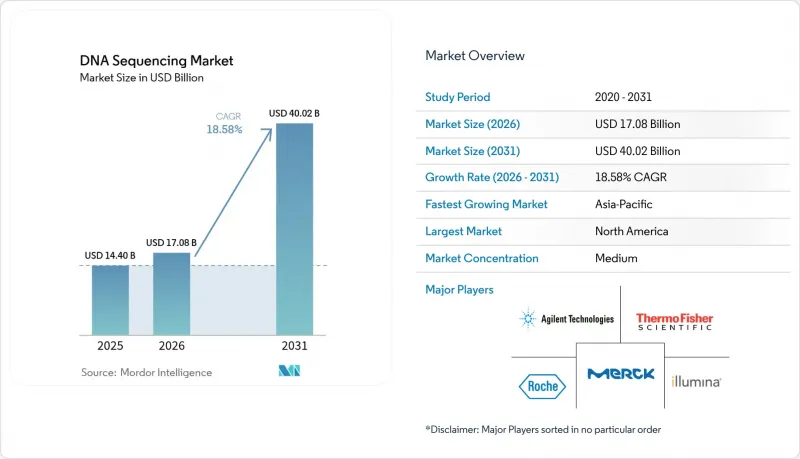
DNA 시퀀싱 시장 규모는 2026년에 170억 8,000만 달러로 추정되고 있어 2025년 144억 달러에서 확대해, 2031년에는 400억 2,000만 달러 달할 것으로 예측됩니다.
2026년부터 2031년까지 연평균 성장률(CAGR) 18.58%로 성장할 것으로 전망됩니다.
본 보고서는 제품 및 서비스별(장비 등), 시퀀싱 기술별(샌거법 등), 워크플로우 단계별(시료 전처리 등), 용도별(임상 진단 등), 최종 사용자별(병원 등), 지역별(북미, 유럽, 아시아태평양, 중동 및 아프리카, 남미)로 분류되어 있습니다. 시장 전망은 금액(달러) 기준으로 제시되어 있습니다.
전 세계 DNA 시퀀싱 시장 동향 및 인사이트
유전체당 비용의 감소가 이용 확산에 혁명을 일으키고 있습니다.
인간 전체 유전체 시퀀싱 비용은 2007년 100만 달러에서 2025년에는 600 달러 미만으로 하락하여 지역 병원에서도 일상적으로 이용할 수 있게 되었습니다. 일루미나(Illumina)사의 NovaSeq X는 이 비용을 200달러 미만으로 낮추었고, 알티마 제노믹스(Altima Genomics)사는 100달러의 유전체 분석 서비스를 제공하고 있어, 이에 따라 예산 배분이 데이터 분석 도구로 이동하고 있습니다. 영국의 종양 센터에서는 현재 소아암에 대해 전체 유전체 시퀀싱을 도입하고 있으며, 독일과 스웨덴에서도 유사한 프로그램이 시범적으로 시행되고 있습니다. 각 벤더사는 하드웨어 판매에서 용도 특화형 솔루션으로 사업 축을 전환하고 있습니다. 일루미나의 플루언트 바이오사이언스 인수는 단일 세포 분석 포트폴리오를 강화하는 것이며, 수익성이 높고 소프트웨어를 많이 활용하는 제품 및 서비스로의 전환을 부각시키고 있습니다. 비용이 상품화 수준에 가까워짐에 따라, 경쟁의 초점은 차별화된 화학 기술과 생물정보학 생태계로 집중되고 있습니다.
보장 범위 확대가 임상 도입을 가속화
메디케어·메디케이드 서비스 센터(CMS)는 2024년, 고형암에 대한 차세대 염기서열 분석의 전국적인 보험 적용 범위를 확대하여 도입의 주요 장벽을 제거했습니다. 전미종합암네트워크(NCCN)는 현재 급성 골수성 백혈병에 대한 전장 유전체 시퀀싱을 권장하고 있어, 임상 수요를 더욱 공고히 하고 있습니다. 그러나 민간 보험사 및 유럽 보험사 간에 보험 적용 현황에 차이가 나타나고 있어, 각 벤더사는 의료경제학적 근거 패키지와 보험사 대상 홍보 팀에 대한 투자를 확대되고 있습니다. 지역별 적용 결정(LCD)은 진단이 확정되지 않은 폐 결절의 위험도 계층화 등 고부가가치 용도를 점점 더 대상으로 삼고 있어, 추가적인 호재로 작용하고 있습니다.
고액의 설비 투자가 시장 진입 장벽이 되고 있다.
최고 수준의 고처리량 장비는 100만 달러를 초과하기도 하며, 연간 유지보수 계약으로 인해 막대한 제반 비용이 추가됩니다. 소규모 검사실에서는 도입을 미루거나 시약 대여 모델 및 집중형 핵심 시설에 의존하고 있습니다. Element Biosciences사는 1기가베이스당 운영 비용이 2-5달러인 28만 9,000달러짜리 ‘AVITI’ 시스템을 통해 접근성의 민주화를 꾀하고 있지만, 여전히 ‘면도기와 면도날’형 비즈니스 모델에서는 소모품 공급을 장악한 기존 기업이 유리한 입장에 있습니다. 그 결과, 자본 요건이 자원이 부족한 환경에서의 확장을 지연시키고, 기존 공급업체의 규모의 경제를 더욱 공고히 하고 있습니다.
부문 분석
2025년에는 사용자가 실행할 때마다 재주문해야 하는 독자적인 플로우셀 및 시약 키트로 인해 소모품이 매출의 57.73%를 차지했습니다. 이는 DNA 시퀀싱 시장을 지탱하는 ‘면도기와 면도날’ 모델을 여실히 보여줍니다. 화학 시약의 이익률은 항상 장비의 이익률을 상회하고 있으며, 이는 제품 업데이트 주기의 가속화를 뒷받침하고 있습니다. 시퀀싱 서비스(Sequencing-as-a-Service) 및 데이터 분석을 포함한 서비스는 연구소가 복잡한 정보 처리 및 규정 준수 관련 업무를 외부에 위탁함에 따라 연평균 성장률(CAGR) 17.85%로 성장하고 있습니다.
소모품 분야의 혁신은 현재 비용 절감과 처리량 향상에 초점을 맞추었습니다. Ultima Genomics는 리소그래피 비용을 절감하고 스케일아웃 생산을 용이하게 하는 무패턴 웨이퍼로의 전환을 추진하고 있습니다. 한편, DNAnexus와 같은 서비스 제공업체들은 클라우드 컴퓨팅, 규정 준수, AI 기반 해석을 결합하여 원시 데이터가 아닌 종단 간 실용적인 보고서를 제공함으로써 고객 유지율을 높이고 있습니다. 이러한 변화들이 맞물리면서, 정기 소모품과 관리형 서비스가 DNA 시퀀싱 시장의 생명선으로서의 입지를 확고히 하고 있습니다.
차세대 쇼트 리드 장비는 검증된 임상 워크플로우, 높은 정확도 및 광범위한 분석 메뉴를 통해 2025년에 매출의 80.98%를 차지했습니다. 나노포어 시퀀싱은 구조적 변이 및 메틸화 패턴을 규명하는 실시간 롱 리드의 성장에 힘입어 연평균 성장률(CAGR) 27.62%를 기록하며 가장 빠르게 성장하는 하위 부문입니다. PacBio사의 SPRQ 화학 기술 덕분에 인간 유전체의 HiFi 시퀀싱 비용이 500달러 미만으로 낮아져, 집단 연구의 비용 효율성이 향상되고 있습니다.
Oxford Nanopore사의 ‘PromethION 2 Integrated’는 온보드 연산 기능을 갖추고 있어 플로우셀 1개당 최대 290Gb의 데이터를 생성할 뿐만 아니라, 99.7%에 달하는 단일 뉴클레오티드 정확도로 임상적 신뢰성을 높이고 있습니다. 각 벤더는 숏 리드의 경제성과 롱 리드의 맥락을 융합한 하이브리드 파이프라인을 점점 더 적극적으로 추진하고 있으며, 그 활용 분야는 종양학에서 메타지놈학, 전사체학으로 확대되고 있습니다. 그 결과, 경쟁이 심화되면서 두 리드 길이 영역 모두에서 혁신의 속도가 가속화되고 있습니다.
지역별 분석
북미는 메디케어 적용 범위 확대, 풍부한 벤처 캐피탈, 그리고 FDA의 지원적인 프레임워크에 힘입어 2025년 매출의 44.65%를 차지했습니다. 미국 국립보건원(NIH)은 희귀질환 및 암 유전체 이니셔티브에 수년에 걸친 보조금을 투입하고 있으며, 인프라 관련 법안은 바이오 제조를 장려하고 있습니다. 그러나 중국의 유전체 관련 공급업체를 규제하는 미국의 법안 초안은 시약 공급을 위협하고, 국내 연구소의 재고 비용을 증가시킬 우려가 있습니다.
아시아태평양은 대규모 인구 시퀀싱 프로젝트와 의료비 증가에 힘입어 연평균 성장률(CAGR) 19.12%로 가장 빠르게 성장하는 지역이 될 전망입니다. 중국은 병원의 암 등록 제도와 소비자 직접 검사를 통해 검사 건수에서 선두를 달리고 있는 반면, 싱가포르의 롱 리드·인구 규모 프로그램은 이 지역의 검사 기반이 될 고품질 아시아인 참조 유전체 구축을 목표로 하고 있습니다. 인도는 ‘국가 유전체 미션’의 일환으로 바이오뱅크 네트워크 구축을 발표했으나, 보험 환급 제도의 불균일성이 임상 도입을 저해하고 있습니다.
유럽에서는 유전체 검사를 일상 진료에 통합한 공공 자금 지원 의료 제도를 통해 여전히 큰 점유율을 유지하고 있습니다. GDPR(EU 개인정보보호규정)에 따라 엄격한 동의 프로토콜과 국경을 넘는 데이터 취급에 관한 규정이 의무화되면서 규정 준수 비용이 증가하고 있습니다. 영국의 ‘Genomics England’는 500만 건의 전체 유전체 분석을 목표로 하고 있으며, 독일은 유전체 데이터 통합을 위한 병원의 디지털화에 자금을 지원하고, 프랑스의 국가 계획에서는 신생아 선별 검사의 시범 사업을 확대되고 있습니다. 중동 및 아프리카, 남미의 신흥 시장은 여전히 발전 단계에 있지만, 비용 감소와 외딴 지역의 진료소에 이동식 검사실 보급에 힘입어 암 시퀀싱 및 감염병 감시 분야에 대한 투자가 확대되고 있습니다.
기타 혜택:
- 엑셀 형식 시장 예측(ME) 시트
- 3개월간의 애널리스트 지원
자주 묻는 질문
목차
제1장 서론
제2장 조사 방법
제3장 주요 요약
제4장 시장 구도
제5장 시장 규모와 성장 예측
제6장 경쟁 구도
제7장 시장 기회와 향후 전망
JHS 26.09.09According to Mordor Intelligence, the DNA sequencing market size in 2026 is estimated at USD 17.08 billion, growing from 2025 value of USD 14.4 billion with 2031 projections showing USD 40.02 billion, growing at 18.58% CAGR over 2026-2031.
This report is Segmented by Product & Service (Instruments, and More), Sequencing Technology (Sanger Sequencing, and More), Workflow Step (Sample Preparation, and More), by Application (Clinical Diagnostics, and More), by End User (Hospitals, and More), Geography (North America, Europe, Asia-Pacific, The Middle East and Africa, and South America). The Market Forecasts are Provided in Terms of Value (USD).
Global DNA Sequencing Market Trends and Insights
Declining Cost-Per-Genome Revolutionizes Access
Sequencing a whole human genome has fallen from USD 1 million in 2007 to under USD 600 in 2025, unlocking routine use across community hospitals. Illumina's NovaSeq X cuts that figure below USD 200, and Ultima Genomics markets a USD 100 genome, altering budget allocation toward data interpretation tools. United Kingdom oncology centers now deploy whole-genome sequencing for pediatric cancers, and Germany and Sweden are piloting similar programs. Vendors are pivoting from hardware sales to application-specific solutions; Illumina's acquisition of Fluent BioSciences strengthens single-cell assay portfolios, underscoring a shift toward higher-margin, software-rich offerings. As costs approach commodity levels, competitive focus centers on differentiated chemistry and bioinformatics ecosystems.
Broader Reimbursement Accelerates Clinical Adoption
Centers for Medicare & Medicaid Services expanded national coverage for next-generation sequencing in solid tumors in 2024, removing a primary barrier to uptake. The National Comprehensive Cancer Network now recommends whole-genome sequencing for acute myeloid leukemia, further cementing clinical demand. Yet reimbursement remains patchy across private payers and European insurers, prompting vendors to invest in health-economics evidence packages and payer-education teams. Local Coverage Determinations increasingly target high-value uses such as indeterminate pulmonary-nodule risk stratification, creating incremental tailwinds.
High Capital Costs Create Market Entry Barriers
A top-tier high-throughput instrument can exceed USD 1 million, with annual maintenance contracts adding significant overhead. Smaller laboratories defer acquisition or rely on reagent-rental models and centralized core facilities. Element Biosciences attempts to democratize access with the USD 289,000 AVITI system that features per-gigabase operating costs of USD 2-USD 5, yet the razor-and-blade economics still favor incumbents that control consumable supply. Capital requirements therefore slow expansion in low-resource settings and reinforce economies of scale for established vendors.
Other drivers and restraints analyzed in the detailed report include:
- Government Precision-Medicine Programs Drive Infrastructure
- Genomics-Based Drug Discovery Expands Applications
- Bioinformatics Bottlenecks Constrain Value Extraction
For complete list of drivers and restraints, kindly check the Table Of Contents.
Segment Analysis
Consumables generated 57.73% of revenue in 2025 owing to proprietary flowcells and reagent kits that users must reorder for every run, underscoring the razor-and-blade model that supports the DNA sequencing market. Margins on chemistry routinely outpace those on instruments, funding accelerated product refresh cycles. Services, including sequencing-as-a-service and data analytics, are climbing at an 17.85% CAGR as laboratories outsource complex informatics and compliance workloads.
Consumable innovation now focuses on lowering cost and increasing throughput. Ultima Genomics is moving to unpatterned wafers that shrink lithography expense and facilitate scale-out manufacturing. Meanwhile, service providers such as DNAnexus couple cloud compute, compliance, and AI interpretation to deliver end-to-end actionable reports rather than raw data, enhancing customer stickiness. Together these shifts position recurring consumables and managed services as the lifeblood of the DNA sequencing market.
Next-generation short-read instruments captured 80.98% of revenue in 2025 thanks to validated clinical workflows, high accuracy, and wide assay menus. Nanopore sequencing is the fastest-growing subsegment at a 27.62% CAGR, propelled by real-time long reads that resolve structural variants and methylation patterns. PacBio's SPRQ chemistry drops HiFi human genome costs below USD 500, improving affordability for population studies.
Oxford Nanopore's PromethION 2 Integrated delivers up to 290 Gb per flowcell with onboard compute, while its 99.7% single-nucleotide accuracy strengthens clinical credibility. Vendors increasingly promote hybrid pipelines that merge short-read economy with long-read context, broadening use scenarios from oncology to metagenomics and transcriptomics. Competitive intensity is therefore accelerating innovation pace across both read-length regimes.
Complete Report Scope:
- By Product & Service
- Instruments
- Consumables
- Services
- By Sequencing Technology
- Sanger Sequencing
- Next-Generation Sequencing (NGS)
- Illumina SBS
- Ion Semiconductor
- Other Technologies
- Third-Generation Sequencing
- By Workflow Step
- Sample Preparation
- Library Preparation
- Sequencing
- Data Analysis & Storage
- By Application
- Clinical Diagnostics
- Oncology
- Reproductive Health (NIPT, Carrier)
- Infectious Disease
- Rare & Genetic Disorders
- Personalized Medicine
- Drug Discovery & Development
- Other Applications
- Clinical Diagnostics
- By End User
- Hospitals & Clinical Laboratories
- Academic & Research Institutes
- Pharmaceutical & Biotechnology Companies
- Other End Users
- Geography
- North America
- United States
- Canada
- Mexico
- Europe
- Germany
- United Kingdom
- France
- Italy
- Spain
- Rest of Europe
- Asia-Pacific
- China
- Japan
- India
- Australia
- South Korea
- Rest of Asia-Pacific
- Middle East & Africa
- GCC
- South Africa
- Rest of Middle East & Africa
- South America
- Brazil
- Argentina
- Rest of South America
- North America
Geography Analysis
North America accounted for 44.65% of 2025 revenue, fueled by Medicare coverage expansion, abundant venture capital, and a supportive FDA framework. The National Institutes of Health channel multi-year grants into rare-disease and cancer-genome initiatives, while infrastructure laws incentivize bio-manufacturing. Proposed US legislation restricting Chinese genomic suppliers, however, threatens reagent flow and increases inventory costs for domestic labs.
Asia Pacific is poised to be the fastest-growing territory with a 19.12% CAGR, driven by population-scale sequencing projects and rising healthcare spend. China dominates volume through hospital cancer registries and direct-to-consumer tests, whereas Singapore's long-read population program aims to create a high-quality Asian reference genome that underpins regional assays. India announces biobank networks under its National Genomics Mission, though disparate reimbursement hinders clinical roll-out.
Europe maintains significant share through publicly funded health systems that embed genomic testing into routine care. The General Data Protection Regulation enforces strict consent protocols and cross-border data rules, raising compliance costs. The UK's Genomics England targets 5 million whole genomes, Germany funds hospital digitalization for genomic data integration, and France's national plan scales newborn-screening pilots. Emerging markets in the Middle East, Africa, and South America remain nascent but invest in oncology sequencing and infectious-disease surveillance as costs fall and mobile labs spread to remote clinics.
- Agilent Technologies
- Bio-Rad Laboratories
- Danaher Corp. (IDT)
- Roche
- Illumina
- Merck
- PerkinElmer
- Thermo Fisher Scientific
- QIAGEN
- Macrogen
- Myriad Genetics
- Eurofins
- Hamilton Thorne
- Pacific Bioscience
- Oxford Nanopore Technologies PLC
- BGI Genomics Co. Ltd. (MGI Tech)
- 10x Genomics Inc.
- GenScript Biotech Corp.
Additional Benefits:
- The market estimate (ME) sheet in Excel format
- 3 months of analyst support
TABLE OF CONTENTS
1 Introduction
- 1.1 Study Assumptions & Market Definition
- 1.2 Scope of the Study
2 Research Methodology
3 Executive Summary
4 Market Landscape
- 4.1 Market Overview
- 4.2 Market Drivers
- 4.2.1 Declining Cost-Per-Genome with Higher-Throughput Platforms
- 4.2.2 Broader Reimbursement and Approvals For Clinical Sequencing
- 4.2.3 Government Precision-Medicine and Population Genomics Programs
- 4.2.4 Genomics-Based Drug Discovery and Companion Diagnostics Uptake
- 4.2.5 Expansion of Long-Read, Single-Cell and Multi-Omics Workflows
- 4.2.6 Growth of Sequencing-As-A-Service and Cloud Bioinformatics
- 4.3 Market Restraints
- 4.3.1 High Capital and Operating Costs of High-Throughput Systems
- 4.3.2 Bioinformatics Talent Shortage and Analysis Bottlenecks
- 4.3.3 Fragmented Global Regulatory and Data-Privacy Landscape
- 4.3.4 Supply-Chain Volatility for Critical Reagents and Flow Cells
- 4.4 Regulatory & Technological Outlook
- 4.5 Porter's Five Forces Analysis
- 4.5.1 Threat of New Entrants
- 4.5.2 Bargaining Power of Buyers
- 4.5.3 Bargaining Power of Suppliers
- 4.5.4 Threat of Substitutes
- 4.5.5 Competitive Rivalry
5 Market Size & Growth Forecasts (Value, USD)
- 5.1 By Product & Service
- 5.1.1 Instruments
- 5.1.2 Consumables
- 5.1.3 Services
- 5.2 By Sequencing Technology
- 5.2.1 Sanger Sequencing
- 5.2.2 Next-Generation Sequencing (NGS)
- 5.2.2.1 Illumina SBS
- 5.2.2.2 Ion Semiconductor
- 5.2.2.3 Other Technologies
- 5.2.3 Third-Generation Sequencing
- 5.3 By Workflow Step
- 5.3.1 Sample Preparation
- 5.3.2 Library Preparation
- 5.3.3 Sequencing
- 5.3.4 Data Analysis & Storage
- 5.4 By Application
- 5.4.1 Clinical Diagnostics
- 5.4.1.1 Oncology
- 5.4.1.2 Reproductive Health (NIPT, Carrier)
- 5.4.1.3 Infectious Disease
- 5.4.1.4 Rare & Genetic Disorders
- 5.4.2 Personalized Medicine
- 5.4.3 Drug Discovery & Development
- 5.4.4 Other Applications
- 5.4.1 Clinical Diagnostics
- 5.5 By End User
- 5.5.1 Hospitals & Clinical Laboratories
- 5.5.2 Academic & Research Institutes
- 5.5.3 Pharmaceutical & Biotechnology Companies
- 5.5.4 Other End Users
- 5.6 Geography
- 5.6.1 North America
- 5.6.1.1 United States
- 5.6.1.2 Canada
- 5.6.1.3 Mexico
- 5.6.2 Europe
- 5.6.2.1 Germany
- 5.6.2.2 United Kingdom
- 5.6.2.3 France
- 5.6.2.4 Italy
- 5.6.2.5 Spain
- 5.6.2.6 Rest of Europe
- 5.6.3 Asia-Pacific
- 5.6.3.1 China
- 5.6.3.2 Japan
- 5.6.3.3 India
- 5.6.3.4 Australia
- 5.6.3.5 South Korea
- 5.6.3.6 Rest of Asia-Pacific
- 5.6.4 Middle East & Africa
- 5.6.4.1 GCC
- 5.6.4.2 South Africa
- 5.6.4.3 Rest of Middle East & Africa
- 5.6.5 South America
- 5.6.5.1 Brazil
- 5.6.5.2 Argentina
- 5.6.5.3 Rest of South America
- 5.6.1 North America
6 Competitive Landscape
- 6.1 Market Concentration
- 6.2 Market Share Analysis
- 6.3 Company Profiles (includes Global level Overview, Market level overview, Core Business Segments, Financials, Headcount, Key Information, Market Rank, Market Share, Products and Services, and analysis of Recent Developments)
- 6.3.1 Agilent Technologies Inc.
- 6.3.2 Bio-Rad Laboratories Inc.
- 6.3.3 Danaher Corp. (IDT)
- 6.3.4 F. Hoffmann-La Roche Ltd.
- 6.3.5 Illumina Inc.
- 6.3.6 Merck KGaA
- 6.3.7 PerkinElmer Inc.
- 6.3.8 Thermo Fisher Scientific Inc.
- 6.3.9 QIAGEN
- 6.3.10 Macrogen Inc.
- 6.3.11 Myriad Genetics Inc.
- 6.3.12 Eurofins Scientific
- 6.3.13 Hamilton Thorne Biosciences
- 6.3.14 Pacific Biosciences of California Inc.
- 6.3.15 Oxford Nanopore Technologies PLC
- 6.3.16 BGI Genomics Co. Ltd. (MGI Tech)
- 6.3.17 10x Genomics Inc.
- 6.3.18 GenScript Biotech Corp.
7 Market Opportunities & Future Outlook
- 7.1 White-space & Unmet-Need Assessment


