|
시장보고서
상품코드
2123249
항공기 연료 시스템 시장 : 시장 점유율 분석, 업계 동향 및 통계, 성장 예측(2026-2031년)Aircraft Fuel Systems - Market Share Analysis, Industry Trends & Statistics, Growth Forecasts (2026 - 2031) |
||||||
 Mordor Intelligence
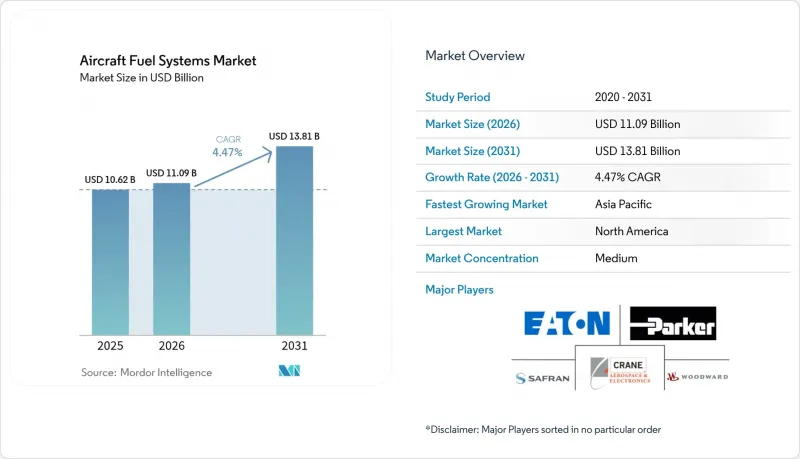
Mordor Intelligence에 의하면, 항공기 연료 시스템 시장 규모는 2025년 106억 2,000만 달러로 평가되었고, 2026년에는 110억 9,000만 달러로 추정되고, 2026-2031년 CAGR 4.47%로 성장을 지속할 전망이며, 2031년에는 138억 1,000만 달러에 이를 것으로 예측됩니다.
본 보고서는 유형별(중력 급유, 펌프 급유, 연료 분사 시스템), 구성품별(연료 탱크, 연료 펌프 등), 항공기 등급별(민간 항공기, 군용기 등), 최종 용도별(OEM 및 애프터마켓), 기술별(기존 기계식 시스템 등), 지역별(북미, 유럽 등)로 분류되어 있습니다. 시장 예측은 금액(달러) 기준으로 제시되어 있습니다.
세계의 항공기 연료 시스템 시장 동향 및 인사이트
전 세계 민간 항공기 인도 대수의 급증
각 항공기 제조업체들은 항공사의 개조 주기에 대응하기 위해 생산량을 늘리고 있습니다. 에어버스는 2025년에 820대의 인도를 목표로 하고 있으며, 최대 4,700 NM의 항속 거리를 실현하기 위해 여러 개의 센터 탱크 및 보조 탱크 배치를 채택한 장거리 단일 통로형 기종을 우선적으로 생산하고 있습니다. 보잉의 F-15EX 전투기 병행 생산은 전투 플랫폼용 연료 펌프 및 밸브 수요를 뒷받침하고 있습니다. 그 결과, 부품 공급업체들은 정밀 펌프, 프로브, 이송 밸브에 대한 주문량 증가에 직면하고 있는 반면, MRO 제공업체들은 이용률이 팬데믹 이전의 비행 시간 수준으로 회복됨에 따라 소모품 교체 주기가 가속화되고 있습니다.
군용 공중 급유 프로그램의 확대
MQ-25 스팅레이는 500 NM 이상 거리에서 1만 5,000파운드의 연료를 이송할 수 있는 최초의 항공모함 탑재형 무인 급유기로, 내결함성 유량 계측 및 자율 차단 로직에 대한 요구 사항을 높이고 있습니다. 미국 공군의 KC-46A 페가수스 증강 및 유럽 동맹국들의 도입은 다점 급유 수요를 부추기고 있으며, 이 모든 경우 대용량 부스터 펌프와 능동식 덤핑 기능을 갖춘 붐 작동 매니폴드가 필요합니다.
새로운 연료 기술에 따른 높은 인증 및 승인 비용
수소 및 SAF(지속 가능한 항공 연료)를 지원하는 신규 연료 시스템에는 일반적으로 수년에 걸친 시험 프로그램과 FAA(연방항공청)의 인증 계획이 요구됩니다. 동 청이 2024년 12월에 발표한 ‘수소 로드맵’에서는 제조업체에 수천만 단위의 인증 비용을 부담시킬 가능성이 있는 데이터 부족이 지적되고 있습니다. 중소 공급업체들은 불균형한 부담을 떠안고 있어 시장 진입이 지연되고 가격 경쟁이 제한되고 있습니다.
부문 분석
2025년, 중력 급유 방식 아키텍처는 항공기 연료 시스템 시장 점유율의 45.05%를 유지했으며, 일반 항공 및 일부 군용기 기단에 있어 비용 효율적인 선택지임을 입증하고 있습니다. 동 기간 동안, 연료 분사 플랫폼용 항공기 연료 시스템 시장 규모는 연평균 성장률(CAGR) 6.07%로 확대되어 모든 유형 중 가장 높은 성장률을 기록했습니다. 이는 실시간 혼합비 최적화를 통해 연료 소비량을 약 15% 절감할 수 있는 FADEC 호환 하드웨어를 채택했기 때문입니다. 펌프 공급 방식의 솔루션은 완전한 디지털 오버레이를 필요로 하지 않으며, 양압 공급이 필요한 기체를 지원하여 성능 면에서 중간적인 위치를 계속 유지하고 있습니다.
각 공급업체들은 차세대 인젝터에 머신러닝 로직을 통합하여 유량 요구 사항을 예측하고 탱크의 균형을 자율적으로 조정함으로써, 연료 회로를 센서가 풍부한 데이터 소스로 변화시키고 있습니다. 사프란(Safran)의 ‘FADEC 4’는 이러한 비약적인 발전을 상징하며, 기존 모델에 비해 10배의 처리 능력을 발휘하는 동시에 전반적인 효율성도 향상시켰습니다. IoT 연결이 조종실 전체로 확대됨에 따라, 기존의 중력식 시스템은 보다 정밀한 소비량 제어, 예측 유지보수 및 수명 주기 비용 절감을 약속하는 분사 어셈블리로부터의 경쟁 압력에 직면하고 있으며, 항공기 연료 시스템 시장 전체에서 기술 전환이 가속화되고 있습니다.
2025년에는 연료 탱크가 매출 점유율의 36.15%를 차지하며 가장 큰 점유율을 유지했습니다. 그럼에도 불구하고, 질소 발생 장치, 멤브레인, 배관 시스템으로 구성된 비활성화 어셈블리는 의무화된 개조 프로그램을 배경으로 연평균 성장률(CAGR) 5.55%를 기록하며 성장했습니다. 항공기 연료 시스템 시장의 비활성화 솔루션 시장 규모는 2026년에 18억 6,000만 달러에 육박할 것으로 예상되며, 향후 10년 말에는 24억 8,000만 달러를 넘어설 것으로 전망됩니다. 운항사는 가연성 위험에 대응하고 보험상의 이점을 얻기 위해 더 높은 자본 비용을 감수하고 있습니다.
가변 속도 전기 펌프와 스마트 모터 구동 밸브는 불활성 가스 주입 중 탱크 내의 압력을 균일하게 유지함으로써 안전성을 높이고 있습니다. 내장형 산소 센서와 연동되어 순도가 허용 범위를 벗어날 경우 승무원이나 정비팀에 알리는 이러한 시스템은 항공기 연료 시스템 시장에서 실시간 데이터 가시성에 대한 중요성을 더욱 부각시키고 있습니다.
지역별 분석
아시아태평양의 항공 서비스 지출은 2025년 520억 달러에서 2043년에는 1,290억 달러로 증가할 것으로 예상되며, 이는 연평균 4.81%의 성장률을 시사함과 동시에 연료 시스템용 예비 부품 수요도 비례하여 증가할 것임을 의미합니다. 유지보수 지출만 해도 연평균 5.0% 증가세를 보이고 있어, 예측 분석 라이선스 제공업체와 특수 씰 제조업체에게 시장 기회가 창출되고 있습니다. 중국에서는 민간 항공의 확대가 국산 와이드바디 항공기 프로그램과 맞물려 티타늄 탱크 피팅의 현지화를 추진하고 있습니다. 인도의 SAF(지속 가능한 항공 연료) 추진은 2030년까지 듀얼 연료 대응 씰의 필요성을 부각시키고 있는 반면, 싱가포르에서는 2026년부터 조기에 1%의 SAF 혼합 규정이 도입됨에 따라 필터의 적응성을 검증하는 생생한 시험장이 되고 있습니다.
북미 시장 점유율 41.98%는 캔자스주, 워싱턴주, 조지아주에 뿌리를 둔 OEM 및 MRO 생태계에서 비롯된 것입니다. 미국 공군(USAF)은 F-15EX 및 KC-46A 주문을 계속하고 있으며, 2030년까지 밸브, 펌프, 호스의 안정적인 조달이 예상됩니다. FAA(연방항공청)의 가연성 규제로 인해 질소 발생 및 모니터링 라인의 개조 작업 범위가 더욱 확대되고 있습니다.
유럽은 환경 규제 분야에서 선도적인 위치를 유지하고 있습니다. ‘ReFuelEU 항공법’은 2025년까지 SAF(지속 가능한 항공 연료) 혼합 비율을 2%로, 2050년까지 70%로 높일 것을 규정하고 있으며, 이에 따라 용해도가 높은 바이오 유래 연료에 대응하기 위해 필터 하우징의 재설계가 요구되고 있습니다. 에어버스와 토탈에너지의 제휴는 2030년까지 연간 150만 톤의 SAF 생산을 목표로 하고 있으며, 이에 따라 새로운 연료의 화학적 특성을 견딜 수 있는 노즐, 개스킷, 씰에 대한 수요를 뒷받침하고 있습니다.
기타 혜택 :
- 엑셀 형식 시장 예측(ME) 시트
- 3개월간의 애널리스트 지원
자주 묻는 질문
목차
제1장 서론
제2장 조사 방법
제3장 주요 요약
제4장 시장 구도
제5장 시장 규모 및 성장 예측
제6장 경쟁 구도
제7장 시장 기회 및 향후 전망
AJY 26.09.07According to Mordor Intelligence, the aircraft fuel systems market size is expected to grow from USD 10.62 billion in 2025 to USD 11.09 billion in 2026 and is forecast to reach USD 13.81 billion by 2031 at 4.47% CAGR over 2026-2031.
This report is Segmented by Type (Gravity Feed, Pump Feed, and Fuel Injection Systems), Component (Fuel Tanks, Fuel Pumps, and More), Aircraft Class (Commercial Aircraft, Military Aircraft, and More), End Use (OEM and Aftermarket), Technology (Conventional Mechanical Systems, and More), and Geography (North America, Europe, and More). The Market Forecasts are Provided in Terms of Value (USD).
Global Aircraft Fuel Systems Market Trends and Insights
Surging Global Commercial Aircraft Deliveries
Airframers are elevating output to meet airline refurbishment cycles. Airbus aims for 820 deliveries in 2025 and prioritizes long-range single-aisle models that utilise multiple centre- and auxiliary-tank arrangements to achieve up to 4,700 NM range. Boeing's concurrent production of F-15EX fighters sustains fuel pump and valve demand for combat platforms. Component suppliers, therefore, face enlarged call-offs for precision pumps, probes, and transfer valves while MRO providers register faster consumable replacement cycles as utilization returns to pre-pandemic flight hours.
Expansion of Military Aerial-Refueling Programs
The MQ-25 Stingray marks the first carrier-based unmanned tanker capable of transferring 15,000 lb of fuel beyond 500 NM, pushing requirements for fault-tolerant flow metering and autonomous shut-off logic. The USAF's KC-46A Pegasus expansion and allied European acquisitions reinforce multi-point refuelling demand, each necessitating high-capacity boost pumps and actively damped boom-actuation manifolds.
High Certification and Qualification Costs for New Fuel Technologies
Novel hydrogen or SAF-ready fuel systems routinely require multi-year test campaigns and FAA certification plans. The agency's December 2024 Hydrogen Roadmap highlights data gaps that could cost manufacturers tens of millions in qualification expenditure. Small suppliers face disproportionate burdens that slow market entry and limit price competition.
Other drivers and restraints analyzed in the detailed report include:
- Rapid Fleet Modernization Toward Fuel-Efficient Platforms
- Predictive Analytics Integration for Real-Time Fuel-System Health
- Aviation-Grade Titanium and Elastomer Supply Bottlenecks
For complete list of drivers and restraints, kindly check the Table Of Contents.
Segment Analysis
Gravity-feed architectures retained 45.05% of the aircraft fuel systems market share in 2025, underscoring their cost-effective appeal for general aviation and selected military fleets. Within the same period, the aircraft fuel systems market size for fuel-injection platforms advanced at a 6.07% CAGR, the fastest among all types, as operators embraced FADEC-compatible hardware that can trim fuel burn by about 15% through real-time mixture optimization. Pump-feed solutions continued to serve the performance middle ground, supporting airframes that require positive pressure delivery without the full digital overlay.
Suppliers are embedding machine-learning logic into next-gen injectors to predict flow requirements and balance tanks autonomously, turning the fuel circuit into a sensor-rich data source. Safran's FADEC 4 illustrates the leap, delivering 10 times greater processing power than earlier units while elevating overall efficiency. As IoT connectivity spreads across flight decks, traditional gravity systems face competitive pressure from injection assemblies that promise tighter consumption control, predictive health monitoring, and lower lifecycle cost, accelerating the technology shift within the broader aircraft fuel systems market.
Fuel tanks held the largest 36.15% revenue share in 2025. Nonetheless, inerting assemblies-spanning nitrogen generators, membranes, and distribution plumbing-advanced at a 5.55% CAGR on the back of mandatory retrofit programs. The aircraft fuel systems market size for inerting solutions stood near USD 1.86 billion in 2026 and is on track to exceed USD 2.48 billion by decade-end. Operators accept higher capital costs in exchange for flammability-exposure compliance and insurance benefits.
Variable-speed electric pumps and smart motor-operated valves augment safety by harmonising tank pressures during inert gas injection. Coupled with embedded oxygen sensors, these systems notify crews or maintenance teams when purity drifts outside thresholds, reinforcing the aircraft fuel systems market's emphasis on real-time data visibility.
Complete Report Scope:
- By Type
- Gravity Feed
- Pump Feed
- Fuel Injection Systems
- By Component
- Fuel Tanks
- Fuel Pumps
- Valves and Manifolds
- Gauges and Sensors
- Inerting Systems
- Fuel Filters
- By Aircraft Class
- Commercial Aircraft
- Narrowbody Aircraft
- Widebody Aircraft
- Regional Aircraft
- Military Aircraft
- Combat Aircraft
- Non-Combat Aircraft
- Helicopters
- General Aviation Aircraft
- Business Jets
- Turboprop Aircraft
- Piston Aircraft
- Helicopters
- Unmanned Aerial Vehicles (UAVs)
- Commercial Aircraft
- By End Use
- OEM
- Aftermarket
- By Technology
- Conventional Mechanical Systems
- FADEC-Integrated Electric Systems
- Inerting-Enabled Systems
- Smart/Connected Fuel Systems
- By Geography
- North America
- United States
- Canada
- Mexico
- Europe
- United Kingdom
- Germany
- France
- Russia
- Rest of Europe
- Asia-Pacific
- China
- India
- Japan
- South Korea
- Rest of Asia-Pacific
- South America
- Brazil
- Rest of South America
- Middle East and Africa
- Middle East
- United Arab Emirates
- Saudi Arabia
- Turkey
- Rest of Middle East
- Africa
- Egypt
- South Africa
- Rest of Africa
- Middle East
- North America
Geography Analysis
Asia-Pacific's aviation services outlay will rise from USD 52 billion in 2025 to USD 129 billion in 2043, implying compound 4.81% growth and a proportional uptick in fuel system spares. Maintenance spend alone accelerates at 5.0% yearly, creating space for predictive analytics licensors and specialty seal manufacturers. China's civil expansion partners with indigenous wide-body programs, pushing the localization of titanium tank fittings. India's SAF push underlines the need for dual-fuel-compatible seals by 2030, while Singapore's early 1% SAF blending rule from 2026 makes it a live testbed for filter adaptability.
North America's 41.98% market share derives from entrenched OEM and MRO ecosystems across Kansas, Washington, and Georgia. The USAF continues to order the F-15EX and KC-46A, locking in steady valve, pump, and hose procurements through 2030. FAA flammability mandates further generate retrofit workscopes for nitrogen generation and monitoring lines.
Europe maintains primacy in environmental regulation. The ReFuelEU Aviation Act begins with 2% SAF by 2025 and scales to 70% by 2050, compelling filter-housing redesigns for bio-derived fuels with higher solvency. Airbus' partnership with TotalEnergies targets 1.5 million t annual SAF output by 2030, underpinning nozzle, gasket, and seal demand that can withstand novel fuel chemistries.
- Eaton Corporation plc
- Parker-Hannifin Corporation
- Safran SA
- Crane Aerospace & Electronics (Crane Company)
- Woodward, Inc.
- RTX Corporation
- GKN Aerospace Services Limited (Melrose plc)
- Triumph Group Inc.
- SECONDO MONA S.p.A.
- Honeywell International Inc.
- Robertson Fuel Systems, LLC (HEICO Corporation)
- Marshall of Cambridge (Holdings) Ltd
- Weldon Pump. LLC.
Additional Benefits:
- The market estimate (ME) sheet in Excel format
- 3 months of analyst support
TABLE OF CONTENTS
1 INTRODUCTION
- 1.1 Study Assumptions and Market Definition
- 1.2 Scope of the Study
2 RESEARCH METHODOLOGY
3 EXECUTIVE SUMMARY
4 MARKET LANDSCAPE
- 4.1 Market Overview
- 4.2 Market Drivers
- 4.2.1 Surging global commercial aircraft deliveries
- 4.2.2 Expansion of military aerial-refueling programs
- 4.2.3 Rapid fleet modernization toward fuel-efficient platforms
- 4.2.4 Rising UAV procurement across civil and defense sectors
- 4.2.5 Predictive analytics integration for real-time fuel-system health
- 4.2.6 Mandatory retrofit of nitrogen-inerting systems for safety
- 4.3 Market Restraints
- 4.3.1 High certification and qualification costs for new fuel technologies
- 4.3.2 Aviation-grade titanium and elastomer supply bottlenecks
- 4.3.3 Fuel-price volatility curbing airline capital expenditure
- 4.3.4 Cyber-security risks in digital gauging and control networks
- 4.4 Value Chain Analysis
- 4.5 Regulatory Landscape
- 4.6 Technological Outlook
- 4.7 Porter's Five Forces Analysis
- 4.7.1 Threat of New Entrants
- 4.7.2 Bargaining Power of Buyers/Consumers
- 4.7.3 Bargaining Power of Suppliers
- 4.7.4 Threat of Substitute Products
- 4.7.5 Intensity of Competitive Rivalry
5 MARKET SIZE AND GROWTH FORECASTS (VALUE)
- 5.1 By Type
- 5.1.1 Gravity Feed
- 5.1.2 Pump Feed
- 5.1.3 Fuel Injection Systems
- 5.2 By Component
- 5.2.1 Fuel Tanks
- 5.2.2 Fuel Pumps
- 5.2.3 Valves and Manifolds
- 5.2.4 Gauges and Sensors
- 5.2.5 Inerting Systems
- 5.2.6 Fuel Filters
- 5.3 By Aircraft Class
- 5.3.1 Commercial Aircraft
- 5.3.1.1 Narrowbody Aircraft
- 5.3.1.2 Widebody Aircraft
- 5.3.1.3 Regional Aircraft
- 5.3.2 Military Aircraft
- 5.3.2.1 Combat Aircraft
- 5.3.2.2 Non-Combat Aircraft
- 5.3.2.3 Helicopters
- 5.3.3 General Aviation Aircraft
- 5.3.3.1 Business Jets
- 5.3.3.2 Turboprop Aircraft
- 5.3.3.3 Piston Aircraft
- 5.3.3.4 Helicopters
- 5.3.4 Unmanned Aerial Vehicles (UAVs)
- 5.3.1 Commercial Aircraft
- 5.4 By End Use
- 5.4.1 OEM
- 5.4.2 Aftermarket
- 5.5 By Technology
- 5.5.1 Conventional Mechanical Systems
- 5.5.2 FADEC-Integrated Electric Systems
- 5.5.3 Inerting-Enabled Systems
- 5.5.4 Smart/Connected Fuel Systems
- 5.6 By Geography
- 5.6.1 North America
- 5.6.1.1 United States
- 5.6.1.2 Canada
- 5.6.1.3 Mexico
- 5.6.2 Europe
- 5.6.2.1 United Kingdom
- 5.6.2.2 Germany
- 5.6.2.3 France
- 5.6.2.4 Russia
- 5.6.2.5 Rest of Europe
- 5.6.3 Asia-Pacific
- 5.6.3.1 China
- 5.6.3.2 India
- 5.6.3.3 Japan
- 5.6.3.4 South Korea
- 5.6.3.5 Rest of Asia-Pacific
- 5.6.4 South America
- 5.6.4.1 Brazil
- 5.6.4.2 Rest of South America
- 5.6.5 Middle East and Africa
- 5.6.5.1 Middle East
- 5.6.5.1.1 United Arab Emirates
- 5.6.5.1.2 Saudi Arabia
- 5.6.5.1.3 Turkey
- 5.6.5.1.4 Rest of Middle East
- 5.6.5.2 Africa
- 5.6.5.2.1 Egypt
- 5.6.5.2.2 South Africa
- 5.6.5.2.3 Rest of Africa
- 5.6.5.1 Middle East
- 5.6.1 North America
6 COMPETITIVE LANDSCAPE
- 6.1 Market Concentration
- 6.2 Strategic Moves
- 6.3 Market Share Analysis
- 6.4 Company Profiles (includes Global level Overview, Market level overview, Core Segments, Financials as available, Strategic Information, Market Rank/Share for key companies, Products and Services, and Recent Developments)
- 6.4.1 Eaton Corporation plc
- 6.4.2 Parker-Hannifin Corporation
- 6.4.3 Safran SA
- 6.4.4 Crane Aerospace & Electronics (Crane Company)
- 6.4.5 Woodward, Inc.
- 6.4.6 RTX Corporation
- 6.4.7 GKN Aerospace Services Limited (Melrose plc)
- 6.4.8 Triumph Group Inc.
- 6.4.9 SECONDO MONA S.p.A.
- 6.4.10 Honeywell International Inc.
- 6.4.11 Robertson Fuel Systems, LLC (HEICO Corporation)
- 6.4.12 Marshall of Cambridge (Holdings) Ltd
- 6.4.13 Weldon Pump. LLC.
7 MARKET OPPORTUNITIES AND FUTURE OUTLOOK
- 7.1 White-space and Unmet-Need Assessment