

|
시장보고서
상품코드
2123251
안티 드론 시장 : 점유율 분석, 업계 동향과 통계, 성장 예측(2026-2031년)Anti-Drone - Market Share Analysis, Industry Trends & Statistics, Growth Forecasts (2026 - 2031) |
||||||
 Mordor Intelligence
안티 드론 시장 규모는 2026년에 24억 7,000만 달러로 평가되고 있어 상업 사업자, 중요 인프라 관리자 및 국토안보 기관이, 소형 무인 항공 시스템 급속한 보급에 대항 하는 움직임을 강하게 하는 것에 따라, 2031년까지 84억 2,000만 달러에 이르고, CAGR 27.83%로 확대될 것으로 예측됩니다.
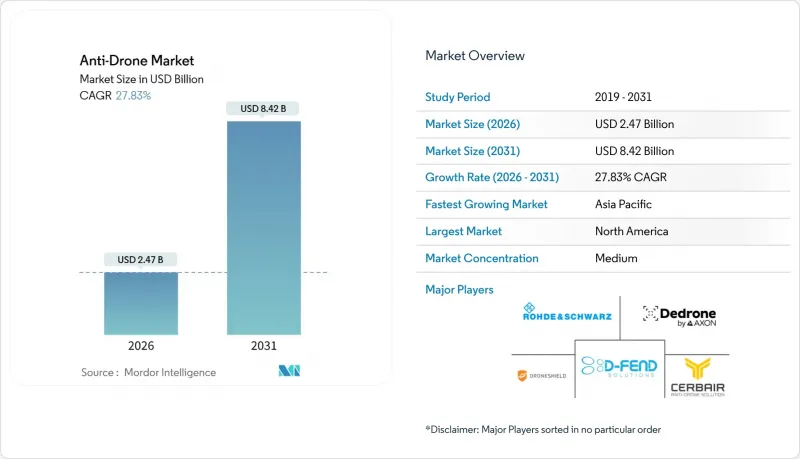
본 보고서는 기술별(감지 시스템 및 무력화·대책 시스템), 플랫폼 유형별(고정식 및 휴대식), 최종 용도별(상업, 국토안보 및 법 집행 기관), 작동 범위별(단거리, 중거리, 장거리), 지역별(북미, 유럽, 아시아태평양, 기타)로 분류되어 있습니다. 시장 예측은 금액(달러) 기준으로 제시되어 있습니다.
세계 안티 드론 시장 동향 및 인사이트
민간 자산을 위협하는 저가 상용 드론의 보급
500달러 미만의 소비자용 드론은 현재 4K 동영상 촬영과 30분간 비행이 가능해졌으며, 이로 인해 악의적인 행위자가 드론 대응 시장에서 최소한의 기술만으로도 정보를 수집하거나 탑재물을 투하할 수 있게 되었습니다. 2024년 FAA(미국 연방항공청)의 월간 사고 기록에 따르면, 공항에서 목격된 드론 건수는 100건을 넘어 전년 대비 40% 증가했습니다. 한편, 코펜하겐 공항에서는 2025년 9월, 신원 미상의 쿼드콥터가 부지 내로 침입함에 따라 90분 동안 운항을 중단했습니다. 영국의 교도소에서는 2024년에 불법 물품을 운반하는 드론의 침입이 347건 기록되었으며, 이에 따라 법무부는 2026년 중반까지 모든 카테고리 A 시설에 고정식 대-UAS(무인항공기 시스템) 설비를 설치하도록 명령을 내렸습니다. 이러한 불균형은 현저합니다. 400달러짜리 드론이 수백만 달러 규모의 시설을 마비시키고, 운영자로 하여금 다층적인 감지 및 대책 체계를 도입하도록 강요하고 있는 것입니다. 보험사는 2025년부터 표준 재산 보험에서 드론 관련 손해를 제외하기 시작했습니다. 이로 인해 위험에 노출된 시설은 보험 적용을 유지하기 위해 사실상 UAS 대응 기술에 대한 투자를 의무화하게 되었습니다.
드론 감지와 관련된 FAA 및 EU의 U-Space 규제 강화
2024년 3월부터 시행되고 있는 FAA의 ‘원격 식별(Remote ID) 규정’에서는 중량 250그램을 초과하는 드론에 대해 식별 데이터 전송이 의무화되어 있으며, 이로 인해 공항 및 중요 인프라 소유자에게는 규정 준수 상황을 실시간으로 모니터링해야 하는 묵시적 의무가 발생하고 있습니다. EU에서는 규정 2021/664에 따라, 회원국은 2026년까지 협력형 및 비협력형 교통 감지를 통합한 U-Space 회랑을 구축해야 할 의무가 있습니다. 이러한 정책으로 인해 책임 소재가 변화하고 있으며, 침입을 감지하지 못한 운항 사업자는 면허 갱신이 어려워질 위험이나 보험료 인상에 직면하게 됩니다. 각국의 항공 당국은 현재 운항 허가를 검증된 드론 방어 능력과 연계하는 것을 일반화하고 있으며, 이로 인해 조달 일정이 단축되고 소프트웨어 정의로 업데이트가 가능한 플랫폼을 제공하는 공급업체가 우대받고 있습니다.
RF 재밍 및 물리적 배제 조치의 법적 지위에 대한 모호성
미국에서는 연방 정부 이외의 주체에 의한 RF 재머 사용이 금지되어 있습니다. 그러나 국토안보부(DHS)의 감독 하에 있는 연방통신위원회(FCC)가 발급하는 실험용 면허를 통해 제한적인 사용이 허용되고 있습니다. 이 절차를 완료하는 데 1년이 소요될 수 있습니다. EU의 무선 장비 지침도 의도적인 간섭을 제한하고 있어, 상업시설은 사이버 기반 제어 또는 물리적 수단으로의 전환을 강요받고 있지만, 이는 안전성 및 불법 행위 책임에 대한 우려를 야기하고 있습니다. 그물 포획형 드론이나 요격탄은 제3자에게 피해를 줄 위험이 따르지만, 세이프 하버 면책을 인정하는 관할권은 거의 없습니다. 이러한 법적 규제의 불일치는 무력화 기술의 상업적 도입을 방해하고, 다가온 위협을 해결할 수 없는 ‘감지 전용’ 시스템으로의 자본 유입을 초래하고 있습니다.
부문 분석
무력화 시스템은 2026년부터 2031년까지 연평균 성장률(CAGR) 27.65%로 확대될 것으로 예측되며, 2025년 매출의 53.95%를 차지했던 ‘감지 전용’ 시스템의 지배적 지위를 점차 잠식해 나갈 전망입니다. 항공 및 통신 규제 당국이 사이버 장악이나 부수적 피해가 적은 물리적 요격 수단에 대해 조건부 승인을 내리기 시작하면서 이러한 전환은 가속화되고 있습니다. Anduril사의 재사용형 요격기 ‘Roadrunner’는 미 육군의 시험에서 95%의 격추 확률을 입증했으며, 일회용 그물 포획 솔루션에 비해 교전당 비용을 1만 달러 미만으로 절감했습니다. D-Fend Solutions사의 ‘EnforceAir2’는 GPS 스푸핑을 이용해 불법 드론을 안전한 착륙 구역으로 유도함으로써, 유럽 관할권 내의 RF 방해 금지 규정을 회피하고 있습니다. 감지는 여전히 중요하지만, 보험사들은 2025년부터 자율적인 대응 능력을 입증한 시설에 대해 보험료를 10%에서 15% 인하하는 조치를 시작하며, 자본 배분 결정을 무력화 능력 쪽으로 기울이고 있습니다.
각 감지 업체들은 하드웨어 증설이 아닌, 분석 기능과 머신러닝(ML) 분류기를 통합함으로써 이에 대응하고 있습니다. Dedrone사의 RF-EO 융합 센서는 Verizon사의 프라이빗 LTE 코어에 통합되어 있어, 초기 설비 투자를 상쇄하는 구독형 요금 체계를 실현하고 있습니다. Epirus사의 20kW 마이크로파 이펙터와 같은 지향성 에너지 시스템은 방위 분야 고객을 끌어들이고 있지만, 30kVA의 전력 요구 사항과 대당 200만 달러의 비용으로 인해 민간 시장에서는 여전히 틈새 시장으로 남아 있습니다. 2026년부터 2031년까지, 안티 드론 시장은 관할 구역에 따라 양극화될 것으로 예측됩니다. 규제가 엄격한 지역에서는 감지 기능만 채택될 것이며, 법적 책임 체계가 법 개정보다 빠르게 진화하는 지역에서는 감지 및 무력화 기능을 통합한 패키지가 도입될 것입니다.
2025년에는 공항, 원자력 발전소, 정유시설 등이 센서의 감지 범위를 중복시켜 연중무휴 24시간 감시를 필요로 함에 따라, 고정형 플랫폼이 매출의 39.85%를 차지했습니다. 그럼에도 불구하고, 이벤트 주도형 보안 계약 증가를 반영하여 휴대용 시스템의 연평균 성장률(CAGR)은 28.59%를 나타낼 것으로 예측됩니다. DroneShield사의 ‘DroneSentry-X Mk2’는 무게 35kg으로 15분 만에 배치 가능하며, 2024년 파리 올림픽 및 2025년 세계경제포럼에서 경비를 담당했습니다.
렌탈 모델의 경제성이 휴대형 시스템의 보급을 뒷받침하고 있습니다. 운영 사업자는 고정식 어레이의 경우 선불 비용 50만 달러에 비해 주당 1만-2만 달러만 지불하면 되기 때문에 이는 ‘C-UAS-as-a-Service(서비스형 안티드론 시스템)’라는 패러다임에 부합합니다. 중요 시설의 안티드론 시장 규모에서는 여전히 고정 설치형이 주류를 차지하고 있습니다. 이는 탈레스(Thales)사의 ‘팔콘 쉴드(Falcon Shield)’가 제공하는 10km의 레이더 감지 범위가 혼잡한 비행장에서는 여전히 필수적이기 때문입니다. 모듈식 설계로 인해 그 경계가 모호해지고 있습니다. 사브(Saab)사의 ‘기라프 1X’는 ISO 컨테이너로 출하되며, 옥상이나 트럭 적재함에 볼트로 고정할 수 있어 반영구적인 이용 사례를 충족합니다.
지역별 분석
북미는 2025년에 전 세계 매출의 40.55%를 차지하며, 이는 미국 국토안보부(DHS)의 계약 및 연방항공청(FAA)의 원격 식별(Remote ID) 시행에 힘입은 결과입니다. 이 지역은 2031년까지 연평균 성장률(CAGR) 25.8%를 나타낼 것으로 예측되지만, 초기 도입자들이 신규 설치에서 소프트웨어 업그레이드로 전환함에 따라 세계 평균보다 약간 낮은 수치를 보일 것으로 전망됩니다. 미국의 원자력 발전소는 NRC(미국 원자력 규제 위원회)의 지침에 따라 2027년까지 주변 감지 시스템 도입이 의무화되어 있습니다. 한편, GAO(미국 정부감사원)의 검증을 거친 공항 시범 사업에서는 전파가 밀집된 환경에서의 오감지를 줄이는 멀티센서 아키텍처가 강화되고 있습니다. 캐나다의 진전은 비교적 완만하지만, 캐나다 교통부(Transport Canada)의 2025년 초안에서는 UAS 대응 조치의 대상 범위가 밴쿠버, 토론토, 몬트리올 각 공항으로 확대되었습니다. 멕시코는 아직 도입 초기 단계이지만, 2024년 후반 카르텔에 의한 드론 사건이 발생한 것을 계기로 과달라하라와 티후아나에서 시범 도입이 시작되었습니다.
아시아태평양은 2026년부터 2031년까지 연평균 성장률(CAGR) 27.11%라는 가장 빠른 성장이 예상됩니다. 이는 인도의 ‘디지털 스카이(Digital Sky)’ 플랫폼을 통한 드론 등록의 철저화, 중국의 스마트 시티 감시 체계 확대, 그리고 일본의 물리적 요격 시스템에 대한 규제 완화 덕분입니다. 인도는 2024년, 상용 대(對) UAS 시스템 도입과 관련된 사전 승인 병목 현상을 해소하고 프로젝트 일정을 앞당겼습니다. 중국의 국영 공항 운영사는 현재 50개 이상의 주요 허브 공항에서 RF-EO 융합 시스템이 운영되고 있음을 밝혔으며, 주요 공급처는 CETC를 포함한 국내 벤더들입니다. 일본은 2024년 나리타 공항을 위해 미쓰비시 전기에 계약을 수여하여 레이더, EO 및 네트워크 요격 장치를 통합했습니다. 한국의 전국적인 5G 구축은 RF 감지를 복잡하게 만들고 있지만, 인천공항에서는 AI 재학습을 통해 2025년 시범 운영 시 오경보율을 10% 미만으로 낮췄습니다.
유럽은 2025년 매출의 약 28%를 차지하고 있으며, 2031년까지 연평균 성장률(CAGR) 26.5%를 나타낼 것으로 예측됩니다. 이는 주로 U-space 준수 및 2025년 코펜하겐 공항 폐쇄와 같은 주목할 만한 사건들이 원인입니다. 영국은 도입을 주도하고 있으며, 승객 수가 500만 명을 초과하는 공항은 연중무휴 24시간 커버리지를 유지해야 하고, 카테고리 A 교도소에서는 2026년 중반까지 시스템 도입이 의무화되어 있습니다. 독일은 2025년에 정유시설를 대상으로 RF 방해에 대한 적용 제외 조치를 마련하여, EU 전체의 규제 완화로 이어질 가능성이 있습니다. 프랑스는 2024년 파리 올림픽 기간 동안 ‘C-UAS-as-a-Service’의 유효성을 입증하고 신속한 재배치 능력을 어필한 탈레스(Thales)사와 드론쉴드(Drone Shield)사에 계약을 수여했습니다. 중동 및 아프리카에서는 사우디아라비아의 NEOM과 UAE가 스마트 시티 청사진에 감지 계층을 통합하고, 2024년 GACA 규정(모든 상업 공항에 시스템 도입을 의무화)에 힘입어 연평균 성장률(CAGR) 26.8%로 시장이 확대될 것으로 예측됩니다. 남미는 여전히 시장 규모가 가장 작은 편이지만, 브라질의 2025년 ANAC 지침을 계기로 상파울루의 과룰류스 공항을 필두로 한 조달 붐이 일어나며 성장세를 보이고 있습니다.
기타 혜택:
- 엑셀 형식 시장 예측(ME) 시트
- 3개월간의 애널리스트 지원
자주 묻는 질문
목차
제1장 서론
제2장 조사 방법
제3장 주요 요약
제4장 시장 구도
제5장 시장 규모와 성장 예측
제6장 경쟁 구도
제7장 시장 기회와 향후 전망
JHS 26.09.09According to Mordor Intelligence, the anti-drone market size was valued at USD 2.47 billion in 2026, and is projected to reach USD 8.42 billion by 2031, advancing at a 27.83% CAGR, as commercial operators, critical infrastructure managers, and homeland security agencies move to counter the accelerating proliferation of small unmanned aerial systems.
This report is Segmented by Technology (Detection Systems and Neutralization/Countermeasure Systems), Platform Type (Fixed and Portable), End-Use Vertical (Commercial and Homeland Security and Law Enforcement), Operating Range (Short-Range, Medium-Range, and Long-Range), and Geography (North America, Europe, Asia-Pacific, and More). The Market Forecasts are Provided in Terms of Value (USD).
Global Anti-Drone Market Trends and Insights
Proliferation Of Low-Cost Commercial Drones Threatening Civilian Assets
Consumer drones priced under USD 500 now deliver 4K video and 30-minute endurance, enabling hostile actors to gather intelligence or deliver payloads with minimal skill across the Anti-Drone Market. Monthly FAA incident logs exceeded 100 airport drone sightings in 2024, a year-on-year rise of 40%, while Copenhagen Airport halted operations for 90 minutes in September 2025 after an unidentified quadcopter breached its perimeter. UK prisons recorded 347 contraband-carrying drone incursions in 2024, prompting the Ministry of Justice to issue an order for fixed counter-UAS installations at all Category A facilities by mid-2026. The asymmetry is stark: a USD 400 drone can idle a multi-million-dollar facility, forcing operators to adopt layered detection and mitigation frameworks. Insurance underwriters began excluding drone-related losses from standard property cover in 2025, effectively obligating risk-exposed sites to invest in counter-UAS technologies to retain coverage.
Stricter FAA And EU U-Space Mandates For Drone Detection
The FAA's Remote ID rule, which has been in effect since March 2024, requires drones weighing more than 250 grams to broadcast identifying data, establishing an implicit obligation for airports and critical infrastructure owners to monitor compliance in real-time. In the EU, Regulation 2021/664 requires member states to develop U-space corridors that integrate cooperative and non-cooperative traffic detection by 2026. These policies shift liability: operators that fail to detect incursions face risks to their license renewal and rising insurance premiums. National aviation authorities now routinely link operating permits to demonstrated anti-drone capability, compressing procurement timelines and rewarding vendors that ship software-defined, update-ready platforms.
Ambiguous Legality of RF Jamming and Kinetic Takedown
US law prohibits non-federal entities from emitting RF jammers; however, experimental licenses granted by the Federal Communications Commission, under the supervision of the Department of Homeland Security (DHS), permit limited use. This process can take a year to complete. The EU's Radio Equipment Directive also restricts intentional interference, pushing commercial sites toward cyber takeover or kinetic options that raise concerns about safety and tort liability. Net-capture drones or interceptor rounds risk third-party damage, yet few jurisdictions provide safe-harbor immunity. This patchwork hinders the commercial adoption of neutralization technologies and diverts capital toward detection-only deployments that cannot resolve immediate threats.
Other drivers and restraints analyzed in the detailed report include:
- Drone Incursions at Critical Infrastructure (Energy, Airports)
- AI-Powered Multi-Sensor Fusion Improves Detection Accuracy
- High False-Alarm Rates In 5G-Dense Urban Zones
For complete list of drivers and restraints, kindly check the Table Of Contents.
Segment Analysis
Neutralization systems are projected to expand at a 27.65% CAGR from 2026 to 2031, gradually eroding the detection-only dominance that delivered 53.95% of 2025 revenue. The shift accelerates as aviation and telecommunication regulators begin granting conditional approvals for cyber-takeover and low-collateral kinetic interceptors. Anduril's Roadrunner reusable interceptor demonstrated 95% kill probability in US Army trials and slashed per-engagement costs below USD 10,000 compared with expendable net-capture solutions. D-Fend Solutions' EnforceAir2 guides rogue drones to safe-landing zones via GPS spoofing, avoiding RF-jamming prohibitions in European jurisdictions. Detection remains critical, yet insurers started offering 10% to 15% premium reductions in 2025 for sites that demonstrate autonomous mitigation, tilting capital-allocation decisions toward neutralization capability.
Detection vendors answer by embedding analytics and machine-learning (ML) classifiers rather than proliferating hardware. Dedrone's RF-EO fusion sensors integrate into Verizon private LTE cores, enabling subscription pricing that offsets upfront capital expenditure. Directed-energy systems, such as Epirus's 20 kW microwave effector, attract defense customers but remain niche in civil markets due to their 30 kVA power requirements and USD 2 million unit costs. Between 2026 and 2031, the anti-drone market is expected to split by jurisdiction: detection-only in regulation-heavy regions and integrated detection-defeat packages in territories where liability regimes evolve faster than legislative reform.
In 2025, fixed platforms accounted for 39.85% of the revenue, as airports, nuclear plants, and oil refineries require 24/7 coverage with overlapping sensor fields. Even so, portable systems are forecast to post a 28.59% CAGR, mirroring the rise of event-driven security contracting. DroneShield's DroneSentry-X Mk2, weighing 35 kg and deployable in 15 minutes, protected the 2024 Paris Olympics and the 2025 World Economic Forum.
Rental economics amplify traction for portables: operators pay USD 10,000-20,000 per week versus USD 500,000 upfront for fixed arrays, aligning with the C-UAS-as-a-Service paradigm. Fixed installations still dominate the anti-drone market size for critical facilities because 10-km radar envelopes, as offered by Thales' Falcon Shield, remain indispensable at congested airfields. Modular designs blur the boundary; Saab's Giraffe 1X ships in ISO containers that bolt to rooftops or truck beds, satisfying semi-permanent use cases.
Complete Report Scope:
- By Technology
- Detection Systems
- Neutralization/Countermeasure Systems
- By Platform Type
- Fixed
- Portable
- By End-Use Vertical
- Commercial
- Homeland Security and Law Enforcement
- By Operating Range
- Short-Range (Less than 1 km)
- Medium-Range (1 to 5 km)
- Long-Range (Greater than 5 km)
- Geography
- North America
- United States
- Canada
- Mexico
- Europe
- United Kingdom
- France
- Germany
- Rest of Europe
- Asia-Pacific
- China
- India
- Japan
- South Korea
- Rest of Asia-Pacific
- South America
- Brazil
- Rest of South America
- Middle East and Africa
- Middle East
- Saudi Arabia
- United Arab Emirates
- Rest of Middle East
- Africa
- South Africa
- Rest of Africa
- Middle East
- North America
Geography Analysis
North America commanded 40.55% of the global revenue in 2025, driven by US DHS contracts and FAA enforcement of Remote ID. The region is forecasted to post a 25.8% CAGR through 2031, slightly trailing the global average as early adopters transition from new installations to software upgrades. US nuclear plants must install perimeter detection systems by 2027 under NRC guidance, while GAO-validated airport pilots reinforce multi-sensor architectures that reduce false positives in dense RF environments. Canada moves more slowly, yet Transport Canada's 2025 draft mandates extend counter-UAS coverage to Vancouver, Toronto, and Montreal airports. Mexico remains nascent, but cartel drone incidents triggered pilot deployments at Guadalajara and Tijuana in late 2024.
The Asia-Pacific region is expected to post the fastest growth at a 27.11% CAGR from 2026 to 2031, as India's Digital Sky platform enforces drone registration, China scales up smart-city surveillance, and Japan liberalizes kinetic interceptors. India removed prior-approval bottlenecks for commercial counter-UAS installs in 2024, accelerating project timelines. China's state-owned airport operators have disclosed that more than 50 major hubs now operate RF-EO fusion systems, primarily sourced from domestic vendors, including CETC. Japan awarded Mitsubishi Electric a contract in 2024 for Narita Airport, integrating radar, EO, and net interceptors. South Korea's nationwide 5G rollout complicates RF detection; yet, Incheon Airport's AI retraining reduced false alarms to below 10% in 2025 trials.
Europe represented roughly 28% of 2025 revenue and is expected to grow at a 26.5% CAGR through 2031, primarily due to U-space compliance and high-profile incidents, such as Copenhagen's 2025 shutdown. The UK leads adoption: airports exceeding 5 million passengers must sustain 24/7 coverage, and Category A prisons must install systems by mid-2026. Germany created an RF-jamming carve-out for refineries in 2025, potentially easing broader EU restrictions. France validated C-UAS-as-a-Service during the 2024 Paris Olympics, awarding contracts to Thales and DroneShield that showcase rapid redeployment capabilities. The Middle East and Africa are expected to expand at a 26.8% CAGR as Saudi Arabia's NEOM and the UAE integrate detection layers into smart-city blueprints, backed by 2024 GACA rules mandating systems at all commercial airports. South America remains the smallest but shows momentum after Brazil's 2025 ANAC guidelines triggered a procurement wave led by Sao Paulo's Guarulhos Airport.
- Dedrone Holdings, Inc.
- CERBAIR
- D-Fend Solutions AD Ltd.
- DroneShield Group Pty Ltd.
- Rohde & Schwarz GmbH & Co. KG
- Thales Group
- QinetiQ Group
- Saab AB
- Anduril Industries, Inc.
- SRC Inc.
- DeTect, Inc.
- CACI International Inc.
- Honeywell International Inc.
- Meteksan Defence Industry Inc.
- OpenWorks Engineering Ltd.
- Rheinmetall AG
- Northrop Grumman Corporation
- Leonardo S.p.A.
- Terma Group
Additional Benefits:
- The market estimate (ME) sheet in Excel format
- 3 months of analyst support
TABLE OF CONTENTS
1 INTRODUCTION
- 1.1 Study Assumptions and Market Definition
- 1.2 Scope of the Study
2 RESEARCH METHODOLOGY
3 EXECUTIVE SUMMARY
4 MARKET LANDSCAPE
- 4.1 Market Overview
- 4.2 Market Drivers
- 4.2.1 Proliferation of low-cost commercial drones threatening civilian assets
- 4.2.2 Stricter FAA and EU U-space mandates for drone detection
- 4.2.3 Drone incursions at critical infrastructure (energy, airports)
- 4.2.4 AI-powered multi-sensor fusion improves detection accuracy
- 4.2.5 C-UAS-as-a-Service cuts CapEx for venue operators
- 4.2.6 Private 5G campus networks enable passive RF detection
- 4.3 Market Restraints
- 4.3.1 Ambiguous legality of RF jamming and kinetic takedown
- 4.3.2 High false-alarm rates in 5G-dense urban zones
- 4.3.3 Privacy concerns over wide-area acoustic/EO surveillance
- 4.3.4 Fragmented liability between drone and site operators
- 4.4 Value Chain Analysis
- 4.5 Regulatory and Technological Outlook
- 4.6 Porter's Five Forces Analysis
- 4.6.1 Bargaining Power of Suppliers
- 4.6.2 Bargaining Power of Buyers
- 4.6.3 Threat of New Entrants
- 4.6.4 Threat of Substitutes
- 4.6.5 Intensity of Competitive Rivalry
5 MARKET SIZE AND GROWTH FORECASTS (VALUE)
- 5.1 By Technology
- 5.1.1 Detection Systems
- 5.1.2 Neutralization/Countermeasure Systems
- 5.2 By Platform Type
- 5.2.1 Fixed
- 5.2.2 Portable
- 5.3 By End-Use Vertical
- 5.3.1 Commercial
- 5.3.2 Homeland Security and Law Enforcement
- 5.4 By Operating Range
- 5.4.1 Short-Range (Less than 1 km)
- 5.4.2 Medium-Range (1 to 5 km)
- 5.4.3 Long-Range (Greater than 5 km)
- 5.5 Geography
- 5.5.1 North America
- 5.5.1.1 United States
- 5.5.1.2 Canada
- 5.5.1.3 Mexico
- 5.5.2 Europe
- 5.5.2.1 United Kingdom
- 5.5.2.2 France
- 5.5.2.3 Germany
- 5.5.2.4 Rest of Europe
- 5.5.3 Asia-Pacific
- 5.5.3.1 China
- 5.5.3.2 India
- 5.5.3.3 Japan
- 5.5.3.4 South Korea
- 5.5.3.5 Rest of Asia-Pacific
- 5.5.4 South America
- 5.5.4.1 Brazil
- 5.5.4.2 Rest of South America
- 5.5.5 Middle East and Africa
- 5.5.5.1 Middle East
- 5.5.5.1.1 Saudi Arabia
- 5.5.5.1.2 United Arab Emirates
- 5.5.5.1.3 Rest of Middle East
- 5.5.5.2 Africa
- 5.5.5.2.1 South Africa
- 5.5.5.2.2 Rest of Africa
- 5.5.5.1 Middle East
- 5.5.1 North America
6 COMPETITIVE LANDSCAPE
- 6.1 Strategic Moves
- 6.2 Market Share Analysis
- 6.3 Company Profiles (includes Global Level Overview, Market Level Overview, Core Segments, Financials, Strategic Info, Market Rank/Share, Products and Services, and Recent Developments)
- 6.3.1 Dedrone Holdings, Inc.
- 6.3.2 CERBAIR
- 6.3.3 D-Fend Solutions AD Ltd.
- 6.3.4 DroneShield Group Pty Ltd.
- 6.3.5 Rohde & Schwarz GmbH & Co. KG
- 6.3.6 Thales Group
- 6.3.7 QinetiQ Group
- 6.3.8 Saab AB
- 6.3.9 Anduril Industries, Inc.
- 6.3.10 SRC Inc.
- 6.3.11 DeTect, Inc.
- 6.3.12 CACI International Inc.
- 6.3.13 Honeywell International Inc.
- 6.3.14 Meteksan Defence Industry Inc.
- 6.3.15 OpenWorks Engineering Ltd.
- 6.3.16 Rheinmetall AG
- 6.3.17 Northrop Grumman Corporation
- 6.3.18 Leonardo S.p.A.
- 6.3.19 Terma Group
7 MARKET OPPORTUNITIES AND FUTURE OUTLOOK
- 7.1 White-Space and Unmet-Need Assessment


