

|
시장보고서
상품코드
2123255
알레르기 면역치료 시장 : 시장 점유율 분석, 업계 동향 및 통계, 성장 예측(2026-2031년)Allergy Immunotherapy - Market Share Analysis, Industry Trends & Statistics, Growth Forecasts (2026 - 2031) |
||||||
 Mordor Intelligence
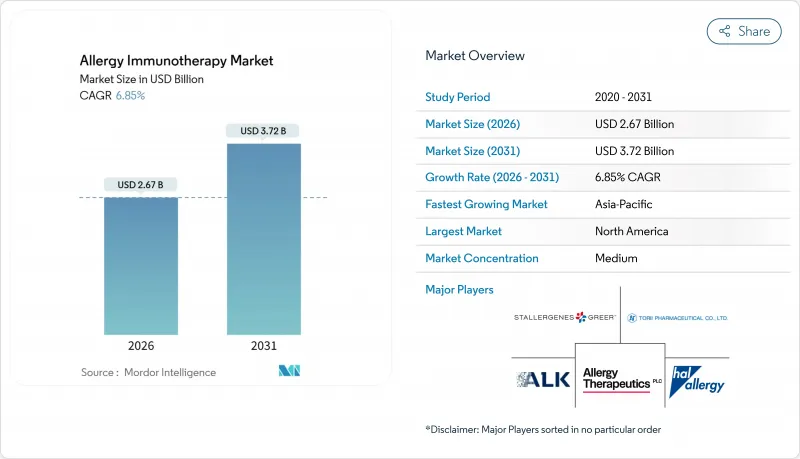
Mordor Intelligence에 의하면, 알레르기 면역치료 시장 규모는 2026년에 26억 7,000만 달러로 추정되고, 예측 기간(2026-2031년)에서 CAGR 6.85%로 성장을 지속할 전망이며, 2031년에는 37억 2,000만 달러에 이를 전망입니다.
본 보고서는 면역치료 유형별(피하 면역치료, 설하 면역치료(SLIT) 등), 알레르기 유형별(알레르기성 비염, 알레르기성 천식 등), 제형별(주사용 현탁액 등), 유통 채널별(의사 대상 직접 판매 등), 지역별(북미, 유럽 등)로 분류되어 있습니다. 시장 예측은 금액(달러) 기준으로 제시되어 있습니다.
세계의 알레르기 면역치료 시장 동향 및 인사이트
호흡기 알레르기 및 식품 알레르기로 인한 전 세계적 부담과 경제적 비용 증가
미국에서는 식품 알레르기, 비알레르기 및 천식 관련 알레르기로 인한 직접 의료비와 생산성 손실이 현재 1,100억 달러를 초과하여, 지속적인 증상 완화를 약속하는 치료법에 대한 지불 주체 수요를 높이고 있습니다. 도시화와 생활 방식의 변화로 인해 노출 위험이 증가함에 따라 전 세계 유병률은 계속 상승하고 있으며, 땅콩 알레르기만 해도 미국에서 150만 명의 어린이들이 영향을 받고 있습니다. 생물학적 제제를 이용한 치료에는 연간 5자리 수의 비용이 소요되므로, 장기적인 면역 요법은 의료 시스템에 있어 비교적 경제적인 선택지가 되고 있습니다. 고용주들은 제대로 관리되지 않는 알레르기가 결근의 원인이 되고 있음을 인식하고 있습니다. 특히 학령기 아동의 경우, 알레르기 반응으로 인해 보호자의 근무 일정이 자주 차질을 빚곤 합니다. 이러한 경제적 부담이 크다는 점이 질환 수정 요법에 대한 보다 광범위한 보험 적용을 추진하는 원동력이 되고 있습니다.
미국, EU, 일본에서의 SLIT 정제 신속 승인 및 보험 적용
2024-2025년 FDA, EMA 및 PMDA는 소아 및 성인을 대상으로 한 여러 SLIT 적응증을 승인함으로써 규제상의 병목 현상을 해소하고, 정제 제형의 경쟁력을 높였습니다. 이와 병행하여, 보험사 측의 규정 변경으로 재택 투여에 대한 상대 가치 단위(RVU)가 추가되고 CPT 청구 기준이 명확해짐에 따라 행정적 장벽이 완화되었습니다. 이러한 일련의 업데이트로 인해 본인 부담금이 감소했으며, 특히 조기 치료 대상이 된 소아 환자층을 중심으로 시장 내 보급이 가속화되고 있습니다. 이러한 동향은 규제 당국의 승인이 보험사의 신뢰를 높이고, 이것이 다시 승인을 뒷받침하는 선순환을 보여주고 있습니다.
저소득 지역에서의 진단·치료 보급률 저하
많은 신흥 경제국에서는 알레르기 전문의, 진단실험실, 그리고 보험 환급 체계가 부족하여, 환자들은 질환을 근본적으로 해결하기보다는 증상을 일시적으로 억제하는 데 그치는 일반의약에 의존할 수밖에 없는 상황에 처해 있습니다. 수입 관세 및 콜드체인 문제로 인해 조달 비용이 증가하고 있습니다. 공중보건 예산은 감염병 대책에 중점을 두고 있어, 대규모 알레르기 대책 프로그램의 시행이 지연되고 있습니다. 이러한 구조적 격차로 인해 유병률 상승과 생산성 저하가 입증되었음에도 불구하고, 보급이 진전되지 않는 상황이 지속되고 있습니다.
부문 분석
2025년, 피하 면역치료는 알레르기 면역치료 시장에서 44.55%의 점유율을 차지했으나, 설하 면역치료는 연평균 성장률(CAGR) 15.25%로 이를 상회할 것으로 예측됩니다. 이러한 성장은 매주 병원을 방문할 필요가 없는 재택 투여 방식 덕분이며, 이는 직장인이나 부모들에게 매력적인 이점으로 작용하고 있습니다. ALK-Abello사의 정제 매출은 2024년에 전년 대비 24% 증가하여 수요가 견조함을 보여주고 있습니다. 여러 알레르겐에 대한 감작으로 맞춤형 조제가 필요한 상황에서는 피하 면역치료(SCIT)이 여전히 우위를 점하고 있지만, 복약 순응도 문제가 성장을 저해하고 있습니다. 경피 및 경구 요법은 여전히 개발 단계에 있기 때문에 단기적으로는 설하 면역치료(SLIT)이 유력한 혁신 기술로 자리 잡고 있습니다.
디지털 약국은 검사, 조제, 배송, 모니터링을 단일 요금제 구독 서비스로 통합하여 디지털에 익숙한 소비자들의 지지를 얻고 있습니다. 온라인 초진 진료에 대한 규제 당국의 승인으로 이러한 비즈니스 모델은 정당성을 확보했습니다. SCIT 전문 클리닉은 시간당 수익 감소 및 법적 책임 위험에 직면해 있으며, 일부 클리닉은 환자를 병원으로 의뢰하고 있습니다. EPIT 및 OIT가 장기적으로는 시장을 뒤흔들 가능성은 있지만, 2031년까지는 SLIT가 성장의 주역으로 남을 것입니다.
2025년 기준, 알레르기성 비염은 알레르기 면역치료 시장 규모의 47.53%를 차지했으나, PALFORZIA의 유아용 적응증 확대 및 가정에서 땅콩 OIT를 완료한 소아에서 100% 내약성이 확인된 NIH의 긍정적인 데이터를 바탕으로, 식품 알레르기 분야는 연평균 성장률(CAGR) 16.85%로 성장할 전망입니다. 식품 알레르기를 대상으로 한 생물학적 제제의 승인은 사회 전반의 관심과 보험사 측의 수용성을 높이고 있습니다. 천식 및 독 알레르기 분야는 임상적으로 중요한 틈새 시장으로 남아 있지만, 아토피 피부염은 파이프라인의 새로운 개척지로 부상하고 있습니다.
땅콩, 달걀, 우유 알레르기는 조기 개입을 통해 평생 지속되는 내성을 얻을 가능성이 있어 투자를 유치하고 있습니다. 저비용의 비독점적 OIT 요법의 상용화는 기존 브랜드 제품에 위협이 되어 경쟁 구도를 완전히 바꿀 가능성이 있습니다. 한편, 중등도에서 중증의 사례에서 바이오의약품이 경쟁에 가세함에 따라 비염 분야의 성장은 둔화되고 있습니다.
지역별 분석
북미는 메디케어(Medicare)의 급여 기준 갱신과 알레르기 전문의의 긴밀한 네트워크에 힘입어 2025년 매출의 42.53%를 차지했습니다. FDA의 소아 적응증 확대로 새로운 환자층이 개척되면서, 미국은 알레르기 면역치료 시장에서 단독으로 최대 시장으로서의 입지를 공고히 했습니다. 2025년 현재 승인을 기다리고 있는 캐나다의 승인 안건과 멕시코의 민간 보험 도입이 지역의 성장세를 유지하고 있지만, 바이오의약품과의 경쟁이 장기적인 성장을 억제하고 있습니다.
아시아태평양은 지역별 가장 높은 연평균 성장률(CAGR) 15.21%를 나타낼 것으로 예측됩니다. 일본에서는 2024년에 삼나무 꽃가루 알레르기 치료제 ‘ITULAZAX’가 승인되어 광범위한 계절성 알레르기로 인한 부담을 경감시키고 있으며, 토리이 제약의 데이터에 따르면 전년 대비 유효성이 향상된 것으로 나타났습니다. 중국 당국은 정제에 대해 브리징 시험을 의무화하고 있기 때문에 당초 초점은 SCIT(피하 면역 요법)에 맞추어져 있습니다. 한편, 인도에서는 2025년에 집먼지진드기용 정제가 출시될 예정이며, 현지 강력한 유통망이 활용될 전망입니다. 가처분 소득 증가와 도시 지역의 알레르기 유병률 상승이 한국 및 호주 전역 수요를 견인하고 있습니다.
유럽은 성숙한 시장이지만 여전히 중요한 시장이며, 2024년 ALK-Abello 매출의 71%를 차지했습니다. 독일은 국가별 매출에서 1위를 차지하고 있으며, 규제 심사 기간 중에도 특정 환자에 대한 공급을 유지하는 ‘Therapieallergene-Verordnung(알레르기 치료제 규정)’의 조항이 이를 뒷받침하고 있습니다. 2024년 EMA의 ‘neffy’ 승인으로 아나필락시스 치료제가 해당 지역의 제품 포트폴리오에 추가되었습니다. 가격 압박과 제네릭 의약품의 진입으로 가격 결정력은 제한되고 있지만, 광범위한 보험 적용 덕분에 판매량은 안정적입니다. 중동 및 아프리카 및 남미는 알레르기 전문의 네트워크가 미비하고 공공 자금도 제한적이어서 다른 지역에 비해 뒤처져 있습니다. 시범 프로젝트는 향후 성장 가능성을 시사하고 있지만, 단기적인 기여도는 여전히 미미합니다.
기타 혜택 :
- 엑셀 형식 시장 예측(ME) 시트
- 3개월간의 애널리스트 지원
자주 묻는 질문
목차
제1장 서론
제2장 조사 방법
제3장 주요 요약
제4장 시장 구도
제5장 시장 규모 및 성장 예측
제6장 경쟁 구도
제7장 시장 기회 및 향후 전망
AJY 26.09.07According to Mordor Intelligence, the allergy immunotherapy market size is estimated at USD 2.67 billion in 2026, and is expected to reach USD 3.72 billion by 2031, at a CAGR of 6.85% during the forecast period (2026-2031).
This report is Segmented by Immunotherapy Type (Subcutaneous Immunotherapy and Sublingual Immunotherapy (SLIT), and More), Allergy Type (Allergic Rhinitis, Allergic Asthma, and More), Formulation (Injectable Suspensions, and More), Distribution Channel (Direct-To-Physician Sales, and More), and Geography (North America, Europe, and More). The Market Forecasts are Provided in Terms of Value (USD).
Global Allergy Immunotherapy Market Trends and Insights
Growing Global Burden & Economic Cost of Respiratory and Food Allergies
Direct medical spending and productivity losses from food, nasal, and asthma-linked allergies now exceed USD 110 billion in the United States, amplifying payer appetite for interventions that promise durable relief. Global prevalence continues to climb as urbanization and lifestyle shifts intensify exposure, pushing peanut allergy alone to affect 1.5 million U.S. children. Biologic therapies carry five-figure annual costs, positioning long-course immunotherapy as a comparatively economical option for health systems. Employers recognize that unmanaged allergies drive absenteeism, especially among school-age children whose reactions disrupt parental work schedules. The magnitude of this economic drag supplies momentum for broader reimbursement of disease-modifying therapies.
Expedited Approvals & Reimbursement of SLIT Tablets in US, EU & Japan
Between 2024 and 2025 the FDA, EMA, and PMDA approved multiple pediatric and adult SLIT indications, shrinking regulatory bottlenecks and sharpening the competitive edge of tablet formats. Concurrent payer rule changes added Relative Value Units for home-based dosing and clarified CPT billing, trimming administrative hurdles. These synchronized updates lower out-of-pocket costs and accelerate commercial uptake, especially among pediatric cohorts now eligible for earlier treatment. The trajectory signals a virtuous cycle where regulatory validation feeds payer confidence and vice versa.
Low Diagnosis & Therapy Uptake in Low-Income Regions
Many emerging economies lack allergists, diagnostic labs, and reimbursement pathways, forcing patients to rely on over-the-counter drugs that mask rather than resolve disease. Import tariffs and cold-chain challenges inflate extract costs. Public health funding favors infectious disease, delaying large-scale allergy programs. These structural gaps hold back penetration despite rising prevalence and documented productivity losses.
Other drivers and restraints analyzed in the detailed report include:
- Inclusion of AIT in Value-Based Care Frameworks
- Home-Based Self-Administration Platforms Improving Adherence
- Product-Specific Anaphylaxis Risk & Safety-Monitoring Costs
For complete list of drivers and restraints, kindly check the Table Of Contents.
Segment Analysis
In 2025 Subcutaneous Immunotherapy captured 44.55% Allergy Immunotherapy market share, yet Sublingual Immunotherapy is forecast to outpace with a 15.25% CAGR. The rise stems from home dosing that erases weekly clinic visits, a compelling benefit for working adults and parents. ALK-Abello's tablet revenues advanced 24% year over year in 2024, signaling strong uptake. SCIT retains an edge where multiple allergen sensitivities demand custom mixes, but compliance hurdles curb growth. Epicutaneous and oral modalities remain developmental, positioning SLIT as the near-term disruptor of choice.
Digital pharmacies integrate testing, formulation, shipping, and monitoring into single-fee subscriptions that resonate with digitally fluent consumers. Regulatory clearance for virtual initiation visits legitimizes these models. Clinics focused on SCIT grapple with lower revenue per hour and liability risk, pushing some to refer patients to hospital settings. While EPIT and OIT may disrupt long-term, SLIT dominates the growth story through 2031.
Allergic Rhinitis maintained 47.53% of the Allergy Immunotherapy market size in 2025, yet Food Allergy is set to climb at a 16.85% CAGR following PALFORZIA's toddler label and supportive NIH data showing 100% tolerance in children completing at-home peanut OIT. Biologic approvals targeting food allergy amplify systemic attention and payer openness. Asthma and venom segments remain clinically important niches, while atopic dermatitis emerges as a pipeline frontier.
Peanut, egg, and milk allergies draw investment as early intervention may induce lifelong tolerance. The commercialization of low-cost, non-proprietary OIT regimens threatens branded incumbents, potentially reshaping competitive dynamics. Meanwhile rhinitis growth decelerates as biologics compete for moderate-to-severe cases.
Complete Report Scope:
- By Immunotherapy Type
- Subcutaneous Immunotherapy (SCIT)
- Sublingual Immunotherapy (SLIT)
- Epicutaneous Immunotherapy (EPIT)
- Oral Immunotherapy (OIT)
- By Allergy Type
- Allergic Rhinitis
- Allergic Asthma
- Food Allergy
- Venom Allergy
- Atopic Dermatitis
- Others
- By Formulation
- Injectable Suspensions
- Sublingual Drops
- Sublingual Tablets
- Transdermal Patches
- By Distribution Channel
- Direct-to-Physician Sales
- Retail & Hospital Pharmacies
- E-commerce / Mail-Order
- Geography
- North America
- United States
- Canada
- Mexico
- Europe
- Germany
- United Kingdom
- France
- Italy
- Spain
- Rest of Europe
- Asia-Pacific
- China
- Japan
- India
- South Korea
- Australia
- Rest of Asia-Pacific
- Middle East and Africa
- GCC
- South Africa
- Rest of Middle East and Africa
- South America
- Brazil
- Argentina
- Rest of South America
- North America
Geography Analysis
North America contributed 42.53% of 2025 revenue, buoyed by Medicare reimbursement updates and dense allergist networks. FDA pediatric label expansions unlocked new cohorts and consolidated the United States as the single largest Allergy Immunotherapy market. Canadian approvals pending as of 2025 and Mexican private-insurance uptake maintain regional momentum, though biologic competition tempers long-term growth.
Asia-Pacific is projected to record a 15.21% CAGR, the fastest among regions. Japan's 2024 approval of ITULAZAX for cedar pollen meets a widespread seasonal burden, with Torii Pharmaceutical data showing year-over-year efficacy gains. Chinese authorities require bridging trials for tablets, pushing initial focus to SCIT, while India's 2025 launch of a house dust mite tablet leverages local distribution heft. Rising disposable income and urban allergy prevalence drive demand across South Korea and Australia.
Europe remains a mature but vital market, accounting for 71% of ALK-Abello revenue in 2024. Germany tops country sales, supported by Therapieallergene-Verordnung provisions that sustain named-patient supply during regulatory review. EMA approval of neffy in 2024 adds anaphylaxis management to the regional portfolio. Pricing pressures and generic entrants limit pricing power, yet broad reimbursement keeps volumes stable. Middle East and Africa and South America trail due to sparse allergist networks and limited public funding. Pilot projects hint at future upside but near-term contributions remain modest.
- Aimmune Therapeutics (Nestle)
- ALK-Abello
- Allergy Therapeutics plc
- Allovate Therapeutics
- Biomay
- Camallergy
- Circassia Group plc
- DBV Technologies
- DESENTUM Oy
- HAL Allergy Group
- HollisterStier Allergy (Jubilant Pharma)
- Inmunotek S.L.
- LETI Pharma
- Merck
- Prota Therapeutics
- Stallergenes Greer
- Torii Pharmaceutical
- Tunitas Therapeutics
- Vida Pharmaceuticals
- Zhejiang Wolwo Biopharmaceutical
Additional Benefits:
- The market estimate (ME) sheet in Excel format
- 3 months of analyst support
TABLE OF CONTENTS
1 Introduction
- 1.1 Study Assumptions & Market Definition
- 1.2 Scope of the Study
2 Research Methodology
3 Executive Summary
4 Market Landscape
- 4.1 Market Overview
- 4.2 Market Drivers
- 4.2.1 Growing global burden & economic cost of respiratory and food allergies
- 4.2.2 Expedited approvals & reimbursement of SLIT tablets in US, EU & Japan
- 4.2.3 Inclusion of AIT in value-based care frameworks
- 4.2.4 Home-based self-administration platforms improving adherence
- 4.2.5 AI-guided personalization of allergen extracts & micro-dosing regimens
- 4.2.6 Microbiome-modulating adjuvants boosting efficacy & durability
- 4.3 Market Restraints
- 4.3.1 Low diagnosis & therapy uptake in low-income regions
- 4.3.2 Product-specific anaphylaxis risk & safety-monitoring costs
- 4.3.3 Irregular supply of GMP-grade allergen source materials
- 4.3.4 Regulatory uncertainty for novel adjuvants & delivery systems
- 4.4 Supply-Chain Analysis
- 4.5 Regulatory Landscape
- 4.6 Technological Outlook
- 4.7 Porter's Five Forces
- 4.7.1 Threat of New Entrants
- 4.7.2 Bargaining Power of Buyers/Consumers
- 4.7.3 Bargaining Power of Suppliers
- 4.7.4 Threat of Substitute Products
- 4.7.5 Intensity of Competitive Rivalry
5 Market Size & Growth Forecasts (Value, USD)
- 5.1 By Immunotherapy Type
- 5.1.1 Subcutaneous Immunotherapy (SCIT)
- 5.1.2 Sublingual Immunotherapy (SLIT)
- 5.1.3 Epicutaneous Immunotherapy (EPIT)
- 5.1.4 Oral Immunotherapy (OIT)
- 5.2 By Allergy Type
- 5.2.1 Allergic Rhinitis
- 5.2.2 Allergic Asthma
- 5.2.3 Food Allergy
- 5.2.4 Venom Allergy
- 5.2.5 Atopic Dermatitis
- 5.2.6 Others
- 5.3 By Formulation
- 5.3.1 Injectable Suspensions
- 5.3.2 Sublingual Drops
- 5.3.3 Sublingual Tablets
- 5.3.4 Transdermal Patches
- 5.4 By Distribution Channel
- 5.4.1 Direct-to-Physician Sales
- 5.4.2 Retail & Hospital Pharmacies
- 5.4.3 E-commerce / Mail-Order
- 5.5 Geography
- 5.5.1 North America
- 5.5.1.1 United States
- 5.5.1.2 Canada
- 5.5.1.3 Mexico
- 5.5.2 Europe
- 5.5.2.1 Germany
- 5.5.2.2 United Kingdom
- 5.5.2.3 France
- 5.5.2.4 Italy
- 5.5.2.5 Spain
- 5.5.2.6 Rest of Europe
- 5.5.3 Asia-Pacific
- 5.5.3.1 China
- 5.5.3.2 Japan
- 5.5.3.3 India
- 5.5.3.4 South Korea
- 5.5.3.5 Australia
- 5.5.3.6 Rest of Asia-Pacific
- 5.5.4 Middle East and Africa
- 5.5.4.1 GCC
- 5.5.4.2 South Africa
- 5.5.4.3 Rest of Middle East and Africa
- 5.5.5 South America
- 5.5.5.1 Brazil
- 5.5.5.2 Argentina
- 5.5.5.3 Rest of South America
- 5.5.1 North America
6 Competitive Landscape
- 6.1 Market Concentration
- 6.2 Market Share Analysis
- 6.3 Company Profiles (includes Global level Overview, Market level overview, Core Segments, Financials as available, Strategic Information, Market Rank/Share for key companies, Products & Services, and Recent Developments)
- 6.3.1 Aimmune Therapeutics (Nestle)
- 6.3.2 ALK-Abello A/S
- 6.3.3 Allergy Therapeutics plc
- 6.3.4 Allovate Therapeutics
- 6.3.5 Biomay AG
- 6.3.6 Camallergy
- 6.3.7 Circassia Group plc
- 6.3.8 DBV Technologies
- 6.3.9 DESENTUM Oy
- 6.3.10 HAL Allergy Group
- 6.3.11 HollisterStier Allergy (Jubilant Pharma)
- 6.3.12 Inmunotek S.L.
- 6.3.13 LETI Pharma
- 6.3.14 Merck KGaA (Allergopharma)
- 6.3.15 Prota Therapeutics
- 6.3.16 Stallergenes Greer
- 6.3.17 Torii Pharmaceutical Co., Ltd.
- 6.3.18 Tunitas Therapeutics
- 6.3.19 Vida Pharmaceuticals
- 6.3.20 Zhejiang Wolwo Biopharmaceutical
7 Market Opportunities & Future Outlook
- 7.1 White-space & Unmet-Need Assessment


