

|
시장보고서
상품코드
2123256
염료 승화 인쇄 시장 : 점유율 분석, 업계 동향과 통계, 성장 예측(2026-2031년)Dye Sublimation Printing - Market Share Analysis, Industry Trends & Statistics, Growth Forecasts (2026 - 2031) |
||||||
 Mordor Intelligence
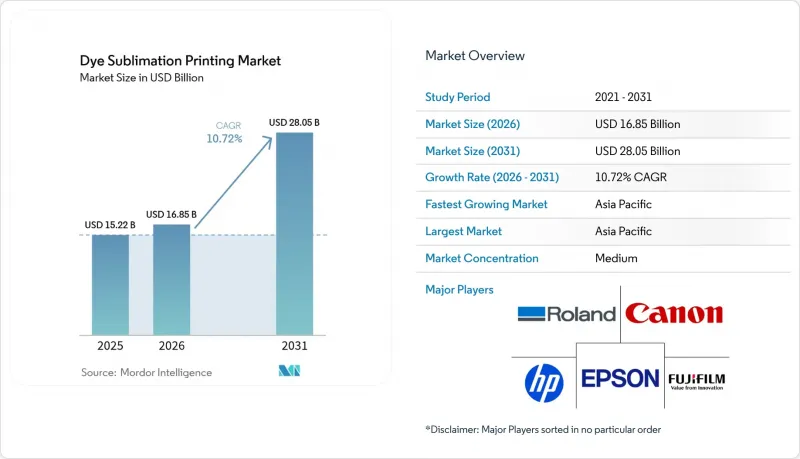
염료 승화 인쇄 시장 규모는 2025년 152억 2,000만 달러에서 2026년에는 168억 5,000만 달러로 확대되어 2026년부터 2031년까지 CAGR 10.72%로 성장을 지속하여, 2031년에는 280억 5,000만 달러에 이를 것으로 예측됩니다.
본 보고서는 용도별(의류, 산업용 섬유 등), 프린터 유형별(데스크톱, 와이드 포맷, 산업용), 잉크 유형별(전사 승화 잉크, 원단 직접 승화 잉크 등), 기판 카테고리별(폴리에스터 원단, 폴리머 코팅된 경질 매체 등), 지역별(북미, 남미 등)로 분류되어 있습니다. 시장 예측은 금액(달러) 기준으로 제시되어 있습니다.
세계 염료 승화 인쇄 시장 동향 및 인사이트
맞춤형 스포츠웨어 및 패션 의류의 붐
클럽, 대학 팀, 독립 브랜드가 재고 위험을 대폭 줄여주는 주문형 마이크로 팩토리 모델에 집중함에 따라, 맞춤화는 ‘있으면 좋은’ 요소에서 ‘구매 결정 요인’으로 변화했습니다. 이전에는 스크린 인쇄에 의존하던 수탁 제조업체들은 추가적인 설비 비용 없이 다색 전면 그래픽을 처리할 수 있도록 디지털 승화 전사 라인을 도입하고 있습니다. Cisco Athletic은 정액 요금으로 무제한의 색상과 배치 옵션을 제공함으로써 이러한 변화를 구현하고 있으며, 복잡성으로 인해 비용이 증가하는 일은 더 이상 없다는 점을 구매자에게 보여주고 있습니다. 팀 입장에서는 2주라는 짧은 리드타임이라는 이점이 있는 반면, 컨버터의 경우 폐기물 감소와 반품 감소로 인해 더 건전한 이익률을 확보하고 있습니다. 동일한 인프라가 현재 패션 캡슐 컬렉션이나 인플루언서 주도 한정 판매에도 활용되면서, 승화 전사 장비 도입 기반이 확대되고 있습니다. 소비자 조사에서 브랜드 충성도와 환경에 대한 투명성이 연관되어 있는 것으로 나타남에 따라, 온디맨드 생산은 재고 정체와 2차 운송을 제거함으로써 기업의 배출량 감축 목표 달성도 지원하고 있습니다.
절수형 디지털 텍스타일 공정으로의 전환
규제 당국이 습식 가공을 수행하는 공장에 대한 압박을 강화하는 가운데, 승화 인쇄의 무수 전사 메커니즘은 환경 규제 준수를 용이하게 하는 지름길이 되고 있습니다. 폐루프식 열회수 시스템을 도입한 업체들은 물 절약 효과에 시너지 효과를 가져오는 에너지 절감 효과를 보고하고 있으며, 공개된 사례 연구에 따르면 레이아웃과 에너지 최적화를 통해 처리 능력이 최대 30% 향상된 것으로 나타났습니다. 유럽의 ‘지속 가능하고 순환형 텍스타일 전략’은 그린 공공 조달 점수를 통해 도입 기업에 인센티브를 제공함으로써, 세계 브랜드에 공급하는 대형 공장의 도입을 가속화하고 있습니다. 컨버터의 경우, bluesign이나 OEKO-TEX 등의 인증을 취득함으로써, 스코프 3의 물 발자국 공시가 의무화된 소매업체와 고부가가치 계약을 체결할 수 있게 됩니다. 또한, 인증을 받은 환경 부하가 낮은 인쇄 기술로 제조된 의류 제품에 대해 소비자가 더 높은 가격을 지불할 의향이 있다는 점도 이러한 경쟁 우위를 더욱 강화하고 있습니다.
자본 집약적인 인쇄기 및 후가공 설비
산업용 승화 전사 라인은 열 프레스기, 건조 터널, 워크플로우 소프트웨어를 포함하면 여전히 20만 달러를 넘는 가격대를 형성하고 있으며, 이는 많은 중소 생산자들이 주저하게 만드는 장벽이 되고 있습니다. 높은 금리로 인해 월별 리스 비용이 상승하고 있으며, 조사 대상인 섬유 기업의 거의 절반이 자금 조달 제약으로 인해 2024년 사업 확장 계획을 연기했습니다. 게다가 프레스기는 안정적인 습도, 첨단 환기 시스템, 고온 가동을 위한 안전 제어 장치가 필요하기 때문에 시설 개보수에는 추가 비용이 소요됩니다. 이에 대응하여 각 장비 제조업체들은 하드웨어, 서비스, 잉크를 1미터당 단가로 묶어 신규 진출기업의 초기 비용을 경감하는 ‘클릭 차지’ 모델을 도입하고 있습니다. 도입은 확대되고 있지만, 자본 측면의 장벽이 신규 시장 진출기업의 수를 계속 억제하고 있으며, 특히 신용 조건이 여전히 엄격한 신흥국 경제권에서는 이러한 경향이 두드러집니다.
부문 분석
2025년 매출액 중 의류가 62.31%를 차지하고 있으며, 팀웨어, 애슬레저, 패스트 패션의 캡슐 컬렉션이 재고 위험 없이 선명한 전면 프린트를 구현하기 위해 승화 인쇄에 의존하고 있다는 사실이 부각되고 있습니다. 대조적으로, 테크니컬 텍스타일은 시장 규모는 작지만, 자동차 제조업체들이 헤드라이너, 도어 패널, 시트 커버에 경량 폴리에스터 복합 소재를 채택하고 있어 연평균 성장률(CAGR) 10.98%를 나타낼 것으로 예측됩니다. 스포츠 리그가 재고 보충 주기를 지속적으로 단축하고 있으며, D2C(소비자 직접 판매) 플랫폼이 주문 집약을 효율화하고 있는 만큼, 의류용 염료 승화 인쇄 시장 규모는 꾸준히 확대될 것으로 전망됩니다.
테크니컬 텍스타일의 성장은 전기차(EV) 인테리어 재설계와 밀접한 관련이 있으며, 사출 성형 부품을 직물로 덮은 부품으로 대체함으로써 탄소 발자국을 최대 25%까지 줄이고 있습니다. 각 제조업체는 FMVSS 302 규격을 충족하기 위해 승화 인쇄와 호환되는 난연 코팅 테스트를 진행하며 새로운 수익원을 개척하고 있습니다. 재활용 소재를 25% 함유하도록 요구하는 자동차 업계의 규제 확대는 승화 인쇄에 가장 적합한 기재인 폴리에스터 기반 구조를 뒷받침하고 있습니다. 규제상 크레딧 제도가 재활용 내장재 사용을 장려하는 가운데, 1차 공급업체들은 다년간의 인쇄 계약을 협상하고 있으며, 이를 통해 컨버터는 산업용 인쇄기에 대한 투자를 정당화하는 데 필요한 생산량 가시성을 확보할 수 있게 되었습니다.
와이드 포맷 모델(74인치 미만)은 대부분의 롤 투 롤 마감 라인의 폭에 적합하며, 패션 및 인테리어 컨버터의 중량 생산 요구를 충족시켜 2025년에도 매출 점유율 55.74%를 유지했습니다. 그러나 74인치를 초과하는 산업용 플랫폼은 싱글 패스의 효율성과 풀 시프트 처리 능력을 추구하는 제조업체들에 힘입어 2031년까지 연평균 성장률(CAGR) 11.76%를 나타낼 것으로 예측됩니다. 엡손이 2025년 9월 완공을 목표로 도호쿠 지역에 51억 엔(3,400만 달러)을 투자하여 진행하는 확장 등, 프린트 헤드 제조업체들이 신규 공장에서 생산 능력을 4배로 확대함에 따라 승화 인쇄 시장은 그 혜택을 누리고 있습니다.
산업용 라인에서는 대칭적인 노즐 배열과 잉크 비산을 억제하는 실시간 드롭워치 시스템을 활용하여 1미터당 잉크 소비량을 줄이고 있습니다. 인라인 고정 통합을 통해 롤이 완전히 고정된 상태로 배출되어 검사 및 절단 준비가 완료되므로 인건비가 더욱 절감됩니다. 이러한 비용 절감 효과를 종합하면, 위치 조정이 필요한 2단계 워크플로우와 비교하여 총 운영 비용을 두 자릿수 비율로 절감할 수 있습니다. 인건비가 높은 지역에 위치한 컨버터의 경우, 자동화는 임금 인상을 상쇄하고 신속한 현지 배송을 우선시하는 리쇼어링 전략을 뒷받침합니다.
지역별 분석
아시아태평양은 밀집된 제조 클러스터, 통합된 원자재 공급, 그리고 베트남 등 시장에서 0%까지 인하된 유리한 설비 수입 관세의 지원에 힘입어 2025년 매출의 40.11%를 차지했습니다. 중국은 여전히 중심지로서, 2024년에는 204억 6,000만 벌의 의류가 생산되어 전년 대비 4.22%의 성장을 기록했습니다. 2025년까지 섬유 기업의 70%를 디지털화하겠다는 정부 프로그램에 따라 소규모 공장에서도 롤 투 롤 방식의 승화 전사 프레스의 도입이 진행되어 시장 침투가 가속화되고 있습니다. 그러나 인건비 급등으로 인해 자동화에 대한 투자가 진행되고 있으며, 그 결과 높은 처리량을 자랑하는 산업용 플랫폼에 대한 수요가 증가하고 있습니다.
북미는 여전히 큰 시장 점유율을 유지하고 있으며, 그 원동력은 라이선스 준수를 위해 신속한 맞춤 제작과 국내 생산을 필요로 하는 대학 및 프로 스포츠 팀입니다. 또한, 이 지역에서는 AI를 활용한 워크플로우 소프트웨어의 도입이 조기에 진행되고 있어, 그 결과 디자인 주기 단축 및 프리프레스 작업의 인건비 절감으로 이어지고 있습니다. 무역촉진권한협정(TPA)은 가공되지 않은 폴리에스터 의류에 대한 수입 관세를 계속 규정하고 있어, 멕시코를 미국의 프린터용 원단 공급업체로 자리매김하는 니어쇼어링 전략에 영향을 미치고 있습니다.
유럽의 엄격한 환경 규제는 물을 사용하지 않는 승화 인쇄 및 PFAS 무함유 코팅의 채택을 촉진하고 있으며, 이는 승화 인쇄 시장에 규제 측면에서의 호재가 되고 있습니다. ‘호라이즌 유럽(Horizon Europe)’은 ‘로컬 포 로컬(Local for Local)’ 디지털 텍스타일 생산에 1,000만 유로를 배정하고 있으며, 이 보조금 제도를 통해 EU 내 마이크로 팩토리의 자본 측면에서의 진입 장벽이 낮아지고 있습니다. 이에 따라 해당 지역에 본사를 둔 각 브랜드는 bluesign, GOTS, ISO 14001 인증을 취득한 컨버터를 우선적으로 선정하는 공급업체 심사를 실시했습니다.
중동 및 아프리카는 UAE의 패션 허브와 남아프리카의 프로모션 제품 붐을 견인력으로 삼아 신흥 시장으로 부상하고 있습니다. 자유무역지대에 대한 인프라 투자로 인해 유럽 및 아시아 시장에 관세 면제 혜택을 받으며 진출할 수 있게 되었으며, 세계 브랜드들에게 이 지역에 마무리 공정을 입지시키는 매력이 높아지고 있습니다. 라틴아메리카는 매출 규모는 작지만, 축구 머천다이징 계약과 국내 스포츠 리그의 부상으로 평균 이상의 성장을 보이고 있어, 지역 다각화를 위한 새로운 방향성이 되고 있습니다.
기타 혜택:
- 엑셀 형식 시장 예측(ME) 시트
- 3개월간의 애널리스트 지원
자주 묻는 질문
목차
제1장 서론
제2장 조사 방법
제3장 주요 요약
제4장 시장 구도
제5장 시장 규모와 성장 예측
제6장 경쟁 구도
제7장 시장 기회와 향후 전망
JHS 26.09.09According to Mordor Intelligence, the dye sublimation printing market size is expected to grow from USD 15.22 billion in 2025 to USD 16.85 billion in 2026 and is forecast to reach USD 28.05 billion by 2031 at 10.72% CAGR over 2026-2031.
This report is Segmented by Application (Garments, Technical Textiles, and More), Printer Type (Desktop, Wide-Format, Industrial), Ink Type (Transfer Sublimation Inks, Direct-To-Fabric Sublimation Inks, and More), Substrate Category (Polyester Fabrics, Polymer-Coated Rigid Media, and More), and Geography (North America, South America, and More). The Market Forecasts are Provided in Terms of Value (USD).
Global Dye Sublimation Printing Market Trends and Insights
Boom in customized sports and fashion apparel
Customization has moved from a nice-to-have to a purchase driver as clubs, collegiate teams, and independent brands commit to on-demand micro-factory models that slash inventory risk. Contract manufacturers that previously relied on screen printing are now adopting digital sublimation lines to handle full-coverage graphics in multiple colorways without incremental setup costs. Cisco Athletic exemplifies the shift by offering unlimited colors and placement options at a flat price, showing buyers that complexity no longer carries a penalty. Teams benefit from two-week lead times, while converters enjoy healthier margins due to lower waste and fewer returns. The same infrastructure is now serving fashion capsules and influencer-led drops, widening the installed base of sublimation equipment. As consumer surveys link brand loyalty to environmental transparency, on-demand production also supports corporate emissions goals by eliminating dead inventory and secondary transport legs.
Shift to water-efficient digital textile processes
Sublimation's water-free transfer mechanism has become an environmental-compliance shortcut as regulators escalate pressure on wet-processing mills. Operators integrating closed-loop heat recovery report energy savings that compound water reductions, and published case studies show up to 30% throughput gains after layout and energy optimization. Europe's Sustainable and Circular Textiles Strategy now incentivizes adopters through green-public-procurement scoring, accelerating uptake among large mills that supply global brands. For converters, the ability to secure certifications such as bluesign and OEKO-TEX unlocks premium contracts with retailers that must disclose Scope 3 water footprints. The competitive edge is further reinforced by consumer willingness to pay higher prices for apparel made with certified low-impact printing.
Capital-intensive presses and finishing equipment
Industrial-grade sublimation lines still command price tags that can top USD 200,000 when heat presses, drying tunnels, and workflow software are included, a hurdle that deters many small producers. High interest rates have pushed monthly leasing costs upward, and nearly half of the surveyed textile firms postponed expansion plans in 2024 due to financing constraints. Facility retrofits add further expense because presses require stable humidity, advanced ventilation systems, and safety controls for high-temperature operations. In response, equipment makers are rolling out click-charge models that bundle hardware, service, and ink into a single cost-per-linear-meter fee, lowering cash outlays for newcomers. Although adoption is growing, the capital barrier continues to suppress the number of new entrants, especially in emerging economies where credit terms remain tight.
Other drivers and restraints analyzed in the detailed report include:
- High-speed industrial printer launches, lowering TCO
- AI-driven design-to-print software adoption
- PFAS regulations on transfer papers
For complete list of drivers and restraints, kindly check the Table Of Contents.
Segment Analysis
Garments accounted for 62.31% of 2025 revenues, underscoring how teamwear, athleisure, and fast-fashion capsules rely on sublimation to execute vibrant all-over prints without inventory risk. Technical textiles, in contrast, represent a smaller base yet are forecast to grow at 10.98% CAGR as automakers adopt lightweight polyester composites for headliners, door panels, and seat covers. The dye sublimation printing market size for garments is projected to expand steadily because sports leagues continue to shorten replenishment cycles and because direct-to-consumer platforms streamline order aggregation.
Growth in technical textiles is tied to electric-vehicle interior redesigns that replace injection-molded parts with fabric-wrapped components, achieving up to 25% lower carbon footprint. Producers are trialing flame-retardant coatings compatible with sublimation to meet FMVSS 302 standards, opening new revenue streams. Broader automotive mandates that call for 25% recycled content favor polyester-based structures, a substrate sweet spot for sublimation. As regulatory credits incentivize recycled interiors, tier-1 suppliers are negotiating multi-year print contracts, giving converters the volume visibility needed to justify industrial press investments.
Wide-format units (<74") retained a 55.74% revenue share in 2025 because they match the width of most roll-to-roll finishing lines and address the mid-volume sweet spot of fashion and decor converters. However, industrial platforms exceeding 74" are expected to log an 11.76% CAGR through 2031, fueled by mills that want single-pass efficiency and full-shift throughput. The dye sublimation printing market benefits as printhead makers quadruple output capacity at new plants, such as Epson's JPY 5.1 billion (USD 34 million) expansion in Tohoku that targets September 2025 completion.
Industrial lines reduce per-meter ink consumption by leveraging symmetrical nozzle arrays and real-time drop-watch systems that cut overspray. Integration of inline fusing further trims labor because rolls exit completely fixed, ready for inspection and cutting. The combined savings can reduce total operating costs by double digits versus repositionable two-step workflows. For converters in high-labor-cost regions, automation offsets wage inflation and supports reshoring strategies that prioritize quick local delivery.
Complete Report Scope:
- By Application
- Garments
- Technical Textiles
- Household Textiles
- Visual Communication/Soft Signage
- Rigid Substrates
- By Printer Type
- Desktop (<44")
- Wide-Format (44"-74")
- Industrial (>74")
- By Ink Type
- Transfer Sublimation Inks
- Direct-to-Fabric Sublimation Inks
- Sublimation Toner Inks
- By Substrate Category
- Polyester Fabrics
- Polymer-Coated Rigid Media
- Blended/Hybrid Technical Textiles
- By Geography
- North America
- United States
- Canada
- Mexico
- South America
- Brazil
- Argentina
- Rest of South America
- Europe
- Germany
- United Kingdom
- France
- Italy
- Spain
- Rest of Europe
- Asia-Pacific
- China
- Japan
- India
- South Korea
- Australia
- Rest of Asia-Pacific
- Middle East and Africa
- Middle East
- United Arab Emirates
- Saudi Arabia
- Turkey
- Rest of Middle East
- Africa
- South Africa
- Kenya
- Rest of Africa
- Middle East
- North America
Geography Analysis
Asia-Pacific generated 40.11% of 2025 revenue, supported by dense manufacturing clusters, integrated feedstock supply, and favorable equipment import tariffs that drop to 0% in markets such as Vietnam. China remains the epicenter with 20.46 billion garment units produced in 2024, representing 4.22% year-over-year growth. Government programs promoting 70% digitalization of textile firms by 2025 are pushing even smaller mills to adopt roll-to-roll sublimation presses, accelerating penetration. Rising labor costs, however, are prompting automation investments that in turn boost demand for high-throughput industrial platforms.
North America retains a sizeable share, driven by collegiate and professional sports teams that require rapid personalization and domestic production for licensing compliance. The region is also early in adopting AI-driven workflow software, resulting in faster design cycles and reduced pre-press labor. Trade-promotion authority agreements continue to shape import duties on blank polyester garments, influencing near-shoring strategies that position Mexico as a substrate supplier to U.S. printers.
Europe's strict environmental regulations stimulate the adoption of water-free sublimation and PFAS-free coatings, giving the dye sublimation printing market a regulatory tailwind. Horizon Europe has earmarked EUR 10 million for local-for-local digital textile production, a grant line that lowers the capital barrier for micro-factories across the bloc. Brands headquartered in the region are therefore engaging in supplier audits that favor converters holding bluesign, GOTS, and ISO 14001 certifications.
The Middle East and Africa are emergent, led by the UAE's fashion hub and South Africa's promotional-product boom. Infrastructure investments in free-trade zones provide duty-free access to both European and Asian markets, making it attractive for global brands to locate finishing operations there. Latin America, while smaller in revenue, shows above-average growth due to soccer merchandising contracts and the rise of domestic sports leagues, adding another vector for regional diversification.
- Seiko Epson Corporation
- Roland DG Corporation
- Fujifilm Holdings Corporation
- Canon Inc.
- HP Inc.
- Mimaki Engineering Co., Ltd.
- Mutoh Holdings Co., Ltd.
- Sawgrass Technologies, Inc.
- Durst Group AG
- Dover Corporation (MS Printing Solutions SRL)
- Kornit Digital Ltd.
- Electronics For Imaging, Inc.
- Ricoh Company, Ltd.
- Brother Industries, Ltd.
- ColorJet India Ltd.
- Gandy Digital Ltd.
- Klieverik Heli B.V.
- DGI Digital Graphic Inc.
- Shenzhen HOMER Textile Tech Co., Ltd.
- Sun Chemical Corp.
- DuPont de Nemours, Inc.
- SPGPrints B.V.
- Huntsman Corporation
Additional Benefits:
- The market estimate (ME) sheet in Excel format
- 3 months of analyst support
TABLE OF CONTENTS
1 INTRODUCTION
- 1.1 Study Assumptions and Market Definition
- 1.2 Scope of the Study
2 RESEARCH METHODOLOGY
3 EXECUTIVE SUMMARY
4 MARKET LANDSCAPE
- 4.1 Market Overview
- 4.2 Market Drivers
- 4.2.1 Boom in customized sports and fashion apparel
- 4.2.2 Shift to water-efficient digital textile processes
- 4.2.3 High-speed industrial printer launches lowering TCO
- 4.2.4 AI-driven design-to-print software adoption
- 4.2.5 EV interior technical-textile demand surge
- 4.2.6 Bio-based polyester enabling sustainable sublimation
- 4.3 Market Restraints
- 4.3.1 Capital-intensive presses and finishing equipment
- 4.3.2 Polyester-only substrate limitation
- 4.3.3 Volatile disperse-dye supply costs
- 4.3.4 PFAS regulations on transfer papers
- 4.4 Industry Value Chain Analysis
- 4.5 Porter's Five Forces Analysis
- 4.5.1 Bargaining Power of Suppliers
- 4.5.2 Bargaining Power of Consumers
- 4.5.3 Threat of New Entrants
- 4.5.4 Threat of Substitutes
- 4.5.5 Intensity of Competitive Rivalry
- 4.6 Impact of Macroeconomic Factors on the Market
- 4.7 Technology Snapshot
5 MARKET SIZE AND GROWTH FORECASTS (VALUE)
- 5.1 By Application
- 5.1.1 Garments
- 5.1.2 Technical Textiles
- 5.1.3 Household Textiles
- 5.1.4 Visual Communication/Soft Signage
- 5.1.5 Rigid Substrates
- 5.2 By Printer Type
- 5.2.1 Desktop (<44")
- 5.2.2 Wide-Format (44"-74")
- 5.2.3 Industrial (>74")
- 5.3 By Ink Type
- 5.3.1 Transfer Sublimation Inks
- 5.3.2 Direct-to-Fabric Sublimation Inks
- 5.3.3 Sublimation Toner Inks
- 5.4 By Substrate Category
- 5.4.1 Polyester Fabrics
- 5.4.2 Polymer-Coated Rigid Media
- 5.4.3 Blended/Hybrid Technical Textiles
- 5.5 By Geography
- 5.5.1 North America
- 5.5.1.1 United States
- 5.5.1.2 Canada
- 5.5.1.3 Mexico
- 5.5.2 South America
- 5.5.2.1 Brazil
- 5.5.2.2 Argentina
- 5.5.2.3 Rest of South America
- 5.5.3 Europe
- 5.5.3.1 Germany
- 5.5.3.2 United Kingdom
- 5.5.3.3 France
- 5.5.3.4 Italy
- 5.5.3.5 Spain
- 5.5.3.6 Rest of Europe
- 5.5.4 Asia-Pacific
- 5.5.4.1 China
- 5.5.4.2 Japan
- 5.5.4.3 India
- 5.5.4.4 South Korea
- 5.5.4.5 Australia
- 5.5.4.6 Rest of Asia-Pacific
- 5.5.5 Middle East and Africa
- 5.5.5.1 Middle East
- 5.5.5.1.1 United Arab Emirates
- 5.5.5.1.2 Saudi Arabia
- 5.5.5.1.3 Turkey
- 5.5.5.1.4 Rest of Middle East
- 5.5.5.2 Africa
- 5.5.5.2.1 South Africa
- 5.5.5.2.2 Kenya
- 5.5.5.2.3 Rest of Africa
- 5.5.5.1 Middle East
- 5.5.1 North America
6 COMPETITIVE LANDSCAPE
- 6.1 Market Concentration
- 6.2 Strategic Moves
- 6.3 Market Share Analysis
- 6.4 Company Profiles (includes Global level Overview, Market level overview, Core Segments, Financials as available, Strategic Information, Market Rank/Share for key companies, Products and Services, and Recent Developments)
- 6.4.1 Seiko Epson Corporation
- 6.4.2 Roland DG Corporation
- 6.4.3 Fujifilm Holdings Corporation
- 6.4.4 Canon Inc.
- 6.4.5 HP Inc.
- 6.4.6 Mimaki Engineering Co., Ltd.
- 6.4.7 Mutoh Holdings Co., Ltd.
- 6.4.8 Sawgrass Technologies, Inc.
- 6.4.9 Durst Group AG
- 6.4.10 Dover Corporation (MS Printing Solutions SRL)
- 6.4.11 Kornit Digital Ltd.
- 6.4.12 Electronics For Imaging, Inc.
- 6.4.13 Ricoh Company, Ltd.
- 6.4.14 Brother Industries, Ltd.
- 6.4.15 ColorJet India Ltd.
- 6.4.16 Gandy Digital Ltd.
- 6.4.17 Klieverik Heli B.V.
- 6.4.18 DGI Digital Graphic Inc.
- 6.4.19 Shenzhen HOMER Textile Tech Co., Ltd.
- 6.4.20 Sun Chemical Corp.
- 6.4.21 DuPont de Nemours, Inc.
- 6.4.22 SPGPrints B.V.
- 6.4.23 Huntsman Corporation
7 MARKET OPPORTUNITIES AND FUTURE OUTLOOK
- 7.1 White-Space and Unmet-Need Assessment


