
|
시장보고서
상품코드
2123262
내시경 재처리 시장 : 시장 점유율 분석, 업계 동향 및 통계, 성장 예측(2026-2031년)Endoscope Reprocessing - Market Share Analysis, Industry Trends & Statistics, Growth Forecasts (2026 - 2031) |
||||||
 Mordor Intelligence
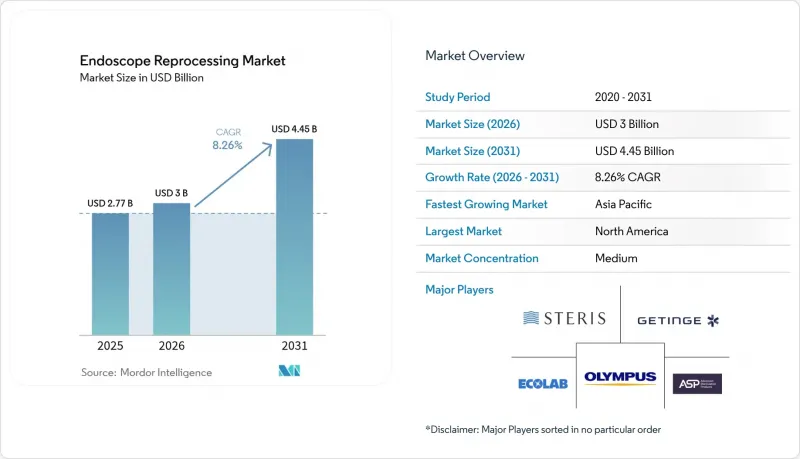
Mordor Intelligence에 의하면, 내시경 재처리 시장 규모는 2025년 27억 7,000만 달러로 평가되었고, 2026년에는 30억 달러로 추정되고, 2026-2031년 CAGR 8.26%로 성장을 지속할 전망이며, 2031년에는 44억 5,000만 달러에 이를 것으로 예측됩니다.
본 보고서는 제품별(고수준 소독제 및 테스트 스트립, 세제 및 효소 와이프, AER(싱글 베이스 및 듀얼 베이스) 등), 내시경 유형별(연성 내시경 등), 용도별(소화기 내시경 검사 등), 최종 사용자별(병원 등), 지역별(북미, 유럽 등)로 분류되어 있습니다. 시장 예측은 금액(달러) 기준으로 제시되어 있습니다.
세계의 내시경 재처리 시장 동향 및 인사이트
내시경 검사 건수 증가 : 고령화가 수요를 견인
고령 인구 증가와 암 검진 지침 확대로 인해 소화기 및 호흡기 내시경 사용이 두 자릿수 성장세를 보이며, 내시경 재처리 시장에 지속적인 호재를 가져오고 있습니다. 2024년 메타분석에 따르면, 미국에서만 연간 2,000만 건 이상의 소화기 계통 검사가 실시되고 있습니다. 검사 건수 증가에 따라 의료 기관은 재처리 능력 강화, 신속한 처리가 가능한 세정제, 그리고 각 사이클에서 무균 상태를 유지하기 위한 누수 검사 도구에 대한 투자를 할 수밖에 없습니다.
저침습 수술 : 내시경 회전율 향상이 재처리 혁신을 주도
외래수술센터(ASC)는 수익성을 유지하기 위해 세심한 일정 관리와 내시경의 신속한 회전율에 의존하고 있습니다. LEAN(린) 워크플로우의 시범 도입을 통해 대기실 대기 시간이 48.8% 단축되었고, 시설 내 총 소요 시간이 12% 감소했습니다. 이러한 성과는 감염 관리 프로토콜을 훼손하지 않으면서 병목 현상을 해소하는 전동 세척기, 건조 캐비닛, 실시간 추적 소프트웨어가 내시경 재처리 시장에서 점점 더 지지를 받는 이유를 여실히 보여줍니다.
인력 측면의 과제 : 기술자 부족이 도입을 방해한다.
효과적인 세척을 위해서는 내시경 구조 및 채널 브러시 세척 기술에 대한 전문 지식이 필요합니다. 그러나 많은 병원에서 인증된 직원의 채용 및 유지에 어려움을 겪고 있으며, 실수가 발생하기 쉬운 작업 공정이 심각한 오염 사고의 원인이 되고 있습니다. 자동화를 통해 수작업의 일부는 줄어들지만, 내시경 재처리 시장 전체에서 검사, 문제 해결, 품질 보증을 수행하기 위해서는 여전히 자격을 갖춘 인력이 필수적입니다.
부문 분석
2025년 시점에서 고수준 소독제와 인디케이터 스트립은 내시경 재처리 시장에서 31.68%의 점유율을 차지했으며, 이는 연성 내시경 분야에서 화학 고수준 소독(HLD)이 오랫동안 주된 방식이었습니다는 점을 반영합니다. 헹굼 공정이 필요 없는 새로운 효소계 세정제는 현재 약 25리터의 물 절약을 실현하고 있으며, 수작업 세척 시간을 15% 단축하고 있습니다. 그러나 잔류 생물막과 관련된 집단 감염 발생으로 인해 감염 관리 위원회는 기화 과산화수소나 과초산 등의 멸균제로의 전환을 추진하고 있습니다. 이러한 변화로 인해, 조작자의 조정 없이 검증된 사이클을 완료하는 일체형 세척·멸균 장치에 대한 수요가 증가하고 있습니다. 이는 인증 감사가 엄격해지는 가운데 중요한 성능 기준이 되고 있습니다.
자동 내시경 재처리 장치는 연평균 성장률(CAGR) 10.31%로 가장 빠르게 성장하는 제품군이며, 내시경 재처리 시장 전체를 주도하고 있습니다. 각 공급업체는 개별 내시경의 일련번호, 사이클 매개변수, 누출 테스트 결과를 기록하는 폐쇄형 문서화, RFID 태깅, 그리고 클라우드 기반 분석 기능을 강조하고 있습니다. 건조 및 보관 캐비닛도 주목을 받고 있습니다. ‘WASSENBURG DRY 320’과 같은 시스템은 HEPA 필터를 통과한 기류 하에서 30일간 미생물학적 품질을 유지합니다. 이러한 제품은 시설이 규정 준수를 입증하고 비용이 많이 드는 재처리 실패를 줄이는 데 도움이 됩니다.
2025년 매출에서 유연 내시경이 차지하는 비중은 71.10%에 달했으며, 이는 모달리티 수준에서 현재 내시경 재처리 시장 규모의 기반을 형성하고 있습니다. 그 도달 범위와 기동성 덕분에 소화기, 호흡기, 이비인후과, 비뇨기과 각 진료실에서 여전히 없어서는 안 될 존재입니다. 그러나 구조가 복잡하기 때문에 관강 내에 잔류물이 쌓이기 쉬운 약점이 있습니다. 따라서 세척 효과를 확인하기 위해 구조화된 보어스코프 검사나 형광 마커가 도입되고 있습니다.
로봇 보조 내시경은 2031년까지 연평균 11.12%의 성장이 예상되며, 내시경 재처리 시장에 새로운 기회를 열어줄 것으로 전망됩니다. 2암식 로봇 대장내시경이나 다장기 수술용 로봇은 인체공학적 편의성과 자율성 향상을 약속하고 있습니다. 이러한 장비의 도입에는 전용 세척 랙, 프로토콜 변경 및 직원 재교육이 필요합니다. 경성 내시경은 관절경 검사 및 복강경 검사 분야에서 안정적인 틈새 시장을 유지하고 있으며, 증기 오토클레이브를 통해 확실하게 멸균할 수 있는 단순한 내강 구조라는 장점이 있습니다.
지역별 분석
북미는 높은 검사 건수와 FDA, CDC 및 인증 기관의 엄격한 감독에 힘입어 2025년 매출의 40.30%를 차지했습니다. 주요 의료 기관에서 감염병 집단 발생에 대한 관심이 높아짐에 따라, 추적 가능한 자동화된 워크플로우와 35분 이내에 십이지장 내시경을 멸균할 수 있는 과산화수소 증기 멸균 장치에 대한 수요가 더욱 증가하고 있습니다. 2031년까지의 지역별 성장률은 연평균 성장률(CAGR) 7.92%로 예측되며, 지출은 데이터가 풍부한 재처리 장치, 보어스코프 검사 카메라, 그리고 고위험 ERCP 사례를 위한 일회용 십이지장 내시경에 집중될 전망입니다.
아시아태평양은 가장 빠르게 성장하는 지역으로, 연평균 10.35%의 성장률이 예상됩니다. 인도의 의료기기 로드맵은 2030년까지 해당 부문의 생산액을 500억 달러로 늘리는 것을 목표로 하고 있으며, 내시경 시스템 및 관련 재처리 장비는 생산 인센티브 대상에 포함되어 있습니다. 중국, 일본, 한국에서는 음압 건조 캐비닛 및 채널별 누출 테스터에 자금이 투입되고 있는 반면, 자원이 제한적인 태평양 제도에서는 정제수 및 인증 기술자 부족 문제에 직면해 있습니다. 유럽은 내시경 재처리 시장의 약 29.30%를 차지하고 있으며, 2031년까지 연평균 성장률(CAGR)은 8.14%로 예측됩니다. EU의 모니터링 데이터에 따르면, 매년 350만 건 이상의 의료 관련 감염이 재사용 가능한 의료기기에서 비롯된 것으로 나타났습니다. 2024년 영국 국민보건서비스(NHS)가 25만 파운드가 넘는 계약을 체결한 것은 병원들이 오염 제거 장치의 유효성을 검증하고 내시경 단위별 추적성을 확보하려는 움직임을 반영합니다. 중동 및 아프리카 및 남미 지역은 3차 의료 기관들이 CSSD(중앙 멸균 공급실)를 현대화하고, 화학 약품을 빈번하게 교체할 필요 없이 다양한 내시경 재고를 처리할 수 있는 AER(자동 내시경 세척기)를 도입함에 따라 완만한 성장세를 보이고 있습니다.
기타 혜택 :
- 엑셀 형식 시장 예측(ME) 시트
- 3개월간의 애널리스트 지원
자주 묻는 질문
목차
제1장 서론
제2장 조사 방법
제3장 주요 요약
제4장 시장 구도
제5장 시장 규모 및 성장 예측
제6장 경쟁 구도
제7장 시장 기회 및 향후 전망
AJY 26.09.07According to Mordor Intelligence, the endoscope reprocessing market size is expected to grow from USD 2.77 billion in 2025 to USD 3.0 billion in 2026 and is forecast to reach USD 4.45 billion by 2031 at 8.26% CAGR over 2026-2031.
This report is Segmented by Product (High-Level Disinfectants and Test Strips, Detergents and Enzymatic Wipes, AER [Single-Basin and Dual-Basin], and More), Endoscope Modality (Flexible Endoscopes and More), Application (Gastrointestinal Endoscopy and More), End-User (Hospitals and More), and Geography (North America, Europe, and More). The Market Forecasts are Provided in Terms of Value (USD).
Global Endoscope Reprocessing Market Trends and Insights
Rising Endoscopy Procedures: Aging Demographics Fuel Demand
An expanding elderly population and broader cancer-screening guidelines are driving double-digit increases in GI and respiratory scope use, giving the endoscope reprocessing market sustained tailwinds. More than 20 million GI examinations are performed annually in the United States alone, according to a 2024 meta-analysis. Higher procedural throughput obliges facilities to invest in additional reprocessing capacity, rapid turnaround detergents and leak-testing tools that uphold sterility for every cycle.
Minimally Invasive Surgery: Scope Turnover Drives Reprocessing Innovation
Ambulatory surgery centers rely on tight scheduling and quick scope turnaround to remain profitable. A LEAN workflow pilot cut waiting-room time by 48.8% and reduced total facility time by 12%. These gains highlight why the endoscope reprocessing market increasingly favors fully automated washers, drying cabinets and real-time tracking software that shorten bottlenecks without compromising infection-control protocols.
Workforce Challenges: Technician Shortages Impede Implementation
Effective cleaning demands specialized knowledge of scope architecture and channel brushing techniques. Yet many hospitals struggle to recruit and retain certified staff, with error-prone steps contributing to notable contamination events. Although automation offsets some manual tasks, qualified personnel remain indispensable for inspection, trouble-shooting and quality assurance across the endoscope reprocessing market.
Other drivers and restraints analyzed in the detailed report include:
- Infection-Control Standards: Regulatory Pressure Transforms Practices
- Automated Reprocessing: Technology Reduces Human Error
- Cost Barriers: Financial Constraints Limit Technology Adoption
For complete list of drivers and restraints, kindly check the Table Of Contents.
Segment Analysis
High-level disinfectants and indicator strips hold a 31.68% endoscope reprocessing market share in 2025, reflecting the historical reliance on chemical HLD for flexible scopes. Novel enzymatic detergents that eliminate rinse steps now save nearly 25 L of water and cut manual cleaning time by 15%. Yet outbreaks linked to residual biofilm are steering infection-control committees toward sterilants such as vaporized hydrogen peroxide and peracetic acid. This shift boosts demand for integrated washer-sterilizers that complete validated cycles without operator adjustment, a key performance criterion as accreditation audits intensify.
Automated endoscope reprocessors are the fastest-growing product group at a 10.31% CAGR, propelling the overall endoscope reprocessing market. Vendors emphasize closed-loop documentation, RFID tagging and cloud-based analytics that record every scope serial number, cycle parameters and leak-test result. Drying and storage cabinets also gain prominence; systems such as WASSENBURG DRY 320 preserve microbiological quality for 30 days under HEPA-filtered airflow. Together, these products help facilities demonstrate compliance and reduce costly re-processing failures.
Flexible endoscopes commanded 71.10% of 2025 revenue, underpinning the current endoscope reprocessing market size at the modality level. Owing to their reach and articulation, they remain indispensable across GI, respiratory, ENT, and urology suites. However, their complexity makes them vulnerable to channel debris. Structured borescope inspections and fluorescence markers are thus being adopted to affirm cleaning efficacy.
Robot-assisted endoscopes are projected to rise 11.12% annually through 2031, carving new opportunities in the endoscope reprocessing market. Two-armed robotic colonoscopes and multi-visceral surgical robots promise enhanced ergonomics and autonomy. Their adoption will demand dedicated washer racks, protocol modifications, and staff retraining. Rigid scopes retain a stable niche for arthroscopy and laparoscopy, benefiting from simpler lumens that sterilize reliably in steam autoclaves.
Complete Report Scope:
- By Product
- High-Level Disinfectants & Test Strips
- Detergents & Enzymatic Wipes
- Automated Endoscope Reprocessors (AER)
- Single-basin
- Dual-basin
- Manual Cleaning Stations
- Endoscope Drying, Storage & Transport Cabinets
- Others
- By Endoscope Modality
- Flexible Endoscopes
- Rigid Endoscopes
- Robot-Assisted Endoscopes
- By Application
- Gastro-intestinal Endoscopy
- Pulmonology & Bronchoscopy
- Urology & Gynaecology
- ENT & Laparoscopy
- By End-User
- Hospitals
- Ambulatory Surgery Centres (ASC)
- Other End-Users
- By Geography (Value)
- North America
- United States
- Canada
- Mexico
- Europe
- Germany
- United Kingdom
- France
- Italy
- Spain
- Rest of Europe
- Asia-Pacific
- China
- India
- Japan
- Australia
- South Korea
- Rest of Asia-Pacific
- Middle East & Africa
- GCC
- South Africa
- Rest of Middle East & Africa
- South America
- Brazil
- Argentina
- Rest of South America
- North America
Geography Analysis
North America held 40.30% of 2025 revenue, supported by high procedural volumes and rigorous oversight from the FDA, CDC and accreditation bodies. A spotlight on infection outbreaks at leading centers has intensified demand for traceable, automated workflows and for vaporized hydrogen peroxide cabinets capable of sterilizing duodenoscopes within 35 minutes. Regional growth is projected at an 7.92% CAGR through 2031, with spending tilted toward data-rich reprocessors, borescope inspection cameras, and disposable duodenoscopes for high-risk ERCP cases.
Asia-Pacific is the fastest-expanding territory, anticipated to advance 10.35% annually. India's medical-device roadmap seeks USD 50 billion in sector output by 2030, with endoscopy systems and ancillary reprocessing devices eligible for production incentives. China, Japan, and South Korea allocate capital to negative-pressure drying cabinets and channel-specific leak testers, while resource-limited Pacific Islands confront shortages of purified water and certified technicians. Europe commands roughly 29.30% of the endoscope reprocessing market, posting an 8.14% CAGR projection to 2031. EU surveillance attributes more than 3.5 million healthcare-associated infections to reusable devices each year. NHS contracts exceeding GBP 250,000 awarded in 2024 reflect hospital moves to validate decontamination equipment and ensure scope-level traceability. The Middle East & Africa and South America follow with moderate growth as tertiary centers modernize CSSD units and adopt AERs capable of handling mixed scope inventories without repeated chemical changes.
- Advanced Sterilization Products Services Inc
- ARC Group of Companies Inc.
- Belimed
- BES Healthcare Ltd
- Creo Medical GmbH
- Ecolab
- Envista Holdings (Metrex Research)
- Getinge
- HOYA Corporation (Pentax Medical)
- Matachana Group
- Olympus
- Shinva Medical Instrument Co.
- Steelco
- STERIS
- UV Smart BV
- Wassenburg Medical B.V.
Additional Benefits:
- The market estimate (ME) sheet in Excel format
- 3 months of analyst support
TABLE OF CONTENTS
1 Introduction
- 1.1 Study Assumptions & Market Definition
- 1.2 Scope of the Study
2 Research Methodology
3 Executive Summary
4 Market Landscape
- 4.1 Market Overview
- 4.2 Market Drivers
- 4.2.1 Rising endoscopy procedures due to gastrointestinal disorders and cancers
- 4.2.2 Increasing adoption of minimally invasive surgeries and daily scope turnover demands
- 4.2.3 Tightening infection-control and accreditation standards mandating validated reprocessing cycles
- 4.2.4 Advances in automated reprocessors that cut turnaround time and errors
- 4.2.5 Growing demand for single-use endoscopic accessories with compatible disinfectants
- 4.2.6 Expanding outpatient and ambulatory surgery center adoption of endoscopic procedures
- 4.3 Market Restraints
- 4.3.1 Shortage of certified endoscope reprocessing technicians and high turnover rates
- 4.3.2 High upfront and lifecycle costs for automated reprocessing systems and drying cabinets
- 4.3.3 Safety concerns with residual contamination in complex duodenoscopes
- 4.3.4 Frequent audits and documentation cause high consumable costs and workflow disruptions
- 4.4 Supply-Chain Analysis
- 4.5 Regulatory Outlook
- 4.6 Porter's Five Forces Analysis
- 4.6.1 Threat of New Entrants
- 4.6.2 Bargaining Power of Buyers
- 4.6.3 Bargaining Power of Suppliers
- 4.6.4 Threat of Substitutes
- 4.6.5 Intensity of Competitive Rivalry
5 Market Size & Growth Forecasts (Value)
- 5.1 By Product
- 5.1.1 High-Level Disinfectants & Test Strips
- 5.1.2 Detergents & Enzymatic Wipes
- 5.1.3 Automated Endoscope Reprocessors (AER)
- 5.1.3.1 Single-basin
- 5.1.3.2 Dual-basin
- 5.1.4 Manual Cleaning Stations
- 5.1.5 Endoscope Drying, Storage & Transport Cabinets
- 5.1.6 Others
- 5.2 By Endoscope Modality
- 5.2.1 Flexible Endoscopes
- 5.2.2 Rigid Endoscopes
- 5.2.3 Robot-Assisted Endoscopes
- 5.3 By Application
- 5.3.1 Gastro-intestinal Endoscopy
- 5.3.2 Pulmonology & Bronchoscopy
- 5.3.3 Urology & Gynaecology
- 5.3.4 ENT & Laparoscopy
- 5.4 By End-User
- 5.4.1 Hospitals
- 5.4.2 Ambulatory Surgery Centres (ASC)
- 5.4.3 Other End-Users
- 5.5 By Geography (Value)
- 5.5.1 North America
- 5.5.1.1 United States
- 5.5.1.2 Canada
- 5.5.1.3 Mexico
- 5.5.2 Europe
- 5.5.2.1 Germany
- 5.5.2.2 United Kingdom
- 5.5.2.3 France
- 5.5.2.4 Italy
- 5.5.2.5 Spain
- 5.5.2.6 Rest of Europe
- 5.5.3 Asia-Pacific
- 5.5.3.1 China
- 5.5.3.2 India
- 5.5.3.3 Japan
- 5.5.3.4 Australia
- 5.5.3.5 South Korea
- 5.5.3.6 Rest of Asia-Pacific
- 5.5.4 Middle East & Africa
- 5.5.4.1 GCC
- 5.5.4.2 South Africa
- 5.5.4.3 Rest of Middle East & Africa
- 5.5.5 South America
- 5.5.5.1 Brazil
- 5.5.5.2 Argentina
- 5.5.5.3 Rest of South America
- 5.5.1 North America
6 Competitive Landscape
- 6.1 Market Concentration
- 6.2 Product Portfolio Analysis
- 6.3 Market Share Analysis
- 6.4 Company Profiles (includes Global level Overview, Market level overview, Core Segments, Financials as available, Strategic Information, Market Rank/Share for key companies, Products & Services, and Recent Developments)
- 6.4.1 Advanced Sterilization Products Services Inc
- 6.4.2 ARC Group of Companies Inc.
- 6.4.3 Belimed AG
- 6.4.4 BES Healthcare Ltd
- 6.4.5 Creo Medical GmbH
- 6.4.6 Ecolab Inc.
- 6.4.7 Envista Holdings (Metrex Research)
- 6.4.8 Getinge AB
- 6.4.9 HOYA Corporation (Pentax Medical)
- 6.4.10 Matachana Group
- 6.4.11 Olympus Corporation
- 6.4.12 Shinva Medical Instrument Co.
- 6.4.13 Steelco S.p.A.
- 6.4.14 STERIS plc
- 6.4.15 UV Smart BV
- 6.4.16 Wassenburg Medical B.V.
7 Market Opportunities & Future Outlook
- 7.1 White-space & Unmet-Need Assessment