

|
시장보고서
상품코드
2123263
단백질 시퀀싱 시장 : 점유율 분석, 업계 동향과 통계, 성장 예측(2026-2031년)Protein Sequencing - Market Share Analysis, Industry Trends & Statistics, Growth Forecasts (2026 - 2031) |
||||||
 Mordor Intelligence
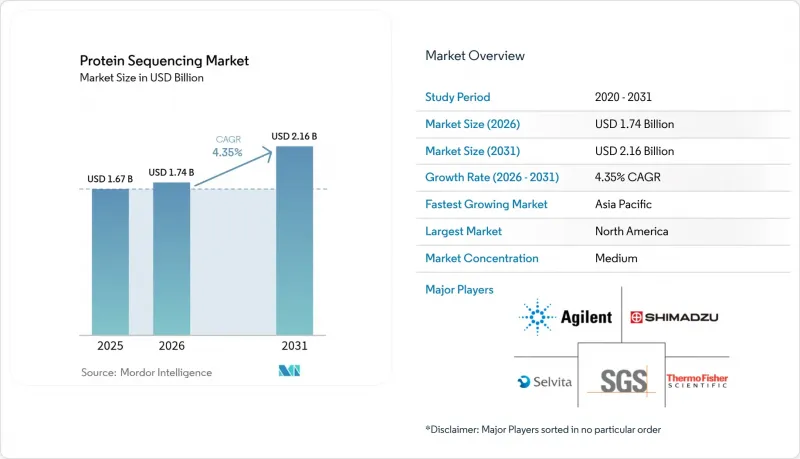
단백질 시퀀싱 시장 규모는 2025년 16억 7,000만 달러에서 2026년에는 17억 4,000만 달러로 확대되어 2026년부터 2031년까지 CAGR 4.35%로 성장을 지속하여, 2031년에는 21억 6,000만 달러에 이를 것으로 예측됩니다.
본 보고서에서는 업계를 제품 및 서비스별(장비, 시약 및 소모품, 소프트웨어 및 서비스), 용도별(바이오마커 발견, 단백질 공학 연구 등), 최종 사용자별(제약 회사 등), 지역별(북미, 유럽, 아시아태평양, 중동 및 아프리카, 남미)로 분류하고 있습니다. 시장 예측은 금액(달러) 기준으로 제시되어 있습니다.
세계 단백질 시퀀싱 시장 동향 및 인사이트
만성 질환 유병률 증가
암, 심혈관 질환, 신경 퇴행성 질환으로 인한 부담이 증가함에 따라, 의료 시스템은 유전체 데이터에 단백질체학 지식을 통합해야 할 필요성에 직면해 있습니다. 영국 바이오뱅크는 60만 개의 샘플에 걸쳐 5,400유형의 단백질 프로파일링을 수행하는 ‘2025 연구’를 시작하여, 혈중 단백질과 임상 결과 간의 대규모 상관관계를 규명하기 위한 기반을 마련하고 있습니다. 암 조기 선별 검사에서 뚜렷한 효과가 확인되었습니다. 혈장을 이용한 다중 암 검사의 민감도는 남성의 경우 93%, 여성의 경우 84%에 달하고,, 현재의 많은 검사법을 능가하고 있습니다. 프로테옴, 유전체,영상 진단의 각 계층을 결합함으로써 AI 모델이 강화되고, 위험 예측의 정확도가 높아져 단백질 시퀀싱 시장 수요를 주도하고 있습니다. 이미 53.78%의 시장 점유율을 차지하고 있는 제약 기업들은 이러한 데이터 세트를 통합하여 치료 표적의 우선순위 설정 및 임상시험 대상자의 계층화를 진행하고 있습니다.
시퀀싱 기술의 발전
단일 분자 기술의 혁신으로 기술적 한계가 재정의되고 있습니다. 옥스퍼드 나노포어 테크놀로지스(Oxford Nanopore Technologies)는 프로토타입 포어 기반 시스템을 사용하여 단백질 변이체 식별에서 98% 이상의 정확도를 달성했다고 보고했습니다. Quantum-Si사는 2025년에 출시된 벤치탑형 시퀀서 ‘Platinum Pro’를 통해 이 비전을 상용화했습니다. 이 장치는 반도체 칩과 머신러닝을 활용한 염기 식별 기술을 결합하고 있습니다. 소프트웨어 측면에서는 InstaNovo와 같은 딥러닝 모델이 희소한 아미노산 리드에서 90.5%의 펩타이드 시퀀싱 정확도를 실현하여 분석 주기를 획기적으로 단축하고 있습니다. 분석 능력의 향상으로 인해 사용자들이 새로 확보된 분해능을 최대한 활용하기 위해 더 많은 양의 시료를 처리하게 되면서, 시약 수요가 연평균 성장률(CAGR) 7.63%로 증가하고 있는 배경이 되고 있습니다.
장비 및 서비스의 높은 비용
초기 투자는 여전히 장벽으로 작용하고 있습니다. 주력 제품인 단일 분자 시퀀서의 가격은 대당 50만 달러 이상이며, 심층 프로테옴 분석을 수행할 경우 소모품 비용으로 샘플 1개당 50달러가 추가로 소요됩니다. FDA의 2024년 직원 감축으로 인해 심사 기간이 길어지면서, 신규 진출기업의 규정 준수 비용이 간접적으로 상승했습니다. 이러한 경제적 요인으로 인해 의약품 개발 기업들은 CRO(의약품 개발 수탁 기관)에 의뢰할 수밖에 없게 되었으며, CRO 시장의 연평균 성장률(CAGR) 8.59%는 장비의 직접 판매를 억제하는 아웃소싱 경향을 반영하고 있습니다. 벤더 측은 구독형 금융이나 시약 대여 플랜을 제공하며 대응하고 있지만, 가격에 민감한 시장에서는 여전히 합리적인 가격으로 이용하기 어려운 상황이 지속되고 있습니다.
부문 분석
2025년, 이 부문은 단백질 시퀀싱 시장에서 가장 큰 기여를 했으며, 소프트웨어 및 서비스가 매출의 38.21%를 차지했습니다. 장비는 여전히 필수적이지만, 가치는 점점 더 복잡한 스펙트럼을 실용적인 결과로 변환하는 클라우드 분석 구독 서비스로 이동하고 있습니다. 시약 및 소모품 분야의 성장은 가속화되고 있으며, 단일 분자 워크플로가 브랜드 제품의 칩과 화학 키트에 의존하고 있기 때문에 연평균 성장률(CAGR)은 7.50%로 확대되고 있습니다. 통합된 생태계는 벤더 락인을 초래하며, 이로 인해 정기적인 매출이 안정화되어 공급업체에게 예측 가능한 현금 흐름의 기반이 되고 있습니다.
고객은 현재 분석 키트, AI 알고리즘, 워크플로우 자동화를 결합한 엔드투엔드 솔루션을 선호하고 있습니다. 개발자들은 실시간 품질 지표와 적응형 화학 반응을 통합함으로써 실행 시간을 단축하고 실험 실패를 줄이고 있습니다. 예측 기간 동안 경쟁 심화에 따라 장비의 이익률은 압박을 받을 가능성이 있지만, SaaS(Software-as-a-Service) 모델과 시약 판매량이 수익성을 뒷받침할 것으로 전망됩니다. 그 결과, 단백질 시퀀싱 시장에서는 지속적인 하드웨어 혁신을 저해하지 않으면서 서비스 중심의 수익 구조로의 광범위한 전환이 진행될 것으로 예측됩니다.
지역별 분석
북미는 2025년에 매출의 43.12%를 차지하며, 풍부한 벤처 캐피탈, 기업 연구개발(R&D) 클러스터, 확립된 규제 절차 등의 혜택을 받고 있습니다. Thermo Fisher Scientific 및 Quantum-Si와 같은 주요 공급업체들은 광범위한 제조 및 지원 네트워크를 운영하고 있으며, 이는 이 지역의 우위를 강화하고 있습니다. 그러나 높은 인건비 및 운영 비용이 점진적인 성장을 억제하고 있어, 그 결과 예측 기간 전체에 걸쳐 연평균 성장률(CAGR)은 한 자릿수 중반에 머물 것으로 예측됩니다.
아시아태평양은 연평균 성장률(CAGR) 8.68%로 가장 빠른 성장을 보이고 있으며, 이는 지역의 바이오 제조 역량을 지원하고 다기관 공동 연구의 윤리 심사를 효율화하려는 정부의 이니셔티브이 원동력이 되고 있습니다. 중국은 대규모 바이오테크놀러지 단지에 자금을 지원하고 있는 반면, 일본, 한국, 인도에서는 산학 협력이 확대되고 있습니다. 다국적 기업의 임상시험 유입이 고처리량 단백질체학에 대한 수요를 자극하여, 해당 지역의 단백질 시퀀싱 시장을 확대시키고 있습니다.
유럽에서는 오랜 기간 축적된 단백질체학 연구 거점과 ‘호라이즌 유럽(Horizon Europe)’ 등 EU 전역에 걸친 자금 조달 메커니즘을 기반으로 꾸준한 진전이 나타나고 있습니다. 문서화 기준의 통일로 국경을 초월한 검체 교환이 용이해져, 컨소시엄 주도의 연구 활동이 가능해졌습니다. 남미, 중동 및 아프리카 시장은 여전히 신흥 단계에 있지만, 진단 프로그램의 확대와 공중보건 기관의 단백질 수준 감시 가치에 대한 인식이 높아짐에 따라 미래 성장이 기대되고 있습니다. 전반적으로, 지리적 분산화는 주기적인 지출 패턴으로부터 공급업체를 보호하는 동시에 전 세계 단백질 시퀀싱 시장의 기반을 넓혀줍니다.
기타 혜택:
- 엑셀 형식 시장 예측(ME) 시트
- 3개월간의 애널리스트 지원
자주 묻는 질문
목차
제1장 서론
제2장 조사 방법
제3장 주요 요약
제4장 시장 구도
제5장 시장 규모와 성장 예측
제6장 경쟁 구도
제7장 시장 기회와 향후 전망
JHS 26.09.09According to Mordor Intelligence, the protein sequencing market size is expected to grow from USD 1.67 billion in 2025 to USD 1.74 billion in 2026 and is forecast to reach USD 2.16 billion by 2031 at 4.35% CAGR over 2026-2031.
This report Segments the Industry Into by Products and Services (Instruments, Reagents and Consumables, Softwares and Services), Application (Biomarker Discovery, Protein Engineering Studies, and More), End User (Pharmaceutical Companies, and More), and Geography (North America, Europe, Asia-Pacific, Middle East and Africa, South America). The Market Forecasts are Provided in Terms of Value (USD).
Global Protein Sequencing Market Trends and Insights
Rising Prevalence of Chronic Diseases
Escalating burdens of cancer, cardiovascular disorders, and neurodegeneration push healthcare systems to augment genomic data with proteomic insight. The UK Biobank initiated a 2025 study profiling 5,400 proteins across 600,000 samples, laying the groundwork for large-scale correlation between circulating proteins and clinical outcomes. Early-stage cancer screening shows pronounced benefit: plasma-based multi-cancer tests reached 93% sensitivity in men and 84% in women, eclipsing many current modalities. Combining proteome, genome, and imaging layers fuels AI models that sharpen risk prediction and drive demand within the protein sequencing market. Pharmaceutical companies, already holding 53.78% share, integrate these datasets to prioritise therapeutic targets and stratify trial populations.
Advancements in Sequencing Technologies
Single-molecule innovations are redefining technical limits. Oxford Nanopore Technologies reported >98% accuracy in identifying protein variants with a prototype pore-based system.Quantum-Si commercialised this vision through the Platinum Pro benchtop sequencer launched in 2025, coupling semiconductor chips with machine-learning-guided base-calling. On the software side, deep-learning models such as InstaNovo now deliver 90.5% peptide sequencing accuracy from sparse amino-acid reads, dramatically shortening analysis cycles. Increased analytic power underpins the 7.63% CAGR rise in reagent demand as users run larger sample volumes to exploit newfound resolution.
High Cost of Instruments and Services
Front-end capital remains a gating factor. Flagship single-molecule sequencers list upwards of USD 500,000 per unit, while consumables can add USD 50 per sample for deep proteome coverage. The FDA's 2024 staff reductions inflated review timelines, indirectly raising compliance costs for newcomers. These economics motivate drug developers to engage CROs, whose 8.59% CAGR reflects an outsourcing preference that tempers direct instrument sales. Vendors counter by offering subscription financing and reagent rental plans, yet affordability gaps persist in price-sensitive markets.
Other drivers and restraints analyzed in the detailed report include:
- Growing Focus on Target-Based Drug Development
- Increased R&D Funding in Proteomics
- Complexity of Data Interpretation
For complete list of drivers and restraints, kindly check the Table Of Contents.
Segment Analysis
The segment generated the largest contribution to the protein sequencing market in 2025, with Software & Services accounting for 38.21% of revenue. Instruments remain essential, but value increasingly migrates to cloud analytics subscriptions that translate complex spectra into actionable readouts. Growth accelerates in Reagents & Consumables, which expand at a 7.50% CAGR as single-molecule workflows rely on branded chips and chemistry kits. Integrated ecosystems create vendor lock-in that stabilises recurring turnover and underpins predictable cash flows for suppliers.
Customers now prioritise end-to-end solutions that bundle assay kits, AI algorithms, and workflow automation. Developers embed real-time quality metrics and adaptive chemistries, shortening run times and reducing failed experiments. Over the forecast window, instrument margins may compress as competition rises, while software-as-a-service models and reagent volumes sustain profitability. As a result, the protein sequencing market is expected to experience a broader shift toward service-centred revenue without diluting ongoing hardware innovation.
Complete Report Scope:
- By Products & Services
- Instruments
- Mass Spectrometry
- Edman Degradation Systems
- Single-Molecule Sequencers
- Reagents & Consumables
- Software & Services
- Instruments
- By Application
- Biomarker Discovery
- Protein Engineering Studies
- Biotherapeutics QC & Discovery
- Synthetic Biology & Cell-free Systems
- Others
- By End User
- Pharmaceutical Companies
- Biotechnology Firms
- Contract Research Organizations
- Academic & Research Institutes
- Others
- By Geography
- North America
- United States
- Canada
- Mexico
- Europe
- Germany
- United Kingdom
- France
- Italy
- Spain
- Rest of Europe
- Asia-Pacific
- China
- Japan
- India
- Australia
- South Korea
- Rest of Asia-Pacific
- Middle East & Africa
- GCC
- South Africa
- Rest of Middle East & Africa
- South America
- Brazil
- Argentina
- Rest of South America
- North America
Geography Analysis
North America generated 43.12% of revenue in 2025, benefiting from deep venture capital pools, corporate R&D clustering, and established regulatory pathways. Leading suppliers such as Thermo Fisher Scientific and Quantum-Si operate extensive manufacturing and support networks that reinforce regional dominance. Nevertheless, high labour and operational costs temper incremental growth, resulting in a mid-single-digit CAGR across the outlook period.
Asia-Pacific is the fastest mover with an 8.68% CAGR, propelled by government initiatives that underwrite local biomanufacturing capacity and streamline ethics review for multi-centre studies. China finances large-scale biotechnology parks, while Japan, South Korea, and India expand academic-industry collaborations. The influx of multinational clinical trials stimulates demand for high-throughput proteomics, enlarging the regional protein sequencing market.
Europe exhibits steady progress, anchored by long-standing proteomics centres and pan-EU funding mechanisms such as Horizon Europe. Harmonised documentation standards facilitate cross-border sample exchange, which enables consortium-driven discovery efforts. Markets in South America, the Middle East, and Africa remain emergent but show promise as diagnostics programmes expand and public health agencies recognise the value of protein-level surveillance. Collectively, geographic diversification cushions suppliers against cyclical spending patterns and broadens the global protein sequencing market footprint.
- Thermo Fisher Scientific
- Agilent Technologies
- Waters Corporation
- Bruker
- Shimadzu
- Rapid Novor
- Quantum-Si
- Encodia
- Erisyon
- Charles River
- SGS
- Selvita
- Alphalyse
- Creative Proteomics
- Proteome Factory
- Bioinformatics Solutions
- MS Bioworks
- Allumiqs
- PPD Laboratories
- Danaher
- Protein Metrics
Additional Benefits:
- The market estimate (ME) sheet in Excel format
- 3 months of analyst support
TABLE OF CONTENTS
1 Introduction
- 1.1 Study Assumptions & Market Definition
- 1.2 Scope of the Study
2 Research Methodology
3 Executive Summary
4 Market Landscape
- 4.1 Market Overview
- 4.2 Market Drivers
- 4.2.1 Rising Prevalence of Chronic Diseases
- 4.2.2 Advancements in Sequencing Technologies
- 4.2.3 Growing Focus on Target-Based Drug Development
- 4.2.4 Increased R&D Funding in Proteomics
- 4.2.5 Expanding Applications in Biotherapeutics and Biomarker Discovery
- 4.2.6 Decreasing Cost of Sequencing Services
- 4.3 Market Restraints
- 4.3.1 High Cost of Instruments and Services
- 4.3.2 Complexity of Data Interpretation
- 4.3.3 Regulatory Hurdles
- 4.3.4 Limited Standardization Across Platforms
- 4.4 Porter's Five Forces Analysis
- 4.4.1 Threat of New Entrants
- 4.4.2 Bargaining Power of Buyers
- 4.4.3 Bargaining Power of Suppliers
- 4.4.4 Threat of Substitutes
- 4.4.5 Competitive Rivalry
5 Market Size & Growth Forecasts (Value in USD)
- 5.1 By Products & Services
- 5.1.1 Instruments
- 5.1.1.1 Mass Spectrometry
- 5.1.1.2 Edman Degradation Systems
- 5.1.1.3 Single-Molecule Sequencers
- 5.1.2 Reagents & Consumables
- 5.1.3 Software & Services
- 5.1.1 Instruments
- 5.2 By Application
- 5.2.1 Biomarker Discovery
- 5.2.2 Protein Engineering Studies
- 5.2.3 Biotherapeutics QC & Discovery
- 5.2.4 Synthetic Biology & Cell-free Systems
- 5.2.5 Others
- 5.3 By End User
- 5.3.1 Pharmaceutical Companies
- 5.3.2 Biotechnology Firms
- 5.3.3 Contract Research Organizations
- 5.3.4 Academic & Research Institutes
- 5.3.5 Others
- 5.4 By Geography
- 5.4.1 North America
- 5.4.1.1 United States
- 5.4.1.2 Canada
- 5.4.1.3 Mexico
- 5.4.2 Europe
- 5.4.2.1 Germany
- 5.4.2.2 United Kingdom
- 5.4.2.3 France
- 5.4.2.4 Italy
- 5.4.2.5 Spain
- 5.4.2.6 Rest of Europe
- 5.4.3 Asia-Pacific
- 5.4.3.1 China
- 5.4.3.2 Japan
- 5.4.3.3 India
- 5.4.3.4 Australia
- 5.4.3.5 South Korea
- 5.4.3.6 Rest of Asia-Pacific
- 5.4.4 Middle East & Africa
- 5.4.4.1 GCC
- 5.4.4.2 South Africa
- 5.4.4.3 Rest of Middle East & Africa
- 5.4.5 South America
- 5.4.5.1 Brazil
- 5.4.5.2 Argentina
- 5.4.5.3 Rest of South America
- 5.4.1 North America
6 Competitive Landscape
- 6.1 Market Concentration
- 6.2 Market Share Analysis
- 6.3 Company Profiles (includes Global level Overview, Market level overview, Core Segments, Financials as available, Strategic Information, Market Rank/Share for key companies, Products & Services, and Recent Developments)
- 6.3.1 Thermo Fisher Scientific
- 6.3.2 Agilent Technologies
- 6.3.3 Waters Corporation
- 6.3.4 Bruker Corporation
- 6.3.5 Shimadzu Corporation
- 6.3.6 Rapid Novor
- 6.3.7 Quantum-Si
- 6.3.8 Encodia
- 6.3.9 Erisyon
- 6.3.10 Charles River Laboratories
- 6.3.11 SGS SA
- 6.3.12 Selvita SA
- 6.3.13 Alphalyse
- 6.3.14 Creative Proteomics
- 6.3.15 Proteome Factory
- 6.3.16 Bioinformatics Solutions
- 6.3.17 MS Bioworks
- 6.3.18 Allumiqs
- 6.3.19 PPD Laboratories
- 6.3.20 Danaher Corporation
- 6.3.21 Protein Metrics
7 Market Opportunities & Future Outlook
- 7.1 White-space & Unmet-Need Assessment


