|
시장보고서
상품코드
2123266
정전기 방지제 시장 : 시장 점유율 분석, 업계 동향 및 통계, 성장 예측(2026-2031년)Anti-static Agents - Market Share Analysis, Industry Trends & Statistics, Growth Forecasts (2026 - 2031) |
||||||
 Mordor Intelligence
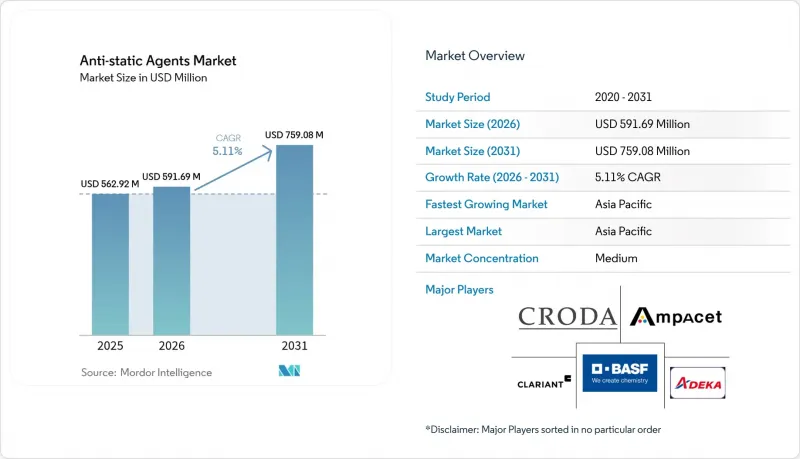
Mordor Intelligence에 의하면, 정전기 방지제 시장 규모는 2025년에 5억 6,292만 달러로 평가되었고, 2026년 5억 9,169만 달러에서 2031년까지 7억 5,908만 달러에 이를 것으로 예측되며, 예측 기간(2026-2031년) CAGR은 5.11%를 나타낼 전망입니다.
본 보고서에서는 업계를 유형별(모노글리세라이드, 디에탄올아미드 등), 원료별(바이오 유래 및 석유화학 유래), 폴리머별(폴리프로필렌, 폴리에틸렌 등), 최종 사용자 산업별(포장, 전자 등), 지역별(아시아태평양, 북미, 유럽 등)로 분류하고 있습니다. 시장 전망은 금액(달러) 기준으로 제시되어 있습니다.
세계의 정전기 방지제 시장 동향 및 인사이트
전자상거래 주도 하에 항정전기 포장재 수요 급증
가전제품의 크로스보더 전자상거래를 통한 출하량은 매장 배송량을 초과하고 있으며, 이로 인해 소포 취급 업체들은 저밀도 폴리에틸렌(LDPE) 필름 및 기포 완충 봉투에 대해 더욱 엄격한 표면 저항률 제한을 충족해야 할 필요가 있습니다. 대규모 물류 센터에서는 마찰 속도가 종종 100m/min을 초과하는 고속 분류기가 도입되어 있어, 마이크로컨트롤러의 기능 장애를 유발할 수 있는 정전기 축적을 악화시키고 있습니다. 따라서 각 포장 변환 업체들은 RoHS 및 식품 접촉 규격을 준수하는 영구적인 정전기 방지 마스터배치를 배합하고, 투명성과 밀봉 강도를 유지하기 위해 첨가제 함량을 3 phr 이하로 억제하고 있습니다. 중국의 온라인 소매 점유율은 이미 국내 매출의 50%를 넘어섰으며, 이로 인해 현지 봉투 제조업체들은 습도에 영향을 받지 않는 정전기 방지 등급 인증을 취득해야 하는 상황에 직면해 있습니다. 한편, 각 브랜드는 재활용 가능한 단일 소재 필름 개발도 동시에 추진하고 있으며, 이를 위해서는 기계적 재활용 과정을 방해하지 않는 아민계 화학 물질이 요구됩니다.
전자 기기의 미세화가 ESD 민감도를 높이고 있다.
3nm 미만의 FinFET 및 게이트 올 어라운드(GAA) 노드는 14nm 디바이스에서 허용되는 피크 전류의 불과 25%만 견딜 수 있기 때문에 반도체 제조 공장에서는 현재 캐리어 트레이와 웨이퍼 박스에 대해 실온 대기 중의 저항률을 10^10Ω 미만으로 지정하고 있습니다. 첨단 시스템 인 패키지(SiP) 조립의 경우, 초박형 인터포저를 통해 전력이 공급되므로 방전 시 국부적인 발열이 증폭되어, 230°C의 리플로우를 견딜 수 있는 영구적인 정전기 방지 코팅이 요구되고 있습니다. imec 등의 연구 컨소시엄은 박막 실리콘에서 고장 전류가 20-40% 감소했다고 보고하고 있으며, 이에 따라 첨가제 공급업체들은 습도 의존성을 피하기 위해 실리카 그래프트화 폴리에테르아미드로의 전환을 추진하고 있습니다. 따라서 정전기 방지제 시장에서는 클린룸용 폴리머에 적합한 온도 안정성이 높고 마이그레이션이 없는 등급에 대한 연구 개발이 집중되고 있습니다.
동물성 지방 유래 원료의 가격 변동
바이오디젤 의무화 급증으로 인해 소기름을 둘러싼 경쟁이 격화되어 가격이 상승하는 한편, 유지 화학계 정전기 방지 중간체공급이 부족해지고 있습니다. EU의 정제소에서는 더 많은 동물성 지방을 수소 처리 식물성 오일 디젤(HT-VO-D) 제조에 전용하고 있으며, 이로 인해 화학 물질공급이 차질을 빚고 있어 배합 제조업체들은 팜 지방산 분획을 이용한 대체 경로를 통해 리스크 헤지를 할 수밖에 없는 상황입니다. 렌더링 업체들은 거의 풀가동 상태이며, 콜드체인 물류로 인한 운임 프리미엄이 가산됨에 따라 석유화학계 아민에 대한 비용 면에서의 우위가 약화되고 있습니다. 식품 접촉용 정전기 방지제를 사용하는 포장 제조업체들은 일부 소매업체가 동물 유래 성분의 사용을 제한하고 있어 추가적인 제약에 직면해 있습니다. 그 결과, 각 제조업체들은 동물성 지방과 동등한 성능을 발휘하는 유채유나 사용 후 식용유를 기반으로 한 에스테르에 대한 시험을 강화하고 있습니다.
부문 분석
지방산 아민은 LDPE 및 PP 필름에서 입증된 효능을 바탕으로 2025년 매출의 38.62%를 차지했습니다. 에톡실화 아민 등급은 계기판에 사용되는 유리 섬유 강화 폴리프로필렌에 적합한 250°C까지의 열 안정성에 힘입어 현재 6.82%라는 가장 높은 연평균 성장률(CAGR)을 기록하고 있습니다. 모노글리세라이드는 FDA 규제 대상인 식품 포장 용도에서 여전히 주력 제품이지만, 배합량이 0.5 phr로 제한되어 있어 성장이 둔화되고 있습니다. 폴리글리세롤 에스테르는 생체 적합성을 통해 가격 프리미엄을 상쇄할 수 있는 의료기기용 파우치에 사용되고 있습니다. 새롭게 등장한 4급 폴리에톡시화 구조는 하이드록실 작용기를 추가함으로써 고유동성 PP에서의 분산성을 향상시키고 블룸 현상을 저감하여, 고성능 차량용 정전기 방지제 시장의 성장 궤도를 더욱 공고히 하고 있습니다.
이 하위 부문의 부상은 폴리프로필렌제 내장 부품용 정전기 방지제 시장 규모에 영향을 미치고 있으며, 해당 시장은 2026-2031년 연평균 성장률(CAGR) 6.52%로 성장할 전망입니다. 폴리에테르·비스페놀 A 공중합체 등의 영구 첨가제는 단가가 높고, 차량의 전체 수명 동안 대시보드를 먼지로부터 보호하기 때문에 OEM의 채택이 촉진되어 에톡시화 시스템의 정전기 방지제 시장 점유율을 끌어올리고 있습니다.
2025년 수요의 79.22%는 석유화학 원료로 충당되고 있으며, 이는 통합형 크래커의 경제성을 반영한 것입니다. 그러나 지속가능성 목표에 따라 생산 능력은 유채유, 팜유, 사용 후 식용유를 원료로 하는 방식으로 전환되고 있으며, 현재 이들 시장은 연평균 성장률(CAGR) 7.21%로 성장을 지속하고, 있습니다. 유럽의 물질 수지 인증 및 탄소 크레딧 거래와 같은 규제적 인센티브로 인해 가격 차이는 12% 미만으로 축소되었습니다. 쿠로다(Kuroda)사의 생분해성 제품 ‘Crodastat 400’은 바이오 시스템이 전도성을 유지하면서 CO2 배출량을 60% 감축할 수 있음을 입증하고 있습니다.
동물성 지방의 가격 변동과 동물 유래 성분에 대한 소비자의 거부감이 이러한 전환을 가속화하고 있으며, 2028년까지 전자기기용 포장 필름 분야에서 식물성 오일 에스테르가 표준이 될 전망입니다. 이러한 변화로 인해 2031년까지 바이오 정전기 방지제 시장 규모는 2억 640만 달러를 넘어설 가능성이 있지만, 경쟁에서의 균형은 아시아 바이오리파이너리의 추가적인 규모 확대에 달려 있습니다.
지역별 분석
아시아태평양은 2025년에 전 세계 매출의 42.75%를 차지했으며, 2031년까지 연평균 성장률(CAGR) 6.63%로 성장할 것입니다. 중국 본토의 웨이퍼 팹 확장 및 인도의 Tier 1 자동차 부품 제조업체 급증은 영구적 정전기 방지제에 대한 수요가 집중되는 지역을 형성하고 있습니다. 지역 내 배합 제조업체들은 대용량 이축 스크류 라인에 투자하고 있습니다. 산요화학의 태국 공장(연산 1,500톤)은 공급 측면의 규모 확대를 상징하는 사례입니다. 생분해성 플라스틱에 대한 정부의 우대 조치는 바이오 원료의 채택을 더욱 촉진하여, 아세안 지역 포장 분야의 정전기 방지제 시장 규모 확대로 이어질 가능성이 있습니다.
북미에서는 첨단 포장 및 전기차 플랫폼이 성장의 견인차 역할을 하고 있습니다. 미국-JOINT 등의 컨소시엄 프로그램을 통해 연방 정부의 보조금이 정전기 방전(ESD) 대책 소재의 연구 개발에 투입되고 있으며, 이는 높은 수익률을 기록하는 마스터배치 공급업체들을 뒷받침하고 있습니다. 기업의 지속가능성 목표(포춘 500에 선정된 전자기기 OEM 업체 대부분이 2030년까지 탄소 중립을 달성하겠다고 공약하고 있음)에 따라 PFAS 프리로의 전환이 가속화되고 있으며, 수성 제품으로 인해 정전기 방지제 시장 상황이 급변하고 있습니다.
유럽의 엄격한 REACH 규정 개정과 대륙 전체에 걸친 PFAS 단계적 폐지는 실리카계 및 바이오 솔루션으로의 급속한 전환을 뒷받침하고 있습니다. 클라리언트(Clariant)가 2023년에 PFAS 사업에서 완전히 철수한 것은 조기 규정 준수의 좋은 사례입니다. 주요 자동차 제조업체가 위치한 독일과 프랑스에서는 VOC가 없는 성형 착색 내장재가 추진되고 있어, 내열성 및 영구적인 정전기 방지제에 대한 수요가 증가하고 있습니다. 중동 및 아프리카, 남미에서는 여전히 가격에 대한 민감성이 남아 있지만, 전자상거래 보급률과 자동차 조립 대수 증가에 따라 판매량은 한 자릿수 후반대의 높은 성장세를 보이고 있으며, 비용 최적화된 전환용 등급을 둘러싼 새로운 경쟁의 장이 되고 있습니다.
기타 혜택 :
- 엑셀 형식 시장 예측(ME) 시트
- 3개월간의 애널리스트 지원
자주 묻는 질문
목차
제1장 서론
제2장 조사 방법
제3장 주요 요약
제4장 시장 구도
제5장 시장 규모 및 성장 예측
제6장 경쟁 구도
제7장 시장 기회 및 향후 전망
AJY 26.09.07According to Mordor Intelligence, the anti-static agents market size was valued at USD 562.92 million in 2025 and estimated to grow from USD 591.69 million in 2026 to reach USD 759.08 million by 2031, at a CAGR of 5.11% during the forecast period (2026-2031).
This report Segments the Industry by Type (Monoglycerides, Diethanolamides, and More), Source (Bio-Based and Petrochemical-Based), Polymer (Polypropylene, Polyethylene, and More), End-User Industry (Packaging, Electronics, and More), and Geography (Asia-Pacific, North America, Europe, and More). The Market Forecasts are Provided in Terms of Value (USD).
Global Anti-static Agents Market Trends and Insights
Surge In E-Commerce-Led Demand For Antistatic Packaging
Cross-border e-commerce shipments of consumer electronics outpace store deliveries, obliging parcel handlers to meet tighter surface-resistivity limits in low-density polyethylene (LDPE) films and bubble bags. Large logistics centers deploy high-speed sorters whose friction often exceeds 100 m/min, exacerbating static buildup that can cripple micro-controllers. Packaging converters therefore integrate permanent antistatic masterbatches that comply with RoHS and food-contact codes, keeping additive loading below 3 phr to preserve clarity and seal integrity. China's online retail share, already above 50% of national sales, pushes local bag makers to qualify humidity-independent antistatic grades. Brands simultaneously pursue recyclable mono-material films, requiring amine-based chemistries that do not hinder mechanical-recycling streams.
Miniaturization Of Electronics Heightening ESD Sensitivity
FinFET and gate-all-around nodes below 3 nm withstand only 25% of the peak current tolerated by 14 nm devices, so fabs now specify room-air resistivity under 10^10 Ω for carrier trays and wafer boxes. Advanced system-in-package assemblies route power through ultrathin interposers, amplifying local heat during a discharge and demanding permanent antistatic coatings rated for 230 °C reflow. Research consortia such as imec document failure-current declines of 20-40% on thinned silicon, guiding additive suppliers toward silica-grafted polyether amides that avoid humidity dependence. The antistatic agent market, therefore, concentrates R&D on temperature-stable, migration-free grades for clean-room polymers.
Volatility In Tallow-Derived Feedstocks
Surging biodiesel mandates elevate competition for beef-tallow, inflating prices and tightening supply for oleochemical antistatic intermediates. EU refineries channel more animal fat toward hydro-treated vegetable-oil diesel, hindering chemical availability and forcing formulators to hedge with palm-fatty-acid distillate routes. Renderers operate near capacity, and cold-chain logistics add freight premiums that erode cost advantages over petrochemical amines. Packaging firms using food-contact antistatic agents face further constraints as certain retailers restrict animal-derived ingredients. Producers consequently intensify trials of rapeseed- and used-cooking-oil-based esters that mimic tallow performance.
Other drivers and restraints analyzed in the detailed report include:
- Transition From Solvent-Borne To Water-Borne Masterbatches
- Growing Demand From The Automotive Industry
- Capital-Intensive Permanent Ionic-Conductive Additives
For complete list of drivers and restraints, kindly check the Table Of Contents.
Segment Analysis
Fatty-acid amines captured 38.62% revenue in 2025, leveraging proven efficacy in LDPE and PP films. Ethoxylated amine grades now post the fastest 6.82% CAGR, propelled by thermal stability up to 250 °C that suits glass-fiber-reinforced polypropylene used in instrument panels. Monoglycerides remain staples in FDA-regulated food-packaging applications, though growth is muted because inclusion levels cap at 0.5 phr. Polyglycerol esters serve medical-device pouches where biocompatibility offsets price premiums. Emerging quaternary polyethoxylated structures add hydroxyl functionality, improving dispersion in high-flow PP and reducing bloom, further cementing the antistatic agent market trajectory in performance vehicles.
The sub-segment's ascent influences the antistatic agent market size for polypropylene interior parts, which is slated to expand at 6.52% CAGR between 2026-2031. Permanent additives such as polyether-bisphenol A copolymers command higher unit pricing but shield dashboards from dust for the full vehicle life, encouraging OEM uptake and lifting the antistatic agent market share for ethoxylated systems.
Petrochemical feedstocks supplied 79.22% of 2025 demand, a reflection of integrated cracker economics. Yet sustainability goals are steering capacity toward rapeseed-, palm-, and used-cooking-oil pathways that now clock a 7.21% CAGR. Regulatory carrots such as mass-balance certification and carbon-credit trading in Europe reduce the price delta to below 12%. Croda's biodegradable Crodastat 400 demonstrates that bio-based systems can match conductivity while cutting CO2 footprint by 60%.
Tallow volatility and consumer sentiment against animal derivatives amplify the pivot, making vegetable-oil esters the default for electronics shipping films by 2028. This shift could push the bio-based antistatic agent market size past USD 206.4 million by 2031, though competitive parity hinges on further scale-up in Asian bio-refineries.
Complete Report Scope:
- By Type
- Monoglycerides
- Polyglygerol Esters
- Diethanolamides
- Ethoxylated Fatty Acid Amines
- By Source
- Bio-based (Vegetable-, Tallow-derived)
- Petrochemical-based
- By Polymer
- Polypropylene
- Polyethylene
- Polyvinyl Chloride
- Other Polymers(Polystyrene, etc.)
- By End-User Industry
- Packaging
- Electronics
- Automotive and Transportation
- Other End-User Industries (Medical and Healthcare, etc.)
- By Geography
- Asia-Pacific
- China
- India
- Japan
- South Korea
- Rest of Asia-Pacific
- North America
- United States
- Canada
- Mexico
- Europe
- Germany
- United Kingdom
- France
- Italy
- Rest of Europe
- South America
- Brazil
- Argentina
- Rest of South America
- Middle East and Africa
- Saudi Arabia
- South Africa
- Middle East and Africa
- Asia-Pacific
Geography Analysis
Asia-Pacific controlled 42.75% of global revenue in 2025 and advances at a 6.63% CAGR through 2031. Mainland China's wafer-fab expansion and India's tier-1 auto-components surge build dense demand corridors for permanent antistatic chemistries. Regional formulators invest in high-capacity twin-screw lines: Sanyo Chemical's 1,500 t/y Thai plant exemplifies supply-side scaling. Government incentives for biodegradable plastics further encourage bio-feedstock adoption, potentially bolstering the antistatic agent market size in ASEAN packaging.
North America rides advanced semiconductor packaging and electrified-vehicle platforms. Consortium programs such as US-JOINT funnel federal grants into ESD-safe materials R&D, which supports high-margin masterbatch suppliers. Corporate sustainability goals-most Fortune 500 electronics OEMs pledge carbon neutrality by 2030-accelerate PFAS-free conversions, reshaping the antistatic agent market landscape with water-borne offerings.
Europe's stringent REACH updates and the continent-wide PFAS phase-out catalyze rapid pivots to silica-based and bio-based solutions. Clariant's complete PFAS exit in 2023 exemplifies early compliance. Germany and France, housing leading auto makers, champion VOC-free molded-in-color interiors, lifting demand for heat-resistant, permanent antistatic agents. The Middle East, Africa, and South America remain price-sensitive but post high single-digit volume growth as e-commerce penetration and automotive assembly rise, making them emergent battlegrounds for cost-optimized migratory grades.
- 3M
- Adeka Corporation
- Ampacet Corporation
- Arkema
- Avient Corporation
- BASF
- Clariant
- Croda International plc
- Emery Oleochemicals
- Evonik Industries AG
- Italmatch Chemicals
- Kao Corporation
- Mitsubishi Chemical Group Corporation
- Palsgaard
- Sanyo Chemical Industries
- Solvay
- Tosaf
Additional Benefits:
- The market estimate (ME) sheet in Excel format
- 3 months of analyst support
TABLE OF CONTENTS
1 Introduction
- 1.1 Study Assumptions & Market Definition
- 1.2 Scope of the Study
2 Research Methodology
3 Executive Summary
4 Market Landscape
- 4.1 Market Overview
- 4.2 Market Drivers
- 4.2.1 Surge in E-commerce-led demand for anti-static packaging
- 4.2.2 Miniaturisation of electronics heightening ESD sensitivity
- 4.2.3 Transition from solvent-borne to water-borne masterbatches
- 4.2.4 Growing demand from the automotive industry
- 4.2.5 Expansion in the healthcare and medical devices industry
- 4.3 Market Restraints
- 4.3.1 Volatility in tallow-derived feedstocks
- 4.3.2 Capital-intensive permanent ionic-conductive additives
- 4.3.3 Rising adoption of inherently dissipative polymers
- 4.4 Value Chain Analysis
- 4.5 Porter's Five Forces
- 4.5.1 Bargaining Power of Suppliers
- 4.5.2 Bargaining Power of Buyers
- 4.5.3 Threat of New Entrants
- 4.5.4 Threat of Substitutes
- 4.5.5 Degree of Competition
5 Market Size & Growth Forecasts (Value)
- 5.1 By Type
- 5.1.1 Monoglycerides
- 5.1.2 Polyglygerol Esters
- 5.1.3 Diethanolamides
- 5.1.4 Ethoxylated Fatty Acid Amines
- 5.2 By Source
- 5.2.1 Bio-based (Vegetable-, Tallow-derived)
- 5.2.2 Petrochemical-based
- 5.3 By Polymer
- 5.3.1 Polypropylene
- 5.3.2 Polyethylene
- 5.3.3 Polyvinyl Chloride
- 5.3.4 Other Polymers(Polystyrene, etc.)
- 5.4 By End-User Industry
- 5.4.1 Packaging
- 5.4.2 Electronics
- 5.4.3 Automotive and Transportation
- 5.4.4 Other End-User Industries (Medical and Healthcare, etc.)
- 5.5 By Geography
- 5.5.1 Asia-Pacific
- 5.5.1.1 China
- 5.5.1.2 India
- 5.5.1.3 Japan
- 5.5.1.4 South Korea
- 5.5.1.5 Rest of Asia-Pacific
- 5.5.2 North America
- 5.5.2.1 United States
- 5.5.2.2 Canada
- 5.5.2.3 Mexico
- 5.5.3 Europe
- 5.5.3.1 Germany
- 5.5.3.2 United Kingdom
- 5.5.3.3 France
- 5.5.3.4 Italy
- 5.5.3.5 Rest of Europe
- 5.5.4 South America
- 5.5.4.1 Brazil
- 5.5.4.2 Argentina
- 5.5.4.3 Rest of South America
- 5.5.5 Middle East and Africa
- 5.5.5.1 Saudi Arabia
- 5.5.5.2 South Africa
- 5.5.5.3 Middle East and Africa
- 5.5.1 Asia-Pacific
6 Competitive Landscape
- 6.1 Market Concentration
- 6.2 Strategic Moves
- 6.3 Market Share(%)/Ranking Analysis
- 6.4 Company Profiles (includes Global level Overview, Market level overview, Core Segments, Financials as available, Strategic Information, Market Rank/Share for key companies, Products & Services, and Recent Developments)
- 6.4.1 3M
- 6.4.2 Adeka Corporation
- 6.4.3 Ampacet Corporation
- 6.4.4 Arkema
- 6.4.5 Avient Corporation
- 6.4.6 BASF
- 6.4.7 Clariant
- 6.4.8 Croda International plc
- 6.4.9 Emery Oleochemicals
- 6.4.10 Evonik Industries AG
- 6.4.11 Italmatch Chemicals
- 6.4.12 Kao Corporation
- 6.4.13 Mitsubishi Chemical Group Corporation
- 6.4.14 Palsgaard
- 6.4.15 Sanyo Chemical Industries
- 6.4.16 Solvay
- 6.4.17 Tosaf
7 Market Opportunities & Future Outlook
- 7.1 White-space & Unmet-need Assessment